Thursday, March 3, 2022

Secrets Revealed from Philadelphia's (Underwater) Monument Cemetery

On Saturday, March 12, 2022 – at 6 p.m. –  I will be giving a virtual presentation on the 1956 destruction of Monument Cemetery in Philadelphia. Many of you have seen my photographs or read my blogs from 2011 and 2012 (see links at end) concerning this landmark event in the city's history. Some of you have probably attended one of my physical or virtual presentations, which I've been calling, "Secrets Revealed from Philadelphia's (Underwater) Monument Cemetery." With each successive presentation, I update the content based on new research. 

The 2022 edition will follow suit and is being sponsored sponsored by the Philadelpha bookstore, A Novel Idea. I appreciate their help and urge you to visit this lovely boutique bookstore in the Passyunk Avenue neighborhood of South Philly. 

A Novel Idea
1726 E Passyunk Ave, Philadelphia, PA 19148 
(267) 764-1202

Each time I make this presentation, I advertise the event on social media. I typically get a slew of comments from people who were unaware of the situation. Last week when I posted the event, someone wrote, “How could this happen?” Another person responded quite succinctly:

70 years ago Temple needed parking. A cemetery was in the way.

That is, of course, the gist of it. However, my presentation fleshes out the story, covering the history of Monument Cemetery (established in 1837), its destruction, and the aftermath of its obliteration. 


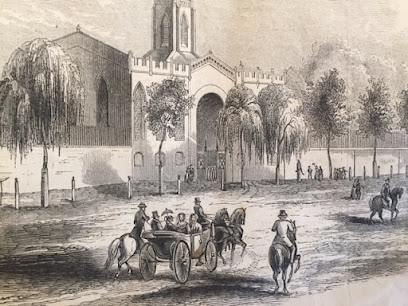
Above you see the Monument Cemetery gatehouse is it stood on North Broad Street in Philadelphia, in 1852 (Gleason’s Pictorial, Vol. III, No. 9, Aug. 28, 1852).


The comments people make (at both my in-person presentations as well as in Zoom virtuals) often provide me with missing details or ideas for further research. Examples include eye-witness accounts by people who were Temple students at the time the cemetery was razed, which certainly casts doubt upon the care which was supposedly exercised in the removal of the bodies.

When I advertise this presentation on Instagram or Facebook, I might get thirty comments, 95% of which will be in the “OMG-how-could-they-let-this-happen” category (which I expect), but there might be another 5% that will go something like this:

“…the graves were relocated, the headstones were used as backfill - no disrespect ...”

Gravestones along the Delaware
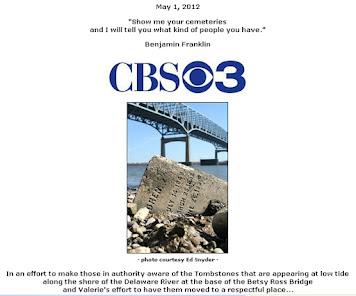
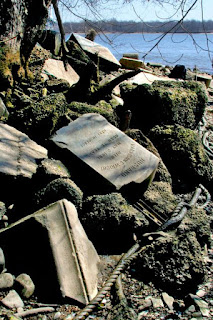
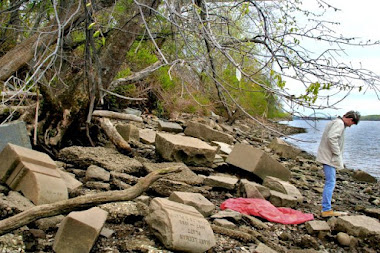
So yes, many of the gravestones were dumped into the Delaware River to help create a strong foundation for the Betsy Ross Bridge (which was then in the planning stage). Dozens of gravemarkers can still be seen at low tide under the bridge. There are differing points of view on this situation, and I am certainly open to everyone's opinion. We learn more about ourselves when we listen to others. Removal of cemeteries happened on a grand scale across the United States after the Industrial Revolution, as cities grew. Small church graveyards as well as large cemeteries often found themselves occupying land that was valued highly by developers. Probably the most disruptive example of this was in 1912 when San Francisco evicted all existing cemeteries - and those buried in them - from within the city limits. In 1929, it began moving the majority of its cemeteries to the town of Colma, California, just outside San Francisco. About 150,000 bodies were moved and many of the gravestones ended up in San Francisco Bay, where some can still be seen today. All in the name of progress.

Monument Cemetery was no different. It sat squarely in the way of the city’s expansion. Like San Francisco, Philadelphia’s population was growing, housing and factories needed to be built. And Monument Cemetery was not the only Philadelphia cemetery moved in that time period. While Monument held about 28,000 bodes, Lafayette Cemetery held about 47,000. Lafayette occupied the land where the present day Capitolo Playground sits in South Philly, next to the two famous cheese steak emporiums – Pat’s and Geno’s. The city paid a contractor to relocate the bodies, but wasn’t much concerned about their actual, eventual destination. But that's another story…

Vault being excavated from Monument Cemetery, Philadelphia, in 1956

And as you might guess (or maybe you might not), when cemeteries are moved, they never seem to move all the bodies. Which may be one reason Temple never went ahead with its plan to build a massive football field on the site previpously occupied by Monument Cemetery. You may have heard of the 2017 discovery of hundreds of bodies in a construction dig at Third and Arch Streets in Philadelphia, the site of the First Baptist Church of Philadelphia's burial ground. The bodies were supposedly relocated to Philadelphia’ Mount Moriah Cemetery in 1860. Well guess what - hundreds of bodies in wooden coffins were excavated from that construction site in 2017. Even when written accounts say that all the bodies were moved, well, all the bodies are never moved. Which is one reason they seldom build anything other than a ball field, playground, or parking lot over an old cemetery.


In conclusion, I try not to be critical. I just present the facts. We would all like to believe that we are, for the most part, good, honest, well-intentioned people. The actions described above were made by our ancestors, not us, right? 

Beware the Ideas of March! 

When I gave this presentation last year to an audience of about 175 attendees (hosted by the Athenaeum of Philadelphia), there was a comment in the Zoom chat – “We should raise money to have a commemorative bronze plaque made and attached to the original cemetery wall on the Temple University campus.” Yes, oddly, the cemetery’s stone border walls were kept in place! They are still there! What a fitting memory to this historic cemetery to have an historic marker or plaque placed on or near that wall.

Please join me at 6 p.m. on March 12! Here is the registration page for the presentation:


Further Reading:
My original three blog posts on the destruction of Monument Cemetery from my Cemetery Traveler blog:


If you want to read about the destruction of Lafayette Cemetery, please follow this link:


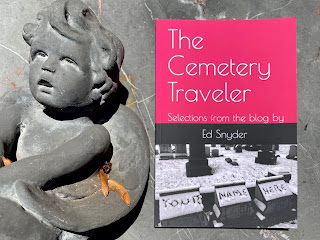
Also, my book, The Cemetery Traveler, which includes excerpts from these blogs, is available from Amazon:


Saturday, February 5, 2022

Moaning in the Gloaming

Any time of year is good for a scary story, right? This involves a visit from maybe around 2017 to the old Leverington Cemetery in Roxborough, Pennsylvania. The cemetery has been in existence since 1744 and the Church next door, with its own graveyard in back, has been around since about 1789 (ref.). The graveyard (the technical term for a churchyard burial ground) was closed to new burials in the 1980s, though the adjoining Leverington Cemetery remains active. The much larger Leverington Cemetery (about nine acres) has a gated entrance on Ridge Avenue.

It was the waning end of a crisp fall day, as I recall. Leverington is one of the few Philadelphia area cemeteries that is safe to explore in the gloaming, safe from being locked in, anyway. The main gate is missing, so anyone can wander in (or out) at their leisure. Which has been a problem, from what I’ve heard. Some have related encounters with ne’er-do-wells who had been hanging about the property, but I personally never had a problem. On this visit I was by myself. I’d been here many times over the years. I checked out the Civil War monument in the back of the cemetery and the old graves back behind the church. Made some photographs as I explored the grounds.

As I was walking behind the maintenance shed in the center of the cemetery, I heard the most god-awful moaning, and stopped short. Where could that be coming from? My blood froze. It was broad daylight, so it wasn’t TERRIBLY frightening, but still, this is a cemetery, right? Anything can happen.

Then ANOTHER god-awful moan! Traffic on Ridge Avenue is a block away; Bob’s Diner, which borders the cemetery, the same distance. No creature anywhere nearby that could make such a sound - Whisky – Tango – Foxtrot (WTF) ...!? As I slowly walked around the front of the shed, I noticed that one of the red, barn-style doors was open. I gingerly approached the opening. Maybe the moaning was coming from inside the shed? As I neared the open door, I peered inside ….. was someone hurt or dying? Was someone already dead?

What I saw came as rather a shock. A gentleman, who I took to be the groundskeeper, was sitting on a white plastic five-gallon bucket. His pants at his ankles, apparently taking a fierce dump! I assume the poor guy had nowhere else to go. 

I backed away, so as to give him his privacy, allowing him to continue to focus on this quotidian event. I made my way out of the area and out of the cemetery, vowing to always take care of business BEFORE going on any long explore. 

References and Further Reading:

https://books.google.com/books?id=161AAAAAYAAJ&printsec=frontcover&source=gbs_ge_summary_r&cad=0#v=onepage&q&f=false

https://roxboroughpa.com/news/leverington-cemetery-preservation-a-family-mission-for-owner-with-deep-roxborough-roots7

Saturday, January 22, 2022

Sleepy Hollow Cemetery

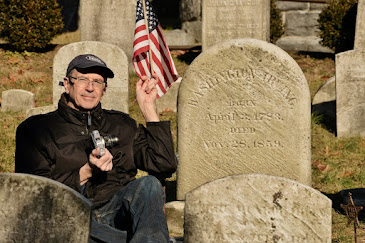
Author Ed Snyder by Frank Rausch

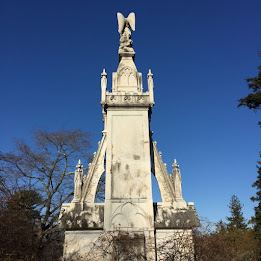
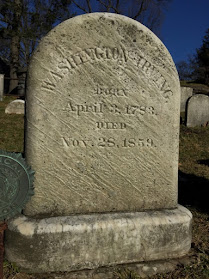
I am not the world’s biggest Washington Irving fan (even less so a John Irving fan), so his grave is not why I visited Sleepy Hollow Cemetery in Sleepy Hollow, New York back in 2018. Not being an Irving fan seems almost un-American to me. I guess this hit home when I was visiting his grave – every once in a while I just play tourist, and go for the celebs. I got my friend Frank to photograph me at Irving’s gravesite. 
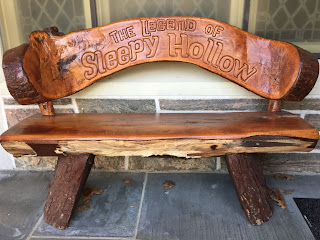
Bench at gatehouse, Sleepy Hollow Cemetery

Irving (1783-1859) lived near Sleepy Hollow and was bewitched by the spookiness of the area. It helped stoke his imagination for writing such tales as the Legend of Sleepy Hollow and Rip Van Winkle in the early 1800s. I read The Legend of Sleepy Hollow as an adult, and it was anticlimactic. Having grown up with this pervasive tale, there was no magic left in the words. I realize that at the time it was written, Irving created a Victorian gothic masterpiece. For me, Rip Van Winkle was a much more enjoyable tale – the game of ninepins in the dark Catskilll Mountains and falling asleep for twenty years to avoid the nuisances of everyday life. A goal as sought after, yet as unattainable, as a bottle of Pappy Van Winkle bourbon. 
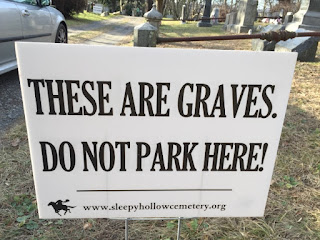
Anyway, I stray from my topic. Which is one of the reasons you read this blog, right? I seldom pander to people’s expectations. Sleepy Hollow Cemetery is certainly worth the visit. The trip was mainly a reason to hang out with my buddy Frank, who had left Philly for Connecticut after he retired. Sleepy Hollow was a good halfway point to meet, and since we both photograph cemeteries, what better place? Frank had been there before, I had not.

Sleepy Hollow is bit north of New York City, near tiny Tarrytown, New York. Which is near White Plains. As I crossed the Tappan Zee Bridge from Nyack, New Jersey, I couldn’t get the great power pop Fountains of Wayne song, “Little Red Light,” out of my head:

“Sitting in traffic on the Tappan Zee

Fifty million people out in front of me

Trying to cross the water but it just might be a while

Rain's coming down I can't see a thing

Radio's broken so I'm whistling

New York to Nyack feels like a hundred miles ….”


It wasn’t raining when I made the trip from Philadelphia up New Jersey’s Garden State Parkway; rather, it was a crisp winter’s day (actually December 27, 2018 – thank you metadata). Being a Thursday, I did hit all the wonderful rush hour traffic – which was not without its charms. I got a slo-mo view of a car fire near the Bronx exit, serendipitously playing out as James Brown’s “Hot Pants” blasted from my car stereo. (By the way, I only recently found out that cars don’t explode when they catch fire -That only happens in the movies. I am so impressionable.)
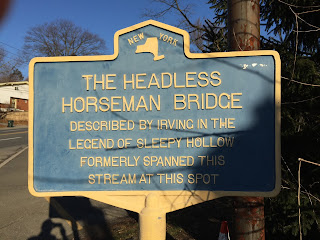
Pulling into small-town Tarrytown is quite a culture shift from the hectic highway driving. The Palisades and the woods are breathtakingly beautiful – and quiet. You quickly realize how the creepiness of the area got to Irving, and sparked his imagination. I’ve only been in a few areas of the country where I got such a creepy vibe, one being the Brandywine River battle grounds in Pennsylvania, famed for George Washington’s lost Revolutionary War battles. You drive along that little river through the woods, and you can feel the ghosts of all the dead soldiers in the morning mist rising off the water. There were Revolutionary War battles fought in the White Plains area as well.
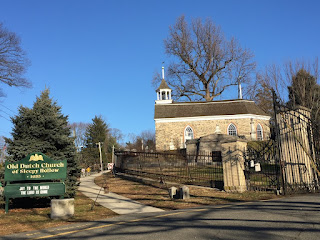
The Old Dutch Church, Sleepy Hollow, New York

Sleepy Hollow Cemetery has the same vibe. It’s quiet, its Gothic, and I’m sure it is creepy any time of year. While the cemetery itself was established in the Victorian era (1849), it is situated near the small graveyard of the Old Dutch Church (established in 1660), the final scene of Irving’s Headless Horseman tale. I can’t picture local Victorian era residents picnicking in either of these places. They just seem too dark. The whole place reminded me somewhat of Georgetown’s Oak Hill Cemetery, wet, scary, not very welcoming. Which of course makes them great places to visit around Halloween.
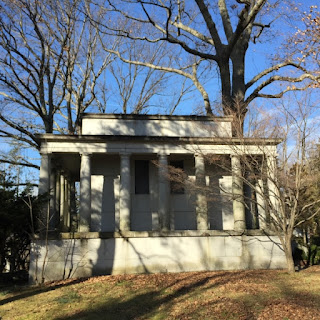
Helmsley Mausoleum

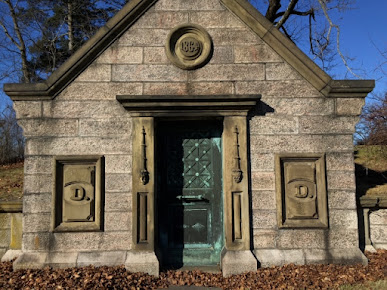
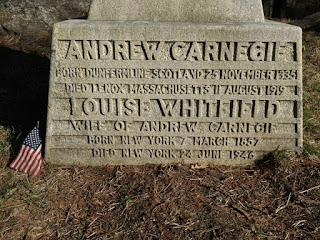
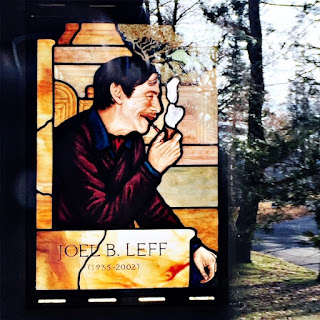
Sleepy Hollow Cemetery has got it all – size (90 acres), angel statuary, and hidden gems like Leona Helmsley and Andrew Carnegie’s graves - Helmsley’s memorial is bigger, in case you’re wondering! (Did you know that Helmsley left $13 million to her dog when she died in 2007?!)  Leona and husband Harry Helmsley owned the largest real estate holding company in the United States, and their huge mausoleum is quite extravagant. Large stained glass windows depicting the New York City skyline are astounding. This other stained glass window in another mausoleum was quite unique – probably a portrait of the deceased above his crypt.
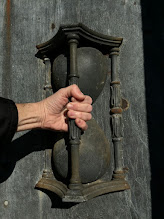
Sleepy Hollow’s landscaping disorients even the most experienced gravewalker. Rolling hills, bridges and streams, graves under a dark canopy of trees – you can just get lost in the place. I’m not sure what a “cheerful” mausoleum looks like, but most of the mausoleums here are, while stately, are rather grim and foreboding. I don’t think I’ve ever been as surprised by the varied and imaginative DOOR HANDLES as I was on the mausoleums at Sleepy Hollow. The hourglass door handle is near Washington Irving’s grave, which is marked with a simple headstone. The creepiness of this specific plot was not lost on me. It’s all very quiet – almost too quiet. Even with remnants of Christmas decorations, it is gothic and dark here. It is not joyous. 
If you are into celebrity graves, Sleepy Hollow is jam packed with them. Washington Irving gets all the press, but there is something for everyone here, people who are much more famous – American labor leader Samuel Gompers, automobile magnate Walter Chrysler, Standard Oil Company founder William Rockefeller, Elizabeth Arden of the famed cosmetics company, IBM pioneer Thomas J. Watson, and so on.


See more famous interments on the Sleepy Hollow Cemetery website: http://sleepyhollowcemetery.org/about-us/famous-interments/
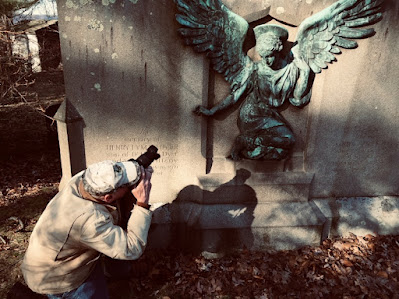
Frank shooting an angel

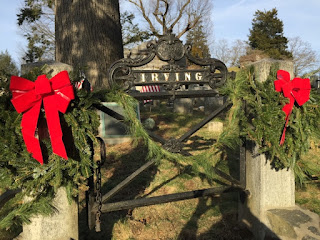
This marvel of a cemetery must be enjoyed while walking (or kneeling, as my friend Frank shows us here). It is one of the few places I’ve been that is so dense with amazing architecture, art, sculpture, and history, that you simply can’t appreciate it by driving along its sinuous roads. It is full of Victorian quirkiness, like iron fencing and gates with cast angels; there are assorted zinc monuments, bronze and marble sculptures, huge monuments, and unique mausoleum stained glass. The fencing is unusual both in style and quantity. Decades after the Victorian era, people felt that the iron plot fencing and decorative gates were rather gauche – so much ironwork around the U.S. was removed and destroyed. 
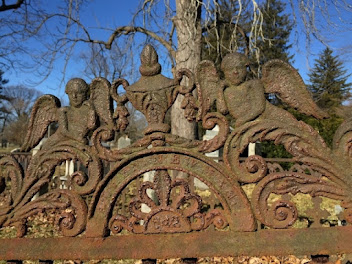
Not so at Sleepy Hollow. Maybe people were too scared of this place to trash the decorative ironwork. Walking through this wonderful chunk of history, you almost expect to find a shadowy figure crumpled at the foot of a monument, as did the protagonist in Irving’s Adventure of the German Student. “A beautiful young woman in black, slumped over with her tangled black hair falling over her face.” After taking her home with him, he awakens the next morning to find her dead. Decapitated, in fact, having been guillotined the day before he met her.

Additional Reading:

http://sleepyhollowcemetery.org/

https://olddutchchurch.org/history/our-history/
Saturday, January 8, 2022

Cemetery Meetups

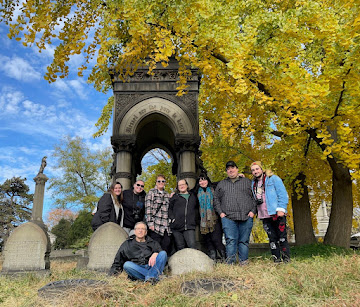
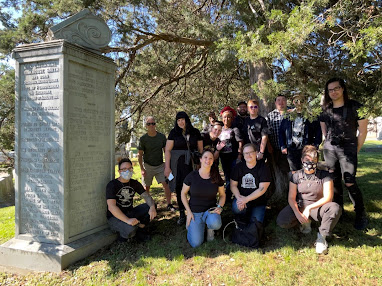
Cemetery Meetup at The Woodlands Cemetery, Philadelphia

Back in the fall of 2021 (when we were thinking that we were all successfully pulling out of the COVID-19 pandemic, pre-Omicron variant), I got this idea in my head that it would be a cool social exercise to get some Instagram cemetery photographers together for an outing at Mount Moriah Cemetery in Philadelphia. I invited mostly people I’ve never physically met. About ten of us showed up – several whom I invited, and some people who THOSE people invited. The only commonality was that these were seriously good photographers who shared a common interest – posting cemetery photography on Instagram.

Mount Moriah Cemetery, Yeadon, PA side

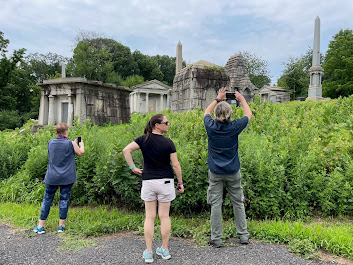
Our initial outing at Mount Moriah went so well that we all decided to do it again. After some conversation, we all realized that we each had explored many cemeteries that the others had not. Thanks to Jenn O’Donnell (IG link), our member who organized an IG Meetup link, we all stayed in close contact with each other and took a vote on the next cemetery location at which to meet. Three additional meetups have occurred since that initial one, in cemeteries in southeastern PA and central and south Jersey. We number about twenty “members,” if you want to call us that.

A few things I’ve learned from my fellow necrogeeks (kudos to Timothy for that term!):

  • Cemetery nerds have the BEST stories!
  • There are funeral strippers in China.
  • If you ask at the office for the key to the community mausoleum, they might just give it to you.
  • Santeria-type offerings at a gravesite could easily involve live animals.
  • There are FAR MORE deaths-head and angelhead gravemarkers outside of New England than I thought.
  • Zinc monuments are still controversial.
  • Snapseed is a cool, in-phone photo-editing ap - and its free.

Mount Moriah Cemetery, Philadelphia and Yeadon, PA.
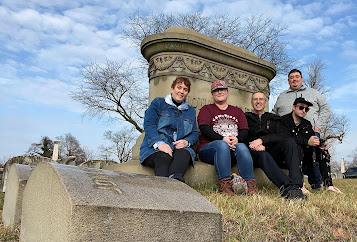
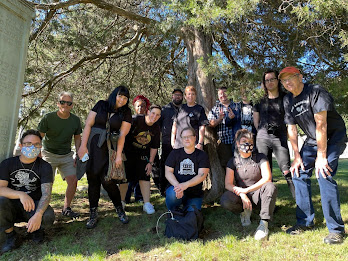
The photo you see directly above was the first group photo we made. Or rather, I made, actually, to sort of document our initial meetup at Mount Moriah. We only began staging the group shots at our second meetup, at Philadelphia’s Laurel Hill Cemetery. We didn’t really know each other well enough, I think, at Mount Moriah, for anyone to suggest a group photo. Plus there was the issue of who was vaccinated and who wasn’t. Also, it might not have occurred to us at the time that we would continue our adventure. I’m not sure who suggested the group photo a month later at Laurel Hill, but it has since become a staple of our gatherings. As more people got vaccinated and boosted, spreading COVID became less of an issue.


Cemeteries need not be places where dreams go to die. As we re-envision what social gatherings should look like in this evolving pandemic, there is one thing that everyone agrees on: outdoor gatherings are safer than indoor ones. So these cemetery meetups appear to be a healthy way to maintain our interactivity as social beings while staying physically safe.

While many cemeteries host official events that draw throngs of people (I realize there might be some of you who are surprised to learn that), such events are carefully planned and quite focused. Our IG meetups are anything but! We just stroll through the cemeteries and graveyards talking, photographing, and perhaps being led to some points of interest by someone who had been there before. We greatly appreciate the hospitality offered by the many open cemetery gates throughout the region, that allow us this opportunity. We also do appreciate the more focused events such as hearse shows, The Market of the Macabre, movie nights, concerts, the Darksome Art and Craft Market, and so on. Such events are all wonderful ways to bring people together, promote small business, and to raise money for the upkeep of the cemeteries.

Evergreen Cemetery, Camden, New Jersey

Victorian-era garden cemeteries of course were designed for large groups of people to visit and enjoy. Before there were parks and museums in the United States, cemeteries were the places you would go to get away from the noise and grit of the cities. They were meant to be calm, contemplative locales, beautifully landscaped in arboreal splendor - a place to revitalize, a place conducive to better physical and mental health. People recognized early in the current pandemic (and especially during lockdown) that cemeteries were in fact the ONLY safe place to congregate. I for one am grateful to all the cemeteries for keeping their gates open and welcoming throughout this time. Hopefully the trend will continue and more people will visit regularly - and I encourage people to donate money to their favorite cemetery to help keep those gates open in the future.

There is, of course, no socially redeeming purpose to cemetery photography itself (or photography in general). As with any art form, it must be shared to offer its greatest value. Interacting with people who share this common interest is exhilarating, at times. Meeting them personally is an added dimension and doing so during the COVID crisis is one of the best things we can do for our mental health. As I write this on the first day of the new year, 2022, the Omicron variant is so widespread that unless we force ourselves into lockdown again, it cannot be avoided. We’ll all get it sooner or later.

COVID has made death more real for many of us (death toll as of January 2, 2022 in the U.S. is 828,732; worldwide it is nearly 5.5 million (ref.)). Probably not since the last pandemic a hundred years ago has death been this concrete. Mentally, this is probably healthier for us – we are now forced to be much more pragmatic about death. Its almost like the present pandemic switched things up: pre-pandemic, death was abstract and society was real (for the most part). During the pandemic, death became more real and society became abstract.

But now with our evolving understanding of COVID-19, we are trying to work our way back to being a society that interacts physically – less screentime and more facetime. Ironically, virtual tools like social media can help us attain this goal. Though Instagram, Facebook, and other social media are quite abstract, we can use these tools to form concrete relationships – to create actual reality from the virtual. Granted, there are situations in which virtual meetings are the only option due to geographic distance, transportation, or the need to reach a larger audience. However, social media can successfully be used as an invitation, an entrée into more fulfilling in-person relationships.

Laurel Hill Cemetery, Philadelphia

Sometimes timing keeps all the members of our IG group from getting together. I’ve missed a couple meetups, but when I see the results others have posted on IG, it makes me wish I had been able to attend. Creatively, for many of us, these meetups will be a seminal influence on what is yet to come (little inside reference to the hooking tree we discovered in Camden).

We share our knowledge of specific cemeteries we have visited, and benefit greatly from the knowledge of others. These people bring a wealth of research and experience to bear in their work and all have their own reasons for doing what they do. It is evident by the joy and camaraderie at our physical meetups that everyone shares a deep interest in those who have gone before us. But why this interest? Perhaps it has something to do with a comment made by Dave Grohl (of Nirvana and The Foo Fighters) in his autobiography, The Storyteller ...

  We all carry traits of people we have never met somewhere deep within our chemistry.”

Another view of the photo above in the shade of an immense zinc gravemarker


Friday, December 31, 2021

Yonder Stands the Sinner


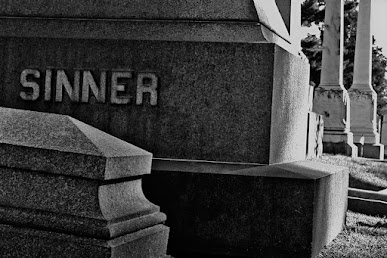
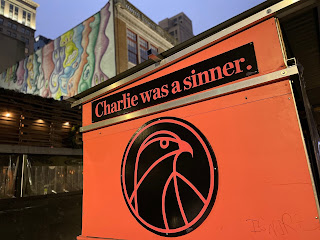
This is an end-of-year, new beginnings post. There is a restaurant/bar in Philadelphia called “Charlie was a Sinner.” I used to work a few blocks away, but never went in. Never understood the name, though I’d always been intrigued by it. As a recovering Catholic, sinning is a familiar concept to me. A way of life. 

So I was driving through center city Philadelphia last week with my twelve-year-old daughter, who is Jewish. She looked out the window, and said, “What does that mean?” I said, its probably an inside joke, maybe the owner called it that because of her friend Charlie? My daughter said, “No, I mean, what’s a ‘sinner?’”

I was speechless. I thought she was kidding. As a product of twelve years of Catholic education (I’m talking 1960s hardcore burn-in-hell Catholic conditioning), I am well aware of sin. We were taught that we were born with “Original Sin,” which could only be cleansed by Baptism. I was Baptized, and spent the rest of my life “sinning.” From grade school through high school, I confessed the mild ones to a Catholic priest in the Sacrament of Confession. 

My wife is Jewish – and as a result, our daughter is too. Jews don’t believe in sin, the way Christians do. In fact, “in Judaism, it is believed that all humans enter the world free of sin.” (The Jewish Concept of Sin (learnreligions.com). What a concept of purity, huh? I never knew this. Our daughter has been attending Hebrew School for most of her life, and has basically been taught to do good things, rather than to not do bad things. Kind of takes the wind out of Neil Young’s sails, when he sings:

“Well, I was about as scared

as I could be.

I went and hid

behind the nearest tree.

Peeked out

from behind the branches.

Sinner!

Yonder stands the sinner

He calls my name

without a sound …”

- Yonder Stands the Sinner, Neil Young

But don’t get the idea that Jews have it easier than Christians – you know those ten commandments? Well, Jews have 613 commandments! Jews focus on missing the mark of goodness when they go astray. And sure, they do wrong and seek forgiveness just as Christians do. Jews, in fact, are encouraged during Yom Kippur, to seek out anyone they might have offended and sincerely request the person’s forgiveness (ref.). A bit more difficult, more humbling and effective, I would say, than confessing your “sins” to an anonymous priest. 

“Greasy Stanley”

I want this blog to be about purity, about goodness. That New Years’ Resolution stuff brings me to the subject of “Greasy Stanley.” My dad, who died in 2004, used to like to tell this story at the turning of each year. When he was a young man, probably in the 1940s and 50s, there was a garage, a gas station/auto repair shop in Luzerne, PA. When you drove your car alongside the pumps to get gas, the owner, who my dad referred to as “Greasy Stanley,” would emerge from the garage where he’d been working on cars, to pump your gas. He always wore the same blackest, greasiest overalls imaginable. Hence the nickname. 

The scene repeated itself all year, except on New Year's Day. Greasy Stanley bought himself one new pair of white overalls every year, and donned them on New Years’ Day. I’m sure it was quite a shock for people to see him in stark white clothes! As the days went on, the clothing got dirtier and dirtier. Greasy Stanley began each year pure as the driven snow, but then ever so gradually, returned to his old ways. Kind of like how people fail to keep their New Year’s resolutions. The point is, though, that he gave himself a fresh start every year. 

I’m considering starting the new year like my daughter and Greasy Stanley. Don a new clean outlook focused less on sin avoidance and more on doing good. And if things get a bit dirty in the process, so be it. 

Like Greasy Stanley, we all know we’re going to mess things up eventually. He never donned those overalls thinking they’d stay white for more than a day. It’s not really a hope for the future as much as it is a new beginning. Sure I’ll mess things up this coming year, but maybe I’ll approach 2022 more focused on doing good things. The words I saw yesterday might be a great mantra for the new year.  They were stenciled on the back of a tractor-trailer I saw as I was driving up the turnpike. A company, oddly, called “Kane is Able” (it seems like so much of the world is focused on sin!) had these sage words to offer:

“BE KIND

 BE CAREFUL

  BE YOURSELF.”


Sunday, November 28, 2021

Muddy Creek Headstones


Back in May of 2021, I participated in my first live-in-person-post-Covid art exhibition. It was the Oddities Bazaar in Denver, PA (near Adamstown which is near Reading). The show was great – at the famous Renninger’s Antiques Mall - but that’s not the point of this blog. The point is a graveyard. 

I’ve traveled quite a bit across the U.S. (and a bit in Italy) over the ten-plus years that I’ve been writing this blog, but COVID put a stop to travel for awhile, didn’t it? During that period I drove around the tri-state area near Philadelphia, where I live, but that was it. Adamstown was an unusual trip for me, only about an hour and a half due west, but still, farther than I’d gone in about 16 months. As I write this in November 2021, travel bans and lockdowns are pretty much a thing of the past. Its no longer unusual to see planes in the sky.

On that day back in May, I got to Renninger’s about 8 a.m., half an hour before setup. So of course, I grabbed my smart phone, hit the Google Maps app, and typed in “cemetery nearby.” Finding hidden gems was never this easy! (By the way, if you try this, you will get different results if you type in “graveyard nearby.” Go figure.)

So, up pops “Muddy Creek Church Cemetery,” no more than half a mile away. Great name! (If you go, the address is 11 S Muddy Creek Rd, Denver, PA 17517.) Shot over there to find the superb sign you see above. Also, the Muddy Creek Church is across the street. It’s a fairly large cemetery, with rolling hills and a central driveway – a few acres. To the right of the entrance are Victorian-era and newer grave stones, to the left are older ones, dating back to around 1730, when the cemetery was established. It was these older stones that caught my attention. 


From the road, just beyond the cemetery sign, were dozens of large brownstone gravemarkers, the kind I’ve seen carved with angel heads in North Jersey. This early in the morning, I could only see their plain backs. They were in shadow, but the other side of the stones – and whatever might be inscribed on them – were brightly lit by the morning sun.

Muddy Creek Lutheran Church in background

I drove into the cemetery from the newer entrance up the road, parked my vehicle as close to the old stones as possible, and got out to stretch my legs. Had about twenty minutes before I had to get over to Renninger’s to start setting up my photography, cards, books, and other items to exhibit and sell. As I walked up the hill, I noted a few really interesting marble-arched gravemarkers, the type of which I’ve only seen around the Pottstown, PA area. 

When I got to the brownstone markers, I was stunned! Looking at me from several stones were life-sized faces carved in bas-relief into the stone! I would guess these are likenesses of the deceased. I’ve never seen this anywhere else. I’ve seen some wonderful brownstone carvings of angels and winged death’s heads here and there, but I’ve never seen anything like this in brownstone! Was it a Pennsylvania Dutch or Amish thing to do? Some neighboring stones had floral design carvings, which reminded me of Amish quilts. 

But these plain folk are not into embellishment, right? Sort of like Quakers, with their simple flush-to-the-ground grass markers? Well, that may be the case with Amish gravemarkers, the Amish being a religious denomination (along with Mennonites, etc.) that falls under the “Pennsylvania Dutch” umbrella term. Some of these Pennsylvania Germans, however, who emigrated to Pennsylvania during the eighteenth and nineteenth centuries developed a highly artistic folk art called Fraktur, so named after the distinctive font style (see link http://frakturweb.org/). Most Fraktur art was created between 1740 and 1860.

The floral carvings on these stones at Muddy Creek seem to be examples of Fraktur folk art, though I am certainly no expert. All names and dates on these stones have been worn away, but the faces, the designs, the feelings remain. Certainly, the wilting flowers became a common, Victorian-era symbol of a life lost, a popular form of mourning art. Turns out I was wrong about these seemingly “simple people” – PA Dutch Fraktur folk art, popular in the early to late 1800s, was highly artistic, colorful, and used to adorn (and therefore closely associated with) rites of social life e.g. birth and marriage. Examples of the documents used to certify such events can be seen here http://frakturweb.org/what-is-fraktur/fraktur-gallery/. Death being a part of life, it makes sense that the Fraktur artistic style would be used to adorn their gravestones.

Mary Roach, in her book, SPOOK, says that readers assume that “authors are experts in the field about which they have chosen to write.” She offers that “Possibly I’m the only one who begins a project from a state of near absolute ignorance.” Well, no, she’s not the only one, LOL. Pretty much describes my approach as well, so I am asking for my readers to help me out! I’ve done a bit of research after the fact, but the faces still baffle me. I’m thinking they were prominent citizens of the area, since they would be the ones with the money to have such a memorial stone carved. It is fairly common to see faces, busts, and even entire bodies sculpted in granite in the Victorian era, but these brownstones seem to have been made prior to that time.

Offering a clue to the area’s history is this plaque on the cemetery fence, designating it as “Cocalico Area Historical Site.” According to the East Cocalico Township website, “The name Cocalico is believed to have originated from "koch hale kung", Delware Indian words meaning "den of serpents", apparently referring to the abundance of snakes near the creek at that time,” (the area being settled around 1723). Hmmmm….glad I didn’t wander off into the woods looking for the actual Muddy Creek. (https://www.eastcocalicotownship.com/about-your-township/pages/township-history)

New England boasts many fine examples of slate stones carved with a likeness of the deceased, and I’m wondering if any of my readers have seen the brownstone versions anywhere else, like these in Muddy Creek? I put their creation age around 1830, as that seems to be the death dates on the marble stones nearby, on which some inscription is still visible. The faces on these stones are not soul effigies, i.e., angel-winged head carvings, but, I believe, the likenesses of the actual deceased person. 

As I was wondering if anyone could shed light on this Muddy Creek Mystery, I happened on a couple recent Instagram posts by @deaths_heads_and_angels (the artist who also goes by the name of @phil_odendron and has become a personal friend over the past few months). He has published images of brownstone gravemarkers in this same geographic region of Pennsylvania, with folk art embellishments of the type I saw. His are mainly soul effigies, however – angelic death’s heads with wings, although he has found a few that do not appear to be skull-based, so they may be representations of the dearly departed (please visit his extraordinary collection of images at https://www.instagram.com/deaths_heads_and_angels/).


Author with Muddy Creek headstone
The progression of gravestone carvings went from the skull and crossbones era during the early 18th century to the softer, angelic representations as that century came to a close. Certainly, throughout this period, there were carvings that depicted the deceased, but now I’m wondering if there was a specific time, at least with those of German heritage in Pennsylvania, that this became a trend – somewhere between the death’s head and the soul effigy, or maybe during.


References and additional reading:

http://www.mclchurch.org/our-story.html

Fraktur Folk Art:

https://en.wikipedia.org/wiki/Fraktur_(folk_art)

http://frakturweb.org/

If you would like to browse my ETSY shop to see the kind of work I had for sale at Renninger’s, please visit here:

https://www.etsy.com/shop/StoneAngels


Monday, July 12, 2021

The Unmarked Grave

Allow me to introduce to you my guest author for this post, 
George Hofmann. 

The Unmarked Grave

There’s a small plot of grass on a gently sloping field dotted with granite markers; memorials to people who were loved and too soon lost. But this plot, wedged between black stones with etchings of people now passed, sits unmarked, barren though covered with lush, freshly cut grass, anonymous. Beneath it, for nearly five years, has lain the remains of an eight-year-old girl. She was in the news once. Now you can’t find her.

I work in the shop that made many of the monuments and grave markers that radiate out in rows from this lonely place. Some of the stones are carved in other plants, but a lot of them we carve ourselves. I draw the inscription on tracing paper on a drafting table, cover a stone with a stencil pad, transfer the image from the drafting paper to the stencil, and carefully, with a steady and respectful hand, cut out each letter and number. We sandblast the stone, so that the name and dates will last longer than the very people who remember the deceased. The stencil pad keeps the stone unscarred. Only the exposed memorial inscription speaks. Then a crew takes the marker to the cemetery and sets it at the grave. Most of the time.

When I first started the job I walked around the stones in the yard, all of them waiting to be set. I noticed some of them were old, with death dates of 2017, 2007, 2003. I asked my boss why they were still there, and he told me they weren’t paid for yet.

There was one marker, a medium-sized one, crammed between several others. It was covered with stained and weather-beaten cardboard and wrapped in steel bands. The cardboard was torn in the center, so I stepped over another stone and bent down to see what was there. Through the frayed and tattered hole gazed a very young girl on a porcelain badge, her face a shy smile, her hands held in front of her in the shape of a heart.

I pulled apart a bit of the cardboard. It was old and wet and it nearly disintegrated. I saw that the girl died in 2016, and in 2021 the red granite meant to keep her memory alive sat hidden on boards like a cenotaph while a mother, a mother surely still grieving, made monthly payments meant to turn that small plot of grass in the cemetery across the street into a proper memorial.

And so she sits there. When working in the yard I walk to her and think of my daughter and thank God… After a few months of glimpsing the photo of the girl silently straining to be seen the stone was moved to another part of the yard, the cardboard and steel cut off, and she finally saw the sun. But there she remains, still a receivable, not scheduled to be set.

A few days ago I Googled her name and saw the news articles. She was killed in a hit and run. At the sentencing of the driver, in 2018, the mother cried that her baby was buried in the ground while the driver could still hug his child. But today when the mother visits the ground where her baby is buried she finds only grass. Grass that grows unaware of what it covers. Grass, green and damp with dew, that lives.

When I’m moving markers in the yard with the two-ton crane and it starts to rain I have to bring the electric crane inside. I stand in the plant and look out at the downpour. The yard becomes muddy around the stones set aside waiting for payment. Over time grass grows up around the splattered granite. You’d think the people that work here would be full of gallows humor, but they’re not. They’re reverent, and I clean the dirty stones and trim the grass pushing up between them.

The girl waits behind a couple to be remembered together and in front of a young man also taken early in a life that surely held promise. She will, eventually, stand on the grass plot where her body lay. People will come to see her and remember, finally. Her monument with her image will join the rows of stones laid out for mourning that declare that a life passed is worth clinging to and never really ends. Those left behind never fully move on. Her small plot a place of reverence for the living covered with grass that will always grow as she will in her mother’s memory - the girl’s picture looking out over the field to stand there longer than any of us will ever be.

******************************************

George Hofmann is the author of Resilience: Handling Anxiety in a Time of Crisis. He lives in Pennsylvania with his wife, their daughter and two poorly behaved dogs.