Showing posts with label pandemic. Show all posts

Saturday, January 8, 2022

Cemetery Meetups

Cemetery Meetup at The Woodlands Cemetery, Philadelphia

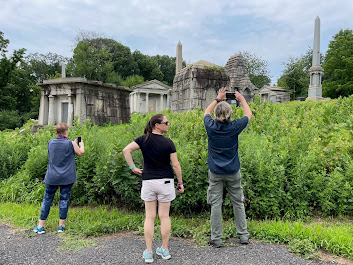
Back in the fall of 2021 (when we were thinking that we were all successfully pulling out of the COVID-19 pandemic, pre-Omicron variant), I got this idea in my head that it would be a cool social exercise to get some Instagram cemetery photographers together for an outing at Mount Moriah Cemetery in Philadelphia. I invited mostly people I’ve never physically met. About ten of us showed up – several whom I invited, and some people who THOSE people invited. The only commonality was that these were seriously good photographers who shared a common interest – posting cemetery photography on Instagram.

Mount Moriah Cemetery, Yeadon, PA side

Our initial outing at Mount Moriah went so well that we all decided to do it again. After some conversation, we all realized that we each had explored many cemeteries that the others had not. Thanks to Jenn O’Donnell (IG link), our member who organized an IG Meetup link, we all stayed in close contact with each other and took a vote on the next cemetery location at which to meet. Three additional meetups have occurred since that initial one, in cemeteries in southeastern PA and central and south Jersey. We number about twenty “members,” if you want to call us that.
A few things I’ve learned from my fellow necrogeeks (kudos to Timothy for that term!):

  • Cemetery nerds have the BEST stories!
  • There are funeral strippers in China.
  • If you ask at the office for the key to the community mausoleum, they might just give it to you.
  • Santeria-type offerings at a gravesite could easily involve live animals.
  • There are FAR MORE deaths-head and angelhead gravemarkers outside of New England than I thought.
  • Zinc monuments are still controversial.
  • Snapseed is a cool, in-phone photo-editing ap - and its free.

Mount Moriah Cemetery, Philadelphia and Yeadon, PA.
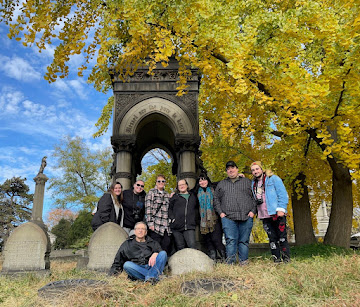
The photo you see directly above was the first group photo we made. Or rather, I made, actually, to sort of document our initial meetup at Mount Moriah. We only began staging the group shots at our second meetup, at Philadelphia’s Laurel Hill Cemetery. We didn’t really know each other well enough, I think, at Mount Moriah, for anyone to suggest a group photo. Plus there was the issue of who was vaccinated and who wasn’t. Also, it might not have occurred to us at the time that we would continue our adventure. I’m not sure who suggested the group photo a month later at Laurel Hill, but it has since become a staple of our gatherings. As more people got vaccinated and boosted, spreading COVID became less of an issue.


Cemeteries need not be places where dreams go to die. As we re-envision what social gatherings should look like in this evolving pandemic, there is one thing that everyone agrees on: outdoor gatherings are safer than indoor ones. So these cemetery meetups appear to be a healthy way to maintain our interactivity as social beings while staying physically safe.

While many cemeteries host official events that draw throngs of people (I realize there might be some of you who are surprised to learn that), such events are carefully planned and quite focused. Our IG meetups are anything but! We just stroll through the cemeteries and graveyards talking, photographing, and perhaps being led to some points of interest by someone who had been there before. We greatly appreciate the hospitality offered by the many open cemetery gates throughout the region, that allow us this opportunity. We also do appreciate the more focused events such as hearse shows, The Market of the Macabre, movie nights, concerts, the Darksome Art and Craft Market, and so on. Such events are all wonderful ways to bring people together, promote small business, and to raise money for the upkeep of the cemeteries.

Evergreen Cemetery, Camden, New Jersey

Victorian-era garden cemeteries of course were designed for large groups of people to visit and enjoy. Before there were parks and museums in the United States, cemeteries were the places you would go to get away from the noise and grit of the cities. They were meant to be calm, contemplative locales, beautifully landscaped in arboreal splendor - a place to revitalize, a place conducive to better physical and mental health. People recognized early in the current pandemic (and especially during lockdown) that cemeteries were in fact the ONLY safe place to congregate. I for one am grateful to all the cemeteries for keeping their gates open and welcoming throughout this time. Hopefully the trend will continue and more people will visit regularly - and I encourage people to donate money to their favorite cemetery to help keep those gates open in the future.
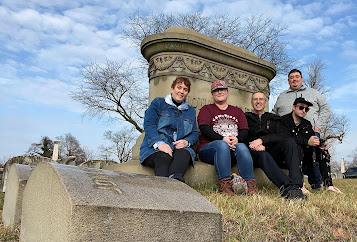
There is, of course, no socially redeeming purpose to cemetery photography itself (or photography in general). As with any art form, it must be shared to offer its greatest value. Interacting with people who share this common interest is exhilarating, at times. Meeting them personally is an added dimension and doing so during the COVID crisis is one of the best things we can do for our mental health. As I write this on the first day of the new year, 2022, the Omicron variant is so widespread that unless we force ourselves into lockdown again, it cannot be avoided. We’ll all get it sooner or later.

COVID has made death more real for many of us (death toll as of January 2, 2022 in the U.S. is 828,732; worldwide it is nearly 5.5 million (ref.)). Probably not since the last pandemic a hundred years ago has death been this concrete. Mentally, this is probably healthier for us – we are now forced to be much more pragmatic about death. Its almost like the present pandemic switched things up: pre-pandemic, death was abstract and society was real (for the most part). During the pandemic, death became more real and society became abstract.

But now with our evolving understanding of COVID-19, we are trying to work our way back to being a society that interacts physically – less screentime and more facetime. Ironically, virtual tools like social media can help us attain this goal. Though Instagram, Facebook, and other social media are quite abstract, we can use these tools to form concrete relationships – to create actual reality from the virtual. Granted, there are situations in which virtual meetings are the only option due to geographic distance, transportation, or the need to reach a larger audience. However, social media can successfully be used as an invitation, an entrĂ©e into more fulfilling in-person relationships.
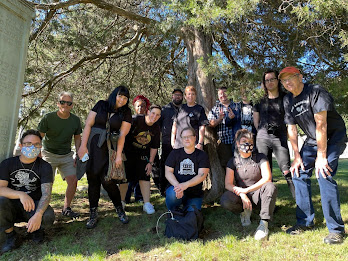
Laurel Hill Cemetery, Philadelphia

Sometimes timing keeps all the members of our IG group from getting together. I’ve missed a couple meetups, but when I see the results others have posted on IG, it makes me wish I had been able to attend. Creatively, for many of us, these meetups will be a seminal influence on what is yet to come (little inside reference to the hooking tree we discovered in Camden).

We share our knowledge of specific cemeteries we have visited, and benefit greatly from the knowledge of others. These people bring a wealth of research and experience to bear in their work and all have their own reasons for doing what they do. It is evident by the joy and camaraderie at our physical meetups that everyone shares a deep interest in those who have gone before us. But why this interest? Perhaps it has something to do with a comment made by Dave Grohl (of Nirvana and The Foo Fighters) in his autobiography, The Storyteller ...

  “We all carry traits of people we have never met somewhere deep within our chemistry.”
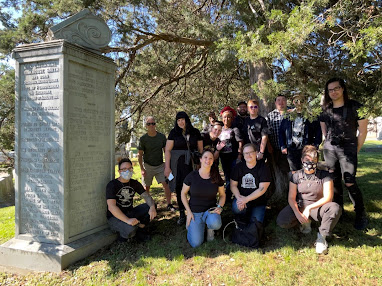
Another view of the photo above in the shade of an immense zinc gravemarker


Sunday, February 28, 2021

The Winter of Our Discontent (Shakespeare, not Steinbeck)

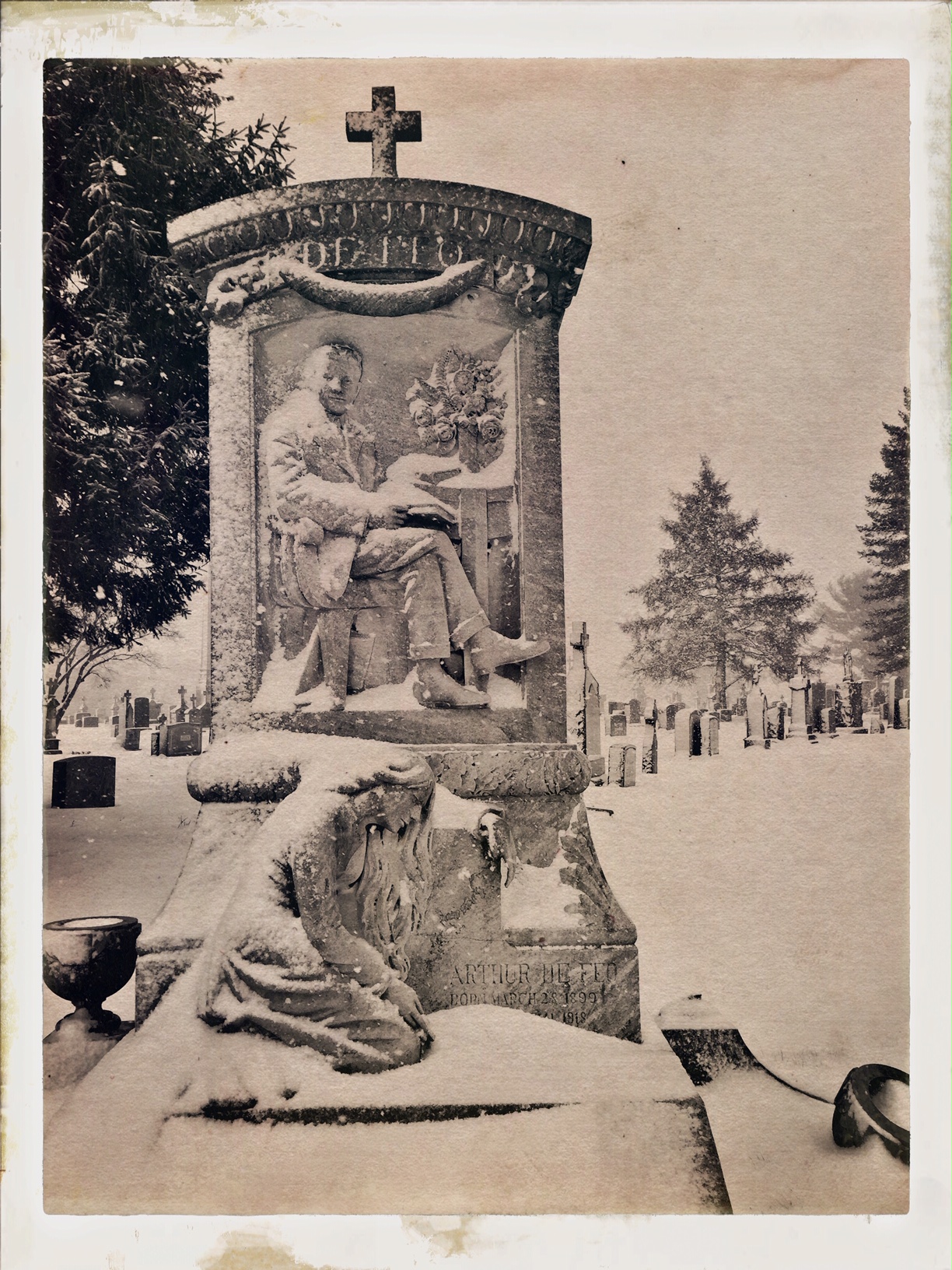
My artistic experiences this winter (it is still technically winter here in Philadelphia – Feb. 2021 as I write this) have not been one of discontent. Rather, reckless winter has allowed me the opportunity to photograph cemeteries and their statues under a blanket of snow. Standing in a blizzard with an umbrella and camera may seem ridiculous, but I assure you, it is anything but a fool’s errand. Numb fingers are simply a sign of weakness leaving the body.

Tintype Hipstamatic App image

The zeitgeist of a Victorian snowfall creates a mood of singular isolation. And freedom, of sorts - it takes one out of the literal social isolation forced on us by the current pandemic. And Paul Simon was wrong – everything does NOT look worse in black and white.

Why Shakespeare and not Steinbeck? Shakespeare’s lines from Richard III are lines of opportunity, versus Steinbeck’s, which are pure misery. Granted, the euphoria of photographing a snowfallen cemetery in below-freezing temperatures can be quickly replaced by misery if you mistakenly lock yourself out of your warm, running vehicle (which I have been known to do). However, Shakespeare is optimistic about the future. As am I. The playwright is saying that even though we may now be miserable (‘Now is the winter of our discontent’), better days are coming (’Made glorious summer by this sun …’).  (Cue the song, "Better Things" by the Kinks.)

But I digress (which is one of the qualities you find most endearing about me). My limerence with cemeteries is boosted when it snows. It just is. I have to get out there fast, while it is still snowing, if possible. Primae noctis, as it were. Not than anyone else is even considering doing the same thing, but it does give me the feeling of being first in, a unique time in a place where I can be ultimately alone with my passion. And in the middle of a pandemic, its rather liberating to not concern myself with social distancing or wearing a mask.

So would I recommend this nostrum of shooting angels in the snow? Well, it is certainly easier if you live in a polar climate zone. Its not something I can easily demonstrate to you, however. You just need to get out there in your gloves, boots, and hand warmers, and let the snow muses guide you. Helps to have an SUV, too, so you don’t get stuck. 


I photographed graveyards in the snow quite often this winter. The Snow Demons were appeased last year – they made no appearance. Apparently, COVID must have royally pissed them off, because they have been out in full force, whiting out my world since even BEFORE winter began (our first snowfall was on December 16, 2020)!

Please realize that cemeteries are places of respect - an obvious consideration when you are photographing in them. While there may be no one else around you there in the snowstorm, burial grounds and monuments mean many things to many people. Be respectful as you work. And be careful. Don’t climb on the monuments. Don’t lean on them. I’ve seen a person who had a large gravestone fall on her. She nearly lost her leg. It was crushed, but was later saved. Luckily there were several people around to lift the thousand-pound granite grave marker off her. So consider the possibility of a monument falling on you in a snowstorm. Think anyone would find you before you died of exposure or trauma?

Defunct crematorium in a snow squall

The Gear
So if I have not scared you off the topic at this point, let’s talk about the gear. Obviously, you want your equipment to be either waterproof or well-protected. I own neither. Which is why I typically carry only one camera with me, protected by a snow umbrella. I leave the rest of the photographic arsenal in the car, running back to swap them as needed. This way, I’m guaranteed to lose such things as lens caps and filters in the snow.

Cross-processed E6 image

Do I use real cameras or the camera in my cell phone? As time goes on, this distinction becomes less relevant. I do have an old iPhone 6 which I use quite a bit. Not bad images except the battery peters out in the cold. If I use it outdoors in winter, I have to keep it connected to an external battery. The apps are interesting as well, I use basic Hipstamatic and Hipstamatic Tintype in addition to straight shooting. I do drag conventional cameras out in the snow with me as well. Certainly, digitals are easiest to use. However, I’ve been shooting quite a bit lately with a 120mm (film) Holga and running outdated slide film through a Nikon F3 35mm film camera, then cross-processing the E-6 film as C-41 (which is kind of standard practice now, since E-6 chemistry is no longer widely available). I like to surprise myself. Digital can be too exacting. At right, you can see an example of a cross-processed image.

Hipstamatic Tintype App image 

It has not, historically, snowed often in the Philadelphia area (at least during the current geological epoch). So when it does, I attempt to make the most of it. It helps to have a plan. Which cemeteries are easiest to access? Are the roads plowed? Luckily for me, the graveyard at left is within walking distance of my house! I have some go-to locations and some go-to statues that I like to check in with during a snowfall – some take on the white cloak better than others...

You can see the same cemetery angel dozens of times, but there might be this one time, as you approach it in the hush of a snowfall, bootfalls crunching, that you seem to be seeing it as it had looked long ago. The more modern mass-produced gravestones mostly hidden, the bespoke, Victorian statuary gently “shrouded in white, allowing the outlines of something older to emerge.” The quote is from science fiction writer William Gibson’s novel, Pattern Recognition. A strange book to be reading during a pandemic, when old patterns are nowhere to be found, new ones emerging all around us.

Actual lychgate shot with Hipstamatic Tintype App

So if this seems to be a winter of discontent for you because of the new patterns that life has assumed, consider COVID-19 as a sort of lychgate, a gateway to another world. I wrote a blog for the website of New York’s Absynthe Gallery recently, entitled "Artist in Residence," which is about creating art during lockdown in a pandemic. Challenging, to make art in the Time of COVID. But as Gibson says in Pattern Recognition, "There are times when you can only take the next step. And then another.” If you’re interested in seeing how other artists are adapting, the gallery is hosting an online “Drink and Draw” Zoom meeting with many of its artists on March 6, 2021 (5 to 7 pm). I am in their corral of artists, but I don’t draw (I do drink, however, so I meet half the criteria). Demonstrating how I make photographs or how I write blogs would be about as entertaining as watching gesso dry; therefore, I will be in attendance solely drinking and learning. Here’s the link to register: https://absynthegallery.com/drink-draw/


Learning, you ask? Well yes. One of the best ways for an artist to progress and improve is by expanding boundaries - watching other artists create in mediums other than your own. I leave you with an old image (all that you’ve seen so far in this blog, I created in the past ten months), the Mount Moriah Cemetery gatehouse. This is in Philadelphia. I was truly honored to have it chosen to represent February in the 2021 fund-raising calendar published by The Friends of Mount Moriah Cemetery, Inc. Being on the Board of Directors of this volunteer organization and helping to save a formerly abandoned cemetery from total ruin has also been a learning experience. 

Saturday, August 8, 2020

New Devils Require New Gods

During the Corona spring and summer of 2020, I felt compelled to mask cemetery statues. A flaw in my personality, I suppose. I didn’t leave the masks on and I did no damage in the act. Initially, I don’t know why I did it. I published a few images and received a handful of comments from upset people. 

Comments like “I was saddened by our beautiful Angels with paper masks covering their exquisite faces - the angels should not be weighted down by human error.”

Exquisite faces, indeed. After months of people wearing masks, I miss all your exquisite faces. I meant no disrespect by masking angels. We created them in our own image, after all. Or more accurately, we created them in our idealized, Western world Christian image. Angels – both male and female, are the supermodels, the Barbie and Ken perfect versions of our white selves. Since we must now mask ourselves and hide our beautiful faces, I wanted to see what these icons looked like, masked. If we must mask, why shouldn’t they? But you know, if we all end up wearing masks for the next year, maybe we NEED unmasked, beautiful statues to remind us of the way things were? Of the goal, the way things should be? Are they a sign of hope? Optimism? Maybe I’m taking this away from people by masking them. 

“Go and make interesting mistakes, make amazing mistakes, make glorious and fantastic mistakes. Break rules. Leave the world more interesting for your being here.”― Neil Gaiman, Make Good Art

I suppose I need to be careful, though - blasphemy and heresy are no laughing matter. In past centuries, such an act could get you killed, defacing statues or paintings of the gods, or public figures. But as Louise Erdrich says in her novel, Tracks, (1989, Harper & Row), “new devils require new gods.” I’m not going to define this statement for you right now. Take from it what you will. Perhaps its about our response to the coronavirus pandemic. When I create art, I want the viewer to take what they can from it. Most likely it speaks to them differently than it speaks to me. I have always defined my art as minimally as possible – I want the viewer to find their own meaning in it. I don’t even like to title my photographic images. Even that narrows things down too much.

Erdrich’s novel, Tracks, is about Indian (yes, she uses that proper name) tribes “struggling to keep what remained of their lands” in last century America. Native American land and all other freedoms were slowly taken from them very much like our present freedoms are slowly being taken from us by coronavirus. We are struggling to keep what remains of our world. Big difference, however, is that while the white settlers of this “new” land benefitted greatly from the indigenous peoples’ loss, no one benefits from the loss due to COVID-19. Unless, of course, it is some evil plot hatched by the spotted lanternfly.

Would George Washington Wear a Face Mask in 2020? No!

People thought I would have more respect for angels and other works of art - I might just as well have “purchased a can of spray paint & had [my] way with these historic & immortal figures!” (“Immortal,” let’s come back to that thought later.) One could say the same of the person who doctored up this painting of George Washington, I suppose. But its all about having the freedom to express oneself, to make a point. Here’s an image below that should really rile up the masses. Old folks need to protect them selves from their kids, who may be asymptomatic COVID-carriers. 

One of the problems with freedom is that people are free to believe anything they like. For months, there was no consistent, insistent decree from our nation’s leaders that we should wear face masks to stop the spread of coronavirus. Should we or shouldn’t we? We were free to believe whatever suited us. Now, of course, it is becoming quite clear that face masks should have been worn all this time. (Wait – shouldn’t our guardian angels have appeared in masks to carry us to salvation? Sorry, getting a bit sarky there.) 


Tensions Mount 

The raw emotion that has surfaced over my masked statuary is a good thing. Isn’t that what art is supposed to do? Make you think? Make you emote? Maybe you love it, hate it, or are indifferent. Maybe that’s how you also view the whole face mask thing in general. 

The issues people have with wearing masks are multitudinous. George Hofmann in his Psych Central article, The Fight Over Facemasks, mentions a few of these. “The science behind wearing a mask seems pretty simple, and among scientists and doctors there’s near universal agreement that wearing masks will prevent transmission and greatly reduce the number of people who contract the virus.” If you don’t believe this, go watch movies about hospitals and research labs.

Hofmann adds, “That’s why I think there’s a lot more to the anger over masks than respect for the health of others or individual liberties.” People’s anger and rage is evident by the almost daily reports like this, an incident that occurred on July 31, 2020. A customer of a cigar store in Bethlehem, PA, shot at the clerk with a handgun when the customer got upset over the store’s masking policy (link to story).

In this chaotic time - new devils require new gods. New problems require new solutions (one interpretation of this statement). The masking quarrel reminds me of the story of Dr. Charles Meigs, a nationally recognized Philadelphia obstetrician, who in the 1850s singlehandedly transmitted infectious and sometimes deadly diseases to hundreds of his patients. Why? He didn’t believe in washing his hands! He didn’t believe he needed to clean his surgical instruments. He didn’t believe there were such things as infectious diseases. He felt that God was on his side, and he could do no wrong! God, can you believe that? Meigs inadvertently killed many of his obstetrical patients as a result of his stubbornness and grandstanding. He simply refused to believe what we all now know, that a basic way to prevent the transmission of infectious disease is good hand hygiene.  (Read the whole Meigs story in my blog post, “Infectious Diseases and Charles Meigs, M.D.”)

Dr. Charles Meigs's grave, Laurel Hill Cemetery, Philadelphia

As I write this in August 2020, we are really still in the discovery phase of this disease, coronavirus. We don’t know how to control it yet, so why argue about face masks? Why not just err on the side of caution? How many of our politicians remind you of Dr. Meigs? How much of our general population reminds you of Dr. Meigs?

George Hofmann offers that the real source of anger is usually hidden behind what we’re fighting over. He opines that “people have felt disaffected and forgotten by the society they see portrayed in the media for a long time.” Sound familiar? As average citizens, we just don’t measure up to the media ideal of ourselves. We are not, nor ever will be, Brad Pitt or Angelina Jolie. Hofmann feels that people generally feel ignored, mere background noise. Proles. He says that putting a mask over their faces, “making them anonymous and unheard [literally], can be a source of great anger.”

We created angels in our ideal image – maybe that’s one reason its so hard to see them masked. The goals of purity, perfection, and escape (perhaps only attainable in the afterlife?) all of a sudden may not seem possible. “Immortality,” as mentioned earlier, may now seem impossible. By masking angels, am I symbolically closing the Heavenly Gates on the viewer? Am I suggesting, as John Cale does in his song, Fear, that “we’re already dead, just not yet in the ground…?” 

But I want to end this missive on a high note, something optimistic. How about this: new devils require new gods. Think about that. 


Further Reading:

George Hofmann’s book Resilience: Handling Anxiety in a Time of Crisis (2020, Changemakers Books), is available here.

Saturday, May 2, 2020

Cemeteries and Funerals in the Time of Coronavirus

While it is true the dead cannot get coronavirus, their world is not spared the effects of the COVID-19 pandemic. If you’re lucky, you haven’t experienced anything related to death in these dark times. But you’ve probably heard bits and pieces related to things like pickup truckloads of bodies unceremoniously removed from nursing homes (click link to read), relatives mortally passing the virus on to their kin, or bodies being cremated along with all their identifying information (wallets, insurance cards, etc.). Graveyards and cemeteries have not been closed to visitors as most other public spaces have, but the kind of activity present in them has radically changed in the spring of 2020.

Woodlawn Cemetery, Bronx, NY
On a positive note, many more people are enjoying these green spaces in ways for which they were intended. They were designed in the Victorian era as serene getaways from the noisy cities, arboreal sculpture gardens to be strolled and picnicked in. The purpose was to help people accept death in a kinder, gentler fashion – enter all the angel statues. And people are strolling through cemeteries once again, being one of the few spaces open at this time when parks and museums, galleries and playgrounds are all closed.

Springtime in the Cemetery
As much beauty as I find in such places, I do sometimes lose sight of the grief inherent in their midst. Some years ago I was in West Laurel Hill Cemetery in Bala Cynwyd, PA (outside Philadelphia), and saw to my amazement, a wonderful black Victorian funeral carriage – complete with a pair of harnessed white horses! It was parked alongside the funeral home. I asked the gentleman who was tending the horses if I could photograph him and he graciously said yes. We chatted as I made photographs and I must have assumed the setup was there for show. Finally he said something that stopped me in my tracks – “The parents will be arriving shortly for the funeral.” (You can read more about this in my original blog post.)

Victorian funeral carriage, West Laurel Hill Cemetery, Bala Cynwyd, PA

I was similarly stopped in my tracks this past week when I read my friend Alexandra Mosca’s article, “A Funeral Home Director’s View of the Pandemic." Alexandra is a funeral director in New York City and writes of the current difficulties faced by families of the recently deceased, where the funeral director must turn the grieving away from the grave. Imagine watching your mother’s casket being lowered into her grave, while your family watches from their car windows. Worse yet, imagine all the funeral homes in your vicinity so busy with the dead that they cannot accommodate your family’s needs.  Read the article here for a part of life that is being tremendously affected by the health crisis.

So while I explore cemeteries as much as I can, I never lose sight of the fact that others may be there for altogether more serious reasons. Please be respectful.

For further reading (links thanks to my friend Bill McDowell):
https://www.inquirer.com/news/philadelphia-ivy-hill-cemetery-crematory-20200505.html?fbclid=IwAR3pYRLa7niPHH5GaIBVkN59QwcWJwr08Ckxlfy9mVuMLa2mLrgHkVKBoks

https://www.inquirer.com/news/coronavirus-black-deaths-philadelphia-terry-funeral-home-covid19-race-disparity-homegoing-burials-20200504.html?fbclid=IwAR2czFQ2p6xb34xkCXJCOA1YLZwc7VFXnnwQk7Yk9GyyO3cww7Iw_NRVzHg