Showing posts with label angel. Show all posts

Friday, January 10, 2025

Some Cemeteries of Trenton, New Jersey


Okay, so when you think of interesting cemeteries to explore, Trenton, New Jersey may not immediately (or ever) come to mind. However, your opinion may change. For our 2024 end-of-the-year meetup, the cemetery photography group I hang with decided on Trenton. It was a midway spot between Philadelphia and north Jersey (the general areas where most of us live), so about ten of us agreed to meet at Riverview Cemetery in Trenton, then continue on to the chain-link graveyard cluster in Hamilton, ending with the State Prison cemetery (whatever that is). All of a sudden, you’re interested, right?

It was a cold morning in December, with rain forecast the following day. Hopefully the rain gods would take pity on us and delay the downpours. I got to Trenton a bit early and was dismayed to find Riverview’s gates closed. I’d been here before – it is a wonderful, sprawling Victorian garden cemetery, full of unique statuary, grand monuments, interesting epitaphs, and the mausoleum of John Taylor, the creator and founder of Taylor Ham! 

You may not realize this, but from Trenton north in the Garden State, this breakfast meat is known as Taylor Ham. South of Trenton, it is merely pork roll. Mick Jagger famously told the audience at a Rolling Stones concert in August, 2019 at the MetLife Stadium that “he and his band mates grabbed Taylor ham sandwiches at the Tick Tock Diner on Route 3 in Clifton earlier that day.” Clifton, New Jersey is near the MetLife Stadium, in East Rutherford, where the Stones were playing. 

Word of Jagger's comments spread like wildfire and so fans would go to the Tick Tock and order “the Mick Jagger special” – Taylor ham, egg and cheese with disco fries.” I think if I ordered one at the diner for breakfast, I’d want the Stones’ song “Start Me Up” blasting from the sound system! However, this morning I had to content myself with a Wake-Up wrap at the Dunkin Donuts in Trenton, near Riverview, while I killed time waiting to see if the gates would be opened at ten. I sat in the parking lot munching away, watching the panhandler at the corner go from car to car. He was a largish guy, dressed all in white, looking like either Elvis or porn actor Ron Jeremy. 

I drove over to St. John's Cemetery down the road from Riverview, and shot the zinc Jesus, then thought there might be another entrance to Riverview. Found that and it was closed too. I texted my graver pals to apprise them of the gate situation and was promptly told about the third entrance, which was open. Three of my friends were already there. How I ever get into these places on my own is puzzling, lol.

This grave marker bears the inscription, "Nevermore."
The light snow on the ground lent a nice contrast to the landscape, and did not totally cover up the chicken eggs laying about. Offerings, of some sort. The group fragmented and visited some familiar spots, like the “Nevermore” door and the receiving vault. I wanted to shoot a short video in John Taylor’s plot, since the poison ivy around its low fence had been cut away. As I approached it, I realized I had forgotten my empty box from Taylor Ham! As I said this, my friend Phil, who was walking with me, said, “You can borrow mine,” as he pulled a neatly folded box from his coat pocket! Cemetery nerds, aren’t we hysterical?

You can see my video at this Instagram link on my @mourningarts page. And while you’re there, check out this awesome “Long Live John Taylor” page! 

Not the first time I've seen the word "cemetery" misspelled!

After about two hours at Riverview and our standard group photo shoot (that's us in the first photo of this piece, with me in the orange cap) we jumped into our respective vehicles and headed off to the Hamilton cluster, as one of our group members has dubbed it. I’d been there once before, but it did not seem all that interesting. Just shows to go you - hang out with other artists and you see things you normally might not. And that happened to me today - note one of the many cemetery signs in the cluster (above).

The cluster is near Hamilton, NJ, but might actually be in East Trenton. It’s not unusual to see a couple of cemeteries next to each other, separated by fencing. What is unusual about the Hamilton cluster is that there are so many separate cemeteries in this one area that it is difficult to even count them! Maybe ten? Fifteen? Not sure. Acres and acres of Christian and Jewish burial grounds, side by side. St. Mary’s, Our Lady of Lourdes, People of Truth Hebrew Cemetery, Congregation Brothers of Israel, Knights of Pythias (I think its cool that there’s a fraternal organization based on math – this group follows the philosophy of Pythagoras, he of the Pythagorean Theorem that you learned in high school. The Masons are based on math as well, come to think of it….) 

Anyway, you didn’t actually need to read the cemetery signs to know which ones were Christian and which were Jewish at this time of year. All the Christian cemeteries had Christmas decorations on many of the graves. The Jewish cemeteries did not. 

The cluster is all on level ground, and each cemetery is bordered with four-foot-high chain link fence. It very much reminded me of the cluster of cemeteries in Old San Antonio, Texas, where there are 31 cemeteries across 103 contiguous acres! (read about that visit here). Very much the same layout. Efficient use of space, but not very picturesque. Zero landscaping, no arboretums, these are “lawn” cemeteries, as opposed to the more picturesque Victorian sculpture garden cemeteries. Beginning in the mid-1800s along with the American rural (Victorian) cemetery movement, there was also an effort to establish more modest cemeteries which were basic, more frugal places to bury loved ones. Hence, what came to be known as a "lawn" cemetery - almost uniform grave markers in neat rows, with little ornamentation. You can read more about lawn cemeteries here. 


The only things that make such a cemetery interesting, or would call attention to any specific grave, are the occasional unique monuments and other memories that 
punctuate the gravescape here and there. Note the bottle of booze (I hope that's booze) left with a few roses at a gravesite. 

The American Institute of Commemorative Art opines that:

“Sculpture should be used only when it is true art, such as we see in the famed cemeteries of Europe. The dignity of all too many American cemeteries is spoiled by the use of commercial statuary such as no trained memorialist would tolerate.”

A bit highfalutin, those words. Certainly, anyone who wants an angel statue on their grave would prefer a hand-sculpted marble piece, versus a factory-cut angel bought at a 
roadside memorial business. But not everyone has the money for that. So we tend to see a mix of statuary and monuments of varying quality and design, spanning generations - some new, some aged, produced by various carvers. One thing is certain - someone wanted to mark that grave and this is the best they could do. A bronze Jesus plaque set into a home-cast concrete stone may have more character that a weeping marble angel bought from a roadside stone vendor. 

The light snow on the grass gave the grounds a bit more character, but the chain link fencing was rather annoying. Most people are visiting a specific grave in a specific cemetery here, so they can just drive around the border of the cemetery, look for the gate, park and walk in. But if you’re there to visit many of the cemeteries, it is tiresome to have to walk a block to the entrance to the next cemetery to get in. The fence is only four feet high, but that’s still a bit much for most people to jump over. When I was in San Antonio, the fencing presented quite a hardship. Not only were there 31 (!) cemeteries all separated by chain-link fence, but that fence was even higher, and it was close to a hundred degrees the day I visited! So, the effort required to walk a block (or more) in the blazing sun just to get to the next gate was exhausting. (You can read more about that visit here.)

Of the cluster cemeteries, Our Lady of Lourdes Cemetery was the most replete with interesting statuary, if that draws you. This is the half of the cemetery north of East Brown Street. The southern half includes the numbered graves of either the New Jersey State Prison or State Hospital burials, not sure which. These are uniform concrete markers in a small plot within the cemetery. There is a bit more landscaping at Lourdes than in any of the other cluster cemeteries. More trees, a columbarium, an interesting angel-flanked family memorial. It is also the largest cemetery in this cluster. There is a sign at the entrance stating that it is “consecrated ground” (i.e., ground that is blessed and made sacred via some religious ceremony).

New Jersey State Prison graves, Our Lady of Lourdes Cemetery, Trenton

The angel-flanked memorial seen above is unusual. Down the road from here is a columbarium, a building to house cremains within individual niches. One of our group said it smelled funny in there. Can't imagine why.

Xmas tree and creche inside the columbarium

Concrete Jesus on a stainless steel cross

Our group fractioned off then rejoined several times, based on our varied interests. Eventually, we all went for a late lunch at a Thai restaurant, traded stories, then went our separate ways. I was done graving for the day, so I went home. With an hour of daylight left, others hit the local pet cemetery and the Presbyterian Church graveyard heading toward Princeton. Hanging with these people is always enjoyable, respectful, educational, and so much better than just appreciating their work on social media. All in all, a grand day out.

So, if you do venture to the Trenton area in search of interesting cemeteries, you will not be disappointed. As I learned, even basic lawn cemeteries offer interesting memories of lives spent, lives that are no more. The dog tags on the urn of cremains stopped me in my tracks.


For your reference and further reading:


Saturday, July 13, 2024

The Cemeteries of Baltimore, Maryland

Chapel, Greenmount Cemetery
No one is ever going to rewrite Led Zeppelin’s, “Going to California” as “Going to Baltimore” (with an achin’ in my heart… ). However, I am quite passionate about Baltimore’s Cemeteries. In this post, I’m going to attempt to tell you why. I was just interviewed by American Cemetery & Cremation magazine for an article they published on “cemetery bloggers,” and the interviewer asked me if I had any favorite cemeteries. I had to say that most of them are in Baltimore, which surprised the author, Alexandra Kathryn Mosca. 

The interview is in the June 2024 issue, if you want to pop down to your local 7-Eleven and pick up a copy. There is a link at the end of this post to view the article electronically, compliments of the publisher, Kates-Boylston Publications. The article is called “Cemetery Bloggers – Blending History and Reverence.” 

American Cemetery & Cremation

Alexandra is from New York and is very passionate about New York City’s many wonderful cemeteries. New York has some glorious Victorian-era sculpture gardens, on the Mount Auburn garden cemetery plan - for example, Green-Wood in Brooklyn and Woodlawn in the Bronx. Mount Auburn, by the way, was the first rural garden cemetery in the U.S. (est. 1831), modeled after Paris’ Pere LeChaise Cemetery (est. 1804), the first garden cemetery. This was followed by Philadelphia’s Laurel Hill in 1836. Garden cemeteries sprang up all over the nation. Baltimore has a lovely “rural” cemetery – as these arboreal sculpture gardens were originally called – Greenmount Cemetery (est. 1838). They were called rural because they were originally built outside the city limits. With the rapid growth of American cities in the mid and late 1800s, these rural cemeteries quickly became inner-city cemeteries. It’s a testament to our culture and society that these wonderful places still exist. And speaking of culture and society, people need to lose any parti pris they may have about Baltimore. There is more to this city than the "Inner Harbor" and John Waters (with all respect to Mr. Waters).

Druid Ridge Cemetery (infrared E4 film image made in 2002)

There are vast burial grounds in Brooklyn, Queens, and the Bronx that rival Baltimore’s magnificent sculpture gardens; however, in my cemetery travels across the U.S., I’ve not seen Baltimore’s equal. My “favorite cemeteries” reply surprises a lot of people who have asked me that question over the twenty-five years I’ve been photographing cemeteries. If you like Victorian garden cemeteries, and you like them densely packed with marble monuments as far as the eye can see, then Baltimore is for you. Loudon Park Cemetery in Baltimore, at 500 acres, is actually larger than either Green-Wood Cemetery in Brooklyn or Woodlawn Cemetery in the Bronx.

New Cathedral Cemetery, Baltimore
If you want star power, sure, New York is the clear winner. Celebrities, business magnates, mobsters – NY’s got the lion’s share. You’d have to go to Chicago or California to find its equal. But if you want to stroll endlessly through grounds densely packed with wonderful Victorian-era marble sculptures, magnificent Gothic mausoleums, and winged bronze angels, Baltimore is the clear winner. Recently, I was so overwhelmed upon entering Baltimore’s New Cathedral Cemetery (photo below), that I just laughed at the sheer sweeping vista of statuary in my field of vision. The deep, broad landscape pans around you like an iMax movie. I was so stunned that I failed to capture the scene photographically – I just walked, wide-eyed and dazed through the labyrinth of monuments. 

New Cathedral Cemetery, Baltimore (Photo by Rachel Bailey)

Luckily, my friend Rachel (IG @photosofcemeteries) was better able to maintain a discerning and objective eye and in so doing, captured the sweeping landscape you see here in a way that I wished I had. Master photographer Robert Capa said, “If your pictures aren't good enough, you're not close enough.” Well, this obviously does not hold true in all cases! My photographs of the statuary and architecture in Baltimore cemeteries suffer from my being too close to my subject! I need to step back, literally. Live and learn. I think this is necessary to capture the full effect of the scene presented to you. One of my photographer heroes, Mary Ellen Mark, said, “It’s not when you press the shutter, but why you press the shutter.”

Calvary Cemetery in Queens, New York

To be fair, Calvary Cemetery (above) in Queens is massively impressive and jam-packed with Victorian monuments – and has an amazing view of Manhattan. It is similar in scope to Holy Redeemer and Loudon Park in Baltimore. One thing that Calvary lacks, however, that Baltimore cemeteries have in abundance, is access. For instance, New York’s cemeteries are so spread out, you could not visit Woodlawn and Calvary on the same day – unless you had a helicopter. In Baltimore, you can easily drive from Druid Ridge Cemetery to Prospect Hill Cemetery (where entertainer Divine is buried) in seventeen minutes (according to Google Maps). Baltimore’s cemeteries are so close, you can’t swing a cat without hitting one (to paraphrase Mark Twain).

Divine's grave, Prospect Hill Cemetery

The main advantage of Baltimore’s cemeteries compared to those of NYC, is that they are easily accessible by car. The Evergreens Cemetery in Brooklyn and Woodlawn in the Bronx are fabulous places, but the traffic and logistical planning one must contend with to access these destinations can be mind-boggling at times. Once, years ago, my brother and I made a trip to NYC to visit Woodlawn Cemetery. At Grand Central, we got on the wrong train and mistakenly headed out to Long Island! By the time we got back to Grand Central, it was too late in the day to get to Woodlawn. Mission aborted. In Baltimore, even the most immense and intense burial grounds are immediately accessible! Baltimore City Cemetery is five minutes from Baltimore Hebrew Cemetery which is five minutes from Holy Redeemer Cemetery – all on the same road! 

Gardens of Faith Memorial Gardens, Baltimore

Now, being from Philadelphia, I would be remiss were I not to mention the grand cemeteries like Laurel Hill, Mount Moriah, and The Woodlands. These are large Victorian-era rural cemeteries like Mount Auburn outside Boston, and like New York’s Green-Wood and Woodlawn cemeteries. All are amazing, serene, finely landscaped and picturesque sculpture gardens, patterned after Père Lachaise. A main difference between all these and Père Lachaise, I now realize, is that the monuments, mausoleums, and other grave markers in Père Lachaise seem to be more densely-packed than what you typically see in American garden cemeteries. It is more like what one finds in the cemeteries of Baltimore, e.g. in Greenmount and Baltimore City Cemetery. 

Holy Redeemer Cemetery, Baltimore (Photo by Rachel Bailey)

Here's another example above of a sweeping Baltimore landscape, Holy Redeemer Cemetery (again, photographed by @photosofcemeteries, not yours truly). Holy Redeemer, by the way, must have the largest abandoned cemetery chapel I’ve ever seen – the green-domed building in this photograph. (Psst …if you look through the keyhole in the red door, you can see inside! But take a real camera with a zoom. Thanks to Teresa @teresacast for pointing this out.)

Greenmount Cemetery
What prompts me to write about Baltimore’s cemeteries at this time, is my friends. I’d been extolling the virtues of these places for twenty years to anyone who asked, but it has only been since 2023 that many of my Philadelphia-area cemetery photography friends began making the hour-and-a-half trip to the Land of the Crab Cake. However, I don’t know that anyone ever went to Baltimore based on my suggestion. Small groups of these cemetery photographers, as well as individuals, have been exploring Baltimore cemeteries over the last year or so. 

Loudon Park Cemetery
One member of our group discovered Baltimore’s treasures years ago on her own. She photographs there on a regular basis. It was at her insistence that many of the others in our group followed suit. It really had nothing to do with my influence. This is really a joy for me to experience, actually – I’m watching others discover their passion for these cemeteries as I had done in the early 2000s. And as I am a part of this group of photographers, this has rekindled my interest and love of these destinations.

I say we ‘discovered” Baltimore’s cemetery gems as if no one knew they were there. While its true that most people may be unaware of their existence, most of these properties – large and small – are well-maintained. It is not the case that any of them are neglected or abandoned. The general public is simply unaware of their existence, or just does not care, and I can appreciate that. I fall into the small category of people who do care. And I appreciate the fact that the city, synagogues, churches, and other organizations maintain these sacred spaces, preserving the dignity of those who are buried within their grounds.

Greif family angel, Baltimore Hebrew Congregation Cemetery

Some of Baltimore’s cemeteries, like Baltimore Hebrew Congregation Cemetery, are walled in, gated and locked – only accessible by checking in at the gatehouse. This keeps the contents, as well as its visitors, safe. By the way, it’s unusual to find an angel in a Jewish cemetery. But this relatively small place has numerous life-sized bronze angels and other effigy sculptures that are simply amazing. Here’s a 2004 photo of me with one. She’s still there if you’d like to stop by for a dance.

Author in Baltimore Hebrew Cemetery, 2004.
I suppose Baltimore’s cemeteries have a deeper meaning for me. I explored these burial grounds back in the early to mid-2000s, when my life was going through an upheaval and I needed alone time with my camera. “All art, like all love, is rooted in heartache,” photographer Alfred Stiegletz said. Walking these many arboreal sculpture gardens alone was therapeutic for me. I saw, touched, and walked amidst exquisite art that I never knew existed. Artwork that most people do not know exists. Sometimes you just have to create your own happiness. 

Greenmount Cemetery
I was happy – actually thrilled – when I happened upon this marble statue (at left) in Greenmount Cemetery, probably around 2004. It confused me, and after photographing it, I spent years researching its meaning. Hercules now graces my business card. From what I’ve determined, this is him as a child, wearing the lion’s skin that he wore as an adult (after killing the monstrous Nemean lion). I surrounded myself with such quiet beauty while the world threw so much ugliness at me. It was a coping mechanism. Maybe some of my current friends can relate to that. Maybe Baltimore’s cemeteries were protection, of sorts, for me, like Hercules’ lion skin that was impervious to attack.

Legend has it that Hercules killed the lion by strangling it with his bare hands, as he could not damage it with arrows or clubs. He then skinned the lion and used it for a protective cloak - ref.)

The group meetups are a relatively new thing for me, which we began as an Instagram meetup of like-minded cemetery photographers during COVID. As of mid-2024, the idea has stood the test of time, with new people joining regularly. Truly lovely people. When I see them become excited about the cemetery adventures we plan, it can be a rather joyous feeling. They inspire me.

Our IG Meetup at Westminster Hall, Baltimore, July 2024

Back when I discovered Baltimore’s cemeteries around Y2K, you had to use paper maps for guidance. Now with GPS camera phones and Google Maps, locating cemeteries has become easier. Locating graves within a cemetery has become easier! One of my friends taught me how to use Google image search, see locations using metadata, and download the Find-A-Grave ap. I’m no Luddite, but technology improves so quickly that its hard to keep up. Its great to have friends who do keep up, and are willing to share! One of my friends seems to be on a personal mission to find all of Baltimore’s cemeteries, and she has found more than I knew existed. This is like a treasure hunt if you are a cemetery photographer. One such gem is Western Cemetery (photo below), which, until the spring of 2024, I was totally unaware of!

Western Cemetery, Baltimore

While Philadelphia, my home town, has a plethora of wonderful cemeteries, it has nothing to compare with the huge burial grounds of New York and Baltimore. But wait, Baltimore itself isn’t that big, right? Smaller than Philly, much smaller than New York. So why does it have so many enormous cemeteries? You know what? I don’t know. Maybe there’s a clue in what Baltimore film maker John Waters said, “So many great people are dead, and so many assholes I know are still alive. Karma's bullshit.”

Sculpture in Baltimore's Greenmount Cemetery

What I do know is that I’ve got more cemetery gems to explore down south with my friends. We’ll revisit my old haunts, plus find new ones thanks to inquisitive minds and Google Maps. Some Baltimore cemeteries, like the music of Pink Floyd, can be scary. Witness the Gothic Revival-style Westminster Hall and Burying Ground with its catacombs and Edgar Allen Poe tomb, and the somewhat overgrown Western Cemetery with its junkyard in the back. Be wary and wise because Baltimore never ceases to amaze ... shine on you crazy diamond.

💎💎💎💎💎💎💎💎💎💎💎💎


Further Reading ....

Alexandra Mosca shared this link on Facebook related to her article on cemetery bloggers. She graciously interviewed me for her article. Link below:

Kates-Boylston Publications is generously offering non-subscribers complimentary digital access to June’s American Cemetery & Cremation magazine. This issue is filled with interesting articles such as ‘Picnic Time Again,’ which delves into the modern revival of 19th-century cemetery outings, a unique blend of grave visits and picnics. The issue also features my article on cemetery bloggers (of which I am one) and the reasons we chronicle the sometimes arcane stories of those who have gone before us. Here’s the link.

https://www.acm-digital.com/acm/library/item/june_2024_/4197300/?fbclid=IwZXh0bgNhZW0CMTAAAR0-ROlGbnG1doZFUPR709o3u3JGxtXEECdnUNDkEjUHoFURbkWbwKog0g0_aem_ZmFrZWR1bW15MTZieXRlcw


Sunday, April 14, 2024

Do You See Faces in the Cemetery?

Faces – besides having been a great rock and roll band in the 70s, what do we know about OUR human faces? I wrote a blog on The Cemetery Traveler in 2015 called “Tombstone Faces” where I posted images like the ones you see here. I didn’t delve very deeply into the subject. Then in April, 2024, my fourteen-year-old daughter said something quite profound, which has prompted me to write this new piece on faces in the cemetery.

We were sitting on the sofa watching her favorite serial killer series on television when she said, “You know how people sometimes see faces in inanimate objects?” I said yes. She proceeded to relate to me a theory she read about recently that suggests that this is a common occurrence and relates to our survival instinct!

"Face pareidolia is the phenomenon in which people see faces or other patterns in ambiguous images, such as Jesus on toast or the man in the moon." -  https://www.livescience.com/25448-pareidolia.html

According to what she read, seeing faces in inanimate objects is a survival technique, an evolutionary advantage, according to the UNSW (University of New South Wales, Sydney, Australia):

“There is an evolutionary advantage to being really good or really efficient at detecting faces, it's important to us socially. It's also important in detecting predators. So if you’ve evolved to be very good at detecting faces, this might then lead to false positives, where you sometimes see faces that aren't really there. Another way of putting this is that it’s better to have a system that's overly sensitive to detecting faces, than one that is not sensitive enough.” 

The graphic design site, Grapheine adds, “this ability may derive from an evolutionary advantage that has led to a hypersensitivity to detecting presence, which favors survival but not necessarily accuracy.” 

Click link to purchase
Better safe than sorry, right? I’d rather see false faces in an abandoned cemetery to keep me alert to the possibility of actual ne'er-do-wells who might be lurking about. Or are there more supernatural reasons for seeing faces here? I always thought that if I didn’t believe in them, they wouldn’t try to get me. This generally works – it has only been on the rarest occasion that I’ve experienced the unexplainable. I’ve been rattled, yes, but never when it had anything to do with a face that wasn’t there. I’ve written about these experiences, by the way, in my book, The Cemetery Traveler, available from Amazon.

There are many examples I know of in local cemeteries where such faces exist. They appear on the old marble posts used to fence off Victorian-era family plots. If the tubular metal cross members are still in place, you don’t see the face, because the tubes fit into the metal channels in the side of the post. Pipe fencing, or gas pipe fencing this was called. The pipes were about two inches in diameter. The channels may have rusted and fallen off, leaving circular “eyes.” With one eye in place, you might see a man with a monocle, or the man in the moon with a rocket in his eye. The fixity of their stare can be unnerving.


Decorative angel, joining two pieces of pipe fencing

The images you see here are from various old cemeteries. In many cases the piping may have rusted off, fallen, and been discarded. Or stolen, if they were of a decorative design. The purpose of the fence is not security, but rather to mark the boundaries of a particular plot. The fence itself is not high, maybe two feet. If the cross members were still there, they would be at just the right height to trip you, as Sharon Pajka says on her website post,
Cemetery Pipe Fencing:  

“I always think of pipe fencing as just the right height to trip you if you’re not paying attention. They are nice reminders to stay off the grass and the flowers.” 

Marble post showing green patina bronze channels, which hold pipe

“The phenomenon of pareidolia can be very disturbing for some people, who may consider it a sign of a deceased person, for example.” - https://www.grapheine.com/en/graphic-design-en/pareidolia-art-of-seeing-faces-everywhere 

Easy to do in a graveyard, right? Scary, perhaps, for the superstitious person who upon visiting a cemetery sees not only faces, but the emotional states in those faces! Angry, shouting, moaning faces. And what's with the nose and mouth on these posts? Or is it just me that sees that? I honestly don't know what purpose those carved gouges in the marble serve. Other than to give me the willies, I suppose.

Lachlan Gilbert tells us, “What this means, say the researchers, is if you feel like a pareidolia object is looking at you, or conveys some sort of emotion, “it may be because the features of the object are activating mechanisms in your brain that are designed to read that kind of information from human faces.” -https://www.unsw.edu.au/newsroom/news/2020/08/why-brain-programmed-see-faces-everyday-objects

So if you really want to catch a fright, I suppose, you can watch some horror movies then go check out these faces in your local graveyard. But since I do not relish the thought of leaving you fearful, face pareidolia has other, more constructive, evolutionary advantages. Jesse Thompson, in the article, Pareidolia: seeing faces in random, inanimate objects could be survival technique, tells us:

"The infant that recognizes the face and smiles back at it, and hence bonds with its parents or caregivers, is more likely to be nurtured and survive.”

------------------------------

References:

https://www.abc.net.au/news/2019-02-17/pareidolia-explains-seeing-faces-in-objects/10813426

https://www.unsw.edu.au/newsroom/news/2020/08/why-brain-programmed-see-faces-everyday-objects

https://www.grapheine.com/en/graphic-design-en/pareidolia-art-of-seeing-faces-everywhere

https://www.sharonpajka.com/2021/09/cemetery-pipe-fencing.html


Saturday, February 10, 2024

Falling Snow in the Cemetery

Okay, no more ChatGPT tricks. This is really me writing this. Really. No, wait, how would you know? Hopefully, my personality will suffuse the text to the degree that you’ll be able to tell its really me. I’m interested in my readers’ take on how I compare to AI, so please comment!

I should have named this post, “Falling In the Snow in the Cemetery,” since that’s one of the things that occurred during the recent January snow week while I was shooting cemeteries. But more on that as we slide along. I’ve photographed cemeteries in the snow many times, and recounted those experiences on this blog. Between January, 2022 and January, 2024, I really had no new experiences to recount.

Why is that? Well, it hadn’t snowed in the Philadelphia area in two solid years. We were due, I suppose. Can’t say I missed it all that much – go global warming! But we did recently get dumped on twice in one week – about three inches initially, then about six a few days later. I had a few opportunities to get out there with the cameras, so, Bob’s your chipmunk, as they say.

Old Swedes Church monument, Philadelphia
Early in the week, it snowed all day and I was able to get out to a few South Jersey cemeteries for some shooting before sunset. Actually, I began my snow shooting in the small Old Swede’s Church graveyard near my house in the Queen Village neighborhood of Philadelphia. The church sexton allows people to walk their dogs on the large open area next to the graveyard, and there were about ten dogs frolicking in the snow that morning. One woman had just entered the property and her large dog was pulling her along. She said something like “Slow down, Petey, I know you want to see your friends!”

Ben Franklin's grave, Christ Church Burial Ground (Pennies ...get it?)

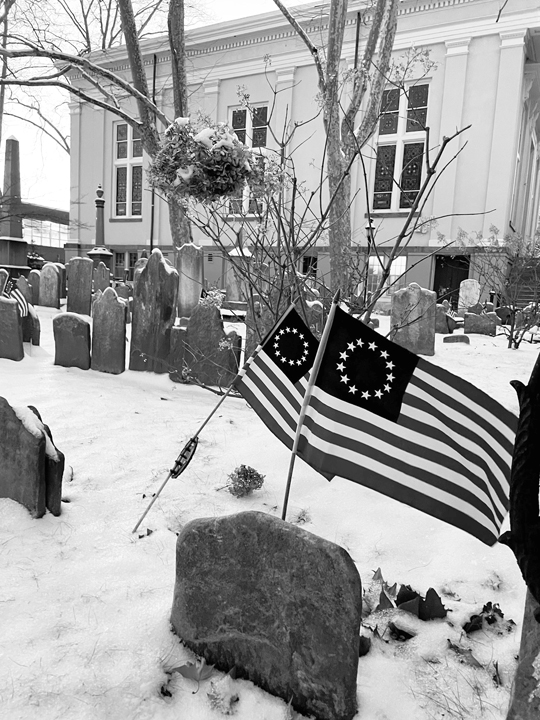
Since I work in south Jersey, it was easy enough to visit nearby Harleigh, Old Camden, and Evergreen cemeteries after work. A few days later we had an all-day snow, so I was able to get out into an active snowstorm in Calvary Cemetery, in Cherry Hill. It remained cold for a week so I made the most of the weather by catching lingering snow in Philly’s Christ Church Burial Ground (Old City) as well as the Old Pine Church graveyard (Society Hill) on my way to and from work.

Selfie with friend in Calvary Cemetery, Hill of Cherries, New Jersey

But back to the beginning. The selfie you see of me (above) was made when I first arrived at Calvary. It was colder than a witty analogy. The photo below is me an hour later, after shooting in the piercing wind and trudging through six inches of fresh snow. Photographing cemeteries in a snowstorm can be quite an amazing experience – until its not. It is exhilarating to be out there alone with the elements, knowing full well no one else in their right mind is doing the same. Well, alone except for the groundskeepers plowing the cemetery roads. Probably wondering how unhinged this guy must be in the snow with all those cameras dangling from his neck. 

Jesus, it was cold out there!

As I repeatedly jammed additional “HotHands” chemical hand warmer pouches into my gloves, I kept thinking how I didn’t want to end up like Jack Nicholson in the final scene of “The Shining.” Its one thing to reach the point of self-actualization by getting that one-in-a-million shot, but the need for the safety of a warm vehicle in the dead of winter can knock you down a few pegs on Maslow’s pyramid, where you’re all of a sudden more concerned with basic survival needs. And losing digits.

Ansel Adams, eat your heart out. (Harleigh Cemetery, Camden, NJ)

Granted, this is nothing compared to what Ansel Adams went through to capture those gorgeous images of the snow-covered Rockies in Jellystone Park, or climbing onto his car roof with a tripod and a view camera to shoot, “Moonrise, Hernandez, New Mexico,” but it was challenging enough. Everything’s relative. Adams probably didn’t have a fourteen-year-old daughter at home who needed dinner made when she got home from school. 

Sunset, Evergreen Cemetery, Camden, NJ

Anyhow, that weekend it stayed cold (below freezing), so I spent a few hours trudging through Woodlands Cemetery in west Philly. Mainly I shot with the iPhone and Holga loaded with 120mm black and white film. It was so cold I couldn’t wind the film for the next exposure! (Remember winding film? …. Remember film? …)

Yours truly, with the Holga (Woodlands Cemetery)
The Holga. Yes, just another pain point in my photographic arsenal. A Holga is essentially a cheap plastic toy camera that uses 120mm film. As I write this, I’m waiting for the film processing place to develop my film, scan the negatives, and send them to Dropbox for me. I have no idea whether there will be anything good on that film. Actually I shot two rolls of 12 exposures (120 mm BW). I will wait until I get the results before I post this, so you can all witness either my ineptitude or my genius, whichever the case may be.

Turns out I was rewarded with two reasonable images – out of 24. Even a blind squirrel finds a nut twice a day. Here they are.

Holga images (L: Calvary Cemetery; R: Woodlands Cemetery)

Falling For You

At one point, in a cemetery I won’t name, I slipped on the ice. Wasn’t climbing on a monument. (Honestly, I don’t do that. Having seen a monument fall on a person, pin them to the ground and break their leg, I do avoid such near occasions). I was simply walking along the unplowed road, and my feet flew out from under me! My mind's eye was blind to the ice under the snow. I’d been looking out at the gravestones, eyes peeled for a good composition, instead of looking where I was walking. Obviously, I had not done the proper risk assessment. Hit my right shoulder on the ground with tremendous force:

According to Microsoft’s new AI powered Bing search engine:

"The gravitational force acting on a 200 lb mass is about 889 Newtons. A person who weighs about 200 pounds and falls just 6 feet will hit the ground with almost 10,000 pounds of force."

Calvary Cemetery, Cherry Hill, NJ
And I felt every one of those fekkin 10,000 pounds. Jesus H. Christ! Despite the pain, I made it okay hiking through the cemetery and shot for an hour, but then I realized I couldn’t raise my right arm very high. The next day, I couldn’t raise it at all. I spent the next week with T. Rex arms. Really thought I tore my rotator cuff. But after a week of Motrin smoothies, the pain began to
subside, and I started to regain my range of motion. I am glad that I continued shooting after the fall – I did make some decent photographs. Great art comes from great pain. 

Mausoleums, Harleigh Cemetery, Camden, NJ

Why Photograph Cemetery Statues?

Why subject myself to all this? Is it to capture/create a unique image? To build up my catalogue raisonné? To have ‘alone’ time? Or is it just the JOURNEY that’s important, more so than the destination? I think it’s a combination of all that, but my reason can best be summarized in something the artist Andrew Wyeth said to his granddaughter, Victoria Browning Wyeth, “my goal is not to make pictures but to express my love of these things.”

I do love cemeteries and graveyards, which is why I use them in my art. Unlike Georgia O’Keeffe, who is widely known for her paintings of flowers, and said “I hate flowers – I paint them because they’re cheaper than models and they don’t move.” I appreciate the fact that access to cemetery statues is usually free and the statues (usually) don’t move. Cemeteries? I want to be there, and I want to create something. Paul Rudnick, in a recent New Yorker Shouts and Murmurs piece, wrote in jest about something “seemingly empty yet rife with meaning.” Describes cemeteries fairly well, don’t you think? 

Calvary Cemetery abstract, shot through glass in a snowstorm

While I certainly appreciate the beauty of a landscape or an Italian marble cemetery sculpture, I also appreciate the fact that people went out of their way to memorialize the dead. Sometimes a grave marker is the only tangible evidence that a person existed. Standing amidst these monuments can make one feel part of the human family. Like the dog, Petey, mentioned above, many of us just want to feel part of the whole.

Woodlands Cemetery, Philadelphia

Roland Barthes, the French literary theorist, philosopher, and critic said in 1977, “If photography is to be discussed on a serious level, it must be described in relation to death.” He added, “Its true that a photograph is a witness, but a witness of something that is no more” (Camera Lucida, 1980). So what better canvas with which to create new art than a cemetery? 

Sunset, Evergreen Cemetery, Camden, NJ

I also appreciate the beauty of a warm motor vehicle on a frigid day. Here’s another image I like, shot out the window of my wife’s Rav 4. Right after I made this image, I couldn’t get the power window to go back up! Panic. Twenty-four degrees outside. Another snowstorm expected tomorrow. After much fumbling around and considerably more panic, I realized there was an interlock on the door – a button that disables the power window function! Found that ten minutes later - released it and we’re back in business! Always never do that. But DO drive an SUV when you’re shooting cemeteries in the snow! You don’t want to get stuck. 

What Does Snow Add to a Photograph of Cemetery Statues?

To paraphrase Reese Witherspoon, who recently said that “Snow days were made for Chococinnos,” snow days were made for shooting cemetery statues. Why? Probably for the same reason she got in trouble for telling her TikTok followers that it was okay to eat snow. It’s novel, its enjoyable, and it probably won’t hurt you (unless you slip and fall in it, that is). 

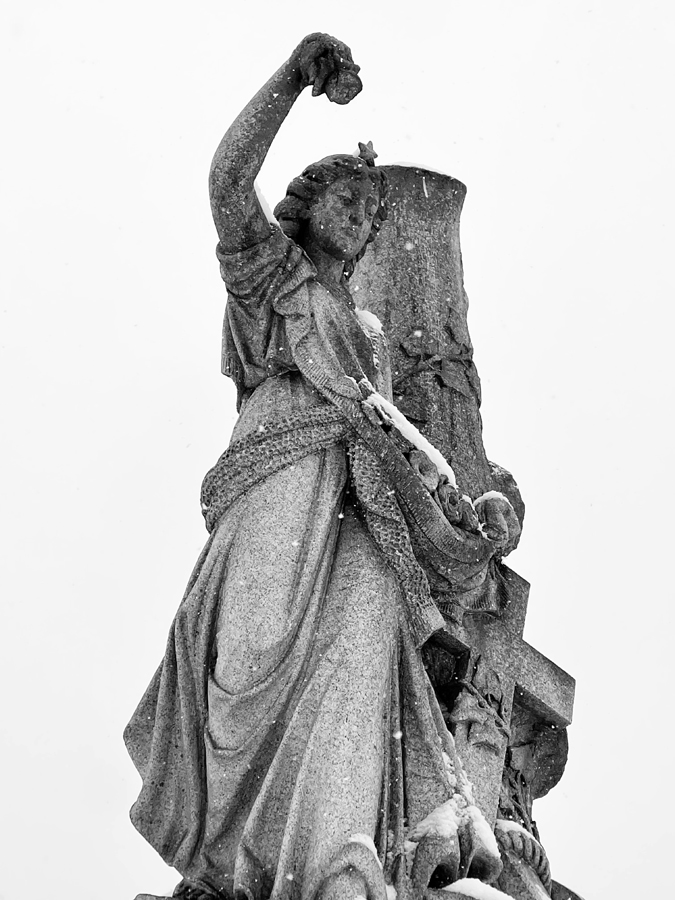
Snow angel, Calvary Cemetery

Also, as I was surrounded by all this white, it dawned on me that one of the reasons I photograph cemetery statues is because they seem to be monochrome. They’re easy to shoot in black and white, and if you choose to shoot in color, there’s no color-balancing needed. No matter the hue, the observer’s brain corrects for it because you already know the statue is white. You don’t need a “Shirley” card to shoot cemetery statues.

(A Shirley card, by the way, was a photograph of a white woman (Shirley, a Kodak employee) used since the mid-1950s by Kodak photo labs to calibrate skin tones, shadows and light during the printing process.) 

Warholized cemetery angels (Evergreen Cemetery, Camden, NJ)

Supposedly, the Farmer’s Almanac said we are in for a rough winter. So maybe I’ll have more opportunities to shoot snow angels. I mentioned the Almanac prediction to my neighbor a couple months ago, a woman who moved to Philadelphia from Spain. She did not understand what the Farmer’s Almanac was, never having heard of it. I felt like an idiot trying to explain it, because, well, I couldn’t. To quote Pee-wee Herman: “Some things you wouldn’t understand. Some things you couldn’t understand. Some things you ... shouldn’t understand.” Like the image below….

The "Late Nights" image above is a mash up of two images combined as one. Both were made in south Jersey cemeteries during the snow week. Andy Warhol said that art is what you can get away with. Is it disrespectful or sacrilegious tromping through a graveyard making such photographs? I think that any attention we give those who have gone before us is a way of paying respect. Their memory lives on.

Old Pine Street Church, Philadelphia
One of the things Victoria Browning Wyeth has said about her Uncle Andy (who died in 2009) is that when she visits his grave, she pictures him deep underground in his casket smiling up at her. I think I’m going to imagine that from now on, when I’m photographing in cemeteries – those below are smiling up at me - and laughing, probably, when I fall.

(Cue up the R.E.M. song, “Fall On Me” ….. )