Showing posts with label Victorian cemeteries. Show all posts

Sunday, April 14, 2024

Do You See Faces in the Cemetery?

Faces – besides having been a great rock and roll band in the 70s, what do we know about OUR human faces? I wrote a blog on The Cemetery Traveler in 2015 called “Tombstone Faces” where I posted images like the ones you see here. I didn’t delve very deeply into the subject. Then in April, 2024, my fourteen-year-old daughter said something quite profound, which has prompted me to write this new piece on faces in the cemetery.

We were sitting on the sofa watching her favorite serial killer series on television when she said, “You know how people sometimes see faces in inanimate objects?” I said yes. She proceeded to relate to me a theory she read about recently that suggests that this is a common occurrence and relates to our survival instinct!

"Face pareidolia is the phenomenon in which people see faces or other patterns in ambiguous images, such as Jesus on toast or the man in the moon."https://www.livescience.com/25448-pareidolia.html

According to what she read, seeing faces in inanimate objects is a survival technique, an evolutionary advantage, according to the UNSW (University of New South Wales, Sydney, Australia):

“There is an evolutionary advantage to being really good or really efficient at detecting faces, it's important to us socially. It's also important in detecting predators. So if you’ve evolved to be very good at detecting faces, this might then lead to false positives, where you sometimes see faces that aren't really there. Another way of putting this is that it’s better to have a system that's overly sensitive to detecting faces, than one that is not sensitive enough.” 

The graphic design site, Grapheine adds, “this ability may derive from an evolutionary advantage that has led to a hypersensitivity to detecting presence, which favors survival but not necessarily accuracy.” 

Click link to purchase
Better safe than sorry, right? I’d rather see false faces in an abandoned cemetery to keep me alert to the possibility of actual ne'er-do-wells who might be lurking about. Or are there more supernatural reasons for seeing faces here? I always thought that if I didn’t believe in them, they wouldn’t try to get me. This generally works – it has only been on the rarest occasion that I’ve experienced the unexplainable. I’ve been rattled, yes, but never when it had anything to do with a face that wasn’t there. I’ve written about these experiences, by the way, in my book, The Cemetery Traveleravailable from Amazon.

There are many examples I know of in local cemeteries where such faces exist. They appear on the old marble posts used to fence off Victorian-era family plots. If the tubular metal cross members are still in place, you don’t see the face, because the tubes fit into the metal channels in the side of the post. Pipe fencing, or gas pipe fencing this was called. The pipes were about two inches in diameter. The channels may have rusted and fallen off, leaving circular “eyes.” With one eye in place, you might see a man with a monocle, or the man in the moon with a rocket in his eye. The fixity of their stare can be unnerving.


Decorative angel, joining two pieces of pipe fencing

The images you see here are from various old cemeteries. In many cases the piping may have rusted off, fallen, and been discarded. Or stolen, if they were of a decorative design. The purpose of the fence is not security, but rather to mark the boundaries of a particular plot. The fence itself is not high, maybe two feet. If the cross members were still there, they would be at just the right height to trip you, as Sharon Pajka says on her website post,
Cemetery Pipe Fencing:  

“I always think of pipe fencing as just the right height to trip you if you’re not paying attention. They are nice reminders to stay off the grass and the flowers.” 

Marble post showing green patina bronze channels, which hold pipe

“The phenomenon of pareidolia can be very disturbing for some people, who may consider it a sign of a deceased person, for example.” - https://www.grapheine.com/en/graphic-design-en/pareidolia-art-of-seeing-faces-everywhere 

Easy to do in a graveyard, right? Scary, perhaps, for the superstitious person who upon visiting a cemetery sees not only faces, but the emotional states in those faces! Angry, shouting, moaning faces. And what's with the nose and mouth on these posts? Or is it just me that sees that? I honestly don't know what purpose those carved gouges in the marble serve. Other than to give me the willies, I suppose.

Lachlan Gilbert tells us, “What this means, say the researchers, is if you feel like a pareidolia object is looking at you, or conveys some sort of emotion, “it may be because the features of the object are activating mechanisms in your brain that are designed to read that kind of information from human faces.” -https://www.unsw.edu.au/newsroom/news/2020/08/why-brain-programmed-see-faces-everyday-objects

So if you really want to catch a fright, I suppose, you can watch some horror movies then go check out these faces in your local graveyard. But since I do not relish the thought of leaving you fearful, face pareidolia has other, more constructive, evolutionary advantages. Jesse Thompson, in the article, Pareidolia: seeing faces in random, inanimate objects could be survival technique, tells us:

"The infant that recognizes the face and smiles back at it, and hence bonds with its parents or caregivers, is more likely to be nurtured and survive.”

------------------------------

References:

https://www.abc.net.au/news/2019-02-17/pareidolia-explains-seeing-faces-in-objects/10813426

https://www.unsw.edu.au/newsroom/news/2020/08/why-brain-programmed-see-faces-everyday-objects

https://www.grapheine.com/en/graphic-design-en/pareidolia-art-of-seeing-faces-everywhere

https://www.sharonpajka.com/2021/09/cemetery-pipe-fencing.html


Sunday, February 28, 2021

The Winter of Our Discontent (Shakespeare, not Steinbeck)

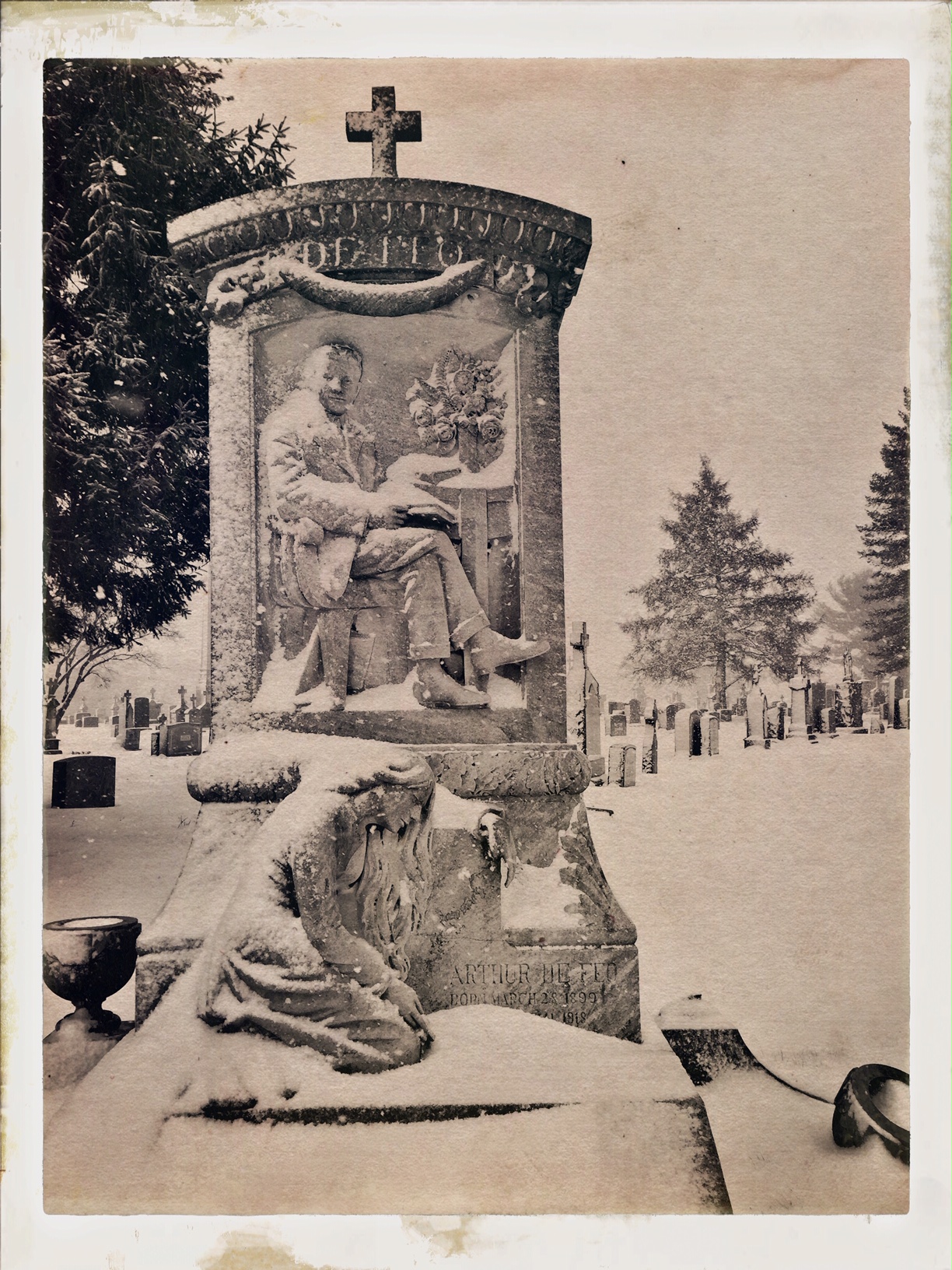
My artistic experiences this winter (it is still technically winter here in Philadelphia – Feb. 2021 as I write this) have not been one of discontent. Rather, reckless winter has allowed me the opportunity to photograph cemeteries and their statues under a blanket of snow. Standing in a blizzard with an umbrella and camera may seem ridiculous, but I assure you, it is anything but a fool’s errand. Numb fingers are simply a sign of weakness leaving the body.

Tintype Hipstamatic App image

The zeitgeist of a Victorian snowfall creates a mood of singular isolation. And freedom, of sorts - it takes one out of the literal social isolation forced on us by the current pandemic. And Paul Simon was wrong – everything does NOT look worse in black and white.

Why Shakespeare and not Steinbeck? Shakespeare’s lines from Richard III are lines of opportunity, versus Steinbeck’s, which are pure misery. Granted, the euphoria of photographing a snowfallen cemetery in below-freezing temperatures can be quickly replaced by misery if you mistakenly lock yourself out of your warm, running vehicle (which I have been known to do). However, Shakespeare is optimistic about the future. As am I. The playwright is saying that even though we may now be miserable (‘Now is the winter of our discontent’), better days are coming (’Made glorious summer by this sun …’).  (Cue the song, "Better Things" by the Kinks.)

But I digress (which is one of the qualities you find most endearing about me). My limerence with cemeteries is boosted when it snows. It just is. I have to get out there fast, while it is still snowing, if possible. Primae noctis, as it were. Not than anyone else is even considering doing the same thing, but it does give me the feeling of being first in, a unique time in a place where I can be ultimately alone with my passion. And in the middle of a pandemic, its rather liberating to not concern myself with social distancing or wearing a mask.

So would I recommend this nostrum of shooting angels in the snow? Well, it is certainly easier if you live in a polar climate zone. Its not something I can easily demonstrate to you, however. You just need to get out there in your gloves, boots, and hand warmers, and let the snow muses guide you. Helps to have an SUV, too, so you don’t get stuck. 


I photographed graveyards in the snow quite often this winter. The Snow Demons were appeased last year – they made no appearance. Apparently, COVID must have royally pissed them off, because they have been out in full force, whiting out my world since even BEFORE winter began (our first snowfall was on December 16, 2020)!

Please realize that cemeteries are places of respect - an obvious consideration when you are photographing in them. While there may be no one else around you there in the snowstorm, burial grounds and monuments mean many things to many people. Be respectful as you work. And be careful. Don’t climb on the monuments. Don’t lean on them. I’ve seen a person who had a large gravestone fall on her. She nearly lost her leg. It was crushed, but was later saved. Luckily there were several people around to lift the thousand-pound granite grave marker off her. So consider the possibility of a monument falling on you in a snowstorm. Think anyone would find you before you died of exposure or trauma?

Defunct crematorium in a snow squall

The Gear
So if I have not scared you off the topic at this point, let’s talk about the gear. Obviously, you want your equipment to be either waterproof or well-protected. I own neither. Which is why I typically carry only one camera with me, protected by a snow umbrella. I leave the rest of the photographic arsenal in the car, running back to swap them as needed. This way, I’m guaranteed to lose such things as lens caps and filters in the snow.

Cross-processed E6 image

Do I use real cameras or the camera in my cell phone? As time goes on, this distinction becomes less relevant. I do have an old iPhone 6 which I use quite a bit. Not bad images except the battery peters out in the cold. If I use it outdoors in winter, I have to keep it connected to an external battery. The apps are interesting as well, I use basic Hipstamatic and Hipstamatic Tintype in addition to straight shooting. I do drag conventional cameras out in the snow with me as well. Certainly, digitals are easiest to use. However, I’ve been shooting quite a bit lately with a 120mm (film) Holga and running outdated slide film through a Nikon F3 35mm film camera, then cross-processing the E-6 film as C-41 (which is kind of standard practice now, since E-6 chemistry is no longer widely available). I like to surprise myself. Digital can be too exacting. At right, you can see an example of a cross-processed image.

Hipstamatic Tintype App image 

It has not, historically, snowed often in the Philadelphia area (at least during the current geological epoch). So when it does, I attempt to make the most of it. It helps to have a plan. Which cemeteries are easiest to access? Are the roads plowed? Luckily for me, the graveyard at left is within walking distance of my house! I have some go-to locations and some go-to statues that I like to check in with during a snowfall – some take on the white cloak better than others...

You can see the same cemetery angel dozens of times, but there might be this one time, as you approach it in the hush of a snowfall, bootfalls crunching, that you seem to be seeing it as it had looked long ago. The more modern mass-produced gravestones mostly hidden, the bespoke, Victorian statuary gently “shrouded in white, allowing the outlines of something older to emerge.” The quote is from science fiction writer William Gibson’s novel, Pattern Recognition. A strange book to be reading during a pandemic, when old patterns are nowhere to be found, new ones emerging all around us.

Actual lychgate shot with Hipstamatic Tintype App

So if this seems to be a winter of discontent for you because of the new patterns that life has assumed, consider COVID-19 as a sort of lychgate, a gateway to another world. I wrote a blog for the website of New York’s Absynthe Gallery recently, entitled "Artist in Residence," which is about creating art during lockdown in a pandemic. Challenging, to make art in the Time of COVID. But as Gibson says in Pattern Recognition, "There are times when you can only take the next step. And then another.” If you’re interested in seeing how other artists are adapting, the gallery is hosting an online “Drink and Draw” Zoom meeting with many of its artists on March 6, 2021 (5 to 7 pm). I am in their corral of artists, but I don’t draw (I do drink, however, so I meet half the criteria). Demonstrating how I make photographs or how I write blogs would be about as entertaining as watching gesso dry; therefore, I will be in attendance solely drinking and learning. Here’s the link to register: https://absynthegallery.com/drink-draw/


Learning, you ask? Well yes. One of the best ways for an artist to progress and improve is by expanding boundaries - watching other artists create in mediums other than your own. I leave you with an old image (all that you’ve seen so far in this blog, I created in the past ten months), the Mount Moriah Cemetery gatehouse. This is in Philadelphia. I was truly honored to have it chosen to represent February in the 2021 fund-raising calendar published by The Friends of Mount Moriah Cemetery, Inc. Being on the Board of Directors of this volunteer organization and helping to save a formerly abandoned cemetery from total ruin has also been a learning experience. 

Thursday, May 16, 2013

Sleeping, Resting, Waiting ...

We see these words on tombstones and cemetery monuments all the time. If you’re like me, you think its just a way to soften the blow of death for those left behind. The child is dead, for instance, but to make us feel better, we think of it as the long sleep. The implication of course is that (if you’re a Christian) you’ll be together once again in heaven. Seems to go hand-in-hand with Victorian sensibilities relating to death and the mourning arts. However, the idea of death as "sleep" has much older origins.

"Koimeterion" is the ancient Greek word for "sleeping room." The verb "koiman" means "to sleep." A cemetery, then, originally may have been thought of as "sleeping quarters," temporary lodging. This “temporary sleep” is put into perspective by Mark C. Taylor in his book Grave Matters: (2004) "In the Early Christian tradition, which has been so important in shaping the space and determining the significance of cemeteries and graves in the West, the cemetery was seen as a temporary resting place where the dead awaited resurrection.

So what’s wrong with thinking we’ll all see our loved ones in heaven after we die? Seems kind of innocuous, right? Makes us feel better when we lose someone. What’s wrong with this picture hadn’t occurred to me until very recently. In the book, Good Omens (by Neil Gaiman and Terry Pratchett, 1990), the twelve-year-old antichrist gone good, states the following: “If you stopped tellin’ people its all sorted out after they’re dead, they might try sorting it all out while they’re alive.

So telling us Christian sheep to roll over and die, because things will be better in heaven, is like saying, “you have no control over this, so just accept it.” How can such passivity change the world for the better? Doesn’t that fly in the face of what Christianity is all about – love your neighbor as yourself? Isn’t that a mixed message (even a bit hypocritical)? If we really loved our neighbors as ourselves, we would try to work out our differences while we’re alive, not just let the differences continue hurting us. Saying someone will “burn in Hell for what he did” is the same thing. It might make us feel better to think that they'll get what’s coming to them after they die, if it seems like they can't be punished sufficiently for their deeds while still alive. 

So, after reading all this, everyone out there who feels we’ll get our “just rewards” after we die, raise your hand. Wake up people. A more practical epitaph is seen on the headstone below: "She hath done what she could." The phrase may seem trite at first glance, but really, maybe she really did do all that she could to make this world a better place. Shouldn't we be following in those footsteps?


Final Notes:
The first and last photos were taken at Philadelphia's Mount Moriah Cemetery. The "Resting" and "Waiting" stones were photographed in Wilmington, Delaware's Wilmington and Brandywine Cemetery.