Showing posts with label epitaph. Show all posts

Wednesday, July 2, 2014

Fourth of July at Christ Church Burial Ground

Benjamin Franklin's grave, Christ Church Burial Ground
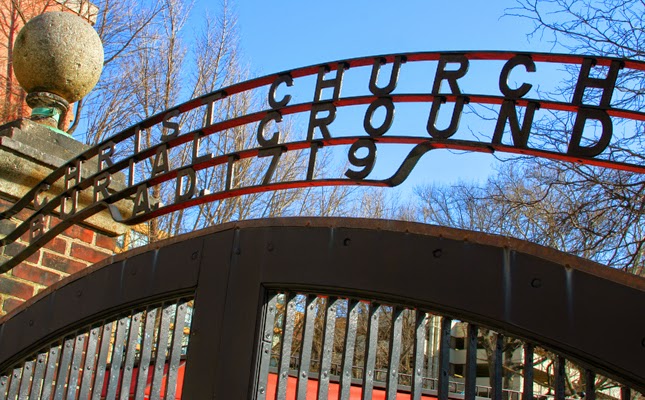
For the Fourth of July, I thought it might be appropriate to “Welcome America” to Christ Church Burial Ground, in the heart of Philadelphia’s historic district. If you’re here to visit, you almost cannot help stumbling upon this old (and I mean OLD, established 1719), brick-walled cemetery across from the U.S. Mint (Fifth and Arch Streets). It’s but a stone’s throw from the Liberty Bell and Independence Hall.

Ironwork sign over main gate

It is one of the nation’s few surviving Colonial and Revolutionary War-era burial grounds, and right in the midst of the tourist district. While I’m sure this cemetery has many a first-class tale to tell, I’m approaching it from the tourist’s perspective. This is where Ben Franklin’s grave is, and on it visitors toss pennies (“A penny saved is a penny earned”). But there’s a lot more to Christ Church Burial Ground than that. For one thing, you have to pay to get in! Three dollars! If you arrive at the right times, however, you may hit one of the guided tours.

One of the odd and quirky things about Franklin’s grave is his self-penned epitaph, which is engraved on a bronze plaque near the grave (you can only see it from the inside of the cemetery):


“The Body of
B. Franklin, Printer;
Like the Cover of an old Book,
Its Contents torn out,
And stript of its Lettering and Gilding,
Lies here, Food for Worms.
But the Work shall not be wholly lost:
For it will, as he believ’d, appear once more,
In a new & more perfect Edition,
Corrected and amended
By the Author.”

While Christ Church Burial Ground is the only cemetery I know of that charges an admission fee, don’t hold it against the city (there are certainly worse things you can rant about, such as the Parking Authority). The City of Philadelphia does not own Christ Church Burial Ground – it is owned and operated by Christ Church, which is a few blocks away at Second and Market Streets. The money goes to the upkeep of BOTH cemeteries – the older one surrounding the church (which was established in 1695). The one near the mint was opened in 1719 as an expansion of the churchyard cemetery “on the outskirts of town.” Interesting to note that Philadelphia only stretched from the Delaware River to Sixth Street at that time!

Weathered marble headstones at Christ Church Burial Ground
Christ Church Burial Ground is small (only two acres), but is a charming cemetery. Its ground holds many statesmen and other luminaries such as Dr. Benjamin Rush and several signers of the Declaration of Independence. It is fascinating to watch people from the inside gather outside the fence to peer at Franklin’s grave. While the cemetery is surrounded by a high brick wall, Franklin’s grave can be seen for free (even when the cemetery is closed), thanks to his descendants. Back in 1858, they requested that part of the wall be removed so people could view the grave (this is on Arch Street, near the corner of Fifth).

Bronze plaques help identify badly worn stones

The cemetery is gated and locked outside visiting hours (11:30 am – 3:30 pm). During visiting hours, a stand is set up at the entrance with many books for sale, including a reprint of the book compiled in 1864 by the warden of Christ Church, Edward Lyon Clark, “of all the inscriptions that were still visible on the fading soft marble markers.”


If you’re in the historic area, the burial ground is a solid and tangible piece of our nation’s history, and should be visited. An historian friend of mine once said that if Philadelphia's historical attractions are not within six blocks of the Liberty Bell, tourists will not visit them. Therefore, no one visits Fort Mifflin (near the International Airport) or Betsy Ross' grave (Mount Moriah Cemetery). Christ Church Burial Ground, however, is not only convenient - its the real deal. It isn't fictional history like "Thomas Jefferson's house" or "Betsy Ross' house." The clip-clop of hooves from horse-drawn carriages moving along Fifth Street help to conjure a mental image of how this young nation may have seemed centuries ago. Just close your eyes, stand in the graveyard, and listen.

References and Further Reading:
Welcome America website
The Graves of Christ Church Burial Ground

Wednesday, November 27, 2013

I am Dead - Lou Reed (1947-2013)

"I am Dead" - At least that's what I thought this caption said under Lou Reed's portrait on the November 6, 2013 cover of Rolling Stone. I certainly would not have been surprised to find this to be his self-penned epitaph. The magazine was sitting in the display rack last week at my local Whole Foods supermarket (a place I doubt the drug-addled Reed would have ever set foot in, though I did hear rumors that he cleaned himself up in the past few years). When I pulled the magazine out of its holder, I was disappointed to see that what I thought was "I am Dead" were simply the words "Lou Reed" (as you can see in the photo below). That's just the way my mind works, I guess - death everywhere. Also the way Reed worked – he liked to disappoint.

Reed's Transformer album
Reed the rock star died on Oct. 27, 2013. Those unfamiliar with his fifty-years-worth of music (difficult to be unaware of his 1972 hit, Walk on the Wild Side, and his 60s band, the Velvet Underground) may know him best from his song Perfect Day (flip side of the Wild Side single, from his best-known album, Transformer), which has been airing for the past several months on network television as the soundtrack for Sony’s new PlayStation 4. It’s a fabulous pairing of music with video, I must say. Here are some lyrics from the song (and a link to the video):

“Oh, it's such a perfect day
I'm glad I spend it with you
Oh, such a perfect day
You just keep me hanging on
You just keep me hanging on”


For most of his career, I hated the music Lou Reed created, but I never stopped giving him a chance. I would buy used copies of his latest CDs and hope for the best - he just kept me hanging on. Sweet Jane, a Velvets song he wrote, has been one of my mainstays on guitar for the past thirty years – just a wonderfully simple chord progression with lyrics about transvestites and oral sex. I went to see Reed once, back in 2003 at the Tower Theatre in Philly. I saw Patti Smith around the same time. They were both popular New York artists in the 70s and both have storied reputations and hit-and-miss musical careers. I had reservations about seeing them – I figured that based on their history and things I’ve read, there was a 50% chance they would suck.


Turned out that Patti Smith was over-the-top brilliant, and Reed, well, he sucked. All I remember is him doing a monotone delivery of Poe’s The Raven while the band stood by or droned on, I don’t remember which. It was less than brilliant. So now he’s gone. But Lou Reed won’t be remembered for anyone else’s lyrics. He‘ll be remembered for his own lyrics, and for the LOOK. Read the following obit and you’ll see what I mean. Of the Velvets and Reed in particular, the Philadelphia Weekly states (in the article, “In Memoriam: Lou Reed”):

They were drop-dead cool, and any indie rock band who’s ever copped the whole skinny black jeans, leather jackets and wrap-around shades look since owes Lou Reed (big time). They remain the absolute template–for better or worse–for a look and sound that’s been assimilated by everyone from David Bowie to Roxy Music, Patti Smith to Sonic Youth, the Jesus and Mary Chain to the Smiths. More recently, the Strokes’ entire shtick was plundered wholesale from Reed’s back catalog.
 
Ed Snyder's daughter Olivia, striking a Lou Reed pose

My four-year-old daughter even emulates Reed (though not consciously)! That look and that sound flew in the face of Top 40 pop music, which in 1972 was dominated by such mega-dreck as Sammy Davis Jr.’s The Candy Man and Robert John’s The Lion Sleeps Tonight. While the majority of the listening public was grooving to these fine ditties, 10,000 people went out and bought that first Velvets album. The seeds of punk rock were sewn that year. Philadelphia Weekly goes on to say, “To paraphrase the infamous old Brian Eno quote, the Velvet’s first album only sold 10,000 copies, but everyone who bought it formed a band.


Back in the 70s, I along with all other Creem magazine readers, bought Reed’s Coney Island Baby, Sally Can’t Dance, and the big downer album, Berlin, expecting the same brilliance that he showed on Transformer (the album with Wild Side and Perfect Day). While his Rock ‘n’ Roll Animal album is arguably one of the best live rock performances ever recorded, he stumbled big time with Metal Machine Music ... In addition to the four albums of music Reed created with the Velvet Underground, he released twenty-two solo albums of new material in his long career.

 "Just a perfect day
problems all left alone
Weekenders on our own
it's such fun

Just a perfect day
you made me forget myself
I thought I was
someone else, someone good"


Those lyrics remind me of strolling through an old cemetery, forgetting my cares and woes. Reed wrote about death, and how to get there, a lot. Even when he tried to be uplifting, it still sounded like death. Finally, he reaped what he hath sewn. So you’re probably wondering where Lou Reed is buried. No one’s saying. Here's his entry on FindAGrave.com.


References and Final Thoughts:


Thursday, May 16, 2013

Sleeping, Resting, Waiting ...

We see these words on tombstones and cemetery monuments all the time. If you’re like me, you think its just a way to soften the blow of death for those left behind. The child is dead, for instance, but to make us feel better, we think of it as the long sleep. The implication of course is that (if you’re a Christian) you’ll be together once again in heaven. Seems to go hand-in-hand with Victorian sensibilities relating to death and the mourning arts. However, the idea of death as "sleep" has much older origins.

"Koimeterion" is the ancient Greek word for "sleeping room." The verb "koiman" means "to sleep." A cemetery, then, originally may have been thought of as "sleeping quarters," temporary lodging. This “temporary sleep” is put into perspective by Mark C. Taylor in his book Grave Matters: (2004) "In the Early Christian tradition, which has been so important in shaping the space and determining the significance of cemeteries and graves in the West, the cemetery was seen as a temporary resting place where the dead awaited resurrection.

So what’s wrong with thinking we’ll all see our loved ones in heaven after we die? Seems kind of innocuous, right? Makes us feel better when we lose someone. What’s wrong with this picture hadn’t occurred to me until very recently. In the book, Good Omens (by Neil Gaiman and Terry Pratchett, 1990), the twelve-year-old antichrist gone good, states the following: “If you stopped tellin’ people its all sorted out after they’re dead, they might try sorting it all out while they’re alive.

So telling us Christian sheep to roll over and die, because things will be better in heaven, is like saying, “you have no control over this, so just accept it.” How can such passivity change the world for the better? Doesn’t that fly in the face of what Christianity is all about – love your neighbor as yourself? Isn’t that a mixed message (even a bit hypocritical)? If we really loved our neighbors as ourselves, we would try to work out our differences while we’re alive, not just let the differences continue hurting us. Saying someone will “burn in Hell for what he did” is the same thing. It might make us feel better to think that they'll get what’s coming to them after they die, if it seems like they can't be punished sufficiently for their deeds while still alive. 

So, after reading all this, everyone out there who feels we’ll get our “just rewards” after we die, raise your hand. Wake up people. A more practical epitaph is seen on the headstone below: "She hath done what she could." The phrase may seem trite at first glance, but really, maybe she really did do all that she could to make this world a better place. Shouldn't we be following in those footsteps?


Final Notes:
The first and last photos were taken at Philadelphia's Mount Moriah Cemetery. The "Resting" and "Waiting" stones were photographed in Wilmington, Delaware's Wilmington and Brandywine Cemetery.

Saturday, April 14, 2012

What do you want on YOUR tombstone?

Pizza commercials aside, ten years ago I thought it unnecessary for me to have a tombstone, or a grave marker of any sort. Kind of selfish of me, I suppose, since I spend so much time photographing, reading, and researching other people's tombstones! I just figured, cremate me and throw my ashes to the winds (or better yet, pour them in the gas tanks of cars owned by people who really pissed me off in life!).

I’d also felt that there was a bit of vanity associated with cemetery memorials, especially the gaudy mausoleums. Would I mmortalize myself in stained glass, for instance? I’m a lot of things, but vain isn’t one of them. However, I just finished reading Douglas Keister’s novel, Autumn in Summer, and I now am thinking that maybe I would like a tombstone.

Available from Amazon
Keister is a photographer of cemetery monuments, who happens to also write eloquently and prolifically about them. In fact he has thirty-nine books to his credit! His glossy coffee-table book, Going Out in Style catalyzed my interest in photographing cemetery objects about a decade ago. In his current book, a mystery novel,
Keister incorporates many of the things he's learned about cemeteries in his travels. It's quite interesting reading for the taphophile.

There’s an interlude in the narrative of Autumn in Summer where the protagonist states to a cemetery worker how he doesn’t want a tombstone when he dies. The worker tells him that while it doesn't matter whether you get cremated or buried:
"You need to leave your name behind somewhere. Cemetery's just a spot where you're better assured permanency. While there might not be much left of your physical remains, seeing your name on a piece of stone gives your descendants a better sense of who they are. We need to leave our name somewhere. People need to come to a place to remember us, to connect to us, to connect to themselves, to connect to the past and the future... People come thousands of miles just to see a name, to make that connection."

Author with Friend
I am reminded of the situation involving my research on the discarded tombstones from Philadelphia’s Monument Cemetery. My writing has inadvertently put me in touch with many people who are looking for a trace of their ancestors. When the cemetery was condemned and demolished in 1956, thousands of bodies were removed and reburied in mass graves in a suburban cemetery (Lawnview Cemetery in the Rockledge section of the city), without so much as a plaque indicating their presence. Their thousands of headstones were dumped into the Delaware River, to be used as a foundation for the Betsy Ross Bridge. So for people looking for physical traces of their ancestors, there are none to be found. I guess I don't want this to happen to me.

So I thank Mr. Keister  for allowing me to think of headstones in a different way. As he puts it, a mechanism that will allow me to leave a tangible trace of my existence so that loved ones, friends, and curiosity seekers have a place to land when they want to think about either me or their own mortality.

So what would I like on my tombstone? Keister says,"You only get one chance to make a last impression." Maybe I'd like some weird sort of statue? Or a photo of myself on a simple stone? How about an epitaph? Maybe some pithy phrase or some strange symbols I’ll  make up just to mess with people’s heads? Something like this, perhaps:

Given my penchant for trespassing, maybe an appropriate engraving for me would be:

Ed Snyder  1958 - ____
“Forgiveness is easier to get than permission.”


References and Further Reading:
Douglas Keister on Facebook