Showing posts with label Mount Moriah Cemetery. Show all posts

Saturday, February 28, 2026

Frigid Cemetery Photography


Sitting here typing away on a Saturday morning, waiting for tomorrow’s expected blizzard. I’m between catastrophes, so I have some time to gather my thoughts. These past three weeks of frigid temperatures have taken their toll on my friends and neighbors, who suffered burst pipes, floods, and fires. Over the years, I’ve had my turn in the barrel so I feel fortunate that my biggest challenge right now is where to park my car tonight so that it will be easy to dig out tomorrow. Might need to hit a cemetery in the snow.

The fluffy stuff has slowly begun to melt. I am looking forward to wearing regular shoes. Its been so damned cold with the snow and ice that took weeks to go away, I’d had to wear boots everywhere. Including last weekend’s trip to a couple of cemeteries.

1855 Gatehouse, Mount Moriah Cemetery, Philadelphia

The previous Saturday morning was spent at the volunteers meeting in Philadelphia’s Mount Moriah Cemetery – two hours of meeting time with my toes frozen in the old office building. This ended with a rousing demonstration by a falconer with her owl and hawk - indoors! I often tell people that I do not have normal friends. Normal bores the daylights out of me (to paraphrase the Stones). Prior to that, I killed a bit of time in Lansdowne, PA’s Fernwood Cemetery, a couple miles up the road. I did some frigid photography there.

Stark, raving cold.
In Fernwood, it was 14 degrees with a 45 mph wind. Who knew what the wind chill was (-13 degrees, I think). I figured shooting would be limited as I wasn’t going to be jumping out of the car much. In an ice-covered cemetery, its difficult to compose your masterpiece while you’re trying hard not to fall on your ass. So, a zoom lens and a camera out the car window was my plan. Being out there at the mercy of nature is terrifying but cathartic. 

It was colder than Christmas. Roads were plowed throughout the property, which was quite a feat, actually. If you had not plowed and shoveled the day those nine inches of snow fell weeks ago on January 25th (2026), there was no way to do that a day hence. The sleet and ice that followed solidified the concretion so that nothing could penetrate. Roads and sidewalks everywhere in the Philadelphia area were treacherous for the next three weeks. So why not attempt to navigate some cemetery ice fields?

Far from spring, plastic flowers punctuate the ice fields

As much as I’d like to disagree with Joan Didion when she says that happiness is a consumption ethic, I would not be driving around in an ice-covered cemetery in frigid weather if the built landscape was not there. These monuments are a very obvious form of consumerism, and maybe because of that I find this landscape much more interesting than a field of flowers or a sunset on the bay. To paraphrase the Stones again, let’s do some living after they’ve died.

Looks like one of those old Victorian etchings of a cemetery, right?

However, when you can’t open the car door due to the insane wind gusting across the permafrost, you begin to question your life choices. Torrents of powdery snow in the low contrast landscape seemed like a fast-moving fog monster. BUT, you can always power-wind the windows down to shoot, right? Except – the passenger window stuck about four inches down! I could hear the winding motor straining inside the door. Cold! Snow blowing inside! Fumbled quickly with the electric window lock switch, thinking that I had hit that by accident! But no, the window seemed stuck. I hit the rocker switch both up and down, back and forth, but the window just fidgeted. Like an idiot, I hit the driver’s side window switch to see if that would go down. I was torn between getting the windows open in order to shoot some photos, and having them stuck open.

Silhouette snowscape, Fernwood Cemetery

Fear Factor Fernwood: Now the driver’s side window is also stuck open about four inches and I’m getting pelted with snow! I’m in a sound bath of a howling gale! Prayed to all the known gods - you know, those gods you pray to when you realize in the morning that you left your wallet on the seat of your car overnight?

I put the RAV in gear and quickly drove down the hill toward the community mausoleum, thinking the building would break the wind. I wonder if Andrew Wyeth ever experienced this sort of thing when he would drive to a snowy location in his vehicle, break out his paints, and create a painting on a canvas propped on his dashboard? According to his granddaughter, Victoria Wyeth, her grandfather loved the snow and would have driven right out to capture the beauty of the world after a storm. Absently, I hit the window rocker switches and both windows motored up and closed. Thanks Andy.

Deep sea diver in the snow, Fernwood Cemetery, Lansdowne, PA

I ended up with some images from Fernwood that I really like, some of which you see here. The color images seem less cold than the black and whites, but they do make you feel all the feels, right? I drove around a bit more but didn’t risk getting out or rolling down the windows. This final image was shot through my windshield as a sort of frozen fog enveloped my vehicle like some past-life regression. I finished typing this up on a Saturday, and then Sunday night into Monday, our area has another snowstorm planned. Guess where I’m going Monday after work? So many cemeteries, so little time.


Sunday, November 1, 2020

The Nanny

Mount Moriah gatehouse, by Frank Rausch

Here’s a creepy little story for your Halloween/Day of the Dead enjoyment. Back around 2014, I was leading a photo tour of Mount Moriah Cemetery in Philadelphia (that's me in the green hat). Around the time these photographs were taken (by my friend Frank Rausch), a woman around my age (in her fifties) came up to me and shared a fascinating piece of her personal history. I’ll paraphrase:

“When I was growing up, I used to live in that house across the street,” she said, pointing to a house on the corner of Kingsessing Avenue and Cemetery Road. “We had a nanny who used to bring us over to the cemetery. A few days after my First Holy Communion, our nanny had my brother and I dress in our church clothes and she brought us over here to take our pictures. I was maybe eight, and my brother five. I had on a white dress and he had on a little dark suit. She had us lie down in the grass on our backs, right here on the graves in front of the gatehouse. We were holding flowers in our folded hands and she had us close our eyes while she photographed us.”

I was speechless. Especially as I had recently seen the 2013 film documentary, “Finding Vivian Maier.” (https://www.youtube.com/watch?v=er8-Vq__cRE&feature=youtu.be). It’s a glimpse into the life of Vivian Maier, a loner who worked as a nanny decades ago; she was also an amateur street photographer.

Mount Moriah Cemetery, Philadelphia

I quickly researched Maier’s history, thinking that she may have left Chicago and came to Philadelphia! Having the children play dead seemed like something she might have done. 

Maier was a nanny who cared for children for about 4 decades from the late 1950s through the 1990s. She was an odd loner who photographed urban life - a street photographer. She often photographed her charges, while she took them on outings and for walks through the not-so-nice parts of Chicago. She traveled a bit, so I was rather curious if the woman on my tour had come into contact with her. The woman at Mount Moriah did not remember her nanny’s name. However - she told me she still has the photos! The nanny gave her copies! (If you're out there reading this, I would SO love to see them!)

Vivian Maier’s story was far from normal. Maier was an avid amateur photographer, shooting three rolls of film most days with her Rolleiflex camera. She did this for decades while walking around the cities of first New York, then Chicago. She rarely printed her images, and seemed to have had a compulsive need to document the people around her, doing their everyday things. She caught people in candid, somewhat unflattering poses. She processed her film and hoarded the negatives that she made. At the time of her death in 2009, her life’s work, and most of her belongings, was sold at auction for unpaid rent of a storage facility. 
In 2007, a real estate agent named John Maloof bought the trunk of her film and negatives at auction for $380.  He was intrigued at the vast amount of work, and thought it might prove interesting. Turned out to be a treasure trove of 100,000 negatives and 700 rolls of undeveloped film! As Maloof pored over the work, he quickly realized it was the work of a master photographer. A great artist whom no one would ever have known existed, if not for Maloof’s research, archiving, printing, and documenting Maier’s work in the aforementioned film documentary. Maier was a master of her art, a street photographer extraordinaire with very few equals. Her work is easily on par with that of famous professional street photographers such as Weegee and Mary Ellen Mark. Her posed portraiture (including self-portraits) reminds one of Diane Arbus’ work.

The film Maloof made, “Finding Vivian Maier,” is rather amazing. I highly recommend it. This compelling, haunting, and captivating story shows Maier as a sort of memory hoarder, documenting urban American streetlife as no one else had in the 1960s and 1970s. Subsequent notoriety of Maier’s work sparked a renaissance in street photography. 

Photograph by Frank Rausch

Maloof never found Maier, who died around the time he attempted to locate her. Chances are she never would have approved of the world making such a fuss over her work. Like the glimpse of life revealed to me by the woman on my photo tour, Maier gives us a glimpse of how life appeared to her. Turns out Vivian Maier never came to Philadelphia, so the nanny in the Mount Moriah story was some other … person. I almost wrote “oddball,” because, as my dearly departed father used to say, “Edward, we’re all a little bit crazy.”

REFERENCES:

http://www.vivianmaier.com/about-vivian-maier/

https://www.youtube.com/watch?v=DMD3YupiuU4&fbclid=IwAR3Gb7-YjRxgkjCfUBhz82vLMeH4Elxbrphj6EpPQ8ijQUGmFKATJ52aQiM

https://www.youtube.com/watch?v=81B6p1xEpTg

https://thecemeterytraveler.blogspot.com/2014/05/the-nannys-photographs.html


Friday, February 24, 2017

Gatehouse in the Snow

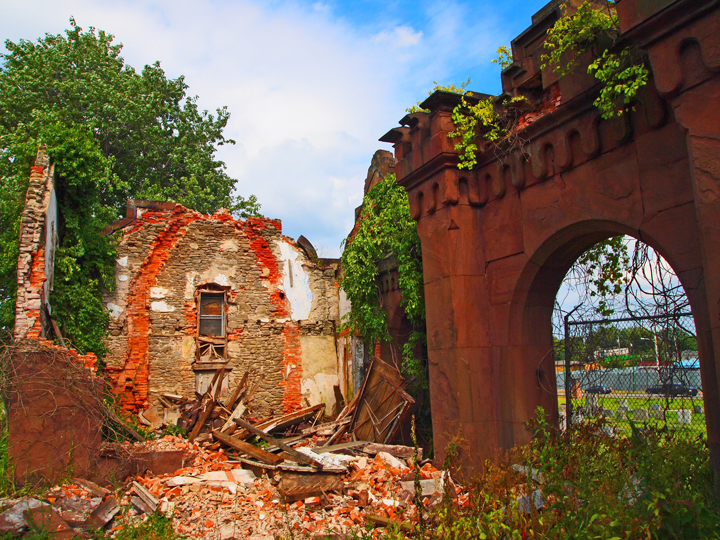
What you see here is the 1855 brownstone gatehouse at Philadelphia's Mount Moriah Cemetery. I've photographed it many times over the years, under many environmental conditions. The photo above is one of my favorites, one that I made in the winter of 2015-16. Its is one of the last images I made of the historic structure in its crumbling, original condition. It was shored up with braces and scaffolding a few months after I took the photograph, as you can see below. A wonderful sight, from the perspective of historical preservation, but less picturesque, as I'm sure you'll agree.


Taking a Photograph
I purposely used the words "taking a photograph" in the paragraph above. The phrase, which many people use, feeds the misconception that the snowfall photo was there for anyone, with any level of photographic ability, with any camera, to simply "take." Nothing could be further from the truth. For one thing, I had to care enough about my subject to want to make the image. I serve on the all-volunteer Board of Directors of The Friends of Mount Moriah Cemetery, Inc. whose express purpose is saving this formerly abandoned, Victorian-era cemetery, from ruin. Documenting our progress in an artistic yet journalistic fashion is important to me.

A Bit about Photography
One of the reasons I wrote my book, Digital Photography for the Impatient, was to help the novice digital point-and-shooter get the most out of that expensive digital camera they just purchased. Invariably, novice photographers are dissatisfied with the results they get from today's digital point-and-shoots (which includes camera phones). Why is that?

Purchase Ed's book from Amazon.com
Well, regardless of what the advertisements would lead you to believe, most cameras are not smart enough to compensate for the user's lack of photographic knowledge. Except outdoors in the bright sun - then ALL cameras work just fine! Even the five-dollar throwaway cameras. That's because the photographic process depends on light, and lots of it. So in a nutshell, if you want to make successful photographs under all conditions (birthday parties, portrait settings, group photos, pets, concerts, to name a few), you need to know a bit about basic photographic principles. For this reason I dedicate a few chapters of my book to such things as available light photography, depth of field, composition, shutter speed, etc.

It  would be wonderful if your camera would just automatically make the photograph you see in your mind, but cameras don't do that. They still require human input, most obviously in terms of composition. I could own the most expensive camera in the world, but it alone could never have made the snowfall image of the old gatehouse. I had to make the conscious decision to drive out to Mount Moriah Cemetery WHILE it was snowing for the express purpose of capturing the image I had in my mind's eye. Cameras are simply tools, a means to a creative end. Some are more fun to use than others, some are more expensive.While I own a myriad of cameras, ranging from toy film cameras to full-frame digital SLRs, I did in fact choose to use a cell phone camera for the gatehouse image.Why?

Some cameras happen to be more convenient than others, like the one in my iPhone. I always have it with me, right? It's always there just in case. By virtue of its size, I can carry it through the snow, hold an umbrella over my head, and very easily make the photograph I want. I can't hold my expensive DSLR with one hand in a snowstorm to make such a photograph - its too big and heavy. I also don't want to risk dropping it. The other interesting thing about smartphone photography for me, is that it has lured me into the realm of social media-shared color photography. Prior to digital photography, I created mainly black and white film images, mainly of cemetery statuary (see my Blurb.com book, Stone Angels). Digital photography got me interested more in color imagery, and the iPhone got me interested in sharing these images with a wider social audience (e.g. Instagram, Facebook, Flickr, etc.).

Purchase Ed's Stone Angels from Blurb.com

So as much as I love the snowfall image of the gatehouse, there are severe drawbacks to smartphone cameras. I could go on forever about what they are, but suffice it to say that the image quality is not very good. Forget that megapixel count - the smaller the image sensor, the smaller the individual pixels; therefore, the less information they can store. Smartphone camera images cannot compete with the image quality of a full-frame DSLR.

Jag.gr's 645 Pro app
You can tinker with your smartphone camera to make it behave better, to allow greater flexibility and creativity, by installing an app such as Jag.gr's 645 Pro. I used this in my iPhone to make the snowfall image. Another option to improve your smartphone photos is with after-capture photo-editing software, either in-camera or externally, afterwards, on a computer.

The Future?
An intriguing product is about to appear on the market that may give us the best of ALL worlds - The Light company's soon-to-be-released multi-lens L16 camera. While I have not used this camera, it has some features that are well worth exploring. For one, it is about the same size as a smartphone, captures video, and is web-enabled.

The Light company's L16 camera

The compact camera, due out in 2017, uses multiple lenses to capture various focus points in the image scene (see the Light company's website for more detail). It boasts a 28-150mm optical zoom equivalent (optical zooms being superior to digital zooms, which smartphone cameras use). PetaPixel says the L16 "packs 16 separate cameras across its surface that simultaneously expose photos at different focal lengths. The resulting images are combined into high-resolution, 52-megapixel photos." The multiple lenses of the camera supposedly allow you to adjust depth of field after capture, a very cool feature. This solves one of the great problems with digital cameras, especially smartphone cameras: due to their design, they cannot provide the shallow depth of field we like in our macro, sports, and portrait photographs.

Now, you should realize by now that high resolution does not a good photo make. You can have a poorly composed, exposed, or focused image with very high resolution. Objective sources will of course analyze, quantify, and publish their results relating to the L16's image capture capabilities after the camera is released.


I personally, would love to put this new technology through its paces. Listing at $1699, it is no amateur's camera. If in fact it provides the same image quality as a DSLR, in addition to all the other advertised features, the price is a bargain. For more information, please see the Light company's website and this Digital Photography Review article (check this site for a review in the future).

Related websites:
Ed Snyder's Photographycoach.com
EdSnyderPhotography.com
Ed Snyder's Stoneangels.net

Saturday, August 13, 2016

Historic Gatehouse Stabilization

Mount Moriah Cemetery gatehouse, Philadelphia, August, 2016

One of Philadelphia’s historic gems is off the beaten path. It is miles from the Liberty Bell historic district. However, visitors who appreciate American history would do well to make the trek to Mount Moriah Cemetery in southwest Philadelphia. After all, Betsy Ross is buried here.

Photo by Ken Smith, FOMMCI
The cemetery and its 1855 brownstone gatehouse have recently been recognized with official historic status, as you can see from this 2016 plaque. The problem is, Mount Moriah and its gatehouse had been left to crumble since the 1970s. The gatehouse is really nothing more than a façade at this point. The cemetery, by 2011, was an overgrown forest.

Since 2011, an all-volunteer organization, The Friends of Mount Moriah Cemetery, Inc., with help from thousands of volunteers from all walks of life, have been slowly but surely bringing the massive cemetery back from the brink. At a reputed 380 acres (ref.), it is the largest cemetery in the state of Pennsylvania. In 2011, it was no doubt the largest abandoned cemetery in the nation.

The iconic gatehouse, which sits at the original entrance to the cemetery, is of prime concern to the preservation and rejuvenation of the historic cemetery. A large portion of the structure was destroyed by fire decades ago and the walls have literally been tumbling down over the past two years. In 2011, this beautiful piece of architecture was covered with vines, hidden by trees, and filled with old car tires and other trash. One of the Friends board members remarked to me that the vines may have been the only thing holding the gatehouse together.

2012 photo of Mount Moriah Cemetery gatehouse, by Ed Snyder

In 2016, the Friends, in conjunction with the recently-formed Mount Moriah Cemetery Preservation Corporation “...secured a $22,000 grant from the Mayor’s Fund to be used toward the rescue of the gatehouse.” The corporation found a contractor who could do the work for $32,500 and the Friends group led a fundraising effort to make up the shortfall.

Rear of gatehouse, looking toward Kingsessing Avenue

Work began on the stabilization of the gatehouse in the summer of 2016. The photos you see here with most of the final bracing in place, were made in August, 2016.

In 2016, the cemetery and its gatehouse became a recognized landmark by the American Institute of Architects; it is on the Philadelphia Register of Historic Places and has been deemed eligible for the National Register.

Mount Moriah gatehouse, c.1855

While the gatehouse may never be restored to architect Stephen Decatur Button’s original design, the original façade will be preserved. In future, this can perhaps be repurposed as a columbarium, a structure of vaults with recesses for urns containing cremated remains.
-------------------------------------------

For more information and/or to donate to Mount Moriah’s preservation, please see our website:

For up-to-the-minute (literally!) updates on the many ongoing restoration efforts, please see The Friends of Mount Moriah Cemetery, Inc. Facebook Group page.

Saturday, May 28, 2016

A Memorial Day Re-Dedication

Original setting of Silent Sentry sculpture, Mount Moriah Cemetery

I very rarely time my blogs with particular events. Not because I don’t try, but because I’m scatterbrained. You would think this would be relatively easy, with, for instance, holidays, which tend to happen on the same day every year! But for Memorial Day 2016, I believe I will actually be able to post a topical blog in time for the holiday! Now, I’m not perfect – the Memorial Day event about which I’m writing actually happened two years ago, in 2014. 
 
Re-enactors at Laurel Hill Cemetery, Philadelphia, for re-dedication of the Silent Sentry, 2014

But here’s a timeless fact: Memorial Day (or Decoration Day as it was originally called), an observance with Civil War origins, was first officially held on May 30, 1868. It was observed in Philadelphia at Laurel Hill Cemetery on that date (ref.).

The Silent Sentry

Ed Snyder with Silent Sentry
But on the Memorial Day in question, in 2014, the Civil War memorial bronze statue "The Silent Sentry" (sometimes referred to tas the "Silent Sentinel") was unveiled to a crowd of hundreds at Philadelphia's Laurel Hill Cemetery. I attended the re-dedication ceremony. It was quite an event, attended by Civil War re-enactors (both men and women), musicians, historians, members of the General Meade Society, the clergy, the military – in short, people from many walks of life. (The photo of me with the statue was made in May, 2013, when the Silent Sentry was initially delivered to Laurel Hill Cemetery.)

After gathering at the gatehouse on that bright sunny day, the crowd first proceeded to the grave of General George Meade (successful Union Army Commander at the Battle of Gettysburg), where some speeches and three 21-gun salutes were made. I happened to be in the wrong (or right, depending on your point of view) place at the time of the salute. I was standing directly behind the line of Civil War re-enactor soldiers when they raised their rifles and fired into the air! I was surprised by the loud reports and the smoke! However, I did manage to snap a few photos, one of which ended up on the front page of the Philadelphia Public Record newspaper a week after the event (click to see image). This is the photo below.

Civil War reenactors giving a 21-gun salute at General George Meade's grave

After Meade's headstone was decorated with floral wreaths (the original intent of "Decoration Day"), those assembled processed to the site of the veiled Silent Sentry statue, which had been placed high up on a newly-made granite pedestal. The original pedestal was long ago reused for a statue in Gettysburg National Cemetery, in Gettysburg, Pennsylvania. 
 

The Silent Sentry statue itself, a magnificent seven-and-a-half-foot-tall bronze of a Civil War soldier, was originally in residence at Philadelphia's Mount Moriah Cemetery. It was installed on the Yeadon, PA side of the cemetery in 1884; Mount Moriah spans two counties, half of it is in Philadelphia, the other half in Delaware County.

Ceremony at General George Meade's grave site

When and why did the Silent Sentry leave Mount Moriah?

If you’re a reader of my blog, you’re probably aware of the fact that Mount Moriah was in pretty bad shape between the years 1970 to 2011. The prior owners allowed it to become overgrown and did not maintain it. The volunteer organization, The Friends of Mount Moriah Cemetery, Inc., took over maintenance of Mount Moriah in 2012 after the enormous property (reputedly 300 acres) was legally abandoned. The Silent Sentry originally stood guard at the Soldiers' Home of Philadelphia plot, which was “a civilian organization that helped care for indigent and disabled Civil War veterans ... The home bought a plot at Mount Moriah for soldiers who died under its care” (ref.). The photo at the beginning of this article is a late-1800s image of the Silent Sentry in its original location (image is owned by the The Friends of Mount Moriah Cemetery, Inc. or FOMMCI, and not for reproduction elsewhere).

The plot is the final resting place for 96 Civil War soldiers. In 1889, after 25 years of service, the Soldiers Home “dissolved their corporation and deeded their treasury and burial lots and memorials in Trust to the ‘Military Order of the Loyal Legion of the United States,’” or MOLLUS (ref.).
 
Civil War veterans' MOLLUS Plot at Mount Moriah Cemetery

Since then, the original Soldiers Home plot has been referred to as the MOLLUS plot. The plot with its small white marble headstones is still there (see photo above), but the statue and pedestal are gone. The Silent Sentry was removed in the 1970s by thieves, who stole it and attempted to sell it to a Camden, New Jersey scrap yard. The scrap dealer notified authorities, who retrieved the damaged sculpture. It was taken to the Laran Bronze foundry in Chester, PA where it was repaired. The bronze statue remained there for about forty years, as MOLLUS did not feel there was adequate security at Mount Moriah Cemetery.

The Silent Sentry’s New Home

Silent Sentry at Laurel Hill Cemetery
The statue has found a new home in Philadelphia’s historic Laurel Hill Cemetery, and was unveiled and
rededicated on Memorial Day 2014. It “stands watch over the Gen. Meade Post No. 1 Grand Army of the Republic burial plot, looking out at the cemetery where nearly 20 other generals from the Revolutionary War, War of 1812, Mexican War, World War I and World War II also are buried” (ref). A fitting place for the statue, in many people’s opinion.

Silent Sentry arriving at Laurel Hill Cemetery, 2013 (http://civilwarcavalry.com)

MOLLUS wanted a more secure location for the Silent Sentry. Although the Friends of Mount Moriah Cemetery, Inc. has made great strides in improving the condition of the cemetery since 2012, there is still little security to guarantee the safety of the such a valuable piece of art. The new location is well-lit, near a public road, and fenced in. 

Veiled "Silent Sentry" statue at left, Laurel Hill Cemetery

But back to the re-dedication of the statue. Speeches were made and music was played during the ceremony. It was a rather solemn event. People forget that Memorial Day means more than just a cookout in the back yard with family and friends. Memorial Day honors those who have died in the defense of their country. Originally, the occasion referred specifically to decorating the graves of the Union war dead with flowers. The legal holiday originated in 1868 by the Grand Army of the Republic (G.A.R.), an organization of Union veterans, for the purpose of honoring Union soldiers who had died in the Civil War. Confederate traditions were observed on a different day but by the beginning of the twentieth century, the two had merged. The nation began observing the day in honor of all those who have died while in military service.  

At the lovely after-party following the ceremony, everyone had a chance to mingle and enjoy complimentary refreshments. I met a gentleman who introduced himself as a member of the “Sons of Union Veterans of the Civil War.” Knowing that my friend Sam Ricks, a member of the “Sons of Confederate Veterans“ was nearby, I introduced them to each other. After they smiled and shook hands, I slipped away into the crowd ….

References and Further Reading:
http://www.usmemorialday.org/

Saturday, February 20, 2016

Architectural Cemetery Treasure In Danger of Collapse

The Friends of Mount Moriah Cemetery, Inc. (FOMMCI) in Philadelphia currently has a “Go Fund Me” page up on the Internet. The goal is to raise $10,500 to stabilize the façade of the historic 1855 gatehouse facing Kingsessing Avenue at Cemetery Avenue. 

The page was posted on February 15, 2016, and by Saturday, February 20, $11,630 was raised! At that point, 157 people had donated. Here is the link to the page, which is headed by my February 2016 photograph of the gatehouse (the one in the snow, shown above):

Mount Moriah Cemetery gatehouse, Philadelphia, c. 1855.

I spread the call on February 15, all over my own social media sites and those of all my cemetery-lover friends. People on the FOMMCI Facebookpage shared the invitation multiple times. The result is an unqualified success!

Rather than reiterate the purpose of the fundraising program, I will quote the FOMMCI Go Fund Me page. I have included more of my gatehouse photos throughout. Please consider donating to this worthy cause – we greatly appreciate your help!


Architectural Treasure In Danger of Collapse


Historic brownstone Gatehouse designed by Stephen Decatur Button, the architectural designer of the Gettysburg Gatehouse is in imminent danger of collapse. This iconic structure built in 1855 was the grand entryway to the 200 acre Mount Moriah Cemetery located in Pennsylvania's Philadelphia and Delaware Counties. The cemetery was privately owned but it was abandoned in 2011. The Friends of Mount Moriah Cemetery, a nonprofit grassroots organization of determined volunteers immediately stepped in to honor those who are buried in the cemetery's hallowed ground, including over 5,000 veterans.

Inside of gatehouse, showing collapsed internal building (Sept. 2014)

Our goal is to stabilize the facade of the brownstone so that a columbarium for cremains can be built behind it in the future. It will cost $35,000 to stabilize this magnificent structure and we now have $24,500 from a grant and donations. We need $10,500 to keep this treasure from becoming a pile of rubble. We need your help!

Author leading tour in front of gatehouse, 2013.

If our fundraising goal is exceeded, donations will be used for additional Mount Moriah Cemetery capital improvements. Your donation is tax deductible. To learn more about the Mount Moriah Cemetery and the work of the Friends of Mount Moriah Cemetery, visit our website.

Thursday, January 21, 2016

Police Patrols at Mount Moriah Cemetery

This was back in the summer of 2015, when I was exploring some of the more heavily forested regions of Philadelphia's Mount Moriah Cemetery. I was with one of my usual cemetery traveler companions, Robert Reinhardt, and we were back in Section 149 on the Yeadon, PA side of the cemetery. (See map link for reference.)

That's my car parked against the trees in the photo above. You might think this was the border of the cemetery, since the grass is cut in the foreground. However, one step into the woods would show that the grave markers continue on for quite some distance. Here's a photo of Rob (at right) in one of the mildly overgrown areas.


John McCullough monument in Section 149
For those of you who are unfamiliar with the current state of this massive, formerly abandoned cemetery, only about 35% of the grounds of Mount Moriah have been rescued from nature's wild abandon. The Friends of Mount Moriah Cemetery, Inc. stepped into the picture in 2011 when the cemetery was officially abandoned. While most of its hundreds of sprawling acres are currently uncut and unmaintained, the all-volunteer Friends group (along with thousands of volunteers and contributors) manage to keep (as of this writing) about 35% of the grounds cut and maintained. This leaves an immense area open to exploration.

Forested area of Mount Moriah Cemetery
For a map showing the state of restoration efforts, click here.
For a current status report (as of Dec. 18, 2015) of Mount Moriah Cemetery, click here.
See daily progress at the cemetery on The Friends of Mount Moriah Cemetery, Inc. Facebook Group Page.

Cut and maintained area of Mount Moriah Cemetery

After about an hour climbing through the heavy undergrowth, knocking through tall stands of Japanese knotweed, and photographing monuments and other grave markers deep in the woods, we heard the distinctive and somewhat close "Bwoop! Bwoop!" of a police car. You know that sound - its the one they use to get you to pull over. I wasn't too concerned because this is one of the few times that I've been caught exploring an abandoned site where I actually had a legitimate reason to be there! I just tell people I'm on the Board of Directors of the The Friends of Mount Moriah Cemetery, Inc. About every thirty seconds, another "Bwoop! Bwoop!" This guy is serious - police are obviously trying to get our attention, and the sound is coming from where my car was parked.

Japanese knotweed encroaching upon a grave

Navigating the terrain at Mount Moriah
Rob is about thirty paces ahead of me moving toward the clearing near section 142 – another "Bwoop! Bwoop!" I lose sight of him as I stop to make photographs. As I enter the clearing, a police cruiser is parked near my car, and Rob is standing next to the officer. Officer looks at me and says, "Ed Snyder?" I say, “Yes.” He says, "Just checking. Have a good day.” Gets into his car and drives away though the cemetery.

That was odd – I assumed Rob told him who we were and what we were doing there. Later, I come to find out that this Yeadon, PA. police officer had asked Rob if he was Ed Snyder! He had already run my plates and knew whose name under which my car was registered! To see me, he had no idea who I was – he just wanted to make sure my car hadn’t been stolen and/or that I was up to no good there in the woods!

Kudos to the Yeadon Police Department for patrolling the back areas of the cemetery looking for evildoers! I have encountered them on a few occasions – the Yeadon police on the Yeadon side of Mount Moriah and the Philadelphia police on the Philadelphia side (photo above). Routine patrols send the message to people that the cemetery is safe and if you are considering committing a crime here, you will be caught.