Showing posts with label Philadelphia. Show all posts

Saturday, August 8, 2026

Philadelphia Cemeteries that Mark Our Nation's 250th Birthday - Part 4

Gloria Dei Old Swedes Church, Philadelphia
I must thank my readers for prompting me to write about the graveyards associated with the first churches of Philadelphia! I swear this was next on my list. Of course I will discuss Old Swedes Gloria Dei in the Queen Village neighborhood - this is actually a few blocks from where I live and therefore a place I visit often! 

But first, lets talk about the settlement of Philadelphia. I thank historian Tom Keels for sparking my initial interest in Philadelphia’s original burial grounds with his wonderful book, Philadelphia Graveyards and Cemeteries (Arcadia, 2003). As Keels says, the city’s 18th century cemeteries spanned its residents’ social hierarchy from “the elegant obelisks and table tombs of Christ Church [est. 1733] to the unmarked trenches of Strangers Burial Ground" [a potters field, established in 1706 in what is now Washington Square Park at Fifth and Walnut Streets – yes, there are thousands of people buried under that park!] 

Washinton Square Park, 5th and Walnut, Philadelphia (former potters field)

Burial grounds in 1700s Philadelphia consisted of those associated with churches or synagogues, private family burial grounds, and public cemeteries (Potters’ Fields). I’ll cover the latter two categories in an upcoming blog post, but for now, we’ll focus on churches and their adjacent graveyards. 

Early 1700s gravemarkers, Old Swedes
The oldest church in Philadelphia, in fact the oldest in Pennsylvania, is Gloria Dei Old Swedes Church, which was built in 1698 (see black and white photo at top). The Swedes’ settlement on the Delaware River in what is now the city‘s Queen Village neighborhood (historically called Southwark) occurred in 1638, predating the establishment of the city itself (1682). The Old Swedes Church is actually the oldest original building surviving in Philadelphia (and in my opinion, its graveyard has the oldest standing gravemarkers (1708) in the city. Betsy Ross was married here in 1777. Imagine that! You can actually stand at the same altar, on the same marble floor on which she stood. There is a story that the lightning rod and cabling running down the building was installed by a company owned by Benjamin Franklin.

Old Swedes is about ten blocks south of Independence Hall, so if you’re visiting the area, it is a lovely walk down through the Society Hill and Queen Village neighborhoods. And these are neighborhoods in the truest sense – Philadelphia has an oddly high percentage of residential housing mixed in with commercial and historic properties. 

Old St. Mary’s Church, with open graveyard entrance gate

Old St. Mary's Church

If you start your tour of historic Philadelphia near Independence Hall, and decide to head on down to Queen Village to see Old Swede’s, do make it a point to walk down Fourth Street, so that you pass Old St. Mary’s Church, at Fourth and Spruce. Its graveyard entrance is only about thirteen feet wide (the width of a typical rowhome in this city), and you might not even see it if you’re driving. You might not even see the massive church itself! Even though the church is not a rowhome (it is about the width of four rowhomes), it’s entrance directly borders the sidewalk on Fourth Street. This is a densely populated city, and you might be surprised that the churches and synagogues are typically not set back from the street separated by a green lawn like you see in the suburbs. Another interesting fact about the building is its unusual rear architectural design (see photo below). All rowhomes in Philly look alike from the front, but they can be wildly different once you get beyond that!

Visitors in Old St. Mary's Church graveyard

St. Mary’s graveyard entrance is bordered by a heavy black iron fence, directly to the right of the church. Its gate is open from about 8 a.m. to 4 p.m. on weekdays and is one of the city’s oldest burial grounds (it was established in 1759). Commodore John Barry, Father of the American Navy (whose statue you see on the giant pedestal behind Independence Hall), is buried here, along with many early Philadelphians. Signers of the Constitution, artisans, publishers, General George Meade’s grandfather George Meade, Jaqueline Kennedy’s great-great grandfather, Michael Bouvier (who was a renowned cabinet maker), are all buried here in this well-maintained graveyard that opens up into a large area behind the church. Helpful placards are placed throughout the graveyard to identify specific graves and to relate a bit of each person's contribution to our country's history.

Rear view of Old St. Mary’s Church and graveyard, Philadelphia

Grave placard, Old St. Mary's Cemetery
Old St. Joseph's Church

Old St. Mary’s was the second Roman Catholic church to open in Philadelphia, the first being Old St. Joseph Church (near Fourth and Walnut Streets), which was established in 1729 by the Jesuits. Both churches are still active and regularly celebrate mass. That said, open Roman Catholic worship was not tolerated in Philadelphia until 1734, when it was declared legal. 

Catholics were discriminated against in the Colonies, and the religion was not tolerated by the Anglican Church (The Church of England). Catholics had to worship and hold mass in secret. In fact, this fascinating bit of history from The Old St. Joseph Church website tells us that the “Church of England was established by law in Maryland in 1702, an Act to Prevent the Spread of Popery was passed in 1704, and Catholics were fully disenfranchised in 1718…” Jesuit missionaries as a result began moving operations to the more religiously tolerant Pennsylvania.

By the summer of 1734, the matter of a public Mass was brought before the Provincial Council in Philadelphia, where it was reported (ref.) that there was “no small concern to hear that a House lately built in Walnut Street [at Third Street, the site of the current Old St. Joseph Church] was sett apart for the Exercise of the Roman Catholick Religion and it is commonly called the Romish Chappell, where Mass [is] openly celebrated by a Popish priest contrary to the Laws of England.” 

“After deliberations by the Council, the civil and religious freedom set out in Penn’s Charter of Privileges – the constitution of the colony – took precedence over the Penal Laws of England, and the chapel [what became Old St. Joseph Church] remained, a testament to Penn’s ‘Holy Experiment.’“

St. Michael's Church and graveyard, Germantown

St. Michael's, Germantown Ave.
St. Michaels's Church

While the Jesuits were fighting religious persecution in center city, and the Swedes were eating cheese steaks in south Philly, the Germans were settling an area north of the city, which would become Philadelphia’s Germantown neighborhood. St. Michael’s Lutheran Church (6671 Germantown Avenue) was founded in 1728 and its graveyard is fascinating – if only for this reason: Christopher Ludwick is buried here: George Washington’s Baker General to the Continental Army! 

Christopher Ludwick, Baker General!
Someone had to bake the bread to make cheese steaks to feed the army, right? Did you know there was such a person?! You can still stroll the cemetery grounds, but the church actually closed in 2016. Many veterans of the Revolutionary War, War of 1812, and the Civil War are buried here, as is Jacob Hinkle. What, you don’t know Jacob Hinkle? Why, he built the Mermaid Inn in Chestnut hill in 1746! The Inn still boasts a rousing folk music jam on a regular basis. 

Another view of Ludwick's large table grave in front of St. Michael's Church

Tour guide with open gate, Hood Cemetery
Hood Cemetery

If you’re touring Philadelphia, and you want to check out Germantown (or “Freedom’s Backyard” as  HistoricGermantownPa.org calls it), you can buy something called the OnePass this summer, which grants you access to nine historic Germantown sites. Available through August (2026), the $43 pass allows you access to historic buildings, but alas no graveyards. The Hood Cemetery (est. 1692) at 4910 Germantown Avenue, is actually on the tour map, but you need special access to get through its unusual keyhole-shaped entryway. While scaling the stone wall is possible, you really shouldn’t - you might injure yourself or the fragile grave markers. This small burial ground has 58 Revolutionary War soldiers buried here, fighters from the Battle of Germantown. It is one of a few secular burial grounds established in Philadelphia during the Colonial era, i.e., it was not associated with any church or religion. It was mainly for Germantown residents.


A most unusual grave marker in Hood Cemetery is the highly personalized zinc 1876 marker for Mary Ann, who died, tragically, when she was hit by a train. Odd that in this year of the semiquincentennial, 150 years later, people still get hit by trains. However, it is not odd to find a grave this recent in a cemetery this old. While Hood Cemetery is relatively small and it had been established 184 years before Mary Ann died, it seems they found space for one more. There is even a grave marker from 1937, which is about the time they stopped burying people here. Harrowgate, by the way, is a neighborhood in North Philadelphia, in the Frankford area. The helpful tour guides explained to me that the accident occurred in Germantown, so that may be why the girl is not buried closer to home.

This gem of an historic burying ground goes by other names (aka Upper Burial Ground and Axe’s Burial Ground); it was renamed Hood after William Hood donated money in 1850 to have the massive marble entryway and front marble fencing wall installed. The site can be visited on the Second Saturday of each month, 10 a.m. – 4 p.m., from May through October. Gates are just open and the well-informed tour guides will let you just wander. throughout, if you like Check out their website:programs@historicgermantownpa.org.

Link to purchase
Old Swedes Gloria Dei Church

I think I want to end this piece with a bit more about Old Swedes and its graveyard. I do include it in my latest book, Abandoned and Forgotten Cemeteries of Philadelphia and its Environs (America Through Time, 2025), as an example of one of the twenty oldest burial grounds in Philadelphia that has NOT disappeared! There are literally 200 unmarked burial grounds under the streets, playgrounds, and parking lots of the city! You can see the names and locations of these properties that have been buried or forgotten on the website of the Philadelphia Archeological Forum (link). It is nothing short of a miracle that about twenty burial grounds are still intact. Old Swedes is one of those gems.

Not only is the burial ground still active, but the church itself is a vibrant part of the neighborhood. Like Old St. Mary’s and Old St. Joseph’s, masses are still regularly celebrated. The graveyard and the church’s adjoining dog park are open all the time, and neighbors are always about enjoying the green space. Not just parishioners – everyone. Their community outreach is rather unorthodox – I give you, the “Sexton Sideshow.” The what? That’s what they call it. There is intense community involvement with events on the grounds, midnight mass at Christmas, and concerts in the church. The press is local, so you need to see the handbills posted on the telephone poles in the neighborhood to see what’s going on. But word gets around quickly. The church is packed for the annual one-man presentation of the rock opera Jesus Christ Superstar!

Grave of Capt. Morris, Old Swedes Church
Each December, come have a beer in the church hall, mingle with your in-the-know neighbors, then file through the graveyard of sea captains and Swedish settlers into the church for a live musical performance of the movie, Oh Brother, Where Art Thou, all presented by local musicians! You really get that old-time church revival feeling here when you’re singing along with a hundred of your closest friends, Will the Circle Be Unbroken and In the Jailhouse Now. The church is so small and the acoustics so perfect, the musicians need little amplification - the experience is stirring. The early Philadelphia churches are still alive and well.

Oh Brother, Where Art Thou? performance, Gloria Dei Church

Conclusion

And just like that, we make it to the end of another America 250 post, where we visit the Philadelphia burial grounds that were established prior to 1776, and are still with us. It is a powerful thing to remember that these sacred spaces don’t simply still exist. They remain with us because of the ongoing efforts of fiercely dedicated people who value their past, don't cover it up, and want it to live on. In this way, we make history every day. 

Grave in Old St. Mary's Church graveyard, Philadelphia

In the book, Pleasure Grounds of Death (University of Michigan Press, 2024), Joy Giguere tells us that the communities that grew during America’s Colonial period “had their origins in the seventeenth century, during which time British, Dutch, and German colonists had created churchyards and common burial grounds for the dead based on Old World practices.” As we continue to explore the people and ideas behind our country’s origins, it becomes obvious how important immigration has been to this nation’s success. You can’t un-ring that bell.


References and Further Reading:


Saturday, February 8, 2020

How Laurel Hill Cemetery Can Teach Us About Beer in Philadelphia

I would like to introduce my friend and guest blogger, Mike Lewandowski. Mike graciously offered the following article about Philadelphia brewers buried in the city's famous Laurel Hill Cemetery. I went on a photo excursion with my friend Frank Rausch, to locate and photograph the gravemarkers of the people Mike writes about. With the help of Frank and David Gurmai from the front office, we found them all! Please enjoy responsibly!


How Laurel Hill Cemetery Can Teach Us About Beer in Philadelphia


Fairmount Water Works designer Frederick Graff

Cemeteries are more than places where we mourn our loved ones upon their passing.  They are also places where an area’s history is remembered.  Laurel Hill Cemetery in Philadelphia is no exception.  Many aspects of Philadelphia’s history can be found at Laurel Hill.  Even the history of beer in Philadelphia flows through the cemetery.

Water is needed to make beer.  Laurel Hill resident Frederick Graff played a key role in developing Philadelphia’s water system, thereby allowing Philadelphia to emerge as a leading source of beer in the 18th century.

On April 1, 1805 Frederick Graff was appointed superintendent and engineer of the Philadelphia Water Works.  The works were located at the modern site of City Hall and run by steam engines which frequently broke down.  Additionally, all of the city’s pipes were wooden, which limited the pressures they could carry.  To overcome these limitations, Graff advocated the construction of a new water system of his own design.


Frederick Graff designed the Fairmount Water Works and a system of cast iron pipes (and the associated fittings like fire hydrants) that were revolutionary. In 1815, the new water works was constructed at the site of the current Fairmount Water Works. A steam engine pumped water up to a large reservoir located at the site of the current art museum. Subsequently feeding water to the city by gravity overcame the mechanical limitations of early steam engines and provided the city (and Philadelphia brewers) with a truly reliable source of water.

In addition to water, malted barley is the second largest ingredient in beer.  Laurel Hill resident William Massey was a brewer and malt producer in the 19th century.  At one time, his malt house produced 100,000 bushels of malt per season. 


Massey was born in England, where his father was a successful brewer in a small town near Stoke, England. William emigrated to Philadelphia at a young age and found work at Gray’s brewery on Sixth Street.  He had great success in several aspects of the brewing industry and was offered a partnership in what was renamed Poultney, Collins & Massey.  By 1870, William Massey was the sole owner of the brewery, and sales took off.  By 1877, Massey’s brewery was the 11th largest in the United States.

Massey was also a philanthropist who donated large sums of money to the Philadelphia House of Refuge (a home for Philadelphia orphans).  Without William’s leadership after his death, the brewery fell on hard times and closed by 1894.

For most of human history, the role of yeast in beermaking was not well understood.  However, advances in microbiology have revealed the importance of how yeast turns malt sugars into alcohol.  Modern lager brewing didn’t start in Bavaria until the late 1820’s and early 1830’s.  Philadelphia brewers were the first in the United States to adopt their brewing to include the new yeast.

John Wagner brought the first new-world cultures of lager yeast from Bavaria to Philadelphia in 1840.  A historical marker at 455 St. John Street in Philadelphia commemorates this revolution in brewing.  Wagner attempted to run a brewery out of his house, but the endeavor did not succeed.  It is speculated that the lack of brewing capacity limited his commercial viability.


An associate of Wagner obtained a sample of the yeast and convinced Charles Wolf and Charles Engel to begin lager brewing in their sugar refinery.  Engel and Wolf were successful and established the United State’s first large scale lager brewery (the Engel & Wolf Brewery).  Eventually, the brewery moved to the Fountain Green section of Philadelphia in 1849.  The Fountain Green location allowed the brewery to excavate the large deep caverns needed to allow lager beer to age at a low temperature without refrigeration.


In 1870, the City of Philadelphia expanded Fairmount Park and bought the site of the Engel & Wolf Brewery.  The brewery was then demolished.  At this time, Charles Engel dissolved his partnership Charles Wolf and merged with Gustavus Bergner to form the Bergner & Engel Brewing Company.  Bergner & Engel constructed a new brewery at Thirty-Second and Thompson Streets in Philadelphia. At one time, this brewery employed 180 men.  Bergner & Engel ceased production as a result of Prohibition.   


Bergner and Engel family plots in Laurel Hill Cemetery

Bergner and Engel are now more than business partners; they are partners in death.  Their grave plots are located adjacent to each other at Laurel Hill Cemetery.  

(And check out this fascinating piece of brewing history: https://www.lib.umich.edu/online-exhibits/exhibits/show/technology_in_brewing/bergner_engel)

Saturday, August 13, 2016

Historic Gatehouse Stabilization

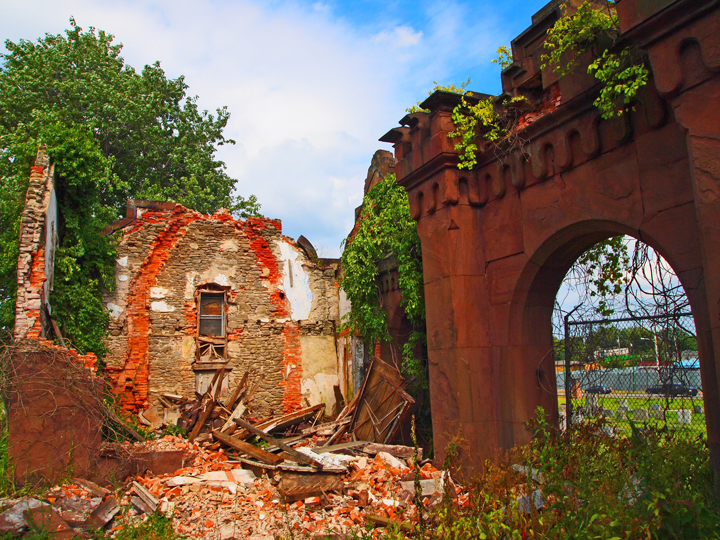
Mount Moriah Cemetery gatehouse, Philadelphia, August, 2016

One of Philadelphia’s historic gems is off the beaten path. It is miles from the Liberty Bell historic district. However, visitors who appreciate American history would do well to make the trek to Mount Moriah Cemetery in southwest Philadelphia. After all, Betsy Ross is buried here.

Photo by Ken Smith, FOMMCI
The cemetery and its 1855 brownstone gatehouse have recently been recognized with official historic status, as you can see from this 2016 plaque. The problem is, Mount Moriah and its gatehouse had been left to crumble since the 1970s. The gatehouse is really nothing more than a façade at this point. The cemetery, by 2011, was an overgrown forest.

Since 2011, an all-volunteer organization, The Friends of Mount Moriah Cemetery, Inc., with help from thousands of volunteers from all walks of life, have been slowly but surely bringing the massive cemetery back from the brink. At a reputed 380 acres (ref.), it is the largest cemetery in the state of Pennsylvania. In 2011, it was no doubt the largest abandoned cemetery in the nation.

The iconic gatehouse, which sits at the original entrance to the cemetery, is of prime concern to the preservation and rejuvenation of the historic cemetery. A large portion of the structure was destroyed by fire decades ago and the walls have literally been tumbling down over the past two years. In 2011, this beautiful piece of architecture was covered with vines, hidden by trees, and filled with old car tires and other trash. One of the Friends board members remarked to me that the vines may have been the only thing holding the gatehouse together.

2012 photo of Mount Moriah Cemetery gatehouse, by Ed Snyder

In 2016, the Friends, in conjunction with the recently-formed Mount Moriah Cemetery Preservation Corporation “...secured a $22,000 grant from the Mayor’s Fund to be used toward the rescue of the gatehouse.” The corporation found a contractor who could do the work for $32,500 and the Friends group led a fundraising effort to make up the shortfall.

Rear of gatehouse, looking toward Kingsessing Avenue

Work began on the stabilization of the gatehouse in the summer of 2016. The photos you see here with most of the final bracing in place, were made in August, 2016.

In 2016, the cemetery and its gatehouse became a recognized landmark by the American Institute of Architects; it is on the Philadelphia Register of Historic Places and has been deemed eligible for the National Register.

Mount Moriah gatehouse, c.1855

While the gatehouse may never be restored to architect Stephen Decatur Button’s original design, the original façade will be preserved. In future, this can perhaps be repurposed as a columbarium, a structure of vaults with recesses for urns containing cremated remains.
-------------------------------------------

For more information and/or to donate to Mount Moriah’s preservation, please see our website:

For up-to-the-minute (literally!) updates on the many ongoing restoration efforts, please see The Friends of Mount Moriah Cemetery, Inc. Facebook Group page.

Monday, June 27, 2016

PPAC 2016 MEMBERS EXHIBITION

JULY 1 – 29, 2016 @ SAVERY GALLERY
ARTIST RECEPTION / July 7, 2016 / 6-8pm
319 N. 11th Street
Philadelphia, PA 19107

Above you see my entry in the annual “Members Exhibition” of the Philadelphia Photo Arts Center (PPAC). It is a first for me (no, I’ve been photographing cemeteries since the late 1990s, smart aleck) – my first publicly hung smartphone image. Seems a bit like cheating, that I didn’t make this image with some super-expensive, high-quality camera. I made it with an iPhone6, which I’ve only owned for six months. Perhaps it is time to stop telling people that I make all my serious photographs with film cameras!

I felt a bit guilty as I delivered the 12-inch square print (made on watercolor paper), archivally matted and framed in a 20-inch silver metal frame, to the exhibition’s curator. As I saw a dozen other people’s work waiting to be hung, I chatted with her about the fact that mine was made with a camera phone. She said she was fascinated by it on the submission site and was looking forward to seeing it in person. We chatted about the improvements in digital imaging technology, but I had to admit to her the main reason I made this image with my camera phone – I wasn’t about to climb over a wall into a graveyard at sunrise toting my Mamiya 645!

So yes, I did exactly that. Climbed a wall and a fence in the wee hours of the morning, into the closed Woodlawn Cemetery in Tampa, Florida. This was at the beginning of June, 2016. I was in town for a conference and was heading back to the airport that morning. Got up extra early and took Uber to the cemetery. I had never been here, and explored the grounds for over an hour – the hour just after sunrise. Imagine my surprise when I found this Victorian lady perched on her marble chair above her own crypt! The rising sun at her back haloed the outline of her statue in a breathtaking manner. The scene screamed, "Monochrome!"

At eight a.m., I called Uber to get a ride to the airport. About ten minutes later a woman of Spanish descent arrived in a late-model black Mercedes. She tentatively rolled down the passenger window as I said hello. As I opened the door, she laughed nervously and said, “I never picked up at a cemetery before. When I got the call, I thought, ‘Even THEY use Uber!'”

So come see my photograph in person, as well as dozens of others by talented photographers who are PPAC members. There is an opening reception, free and open to the public. I’ve reproduced below their announcement of the show from the PPAC website. I particularly like the last line: “As always, this survey of regional photographers will welcome a diverse array of photographic themes and subject matter.” I’m sure every photograph in the exhibit has a story behind it like mine. Come meet the artists and ask them!

JULY 1 – 29, 2016 @ SAVERY GALLERY
ARTIST RECEPTION / July 7, 2016 / 6-8pm
319 N. 11th Street
Philadelphia, PA 19107

Balancing a huge pool of talent with close-knit camaraderie, Greater Philadelphia is a welcoming home for any artist. As members of the Philadelphia Photo Arts Center will tell you, it’s an even better place to be a photographer. To celebrate the talent within our community, PPAC will host our annual Members Exhibition from July 1 to 29, 2016 at SAVERY Gallery. The Member Show opening reception will be held on Thursday, July 7th from 6-8pm. As always, this survey of regional photographers will welcome a diverse array of photographic themes and subject matter.

Saturday, February 20, 2016

Architectural Cemetery Treasure In Danger of Collapse

The Friends of Mount Moriah Cemetery, Inc. (FOMMCI) in Philadelphia currently has a “Go Fund Me” page up on the Internet. The goal is to raise $10,500 to stabilize the façade of the historic 1855 gatehouse facing Kingsessing Avenue at Cemetery Avenue. 

The page was posted on February 15, 2016, and by Saturday, February 20, $11,630 was raised! At that point, 157 people had donated. Here is the link to the page, which is headed by my February 2016 photograph of the gatehouse (the one in the snow, shown above):

Mount Moriah Cemetery gatehouse, Philadelphia, c. 1855.

I spread the call on February 15, all over my own social media sites and those of all my cemetery-lover friends. People on the FOMMCI Facebookpage shared the invitation multiple times. The result is an unqualified success!

Rather than reiterate the purpose of the fundraising program, I will quote the FOMMCI Go Fund Me page. I have included more of my gatehouse photos throughout. Please consider donating to this worthy cause – we greatly appreciate your help!


Architectural Treasure In Danger of Collapse


Historic brownstone Gatehouse designed by Stephen Decatur Button, the architectural designer of the Gettysburg Gatehouse is in imminent danger of collapse. This iconic structure built in 1855 was the grand entryway to the 200 acre Mount Moriah Cemetery located in Pennsylvania's Philadelphia and Delaware Counties. The cemetery was privately owned but it was abandoned in 2011. The Friends of Mount Moriah Cemetery, a nonprofit grassroots organization of determined volunteers immediately stepped in to honor those who are buried in the cemetery's hallowed ground, including over 5,000 veterans.

Inside of gatehouse, showing collapsed internal building (Sept. 2014)

Our goal is to stabilize the facade of the brownstone so that a columbarium for cremains can be built behind it in the future. It will cost $35,000 to stabilize this magnificent structure and we now have $24,500 from a grant and donations. We need $10,500 to keep this treasure from becoming a pile of rubble. We need your help!

Author leading tour in front of gatehouse, 2013.

If our fundraising goal is exceeded, donations will be used for additional Mount Moriah Cemetery capital improvements. Your donation is tax deductible. To learn more about the Mount Moriah Cemetery and the work of the Friends of Mount Moriah Cemetery, visit our website.

Tuesday, October 6, 2015

Friends and Family Day at Mount Moriah Cemetery: Oct. 10, 2015

Philadelphia's Mount Moriah Cemetery celebrates its 160th Anniversary with Friends and Families on Saturday, October 10, 2015 from 10:00 am until 2 pm. The address is 6201 Kingsessing Ave, Phila., PA. Come out and enjoy the day! 

Thousands have helped bring Pennsylvania's largest cemetery back from overgrown abandonment since the Friends of Mount Moriah Cemetery, Inc. began coordinating restoration efforts in 2011. Come out and meet your co-workers! Meet that guy you saw with the chainsaw! What's his deal? Talk with the gal on the riding mower! Meet members of the Friends and the Mount Moriah Preservation Corporation.We all have something in common: the desire to honor and respect those who came before us.

Friends and Families Festival 2013
Friends and Families Day is our way of saying "THANK YOU!" to the thousands of volunteers and contributors who have helped us make great progress at Mount Moriah Cemetery (both Philadelphia and Yeadon sides) throughout the year. Join us as we celebrate the many accomplishments of 2015 on this 160th Anniversary of Mount Moriah (the cemetery was incorporated in 1855).

If you have not been to Mount Moriah for a few months (or more), you will be surprised at how much ground our volunteers have taken back from Mother Nature! entire sections that were overgrown this past spring are now cleared of trees and the grass is mowed! Fall is also a fine opportunity to see and photograph the hidden monuments and other memorials as the foliage begins to disappear. Enjoy the natural setting, see the wildlife and exotic flowers and trees, appreciate the history. Many areas are still overgrown, but soon, you will be able to see through the forest. Oh, and best of all - the deer ticks are gone!

Event Description 

"Friends and Families Day"  

Join us for a celebration of the 160th anniversary of Mount Moriah Cemetery!

Guests include:  
Music by Last Chance (the folk-roots fusion and bluegrass duo of Jack Scott and Ingrid Rosenback)

Kathryn Manz, from the Genealogical Society of Pennsylvania

Arts and crafts for the kids
 
Refreshments

Come out and enjoy the day!

When

Where
Mount Moriah Cemetery - 6201 Kingsessing Ave. Philadelphia, PA 19142  View Map 

Please RSVP here to let us know you plan to attend! 
The Friends of Mount Moriah Cemetery (FOMMCI) Website
The Friends of Mount Moriah Cemetery (FOMMCI) on Facebook 

Friday, July 31, 2015

Shooting Old Graveyards with Old Cameras

What better way to test out a new camera than in a cemetery? And by “new,” I mean new to me. A good friend sold me an old Mamiya 645 Super, a medium format (meaning 120mm film, wider film than 35mm) camera with a 45mm Mamiya lens.

Why Film?
 
"Snyder bought another film camera?!"
Well, until prices plummet, I still cannot afford a full-frame DSLR. As of this writing, they are still at the $5,000 altitude. This is why, a few years ago, I purchased a Nikon F3 film SLR – an absolutely beautiful thirty-year-old camera! And yes, you can still buy most size and speeds of film, and yes, you can still get it processed. (The smart thing to do is to get hi-res scans done of each frame at time of processing – this may double the processing price, but its worth it. Most services will otherwise charge five dollars per frame to scan your images!)

(Philadelphia Photographics is the company I use, by the way, for film processing. They also do mail order and digital uploads.)

So recently, I purchased this five-pound dinosaur of a Mamiya medium format film camera. Why, you ask. Well, to get the resolution of a full-frame DIGITAL medium format camera, you would have to part with quite a few dead presidents. The digital version of the Mamiya 645 is – ready for this? TWENTY-FIVE THOUSAND DOLLARS!! While I could soften the blow and just buy a digital back for my Mamiya at a mere $12,000, I think I shall be content with the wonderful film images this machine produces.

Even though my scanned images in this article may look good, bear in mind that they are only 4MB scans – the original 40 x 56 mm negatives offer infinite resolution. So when you think in terms of a full-frame 50 MP medium format digital camera FOR $25,000 – well, 50 MP is still a far cry from infinite resolution!

Why did I shoot my first photos in a cemetery?

A bit fuzzy, a bit overexposed
To paraphrase artist Georgia O’Keefe, tombstones don’t move and you don’t have to pay the statues modelling fees. Plus, I’ll use any excuse to visit and make photographs in a cemetery! The images you see here are from the first roll of Ilford FP4 Plus, ISO 125 black and white film that I shot in the Mamiya 645. I got fifteen frames to the roll – the images are rectangular versus square, as 120 film produces when used in a Holga. Most images came out well-exposed, though a few are out of focus. I’m thinking the fuzzy ones were more a result of my not holding the camera steady during exposure. I may have to use a slightly faster shutter speed in future. This one at right is also overexposed.

At about five pounds, this camera almost requires a tripod. Even with the handy side grip (which is part of the auto-winder), it’s a bit challenging to keep the camera steady while holding the prism viewfinder up to your eye. There is an optional top-view finder available for the Mamiya 645, but honestly, with my bad back and less-than-stellar eyesight, I think that may not work for me. I’ll just have to make the eye-level finder work. The prism focus aid works pretty well, but split-screens are easier to see.

Mamiya 645 with Canon DSLR (Rebel model)

Here are a couple photos I took to show the relative size of this behemoth – one with the Mamiya 645 next to my Canon Rebel DSLR (above) and one with it next to my Canon G11 DPS* camera. Funny how the G11 is about the size of the Mamiya’s auto-winder handle!

Mamiya 645 with Canon G11

*I call digital point-and-shoots “DPS” cameras in my book, Digital Photography for the Impatient.

When I was making these initial photographs at Laurel Hill Cemetery in Philadelphia, I purposely shot with as wide an aperture as possible on this bright sunny day. I wanted to make the most of shallow depth of field. Shallow depth of field is very difficult to attain with a digital system, unless you have a very expensive (fast) lens. The 45mm Mamiya lens on my camera opens to f2.8, which is the setting at which I made most of the black and white images you see here.

I also wanted to check internal light meter, to see if it was in the ballpark, and it was. I metered off the stone areas that I wanted to be properly exposed. Next time, I’ll meter off the middle gray card my friend gave me with the camera, to see how that changes things.

If, upon reading this, you feel that I adduce a tropism to film in this digital age, you are correct. However, it is not because I am analog-hearted. As I said earlier, film has Infinite resolution, whereas digital JPEGs and RAW files do not. When you produce a print from one of these 120mm negatives, you see the difference. So most of my serious photography is done with film, even in this late year of 2015. Digital, for me, is simply a convenience.

Someday, digital may totally replace film, as soon as high quality image sensors come down in price and are therefore available to the common man. Next up, this common man plans to shoot a roll of 120mm color film in the Mamiya 645 Super as he continues his regression into the dim, dark, and distant past of film photography!