Showing posts with label FOMMCI. Show all posts

Saturday, February 20, 2016

Architectural Cemetery Treasure In Danger of Collapse

The Friends of Mount Moriah Cemetery, Inc. (FOMMCI) in Philadelphia currently has a “Go Fund Me” page up on the Internet. The goal is to raise $10,500 to stabilize the façade of the historic 1855 gatehouse facing Kingsessing Avenue at Cemetery Avenue. 

The page was posted on February 15, 2016, and by Saturday, February 20, $11,630 was raised! At that point, 157 people had donated. Here is the link to the page, which is headed by my February 2016 photograph of the gatehouse (the one in the snow, shown above):

Mount Moriah Cemetery gatehouse, Philadelphia, c. 1855.

I spread the call on February 15, all over my own social media sites and those of all my cemetery-lover friends. People on the FOMMCI Facebookpage shared the invitation multiple times. The result is an unqualified success!

Rather than reiterate the purpose of the fundraising program, I will quote the FOMMCI Go Fund Me page. I have included more of my gatehouse photos throughout. Please consider donating to this worthy cause – we greatly appreciate your help!


Architectural Treasure In Danger of Collapse


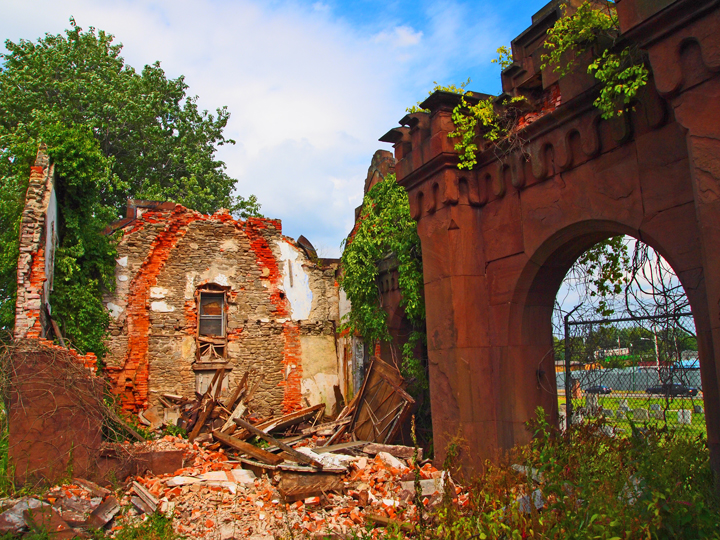
Historic brownstone Gatehouse designed by Stephen Decatur Button, the architectural designer of the Gettysburg Gatehouse is in imminent danger of collapse. This iconic structure built in 1855 was the grand entryway to the 200 acre Mount Moriah Cemetery located in Pennsylvania's Philadelphia and Delaware Counties. The cemetery was privately owned but it was abandoned in 2011. The Friends of Mount Moriah Cemetery, a nonprofit grassroots organization of determined volunteers immediately stepped in to honor those who are buried in the cemetery's hallowed ground, including over 5,000 veterans.

Inside of gatehouse, showing collapsed internal building (Sept. 2014)

Our goal is to stabilize the facade of the brownstone so that a columbarium for cremains can be built behind it in the future. It will cost $35,000 to stabilize this magnificent structure and we now have $24,500 from a grant and donations. We need $10,500 to keep this treasure from becoming a pile of rubble. We need your help!

Author leading tour in front of gatehouse, 2013.

If our fundraising goal is exceeded, donations will be used for additional Mount Moriah Cemetery capital improvements. Your donation is tax deductible. To learn more about the Mount Moriah Cemetery and the work of the Friends of Mount Moriah Cemetery, visit our website.

Sunday, March 15, 2015

Mount Moriah Cemetery - A Winter Wonderland

For most people, a walk through a winter wonderland would not involve an old graveyard. Luckily for you, I’m not most people. When it snowed ten inches in Philadelphia in early March, the first place I wanted to see under a blanket of snowy-white frosting was Mount Moriah Cemetery.

Straddling Philadelphia and Delaware counties in the cities of Yeadon and Philadelphia, Pennsylvania, Mount Moriah is a previously neglected and abandoned, several-hundred acre Victorian-era cemetery. It has been recently adopted by the volunteer group Friends of Mount Moriah Cemetery, Inc. and is presently being maintained and restored through the herculean effort of thousands of volunteers. The legal entity Mount Moriah Cemetery Preservation Corporation has even more recently (2014) been appointed the legal responsible party for business operations. (You can read more about this at the link at the end, but for now, back to the snow. 

Yeadon, PA side of Mount Moriah Cemetery
At ten inches deep, walking through the cemetery was not a walk in the park (although in Victorian times, cemeteries were the only parks available to the public!). This was going to be a challenge, as the roads are not plowed and walkways are not shoveled. (Although the property is now the legal responsibility of the court-appointed and newly-formed
Mount Moriah Cemetery Preservation Corporation, funds have yet to be identified for ongoing routine maintenance, security, and regular staffing.) In order to not exhaust myself and my limited time, I had to decide what area of the cemetery would provide me with the most picturesque results with the least amount of hiking. I chose the Yeadon side, as it has a circle of grand old mausoleums up on a hill.  

Mausoleum rooftop beyond the snow

I trudged through the snow in the torrential sunshine (though it was only about twenty-three degrees), thinking how much the landscape reminded me of Aspen, Colorado in the winter. With light puffy snow on all the tree branches, it all looked bucolic indeed. My super literary abilities failed me and I was rendered speechless (but fear not – I have retained my acerbic wit and power to forget peoples’ names!). The beauty of this place created for me as spiritual an experience as may indeed be possible at this late date. 

The sky was blue and cloud-free. On a day like this, attention is riveted to detail: detail as audacious as the bright sun playing on the glistening ice that hangs from the roofs of the grand Victorian mausoleums; detail as subtle as the swirls made by this flag as the breeze blew it around. I spent about an hour climbing over the drifts and buried granite coping behind the mausoleums, making photographs of the brilliant decay. Yes, the mausoleums are in this condition because of years of neglect and vandalism. Graffiti defaces a few, while all have their doors and windows bricked up. However, like most other things, snow tends to cover up a multitude of sins and makes everything look clean and pure. I decided to walk around the hill behind the mausolea to one of my favorite spots.


There were some people tracks heading toward the area in which I was interested, so perhaps others recently had the same idea. The snow was a nuisance to walk through, but I’d much rather be walking through it making photographs than shoveling it – which is what I had been doing recently. This was a welcome respite from the last two dreary days during which schools were closed due to all the snow that fell during a 24-hour period.

Footprints in front of the Maull family plot, Section 141, Mount Moriah Cemetery

The road along the front of the mausolea takes you up the hill to an area replete with elaborate granite monuments, obelisks, and family plots - many of them in the woods. One of my favorite sites (and sights) at Mount Moriah is the Maull family plot. It is relatively easy to get to, as the roadways, though overgrown and grassy (no vehicular access), are perfectly walkable. That said, it is quite off the beaten path and not usually seen by casual visitors. If you read my blog, you know full well that I am not a casual visitor!

Maull plot after a snow, early March, 2015

The Maull plot is singular in that it has two Japanese maple trees growing in it. Their twisting branches are covered with flaming red and orange leaves in the fall. The scene is made quite picturesque as the leaves frame the headstones and monuments in the plot. In winter, all these shapes, covered with snow, provide a myriad of photographic choices. You just cannot take a bad photograph here – it’s like shooting a supermodel! Well, it is now, anyway. Not quite a supermodel up until recently. In addition to clearing the plot so visitors can have better access, the Friends volunteers have also removed the unsightly graffiti from the back of the plot's large central monument!

Graffiti removed from monument at Mount Moriah Cemetery

Japanese maple tree
I walked around and finally through the plot, making photos from various vantage points, with different cameras. I was careful to work my way into the plot slowly, to ensure I did not deface the snowscape with my footprints until I exhausted all possibilities before me. I walked out of the plot onto the main road and was a bit startled to see a gentleman walking toward me. He had two cameras around his neck. After hellos and introductions, it turned out that he was none other than local photographer David Huisken, who has posted many of his photos of the Maull plot on Facebook. It was great to meet someone with common interests, even if one is as seemingly bizarre as sharing a “favorite” spot in a cemetery!

I must say, however, that as I left David, I felt a bit guilty that I made all those footprints in the area he came to photograph! He had, however, already made some wonderful images down near Cobbs Creek, which separates the cemetery's Yeadon side from its Philadelphia side. This image below (which David graciously let me publish here) captures the beauty of Mount Moriah with no grave stones in the scene at all - a novel approach! This area along Cobbs Creek Parkway is part of Philadelphia’s Fairmount Park (at over 9,200 acres, Fairmount Park is one of the largest urban green spaces in the United States).


Cobbs Creek at Mount Moriah Cemetery, Philadelphia (photo by David Huisken)

I write this a few days after my walk through Mount Moriah. It is fifty degrees and the snow is gone. It has turned to water which will serve to boost plant growth and swell Cobbs Creek. Looking at David Huskein’s wonderful image of the creek and the Philadelphia side of Mount Moriah, you’d hardly guess that he was standing at the mangled rusty guardrail alongside the gritty, grimy parkway when he made his photograph. Snow does cover a multitude of sins and offers us beauty, if just for a short while.

So if you’ve ever wanted to visit the stunning beauty that is Mount Moriah Cemetery, now is the time to go. Winter is great since all the foliage is dead and you can see the monuments and gravestones through the trees. Thanks to the efforts of hundreds of volunteers, you now have much greater access to all parts of the cemetery. However, since only about thirty percent of this hundred-acre wood has been cleared and is regularly maintained, the greater portion of the grounds will quickly be overgrown with greenery come spring. 

References and Further Reading:
The  Friends of Mount Moriah Cemetery, Inc. website
The  Friends of Mount Moriah Cemetery, Inc. Facebook Group Page

Saturday, November 22, 2014

A Cemetery and its Friends


Recently a student from Philadelphia’s Temple University wrote a blog about her experience volunteering to help clean up at Mount Moriah Cemetery (Philadelphia and Yeadon, PA). I was struck by how well-written and on point she was, in explaining what some people find so appealing about volunteering to help maintain cemeteries. I want to share her perspective with you through The Cemetery Traveler. (The link to her blog can be found at the end.)

I’ve been volunteering at Mount Moriah myself for a few years, as part of the Friends of Mount Moriah Cemetery, Inc. (FOMMCI), and I have my own reasons for doing so. Alyssa, the Temple student, volunteered as part of the university’s civic engagement program. I’m not sure she expected the experience to be so profound. Thousands of students have taken part in this sort of community volunteer program since the FOMMCI started it in 2011, and it is obvious that many are affected in the same way Alyssa was. I’ve spoken to a number of them during cleanup events, and many share her experience.


As part of a hard day’s work, she states, “It was amazing to uncover tiny grave stones and large markers and even more thrilling to see the size of the space we helped to bring out from underneath the mess of tangled vegetation. It was also great — after learning more about the context of the cemetery clean-up — to think about the people that were buried there and know that we were helping families rediscover or simply have the ability to locate and visit deceased family members.”

Mount Moriah is at this point still about seventy-five percent overgrown with trees, vines, and other flora. Alyssa describes the situation clearly when she states, "Tombs were entombed again in brush and trees: a layer of time measured in yards of vegetation.” The cemetery is huge, recently abandoned (2011), and more recently put back on track (Sept. 17, 2014) with the legal appointment of the Mount Moriah Cemetery Preservation Corporation as receiver of the property (which now has legal custodial responsibility). However, until funding is appropriated as part of the overall plan to maintain the cemetery, Mount Moriah is still greatly dependent on volunteers.


Please check the FOMMCI website for future cleanup and restoration events. You simply cannot foresee how being part of such a community effort can benefit so many – yourself included. Also, now that it is cold out, the vegetation has mostly died and you can see much more of the cemetery than you can in summer. Come and visit! Both the Philadelphia and Yeadon sides are open from 9 a.m. to dusk.

**************************************************
Alyssa's blog, "Mount Moriah: A Cemetery and Its Friends," can be read here.
The Friends of Mount Moriah Cemetery, Inc. website
The Friends of Mount Moriah Cemetery Group on Facebook

Saturday, September 13, 2014

Houdini and Victorian Magician Robert Heller

With the popularity of the current television series, Houdini (The History Channel), I thought I would mention one of Harry’s predecessors. Robert Heller was a Victorian-era magician. He also happened to be an idol of Harry Houdini’s. Houdini, who reached his prime after 1900, referred to Heller as the most versatile magician who ever lived.
Robert Heller (1826 – 1878), whose real name was William Henry Palmer, is buried in Philadelphia’s Mount Moriah Cemetery (on the Yeadon, PA side). I visited his grave last year. Doesn’t sound like much of a feat, given the fact that I only live ten miles away! However, for many years, his headstone was missing. Not the act of a conjurer, but rather ground subsidence, or maybe vandalism. A group of magic historians had been trying to locate it for the past several years, no doubt to pay homage to the person who single-handedly popularized theatrical magic in America.

Houdini at Heller's grave, Mount Moriah (ref.)
Around the time (2011) that the Friends of Mount Moriah Cemetery, Inc. (FOMMCI) began restoration efforts at this massive, formerly abandoned cemetery (the largest cemetery in all of Pennsylvania, at 380 acres), interest in Heller’s grave was renewed. The grave had actually been lost and found and lost and found a number of times since Heller’s death in 1878. Harry Houdini himself found it around 1910 (here’s a photo of him standing next to it). After that, it disappeared (fell over and was covered with weeds) until Donna Morelli found it again over a hundred years later, in 2013.

Heller's grave site in 2011 (from "The Magic Detective" blog)
Donna (on Facebook, The Haunt of Mount Moriah) is a board member of the Friends of Mount Moriah Cemetery, Inc. After running across the photo of Houdini next to Heller's grave on the Internet, she and other volunteers located the plot through burial records and old plot maps (Section 135, Lot 189). The section of the cemetery in which Heller’s grave resides looked like this at the time (see above photo, which I borrowed from Dean Carnegie’s blog, “The Magic Detective”).

In the fall of 2013, Donna and Board Treasurer Ken Smith cut back all the weeds and trees around the grave, and raised Heller’s headstone from the earth. Section 135 is an area of the cemetery that had probably not been maintained by the previous cemetery owners since the 1960s. Now it has been cut back, cleared of weeds and is regularly mowed. (You can see the current state of each section in this landscape plot map; Section 135 is at far right, center.) In fact the FOMMCI, with its thousands of volunteers on regularly-scheduled cleanup days, are only able to keep about 25% of the 380-acre cemetery grounds maintained (this will change soon, as cemetery ownership is expected to be transferred from the defunct original association to a new corporation).


A few weeks after Heller’s headstone was raised and reset, I visited the grave site. Ken Smith had conscientiously cleared a path the width of a car lane back from the main road of the cemetery to the outer reaches of the northernmost end so people could gain access to the site. Which is not to say I did not have some difficulty finding it! A plot map is wonderful (you can see them on the FOMMCI website), but it’s not very easy to get your bearings in an old overgrown cemetery. For one thing, section markers may be missing or hidden by weeds so you cannot even tell where the corner of a section is! Once you’re in a section, you need to count out the plots to get to your destination. That said, if the entire section is overgrown or grave markers are missing, the task becomes exceedingly difficult.

The northern end of Mount Moriah is so overgrown currently that if not for the old roads bordering the sections, it would be impossible to guess where one section began or ended. Turned out that I initially mistook Section 132 for 135 and spent an hour crashing through a dense thicket of small trees and eight-foot tall Japanese knotweed stalks looking for a headstone the shape of the one in the Houdini photo. I didn’t realize at the time that Ken had cleared a path directly to the Heller headstone – you couldn’t actually see Section 135 from 132 through the thicket. Bear in mind that I was there in the fall, when visibility through the foliage is at its best!

After some persistence, however, I located Section 135. In a small cleared area of 135 bordering Section 137, I found the stone in question. It really is like finding buried treasure, when you find a grave marker that no one has seen for decades or more. When I also realized that I was standing in Harry Houdini’s footsteps, I had to set up my camera and take a picture. I must say it gave me an odd feeling, like it was standing in a sacred place. I suppose all graves are, or should be, anyway.

It is interesting to note that Houdini himself was dismayed at the condition of the cemetery, and especially Heller’s grave, when he visited around 1910. At that time Mount Moriah had been in existence for 55 years. Apparently, conditions were bad at that point. By the 1960s, cemetery conditions worsened, and reached a deplorable state in 2011 when the FOMMCI took over and began to organize massive clean ups and restoration events.

So why all the fuss about clearing Heller’s grave? Who ever heard of him, anyway? Isn’t Houdini the superstar? Well, yes, but everything has a history, including magic as popular entertainment. In the blog, The Magic Detective, author Dean Carnegie offers:

Rober Heller (ref.)
“What affect did Heller have on the world? For one, according to drama and theatrical people of the time [1860-1870s], it was Heller that put conjuring in a new light for American audiences. In the way that Robert Houdin modernized magic for his period by changing his costume and bringing magic indoors, Heller did a similar thing in America by adding other elements such as comedy and music. I'm sure his affect was felt all over the globe when he performed.”

Robert Houdin? Who was he and why does that name sound so much like “Houdini?” Harry Houdini was in fact the stage name of one Ehrich Weiss. Like William Henry Palmer, who adopted the stage name “Robert Heller,” Weiss  changed his name to “Harry Houdini.” The name "Houdini" was a nod to the French magician, Jean Eugène Robert-Houdin, who was famous in the generation prior to Houdini’s. Apparently Robert-Houdin was quite influential, as Robert Heller actually changed professions in 1848 from professional musician to professional magician after seeing Robert-Houdin perform! (In 1874, when Houdini became more experienced and famous, he wrote a book debunking Robert-Houdin, called The Un-masking of Robert-Houdin! Robert Heller, however, was always held in high esteem by Houdini.)

Heller moved from Britain to America in the 1860s, where he began his successful career as a magician. “At first an imitator of his more famous contemporaries,” says the Encyclopedia Britannica,  “Heller eventually emerged as an entertaining and witty performer whose most famous act was a second-sight (mind-reading) presentation."

Promotional poster from Robert Heller's theatrical performance (Ref.)


Speaking of “second sight,” when I finally located Heller’s grave, I was a bit taken aback by what appeared to be a crystal ball on the ground nearby. Upon further investigation, however, it was merely a granite decorative sphere from a neighboring plot, which had probably fallen off an old gate post. Heller’s grave site, as well as the area immediately surrounding it, is not pretty. The ornamental grave plot fencing is long gone (seen in the vintage photos of Houdini at the grave). A rusting wreck of an old truck sits nearby – the last one still to be removed from the old cemetery. Trees, vines, and knotweed grow wild outside the cleared area, headstones have fallen. While the FOMMCI and thousands of volunteers routinely perform amazing feats of magic in keeping the flora under control, there is so much more to do!

Houdini at Heller's grave, c. 1910 (Ref.)
If any magic aficionados, historians, or magicians themselves are reading this, come to the next cleanup day at Mount Moriah Cemetery and lend a hand! Help us preserve the history of the person Harry Houdini called (in his Conjurer's Monthly Magazine) "the most versatile magician who ever lived." So while we must thank Friends Donna Morelli and Ken Smith for reintroducing Robert Heller to a new generation, let us not forget that “Had it not been for Houdini, the whereabouts of Heller's grave would likely be lost forever because it was Houdini who had rediscovered the grave." (ref.)

How to Help:
The Friends of Mount Moriah Cemetery is a 501(c)3 nonprofit organization dedicated to the preservation and promotion of Mount Moriah Cemetery by honoring the memory of those interred here through community engagement, education, historic research, and restoration. For a schedule of cleanup days, click here! All are welcome to attend any cleanup event!

References and Further Reading:

Read more about Robert Heller on the FOMMCI website