Showing posts with label Temple University. Show all posts

Sunday, April 13, 2025

More Graves Unearthed on Temple's Campus

On April 11, 2025, the news announced that coffins and human remains were found during excavation for a new building on the Temple University campus in Philadelphia. Temple supposedly expected this. And they should have, since this former parking lot at Broad and Berks Streets had been home to 28,000 graves. Its kind of odd how NBC reports that the bodies were relocated in the 1950s to Lawnview Cemetery in Rockledge, a northeast Philly suburb. Well, obviously not all the bodies. The gravestones were not relocated there – they were dumped into the Delaware River.

Gravemarkers along the Delaware River, under Betsy Ross Bridge

Like so many other sites in Philadelphia formerly occupied by burial grounds, buildings that require deep foundations are seldom constructed. Guess why. Typically, a playground, ball park, or a parking lot is built on the land. Temple shelved plans for building a new football stadium where their Geasey Field is, most likely, because they were afraid to unearth graves. That complicates things. The current excavation has stopped. Temple was prepared, says the news, and immediately brought in the police, Philadelphia Coroner’s Office, a medical examiner, and an archeologist. 

Slogging around in the mud at the site I really had a sense that I had trodden on sacred ground. When we bury our people, we are bequeathing their remains to the earth. Handing it down, so to speak, in a reverent manner. This is not like throwing out the trash. When a cemetery is vacated, repurposed, not everything can be removed. It is just not possible. Remnants, no matter how small, remain. Bone fragments, coffins. 

When I reached into the mud to pick up a few pieces of the stone that had been broken away from the old cemetery wall, there was mud all over my hands. I got a jarring feeling as it covered my fingers – this is the same soil that held 28,000 bodies in 1956. 

Its like what Mark Twain said when he visited the Holy Land in 1867: you don’t need to be a Christian to realize and respect that something significant happened here. 

Current construction showing cemetery wall that borders North Broad Street

Why has Philadelphia abandoned and moved so many cemeteries throughout its history? We put forth great effort to memorialize ourselves, only to find that our monuments to immortality have not stood the test of time. As the city grew, cemeteries were unceremoniously destroyed. People actually now make stipulations in their burial contracts that their remains shall never be disturbed. There are, however, some recent and ongoing success stories in and around Philadelphia, where faltering cemeteries have been stabilized and restored by volunteers. Is it because we now care more than we used to?

Barnes and Noble link to preorder 
I cover many of these topics in my new book, Abandoned and Forgotten Cemeteries of Philadelphia and its Environs (Fonthill, 2025). In fact, what happened to Monument Cemetery is covered in great detail, with many photos of the gravestones under the Betsy Ross Bridge. One of them graces the cover of the book. (You can preorder the book from Amazon here - publication June 30, 2025.) In addition to the removal of cemeteries, the book – and upcoming public presentations –  will focus on recent discoveries, the frequent accidental unearthing of human remains, genealogical challenges, and the 200 unmarked burial grounds that silently sleep under Philadelphia’s streets, parking lots, and playgrounds. Ben Franklin said, “Show me your cemeteries and I will tell you what kind of people you have.”  

It will be interesting to see how this situation at Temple plays out. The coffins and bones were found about six feet below the surface of the original parking lot. As we all know, burials can be stacked. There could be layers of coffins deeper down. I am curious about Temple’s “protocol,” as they call it, for when human remains are found. I am curious about Temple’s “protocol,” as they call it, for when human remains are found. In Philadelphia, if the remains are found on private property, the landowner (in this case Temple University) does not own any human remains interred in that land. Under Pennsylvania law, such remains are under the control of next of kin/descendants and the courts. In this case, one would expect that Temple would have needed a court order to disturb these burials.

Original cemetery gatehouse on Broad Street

The plot of land where the discovery was made is to be the future home of Temple’s Klein College of Media and Communication, with planned completion in 2027. I wonder if the cemetery wall will remain, which still borders Broad Street? (You can see the wall in the gatehouse lithograph at left.) Current Temple students being interviewed find this all rather spooky. One student states that it's a weird history for a building where students will have to take classes. They will know that the building was constructed over a cemetery, and they did not remove all the bodies. Obviously the developer never saw the movie, Poltergeist.

As Temple’s online newsletter states, “This is a developing story, check back for updates.” (Click here for CBS News video.)

+++++++++++++++++++++++++++++++++++++++++++++++++++++++++++++

Please visit my previous posts on The Cemetery Traveler to read the history of Monument Cemetery, including its destruction and aftermath:

https://thecemeterytraveler.blogspot.com/2011/04/watery-remains-of-monument-cemetery.html

https://thecemeterytraveler.blogspot.com/2011/05/how-monument-cemetery-was-destroyed.html

https://thecemeterytraveler.blogspot.com/2012/03/beachcombing-in-hell-gravestones-of.html 

Sunday, December 13, 2015

Union Cemetery Has Gone Missing ...

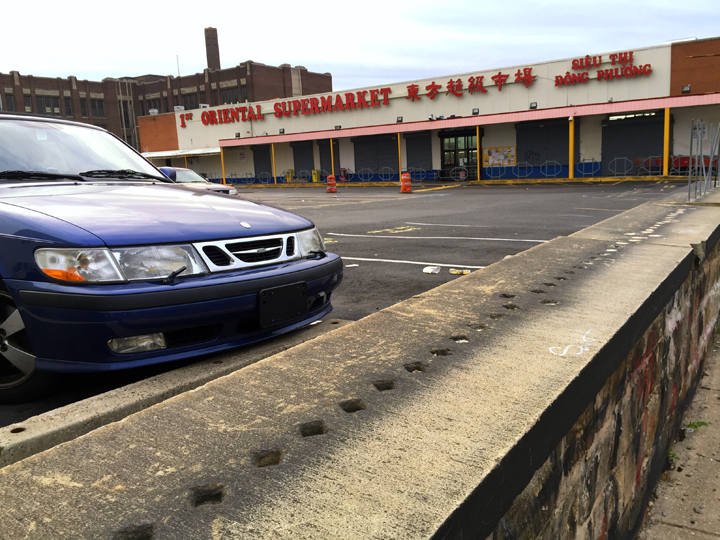
Here’s a short blog on an odd little situation I just discovered. I live in South Philadelphia near Third Street and Washington Avenue. At Sixth Street and Washington Avenue (running to Federal Street), there used to be a cemetery. It was called the Union Cemetery. The City of Philadelphia “removed” the cemetery around 1970 to further develop the commercial business corridor along Washington Avenue.

I have driven past the particular Asian supermarket you see in the photo above, which is at Sixth and Washington (Federal Street is behind it). I have driven past it hundreds of times since moving to the neighborhood in 2008. Until a few weeks ago, I had no idea that the stone wall along Sixth Street (on the south side of Washington) is the ACTUAL stone retaining wall of the Union Cemetery! Complete with holes in the granite top where the iron fence was anchored!

It is no wonder they would they destroy a cemetery to build a parking lot, but why KEEP the original retaining wall? If you’re expecting to find the answer here, you may as well stop reading – I don’t have it. There is quite a bit of information (and photos, as bizarre as that is!) on the cemetery’s demise all over the Internet, but I could not find out much about the wall. I suppose it will remain just one of those odd little cemetery facts.

Union Cemetery wall with fallen fencing, c. 1970 (Ref. 1)

I will quote a few of these sources and you can see more of the historic photos at the link to the Temple University Archives (at end). Temple, by the way, is no stranger to cemetery destruction. They conned the City of Philadelphia into condemning the city’s second Victorian cemetery in 1956 so the university could build a you guessed it – a parking lot. (Read more about that on my blog post, "How Monument Cemetery Was Destroyed," at the link at the end.)

Picking through human bones during excavation of Union Cemetery, c. 1970 (Ref. 2)

Historic map of South Philadelphia's Union Cemetery (Ref. 4)
But back to the little ol’ Union Cemetery, the graveyard in the Southwark section of Philadelphia which occupied land about the size of half a city block. The name "Union," perhaps, may have sprung from the fact that a union, or association, of people established it in 1841. Ironically, 100 Civil War soldiers - mostly Union Army veterans, I suppose - were later buried here. Where are they now? Under the parking lot of the Asian supermarket? Supposedly not. Above you see a photo of a young man picking through the bones in 1970 so they could be reinterred, in a mass grave, I expect, in Frazer, PA – a distant suburb of Philadelphia . Get those dead as far away from the living as possible! Make way for progress!

Original entrance gate from Union Cemetery resides at Philadelphia Memorial Park in Frazer, PA. (Ref. 1)

From the Find A Grave website (Ref. 1):

"The Union Burial Ground was located at the NE corner of 6th and Washington; Federal Streets in South Philly, was incorporated in 1841 as an "association" cemetery, catered to the poorer residence who as association members could obtain a decent family plot for $10.00. This cemetery was called Sixth Street Union to differentiate it from another Union Burial Ground at 10th and Washington Avenue. In 1970 the cemetery which contained the graves of over 100 Civil War Soldiers and Sailors and their families was neglected and vandalized. That same year the site was sold for use as a supermarket. About 2,000 graves were dug up, the remains boxed and then reburied in Philadelphia Memorial Park in Frazer, Chester County."
Casual onlookers during the demise of Union Cemetery, c. 1970 (Ref. 3)
 

Union Cemetery's decline began at the end of the nineteenth century, as the area's residents began to move away, edged out by commercialization. With no close relatives living nearby to care for the graves, the cemetery went to ruin (Ref. 4). As I said, by 1970, it was gone - gone, that is, except for one of it's retaining walls. Perhaps it was left intentionally as a reminder to future generations - a reminder of the ground's sacred past, or perhaps our callous handling of the dead.

Saturday, November 22, 2014

A Cemetery and its Friends


Recently a student from Philadelphia’s Temple University wrote a blog about her experience volunteering to help clean up at Mount Moriah Cemetery (Philadelphia and Yeadon, PA). I was struck by how well-written and on point she was, in explaining what some people find so appealing about volunteering to help maintain cemeteries. I want to share her perspective with you through The Cemetery Traveler. (The link to her blog can be found at the end.)

I’ve been volunteering at Mount Moriah myself for a few years, as part of the Friends of Mount Moriah Cemetery, Inc. (FOMMCI), and I have my own reasons for doing so. Alyssa, the Temple student, volunteered as part of the university’s civic engagement program. I’m not sure she expected the experience to be so profound. Thousands of students have taken part in this sort of community volunteer program since the FOMMCI started it in 2011, and it is obvious that many are affected in the same way Alyssa was. I’ve spoken to a number of them during cleanup events, and many share her experience.


As part of a hard day’s work, she states, “It was amazing to uncover tiny grave stones and large markers and even more thrilling to see the size of the space we helped to bring out from underneath the mess of tangled vegetation. It was also great — after learning more about the context of the cemetery clean-up — to think about the people that were buried there and know that we were helping families rediscover or simply have the ability to locate and visit deceased family members.”

Mount Moriah is at this point still about seventy-five percent overgrown with trees, vines, and other flora. Alyssa describes the situation clearly when she states, "Tombs were entombed again in brush and trees: a layer of time measured in yards of vegetation.” The cemetery is huge, recently abandoned (2011), and more recently put back on track (Sept. 17, 2014) with the legal appointment of the Mount Moriah Cemetery Preservation Corporation as receiver of the property (which now has legal custodial responsibility). However, until funding is appropriated as part of the overall plan to maintain the cemetery, Mount Moriah is still greatly dependent on volunteers.


Please check the FOMMCI website for future cleanup and restoration events. You simply cannot foresee how being part of such a community effort can benefit so many – yourself included. Also, now that it is cold out, the vegetation has mostly died and you can see much more of the cemetery than you can in summer. Come and visit! Both the Philadelphia and Yeadon sides are open from 9 a.m. to dusk.

**************************************************
Alyssa's blog, "Mount Moriah: A Cemetery and Its Friends," can be read here.
The Friends of Mount Moriah Cemetery, Inc. website
The Friends of Mount Moriah Cemetery Group on Facebook

Thursday, May 3, 2012

2nd Anniversary of "The Cemetery Traveler!"


Well, it’s been two years since I began writing The Cemetery Traveler blog. That’s most of my two-and-a-half year-old daughter’s lifetime – a fact that puts all that work into startling perspective for me. I’ve posted 120 articles and have 144 regular subscriber/followers. I greatly appreciate the fact that you’re reading this and hope you will continue. 

Daughter Olivia at Laurel Hill Cemetery
After 120 blog postings, you might think I’ve run out of material, especially since these postings have not been just a photo and a few sentences. They’ve been more substantial than even I expected they would be. The articles began as short pieces, but then the content took on a life of its own. I began to get carried away – the blogs started to read like mid-career Dickens. Frankly I’m surprised they held peoples’ attention. But readers responded. In blog comments and private emails, they expressed opinions. Many of the most commented-on pieces were about abandoned cemeteries.

When I started The Cemetery Traveler, my intent was mostly to recount my past experiences traipsing through the graveyards of America (and Europe), camera in tow. However, through Facebook I’ve encountered new ideas, new friends, and made new excursions. I’ve written (or will write) about a variety of people with whom I’ve had interactions in reference to my blog – a psychic, a film maker, descendants of people whose graves I’ve photographed, Andy Warhol’s niece and nephew, Victorian-era and Civil War re-enactors, and fellow writers. I’ve also met new companion adventurers (or ‘gravers,’ as we’re sometimes called!).


Ed's photograph in "175 Years of Reflections"

On rare occasion, I actually wrote about photography (e.g. my blog about ‘painting with light’ in a cemetery at night). This past year saw the publication of the book, 175 Years of Reflections, Laurel Hill Cemetery, which one of my photographs was chosen to be in. The book celebrates Philadelphia’s Laurel Hill Cemetery and its 175th anniversary.

Abandoned Cemeteries

Probably one of the least expected results of the The Cemetery Traveler blog has been my interest in helping to restore abandoned and run-down cemeteries around Philadelphia .

Mt. Moriah Cemetery, Philadelphia
Initially, I started exploring and photographing them like they were carnival sideshow attractions. However, my postings generated quite a bit of heated discussion, mostly from the “how could they let this happen” crowd, but also from descendants of people buried in those cemeteries! I received messages like this (related to Philadelphia’s gigantic abandoned Mt. Moriah Cemetery):

"Mount Moriah holds different emotions for different people. I have family here. As a child in the 70s, I actually played and rode my bicycle with my friends in this place. The people buried here need people to speak for them and try to undo the damage that has been done to them. Help us to do that with your lens. And if you are adventurous, come to a clean-up. They are inspiring and lets those buried here that someone still gives a damn."

Primarily as a result of people commenting on my blogs, I have participated in several clean-up days, and the comment is correct – the work is inspiring.

Tombstone under Betsy Ross Bridge
I also received many comments and emails about the destruction of Monument Cemetery (Philadelphia, 1956), and the unceremonious dumping of its thousands of headstones into the Delaware River. I received dozens of emails from descendants, looking for traces of their ancestors. The stones can still be seen under the Betsy Ross Bridge (at low tide), so I photographed them, and added the names, dates, and photos of the stones to the online database at FindAGrave.com, as suggested by one reader, whose initial comment to me was:

"While their graves may never be found, their information would be of great interest to family, historians, and genealogists."

The majority of comments  related to the destruction of Monument Cemetery were of this nature:

"I came across your site while trying to locate this cemetery so I could visit my ancestors' tombstones, as many of them were buried at Monument. I feel a bit sick realizing they're now in a mass grave and their tombstones have been dumped like this."

"I join many of those who are horrified that this could have happened in Philadelphia during the 1950's.  It seems so disrespectful and almost sinister in that advertisements were not required to be made in the newspapers if relatives could not be reached.....I think my family, especially my grandmother would have rallied the family (a large one) to relocate the graves of her mother, aunt and grandparents.  I gave a presentation of our family history at our reunion a year ago and my generation was horrified at what we discovered about the cemetery."
  
Opinions on the travesty of Monument Cemetery ran to the other extreme as well:

"I understand that moving a cemetery for parking seems crass, but the world belongs to the living and the not-yet-living - and Temple [University] has been and remains the most-affordable, best-hope for higher Education in Philadelphia. Isn't that worth more than a decaying cemetery?"

Some people were upset that I wrote about the cemeteries in their neighborhoods in a sensationalistic way. It got peoples’ attention, though, didn’t it? I am sure it helped with public awareness and the need to restore, rehab, and care for what we have.

What’s on The Cemetery Traveler’s  event horizon?

So what is on The Cemetery Traveler’s event horizon for "Year Three" of the blog? Well, a few things.

  • Publish a book of selections of essays from The Cemetery Traveler blog. I expect this to be available in about six months, with eBook versions on Nook  and Kindle. I have to thank the observant reader who commented on this photo a while back, “This photo screams ‘Book Cover’!”
  • Pay closer attention to comments made and emails sent by my readers, as your feedback adds another dimension to my writing. That said,  I’ve not been prompt with my replies. I’ll do better – or at least the best I can with two-and-a-half year-old vying for my attention! 
  • More travel! I plan to have a vendor table at the AGS (Association for Gravestone Studies) Conference in West Long Branch, New Jersey on June 22, 2012. Hope to become a member and interact with the conference attendees. I’m also planning to visit some of the historic cemeteries in Charlotte, North Carolina next month.
In Conclusion…

An advantage the living have over the dead:  we can go to sleep at the end of a long day, then wake up and do it all over again. So, shall I keep on writing? In the words of author/screenwriter S.J. Perelman, “To the fiery temperament, decision is consonant with action.” In other words, I intend to continue shooting off my mouth without thinking. Stay tuned – all shall be revealed.

Friday, March 16, 2012

Beachcombing in Hell – The Gravestones of Monument Cemetery


Well this is a new experience for me – I just uploaded twenty-five names and dates to the website "FindAGrave.com" for Philadelphia’s defunct Monument Cemetery. I’ll add photos of the headstones this week. 

I recently found myself in a strange situation - well, stranger than usual. After publishing two blogs last year about the remains of Philadelphia’s aforementioned (demolished) 28,000-grave Victorian-era cemetery, I received an overwhelming number of comments and questions. These ranged from anger and indignation at the very idea of paving over a cemetery, to pleas from readers looking for traces of lost ancestors. 

I’m not going to dwell on the how’s and why’s of that situation for this blog - you can read about all that in my previous postings (The Watery Remains of Monument Cemetery [April  2011] and How Monument Cemetery was Destroyed [May 2011]). The short story is that in 1956, Monument Cemetery was condemned and leveled by the City of Philadelphia so that Temple University could build a parking lot. Thousands of monuments, tombstones, and other grave markers were dumped into the Delaware River, later used as part of the foundation for the Betsy Ross Bridge. The human remains were re-interred in mass graves at Lawnview Cemetery, in the northeast section of the city.

Comments on my postings ranged from intense moral outrage to defense of the project by Temple sympathizers. There were questions about how to access the cemetery records (as I had done) at the Historical Society of Pennsylvania, and there were people wondering if I photographed any of their ancestors’ headstones. Regardless of your position or interest level, this heap of marble and granite at the river’s edge tells a very human story.

From a memorial at Lawnview Cemetery, Rockledge, PA
When I received the following comment from a reader, I realized that people might be interested in the names and dates on the stones piled under the bridge:
While their graves may never be found, their information would be of great interest to family, historians, and genealogists.
Betsy Ross Bridge
At one point during the year, a Facebook friend of mine posted three of my photographs on the “Find A Grave” website (which boasts records of 77 million grave records worldwide). To my surprise, someone had already taken the time to log in 747 names of those buried in Monument Cemetery, but unlike those of most other entries, none of these included a photograph of the gravestone.

Frankford Creek enters Delaware River
Therefore, I decided to make another trip, for the sole purpose of recording names and dates, and uploading them to “Find A Grave.” Names and photographs are important to people, they are tangible links to the past. So at the beginning of March, 2012, I trekked out to the Bridesburg section of Philadelphia near the Tioga Marine Terminal on the Delaware River.

To be honest, my first visit to the water’s edge was to gawk at the piles of tombstones like they were some sideshow attraction. Many people have. I even received one email from people who had “reached it via jetski rather than by land” - an adventure outing.  For a good idea of what you must go through to reach this remote and squalid area of riverfront, check out this YouTube video: The Local Frontier: The Lost Cemetery. I’m sure you’ll agree with the narrator, that “Death remains the final frontier.

So armed with some cameras, a weapon, and my friend Bob, I parked outside the gate labeled “Private Property” and cut into the woods through a break in the fence. It’s about a fifteen minute walk through the thicket along the muddy Frankford Creek, opposite the abandoned PECO power plant.  The homeless have set up an encampment here. About six tarp-tents lay in our path, with a few people sitting in front of them. “What do you want?” asked one of them as we walked through their midst. “Just passing through,” was Bob’s reply, and to me, it seemed as though we would indeed be passing through a number of peoples’ lives.

It’s a chancy undertaking, this short journey to the water. You never know what, or who, you may run into. But as author Neil Gaiman says in his novel, The Graveyard Book, "If you dare nothing, then when the day is over, nothing is all you will have gained. When you get to the Delaware River, you must negotiate your way down the twelve-foot embankment, which is literally a jumble of granite monuments sticking out of the ground. You throw yourself against the big tree whose roots have grown around Dr. Charles Ayer’s headstone. You step on the bluish granite Lunney family grave marker as you maneuver yourself down to the water’s edge.

Monuments in foreground
It’s low tide, so you can see more of the Witham monument that is typically underwater. As you walk along the shore, you can easily lose your footing on pieces of wet marble monuments, bricks, iron fencing, and glass. Climbing around the five-hundred pound granite monument chunks, you catch glimpses of names on stones sticking out of the mire. Bob called it “beachcombing in Hell” as he picked up fragments of tombstones and bits of old funerary ceramic.

I spent about two hours photographing the faces of as many whole tombstones and monuments as I could find. The list below consists of 25 names that appear on 17 separate stones:

Ayers, Charles A. , M.D. (1851 – 1913)
Classey, Robert (Died Jan. 16, 1855) and Jane Classey (Died Dec. 12, 1888)(“Father and Mother”); James W. Classey (Died Aug. 5, 1891) (“Son of the Above, Brother”)
Cousley, Andrew (Born April 15, 1861 – Died Dec. 28, 1895) “Husband” and Cousley, Margaret (1856 – 1934) “Wife”
Eppelscheimer, Amanda, Died 1918 and Eppelscheimer, (Name obscured) Died 1924
Green, Bartholomew (1853 – 1906)
Heilman, William Henry (1846 – 1909) (“Late Captain 15th U.S. Infantry, Born Philadelphia, Pennsylvania”)
Heilman, Magdalena (1818 – 1906)
Irons, Mary H. (1823 – 1917) (“Wife of Capt. Babel H. Irons”)
Leeman, Adelia Harriet (1854 - 1901)
Leeman, Mary Ann (1829 - 1894)
Lunney, James, “Died 1883, Aged 67 Years” (1816 – 1883) and Mary, “Wife of James Lunney, Died 1892”
Mortimoore, Charles (July 17, 1817 – May 2, 1873) and Catharine (Feb. 9, 1818 – Jan. 11, 1889); Phoebe  “Born Dec. 26, 1789, Died Jan. 19, 1861.”
Platt, Mary Leeman (1857 – 1893) and Charles C. (1853 – 1929)
Sagee, Mary F. (1853 - 1931) (“Daughter of Francis and Anne J. Sagee” )
Stark, James, “Departed This Life March 9, 1890, Aged 42 Years” (1848 - 1890)
Witham, (Name obscured) (1840 – 1909)
Wright, Harrison G. “Husband, Died May 3, 1881, Aged 36 Years, Rest in Peace” (1845 - 1881)

Alas, I found none of the names that descendants had asked me to look for. The odds, of course, were not in my favor – 25 names out of the original 28,000 people buried at Monument is a drop in the bucket. But hey, these 25 names may be beneficial to someone someday, since I’ve just added them to the list of people in the Monument Cemetery section of the “Find A Grave” site (see link at end of article), which now totals  772 entries. Doing so also gave me an appreciation for the tremendous amount of work other people have exerted inputting all this data.

Author on Tombstones
Low tide was at noon that day, and a couple hours later, Bob was surprised to see the tide obviously coming in. And when I say “tide,” I mean the filthy, oil-slicked sluice of this River Styx.  He'd thought I was joking when I told him that we needed to be here at noon. Rivulets of dark water snaked in over the twenty feet of muck that temporarily separated land from sea.  It was like watching time leak through from the past. Soon the broken bottles, rusting bits of metal, and low-lying headstones would be covered. All these people have had their lives - these people whose names appear in chiseled stone. The names would be obscured until the next low tide, but because of current public interest in what happened to Monument Cemetery, their memory lives on in ways they never could have expected.

References and Further Reading:

Ed Snyder's blogs on Monument Cemetery:
The Watery Remains of Monument Cemetery [April  2011]
How Monument Cemetery was Destroyed [May 2011]

The Local Frontier: The Lost Cemetery (YouTube video)
Find A Grave website:  Listings for burials at Monument Cemetery, Philadelphia, PA

Friday, May 6, 2011

How Monument Cemetery was Destroyed


Concrete crypt being removed from Monument Cemetery, 1956
By the summer of 1956, the job of clearing Monument Cemetery was well under way. Bodies had already been removed from one section of the old grave yard. At that time, the University referring to it as PROGRESS, stated that "the old cemetery...will provide much needed parking space by fall." - Things that Aren't There Anymore


Betsy Ross Bridge in background
After my photo excursion to find the last remains of Philadelphia’s Monument Cemetery, I was overwhelmed with questions – my own as well as those posed by my readers. Questions like, how could some entity (Temple University, in this case) just buy a cemetery and build a parking lot over it? Was the cemetery actually abandoned?  Supposedly, all the bodies were removed, but how did they do that? And the families were okay with it? When this happened in 1956, the cemetery was over a century old – did they contact the relatives of the 28,000 people buried there? Why were all the monuments and headstones dumped into the Delaware River? I get a weird feeling now whenever I drive over the Betsy Ross Bridge, like its somehow sacrilegious that granite tombstones are part of its foundation.

They say the universe is finite, contained, and searchable, so, in an attempt to find answers, I paid a visit to the Pennsylvania Historical Society in Philadelphia. I knew from past visits here and to the Library Company of Philadelphia next door, that they had certain records related to area cemeteries. Once I got into the Historical Society to begin my research, I was amazed to find hundreds of bound volumes (handwritten as well as copied) of burial records and tombstone inscriptions from more cemeteries than I thought existed, along with all their original deeds, charters, and annual reports. There were also vintage brochures and guidebooks (c. 1850) printed by the large Victorian garden cemeteries for advertising purposes. You can actually peruse these wonderful parchment-like and very fragile volumes from the Laurel Hill, Woodlands, and Mt. Vernon cemeteries in Philadelphia. Wonderful lithographs of monuments, chapels, and gatehouses adorn the pages, many of which are either no longer in existence or are so weather-worn as to be barely recognizable. It’s obvious that such documentation is necessary for accurate restoration of cemetery sculpture and monuments. After about half an hour of searching, I came upon a three-volume set of documentation related to Monument Cemetery.

In the set of burial records were tombstone inscriptions, an alphabetical listing of those interred, and legal documentation for the property. At the end of Vol. I, there were dozens of copied newspaper clippings related to the battle to close the cemetery (mid-1950s). As I read through these clippings, certain things became clear
I better understood how a cemetery could be made to disappear.

In a nutshell, the cemetery had not been abandoned, it was destroyed. Bodies were reinterred elsewhere and most of the tombstones and monuments were dumped into the Delaware River, to be used as foundation rock for when the city built the Betsy Ross Bridge. In my previous blog,
The Watery Remains of Monument Cemetery,” I wrote about my excursion to find the stones, which are visible at low tide. Visible with a bit of work, that is. You can’t just look down into the water and see them as you drive across the bridge.

How did Temple University acquire Monument Cemetery
?
 

As the universe expands, so do universities. In the 1950s, Temple was developing itself into a commuter school, and needed more parking – and those 15 acres across the street were just being wasted on a cemetery. They’d actually been trying to acquire the cemetery since 1928, but continually met with resistance from the cemetery’s owners. 


Nearly bankrupt cemetery railroaded into oblivion?

According to records, the owners of Monument Cemetery only had about $11,000 in assets by 1953. This was barely enough income for the owners to provide necessary maintenance to the buildings and upkeep to the graves. With no new plots sold since 1929, there had been little income for 24 years (the only available burial space was in lots that had been previously sold). The cemetery had been in business for 114 years, and its 15 acres were filled to capacity with 28,000 graves. As a result, the cemetery physically deteriorated to the point where it invited vandalism. The owners were actively trying to sell it, but were “insensed” at potential buyers’ (including Temple) plans for the land. Eventually Temple lobbied the city government to condemn it, and ended up acquiring it after that occurred. According to the Philadelphia Evening Bulletin of May 28, 1953, public hearings were held in which “a number of persons” testified that “the cemetery was now a haven for rats, criminals, tramps, and sex offenders.” (Kind of sounds like the North Philly that we know today.)

It appears that legal title passed from the owners of Monument Cemetery to the City of Philadelphia, but I could find no record of the amount the owners were compensated. Once a government determines that private property is needed for the completion of a public project (Temple is a public, i.e. state school), that property is likely going to be lost (ref). The property owner is entitled to fair compensation for the loss, but it appears that Monument’s owners received far less (if anything). Kind of like when my grandmother's house was taken through "eminent domain" by a local municipality so that
a playground could be built. 

Estimated value of the land in the part of Philadelphia in which Monument Cemetery was situated was about $40,000 per acre, making the cemetery’s 15 acres worth about $600,000. Temple had previously stated that it could not afford to buy the land at that price. As Lawnview Cemetery (in Rockledge, a Philadelphia suburb) was later awarded a $700,000 contract by the city for “the transfer and perpetual care of the bodies,” I find it hard to believe the city paid Monument’s owners anything for the land.


Did they actually remove the bodies?

Well, if you can believe the newspapers, yes. But who knows? The crane in the top photo shows a concrete crypt being hoisted out of the ground, but what of the thousands of older burials that only had wooden coffins? I began to wonder what sort of notifications were sent to families whose loved one were buried there… eviction notices? Did they board up the periphery of the cemetery so people couldn’t see the coffins coming out of the ground? Did people care? I had to find out, and as I could find nothing on the topic online, I hoped the Historical Society would provide. 

The dozens of newspaper clippings mentioned above cover the final two years of the cemetery’s existence – from 1954 (when its fate was mired in political intrigue) to 1956 (when the cemetery was condemned, given to Temple, and dug up). During the time that the cemetery’s owners were trying to sell it in above-board fashion, Temple had made low offers, and was turned down. In its relentless quest for the land, Temple resorted to political tactics to have the ground condemned, while maintaining an air of empathy by declaring that if it acquired the cemetery, it would also have to dig up Temple's founder, Dr. Russell Conwell, and his wife, who were buried there. In the end, they moved those graves across the street near Conwell Hall (where I used to go to pay my daughter’s tuition).

How were lot holders notified?

Apparently, the majority were not. But first, let’s do some math. In 1954 when the cemetery owners sent out mailings to lot holders announcing the likelihood that graves would have to be moved when the cemetery was sold, they only had reliable contact information for 748 families - out of 28,000 burials. Of these 748, only 400 lot holders responded to mailings – 300 of whom met to vote on which cemetery they would want their ancestors moved to. Two cemeteries bid on the contract − Lawnview Cemetery and Philadelphia Memorial Park in Frazer, PA. Lawnview was chosen after a nine-month debate, mainly because it was closer to Monument Cemetery (more convenient for the lot holders) and it would charge less for removal of the bodies.  


So only 300 family plots were moved to Lawnview along with their monuments and headstones. I would assume that some of the remaining 100 of the contacted lot holders had their loved ones moved privately to different cemeteries at their own expense. But the vast majority of the 28,000 bodies, it seems, went unclaimed

In order to clear the land of human remains and stonework, 28,000 bodies had to be re-located, about 20,000 of which were unclaimed. These 20,000 – a staggering number − were the ones that were quietly dumped into a large mass grave at Lawnview Cemetery. Their monuments and any of the elaborately carved stonework that hadn't been claimed by relatives were sold to developers, and hauled to the river to be used as part of the foundation to build the Betsy Ross Bridge (construction was completed in 1976). Monuments, including major works of art by 19th century sculptors, were dumped into the river to be used as “riprap” (granite or concrete rubble from building and paving demolition commonly used to protect shorelines from water or ice erosion).

Did the public care what was going on?

Historian Tom Keels says, “…in the 1950s it was, 'This is an old moldy Victorian cemetery. Who cares.'"

“The way cemeteries and their occupants were treated after World War II was shocking. The city was in flux. It was losing jobs, it was losing people and there was a decision early on that the city was going to redevelop at least its central area. It was going to reinvent itself as a neo-colonial city. Society Hill and Independence Mall were constructed, while hundreds of Victorian buildings were razed ‘because 18th century was good, Victorian was bad.’ Unfortunately, this extended to many Victorian cemeteries.Tom Keels

Forgotten graves?  Not totally.

But what of the people whose loved ones were buried at Monument, who were not aware of its closing? Many of my current readers are appalled by what happened to this cemetery, shocked by the callousness of a modern society. Looking back, it seems that it all occurred precisely because of the modernism of our society and how we value “progress.” It all sounds like Temple and the City of Philadelphia tied up Monument Cemetery in a neat little package and everyone was happy. Today, it’s a different story, as I come upon these chilling posts on the reader forum of Geneology.com:


"they say there is a mass grave .. where is it and where are the babies that were buried there as there was so many of my family buried there too..why didn't anyone fight it and how could they get away with this? i can't believe the things i read about it as i look for my family .."

"hello thank you i went to find a grave and lawnview and typed in my family name but nothing..came up. do they have a list from monument and where all the people from monument were reburied. at least they could have done that. so many of my family was buried there. a lot of babies from years ago. a few made it to arlington but not many. thank you and i don't know how they could do things like this ..isn't anything sacred..? i sure appeciate your help. thank you again  -alice"

"Monument Cemetery. This is where my ancestors-Wareham- had a large family plot. It was removed and built over by Temple University. What a shame ! If you are connected to this family, please reply. Jeanie "

More about the
1956 dumping of tombstones into the river.

As I mentioned in my previous blog posting, “The Watery Remains of Monument Cemetery,” my friend Leo and I trekked out to the river last month and found the site of the discarded tombstones from Monument Cemetery. We only actually found about 50 exposed whole grave markers, so the rest must must be either buried, drowned, or reduced to rubble. When you think about it, roughly twenty thousand bodies were unclaimed, so there had to be several thousand gravemarkers discarded.


Sartain Monument (Univ of Penn)
Supposedly, John Sartain's Egyptian-style monument was dumped into the Delaware and is now part of the bridge. Sartain was one of the original designers of Monument Cemetery; he and his family were buried there. Sartain’s is not a name with which I was familiar, but to whom the literary world owes a debt of gratitude. He was Edgar Allen Poe’s friend, colleague, and publisher while Poe lived in Philadelphia.

John Sartain was a true renaissance man – publisher, engraver, artist, and architect. He was responsible for the design of Monument Cemetery’s gatehouse and the cemetery’s immense (over 70 feet high) central monument to George Washington and General Lafayette (seen at left being dismantled). According to Sartain’s autobiography, The Reminiscences of a Very Old Man, “Monument Cemetery” derived its name from this monument. Sartain’s own memorial (seen above in front of the base of the Washington monument in a 1954 photograph) lives with the fishes - supposedly dumped as unceremoniously as the rest of the stones.

Sartain's Union Magazine featured the first publication of Poe’s haunting poem, Annabel Lee, which is about a rivalry that resulted in a watery death. Makes you wonder what horrors Poe could have conjured with the idea of unearthing 28,000 graves and dumping their tombstones into the river. But then he probably would never have conceived of anything so bizarre – or did he?

And this was the reason that, long ago,
In this kingdom by the sea,
A wind blew out of a cloud, chilling
My beautiful Annabel Lee;
So that her high-born kinsmen came
And bore her away from me,
To shut her up in a sepulchre

In this kingdom by the sea. 

- from Annabel Lee, by Edgar Allan Poe


References for Further Reading: