Showing posts with label cemetery restoration. Show all posts

Sunday, July 19, 2020

Cemetery Restoration at the Jersey Shore

Summer 2020. COVID-19 summer. Vacation with the fam. Brigantine, New Jersey, just north of Atlantic City. Cemetery visitation plans: Atlantic City Cemetery and maybe another. Maybe Winslow Junction – train graveyard, or Fleming’s Junkyard, last resting place of all other modes of transportation. Except the rental condo was infested with bugs that bored into my skin and drew blood. The pool was also closed for the season, which was not mentioned on their website. Sweet. 

I’m a high-functioning individual with good insight and a positive outlook. Therefore, we packed up the plantation and moved further north. On to the Coral Seas Motel in Beach Haven, New Jersey, on LBI, i.e., Long Beach Island - my go-to Jersey Shore vacation spot for about 35 years. Coral Seas tells us their pool is open and they have no bugs. Ambrosia. No wait, that’s food, isn’t it? No matter, the custard is better on LBI anyway. Beach Haven is only about fourteen miles north as the crow flies from Brigantine. As the car drives, however, it is a sixty-mile inland journey up the coast. 

Manahawkin Baptist Church, NJ
Once we were settled, pooled, and availed ourselves of a bug-free night, I planned a new cemetery jaunt. About ten miles north toward Barnegat Bay, there are a few cemeteries on Route 9 shown on the Internet.  So, I woke up at 6:30 am and headed north. (“Up, Sluggard, and waste not life; in the grave will be sleeping enough.” Poor Richard’s Almanac, 1741.) Passed my favorite church graveyard, Manahawkin Baptist Church in Manahawkin, NJ (where I swear I saw Johnette Napolitano from Concrete Blonde a few years ago, walking around with a guy who was carrying a guitar case). Even though the sunrise light was AWESOME, I figured I’d catch it on the way back (always NEVER do this! You can never set foot in the same river twice). 

I hit the Barnegat Masonic Cemetery after passing an amazing looking outdoor nautical antique dealer which I didn’t stop at. Drove around the cemetery for a few minutes and realized I’d been there before. Locale wasn’t familiar, but the headstones and monuments were. I’m kind of freewheeling this blog while I’m drinking “Spirits of the Apocalypse” bourbon, trying to drain the bottle so I don’t have to use valuable storage space in the Saab on tomorrow’s trip home (my ten-year-old daughter won all kinds of arcade toys that will take up precious cargo space). 

So I sped off up Route 9 to the next graveyard on the eMap, something called Old Waretown Cemetery. Had a heck of a time finding this. The eMap on my iPhone showed the cemetery plain as eDay, but all I actually saw was a patch of woods with a vacant lot next door. I drove around the lot thinking the cemetery was forgotten in the woods, when it occurred to me that it might be accessible from the other side of the patch of woods, the road less traveled. That’s when I saw the green sign you see at the beginning of this essay.

"Olde" Waretown Cemetery on Barnegat Bay, New Jersey

The cemetery, penned in on three sides by pine forest, was at the end of a short street. Houses lined one side of the street and an industrial garage on the other. A garage worker was starting his day and paid me no mind. I docked the Pequod at the end of the street and got out. The pine-sheltered graveyard was only about a quarter of a city block in size, and had many old headstones, Revolutionary War Veteran medallions, and U.S. flags on some graves. The only thing that really stood out was the restoration setup in the middle of the graveyard – and the moss. The property was so shaded by the tall trees that moss grew thick on the sandy ground. It was like walking on a thick soft carpet.

Repair and restoration of headstones

Revolutionary War veteran's grave marker

Soldiers, sailors, and early settlers of the area are buried here. Some stones date to the early 1800s. Many were just moss-covered nubs of stone, they were so weatherbeaten. The snow, rain, wind, and sandblasting caused by the latter, all work to erode these marble, slate, and brownstone gravemarkers. 
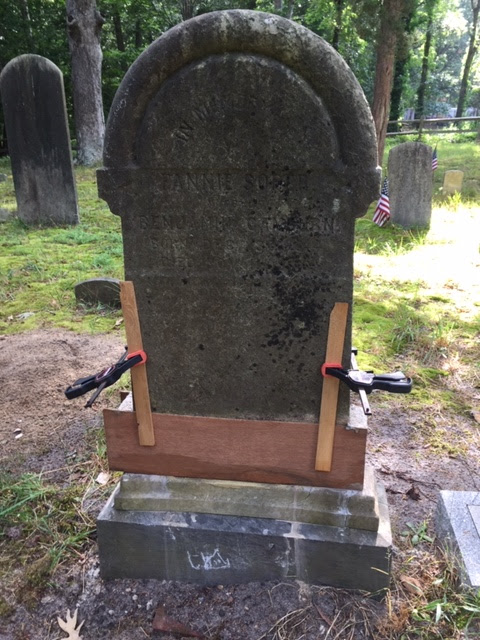
Many were broken, but someone, or perhaps a group of people are trying to save them from being buried like the people whose graves they mark. The restoration of two of the stones here is being conducted in a highly professional manner. Clamps, epoxy, supporting structure, binding straps, etc. A laborious enterprise, to be sure, and without a doubt, a labor of love.


Headstone with matching footstone
Another repaired stone, this one recently reattached to its base, was accompanied by a matching footstone! This may be old news to many of my readers, but I just learned of this custom in June, 2020 at the Life and Death Event created by Tania Kirkman. This was a mostly online three-day event with dozens of lectures (with this one given by me) related to death and all its trappings. 


At Life and Death, a friend of mine, Brenda Sullivan of The Gravestone Girlsgave a presentation entiltled, “Welcome to the Graveyard: A Tour of Cemetery Art and History.” She covered American burial practices and cemeteries from the 1600s to the present day. Brenda explained that for a certain period of time, it was popular practice to mark both the head as well as the foot of one’s grave, with both stones facing east. The thought being that on Judgement Day, when Christians emerge from their graves they emerge headfirst in the proper direction to face their maker! Also, the two stones effectively mark the boundary of the grave, to prevent accidental excavation. 

The head and footstone in above photo are about six feet apart. On a nearby child’s grave, the stones were about three feet apart. Footstones typically have the initials of the deceased engraved on them. As you can see in the photo above of William N. Smith’s headstone, his footstone bears the initials, “WNS.” I had seen these small stones many times over the years and naively thought they were simply inexpensive grave markers. The obvious has a way of eluding me at times!

Broken headstone epoxied back onto its base

It was getting to be about 8:30 a.m. and I needed to be back in Beach Haven to pick up pancakes for my daughter from Uncle Will’s Restaurant, so I headed back to my car. As I drove out to the main street to leave, I stopped to photograph “The Olde Cemetery” sign. Two men were standing in the adjoining yard. I said hi and asked them if they knew who has been repairing the grave markers. With facemasks on (this being the Summer of COVID-19), I could barely make out what they said. Sounded like “Bill Watt, and he had volunteers helping from the local VFW.” So Bill, if you’re reading this, I’d love to hear your story. Great work.

Sheetrock grave markers at Manahawkin Baptist Church graveyard 

On the way back, I did stop at the Manahawkin Baptist Church to do some photography, but as they say about the past, it had passed. The early sun was no longer early enough. I walked around a bit, spooking rabbits at silflay that tore across the open spaces. Something new to my eyes was this family plot with five of what appeared to be gravemarkers made of sheetrock! Obviously, someone went to a lot of trouble to make them – and to attach wooden letters spelling out the names of the deceased. However, I cannot imagine they will weather very well.

Many of the graves in these Jersey shore cemeteries could be anywhere - Missouri, Montana, Minnesota. However, there are some occasional concrete, or maybe granite, reminders that they are close to the ocean. As I left, I walked by the maritime version of Potter’s Field, a square area roughly 150 feet on a side, with a large granite central monument to the "Unknown From The Sea.”

Read more about the history of Old Waretown Cemetery here.

Sunday, September 27, 2015

Pope Day at Mount Moriah Cemetery

Volunteers Austin Mee (L) and David Munyun (photo by Robert Reinhardt)
As the Pope tools around Philadelphia this weekend - part of the World Meeting of Families Celebration - a young man is expressing his respect for families in another way. We had the honor of talking with him and his grandfather at Philadelphia’s Mount Moriah Cemetery.

As part of a community service project that he is expected to accomplish for his school, this teen chose to help perform grounds restoration work here in this Philadelphia cemetery. The Friends of Mount Moriah Cemetery, Inc. and thousands of volunteers have been able to keep about twenty-five percent of this formerly abandoned, several-hundred acre cemetery clear of trees and other invasive vegetation since 2011. It is an immense challenge to just maintain cleared sections and mow grass on this huge property, let alone take back additional acreage. The majority of the cemetery looks like the scene below.


But Section G on the Philadelphia side of the cemetery is in the process of being restored thanks to young Austin Mee and his grandfather, David Munyun. While most of the population living around Philadelphia was either on the Ben Franklin Parkway waiting for Pope Francis to arrive, or avoiding it all at the Jersey Shore, these guys were cutting weeds, clearing graves, and chopping down trees.
So on Saturday, September 26, 2015, we met up with them to witness their accomplishment.

Robert Reinhardt (L) and David Munyun discuss recently cleared area
 
While the area of the grounds in which these fellows are working appears to be relatively clear and maintained from these photographs, it did not look like this until very recently. Trees had been taken down and weeds and thorn bushes were removed before the grass could even be cut. When my friend Rob and I arrived, most of the hard work had already been done. David and Austin had cut back weeds and trees at dozens of grave sites, and piled the debris for later pickup. They had cut back many trees of various sizes and were in the process of filling the trunks with weed killer (to kill the stump so it cannot grow back and cause additional damage to the monuments and headstones). They took a short break to talk with us.


Austin is a student at Saint Augustine Preparatory School in Richland, New Jersey (southern part of the state, about fifty miles south of Mount Moriah Cemetery), and David is a retired PECO employee. As you can see in the video above, Austin is totally engaged in this work and understands the impact he is making by generously donating his time and energy to this community cause. Also, it's great that he's spending time with his Grand Dad!
 
From the Saint Augustine Website:
"Service is an integral component of the Augustinian Education. Through service to others, students get to know themselves better, develop an attitude of gratitude, and make a difference in the world. Students are exposed to community service through their participation in extra-curricular activities, as every one of our athletic programs is required to perform a service project."

Further Reading:
If you would like to help the The Friends of Mount Moriah Cemetery, Inc., please visit this site to see how you can donate your time or money to this cause! All are welcome to the scheduled restoration events listed!  
 
Click here to see the landscaping map of Mount Moriah, which shows condition of all areas and their current state of maintenance.

Thursday, May 21, 2015

“Monuments Men” Visit Mount Moriah Cemetery on Memorial Day

Memorial Day 2015 will be celebrated in an unusual way at Mount Moriah Cemetery (half of which is in Philadelphia, half in Yeadon, Pennsylvania). Two companies, Kreilick Conservation LLC (of Oreland, PA) and the George Young Company (of Swedesboro, New Jersey) will donate their services in an effort to upright, restore, and in some cases, reassemble some of the toppled U.S. military veterans’ grave markers and monuments. The day’s work will be overseen by Ken Smith of the Friends of Mount Moriah Cemetery, Inc. The non-profit, volunteer organization currently coordinates all such restoration efforts.
 
Friends' treasurer Ken Smith (L) with T. Scott Kreilick of Kreilick Conservation LLC

T. Scott Kreilick’s company specializes in laboratory and field analysis of materials, condition assessments, emergency response and stabilization, treatment, documentation, and maintenance of architecture, monuments, sculpture, and objects. Young’s company is a heavy hauling, rigging, and transport firm best known for moving the Liberty Bell to its current place on Independence Mall in Philadelphia. The George Young Company has been in business since 1869 and Mr. Young’s ancestors are buried on the Yeadon side of Mount Moriah.

Volunteer workers at the Young family monument

Following is the list of toppled monuments and headstones marking the graves of veterans (and others) that will be worked on (along with the cemetery section in which they reside):

1. Brevet Brig. Genl. John K. Murphy 1796-1876 Section 128

2. Brevet Brig. Genl. Edwin R. Biles 1828-1883 Section 30

3. Major John Lockhart 1833-1917 Section 201

4. Lieut. Wm. Rainey Ritchie 1877-1904 Section 200

5. Samuel Watson 1838-1885 Section E

6. Thomas T. Tasker, Jr. 1799-1892 Section 129

(Click link to read about U.S. military veterans buried in Mount Moriah Cemetery.)

Kreilick examining monument at Mount Moriah
Kreilick Conservation, LLC proposes to wash the individual granite components of each monument. Their restoration specialists will fill cracks by injection grouting and color-matched mortar fills. Some cracks or detached elements that require more extensive intervention may be pinned to facilitate the repair and stability. Individual monument components will be rigged and repositioned by George Young Company personnel. Kreilick Conservation personnel will provide conservation oversight. These services are being provided at no charge.

All services provided by Kreilick Conservation, LLC are conducted in accordance with the American Institute for Conservation of Historic and Artistic Works’ (AIC) Code of Ethics and Guidelines for Practice, and in accordance with the Secretary of the Interior’s Standards for Restoration.

Masonic Circle of St. John, Mount Moriah
Kreilick and Young have partnered to do similar work in the past, volunteering their company’s resources (e.g. people and cranes) at other Philadelphia area cemeteries. Their goal is to accomplish what they can in a single day. In 2005, for instance, they re-set 36 headstones at Montgomery Cemetery in Norristown, PA, that had been pushed over by vandals. The two men team up for such projects on Memorial Day to focus attention on the need to maintain the region's historic cemeteries. Many are deteriorating.

The work at Mount Moriah is even more ambitious than their Montgomery Cemetery project. Most of the damage to the larger structures at Mount Moriah was probably caused by ground subsidence or overgrowth of trees, rather than vandalism. Each of the six monuments is considerably larger and heavier than a simple headstone. Uprighting and reassembling fallen granite obelisks and other memorials requires leveling the massive bases and using a crane to lift the pieces. Then, the pieces must be secured.

Kreilick meeting with Ken Smith (right) to plan the resetting of monuments

We applaud the efforts of Kreilick Conservation, LLC and the George Young Company in assisting the Friends of Mount Moriah Cemetery, Inc. in this restoration work. Their planned endeavor to raise these monuments to the fallen is a fitting tribute to the deceased. Memorial Day, after all, is the day the United States has set aside to remember and honor those who died while serving in our country’s armed forces. 'History,' as they say, is what we deem worth remembering.

References and Further Reading:


Saturday, November 22, 2014

A Cemetery and its Friends


Recently a student from Philadelphia’s Temple University wrote a blog about her experience volunteering to help clean up at Mount Moriah Cemetery (Philadelphia and Yeadon, PA). I was struck by how well-written and on point she was, in explaining what some people find so appealing about volunteering to help maintain cemeteries. I want to share her perspective with you through The Cemetery Traveler. (The link to her blog can be found at the end.)

I’ve been volunteering at Mount Moriah myself for a few years, as part of the Friends of Mount Moriah Cemetery, Inc. (FOMMCI), and I have my own reasons for doing so. Alyssa, the Temple student, volunteered as part of the university’s civic engagement program. I’m not sure she expected the experience to be so profound. Thousands of students have taken part in this sort of community volunteer program since the FOMMCI started it in 2011, and it is obvious that many are affected in the same way Alyssa was. I’ve spoken to a number of them during cleanup events, and many share her experience.


As part of a hard day’s work, she states, “It was amazing to uncover tiny grave stones and large markers and even more thrilling to see the size of the space we helped to bring out from underneath the mess of tangled vegetation. It was also great — after learning more about the context of the cemetery clean-up — to think about the people that were buried there and know that we were helping families rediscover or simply have the ability to locate and visit deceased family members.”

Mount Moriah is at this point still about seventy-five percent overgrown with trees, vines, and other flora. Alyssa describes the situation clearly when she states, "Tombs were entombed again in brush and trees: a layer of time measured in yards of vegetation.” The cemetery is huge, recently abandoned (2011), and more recently put back on track (Sept. 17, 2014) with the legal appointment of the Mount Moriah Cemetery Preservation Corporation as receiver of the property (which now has legal custodial responsibility). However, until funding is appropriated as part of the overall plan to maintain the cemetery, Mount Moriah is still greatly dependent on volunteers.


Please check the FOMMCI website for future cleanup and restoration events. You simply cannot foresee how being part of such a community effort can benefit so many – yourself included. Also, now that it is cold out, the vegetation has mostly died and you can see much more of the cemetery than you can in summer. Come and visit! Both the Philadelphia and Yeadon sides are open from 9 a.m. to dusk.

**************************************************
Alyssa's blog, "Mount Moriah: A Cemetery and Its Friends," can be read here.
The Friends of Mount Moriah Cemetery, Inc. website
The Friends of Mount Moriah Cemetery Group on Facebook

Wednesday, May 14, 2014

Friends of Mount Moriah Cemetery - "Urning" Our Respect

Whenever I’m looking for something to write about, I’ll take a drive out to Mount Moriah Cemetery in southwest Philadelphia to see what’s up. Something always is. Since the weather broke and the insanely snowy winter loosened its grip on the region, The Friends of Mount Moriah Cemetery, Inc. has been hosting restoration events every weekend. There are so many volunteer organizations wanting to participate in this effort, that every time I visit, a new previously-forested area seems to be cleared!

The obvious large-scale cleanup has been the inner “Circle of Saint John,” the Masonic plot which can actually now be seen and easily accessed for the first time in ten years. (The lead photo in this article was made in May 2014, after substantial clearing had occurred.) Various groups of people have participated in the restoration of this particular area of the cemetery, including local Masonic lodge members and students from Drexel University. I had seen photos of the cleared area but until you see it in person, you cannot appreciate the magnitude of the job. The photo below shows the same area in 2011.

Circle of St. John at Mount Moriah Cemetery, Philadelphia, winter 2011

My focus of this article, however, is less on the magnitude of this work than on the meticulous CARE involved. Obviously, the people involved are focused on more than just the brute force work of clearing the area of invasive trees, vines, and knotweed. They’re doing this because they’re interested in what’s under the brush – the graves of our ancestors. This is about respect for the dead and keeping their memory alive.

On walking through the Circle, this granite draped urn (at left) caught my eye. It was placed at the foot of a large memorial, the one it had fallen from. It seems a rather small detail, but it exemplifies the great care that the volunteers take to ensure this statuary continues to exist, and the memories remain strong. The urn can be viewed as a simple design accent on a grand Victorian memorial, but in past times, it was viewed as much more than that.

This particular urn was found embedded in the ground, having fallen about ten feet from the top of the monument behind it, god knows how many years ago. The Friends (Bill Warwick, Bill McDowell, and Ken Smith) dug it out and carefully placed it where you see it in the photo. My estimate of the weight of this thing is three hundred pounds. No small feat. To give you an idea of the size of this objet d’art, take a look at the photo below of me crouched behind a similar urn a few plots away. I weight two hundred pounds and am six foot two.
 
Author Ed Snyder with fallen granite urn

The urn was a very common piece of Victorian funerary art. However, designers did not use the urn as a literal symbol of a cinerary urn (which holds ashes, or cremated remains), simply because cremation was far less common then.They meant for it to symbolize a container of sorts, like the human body, which holds inside it, the soul.

Douglas Keister, in his book, Stories in Stone,” says:
“The draped cinerary urn is probably the most common nineteenth-century funerary symbol." The drape may symbolize the veil between earth and heaven. Since cremation was seldom practiced in the 1800s, the urn likely does not signify a literal vessel for ashes (or cremains). More likely it symbolizes the human body, a simple vessel for the spirit. Keister goes on to state that the urn and the willow tree “were two of the first funerary motifs to replace death’s head …. effigies when funerary symbolism started to take on a softer air after the [American] Revolutionary War.

Keister tells us that the phrase “gone to pot” may have originated as a reference to a cinerary urn.

Cleared section of the Circle of St. John


Friends' treasurer Ken Smith, with chain saw
So the fallen urns are not just adornments on the larger monuments – they very personally signify the bodies of the deceased. The care with which they are handled and treated by the volunteers who are restoring Mount Moriah Cemetery should not go unnoticed. Another thing that should not go unnoticed is the fact that these incredibly heavy objects are not even attached to the monuments! You can see that the base of the urn I am crouched near is smooth! It was just sitting up there, ten feet off the ground! This one may have fallen 50 years ago when the monument tilted off level due to ground subsidence. I wonder if such things are more securely attached in earthquake-intensive areas like California?

Visit the Friends of Mount Moriah Cemetery, Inc. website to learn more and find out how you can help! (Click here!)

Wednesday, November 28, 2012

Visit Mount Moriah Cemetery Now!

Gatehouse, Mount Moriah
It’s sort of traditional for me to write about Philadelphia's Mount Moriah Cemetery in the fall -  since that’s when everything begins to die. Formerly Pennsylvania’s largest abandoned cemetery (it is no longer abandoned, having been adopted by the recently-formed Friends of Mount Moriah Cemetery in 2011), fall and winter were the best times to see this opulent Victorian masterpiece, when the secret cloak of its forest green fell to the ground.


Easily half of Mount Moriah’s (approximately) 380 acres were covered by forest – an astounding sight for the uninitiated. About ten percent of the grounds was clean-cut, as active burials were taking place there up until 2011 (there are none allowed, at this time). The rest of the place was a wildly overgrown thicket of invasive vines, poison oak and ivy, and thorns that could pierce through armor.


But this year is different. Thanks to the tireless efforts of a handful of individuals − leaders in the restoration effort − the progress toward freeing this beautiful cemetery from its forest confines is astounding. Looking at the photo above may give you the impression that Mount Moriah Cemetery is is mess. However, this cluster of mausoleums and monuments was buried in trees up until this past summer. You couldn't see any of this architecture before!

The Friends group has organized many official volunteer cleanup days with busloads of college students from the likes of (Philadelphia area) Cheyney and Villanova Universities, with the result being huge areas of the cemetery (both the Philadelphia and the Yeadon sides) looking neat and trim. I was rather shocked to see the condition of the Yeadon side (photo at left) in October, with the weeds all cut back and the mausoleums unobstructed by trees! Looking at this from the road, it looked like, well, a cemetery - one that you could easily enter and walk around in, safely.

Much of the praise goes to the handful of concerned citizens who work the cemetery not only every weekend, but daily (many who are members of the Friends). They’ll chainsaw some trees crowding out a family plot or machete their way to a hidden tombstone to help a visitor locate an ancestor’s grave. Patches of tall weeds have been hacked away to provide at least visible access to some giant monuments as well as smaller grave stones that I can only assume have been hidden for decades. I’m not used to being able to photograph small details (see right) on monuments and stones at Mount Moriah, but this is very possible now.

Circle of  St. John
Yeadon side
One thing that elated me about a recent (November 2012) trip to Mount Moriah was the presence of makeshift access roads that several individuals have created by plowing down weeds and trees through various areas of the cemetery. You now have easy access (do take a map, however!) to such grand sites as the Circle of Saint John, Betsy Ross’ grave (the one with the flagpole behind the Circle), and the area behind the mausoleums (on the Yeadon side). The latter has a wonderful Japanese maple tree that turns an amazing red color in the fall.

Fall foliage at Mt. Moriah
Recently, I introduced my friends Karen and Bob to the splendors of Mount Moriah. As we hiked across the grounds, I was happy to be able to show them the sights without too much effort. Still, there are wildly overgrown portions of the cemetery − the place is huge and will continue to require work for a long time to come. But there is beauty in this, as well. We were all rather shocked to see a ten-point buck trotting out of the weeds near the Naval Asylum Plot on the Yeadon side. I had wondered why the sign at the entrance gate had recently been changed to say, “No Hunting,” in addition to "No Dumping!" (Good call, Donna!)

Ten-point buck at Mount  Moriah Cemetery

So to sum up, Mount Moriah is worth a visit, now more than ever. See it in its fascinating state of recuperation, with noticeable improvements on almost a daily basis. In fact, many more people are visiting these days. Quite a few visitors with whom I’ve spoken have relatives buried here. They’ve stayed away for decades because of the steady decline of the cemetery’s conditions. Though I am certainly grateful to the Friends of Mount Moriah Cemetery for clearing the way for me to make interesting photographs, the most grateful people seem to be the descendants of those buried here. Maintaining this as an active, open, and safe memorial park is certainly in keeping with the original intent of the Victorian cemetery planners - to keep memories sacred.

Further Reading:

Historic Mt. Moriah to be Brought Back from the Dead
Some wonderful genealogical reading here related to findings at Mt. Moriah.
Friends of Mount Moriah Cemetery on Facebook

If you're interested in purchasing one of the bright yellow "Friends of Mount Moriah" t-shirts depicted at the beginning of this article, please contact Friends' President Paulette Rhone. They are $16, funds which will aid the restoration effort.

To make a financial contribution to the upkeep of Mount Moriah Cemetery, click here.

Tuesday, April 3, 2012

Mt. Moriah Clean-Up on Civil War Anniversary


Just got home from the big "Park Day 2012” (March 31) cleanup event at Mt. Moriah Cemetery in West Philadelphia. Owww...my back. Wait right there while I fix myself a Motrin Smoothee... 

From the Friends of Mount Moriah Cemetery website (link at end of article):
"On Saturday, March 31, 2012, history buffs and preservationists from around the country will team up with the Civil War Trust to help clean and restore America’s priceless battlefields, cemeteries and shrines.  The nationwide effort – dubbed Park Day – is underwritten with a grant from History™ and has been endorsed by Take Pride in America, a division of the US Department of the Interior.

The Friends of Mount Moriah Cemetery, in commemoration of the Sesquicentennial of the Civil War, will participate in Park Day 2012, an annual event sponsored nationwide by the Civil War Trust, The History Channel and the National Park Service."

There were probably a hundred people working at the cemetery today, totally amazing! Folks digging out family plots, clearing brush from obscuring the veterans' burial ground, hauling rocks away that had been dumped, and weed-whacking with a vengeance. Chains saws tore away at the trees that had been overtaking graves, and machetes hacked away at the vines and other invasive growth. ABC News was there and Philadelphia mayor Michael Nutter stopped by to give everyone a T-Shirt and a "Thank you" from the city.

Veteran's Grave
Even though Park Day is mainly about saving locations historically linked to the Civil War, there were very few Civil War buffs at Mt. Moriah today. There were a few guys with period kepi caps, but there were also groups of high school and college kids, neighbors, and people who have family buried here. Some of the latter used the opportunity to clear their own ancestors’ graves, but most just helped with the mass cleaning of the overgrown areas in front of and around the Soldiers’ Plot (Section 200). This is where the bulk of the work was concentrated. Local Veterans’ organizations care for these actual grave sites, but not the overgrown plots that keep you from accessing (or even seeing) the section. The rake trucks, police cars, food trailer, and an assortment of other city vehicles were parked here, near the barricaded Cobb’s Creek entrance.

Groups of Volunteers working at Mt. Moriah Cemetery
Weed whacking
The work began at 8 am, and mercifully ended at 1 pm. Everyone had to register and sign waivers to the effect that it was their own responsibility if they got hurt. Good plan, given all the chainsaws ripping through trees and machetes swinging at the underbrush. (I thought it rather comical that one guy was distributing brand new machetes to any takers this morning. "Where do you actually BUY a machete?" I asked. He said, "Home Depot! I was actually surprised at the quantity they had available!" Hey, this IS Philadelphia, after all.)

It's a strange feeling to pull a wet flag out from under the weeds and drape it on a stone, stranger yet to discover a hidden flush-to-the-ground veteran's marker, and weedwhack it back from obscurity into the light of day.

Between trysts with Japanese knot weed and tearing through the tall grass with a gas-powered weed whacker, I chatted with some of the other volunteers. I was surprised to learn that about ninety-five percent of the 400−person membership of the Friends of Mount Moriah are descendants of those interred at the cemetery! I wondered if they came out en masse because they felt it was safer here with so many other people around. I felt WAY in the minority, just being someone who cares about the cemetery, the neighborhood, and the memory of the thousands buried here. 

Rakers taking a break (note mausoleum and monuments in background)
 
There was a college-aged guy making a video of the day’s work, who was surprised when I told him about the dangers of being in here alone.  I had just been told that the city pound rounded up the latest pack of resident wild dogs and hauled them away. They seem to form in the overgrown wilderness areas of this cemetery every few months. In the photos here you see relatively low grass around the tombstones. The woods in the background actually delineate the major portions of the cemetery – probably eighty percent of its 380 acres. If you look closely at the trees in the photo above, you can see a mausoleum in the center and a red granite obelisk sticking out of the trees.

Philadelphia Mayor Nutter (second from right)
I caught bits and pieces of some on-camera interviews with people throughout the day. Many of the volunteers were in their sixties, had grown up nearby, then moved away. The 1960s were fine here, so they said, with things going downhill in the 1970s. One woman’s husband worked here as a groundskeeper in the 1970s-80s. He told her, “A place this size would take a crew of ten people seven days to just cut all the grass. Then you’d have to start over.” Another woman and her friends learned to ride their two-wheeled bicycles on the hilly roads of the cemetery when they were children.Two volunteers, both equipped with site maps and print-outs of burial records, found they both had ancestors buried in the same section of the cemetery. This place is more than a graveyard – it’s really a web of relationships.

Every hour or so, I would take a break and hit the Potty Queen or grab a bottle of water from the free supply. Once, on my return to the work site, I came upon a woman shoveling turf off a buried sidewalk that crossed the section in which her ancestors were buried. She was working in front of four large granite stones, one of which was knocked off its pedestal. She and her husband were dismayed that the base was unlevel, so righting the stone would not be a permanent fix.  This is the sort of thing “Perpetual Care” was supposed to encompass, and what people paid for as part of the original burial fee. Unfortunately, the cemetery owners didn’t live up to their end of the bargain.

At one point, I laid down the weed-whacker to help load a truck with chainsaw-cut logs, and then helped load chunks of busted-up concrete from an illegally-dumped pile. One of the local residents had a four-wheeler and a large hauling wagon which she used to cart off the concrete to dump into sink holes in other parts of the cemetery. While we were loading the concrete, a fellow volunteer – who came from the other side of Lancaster to be here today – told me he has relatives buried on the Cobb’s Creek side of the cemetery. When he was visiting and tending to these graves about five years ago, two trucks appeared, dumping building materials in the weeds nearby. Imagine the BALLS that takes! Especially when the dumper SEES a person there tending a grave! Luckily, this has stopped, mainly due to the city having barricaded the entrance with concrete highway dividers.

Food Tent
Around noon, I headed over to the food cart for a Philly soft pretzel and was thrilled to find piles of hot dogs on buns! Don’t know if these were voluntarily provided or paid for by the city, but after all that work, these things tasted great.

The section in which we were working looked great with all the grass cut, so then people began hacking away at the periphery, felling trees growing on the hillside. College students swarmed over the area bagging the grass clippings, and some of the people more knowledgeable about the cemetery led small groups of interested parties on quick tours here and there. I called my wife to tell her how great the place looks. She said, "If you clean it all up, what will you take pictures of?" Then I told her that we probably only cleared a few acres.While that small area does look much better, the place is almost 400 acres of mess, most of which is a forest. Everything's relative - where will the hawks and vultures roost then?

Mt. Moriah Hawk
I was surprised at the number of people who routinely visit Mt. Moriah (aside from myself, of course). There’s the guy who rides his bike through the place every midnight, the woman who lives nearby and cuts grass here with her riding mower, and the guy with the chainsaw who cuts down the invading trees in his spare time. I felt better about the place knowing that there are several (sort of) normal people who “haunt” Mt. Moriah Cemetery!

At the end of the day, the city will hopefully find a "receiver" to manage the cemetery. A Pennsylvania State Representative introduced legislation last year that would protect an entity willing to take over operation of the abandoned cemetery from current and past outstanding liabilities. Expecting descendants or other volunteer organizations to keep the place up is just not realistic. One fellow I spoke with used to live nearby as a child, and he and his cousins used to come here to tend to his great-grandparents' graves. Cemeteries used to count on this sort of thing, before people became more mobile and began moving all over the country. This particular gentleman moved away to the other side of Lancaster, PA. in the 1970s. He brought his mother back in the early 1980s and they were greeted by "about thirty guys hanging out in the cemetery, shouting threatening things" at them. He said his mother never returned. Hopefully, now that more and more people are actively involved with Mount Moriah Cemetery, those days are gone for good.

As I finish writing this two days after the cleanup, my biceps are aching. I earned a new appreciation for the backbreaking work done by cemetery groundskeepers. I don’t REALLY look forward to the next cleanup day (which will be published here), but there’s always Dr. Seuss' Lorax nagging:

Purchase from Amazon
 “Unless someone like you
Cares a whole awful lot, nothing is going to get better.
It’s not.
” – The Lorax, Dr. Seuss


References and Further Reading:

Park Day 2012
Volunteers Help Clean up Mount Moriah Cemetery (Delaware County Daily Times, April 2, 2012)