Showing posts with label Revolutionary War. Show all posts

Sunday, December 15, 2024

Cemeteries as Roadside Attractions


South Jersey (especially along Route 9) is unparalleled for roadside attractions. Giant fiberglass cartoon figures, fanciful soft serve ice cream stands, diners, pyramids made of hubcaps, the list goes on. The list now, for me, includes small, pocket-sized cemeteries, like the one above, along Route 9 in Cape May Court House, New Jersey. 

In the summer of 2024, I was researching forgotten cemeteries for my book, “Abandoned Cemeteries of Philadelphia and its Environs” (expected publication in late 2025, on Fonthill). South Jersey, being in the general area of Philly, was on my radar. I happened to be in Cape May, so why not check out the local cemeteries? 

On my drive back north to Philly on Route 9, I noticed some small burial grounds pop up on my phone map. They were right along the highway. I stopped at two of them, plots of land about twenty feet wide, and fifteen feet deep, with maybe as many as ten old headstones standing at attention. The grounds were well taken care of.

Robert Morris in Holmes Family Cemetery
No doubt, these were family plots that had been on private property at one time. A few such burial grounds still exist in Philadelphia, e.g. the DeBenneville (est. 1758) and Vandegrift (est. 1775) cemeteries on North Broad Street and Bristol Pike, respectively, but New Jersey has many more. Why? Certainly south Jersey is more rural, but there must be other reasons why most private family cemeteries in Philadelphia were moved or built over. Chances are that heavy industrialization and rapid population growth in Philadelphia in the mid to late 1800s contributed to the eradication of small family cemeteries.

One of the topics I cover in my book is the disappearance of such small family burial grounds. Large farms and estates dwindled in size as parcels of land were sold off throughout the 1800s and early 1900s. These family burial grounds either disappeared, were built over, or the graves were moved. Some still exist, providing us with interesting slices of history. 

Holmes Family Cemetery along Route 9, Cape May Court House, NJ

A cemetery I stopped at on Route 9 in Cape May Court House (that’s the name of the actual town) was a place that my cellphone map app called the Holmes Family Cemetery. Most of the gravestones had a death date in the early 1800s. Someone had placed small American flags on the veterans’ stones, men who had fought in the Revolutionary War. But wait, there was no Battle of Cape May, right? According to the book, Cape May County Story (Avalon Publishing, 1975) by Boyer and Cunningham:

“New Jersey became the foremost state in resisting British tyranny in January of 1775 when the Assembly voted to present grievances to the King. Jonathan Hand and Eli Elrdidge represented Cape May County at that meeting. No colony was more deeply involved in the Revolution than New Jersey. It was a natural passageway between New York and Philadelphia and was always in a condition of siege. Benjamin Franklin likened it to a barrel, open at both ends. It had been called the “Corridor State” and the “Cockpit of the Revolution” by some, and others referred to this state as the “Pathway to Freedom.”

American men who fought in the famous New Jersey battles of Monmouth, Trenton, Red Bank, and Princeton, had to come from somewhere. Many came from south Jersey, some of whom are probably buried in the Holmes Family Burial Ground. Excluding Quakers (conscientious objectors) and Tories (loyal to the King), the above noted historians tell us that “49 percent of the male population in the state bore arms and New Jersey contributed one eighth of the total men from all the colonies that fought in the war.”

The Holmes Family Cemetery was distinctive in that every headstone had daddy-long-legs spiders on them! Odd. What was even odder was all the other types of spiders dangling from the pine trees on web strands above my head. 

About a mile up the road was a rather peculiar small cemetery in that it appeared to be in someone’s front yard. Curious, I parked across the busy street and walked up to the house, which had a pickup truck parked in the driveway. I knocked on the door. A man about 45 years old appeared. I told him I was researching a book on abandoned cemeteries and asked if he knew the story behind the gravestones in his front yard. My cellphone app called this the Hand Family Burial Ground. Perhaps the Jonathan Hand (1728 – 1789) mentioned in the passage above was a member of this family, and may be resting below one of the nameless, worn stones in this plot.          

The homeowner asked me to wait while he put his shoes on. He came outside carrying a paperback book. He told me that when he bought the house about twenty years ago, it was explained to him that he did not own that small portion of land in his front yard. It was owned by the state of New Jersey. When Route 9, a state-owned highway, was built, all the small burial grounds along it were purchased by the state. The state maintains them. 

Roadside view of Craig's property, Hand Family Cemetery in foreground

Craig's front yard looking toward Route 9, with Hand Family Cemetery near road

The owner, Craig, told me a rather comical story. He said that shortly after he bought the house, he woke up one morning to a lot of activity near the street. Cars were pulling up, people getting out and gathering in the cemetery. Suddenly, shots rang out and he hit the deck! He peeked through one of his windows and realized that a twenty-one gun salute had just occurred. It was Memorial Day and people were placing flags on the graves!

As I thanked him and was turning to leave, he held out the paperback as a gift. He said “My mother was a historian and co-authored this book. You can have it.” The book is called Cape May County Story, the very book I quoted above. And yes, it does mention cemeteries. 

Sarah Somers (1770 - 1796)
It is interesting to see familiar surnames on the stones in these old cemeteries. Sarah Somers (1770 - 1796) and Sarah Hand (1741 – 1826), both buried in the Hand plot, each have surnames that should be familiar to beachgoers who frequent the Jersey shore. Sarah Somers and her husband, Constant Somers, may be related in some way to nearby Somers Point, a south Jersey beach town. Sarah Hand along with her husband Jesse Hand, Esq., may have been related to the still current and popular shore business, Hand’s Department Store on Jersey's Long Beach Island.


Sarah Hand (1741 – 1826)

The two small cemeteries I stopped at had been private family burial grounds at the edges of farms. As the farms were diced up and sold as small packets of land for development as residential properties, the burial grounds were kept intact. There is another small cemetery on the grounds of the Cape May Zoo, but I could not find that one. They may all have been forgotten by the public, as they are hidden in plain sight, but they have, thankfully, been saved from oblivion by the state of New Jersey. They may not be as eye-catching as a giant fiberglass cow, but they will outlast most of Jersey's other roadside attractions.


Sunday, July 19, 2020

Cemetery Restoration at the Jersey Shore

Summer 2020. COVID-19 summer. Vacation with the fam. Brigantine, New Jersey, just north of Atlantic City. Cemetery visitation plans: Atlantic City Cemetery and maybe another. Maybe Winslow Junction – train graveyard, or Fleming’s Junkyard, last resting place of all other modes of transportation. Except the rental condo was infested with bugs that bored into my skin and drew blood. The pool was also closed for the season, which was not mentioned on their website. Sweet. 

I’m a high-functioning individual with good insight and a positive outlook. Therefore, we packed up the plantation and moved further north. On to the Coral Seas Motel in Beach Haven, New Jersey, on LBI, i.e., Long Beach Island - my go-to Jersey Shore vacation spot for about 35 years. Coral Seas tells us their pool is open and they have no bugs. Ambrosia. No wait, that’s food, isn’t it? No matter, the custard is better on LBI anyway. Beach Haven is only about fourteen miles north as the crow flies from Brigantine. As the car drives, however, it is a sixty-mile inland journey up the coast. 

Manahawkin Baptist Church, NJ
Once we were settled, pooled, and availed ourselves of a bug-free night, I planned a new cemetery jaunt. About ten miles north toward Barnegat Bay, there are a few cemeteries on Route 9 shown on the Internet.  So, I woke up at 6:30 am and headed north. (“Up, Sluggard, and waste not life; in the grave will be sleeping enough.” Poor Richard’s Almanac, 1741.) Passed my favorite church graveyard, Manahawkin Baptist Church in Manahawkin, NJ (where I swear I saw Johnette Napolitano from Concrete Blonde a few years ago, walking around with a guy who was carrying a guitar case). Even though the sunrise light was AWESOME, I figured I’d catch it on the way back (always NEVER do this! You can never set foot in the same river twice). 

I hit the Barnegat Masonic Cemetery after passing an amazing looking outdoor nautical antique dealer which I didn’t stop at. Drove around the cemetery for a few minutes and realized I’d been there before. Locale wasn’t familiar, but the headstones and monuments were. I’m kind of freewheeling this blog while I’m drinking “Spirits of the Apocalypse” bourbon, trying to drain the bottle so I don’t have to use valuable storage space in the Saab on tomorrow’s trip home (my ten-year-old daughter won all kinds of arcade toys that will take up precious cargo space). 

So I sped off up Route 9 to the next graveyard on the eMap, something called Old Waretown Cemetery. Had a heck of a time finding this. The eMap on my iPhone showed the cemetery plain as eDay, but all I actually saw was a patch of woods with a vacant lot next door. I drove around the lot thinking the cemetery was forgotten in the woods, when it occurred to me that it might be accessible from the other side of the patch of woods, the road less traveled. That’s when I saw the green sign you see at the beginning of this essay.

"Olde" Waretown Cemetery on Barnegat Bay, New Jersey

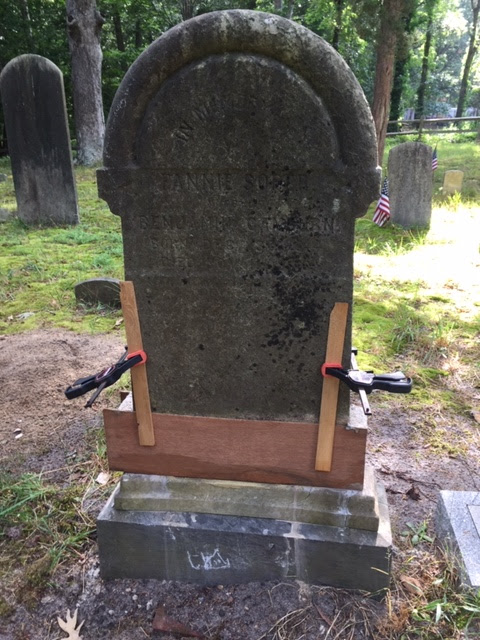
The cemetery, penned in on three sides by pine forest, was at the end of a short street. Houses lined one side of the street and an industrial garage on the other. A garage worker was starting his day and paid me no mind. I docked the Pequod at the end of the street and got out. The pine-sheltered graveyard was only about a quarter of a city block in size, and had many old headstones, Revolutionary War Veteran medallions, and U.S. flags on some graves. The only thing that really stood out was the restoration setup in the middle of the graveyard – and the moss. The property was so shaded by the tall trees that moss grew thick on the sandy ground. It was like walking on a thick soft carpet.

Repair and restoration of headstones

Revolutionary War veteran's grave marker

Soldiers, sailors, and early settlers of the area are buried here. Some stones date to the early 1800s. Many were just moss-covered nubs of stone, they were so weatherbeaten. The snow, rain, wind, and sandblasting caused by the latter, all work to erode these marble, slate, and brownstone gravemarkers. 

Many were broken, but someone, or perhaps a group of people are trying to save them from being buried like the people whose graves they mark. The restoration of two of the stones here is being conducted in a highly professional manner. Clamps, epoxy, supporting structure, binding straps, etc. A laborious enterprise, to be sure, and without a doubt, a labor of love.


Headstone with matching footstone
Another repaired stone, this one recently reattached to its base, was accompanied by a matching footstone! This may be old news to many of my readers, but I just learned of this custom in June, 2020 at the Life and Death Event created by Tania Kirkman. This was a mostly online three-day event with dozens of lectures (with this one given by me) related to death and all its trappings. 


At Life and Death, a friend of mine, Brenda Sullivan of The Gravestone Girlsgave a presentation entiltled, “Welcome to the Graveyard: A Tour of Cemetery Art and History.” She covered American burial practices and cemeteries from the 1600s to the present day. Brenda explained that for a certain period of time, it was popular practice to mark both the head as well as the foot of one’s grave, with both stones facing east. The thought being that on Judgement Day, when Christians emerge from their graves they emerge headfirst in the proper direction to face their maker! Also, the two stones effectively mark the boundary of the grave, to prevent accidental excavation. 

The head and footstone in above photo are about six feet apart. On a nearby child’s grave, the stones were about three feet apart. Footstones typically have the initials of the deceased engraved on them. As you can see in the photo above of William N. Smith’s headstone, his footstone bears the initials, “WNS.” I had seen these small stones many times over the years and naively thought they were simply inexpensive grave markers. The obvious has a way of eluding me at times!

Broken headstone epoxied back onto its base

It was getting to be about 8:30 a.m. and I needed to be back in Beach Haven to pick up pancakes for my daughter from Uncle Will’s Restaurant, so I headed back to my car. As I drove out to the main street to leave, I stopped to photograph “The Olde Cemetery” sign. Two men were standing in the adjoining yard. I said hi and asked them if they knew who has been repairing the grave markers. With facemasks on (this being the Summer of COVID-19), I could barely make out what they said. Sounded like “Bill Watt, and he had volunteers helping from the local VFW.” So Bill, if you’re reading this, I’d love to hear your story. Great work.

Sheetrock grave markers at Manahawkin Baptist Church graveyard 

On the way back, I did stop at the Manahawkin Baptist Church to do some photography, but as they say about the past, it had passed. The early sun was no longer early enough. I walked around a bit, spooking rabbits at silflay that tore across the open spaces. Something new to my eyes was this family plot with five of what appeared to be gravemarkers made of sheetrock! Obviously, someone went to a lot of trouble to make them – and to attach wooden letters spelling out the names of the deceased. However, I cannot imagine they will weather very well.

Many of the graves in these Jersey shore cemeteries could be anywhere - Missouri, Montana, Minnesota. However, there are some occasional concrete, or maybe granite, reminders that they are close to the ocean. As I left, I walked by the maritime version of Potter’s Field, a square area roughly 150 feet on a side, with a large granite central monument to the "Unknown From The Sea.”

Read more about the history of Old Waretown Cemetery here.

Friday, July 1, 2016

Sons of the Revolution

Prior to finding this grave marker in a cemetery, I had not heard of the "Sons of the Revolution." As we near America’s Independence Day, the Fourth of July, let’s delve a bit deeper into this. I found it as I was roaming through St. Andrew’s Cemetery in Mount Holly, New Jersey, back in the spring of 2016, when I noticed this bronze plaque at a veteran’s grave. I’ve been drawn to these small bronze memorial markers for the past several years – mainly because they seem to be slowly disappearing as people steal them for scrap.

I had heard of the Daughters of the American Revolution, the D.A.R., but oddly, not the Sons. A fraternal organization, the Sons of the Revolution was formed in 1876 to keep the history of the American Revolution alive, through people with direct lineage to those who fought in the war. There are some links at the end where you can investigate the Sons and Daughters further.

The Sons of the Revolution annual board meeting will be held Oct. 7-9, 2016 at Fraunces Tavern at 54 Pearl Street (near Battery Park, Lower Manhattan) in NYC. This is an awesome place to grab a beer, by the way - it is where Gen. George Washington took his men for beers! This place is steeped in American history. On the eve of July 4, 2016, the museum at Fraunces would be a wonderful place to spend a few hours, if you happen to be in New York City. The tavern is about a block from the port of the Staten Island Ferry, which itself is a wonderful attraction – you glide by the Statue of Liberty!

I was at Fraunces a few years ago and I must say, the period furniture, flags, signed documents, paintings, and sculpture are amazing to see. Rooms upon rooms were filled with artifacts (some of which you can see at this link to Fraunces Tavern® Museum), and the rooms themselves were filled with Wall Street-types at happy hour! It’s interesting to consider this place has been in continuous operation since 1719, making it the oldest restaurant in New York City; Samuel Fraunces purchased the property in 1762.

Fraunces Tavern, from the website http://forknplate.com/2014/10/21/the-7-oldest-restaurants-in-new-york-city/

Not many people think of New York when they think about the Revolutionary War. However, Fraunces’ was a central meeting place for Loyalists during the war. Samuel Fraunces kept the tavern open during the period of British occupation of New York. Once the British were defeated at the Battle of York Town in 1781, the tavern evolved into an American government “headquarters while negotiations with the British concerning their evacuation from the City were underway” (ref.).
 
George Washington in the Continental Army, by C.W. Peale (Ref.)


I was fascinated by the account below, which describes an emotional scene from the end of the war (excerpted from the Memoirs of Colonel Benjamin Tallmadge (1830) in the collection of Fraunces Tavern Museum)

"On November 25, 1783, British troops left New York City – the last American city to be occupied. This day would later be referred to as Evacuation Day. George Washington led his Continental Army in a parade from Bull’s Head Tavern in the Bowery to Cape’s Tavern on Broadway and Wall Street. New York Governor George Clinton’s Evacuation Day celebration was held at Fraunces Tavern. During the week of Evacuation Day George Washington was in the City, and he made use of the Tavern by dining in and ordering take-out.

On December 4, 1783, nine days after the last British soldiers left American soil, George Washington invited the officers of the Continental Army to join him in the Long Room of Fraunces Tavern so he could say farewell."

Washington then headed to Annapolis where he resigned his commission as Commander-in-Chief of the Continental Army. From there, he went on to bigger and better things. Thanks to the Sons of the Revolution and their bronze grave marker, for giving me the idea to research this piece. Another bit of history as we celebrate the anniversary of our nation's independence.

References and Further Reading:

Saturday, May 14, 2016

Ebeneezer Tucker, of Tuckerton, N.J.

I’ve been wearing the same old pair of jeans for a few weeks now, in order to jog my memory so I would write this blog. I bought them last summer under a strange set of circumstances which has to do with death and cemeteries. You’ll see.

In the summer of 2015, I flew off to a distant land to attend the funeral of my friend’s wife. The day of the funeral coincided with the week my wife and I rented a place on the Jersey shore. Plan was that she and my daughter would drive down to the shore (from where we live in Philadelphia), then I would fly back to Philly after the funeral and drive to Long Beach Island, where we would be staying.

A hectic week, that was. I flew back to Philly on a red-eye flight, and caught a few hours’ worth of sleep at home. Next morning I threw my stuff in the car and headed to LBI to spend the remainder of the week at the shore. I was quite diligent about including my photographic gear in that stuff, as I’d planned to stop at a cemetery I’d never been to on the mainland opposite LBI. Tuckerton, New Jersey, was my stopover destination, a small fishing village on the bay.

On scenic Route 9, in South Jersey!
Just about the time I was to get off the Atlantic City Expressway and head north on Route 9, I had one of those heart-stopping realizations – I had forgotten my clothes! I remembered the camera gear, of course, but I neglected to grab my suitcase with a week’s worth of clothes! Atlantic City was an hour south of Philadelphia, so there was no way I was turning back. But I didn’t want to be late getting to the shore to see my wife and daughter. What’s a guy to do?

This guy figured he had two options:
  •       Stop at the Atlantic City outlet mall and blow a few hundred dollars on casual clothes; or
  •       Stop at the Goodwill on the Black Horse Pike just outside AC and blow but a few DOLLARS on a week’s wardrobe!
I opted for the latter. I think I spent a total of thirty dollars. My wife would be appalled, of course, but hey, when in a pinch….

On scenic Route 9, in South Jersey!

So anyway, these jeans I’ve been wearing the last week, they were one of the thrift shop scores. Half the clothes I threw away since last summer, but a few shirts and these cheap jeans I kept. Every time I looked at them, I thought, “I gotta write that blog.” So they served that purpose, at least.

On scenic Route 9, in South Jersey!
Every photographer who travels the fine roads of New Jersey knows that Route 9 is a visual feast of roadside attractions, such as giant milk bottles, tiny Victorian houses, and dinosaur statues. And that’s only within a ten-mile stretch. Eventually I made it to Tuckerton, where a friend of mine lives. My stop was not at his place, however. It was Old Methodist Cemetery, a new notch on my “Cemetery Traveler” belt. (This cemetery, by the way, is also called Greenwood Cemetery on some maps.)

Old Methodist Cemetery, Tuckerton, New Jersey

This cemetery is tiny – maybe it takes up the space of sixteen single-family homes. An easy analogy, as Old Methodist is in a residential area, surrounded by single-family homes. The major cross street is North Green Street, a few blocks north of Route 9, or Main Street, as its called here in Tuckerton.

A permanently ajar rusty gate at the corner entrance and low stone walls on two sides separate its overgrown grass from the well-manicured middle-class lawns around it. As is my wont, I seldom do research on a cemetery BEFORE I visit it. Sure, I miss stuff that later on I kick myself for, but generally, I like surprises. So, coming upon old Ebenezer Tucker’s tall white marble obelisk was a bit exciting.

Ebeneezer Tucker's monument at rear
I kind of figured this sleepy little fishing village had a founder named Tucker. Tucker, oddly, was born in Tucker’s Beach, New Jersey, but later moved to what is now Tuckerton, which was in fact named after him.  So what did he do that was so noteworthy as to have the town named after him? consider the following excerpt from the website Tuckerton.com:

"It was from Ebenezer Tucker (1758 – 1845) that Tuckerton received its name. In March 1789, Mr. Tucker hosted a feast at 'Clamtown' for the residents at which time they officially changed the name to Tuckerton. Tucker was prominent as its first Collector of customs; a soldier of the Revolutionary War and served at the battle of Long Island. He was a member of Congress from New Jersey 1825-1829; a Judge of the Court of Common Pleas; Justice of Court Of Quarter Sessions and Judge of the Orphans Court."

That’s all very quaint, and it's not surprising that the locals put him on a pedestal for his good deeds. But there's a little known fact about Tuckerton, this sleepy little seaside village, that surprised me - and made me wonder why Tuckerton is not better known outside of South Jersey. The website, Tuckerton.com, states:“Tuckerton became the Third Port of Entry of the United States, with Ebenezer Tucker appointed Collector; his  commission bearing date March 21, 1791 signed by George  Washington, president and Thomas Jefferson, Secretary of State.”

Odd Fellows Symbol on headstone
Apparently, Ebeneezer Tucker was quite a big deal, as was Tuckerton itself! What were the first two points of entry into the United States, you may ask? New York City and Philadelphia. At one time, for sure, Tuckerton played a major role in the growth of our nation. Today, people might think it unusual for a town this small to have THREE cemeteries, but then back in the day, it's population must have been much larger.

http://www.theus50.com/newjersey/seal.php
Walking through Old Methodist Cemetery you certainly do get a sense of history. Some of the headstones are very old, dating to the late 1700s. Established in 1699, Tuckerton was originally called “Clamtown,” as you read above. Tuckerton must have been a major source of this sea food before it was all fished out. So let's see, what else can I tell you about this little graveyard?

New Jersey State Seal
One thing that baffles me is the fact that, given the hard Atlantic coast weather, with the ocean salt spray and all that, why the detail has not worn off the soft marble grave markers? Further inland where there is more pollution and acid rain (I assume), such detail has long vanished from similar stones. Here, you can see the Victorian symbols of death quite clearly, the willow, the lamb. Even the New Jersey State Seal on old Ebeneezer Tucker’s 1845 marble obelisk is still plainly visible!

References and Further Reading:

Friday, March 4, 2016

The Reverend George Duffield

If you walk or drive around the Society Hill section of Philadelphia, you may have recently noticed something odd in the graveyard of the Old Pine Street Church. The church entrance is on Pine, and the graveyard surrounds this monstrous yellow church building on three sides. On the west side of the church, you can see an unusual object towering above the old iron fence along Pine Street. At first glance, it appears to be a black and tan statue on a pedestal.

Old Pine Street Church, Philadelphia

If you look at it from either side, you see a man’s face at the top. His back, or rather, his black cloak, faces Pine Street, so you can’t clearly see the object unless you are in the graveyard. I, for one, welcome any opportunity to enter a graveyard.


Originally, Old Pine Street Church, founded in 1764, was known as the Third Presbyterian Church of Philadelphia and has come to be known as the “church of the patriots.” John Adams was one of the many members of the parish who loyally stood with George Washington during this tense, pre-Revolutionary War period in American history. The church’s pastor at the time, Reverend George Duffield, preached the “no taxation without representation” motto to his congregation – one of the rallying cries of the thirteen colonies. (Separation of church and state, by the way, is not actually addressed in the United States Constitution, as is popularly believed.) Because of his inflammatory patriotic tendencies, King George III offered 50 British pounds for Duffield, dead or alive.

Reverend George Duffield
Defying British arrest, Duffield served as chaplain to the First Continental Congress in 1774 and, with many of his parishioners, joined Washington at Valley Forge in the winter of 1776-77. He served as pastor of the church from 1772 until his death in 1790” (ref). That’s him you see carved from a hundred-year-old Norway maple along the fence in the church’s graveyard. Kind of ironic that he is sculpted making a peace sign with his left hand.

13-star U.S. flags wave by the hundreds
From his sculpted stance against Pine Street, Duffield seems to be addressing his parishioners, the inhabitants of this old graveyard. And it is old - quite old. This historic colonial churchyard contains burials of about 3,000 late 18th and early 19th century Philadelphians. The graveyard is home to the remains of a signer of the U.S. Constitution, 285 Revolutionary War soldiers, and the first ringer of the Liberty Bell. For the most part, burials ceased in 1830.

Why is the Rev. George Duffield statue here?

During 2015, I had noticed the slow transition from tree to patriot, but I had no idea what the final product was to be. For many years prior, I noticed that the big tree on the west side of the church yard was pushing on the black iron fence and bowing the old stone wall. At some point, it looked as though the tree might fall onto Pine Street and destroy the wall, fence, and sidewalk. A minor disaster, this would have been, especially if the church were to lose the beautiful cast and wrought iron fence, which dates back to 1835. The fence is now off level and bowed, however, as you can see from the photo above.
Detail of fence of Old Pine Street Church

Around the summer of 2015 I noticed the tree had been cut down - except for it's tall trunk. As the months went by, I noticed changes to that trunk (I live in the area, so I see it quite often). First off, it appeared to be burnt, charred! Then, no, it had been painted black! I finally stopped in the fall of 2015 when I realized that it had been carved into the likeness of a person. Recently I stopped by to investigate further.

Placard on fence of Old Pine Street Church

The church had commissioned sculptor Roger Wing to carve a larger-than-life-sized statue of a bible-toting Rev. George Duffield out of the Norway maple tree trunk! He wears the vehement expression you would expect of a Revolutionary-era patriot engaging his congregation, inciting them to revolt against the King of England. The description of his oratory prowess in this Philly.com article is interesting:

"Though Duffield is buried within the church rather than in the churchyard, his likeness in battlefield pose is fitting. On those grounds are interred 285 veterans of the Revolutionary War, men who likely heard Duffield's fiery battlefield sermons in person." - In Society Hill, a Revolutionary War minister emerges from a stump

Roger Wing's masterful carving of Duffield
In the same article, sculptor Roger Wing's work on this project is described in fascinating detail. When I read that he also sculpts ice, I realized he was the fellow I met at the beginning of February, 2016, creating ice sculptures at an art benefit. Turns out, Roger Wing and I are both members of InLiquid, a non-profit art and design organization based in Philadelphia. At InLiquid's 16th annual Benefit Auction in February, Roger was sculpting ice with a chainsaw in front of the Crane Arts Building (Fishtown section of Philadelphia). My six-year old daughter and I watched him work in rapt fascination.

The Duffield maple tree likely has its roots entangled in the iron fence and wall of the churchyard, so it probably would have been impossible to remove the tree without destroying the fence. In a sense, the Reverend George Duffield continues to support his church, physically, 200 years after his death! The statue is a very fitting memorial to Duffield, and our patriotic, forefathers in general. The statue was dedicated on November 18, 2016. Stop by and see this memorial to our nation's birth - to liberty - on Pine Street in Philadelphia, midway between Fourth and Fifth Streets.