Showing posts with label Cemetery. Show all posts

Sunday, February 8, 2026

The Zen of the Snow-Covered Cemetery

The snowstorm began on Sunday, January 25, and got more intense as the day progressed. By noon, it was relentless. The Philadelphia area expected about six inches of snow, but it soon turned to sleet and became untenable. If you were driving in a cemetery – like me – you were hard-pressed to stay on the recently plowed roads. I found myself driving on the lawn in the blinding snow at one point. Kind of reminded me of the time near Snowmass, Colorado, when my friend Mike was driving us through a snowstorm in his Subaru. The car was creeping slowly forward, but we could see nothing through the windshield. I rolled down the passenger window to get a less foggy view, and right next to us were tall hedges! “Um, Mike? I think we’re in someone’s yard….”

Gates open, roads plowed ...

So why would I be driving around a cemetery in a snowstorm? The question is, why would you NOT be driving around a cemetery in a snowstorm? Unique experience! With the snow-covered monuments and statues, it is like immersing yourself in a dynamic art installation! The zen of a snow-covered cemetery is difficult to put into words. There is a state of attentiveness that happens clearly in such an environment in such a situation. As Brad Warner says in his book, Hardcore Zen, its not enlightenment, and "yet there is something, and even though this experience doesn't change anything at all, it changes everything." 

I was there at 9:30 a.m., when the cemetery opened. This was hours before the radio started pleading with people to stay off the roads unless it’s an emergency. I knew it was going to snow the night before, so I planned on hitting Holy Cross Cemetery in Yeadon, PA (which borders Philadelphia where I live, on the west side). It is one of my go-to cemeteries because it has lots of low statues that get covered with snow. It is also relatively convenient for me to get there and I know that unlike Woodlands Cemetery in West Philly, Holy Cross plows its roads.

The snow was soft as it fell, and I made a few quick statue photographs but JESUS CHRIST was it cold (see above)! And windy! With chemical hand warmers in my gloves, hood up over my head, I kept the SUV running with the heater on full blast as I jumped out every few minutes to photograph something. To drive through a snow-covered cemetery is one of the reasons God gave us SUVs. God, however, cannot prevent you from locking yourself out of it in a snowstorm like I experienced about fifteen years ago. Always never do that.

I was careful not to slip in the snow (which was getting deeper) as I walked amidst the gravestones. The whiteout made it easier to spot the ceramic memorial photographs on the stones. I don’t think I’d ever seen this one before, even though I’d been in Holy Cross countless times. Might be a postmortem photo, not sure. Snow and bitter cold changes your perspective, as well as your tolerance for pain.

Postmortem image?

The trucks were re-plowing the roadways during the 90 minutes or so that I was there. Saw a small herd of deer running away from the plow truck at one point. The workers must have thought I was nuts. Or maybe they thought I was true to my art. Naw, they probably just thought I was nuts. When the snow started to fall more and more heavily, it was with less and less alacrity that I would stop and jump out to make a photograph. I only strung lights on a couple statues as it was just too cold to work the fine wires and switches on the battery packs. But like Christmas, its not over, ‘til its over, and you throw away the tree (from the Louden Wainwright song, Suddenly its Christmas). I finally resorted to just shooting out the window with a zoom lens.

Driving became virtually impossible. Defrosted snow turned to ice on my wiper blades, requiring a stop every few minutes with attempts to pull enough ice off the wipers so I could sort of see through the windshield. Then came the sleet. This storm, and driving a vehicle in it, just became a discordant experience. When I finally left the cemetery and got to the main roads, vehicles were stuck everywhere, on small inclines, at intersections. Again, it reminded me of Colorado. Once I was invited by a group of British friends to ski the Arapaho Basin with them. The mountain was higher and more remote than I was used to. It began to snow heavily as we began to descend from the top. My goggles fogged up and they left me for dead. Ah, good times.

So why would I put myself through this? If I lived in Colorado, this sort of storm would be a more quotidian event. However, Philadelphia rarely sees this heavy a snowfall. So, when such a gift is bestowed upon us, I view it as an impact opportunity not to be squandered. That said, getting stuck in a snowbank on the highway is not my jam. I did have to back down an on-ramp to Interstate 95 near the airport because a small clot of cars was blocking my progress. Seems the highway maintenance vehicles plowed the snow against the on and off ramps, blocking them. As Foghorn Leghorn says, “Some people ain’t got the sense God gave a bowling ball.” 

By the next morning, the nine inches of snow was anointed with a layer of ice that only a flamethrower could penetrate. Temperatures had dropped to about eighteen degrees after the sleet storm Sunday afternoon. They dropped into the single digits over the next few days. I didn’t go back to Holy Cross Cemetery during the week because with the snow sleeted over, this concretion became nine inches of ice. My friend Linda, in my neighboring state of Delaware, calls this “snowcrete.” You take your life in your hands trying to climb through/over a crosswalk. It is relatively easy to do a James Brown split on the ice if you aren’t careful. Owwww! (screamed in a high-pitched James Brown-type vocal).

I did spend a few hours after work during the week driving through various cemeteries in the area, shooting bleached snowscapes and every once in a while, getting out of my vehicle to shoot something up close. The close shots were rare, because even though roads were plowed in some Philadelphia and south Jersey cemeteries, you could not actually walk on the ice fields. Too treacherous. Too real. Didn't want to get stuck in the snow like this hearse at Laurel Hill Cemetery!

Hearse in the snow, Laurel Hill Cemetery, Philadelphia

So back to zen, and the truth found in the frozen reality of a snow-filled cemetery. There is that, but I’m also a treasure hunter, I guess, looking for that once-in-a-lifetime photograph in a snow-covered graveyard - these sophisticated built environments we make to avoid the truth. Or at least tuck it away down a side street. Attempting to make an amazing photograph is not a hobby, or a job for me – its more like an addiction, as one of the characters said in reference to wildcat oil drilling in the television series Landman. While I wish I was good enough to capture a Red-Tailed hawk plucking one of the just-released doves out of mid-air at a funeral, I must be content with shooting gravestones in the snow. I rather like this one below, which I made in Fernwood Cemetery, in Lansdowne, PA.  Kind of looks like and old Victorian lithograph, doesn't it?

While it is tempting to stay indoors where my furnace works, there is hot water to shower, and the ice box is filled with frozen burritos, I have been venturing out daily to photograph the ice in my local cemeteries. I plan to continue doing so until the city decides to remove the frozen snow, the weather gets warmer, and the rock salt barges are freed from the ice on the Delaware River (now that’s ironic).


Wednesday, December 31, 2025

A Cautionary New Year’s Tale Involving Cemeteries


On the last night of the year, the town gathered where it always did: not in the square, not by the river, but at the old cemetery on the hill.

This was tradition, though no one could quite remember how it began. Lanterns were hung from iron hooks, their light trembling over dates and names. People brought thermoses of cider, paper hats, and a confidence that the year ahead could be bargained with if approached respectfully—preferably where time had already lost.

“Midnight sounds clearer up here,” someone always said.

What they meant was that silence sounded clearer.

Among the crowd was Jonah Pike, who had decided—after a year of broken promises, missed chances, and a calendar that felt more accusatory than helpful—that this New Year’s Eve would be different. He would confront the year properly. He would be honest. At five minutes to midnight, Jonah wandered away from the lanterns and found himself before a modest stone, its lettering softened by decades of weather. He did not know the name carved there, but the dates caught his attention. The life between them was shorter than Jonah expected.

“Sorry,” Jonah murmured, for reasons he couldn’t explain.

The wind moved through the trees, and with it came a peculiar sound—not a voice, exactly, but the sense of being corrected. You’re not sorry, the silence seemed to say. You’re impatient. Jonah laughed nervously. Cemeteries had a way of doing that to people: making thoughts sound like answers.

As the final seconds of the year were counted—ten, nine, eight—the ground felt unusually solid beneath his feet, as if it were listening too. At midnight, the bells rang from town below. Cheers erupted. Corks popped. Someone tripped over a headstone and swore, then laughed.

Jonah, however, felt something shift—not beneath him, but behind his eyes. The year ahead unspooled in quick, unasked-for images: postponed apologies, health ignored, hours squandered, love treated as renewable instead of fragile. Nothing dramatic. Nothing supernatural. Just ordinary regret, arriving early.

The cemetery, it seemed, did not traffic in ghosts. It dealt in inventory. Jonah understood then the unspoken rule of the hill: you didn’t come here to celebrate the future. You came to measure it—against what was already finished. He walked back to the lanterns quieter than before. When friends asked what he wished for, he surprised himself by answering honestly. “Less later,” he said. “More now.” They laughed, assuming it was a joke.

By morning, the cemetery was empty again, holding its names and dates with patient neutrality. It would be there next year, and the year after that, ready to remind anyone who came seeking fresh beginnings of an inconvenient truth: Time does not reset. It only continues—and it keeps excellent records.

++++++++++++++++++++++++++++++++++++++++++++++++++++++++

Hey, that was almost interesting, right? I typed the title into ChatGPT and this is the AI slop it spat out. The photos are actually mine. Please stay tuned for my original New Year's piece tomorrow! Same title, this time my original writing. No more jokes!


Tuesday, February 18, 2025

Skull Art and Other Transgressive Behavior


One frigid morning in January, I headed out to my local cemetery to do some photography. There was snow and ice all over the place, so why would I not head out to my local cemetery to do some photography. In fact, weeks later an ice storm was forecast for the following day and my brother told me to be careful - I told him I was prepared: I knew which cemetery I was going to visit.

On this particular January day, I was rather careful each time I stepped out of the car, cautious with each step. Last year, I slipped on the ice in a cemetery and tore my rotator cuff. Took eight months for that to heal. Had my hip replaced at the end of April 2024, so I really did not want to break any more body parts. Still, I am always looking for a new place to spend the rest of my sins.

I did not want to slip, fall, and crack my skull. Actually, either of my skulls. Today was BYO Skull Day at the cemetery, and I had two of my largest with me. One might be a quondam deer, the other a pit bull. Of the roughly ten skulls I own, all but one was found in an abandoned cemetery. The largest, an antlered deer, I severed from its spinal column with an ice chopper (in an abandoned cemetery). Yes, I know, you have questions. Really wasn’t as dramatic as it sounds – most of the flesh had been either eaten away or rotted off the bones by the time I got to it. Most of the other skulls were picked clean and bleached white by the sun by the time I found them. Takes forever for that to happen. It intrigues me that people go to such extremes to strip flesh from bones. 


Assuming I haven’t lost you by this point or severely grossed you out, lets get to the photography part. I was hoping there would be snow on the statues but there was very little. Still, the snow on the ground lent a stark, uncluttered backwash for the photography I’d planned. Well, “planned” is a strong word. Planned in the sense that I brought my skulls and some cameras. I began by looking for skull settings, i.e. statues of appropriate scale to maybe hold one of the skulls. That’s a photo of St. Lucy above holding a skull as opposed to holding her own disembodied eyeballs (look that up, I’ll wait…… I think my image is actually less bizarre than what the statue is really meant to portray.) 

For what I was doing in this cemetery today I wished I could have visualized the end product or at least recognized what step I was at in the process. Pursuing a new artistic endeavor like this is like brushing your teeth with your less dominant hand. Awkward. But you know, nothing great ever came from people who operated solely in their comfort zone. My friend Jason calls this “leaning into your limitations.”

Physically, being there that day was far from comfortable. It was almost too cold to think. Temperature was about twenty degrees Fahrenheit and even though I was wearing long underwear and had chemical warming pouches in my shoes and gloves, my fingers got cold, red, and numb on many occasions. I had to repeatedly jump back into the running SUV and blast hot air out the dashboard vents onto my numb fingers.

I would drive to a statue, decide whether it was skull-worthy, then perhaps spend twenty minutes staging a photo. On two occasions, police cruisers drove by. I assume they just figured I was some photography nut photographing statues. And of course they would be right. I kept the skull of the moment close to my chest so they wouldn’t see it as they drove by. I assume, I hope, they would’ve stopped to question me if they thought any skullduggery was afoot.

Maybe I’m channeling my inner Joel-Peter Witkin with all this, but I’m sure Witkin did all his startling, grotesque, and macabre body parts-photography in a fancy studio, with assistants - not outdoors in below-freezing winter. Maybe we’re searching for a similar grail here, I don’t know. The process of arranging skulls on cemetery statues got me thinking about Witkin’s process, what he may have been thinking or planning. The viewer typically only sees the final product. 

But art “is an event in itself, something that comes into being,” says Karl Ove Knausgaard, in his New Yorker (Feb. 3, 2005) article, Private Eye. The piece is about how a particular artist creates presence in her painted portraits. Without a doubt, a Witkin still life, or one of my images here clearly imply presence of the artist in the creation of the piece. What I’ve done should elicit a different reaction from the viewer, different from the viewer seeing a simple photograph of a gravestone. The viewer certainly can feel my “presence” in these images.

As with any still life, the material world is supposed to suggest something else. If Witkin’s and my photographs seem about as joyous as the Doomsday Clock to you, consider this other skull fun: see how artist Filip Hodas creates “cartoon fossils.” There are in fact, people even more deviant than I. Visit this website to see his lovely work!

Glenn Hendler asks in his book, Diamond Dogs, is there any way to ‘use’ a medium without being at the same time ‘in’ it? He wrote this about the David Bowie album of that name. He describes Bowie’s music on this album as having “randomness balanced with an assertion of control.” I think that might be an honest description of my own photographs. Like Bowie as he was writing these songs, I think I’m trying to stimulate my own imagination. Maybe what you see here is merely a step in a much longer process, rather than a final product. I’m not a U2 fan, but I still haven’t found what I’m looking for.

Staged still lifes can be beautiful, but random beauty can be startling. A week after my photo shoot at this cemetery, I visited another snow-covered one, where I saw the most beautiful red fox break the stillness of the snowscape with its gentle trotting. It was so fluid and graceful as it padded through the snow between the tombstones, it seemed random, but for the fox, it was probably the same path it took every afternoon. The fox trotted up the small hill toward a mausoleum. It turned around, looked at me, and flopped down in the sun alongside the mausoleum. Seemingly random nature can be more beautiful than anything a human can create.

It made me feel better about my progress, transgressive as my behavior may be. As Douglas Adams said in his novel, The Long Dark Tea-Time of the Soul, I may not have gone where I intended to go, but I think I have ended up where I needed to be.” 


For reference and further examination:

Joel-Peter Witkin | Artnet

Karl Ove Knausgaard Latest Articles | The New Yorker

A 3D Artist Imagines the Realistic Fossilized Skulls of Endearing Cartoon Characters — Colossal


Sunday, December 15, 2024

Cemeteries as Roadside Attractions


South Jersey (especially along Route 9) is unparalleled for roadside attractions. Giant fiberglass cartoon figures, fanciful soft serve ice cream stands, diners, pyramids made of hubcaps, the list goes on. The list now, for me, includes small, pocket-sized cemeteries, like the one above, along Route 9 in Cape May Court House, New Jersey. 

In the summer of 2024, I was researching forgotten cemeteries for my book, “Abandoned Cemeteries of Philadelphia and its Environs” (expected publication in late 2025, on Fonthill). South Jersey, being in the general area of Philly, was on my radar. I happened to be in Cape May, so why not check out the local cemeteries? 

On my drive back north to Philly on Route 9, I noticed some small burial grounds pop up on my phone map. They were right along the highway. I stopped at two of them, plots of land about twenty feet wide, and fifteen feet deep, with maybe as many as ten old headstones standing at attention. The grounds were well taken care of.

Robert Morris in Holmes Family Cemetery
No doubt, these were family plots that had been on private property at one time. A few such burial grounds still exist in Philadelphia, e.g. the DeBenneville (est. 1758) and Vandegrift (est. 1775) cemeteries on North Broad Street and Bristol Pike, respectively, but New Jersey has many more. Why? Certainly south Jersey is more rural, but there must be other reasons why most private family cemeteries in Philadelphia were moved or built over. Chances are that heavy industrialization and rapid population growth in Philadelphia in the mid to late 1800s contributed to the eradication of small family cemeteries.

One of the topics I cover in my book is the disappearance of such small family burial grounds. Large farms and estates dwindled in size as parcels of land were sold off throughout the 1800s and early 1900s. These family burial grounds either disappeared, were built over, or the graves were moved. Some still exist, providing us with interesting slices of history. 

Holmes Family Cemetery along Route 9, Cape May Court House, NJ

A cemetery I stopped at on Route 9 in Cape May Court House (that’s the name of the actual town) was a place that my cellphone map app called the Holmes Family Cemetery. Most of the gravestones had a death date in the early 1800s. Someone had placed small American flags on the veterans’ stones, men who had fought in the Revolutionary War. But wait, there was no Battle of Cape May, right? According to the book, Cape May County Story (Avalon Publishing, 1975) by Boyer and Cunningham:

“New Jersey became the foremost state in resisting British tyranny in January of 1775 when the Assembly voted to present grievances to the King. Jonathan Hand and Eli Elrdidge represented Cape May County at that meeting. No colony was more deeply involved in the Revolution than New Jersey. It was a natural passageway between New York and Philadelphia and was always in a condition of siege. Benjamin Franklin likened it to a barrel, open at both ends. It had been called the “Corridor State” and the “Cockpit of the Revolution” by some, and others referred to this state as the “Pathway to Freedom.”

American men who fought in the famous New Jersey battles of Monmouth, Trenton, Red Bank, and Princeton, had to come from somewhere. Many came from south Jersey, some of whom are probably buried in the Holmes Family Burial Ground. Excluding Quakers (conscientious objectors) and Tories (loyal to the King), the above noted historians tell us that “49 percent of the male population in the state bore arms and New Jersey contributed one eighth of the total men from all the colonies that fought in the war.”

The Holmes Family Cemetery was distinctive in that every headstone had daddy-long-legs spiders on them! Odd. What was even odder was all the other types of spiders dangling from the pine trees on web strands above my head. 

About a mile up the road was a rather peculiar small cemetery in that it appeared to be in someone’s front yard. Curious, I parked across the busy street and walked up to the house, which had a pickup truck parked in the driveway. I knocked on the door. A man about 45 years old appeared. I told him I was researching a book on abandoned cemeteries and asked if he knew the story behind the gravestones in his front yard. My cellphone app called this the Hand Family Burial Ground. Perhaps the Jonathan Hand (1728 – 1789) mentioned in the passage above was a member of this family, and may be resting below one of the nameless, worn stones in this plot.          

The homeowner asked me to wait while he put his shoes on. He came outside carrying a paperback book. He told me that when he bought the house about twenty years ago, it was explained to him that he did not own that small portion of land in his front yard. It was owned by the state of New Jersey. When Route 9, a state-owned highway, was built, all the small burial grounds along it were purchased by the state. The state maintains them. 

Roadside view of Craig's property, Hand Family Cemetery in foreground

Craig's front yard looking toward Route 9, with Hand Family Cemetery near road

The owner, Craig, told me a rather comical story. He said that shortly after he bought the house, he woke up one morning to a lot of activity near the street. Cars were pulling up, people getting out and gathering in the cemetery. Suddenly, shots rang out and he hit the deck! He peeked through one of his windows and realized that a twenty-one gun salute had just occurred. It was Memorial Day and people were placing flags on the graves!

As I thanked him and was turning to leave, he held out the paperback as a gift. He said “My mother was a historian and co-authored this book. You can have it.” The book is called Cape May County Story, the very book I quoted above. And yes, it does mention cemeteries. 

Sarah Somers (1770 - 1796)
It is interesting to see familiar surnames on the stones in these old cemeteries. Sarah Somers (1770 - 1796) and Sarah Hand (1741 – 1826), both buried in the Hand plot, each have surnames that should be familiar to beachgoers who frequent the Jersey shore. Sarah Somers and her husband, Constant Somers, may be related in some way to nearby Somers Point, a south Jersey beach town. Sarah Hand along with her husband Jesse Hand, Esq., may have been related to the still current and popular shore business, Hand’s Department Store on Jersey's Long Beach Island.


Sarah Hand (1741 – 1826)

The two small cemeteries I stopped at had been private family burial grounds at the edges of farms. As the farms were diced up and sold as small packets of land for development as residential properties, the burial grounds were kept intact. There is another small cemetery on the grounds of the Cape May Zoo, but I could not find that one. They may all have been forgotten by the public, as they are hidden in plain sight, but they have, thankfully, been saved from oblivion by the state of New Jersey. They may not be as eye-catching as a giant fiberglass cow, but they will outlast most of Jersey's other roadside attractions.


Tuesday, February 13, 2024

Toy Story … in an Abandoned Cemetery

This is my gratuitous Valentine’s Day post – you’ll just have to bear with me. Valentine’s Day is not the subject of the post, but apparently, there is some love involved. Tough love, maybe? You only hurt the ones you love? Again, bear with me (nyuk nyuk). If you’ve ever walked through a cemetery, you’ve probably seen stuffed toy animals on graves. Usually childrens’ graves. A common practice, leaving such an offering, a remembrance, perhaps. But in abandoned cemeteries? 

Abandoned cemeteries are a form of dystopia, to be sure. The environment – meaning nature – is usually in the process of destroying what humans built. For the past twenty years a Victorian-era cemetery in Philadelphia has been in a sad state of disrepair, only accessible to those who the owner or caretaker allows in. Many wonder how it got this way, but the real question on everyone’s mind is:

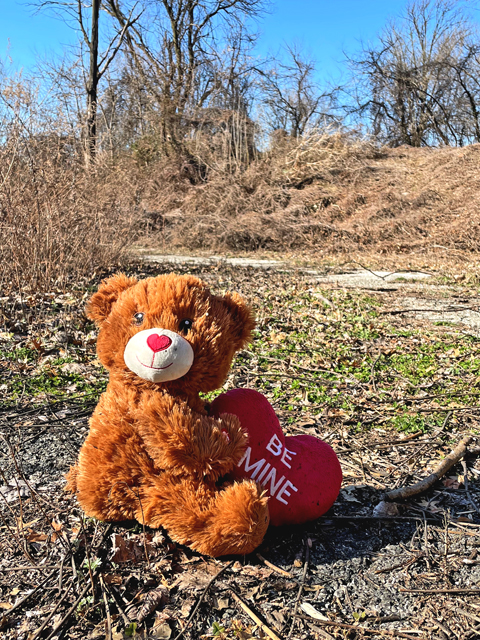
Why are there so many toy stuffed animals lying about throughout Mount Vernon Cemetery? 

There are no visitors to place them on graves in loving memory of the deceased. There are no visitors. There is no visitor access. You can almost picture some hideous beast living in its burrow, periodically feasting on stuffed animals. The ones you see here, matted down with weeds and rain, well, don’t really belong here, do they? The trapped, partially dismembered clown fish above has a look of fear in its eye. 
Stuffed Animal Dystopia.

Its almost as if some beast killed them with its poisonous saliva and secreted a fluid to trap them in weeds until it later required a snack. Much like an insect that gets caught in a spider’s web. Perhaps this is simply attribution bias on my part. Perhaps not. One poor toy was in the process of being dragged into the beast’s lair as I stumbled upon the massacre scene. You can just hear Jennifer Lawrence singing, “The Hanging Tree,” right?

Into the lair of the beast ....

Do the toys get thrown over the fence by the caretakers of the active cemetery next door, as they clear graves prior to mowing? Then something, or some things, retrieve the toys and drag them through the fence into the abandoned graveyard. The mind wanders to Neil Gaiman’s The Graveyard Book ..and the toys Bod may have left lying around the cemetery in his formative years.

A fox, perhaps, requires such playthings? That, apparently, is the general thought if you read the Instagram posts by the volunteers now caring for the cemetery.

So, first off, Mount Vernon Cemetery in Philadelphia is no longer abandoned. Technically, it never was. It was simply ignored by its owner - for about twenty years. It is currently being maintained by many dedicated volunteers. There are regularly scheduled cleanup days and occasional tours, but access is closely controlled. Here’s a photo of my friend Kim posing with some bears during a recent tour.

Mount Peace Cemetery, next door, has always been well-cared for. It seems likely that somehow, these small grave decorations travel from there into unkempt Mount Vernon next door. Perhaps the wild foxes that prowl the wooded grounds of Mount Vernon steal these objects from Mount Peace in the night - they snitch Winnie-the-Pooh from a defenseless grave, and abscond through some hole in the cyclone fence into the wild next door. But to what end?

Mount Vernon’s twenty-seven acres is probably twenty percent cut back at this point, with nature having a twenty-year lead on the humans trying to tame the bush. So there are plenty of hiding places for fox, deer, and so on. I’ve seen small herds of white-tails leaping through the underbrush. Sometimes you’ll even see shredded toys, along with …. bones?

So, do the red foxes drag the stuffed critters into their burrows for padding? Groundhogs do this – but with them, its usually the flags from the little flagpoles people stick on graves. But then, why are they scattered all over the grounds? That’s like saying if humans are descended from apes, then why are there still apes?

What I don’t know about the housekeeping habits of small woodland creatures could fill volumes. Perhaps instead, UFOs are involved. Whatever the case may be, if you find yourself walking through a more-or-less abandoned cemetery alone and you round a bend to find this Ted smiling at you in the middle of the road, your brain does not race for a logical explanation. Your brain screams.


Saturday, January 27, 2024

Snow, Tombstones, and a Camera: A Hilarious Frolic in the Cemetery (by ChatGPT)

"Jesus, its cold out here ..."

Intro: If you were weirded out by my previous post, “Photographing Cemeteries in the Snow: A Frozen Elegy,” which I admitted at the end was generated by the IA program ChatGPT, here’s a doozy. I thought I would test the ap by inserting the word “funny” into my request. To wit, write a “500 word funny essay on photographing cemeteries in the snow.” Here’s where we landed. Like my previous post, I just added photographs that I took last week during and after a couple snowstorms in the Philadelphia/south Jersey area. The title was ChatGPT's idea.

Calvary Cemetery, Cherry Hill, NJ
Photographing cemeteries in the snow might sound like an odd choice for a lighthearted escapade, but sometimes humor emerges from the most unexpected places – or in this case, from the frosty embrace of gravestones and the whimsy of winter.

First things first, navigating a snow-covered cemetery with a camera is like trying to salsa dance in flippers – it's entertaining, awkward, and you're bound to draw some puzzled looks. Picture this: a photographer attempting to capture the perfect shot, slipping and sliding on icy paths, all while trying not to disturb the eternal slumber of those beneath. It's a slapstick comedy waiting to happen.

Calvary Cemetery, Cherry Hill, NJ

The snow, in all its fluffy glory, has a knack for turning tombstones into shape-shifting snow sculptures. Forget about reading the inscriptions; half the time, you're left deciphering what might be a name or just a whimsical snow doodle left by a particularly creative winter sprite. Perhaps the dearly departed are playing a frosty game of hide-and-seek, leaving photographers scratching their heads and chuckling at the snow-covered riddles.

Old Camden and Evergreen Cemeteries, Camden, NJ

Now, let's talk about the snow angels – not the celestial beings, but the unintentional ones photographers end up making. The cold ground and the excitement of capturing the perfect shot can lead to unexpected acrobatics. You might find yourself unintentionally channeling your inner winter Olympian with a graceful, or not so graceful, snow dive. The camera might capture a breathtaking shot, but the outtakes reel is a comedy goldmine.

Snow Angel, Woodlands Cemetery, Philadelphia

Evergreen Cemetery, Camden, NJ
As if nature itself is playing a prank, the weather during a cemetery photoshoot can be as capricious as a mischievous imp. One moment, the sun is casting a warm glow on the snow, turning the cemetery into a winter wonderland. The next, a snowstorm sweeps in, and you're left frantically trying to protect your camera from an unexpected icy baptism. It's a classic case of "weather, you had one job!"


Sheltering in place, Calvary Cemetery, Cherry Hill, New Jersey

.

Evergreen Cemetery, Camden, NJ

And let's not forget about the ghostly footprints that appear on the snowy canvas. In a normal world, these might evoke a sense of mystery and intrigue. In the world of cemetery photography, they're more likely to make you wonder if the resident spirits are testing out a new pair of snowshoes. Who knew the afterlife could be so fashion-forward?


As photographers tiptoe around the cemetery like clumsy ballet dancers, the hush of winter is occasionally interrupted by the unexpected symphony of wildlife. Squirrels, confused by the human antics, might decide to join the photoshoot, photobombing your carefully composed shots with their acrobatic antics. It's a woodland comedy show with an audience of one – you and your camera.

In conclusion, photographing cemeteries in the snow is a hilarious adventure, a quirky dance between the living and the departed, and a reminder that humor can be found even in the most unexpected places. So, grab your camera, put on your most absurd winter gear, and embark on a frolic through the snow-covered tombstones – who knows, you might capture the laughter of the dearly departed echoing through the frosty air.

Colestown Cemetery, Cherry Hill, New Jersey

Epilogue: WTF? …"weather, you had one job?" What ... does that mean? "Hilarious," as the title implies? Well, no. This is a fairly ridiculous and repulsive essay. Hopefully, my photos gave you a chuckle, at least. Rest assured, future frolics will be in my own awkward hand. I like giving new technology a shot, though. It helps me thrive as my truest self (a line I stole from one of the characters in the television streaming series, “Beef”).