Showing posts with label cemetery statues. Show all posts

Friday, April 26, 2024

A Last Visit with Old Friends - Perhaps


Heading into a weekend at the beginning of February, 2024, snow was forecast for Friday night into Saturday morning. I had such a rough week at work that I was looking forward to sleeping late Saturday and Sunday. Cemeteries in the snow is an adventure I normally look forward to; however, I was pooped.

I woke up at 8 a.m. Saturday (slept over two hours later than usual!), looked outside, and saw that about three inches of snow had fallen. It was still snowing. Do I venture out? Adventure calls. What the hey. I felt up to it. My wife and daughter wouldn’t even be awake for hours, so I decided to head out. Cemetery of choice? Holy Cross Cemetery in Yeadon, PA. This is about ten miles west of where I live in Philadelphia, just outside its border where Delaware County begins. Holy Cross is the first cemetery I every photographed in, back in the late 1990s. I used to live nearby. It’s a good choice in the snow for a few reasons:

  • Many, many sculptures, statues, and other structures low to the ground. Interesting to photograph normally, even more interesting covered in snow.
  • The terrain is FLAT! However, even with a front- or four-wheel drive vehicle, icy hills are not your friend!
  • The cemetery is very large, with many trees. Plenty of areas for wildlife, e.g. deer and fox. (Other than geese, most of the wildlife was hidden during my visit).


Once I got to Holy Cross, it was still snowing lightly, with a six-inch layer of the fluffy stuff on everything. I drove to a few of my usual favorite spots, alternating between my iPhone, Holga (120 mm film), and DSLR to capture certain images. While it is true what they say – the right kind of camera is the one you have with you, I do prefer the flexibility. For instance, there's no way I could simulate a tintype image like the one at right without the Hipstamatic tintype ap on my iPhone.

I drove around the icy roads in my old RAV4 – stopping often to step out into the snow to photograph something or other. Since I fell on the ice this winter and hurt my shoulder, and my left hip is shot (surgery scheduled for April 29, 2024), I have become rather adroit when it comes to safety in the snow and ice. Which of course means that currently, I am rather limited in my hiking and trudging abilities. After the hip replacement (well, after the oxycontin wears off), I have already planned two cemetery adventures with friends. I may even take up parkour in the more densely-monumented cemeteries. (Not.)

It dawned on me during my peregrinations that I was visiting some old friends, statues I had photographed many times throughout the past twenty years. After photographing a few new scenes and some old ones, I turned around and saw this pillared angel, one that I had photographed countless times. In fact, it was the first cemetery angel that caught my eye, ever, back in the film photography days of the late 1990s. It looks uncannily the same, down to the missing arm and weird horizontal lash marks.

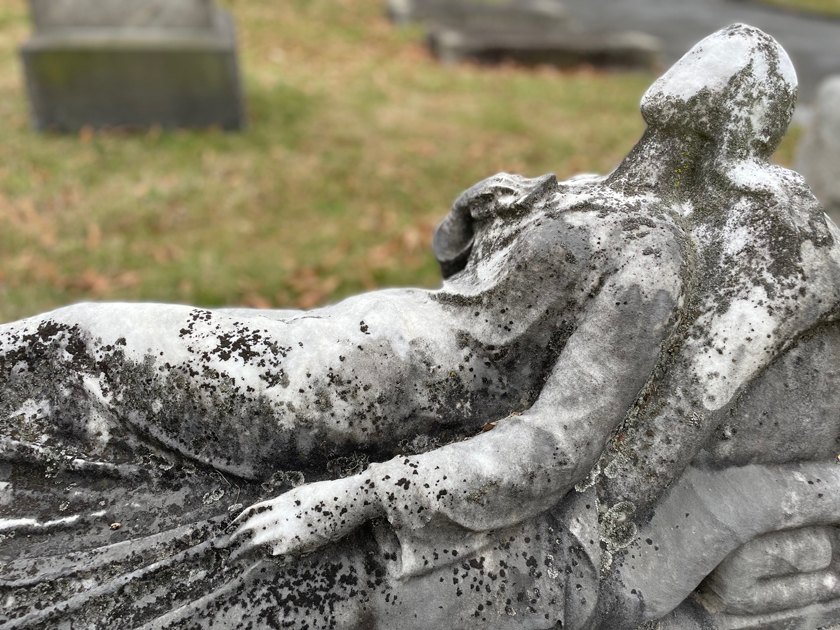
Which is more than I can say for the other statues I subsequently photographed. Weathering has caused loss of detail, lichens have darkened faces. Cemetery statues age just as humans do, but show their age more slowly. Even this Victorian-era marble statue of a young girl has deteriorated under her protective metal and glass. Or maybe, because of the metal and glass.

The veiled face of this soul emerging from its coffin has lost what little detail its winding sheet suggested. The diaphanous, sensual angel below has become darkened with interminable age and grime. The pure snow, which can give a squalid scene a fresh, clean, heavenly appearance, simply accentuates her age, these many years later. Or maybe to me, it just gives her a Dorian Gray-like appearance.

But these are old friends. I shouldn’t be critical. The hooded bronze figure above and the green patina Virgin Mary are ageless, and the snow allows them to be photographed with less distraction in the background. I didn’t want to turn my head on the bronze BVM below while she was holding that snowball. After shooting three statues in various areas, I intentionally drove to a few more of my past haunts. None ever disappoints. Statues erode and change with time, yet are always interesting. A blanket of fresh snow brings out new personalities in the sculpture and statuary.

As I was writing this, I realized I had neglected one of my oldest friends. Such is the plethora of artwork here at Holy Cross, that it is easy to miss a few. choice beings The image below of the mourning woman is from a few winters ago. She's always interesting, as is the entire monument. But you'll just have to visit to see it. I added a bit red to the snow, just because.
 

My cold winter trek only lasted an hour or so, and oddly took on the purpose of visiting these statues almost for the sake of just VISITING them, rather than looking for artistic, photographic opportunities. It was snowing lightly as I left my old haunt, my old friends, in Holy Cross. I remember thinking the snow would soon be gone, as would I. Not forever, though, hopefully. This is the last blog I’ll post before going under anesthesia and the knife, to have my hip replaced. I’m assuming I’ll wake up and write again, but if not, I promise to come back and haunt you all. Peace out.


Saturday, January 27, 2024

Snow, Tombstones, and a Camera: A Hilarious Frolic in the Cemetery (by ChatGPT)

"Jesus, its cold out here ..."

Intro: If you were weirded out by my previous post, “Photographing Cemeteries in the Snow: A Frozen Elegy,” which I admitted at the end was generated by the IA program ChatGPT, here’s a doozy. I thought I would test the ap by inserting the word “funny” into my request. To wit, write a “500 word funny essay on photographing cemeteries in the snow.” Here’s where we landed. Like my previous post, I just added photographs that I took last week during and after a couple snowstorms in the Philadelphia/south Jersey area. The title was ChatGPT's idea.

Calvary Cemetery, Cherry Hill, NJ
Photographing cemeteries in the snow might sound like an odd choice for a lighthearted escapade, but sometimes humor emerges from the most unexpected places – or in this case, from the frosty embrace of gravestones and the whimsy of winter.

First things first, navigating a snow-covered cemetery with a camera is like trying to salsa dance in flippers – it's entertaining, awkward, and you're bound to draw some puzzled looks. Picture this: a photographer attempting to capture the perfect shot, slipping and sliding on icy paths, all while trying not to disturb the eternal slumber of those beneath. It's a slapstick comedy waiting to happen.

Calvary Cemetery, Cherry Hill, NJ

The snow, in all its fluffy glory, has a knack for turning tombstones into shape-shifting snow sculptures. Forget about reading the inscriptions; half the time, you're left deciphering what might be a name or just a whimsical snow doodle left by a particularly creative winter sprite. Perhaps the dearly departed are playing a frosty game of hide-and-seek, leaving photographers scratching their heads and chuckling at the snow-covered riddles.

Old Camden and Evergreen Cemeteries, Camden, NJ

Now, let's talk about the snow angels – not the celestial beings, but the unintentional ones photographers end up making. The cold ground and the excitement of capturing the perfect shot can lead to unexpected acrobatics. You might find yourself unintentionally channeling your inner winter Olympian with a graceful, or not so graceful, snow dive. The camera might capture a breathtaking shot, but the outtakes reel is a comedy goldmine.

Snow Angel, Woodlands Cemetery, Philadelphia

Evergreen Cemetery, Camden, NJ
As if nature itself is playing a prank, the weather during a cemetery photoshoot can be as capricious as a mischievous imp. One moment, the sun is casting a warm glow on the snow, turning the cemetery into a winter wonderland. The next, a snowstorm sweeps in, and you're left frantically trying to protect your camera from an unexpected icy baptism. It's a classic case of "weather, you had one job!"


Sheltering in place, Calvary Cemetery, Cherry Hill, New Jersey

.

Evergreen Cemetery, Camden, NJ

And let's not forget about the ghostly footprints that appear on the snowy canvas. In a normal world, these might evoke a sense of mystery and intrigue. In the world of cemetery photography, they're more likely to make you wonder if the resident spirits are testing out a new pair of snowshoes. Who knew the afterlife could be so fashion-forward?


As photographers tiptoe around the cemetery like clumsy ballet dancers, the hush of winter is occasionally interrupted by the unexpected symphony of wildlife. Squirrels, confused by the human antics, might decide to join the photoshoot, photobombing your carefully composed shots with their acrobatic antics. It's a woodland comedy show with an audience of one – you and your camera.

In conclusion, photographing cemeteries in the snow is a hilarious adventure, a quirky dance between the living and the departed, and a reminder that humor can be found even in the most unexpected places. So, grab your camera, put on your most absurd winter gear, and embark on a frolic through the snow-covered tombstones – who knows, you might capture the laughter of the dearly departed echoing through the frosty air.

Colestown Cemetery, Cherry Hill, New Jersey

Epilogue: WTF? …"weather, you had one job?" What ... does that mean? "Hilarious," as the title implies? Well, no. This is a fairly ridiculous and repulsive essay. Hopefully, my photos gave you a chuckle, at least. Rest assured, future frolics will be in my own awkward hand. I like giving new technology a shot, though. It helps me thrive as my truest self (a line I stole from one of the characters in the television streaming series, “Beef”).


Sunday, January 29, 2023

Clutching


Laurel Hill Cemetery, Philadelphia

Look closely at the hand above, see how it is pulling on the bed covers? It appears to have a death grip on the sheets. This is a fairly common sculptural element in cemetery art. It’s impact was rather lost on me until I made this photograph. Well, not exactly when I MADE it, more so when I reviewed the images on my phone the next day. Why? Mainly because it reminded me of a Cemetery Traveler blog I had written some years ago. 

As I described in my June 17, 2020 post, “Johnny Thunders Dead in New Orleans,” (link below) I described how the guitarist formerly of the New York Dolls had a death grip on his bed covers when the hotel caretaker found his lifeless body. This was at the St. Peter Guest House – a rooming house - in New Orleans, in 1991. Thunders’ death grip may have looked just like what you see carved in this statue.

http://thecemeterytraveler.blogspot.com/2010/06/johnny-thunders-dead-in-new-orleans.html

So, what exactly is a “death grip?”

 “Death grip: A cadaveric spasm described as an instantaneous tightening of the hand or other body part at the time of death, the mechanism of which is unexplained.”

https://medical-dictionary.thefreedictionary.com/

Woodlands Cemetery, Philadelphia

At some point back in 1999, I spent a couple days photographing New Orleans cemeteries. As I described in the blog post mentioned above, I also visited the St. Peter Guest House, being a New York Dolls fan. Johnny Thunders died here. The Dolls were a flamboyant glam rock punk band that came into being in 1973, the mechanism of their popularity being also largely unexplained. Back then, you would rarely admit in public that you listened to glam or punk. Now, of course, their music is almost considered “classic rock.” I doubt the Dolls would have expected that their music would be listened to FIFTY years later!

By the same token, I certainly did not expect to be talking to the man who found Johnny’s body when I visited the St. Peter Guest House. As I have previously written, “Royce found Johnny on the floor next to his bed with the bedsheets crunched in a deathgrip by his stiff hands.” I invite you to read my account of this adventure here.

It is odd how things you see, smell, hear, and taste can remind you of a past experience. Often, the memory jumps to the forefront of our consciousness without warning. This is actually a good description of the New York Dolls themselves. In 1973, they jumped to the forefront of the music world’s consciousness without warning. 

In the same way as the death grip adds a stark, mortal detail to the serene form of these statues, we can be reminded of how Johnny Thunders and the Dolls added a stark, mortal detail to music’s serene form in 1973. The Dolls were scraping, clutching their way toward stardom, in the midst of the serene popular music hits of 1973. Take a look at the list below to see what they were up against. We always need someone to continually claw at the sheets of complacency.

Top Songs of 1973  (https://top40weekly.com/top-100-songs-of-1973/)

1 Tie a Yellow Ribbon Round the Ole Oak Tree - Tony Orlando & Dawn

2 Bad, Bad Leroy Brown - Jim Croce

3 Killing Me Softly with His Song - Roberta Flack

4 Let’s Get It On - Marvin Gaye

5 My Love - Paul McCartney & Wings

6 Why Me - Kris Kristofferson

7 Crocodile Rock - Elton John

8 Will It Go Round in Circles - Billy Preston

9 You’re So Vain - Carly Simon

10 Touch Me in the Morning - Diana Ross


Friday, November 16, 2012

Scanning Old Cemeteries

I bought a flatbed scanner this past year, with the intention of scanning the thousands of cemetery negatives I shot between 1998 and 2005. I haven’t been scanning everything, but selecting specific images to print and post on Facebook and other social media.

Daughter Julie holding umbrella
Looking at a contact sheet has the ability to pull me back to the day I made the images. Digital photography does not have this effect on me. Sure, an individual digital image may conjure up the memories, but the contact sheet (shoot this) can present you with your entire body of work for the day in one glance. It’s an interesting feeling.

 Julie enjoying a sno-cone
One of the sheets I was scanning the other day had my daughter Julie in some of the frames. She was about eighteen at the time (2000) – she’ll be thirty this December! Julie would visit cemeteries with me once in a while, often assisting me with my gear, but also making photographs herself. The images you see here were from a particularly snowy day at Holy Cross Cemetery in Yeadon, Pennsylvania (just outside Philadelphia, on the southwest side). Holy Cross was a few miles from the house in which we used to live, and was my destination of choice during inclement weather.

Why inclement weather? Living near a cemetery was great – if it rained or snew, I’d be right there. Cemetery statues just look very interesting and different when they’re under the duress of storm clouds or swirling snow. From time to time, Julie would come with me to help carry my tripod and other equipment so I wouldn’t be freezing my hands (or other body parts) off. She would also hold a reflector or a rain umbrella over my head (and camera) so I could get the shot I wanted.

Photo of Scarlet by Julie Snyder (see her website)
It seems that dragging Julie around to cemeteries had a weird effect on her – she lives near a different cemetery now and walks her dog there (she is very responsible, and picks up after her dog). Not so unusual, you may be thinking; however, she plays hide-and-seek with the dog by lying down in sunken graves! She’ll be playing with the dog and when the dog looks away at a squirrel or something, Julie will dive down into one of those depressions in the ground (ground settles over time as a casket deteriorates if it’s not inside a concrete vault) and hide. The dog will whip back around looking frantically for her and so on. You would certainly guess correctly that this is my child.

Thursday, June 2, 2011

Secrets of Cemetery Monument Revealed

While every tiny tombstone and each magnificent cemetery memorial must have a story associated with it, the Gardel monument in Philadelphia’s Mount Vernon Cemetery is, in my opinion, highly unusual. Why? Because every aspect of its mysterious symbolism is documented.

The monument is the most conspicuous sculpture in the cemetery, being twenty-five feet high, pyramid-shaped and adorned with white marble statuary. Its right side can be seen from Lehigh Avenue, if you peer through the trees and weeds. Mount Vernon Cemetery is a strange place, whose story is a mystery to most people (even the folks who run Laurel Hill Cemetery across the street). It is kept locked up, and rarely do you see anyone at the gatehouse inside the entrance. In summer, the foliage is so overgrown that all you can see of the magnificent monuments are the tops of the obelisks here and there. Winter is the only time to see anything through the fencing. If you're very lucky, someone might answer the phone and you might schedule a time to be allowed in. Or, if you happen to drive by and see the guy with the truck inside the gate, you can accost him and see if he'll let you in. You're not allowed to walk around by yourself, either!

The Gardel monument with its brownstone pyramid and white marble figures seems to be an exercise in symbolism run amok. But how often do we get a precise description of such symbolism? Not very. The monument was constructed in the memory of Julia Hawks Gardel, who died in 1859, while "on tour" in Damascus, Syria (which I take to mean she was on a trip).

Author and historian Tom Keels says in his book, Philadelphia Cemeteries and Graveyards, “For many years, the Gardel monument was featured extensively on Mount Vernon brochures…today the monument stands guard over a derelict cemetery.” I located a brochure (circa late 1800s) at the Historical Society of Pennsylvania, in which the monument is described as a "splendid work of art." And it is that. To get an appreciation for the size of its marble statuary, note Frank, my photographer friend standing amidst the statuary. The sculptures are quite beautiful, albeit weathered and worn, with trees and vines growing in the cracks between the pyramid's brownstone blocks.

 Stereoscopic photograph of Gardel Monument, c. 1865  (ref.)

A friend of Frank's recently happened to acquire a vintage stereoscopic ("3-D") photograph of the Gardel monument (shown above), which has a printed explanation of the memorial on its back.While some mourning art is expressed with symbolism of a general kind (for example, a pyramid usually signifies 'eternity'), the Gardel monument was instead designed very purposefully to relate to the life - and death - of the deceased, Julia Gardel. In my experience, it is unusual to find such specifics in funerary art, where typically the highly personal meanings of statues and monuments have been lost to the ages. I've transcribed the description word for word, so please excuse the misspellings and odd terms.


            "Descriptive"


The Gardel family, while traveling from Jerusalem to Damascus, was attacked by the Bedouins,causing the death of Mrs. Gardel soon after arriving in Damascus.

Representatives of Europe, Asia, Africa, and America were present at the funeral, hence the artist’s idea – a funeral procession. A figure, representing Europe, preseded by a Genius with torch and key, who deposit the cineary urn in the pyramid.

Asia, represented by a female figure, seated on a camel in a kneeling posture.

Africa, a beautifully posed Egyptian female, reclining on a sphinx, an Egyptian emblem − head and chest of a woman, posterior portions the lion − typical of the overflow of the Nile, which always occurs under the signs of Leo and Virgo.

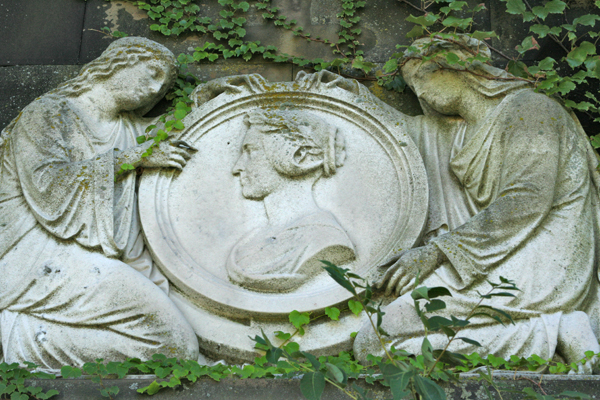
 The bas-relief over the door contains the bust of Mrs. Gardel, inclosed in a medallion, supported in the hands of hope and faith − emblems of the religious character of the deceased. The two figures are in the act of raising the medallion to the crown above it.

The uppermost figure represents America, surrounded by the emblems of the physical sciences, cut on both sides of her socle, and with one arm resting on the Bible, deposits with the other, on the head of the deceased, the crown of Immortelles, awarded to her long and earnest labors in the mental and moral education of American youth.


                Sculptor, G. Geef, Brussels, Siolvar of the King of Belgium. Cost, $31,000.


Julia and her husband Bertrand Gardel were teachers in Philadelphia, and must have been quite well off to afford such a cemetery memorial and a trip overseas (especially on a teacher's salary!). Bertrand Gardel, a French teacher and patron of the arts, was kind of mentor to the artist Thomas Eakins (at the time also a Philadelphia resident). According to author Sidney Kirkpatrick, Gardel "exposed Eakins to sculpture while supervising the construction of a 25-foot high monument he commissioned for his wife’s burial plot at Mount Vernon Cemetery." Further quoting Kirkpatrick from his book, The Revenge of Thomas Eakins, "the imposing pyramid-shaped memorial, gathering allegorical figures in mourning after a design by the Italian sculptor Antonio Canova, inspired Tom to try his own hand at funerary design." Bertrand Gardel himself was immortalized as one of the chess players in Eakins' painting, The Chess Players (1876). Bertrand is buried with Mrs. Gardel, having died 36 years later in 1895.

References and Further Reading: 

The Gardels on FindAGrave.com 
What are Stereoscopic Photographs?


Monday, February 14, 2011

The Art of Sensual Statues in Cemeteries

Ah, Valentine’s Day, when people’s fancy turns to love and, let’s face it, sex. On walking through just about any Victorian cemetery established after 1850, one is likely to see sensual female figures, carved from a variety of material – granite, marble, bronze. This is especially true in France and England, the birthplaces of the “garden cemetery.” For the uninitiated, garden cemeteries are essentially outdoor sculpture gardens, conceived in Europe in the Victorian era (1837 – 1901) to try and dispel some of the fear and bleakness associated with death and dying. Pere Lachaise in Paris and Highgate in London are examples.

The practice carried across the Pond in 1831 with the founding of Mount Auburn Cemetery (Cambridge, MA) and then Laurel Hill in 1836 (Philadelphia, PA). Statues in these and other Victorian cemeteries hearken back to a time when these unique memorial gardens served the public as an idyllic getaway from the noisy city. Now forgotten by the public and worn by the elements, this rare artwork was enjoyed by our ancestors long before museums, galleries, and parks came into being.

Now, you’d think statues of semi-nude women would have clashed with staunch Victorian sensibilities, wouldn’t you? Especially in a cemetery – a reverent and respectful place frequented by the public! What role do these women play in the grieving process? They are symbolic, of course, but of what (besides affluence)? These typically life-sized sensual figures do give memorial parks a feeling of life, which really was the intent of the architects of early garden cemeteries.

In his book, Death: The Trip of a Lifetime, Greg Palmer offers that in many cultures, “women are the designated grievers.” Ok, but why physically attractive females? David Robinson says in his book Saving Graces, “Their gowns are revealing and they are often topless and sometimes nude.” He goes on to say that these statues were usually individually commissioned and sculpted, often by famous sculptors. In Western artistic tradition, the ability to accurately depict the female figure is what most defines artistic talent. So again, why physically attractive females? While her countenance may effectively express true sorrow and loss, even anguish, there are no ugly angels.

Besides the fact that most professional sculptors were male (we’ll assume at least some of them, like Rodin, were heterosexual) and these commissions afforded them a regular income, sensual statues provided an opportunity for them to bring their artistic fantasies to life for a noble purpose. A female friend of mine once referred to such sensual mourning statuary as “Mourn Porn.”

Whose is Bigger?

So that covers females, but what about the male nude? Why do we see no copies of Michaelangelo’s (anatomically correct) David in cemeteries? Maybe because the results would generate such public outcry, that the penises would be broken off, as was done to the Oscar Wilde monument in Paris’ Pere Lachaise Cemetery! (Afterwards, the cemetery’s director supposedly used it as a paperweight.)

While its true that we see a male angel once in a great while, most male statues in cemeteries depict the actual deceased man, often in a formal or noble pose. The allusion to male sexuality in mourning art is a bit more subtle, usually. Maybe you have to view it from a female perspective, but don’t all those obelisks below seem a bit phallocentric? In fact the tallest funeral monument in the United States was erected (pun intended) in Philadelphia’s Woodlands Cemetery in 1897, an obelisk that stands 150 feet high (below, left)!

Woodlands Cemetery, Philadelphia


Gee, it seems that when male sexuality is involved, the results get pretty dramatic. There was an incident in a Philadelphia suburb in 2003 that blatantly brought to light the competitive nature between two men. Rival businessmen Goodin (1836-1890) and Gallagher (1834-1915) were both buried in the St. Denis Church Cemetery in Havertown, PA. Goodin died at age 54, leaving orders to erect an imposing 20-foot-tall monolith atop a 10-foot-tall granite base. Church history offers this analysis: "He had to call attention to himself even at his own demise." Missing his friend and favorite adversary, Gallagher slyly bought the neighboring grave plot. He would wait 25 years before death let him claim final victory: an even more magnificent monolith of paler granite set atop an ornate base, the whole structure soaring to a pyramidal point about three feet higher than Goodin's highest point. In 2003, a storm toppled both monoliths.

So let's try to put all this Mourn Porn in perspective. If death is portrayed as beautiful, perhaps it will lose its sting. For Romeo and Juliet, as with the Romantic era in general (1825 – 1900), death was the focus of extreme emotion and the ultimate expression of love (Robinson, 1995). This period of time coincides with Victorian era, in which the idea of death in art and popular culture became less associated with horror and fright and more with love and desire. No other era in Western culture has ever exhibited to such an extent the artistic emphasis on death as a visible part of the consciousness of an entire population.

In her book Mourning Art and Jewelry, Maureen DeLorme tells us that the pressures of continually facing death as an intrusion (French Revolution, Napoleanic Wars, high mortality from plagues and disease, etc.) made the need to keep both the presence of the departed near at hand while at the same time bidding farewell. So the idea of sculpted sensual beings in cemeteries became a tangible realization of a new Western psychology. Their purpose? To comfort the living and soften the finality of death. While angels may epitomize the tension between freedom and confinement, the sensuals walk the tightrope between spiritual purity and earthly desire. Undeniably conflicting, yet totally human forces of nature.

Links of Interest:

Death: The Trip of a Lifetime by Greg Palmer
Read about the Woodlands Cemetery, and America's tallest cemetery monument!
Read about the competitive businessmen and their toppled obelisks!