Showing posts with label happy new year. Show all posts

Friday, January 2, 2026

A Cautionary New Year’s Tale Involving Cemeteries (the Non-ChatGPT Version!)

Whether you’re spending New Years’ Day visiting a premature baby in an ICU or waiting for your mom to die in hospice, you can’t help but wonder what the new year will bring. You hope its good – or at least as good as it can get. Life can be like standing in a graveyard while its snowing – you’re surrounded by death, but then something may soften the idea. You feel that newfallen snow brings the idea of new life, a fresh start.

So instead of an all-night tears-of-the-moon rain tonight, snow is forecast. The group of cemetery photographers I had planned to hang with tomorrow backed out due to the expected snow and icy conditions. But that’s why God created the SUV, am I right? Back when I drove Saab convertibles, I would’ve found myself begging off as well. But seeing as I have an SUV, I will be out there tomorrow morning in the snow. Supposedly it will still be falling in the morning. This will make my inner child very happy.

I have a go-to cemetery for snow days, with lots of angel statues and other monuments, so hopefully I’ll have some images to post with this piece. Make hay while the sun shines, they used to say. Or as an eighty-year-old woman told me yesterday, “have fun and enjoy yourself while you’re in your sixties and seventies!” Weird, but true. She said all your kids have grown, they have their own lives, and you can just go out and have fun. While its true that most of our knowledge of the world is vicarious, I hoped to meet some of my own snow ghosts to haunt my dreams.

And haunt me they did. I always figured that if I didn’t believe in them, they wouldn’t try to get me. But that does not always work. For instance, I was raised Catholic, twelve years of good-versus-evil Bible squitter. Then a couple weeks ago, I started reading a book my friend George loaned me, by Randall Sullivan, called The Devil’s Best Trick (2024, Atlantic Monthly Press). The trick is that the devil has convinced us that he’s not real. 

I began reading the book in bed. Read about twenty pages, and put it beside my pillow and went to sleep. What I read had not been scary. The book is comprised mainly of historical accounts, exorcisms, and the author’s experiences. I awoke from a really disturbing nightmare. Something dark was slowly flapping its wings as it sat on a sort of altar inside a sort of church. Really nothing more to it than that, other than the feeling of intense evil. I tried going back to sleep, but was too wired. I took the book from beside my pillow and threw it under my bed. I fell asleep just fine.

Maybe the snow tomorrow will white-out some of the evil surrounding us these days. At least until it melts and things resume looking shitty again. Slowly, the dirty soil bleeds into the white snow. But a lot of that is perception, right? When Victoria Wyeth gave a recent talk on how her grandfather Andy painted snow, she presented four categories, something like, flurries, footprints, melting snow, and dirty snow. The dirty snow intrigued me. She explained how the soil’s brown colors were drawn up and absorbed by the snow, changing its colors in subtle ways. It had gone far from being simply “dirty” snow – now it was snow tinged with raw or burnt umber. It really is all in your perception of things, right? So is dirty snow evil, filthy, or just tinged with brown pigment? It’s a perception thing – you need to choose.

Sometimes a misimpression or misunderstanding pays off. Charles Dickens’ misperception of, or rather misreading of, Ebeneezer Scroggie’s tombstone in Scotland’s Canongate Kirk graveyard lead him to believe that Scroggie was “a mean man” - it actually said, “meal man.” Scroggie, it seems, was a successful corn merchant. Dickens conjured up the famous skinflint character Ebeneezer Scrooge based on his idea of what he thought Scroggie was – a mean man. So Dickens’ mistake paid off, obviously. (Ref.)

What then will the new year bring? Misperceptions? Mistakes? Sure. Lean into them, learn from them. Certain experiences can create an artistic epiphany as sometimes happens with snow falling in a graveyard. Maybe you pivot your old way of thinking, like the “ah-ha” moment I had last week when I realized why metal water bottles are so popular. After dragging some women to the new Neil Diamond-themed movie, “Song Sung Blue,” I was about to apologize, thinking they’d found it boring. Then I realized they were drunk and didn’t care. Its been, what, twenty years since metal “water bottles” became a thing? It never occurred to me that anyone would fill them with anything but water. Well, Bob’s your uncle, as the Brits say. Same startling realization as when I found out that the song, "Over the Rainbow" from The Wizard of Oz is the most famous Jewish song ever. Didn't know that, hmm? Written by two Jewish immigrants about hope, the promised land, and exile.

So after all, it snowed a bit last night, but then turned to freezing rain. The snow was tentative, I realized that. I wasn’t treating the situation like it would be the last dinner on the Titanic. When I went to the cemetery this morning, it was not what I expected, or hoped for. (Really, what is?) Instead of standing inside a calm snow globe that someone had just shaken, I was greeted by icy roads and ice-covered monuments. I spent about two hours trying not to kill myself on the ice and made a few photos while I was at it (much to the amusement of the drivers of the two plow trucks parked on the property). As I grabbed onto the base of a monument to keep myself from falling, I wondered what other purpose these monuments served. 

Why do monuments even exist? Sure, we all know they are meant to memorialize someone or something. In her article, “What monuments stand to teach Americans about themselves,” (Spectator, December 2025) Julia Friedman says that they show us “just how attached we are to grievance…reimagining defeat as victory.” A beautiful angel carved in granite indicates to us that even though the deceased person may have died, they succeeded in being borne aloft by angels to the heavens, and to their eternal reward. Success! Victory over death! Bullfeathers. Would we install a monument on the grave of the hiker who was killed by a mountain lion in Colorado on New Years' Day? 

Fancy cemetery monuments and buildings with your name on them do not define your life – your actions do. Whether you feel like last year was a dumpster fire or the Second Coming, keep in mind what ChatGPT said in my last blog post: cemeteries remind anyone seeking fresh beginnings of an inconvenient truth: Time does not reset. It only continues—and it keeps excellent records.

So for the new year, maybe be more realistic? Be more artistic – add beauty to the world. As the great philosopher Frank Zappa said, the human mind is like a parachute – it works best when its open. Accept your mortality, and that of others. There are so many choices in life that sometimes it looks like a Chinese menu. Buy that dog for your kid. Accept that people lie to you. Accept that people are lying to you every day. In my previous ChatGPT-created post, I lied to you. Maybe do your children a favor and lie to them every once in a while (but point it out shortly afterwards). Explain it to them as a life lesson – people will lie to you, so don’t be like a heifer to the slaughter, as musician Brian Eno sings in “Baby’s on Fire.” Instead of memorializing oneself with an expensive monument, maybe focus on making the world a slightly better place. Otherwise, the new year will suck as badly as the old one. Remember the Devil’s best trick… that the Devil has convinced us that he’s not real. 

I’ll leave you with the last verse of Eno’s “Baby’s On Fire.” Maybe it relates to your life, your job, your nation. Maybe in the new year, we should all show more respect for each other. I’m not expecting perfection, and neither should you. I’ll be happy with a six-seven year.

“But baby's on fire!
And all the instruments agree that
Her temperature's rising
But any idiot would know that”

++++++++++++++++++++++++++++++++++++++++++++++++
 
Read my previous post, which I authored with the use of ChatGPT,  
"A Cautionary New Year’s Tale Involving Cemeteries:"

Wednesday, December 31, 2025

A Cautionary New Year’s Tale Involving Cemeteries


On the last night of the year, the town gathered where it always did: not in the square, not by the river, but at the old cemetery on the hill.

This was tradition, though no one could quite remember how it began. Lanterns were hung from iron hooks, their light trembling over dates and names. People brought thermoses of cider, paper hats, and a confidence that the year ahead could be bargained with if approached respectfully—preferably where time had already lost.

“Midnight sounds clearer up here,” someone always said.

What they meant was that silence sounded clearer.

Among the crowd was Jonah Pike, who had decided—after a year of broken promises, missed chances, and a calendar that felt more accusatory than helpful—that this New Year’s Eve would be different. He would confront the year properly. He would be honest. At five minutes to midnight, Jonah wandered away from the lanterns and found himself before a modest stone, its lettering softened by decades of weather. He did not know the name carved there, but the dates caught his attention. The life between them was shorter than Jonah expected.

“Sorry,” Jonah murmured, for reasons he couldn’t explain.

The wind moved through the trees, and with it came a peculiar sound—not a voice, exactly, but the sense of being corrected. You’re not sorry, the silence seemed to say. You’re impatient. Jonah laughed nervously. Cemeteries had a way of doing that to people: making thoughts sound like answers.

As the final seconds of the year were counted—ten, nine, eight—the ground felt unusually solid beneath his feet, as if it were listening too. At midnight, the bells rang from town below. Cheers erupted. Corks popped. Someone tripped over a headstone and swore, then laughed.

Jonah, however, felt something shift—not beneath him, but behind his eyes. The year ahead unspooled in quick, unasked-for images: postponed apologies, health ignored, hours squandered, love treated as renewable instead of fragile. Nothing dramatic. Nothing supernatural. Just ordinary regret, arriving early.

The cemetery, it seemed, did not traffic in ghosts. It dealt in inventory. Jonah understood then the unspoken rule of the hill: you didn’t come here to celebrate the future. You came to measure it—against what was already finished. He walked back to the lanterns quieter than before. When friends asked what he wished for, he surprised himself by answering honestly. “Less later,” he said. “More now.” They laughed, assuming it was a joke.

By morning, the cemetery was empty again, holding its names and dates with patient neutrality. It would be there next year, and the year after that, ready to remind anyone who came seeking fresh beginnings of an inconvenient truth: Time does not reset. It only continues—and it keeps excellent records.

++++++++++++++++++++++++++++++++++++++++++++++++++++++++

Hey, that was almost interesting, right? I typed the title into ChatGPT and this is the AI slop it spat out. The photos are actually mine. Please stay tuned for my original New Year's piece tomorrow! Same title, this time my original writing. No more jokes!


Friday, December 31, 2021

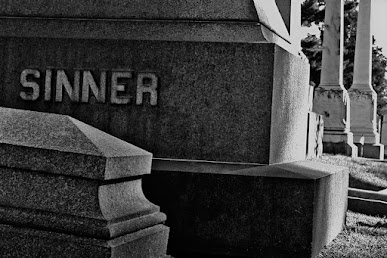
Yonder Stands the Sinner


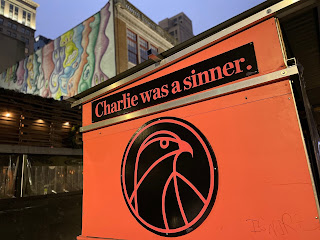
This is an end-of-year, new beginnings post. There is a restaurant/bar in Philadelphia called “Charlie was a Sinner.” I used to work a few blocks away, but never went in. Never understood the name, though I’d always been intrigued by it. As a recovering Catholic, sinning is a familiar concept to me. A way of life. 

So I was driving through center city Philadelphia last week with my twelve-year-old daughter, who is Jewish. She looked out the window, and said, “What does that mean?” I said, its probably an inside joke, maybe the owner called it that because of her friend Charlie? My daughter said, “No, I mean, what’s a ‘sinner?’”

I was speechless. I thought she was kidding. As a product of twelve years of Catholic education (I’m talking 1960s hardcore burn-in-hell Catholic conditioning), I am well aware of sin. We were taught that we were born with “Original Sin,” which could only be cleansed by Baptism. I was Baptized, and spent the rest of my life “sinning.” From grade school through high school, I confessed the mild ones to a Catholic priest in the Sacrament of Confession. 

My wife is Jewish – and as a result, our daughter is too. Jews don’t believe in sin, the way Christians do. In fact, “in Judaism, it is believed that all humans enter the world free of sin.” (The Jewish Concept of Sin (learnreligions.com). What a concept of purity, huh? I never knew this. Our daughter has been attending Hebrew School for most of her life, and has basically been taught to do good things, rather than to not do bad things. Kind of takes the wind out of Neil Young’s sails, when he sings:

“Well, I was about as scared

as I could be.

I went and hid

behind the nearest tree.

Peeked out

from behind the branches.

Sinner!

Yonder stands the sinner

He calls my name

without a sound …”

- Yonder Stands the Sinner, Neil Young

But don’t get the idea that Jews have it easier than Christians – you know those ten commandments? Well, Jews have 613 commandments! Jews focus on missing the mark of goodness when they go astray. And sure, they do wrong and seek forgiveness just as Christians do. Jews, in fact, are encouraged during Yom Kippur, to seek out anyone they might have offended and sincerely request the person’s forgiveness (ref.). A bit more difficult, more humbling and effective, I would say, than confessing your “sins” to an anonymous priest. 

“Greasy Stanley”

I want this blog to be about purity, about goodness. That New Years’ Resolution stuff brings me to the subject of “Greasy Stanley.” My dad, who died in 2004, used to like to tell this story at the turning of each year. When he was a young man, probably in the 1940s and 50s, there was a garage, a gas station/auto repair shop in Luzerne, PA. When you drove your car alongside the pumps to get gas, the owner, who my dad referred to as “Greasy Stanley,” would emerge from the garage where he’d been working on cars, to pump your gas. He always wore the same blackest, greasiest overalls imaginable. Hence the nickname. 

The scene repeated itself all year, except on New Year's Day. Greasy Stanley bought himself one new pair of white overalls every year, and donned them on New Years’ Day. I’m sure it was quite a shock for people to see him in stark white clothes! As the days went on, the clothing got dirtier and dirtier. Greasy Stanley began each year pure as the driven snow, but then ever so gradually, returned to his old ways. Kind of like how people fail to keep their New Year’s resolutions. The point is, though, that he gave himself a fresh start every year. 

I’m considering starting the new year like my daughter and Greasy Stanley. Don a new clean outlook focused less on sin avoidance and more on doing good. And if things get a bit dirty in the process, so be it. 

Like Greasy Stanley, we all know we’re going to mess things up eventually. He never donned those overalls thinking they’d stay white for more than a day. It’s not really a hope for the future as much as it is a new beginning. Sure I’ll mess things up this coming year, but maybe I’ll approach 2022 more focused on doing good things. The words I saw yesterday might be a great mantra for the new year.  They were stenciled on the back of a tractor-trailer I saw as I was driving up the turnpike. A company, oddly, called “Kane is Able” (it seems like so much of the world is focused on sin!) had these sage words to offer:

“BE KIND

 BE CAREFUL

  BE YOURSELF.”