Showing posts with label photographing tombstones. Show all posts

Saturday, April 14, 2012

What do you want on YOUR tombstone?

Pizza commercials aside, ten years ago I thought it unnecessary for me to have a tombstone, or a grave marker of any sort. Kind of selfish of me, I suppose, since I spend so much time photographing, reading, and researching other people's tombstones! I just figured, cremate me and throw my ashes to the winds (or better yet, pour them in the gas tanks of cars owned by people who really pissed me off in life!).

I’d also felt that there was a bit of vanity associated with cemetery memorials, especially the gaudy mausoleums. Would I mmortalize myself in stained glass, for instance? I’m a lot of things, but vain isn’t one of them. However, I just finished reading Douglas Keister’s novel, Autumn in Summer, and I now am thinking that maybe I would like a tombstone.

Available from Amazon
Keister is a photographer of cemetery monuments, who happens to also write eloquently and prolifically about them. In fact he has thirty-nine books to his credit! His glossy coffee-table book, Going Out in Style catalyzed my interest in photographing cemetery objects about a decade ago. In his current book, a mystery novel,
Keister incorporates many of the things he's learned about cemeteries in his travels. It's quite interesting reading for the taphophile.

There’s an interlude in the narrative of Autumn in Summer where the protagonist states to a cemetery worker how he doesn’t want a tombstone when he dies. The worker tells him that while it doesn't matter whether you get cremated or buried:
"You need to leave your name behind somewhere. Cemetery's just a spot where you're better assured permanency. While there might not be much left of your physical remains, seeing your name on a piece of stone gives your descendants a better sense of who they are. We need to leave our name somewhere. People need to come to a place to remember us, to connect to us, to connect to themselves, to connect to the past and the future... People come thousands of miles just to see a name, to make that connection."

Author with Friend
I am reminded of the situation involving my research on the discarded tombstones from Philadelphia’s Monument Cemetery. My writing has inadvertently put me in touch with many people who are looking for a trace of their ancestors. When the cemetery was condemned and demolished in 1956, thousands of bodies were removed and reburied in mass graves in a suburban cemetery (Lawnview Cemetery in the Rockledge section of the city), without so much as a plaque indicating their presence. Their thousands of headstones were dumped into the Delaware River, to be used as a foundation for the Betsy Ross Bridge. So for people looking for physical traces of their ancestors, there are none to be found. I guess I don't want this to happen to me.

So I thank Mr. Keister  for allowing me to think of headstones in a different way. As he puts it, a mechanism that will allow me to leave a tangible trace of my existence so that loved ones, friends, and curiosity seekers have a place to land when they want to think about either me or their own mortality.

So what would I like on my tombstone? Keister says,"You only get one chance to make a last impression." Maybe I'd like some weird sort of statue? Or a photo of myself on a simple stone? How about an epitaph? Maybe some pithy phrase or some strange symbols I’ll  make up just to mess with people’s heads? Something like this, perhaps:

Given my penchant for trespassing, maybe an appropriate engraving for me would be:

Ed Snyder  1958 - ____
“Forgiveness is easier to get than permission.”


References and Further Reading:
Douglas Keister on Facebook

Monday, October 24, 2011

Beginning to Die - The Strange State of Mt. Moriah Cemetery

Things are beginning to die once again at Mount Moriah Cemetery, in southwest Philadelphia. It is October, when the grounds unveil their new fall wardrobe. Which is essentially the opposite of what the living do as it gets colder − a paring down, a baring-all in comparison to its heavily clothed leafy summer atire. It’s really the only time of the year to see this enormous Victorian cemetery in all its run-down glory. No camouflage to mask its sores, no briars and poison ivy left to prohibit access to its most forbidden corners. 


Volunteers pruning trees
The volunteer clean-up crews have died out for the season as well. As the heavy weed growth has been curtailed by Mother Nature, there is no need for whacking, mowing, and raking. Though an enormous amount of maintenance and restoration can keep volunteers busy all winter, the idea may to avoid burning out the willing help. 

As one of the registered volunteers, I received this letter last week from the Chief of Staff at the Philadelphia Managing Director’s Office. I thought it would be of interest to all my readers to see what goes on behind the scenes of keeping a cemetery from dying. Maintaining any cemetery as a viable business is not an easy thing to do, which is no wonder so many succumb to abandonment.  Read on, you may learn a bit about the biz. You’ll also see how a cemetery can be managed quite unscrupulously.

(Photographs by Ed Snyder)

All - I have been asked by a number of stakeholders to recap what's happened around Mt. Moriah Cemetery.  That overview is below.  As you'll see, this situation is complicated and there's no easy answers.  However, I'm confident that by working together, we'll continue to make progress.
If you have additional questions, please let me know.
 
Brian Abernathy, Chief of Staff
Managing Director's Office
Suite 1430 Municipal Services Building
1401 John F. Kennedy Blvd.
Philadelphia,  PA  19102
T:
(215) 686-2134
C:
(267) 455-4444

Mt. Moriah Cemetery – An Overview

Background and History
Mt. Moriah Cemetery is an historic burial ground incorporated by an Act of the State Legislature in 1855.  While reports indicate that the Cemetery is 380 acres, a review of real estate records indicates that it is approximately 200 acres.  Philadelphia and Yeadon share approximately equal shares of the Cemetery.
 
Since its founding, the Cemetery has been governed and cared for by the Mt. Moriah Cemetery Association.  In 2004, the last known member of that Association, Horatio C. Jones, Jr., passed away.   From 2004 until March 2011, the Cemetery appears to have been operated by an employee of the Association. 
  
The State still recognizes the Mt. Moriah Cemetery Association as the legal owner and operator of the Cemetery; however, because the last known board member has passed away, no individual exists to act on the Association’s behalf.  As such, no responsible party is present to assist with maintenance, burials, disinterments or the placement of headstones.
 
Sometime after the mid-1950s, the Association established a Perpetual Care Fund to assist in the long-term maintenance of the grounds.  The Fund would deposit a percentage of the cost of the burial lot into a separate account.  The interest earned on the account was to be spent to maintain the grounds and the principal of the account was not to be spent. 

In March, the City was made aware through news reports and citizen phone calls that Mt. Moriah had ended its business operations.  To our knowledge, no one from the Association informed the State, the City or the funeral directors that had worked with the cemetery of its intent to close.  
 
Since first hearing of the closure, the City has led a working group consisting of representatives of Yeadon, Council President Verna, Councilwoman Blackwell, Councilman Jones, Representative Waters and Senator Williams.
 
Governing Authorities
Cemetery operations are governed by state law and regulated by the Commonwealth’s Real Estate Commission.  However, the Commission’s authority is limited to licensing and ensuring that proper payments are made to the Perpetual Care Fund. The City itself has no specific oversight of cemetery operations although the City’s Property Maintenance Code does apply in the maintenance of the buildings and grounds not occupied by existing burial lots.

Burned-out car hung up on gravestone
There is no state or local agency directly charged with regulatory oversight of cemetery maintenance or the physical conditions of burial lots; however, the failure to properly maintain the cemetery may constitute a misdemeanor under the State’s Burial Grounds Law and other criminal violations may have occurred.
 
The Pennsylvania Attorney General has received complaints alleging consumer fraud relating to the purchase of burial plots that may no longer be available.  The Attorney General cannot confirm or deny that an investigation is ongoing; meanwhile, other state agencies may also be conducting their own, independent investigations. 

Maintenance and Records
Cemetery forest
The Cemetery has been poorly maintained for decades with many of its historic sections overgrown and wooded.  Since its closure, the portions of the Cemetery that had previously been maintained by the Association have deteriorated.   Because business operations have ceased at the Cemetery, there is no operator to coordinate and consent to the placement of new headstones, and, regardless of whether or not burial plots were previously purchased, no operator to coordinate and consent to new burials on the property.  
 
Mount Moriah Gatehouse, Kingsessing Avenue
Because of the condition of the property and the deterioration of the historic gatehouse, which is on the Philadelphia Register of Historic Places, the City instituted a Code Enforcement complaint against the Association.  The City named the Association and Lydia Jones – the widow of the last known board member of the Association - as defendants.   Lydia Jones appeared through an attorney and claimed that she has no substantive relationship to the Cemetery.  
 
The City’s action against Mount Moriah revealed that the Association that owns and operates the cemetery has not had a board of directors or any other person authorized to act on behalf of the Association since 2004 when the last board member of the Association, Horatio Jones, died.  
 
Due to overgrowth of foliage, mausoleums can only be seen in winter.
Since the Association is a non-stock entity there are no shareholders to push for the election of new board members.  While it is still a validly existing entity in the eyes of the Commonwealth of Pennsylvania, there are no individuals that are duly authorized to run and operate the business.
As such, it is unlikely that the Court will hold any person, in their individual capacity, responsible for the property maintenance violations.
 
Through this lawsuit, the City also learned that the balances of the bank accounts owned by the Association are too low to effectively operate the Cemetery.  This issue has been reported to the Real Estate Commission, the Attorney General and District Attorney.  
 
Graffitied mausoleum
As part of the City’s court action, the Court allowed the City access to the property to abate the most egregious conditions.  The City’s vacant lot program was able to cut the grass on a significant portion of the property at a significant cost.  This effort culminated in a community event organized in larger part by three community organizations: the Friends of Mt. Moriah, Save a Grave for Mt. Moriah and Build a Fence for Mt. Moriah. The Association has been billed and a lien will be placed on the property for the full amount.  

These community groups have committed to provide best efforts to maintain the property for the immediate future and several additional community clean-ups are scheduled. Estimates for annual maintenance of the entire property are approximately $500,000.
 
Yeadon side, Cobbs Creek Pkwy.
Because of the resources required to maintain the property, Yeadon has not been able to take the same action as Philadelphia; however, they are moving forward with property violations and intend to lien the property.
 
Because of the imminent threat of damage to the historical records contained in the Association’s office, the Court authorized the City to remove and secure the historic records.  The records are currently being stored by Iron Mountain, a records storage company.  The City’s Consumer Affairs Advocate Lance Haver is the point-of-contact for family members inquiring about their loved ones.
 
Ongoing Operations – The Long-term Issue
The future operations of the cemetery are complex and must account for a number of issues.  
        Considerations include:
        The Cemetery is one of the few cemeteries in the City known to accept Muslim burials.
        The Cemetery is one of two in the vicinity known to accept “communal” burials – burials where three bodies share one grave and are a less expensive option for many families.
 
        The Cemetery charged approximately $1500 per burial – a much more affordable option than other cemeteries, which charge up to $5000 per plot.
        Approximately 60% of Philadelphia’s portion of the cemetery and perhaps more of Yeadon’s portion – including the most important historical sites - is overgrown and inaccessible to the public.  
        While approximately 80,000 dead are buried in the Cemetery, by most reports, there is still significant space for additional burials.
        As previously mentioned, the perpetual care fund – a fund established by law in the 1950s to guarantee ongoing cemetery maintenance into which 10% of the plot cost is to be deposited – and the general operating account do not have balances sufficient to maintain the property.  
 
        Several reports have indicated that burials may have not occurred properly (i.e. within a drainage area) and there are unconfirmed reports that multiple burials have occurred in single (not communal) plots.
        Because of the questions surrounding the Cemetery’s operations, whatever entity takes control of the Cemetery in the future must be protected from the Association’s past liability.
 
The Cemetery contains several historical burials including soldiers of the Revolutionary, Spanish-American, Civil and both World Wars.  
        Notable individuals buried at the Cemetery include Betsy Ross (thought to be moved in the mid-1970s); George Connell, Philadelphia’s first Mayor; Senator Israel Wilson Durham, a former President of the Phillies; John Whitehead, singer, songwriter and producer; and Henry Jones, fugitive slave turned successful restaurant owner that won a landmark Supreme Court decision to allow his burial at the cemetery.  
        
Several churches moved their cemeteries to Mt. Moriah over the years.  Notable sections include: First Baptist Church, St. Paul’s Presbyterian Church, St. George’s Methodist Church and others.  Several Masonic Lodges also have specific sections and the Beverly National Cemetery maintains veterans’ sections.
        The Cemetery may be a node for the East Coast Greenway.
        Because of these historical and environmental attributes, funds may be available through historic preservation, recreation and environmental grants.
        Because the Cemetery is an important resource to several racial, religious and socioeconomic stakeholders, it is important to guarantee stability of its future operations.  
 
Today, the Mount Moriah Cemetery is owned by a defunct non-profit corporation and the Cemetery cannot continue its business operations unless and until the ownership issue is addressed. In order to obtain a new owner for the property court action is likely required.  
 
Yeadon and Philadelphia are currently negotiating the development of a new not-for-profit organization to take ownership of the property.  Because of the complexity of the issues and in order to insure a similar situation does not occur in the future, ongoing municipal involvement is important.  While the organization would be led by the municipal governments, the organization’s board would be as diverse as those interested in the Cemetery and include representatives of different races, religions and backgrounds. 
 
Funding
There are several opportunities to fund the new organization and improve the Cemetery’s current conditions.  Historic preservation grants, storm water management fees, funding as a portion of the East Coast greenway, environmental protection grants and donations from stakeholders like the various churches, masons and veterans’ organizations are all potential funding sources. Cemetery operations could be funded by new burials.  Once the site is abated, most death care industry experts believe the cemetery may be self-sustaining.


Thursday, July 7, 2011

How to Paint Tombstones

Moonlit scene, Laurel Hill Cemetery, Philadelphia
I thought that might get your attention! I’m actually referring to the photographic technique, "painting with light." Over the years, I’ve toyed with the idea of going into a cemetery at night to take time exposure photographs of statues and monuments, illuminating them solely with a flashlight. The idea is to essentially photograph the darkness, while gradually illuminating the object by “painting” it with a flashlight beam. The only real gear you need is an SLR camera, tripod, and flashlight. Oh, and a cemetery at night.

That last issue was resolved for me last month when my friend Frank, who works at Historic Laurel Cemetery in Philadelphia, suggested getting a group of photographers together for a full moon shoot on the grounds.
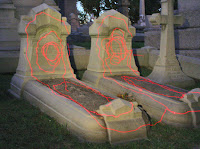
Before I went, I could have read up on painting with light techniques, but as is my nature, I prefer to learn from my own mistakes. At the time, a laser pointer seemed like a cool idea – you know, outlining the statue, drawing fine designs. Well, as you can see from this image at right, such technique requires much practice! And since I have the patience of a gnat, I’d be better off next time just illuminating the entire statue with a broad flashlight beam, like my friend Zen Bojczuk did with this image below.

Photo by Zen Bojczuk
Before I get all technical on you, let me share some images with you from Zen Bojczuk’s Facebook album from that evening's shoot, "Graveyard Shift." (His gear and settings: Camera: Pentax K10D; Lens: Pentax 18-55 at F8 - F11; ISO 100). Also, being in a graveyard at night is a bit unsettling, even if you are there with a group of people. We all sort of wandered off in different directions as we waited for the full moon to appear (hoping of course, that it would not be accompanied by werewolves). I chose to make some photographs behind Millionaire’s Row, the hillside stretch of fancy Gilded Age mausoleums. Peering into the rear windows of these buildings (like the one at the top of this article) at night is enough to give you the willies – and it certainly doesn’t calm your nerves when you scare a bunch of bats off their roost in a nearby tree!
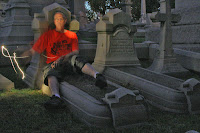
While we all waited for it to get dark enough to start our light painting, I played around with ghost images of myself (long shutter speed, hit the self-timer, then run over and get in the scene).

Photograph by Frank Rausch
Other photographers like Frank were somewhat more productive, making wonderful moonlit images like the one above. (His gear and settings: Camera: Nikon D90; Lens: AF-S Nikkor 18-105mm f3.5-5.6G; ISO 400; 30 - 40 second exposures). About 10 o’clock the full moon seemed to just appear. Since I didn’t know exactly where it would be, it was difficult to plan on what statues to photograph. You can photograph them lit by the moon itself, but that’s not really what I wanted. If the scene is evenly lit, albeit dimly, your camera will just compensate for the low light and provide you with a best possible exposure, which will probably just look like a very grainy daylight photograph. When you paint with light, you illuminate a specific object or objects, while everything around it will be dark (unless lit by other sources, e.g. street lights). The moon itself is best used as a compositional element, a point light source to add interest to your scene.

Shooting the Moon
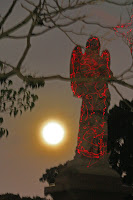
 
When you look at my photo at left, why is the moon just a bright ball of light? Shouldn’t a rising moon (think wolf moon or harvest moon) be big and yellow, allowing you to see its crater details? You’ve seen the photos − a properly-exposed moon rising above a dim landscape like the one below. Well guess what?  Such photographs are impossible to take. They are all doctored!
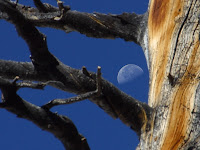
Yosemite Moon stock photo (ref)
They’re either double exposures (two separate images sandwiched together) or Photoshopped to dim down the bright moon and/or boost the brightness of the landscape (this is the principle behind HDR, High Dynamic Range, which essentially evens out the range of an image’s brightness extremes). If you’re a photographer, you know you can’t have a properly-exposed bright object and a properly-exposed dim object in the same image. Photography doesn’t work that way. Neither do your eyes, by the way. Your brain compensates for such differences in brightness almost immediately, making you THINK you see everything with even brightness. Consider those times you’re driving and are blinded by the headlights of an oncoming car – overpowers your ability to see anything else, doesn’t it? Well, that’s how a camera reacts to exposing for a bright moon – all other dimmer detail is lost.

What Camera Should You Use when Painting with Light?
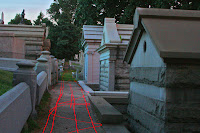
While you can hypothetically set a point-and-shoot digital to make a 60-second exposure, its image sensor is not very light sensitive. This will result in grainy, mottled images. You’d have much better results with a DSLR, whose larger image sensor is much more light sensitive. (A film SLR will work fine too, only you won’t see your images immediately). Put the camera on a tripod and lock the shutter up or set the shutter speed to ‘B’ (shutter stays open as long as the shutter release is held), bathe the statue with your flashlight beam, then close the shutter. Of course to do this, you need a cable release or remote for the shutter – you can’t hold your finger on the shutter release for a minute because you’ll move the camera. You need the camera to be perfectly still during the exposure. Since I forgot my shutter release cable, I used the camera’s self-timer to initiate the exposure. The image above was made with a thirty-second exposure, which gave me time to trace the walkway with my laser. The weird colors are a result of ambient skylight and my camera's image sensor misbehaving in its non-linear region (different image sensors will respond differently to low light situations). My gear, by the way, is a Canon Rebel XT DSLR with a Canon 28 -135mm lens. I shot at ISO 1600, which in retrospect, was a mistake. I should have used a lower light sensitivity, which would've underexposed the ambient-lit parts of the scene.

Exposure Settings

A reasonable point at which to start your experimentation is the "Auto" mode on your camera, though your results will vary widely from one camera to the next. In my book, Digital Photography for the Impatient, I refer to the prime determinants of a successful photograph (besides composition, which only the photographer can control) as LAFSLight sensitivity (ISO), Aperture, Focus, and Shutter speed. Outside in the sun, you can usually set your camera on ‘Auto’ and let it make all these adjustments for you. However, for painting with light, the ‘Auto’ setting probably won’t work that well. LAFS are critical when making photographs in low-light conditions, so it makes sense to know how to adjust all of them. You might even want to experiment with all manual settings, though I prefer to use aperture-priority. Let’s look at each of the settings individually.

Light Sensitivity (ISO)

Photo by Frank Rausch
You would think that to achieve a properly exposed image you’d want your ISO cranked to max in a situation where the light is extremely dim. Not so fast, 60-Wattson..You really don't want a properly-exposed image, you want the background to be black, and the subject to be well-lit. You’re being very selective here. Think about shooting fireworks – you really just want to record light trails on a black sky, right? You don’t want the sky to be “properly exposed.” So you really don’t want an ISO of 1600 or higher. Try ISO 400, like Frank did for the image shown here, or even ISO 100 like Zen Bojczuk uses! Seems counter-intuitive, doesn't it? But it works.

Aperture

This one’s a bit tricky. You would think shallow depth of field, wide open aperture, right? After all, You don’t need anything in front of or behind the statue to be in focus, just the statue itself. Also, a wide open aperture (f-stop) would allow your lens to gather more light. Ah, but this works against you. You actually want a small, closed-down aperture for two reasons. One, exposure time should be at least half a minute allowing you time to paint the object – a small aperture will force this (small aperture requires longer shutter speed). Two, a small aperture will allow your lens focus to be more forgiving. What do I mean by that? Read on!

Focus

Ever try to focus in the dark? Not so easy, is it? Automated cameras have different ways of doing this, and some focus better than others. Some focus ultrasonically or with an infrared beam, invisible methods which could conceivably give you a properly focused image. Others use a burst of the camera’s own on-board flash to illuminate the object, allowing the lens’ optical focusing system to make the necessary adjustment. You can also manually focus your lens by pacing off the approximate camera-to-monument distance then rotating your lens barrel to that distance (its handy to have a small flashlight to assist you in this process!). I actually had to manually focus because one of the people in our group had epilepsy, and an attack can sometimes be triggered by strobed light.

What I plan to do on my next light-painting expedition is bring a bright flashlight to illuminate the statue while I allow my camera to auto-focus on it. Then I'll turn the auto-focus to manual, locked at that proper focus, and start taking pictures. Another practical tip for manually focusing in the dark: after you estimate the distance the best you can, shoot at a small aperture (i.e., a high f-stop). The smaller the aperture, the greater your depth of field – which means that there will be more things in focus around your set focus point. A wide angle lens also works to your focus advantage –  a 28mm lens inherently has greater depth of field than a 50mm or longer lens, for example.

Shutter Speed
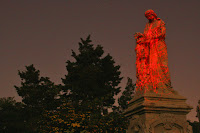
Lasered statue
Shutter speed, or your exposure time, needs to be long enough for you to paint the tombstone, statue, or monument. Generally, this might need to be 15 seconds or more, depending on how wide a swath of light your flashlight provides and how large the statue is. My shutter speed for the image shown here was about forty seconds – cut a bit short when a helicopter appeared out of nowhere! (In case you're unaware, you can get thrown in the slammer for such an irresponsible act as aiming a laser at an aircraft. Check out this Philly news item from April 2011: Man Gets 33 Months for Aiming Laser Pointer at Helicopter.)

Though you can paint with light using a film SLR, the beauty of digital is that an LCD display gives you instant feedback on your technique. You just need to understand LAFS so that you know what you need to adjust to make your next image better! As I was leaving Laurel Hill that night, it occurred to me for next time, why not get a few people with flashlights – and various colored gelatin filters – to bathe a statue in various colors while I photograph it! Psychedlia!

References and Related Links:

Read about Ed Snyder's book, Digital Photography for the Impatient
 
Zen Bojczuk attributes his knowledge of light painting to photographer Harold Ross. View Ross' "Night Portfolio" on his website.

Learn more about HDR - "High Dynamic Range"

Man Gets 33 Months for Aiming Laser Pointer at Helicopter