Showing posts with label headstones. Show all posts

Saturday, November 9, 2024

Emotions Evoked by Grave Markers


In September of 2024 I had a show of some of my cemetery photography at Box Spring Gallery in Philadelphia. It was called, “Ghosts.” Nine of my cemetery snow photographs were exhibited. The image you see here was one of the framed photographs.

During the opening reception, there was a woman with her daughter, walking from photo to photo, looking at each piece. I overheard their conversation in front of this one. The mom asked the girl, who was maybe six years old, “What emotion do you feel when you look at this?” The girl said, “I feel cold.”

The mom then said something like, “I feel cold too, but when I look into her eyes, everything seems to get warmer and the snow begins to melt away.” What an amazing observation. Very personal.

Because this statue has human-like qualities, it becomes easier to assign human characteristics to it. And so maybe it becomes easier to react to it in some emotive way. Annette Stott points out in her paper “Personhood and Agency: A Theoretical Approach to Gravemarkers in Mainstream American Cemeteries,”1 that there are various kinds of cemetery monuments ranging from those that bear no resemblance to a human being, to those that recall the human shape. These gravemarkers guarantee the deceased’s continued visibility into a distant future and bring new life to the person’s emplaced and re-bodied identity. 

That last line is a mouthful, but what she means is that long after the buried body has disintegrated, the gravemarker becomes a physical substitute for that person. If said gravemarker has a human form, it is that much easier to relate to it as the actual deceased person. 

Observers seem to find meaning in the images I make, probably different from the meaning or feeling the statue was originally intended to invoke. I try not to define these photographs. I’m usually surprised by peoples’ observations. I dislike giving the photographs titles, because that can very easily define a piece. The one at top is called “Denizen.” Kind of vague, right? Almost meaningless. That’s my intent. I would much rather the viewer find personal meaning in the work, as the mom did above.

Many of the images in the show were cemetery statues and all of them were photographed in the snow. They were challenging to make, since it was cold, windy, and sometimes snowing as I plodded through various cemeteries. So there is a story behind each piece, but I’m not there to recreate that for all viewers. That’s why I need each individual piece to stand on its own. Artists are sometimes urged to write an “Artist’s Statement” for an exhibit, to help put the work in perspective for the viewer. Sometimes this helps, sometimes not. As I said, I don’t really want to define everything for the observer. After they purchase a piece and live with it a few months or years, perhaps it will take on new meanings.

Artist Statement: A Frozen Elegy

Through the lens of a camera, cemeteries in the snow reveal a frozen elegy, where silence and solitude merge to create a visual ode to the eternal cycle of existence. The unpredictability of nature challenges me to create images that capture the ephemeral beauty of the moment.

A snow-covered landscape transforms cemeteries into a surreal and hauntingly beautiful realm. The soft white blanket conceals the intricate details of tombstones, creating a minimalist aesthetic that accentuates the stark contrasts between calm and suffering, between life and death.

There is something very intimate about being in a snow-covered cemetery by yourself. Leaving one’s footsteps in silence serves as a reminder of the shared human experience of mourning, remembrance, and the fact that life does, in fact, go on.

When I wrote the statement above, I was thinking more about the experience of making the photographs, and I hadn’t thought about the monuments, the statues, the tombstones themselves. The mom’s comments drew me back to the stones. 

At the time of the exhibit, I was finishing up a new book I’m writing called, “Abandoned Cemeteries of Philadelphia and its Environs,” and Stott’s comments kept coming back to me as I wrote about one abandoned cemetery after another. Her paper addresses the power that a gravemarker has over us. A stone is just a stone until a name and date are carved into it. Then it begins to take on an identity. When it is placed on a grave, it simply marks the spot where that person’s bones are buried. A century later, the bones are dust and the coffin probably disintegrated. At that point, when we look out over a cemetery filled with hundred-year-old gravestones, we see them as person substitutes. We don’t think of them all as simply marking the graves where the people are buried.

So to look back at a face in the snow and breathe life into it is not an unusual reaction. Many people have had some visceral response to a gravestone, a statue, a monument. Sometimes the encounter elicits an emotion that we have no name for. Stott does a wonderful job explaining why we react to gravemarkers the way we do.

“One way people demonstrate their humanity to themselves is through grave marking, an activity no other living being seems compelled to do.” – Annette Stott

The fact that the curator of the Box Spring Gallery, Gaby Heit, came up with the title “Ghosts,” for the exhibit was fortuitous. It made me think that the people buried beneath these stones are now nothing more than ghosts – the stone is all that is left. As there are probably no people still alive who even remember the deceased whose graves these stones mark, the stones may be the only tangible evidence left that these people even existed. They are truly, as Stott calls them, “person substitutes.” And because of that we react to them differently than we would to an unmarked stone found on a mountainside, for example.

Stott calls this “agency.” Art objects like grave markers have agency in that they are representative of the deceased, yes, but they can act as a surrogate, an “agent” for the deceased. The statue in the top photo, the denizen of some particular cemetery, is also bonded to that particular cemetery. All things equal, it will always be there, and only there. A sobering, if not chilling remark Stott makes is that:

“Gravestones designate a border between life and death, body and spirit, by marking the place on earth where the body is hidden from sight permanently.” – Annette Stott

So perhaps that is one reason we get a funny feeling when we look at a tombstone or monument in a cemetery - it brings to mind our own mortality. We see that border between life and death - our life, and eventually, our death. 

REFERENCES

1. Stott, A “Personhood and Agency: A Theoretical Approach to Gravemarkers in Mainstream American Cemeteries,” Association for Gravestone Studies, Markers Vol. XXXV, Sterling, 2019


Wednesday, April 26, 2023

Death's Head and Soul Effigies in the Graveyard, West Orange, NJ


I mapped out my pre-meeting destination a few days before my trip to north Jersey – the West Orange Presbyterian Church. Why? If I got to the Newark area a couple hours before our group meetup time (11 a.m.), I can fit in a visit to this place and photograph some of the death’s head and angel head gravestones not commonly found in the Philadelphia area.

The morning of my trip from Philadelphia to the Oranges (near Newark, NJ) was rather busy. This was a Sunday morning at the beginning of April, 2023. I drove my wife and daughter to the airport at 3:30 am, as they needed to catch a 6:30 am flight to Miami. The airline demanded a three-hour arrival time because of the near-tornado situation that occurred the night before. After dropping them off, I came home and packed my photo gear for the trip north (about a 2-hour drive). I figured if I got there early, I would just explore one or two other nearby cemeteries.

After I packed the SUV and started to drive out of my neighborhood, the “Low Air in Tire” light came on my dashboard. A nuisance that crops up once every six months or so. In BMW’s wisdom, they don’t actually tell you which tire is low, so you have to check them all. Sigh. So I drove a mile to my local air pump station at the car wash in South Philly, checked the tires, found out the driver’s side rear tire was low. Filled it up and hit the highway. 

Our meetup group of cemetery photographers planned to begin the day in Holy Sepulchre Cemetery, in East Orange, then close the day down the road at Fairmount Cemetery. My early solo trip would be a prequel. On the way up the Jersey turnpike, I decided on which of two nearby cemeteries I’d visit first – the 18th century churchyard of the Presbyterian Church in West Orange, and then, if time permitted, Mount Pleasant Cemetery in East Orange.


I found the church and graveyard without much difficulty, arriving about 8 a.m. Sunny, but chilly – maybe 40 degrees. My friend Phil told me this burial ground had a lot of “soul effigy” headstones, which I was eager to see. He believes it has the largest number of existing stones carved in this style by Newark’s Uzal Ward and his several imitators.

Soul effigy stones

Although there are some marble grave markers scattered along the front and sides of the church, the vast majority (literally hundreds) of markers here are of the brownish-red sandstone variety, commonly found from central New Jersey north throughout New England. Most are adorned with either the winged death’s head skull, or the angel head with wings. Inscribed death dates range from the early 1700s to the early 1800s. 

According to the Atlas Preservation article (ref.), Gravestone Evolution in America From the First Settlers to the Early Victorian Era, this locally quarried sandstone has “a very fine grain, and was relatively high in silicates. It tends to weather minimally and … concise lettering on stones dating back to as early as the middle to late 1600s can be easily read today…. “

This material is commonly known as “brownstone,” the slang term for sandstone that is brown in color. In the Atlas Preservation article, the author states that the reason sandstone was used was because “Stones needed to be soft enough to split and carved with hand tools, but durable enough to resist erosion.” It seems odd that it is so durable – you would think the “sands of time” would wear it down easily. The author accurately states, “A historical graveyard, and all that goes into it, is a kind of ancient puzzle, that I hope will intrigue you as it does me.”https://atlaspreservation.com/pages/american-gravestone-evolution-part-1

I’m no aesthete, but what I find most fascinating about these stones is the soul effigy carvings, as my friend Phil refers to them. He been sort of a death’s head divining rod for me lately – I really had no idea where to find them. Phil has explained to our Cemetery photography meetup group that such imagery is quite common in the old church graveyards of central and northern Jersey. 

Side door of First Shiloh Baptist Church, West Orange

This particular church, formerly Presbyterian, established in 1718, is now operated as the First Shiloh Baptist Church. The gargantuan brick and wooden structure has seen better days. It appears to be abandoned, but it is hard to say. Partially eaten food and canned goods rest near the entrances, trash surrounds the front grounds of the church, the woodwork is cracked and peeling. Although I saw no homeless people or vagrants in the area, it did appear to be a rest stop of sorts. 

Food at the front door.


Why such an equal mix of death’s head and angel head grave markers? Perhaps a hundred of each? I should have paid more attention to the death dates to see if they validated the following statement from Archeology.org:

“…the death's-head motif accompanied the harsh beliefs of orthodox Puritanism. Its replacement by the cherub reflected eighteenth century religious liberalization during the "Great Awakening," a period when some scholars believe orthodox Puritan views were being replaced by a more liberal perspective.” - https://archive.archaeology.org/8309/etc/gravestones.html


It would be interesting to see if the death’s head stones were generally older than the angel head ones. Maybe on my next trip - I guess that’s why they make tomorrows. 

My Next Adventure

Statue at First Shiloh
My next adventure turned out not to be Mount Pleasant Cemetery. After walking the grounds and photographing the headstones at First Shiloh for an hour, I jumped into the car to warm up, find a coffee shop, then zoom off to Mt. Pleasant Cemetery (about five miles away). As soon as I started my car, that pesky “Low Air in Tire” light came on my dashboard again. Rats! Obviously, I’ve got a slow leak. Where to find a tire repair place?!


Luckily, it was only 9 a.m. and I was scheduled to meet up with my friends at 11 a.m. So I had two hours. With my usual sangfroid, I typed “Tire Repair Near Me” into Google Maps on my cellphone instead of my typical message, “Cemetery Near Me.” Most places were closed, Firestone, gas stations, etc. However, there was a Mavis Discount Tire that opened at 9 am about five miles in the direction opposite my preferred direction. Beggars can’t be choosers, so off I went, tout de suite.

Took about half hour to get there, through lots of congested traffic areas, but I arrived about 9:30, and pulled into a large suburban retail resort. Drove past a Whole Foods in a strip mall to the Mavis at the bottom of the parking lot. Many cars in the parking lot. Ouch. Docked the Pequod and went into the customer area. At the counter I asked the fellow if they could fix a slow leak quickly. 

The guy started filling out the work order and asked me how far away I was visiting from, as he took the info from my Pennsylvania auto registration card. I told him a hundred miles away, and I need to get to a cemetery in an hour. He quickly looked up and a bit startled, said, “We’ll get you on the road as quickly as possible, sir.” I didn’t think I needed to explain that I was not heading for a funeral.

First Shiloh (Presbyterian) Church
I left my keys with him and told him I would walk up to the Whole Foods and be back soon. Feeling way more comfortable with the situation, I walked over to the Food Hole for coffee and a breakfast sammie. When I walked in I noticed they had potted gardenias on sale. I like having one in front of my house, so I figured I would buy one before I left. So after downing some breakfast, I bought a gardenia and headed down the parking lot toward Mavis Tire.

When I was about a hundred yards away, my cell phone rang. My car was ready. Thirty-two dollars to fix the nail hole in my tire and off I headed toward Holy Sepulchre Cemetery. For anyone’s reference, I give a five-star rating to the Mavis Tire Supply, LLC, at 235 Prospect Avenue in West Orange, New Jersey!

I ended up putting in a full day with my meetup friends at Holy Sepulchre and Fairmount Cemeteries, experiencing zero lassitude given the fact that I was running on about three hours’ sleep from the night before! But more on that excursion another time. The preprandial at Dunkin Donuts across from Holy Sepulchre helped me begin my day a third time - like a new angel getting its wings.


Sunday, November 28, 2021

Muddy Creek Headstones


Back in May of 2021, I participated in my first live-in-person-post-Covid art exhibition. It was the Oddities Bazaar in Denver, PA (near Adamstown which is near Reading). The show was great – at the famous Renninger’s Antiques Mall - but that’s not the point of this blog. The point is a graveyard. 

I’ve traveled quite a bit across the U.S. (and a bit in Italy) over the ten-plus years that I’ve been writing this blog, but COVID put a stop to travel for awhile, didn’t it? During that period I drove around the tri-state area near Philadelphia, where I live, but that was it. Adamstown was an unusual trip for me, only about an hour and a half due west, but still, farther than I’d gone in about 16 months. As I write this in November 2021, travel bans and lockdowns are pretty much a thing of the past. Its no longer unusual to see planes in the sky.

On that day back in May, I got to Renninger’s about 8 a.m., half an hour before setup. So of course, I grabbed my smart phone, hit the Google Maps app, and typed in “cemetery nearby.” Finding hidden gems was never this easy! (By the way, if you try this, you will get different results if you type in “graveyard nearby.” Go figure.)

So, up pops “Muddy Creek Church Cemetery,” no more than half a mile away. Great name! (If you go, the address is 11 S Muddy Creek Rd, Denver, PA 17517.) Shot over there to find the superb sign you see above. Also, the Muddy Creek Church is across the street. It’s a fairly large cemetery, with rolling hills and a central driveway – a few acres. To the right of the entrance are Victorian-era and newer grave stones, to the left are older ones, dating back to around 1730, when the cemetery was established. It was these older stones that caught my attention. 


From the road, just beyond the cemetery sign, were dozens of large brownstone gravemarkers, the kind I’ve seen carved with angel heads in North Jersey. This early in the morning, I could only see their plain backs. They were in shadow, but the other side of the stones – and whatever might be inscribed on them – were brightly lit by the morning sun.

Muddy Creek Lutheran Church in background

I drove into the cemetery from the newer entrance up the road, parked my vehicle as close to the old stones as possible, and got out to stretch my legs. Had about twenty minutes before I had to get over to Renninger’s to start setting up my photography, cards, books, and other items to exhibit and sell. As I walked up the hill, I noted a few really interesting marble-arched gravemarkers, the type of which I’ve only seen around the Pottstown, PA area. 

When I got to the brownstone markers, I was stunned! Looking at me from several stones were life-sized faces carved in bas-relief into the stone! I would guess these are likenesses of the deceased. I’ve never seen this anywhere else. I’ve seen some wonderful brownstone carvings of angels and winged death’s heads here and there, but I’ve never seen anything like this in brownstone! Was it a Pennsylvania Dutch or Amish thing to do? Some neighboring stones had floral design carvings, which reminded me of Amish quilts. 

But these plain folk are not into embellishment, right? Sort of like Quakers, with their simple flush-to-the-ground grass markers? Well, that may be the case with Amish gravemarkers, the Amish being a religious denomination (along with Mennonites, etc.) that falls under the “Pennsylvania Dutch” umbrella term. Some of these Pennsylvania Germans, however, who emigrated to Pennsylvania during the eighteenth and nineteenth centuries developed a highly artistic folk art called Fraktur, so named after the distinctive font style (see link http://frakturweb.org/). Most Fraktur art was created between 1740 and 1860.

The floral carvings on these stones at Muddy Creek seem to be examples of Fraktur folk art, though I am certainly no expert. All names and dates on these stones have been worn away, but the faces, the designs, the feelings remain. Certainly, the wilting flowers became a common, Victorian-era symbol of a life lost, a popular form of mourning art. Turns out I was wrong about these seemingly “simple people” – PA Dutch Fraktur folk art, popular in the early to late 1800s, was highly artistic, colorful, and used to adorn (and therefore closely associated with) rites of social life e.g. birth and marriage. Examples of the documents used to certify such events can be seen here http://frakturweb.org/what-is-fraktur/fraktur-gallery/. Death being a part of life, it makes sense that the Fraktur artistic style would be used to adorn their gravestones.

Mary Roach, in her book, SPOOK, says that readers assume that “authors are experts in the field about which they have chosen to write.” She offers that “Possibly I’m the only one who begins a project from a state of near absolute ignorance.” Well, no, she’s not the only one, LOL. Pretty much describes my approach as well, so I am asking for my readers to help me out! I’ve done a bit of research after the fact, but the faces still baffle me. I’m thinking they were prominent citizens of the area, since they would be the ones with the money to have such a memorial stone carved. It is fairly common to see faces, busts, and even entire bodies sculpted in granite in the Victorian era, but these brownstones seem to have been made prior to that time.

Offering a clue to the area’s history is this plaque on the cemetery fence, designating it as “Cocalico Area Historical Site.” According to the East Cocalico Township website, “The name Cocalico is believed to have originated from "koch hale kung", Delware Indian words meaning "den of serpents", apparently referring to the abundance of snakes near the creek at that time,” (the area being settled around 1723). Hmmmm….glad I didn’t wander off into the woods looking for the actual Muddy Creek. (https://www.eastcocalicotownship.com/about-your-township/pages/township-history)

New England boasts many fine examples of slate stones carved with a likeness of the deceased, and I’m wondering if any of my readers have seen the brownstone versions anywhere else, like these in Muddy Creek? I put their creation age around 1830, as that seems to be the death dates on the marble stones nearby, on which some inscription is still visible. The faces on these stones are not soul effigies, i.e., angel-winged head carvings, but, I believe, the likenesses of the actual deceased person. 

As I was wondering if anyone could shed light on this Muddy Creek Mystery, I happened on a couple recent Instagram posts by @deaths_heads_and_angels (the artist who also goes by the name of @phil_odendron and has become a personal friend over the past few months). He has published images of brownstone gravemarkers in this same geographic region of Pennsylvania, with folk art embellishments of the type I saw. His are mainly soul effigies, however – angelic death’s heads with wings, although he has found a few that do not appear to be skull-based, so they may be representations of the dearly departed (please visit his extraordinary collection of images at https://www.instagram.com/deaths_heads_and_angels/).


Author with Muddy Creek headstone
The progression of gravestone carvings went from the skull and crossbones era during the early 18th century to the softer, angelic representations as that century came to a close. Certainly, throughout this period, there were carvings that depicted the deceased, but now I’m wondering if there was a specific time, at least with those of German heritage in Pennsylvania, that this became a trend – somewhere between the death’s head and the soul effigy, or maybe during.


References and additional reading:

http://www.mclchurch.org/our-story.html

Fraktur Folk Art:

https://en.wikipedia.org/wiki/Fraktur_(folk_art)

http://frakturweb.org/

If you would like to browse my ETSY shop to see the kind of work I had for sale at Renninger’s, please visit here:

https://www.etsy.com/shop/StoneAngels


Saturday, March 4, 2017

Jewish Cemetery Vandalized in Philadelphia

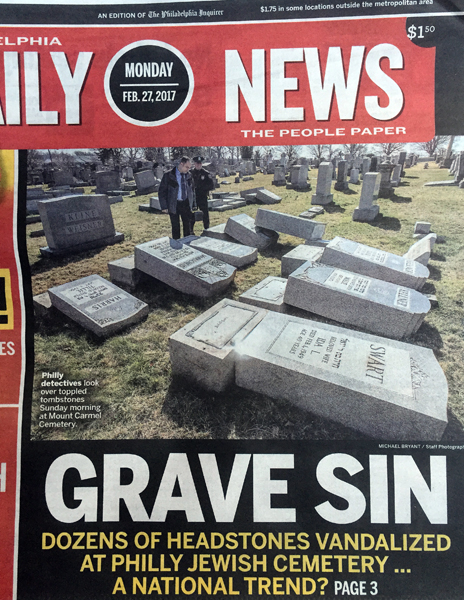
This has been a busy week for the small (Jewish) Mount Carmel Cemetery in Philadelphia. You’ve no doubt heard of the desecration - it became national news: 75 to 100 headstones were knocked over sometime Saturday evening, February 25, 2017. This follows on the heels of similar vandalism in Missouri, from February 20, when over 100 headstones were toppled in the Jewish Chesed Shel Emeth Society cemetery in University City, Missouri (see story at this link: https://www.youtube.com/watch?v=yO2QXjwYtg0).

Philadelphia Daily News
To fuel the fear of a “hate wave” spreading across America, about thirty bomb threats were made at the end of February to Jewish schools and community centers in eighteen states (see link). As of this writing, the case has been solved and seems to have been the work of one person, not related to the incident at Mount Carmel Cemetery.
A portion of the damage in Philadelphia's Mount Carmel Cemetery

Bad stuff, any way you look at it. However, I’m not going to jump on the hate crime bandwagon just yet, even though the FBI is investigating the vandalism. Why? Well, for one thing, thirty-three headstones were toppled last month in the Holy Redeemer Catholic Cemetery in the Bridesburg section of Philadelphia (see link), less than two miles from Mount Carmel. So it may not be antisemitism, just cowardly aggression toward those who cannot defend themselves – the dead. In both Philadelphia situations, communities have come together to repair the damage.

Volunteer registration at Mt. Carmel coordinated by the Jewish Federation of Greater Philadelphia

I’m still (perhaps naively) thinking it was a small group of drunken kids with beer muscles, at least in Philadelphia. Should the people responsible be caught and punished? Damned right. A $69,000 reward (it increases each day, see link) is being offered through a variety of sources for the apprehension of those responsible. 

Headstone fallen and broken in half
Looking at the situation from a vandal’s perspective, Mount Carmel was, unfortunately, an easy target. And that may simply be the main reason it WAS targeted. If you wanted to topple headstones, Mount Carmel would be a better choice than any of the cemeteries on the other three sides at this intersection (Cedar Hill and North Cedar Hill) of East Cheltenham Avenue and Frankford Avenue in north Philadelphia. At Mount Carmel, you are hidden from the road by the densely-packed headstones, making it easy to do your dirty work without being seen.

Mount Carmel Cemetery also has no road inside it so neither police, nor any other cars, can drive through it. Besides, the gates are left open at night, unlike the other, better cared for and more secure cemeteries. The rear gate opens up onto a parking lot and there is quite a bit of tree cover. These many drawbacks will be remedied, however, through the generosity of many donors - significant improvements will be made to the cemetery going forward. 

Wide open rear gate at Philadelphia's Mount Carmel Cemetery

Throughout this past week, hundreds of people have volunteered their time to help repair the damage done at Mount Carmel Cemetery. 

On March 1, 2017, I visited and spoke with members of the Jewish Federation of Greater Philadelphia, who were organizing the volunteer effort. A registration table was set up at the cemetery’s entrance, bottled water and bags for trash, branches, and weed clippings were provided. Dozens of volunteers (all races and religions) spent the day cleaning up debris, raking leaves and dead branches, and marking and cataloging the damaged grave stones. The Federation has been receiving calls from individuals asking if their ancestors’ headstones had been knocked over. They took it upon themselves to gather this information. Someone had placed cut flowers on all the damaged headstones and monuments. People are upset, but have joined together to correct the situation.

Philadelphia Inquirer, www.philly.com

I’ve seen damage in cemeteries, but I was not prepared for this. You can't really grasp the magnitude of the damage through on-the-ground newspaper photos. A hundred headstones does not seem like a lot, but Mount Carmel is not a large property. This may amount to a tenth of all the stones in the cemetery. The swath taken by the vandals is obvious, as you walk the length of the property. Stones are toppled throughout the center portion of the rectangular cemetery (east to west). The aerial photographs published by the newspapers give the best depiction of the extent of the damage. Seeing this atrocity in person is jaw-dropping – cracked stones, large monuments pushed off their pedestals, grave markers of all shapes and sizes knocked over.

From the Philadelphia Police Department
Anyone with information on the suspect(s) involved in this crime, please contact either:

·         Northeast Detective Division – 215-686-3153/3154
·         Philadelphia Police Tip Line – 215-686-TIPS (8477)
·         Tips via email – tips@phillypolice.com
·         Citizens Crime Commission – 215-546-TIPS (8477)

Jewish Federation of Greater Philadelphia Donation page for Mount Carmel Cemetery:


Preventing Future Damage
There is a clear message being sent to the criminals responsible for the Mount Carmel damage – the greater community will repair the damage and will prevent such damage in the future. Police will patrol the property 24x7 until the criminals are caught. Fencing will be improved.

“… the Philadelphia Building and Construction Trades Council offered to replace the toppled headstones and … the International Brotherhood of Electrical Workers Union Local 98 offered to install additional lighting and security cameras." -  http://www.jta.org/2017/02/28/news-opinion/united-states/philadelphia-labor-unions-offer-to-repair-secure-vandalized-jewish-cemetery

Mount Carmel is apparently an active cemetery, as I was told of a relatively recent burial here, 2015. There is a bit of pre-existing damage (a few fallen headstones), a bit of overgrowth, and some areas where the ground has subsided, causing a handful of grave markers to tilt. Clearly, work needs to be done here, especially if families have paid for “perpetual care.”
Volunteers bagging debris at Mount Carmel Cemetery

The lopsided headstones made me realize that before members of local labor unions are allowed to reset the fallen headstones, someone needs to consult a professional about a safe and secure way of doing that. Even if the stone base of the headstone is level, the headstone should be pinned to its base with steel or fiberglass rebar to prevent future damage. Believe it or not, many extremely heavy granite headstones simply sit on their bases! They are not fastened in any way, which is why people are injured or killed when headstones fall on them! If the base is not level, it needs to be leveled first, as shown in this video:


Pinning a headstone to its base is not an unusual practice, but it does cost more money, which is probably part of the reason it is not always done. Two holes are drilled in the base and the underside of the headstone, ... rebar is used to attach the stone to the base, then the joint is sealed to keep water from seeping into the joint between the stones.

“Blind Pinning is exactly what it implies, pins you do not see once the stone is installed. The concept is very simple. Holes are drilled in both the [headstone] and base at exactly the same locations so they match up when joined. Then metal [or other material] pins are placed in the holes, and usually mortared in place. The basic thinking was that if the monument was knocked or began to lean the pins would prevent a complete failure, and the damage this may cause.”International Southern Cemetery Gravestones Association, “HOW TO INSTALL A GRAVESTONE”


References and further reading:

Mount Carmel Cemetery 5722 Frankford Avenue Philadelphia, PA 19135. Phone: 215-535-1530. Fax: 215-535-5192 

Saturday, April 14, 2012

What do you want on YOUR tombstone?

Pizza commercials aside, ten years ago I thought it unnecessary for me to have a tombstone, or a grave marker of any sort. Kind of selfish of me, I suppose, since I spend so much time photographing, reading, and researching other people's tombstones! I just figured, cremate me and throw my ashes to the winds (or better yet, pour them in the gas tanks of cars owned by people who really pissed me off in life!).

I’d also felt that there was a bit of vanity associated with cemetery memorials, especially the gaudy mausoleums. Would I mmortalize myself in stained glass, for instance? I’m a lot of things, but vain isn’t one of them. However, I just finished reading Douglas Keister’s novel, Autumn in Summer, and I now am thinking that maybe I would like a tombstone.

Available from Amazon
Keister is a photographer of cemetery monuments, who happens to also write eloquently and prolifically about them. In fact he has thirty-nine books to his credit! His glossy coffee-table book, Going Out in Style catalyzed my interest in photographing cemetery objects about a decade ago. In his current book, a mystery novel,
Keister incorporates many of the things he's learned about cemeteries in his travels. It's quite interesting reading for the taphophile.

There’s an interlude in the narrative of Autumn in Summer where the protagonist states to a cemetery worker how he doesn’t want a tombstone when he dies. The worker tells him that while it doesn't matter whether you get cremated or buried:
"You need to leave your name behind somewhere. Cemetery's just a spot where you're better assured permanency. While there might not be much left of your physical remains, seeing your name on a piece of stone gives your descendants a better sense of who they are. We need to leave our name somewhere. People need to come to a place to remember us, to connect to us, to connect to themselves, to connect to the past and the future... People come thousands of miles just to see a name, to make that connection."

Author with Friend
I am reminded of the situation involving my research on the discarded tombstones from Philadelphia’s Monument Cemetery. My writing has inadvertently put me in touch with many people who are looking for a trace of their ancestors. When the cemetery was condemned and demolished in 1956, thousands of bodies were removed and reburied in mass graves in a suburban cemetery (Lawnview Cemetery in the Rockledge section of the city), without so much as a plaque indicating their presence. Their thousands of headstones were dumped into the Delaware River, to be used as a foundation for the Betsy Ross Bridge. So for people looking for physical traces of their ancestors, there are none to be found. I guess I don't want this to happen to me.

So I thank Mr. Keister  for allowing me to think of headstones in a different way. As he puts it, a mechanism that will allow me to leave a tangible trace of my existence so that loved ones, friends, and curiosity seekers have a place to land when they want to think about either me or their own mortality.

So what would I like on my tombstone? Keister says,"You only get one chance to make a last impression." Maybe I'd like some weird sort of statue? Or a photo of myself on a simple stone? How about an epitaph? Maybe some pithy phrase or some strange symbols I’ll  make up just to mess with people’s heads? Something like this, perhaps:

Given my penchant for trespassing, maybe an appropriate engraving for me would be:

Ed Snyder  1958 - ____
“Forgiveness is easier to get than permission.”


References and Further Reading:
Douglas Keister on Facebook