Showing posts with label cemetery vandalism. Show all posts

Saturday, March 4, 2017

Jewish Cemetery Vandalized in Philadelphia

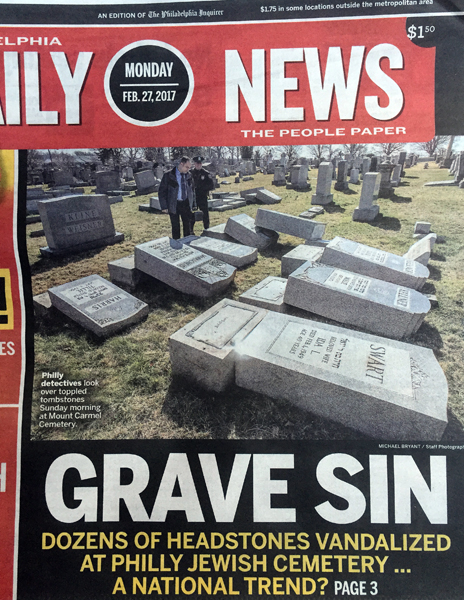
This has been a busy week for the small (Jewish) Mount Carmel Cemetery in Philadelphia. You’ve no doubt heard of the desecration - it became national news: 75 to 100 headstones were knocked over sometime Saturday evening, February 25, 2017. This follows on the heels of similar vandalism in Missouri, from February 20, when over 100 headstones were toppled in the Jewish Chesed Shel Emeth Society cemetery in University City, Missouri (see story at this link: https://www.youtube.com/watch?v=yO2QXjwYtg0).

Philadelphia Daily News
To fuel the fear of a “hate wave” spreading across America, about thirty bomb threats were made at the end of February to Jewish schools and community centers in eighteen states (see link). As of this writing, the case has been solved and seems to have been the work of one person, not related to the incident at Mount Carmel Cemetery.
A portion of the damage in Philadelphia's Mount Carmel Cemetery

Bad stuff, any way you look at it. However, I’m not going to jump on the hate crime bandwagon just yet, even though the FBI is investigating the vandalism. Why? Well, for one thing, thirty-three headstones were toppled last month in the Holy Redeemer Catholic Cemetery in the Bridesburg section of Philadelphia (see link), less than two miles from Mount Carmel. So it may not be antisemitism, just cowardly aggression toward those who cannot defend themselves – the dead. In both Philadelphia situations, communities have come together to repair the damage.

Volunteer registration at Mt. Carmel coordinated by the Jewish Federation of Greater Philadelphia

I’m still (perhaps naively) thinking it was a small group of drunken kids with beer muscles, at least in Philadelphia. Should the people responsible be caught and punished? Damned right. A $69,000 reward (it increases each day, see link) is being offered through a variety of sources for the apprehension of those responsible. 

Headstone fallen and broken in half
Looking at the situation from a vandal’s perspective, Mount Carmel was, unfortunately, an easy target. And that may simply be the main reason it WAS targeted. If you wanted to topple headstones, Mount Carmel would be a better choice than any of the cemeteries on the other three sides at this intersection (Cedar Hill and North Cedar Hill) of East Cheltenham Avenue and Frankford Avenue in north Philadelphia. At Mount Carmel, you are hidden from the road by the densely-packed headstones, making it easy to do your dirty work without being seen.

Mount Carmel Cemetery also has no road inside it so neither police, nor any other cars, can drive through it. Besides, the gates are left open at night, unlike the other, better cared for and more secure cemeteries. The rear gate opens up onto a parking lot and there is quite a bit of tree cover. These many drawbacks will be remedied, however, through the generosity of many donors - significant improvements will be made to the cemetery going forward. 

Wide open rear gate at Philadelphia's Mount Carmel Cemetery

Throughout this past week, hundreds of people have volunteered their time to help repair the damage done at Mount Carmel Cemetery. 

On March 1, 2017, I visited and spoke with members of the Jewish Federation of Greater Philadelphia, who were organizing the volunteer effort. A registration table was set up at the cemetery’s entrance, bottled water and bags for trash, branches, and weed clippings were provided. Dozens of volunteers (all races and religions) spent the day cleaning up debris, raking leaves and dead branches, and marking and cataloging the damaged grave stones. The Federation has been receiving calls from individuals asking if their ancestors’ headstones had been knocked over. They took it upon themselves to gather this information. Someone had placed cut flowers on all the damaged headstones and monuments. People are upset, but have joined together to correct the situation.

Philadelphia Inquirer, www.philly.com

I’ve seen damage in cemeteries, but I was not prepared for this. You can't really grasp the magnitude of the damage through on-the-ground newspaper photos. A hundred headstones does not seem like a lot, but Mount Carmel is not a large property. This may amount to a tenth of all the stones in the cemetery. The swath taken by the vandals is obvious, as you walk the length of the property. Stones are toppled throughout the center portion of the rectangular cemetery (east to west). The aerial photographs published by the newspapers give the best depiction of the extent of the damage. Seeing this atrocity in person is jaw-dropping – cracked stones, large monuments pushed off their pedestals, grave markers of all shapes and sizes knocked over.

From the Philadelphia Police Department
Anyone with information on the suspect(s) involved in this crime, please contact either:

·         Northeast Detective Division – 215-686-3153/3154
·         Philadelphia Police Tip Line – 215-686-TIPS (8477)
·         Tips via email – tips@phillypolice.com
·         Citizens Crime Commission – 215-546-TIPS (8477)

Jewish Federation of Greater Philadelphia Donation page for Mount Carmel Cemetery:


Preventing Future Damage
There is a clear message being sent to the criminals responsible for the Mount Carmel damage – the greater community will repair the damage and will prevent such damage in the future. Police will patrol the property 24x7 until the criminals are caught. Fencing will be improved.

“… the Philadelphia Building and Construction Trades Council offered to replace the toppled headstones and … the International Brotherhood of Electrical Workers Union Local 98 offered to install additional lighting and security cameras." -  http://www.jta.org/2017/02/28/news-opinion/united-states/philadelphia-labor-unions-offer-to-repair-secure-vandalized-jewish-cemetery

Mount Carmel is apparently an active cemetery, as I was told of a relatively recent burial here, 2015. There is a bit of pre-existing damage (a few fallen headstones), a bit of overgrowth, and some areas where the ground has subsided, causing a handful of grave markers to tilt. Clearly, work needs to be done here, especially if families have paid for “perpetual care.”
Volunteers bagging debris at Mount Carmel Cemetery

The lopsided headstones made me realize that before members of local labor unions are allowed to reset the fallen headstones, someone needs to consult a professional about a safe and secure way of doing that. Even if the stone base of the headstone is level, the headstone should be pinned to its base with steel or fiberglass rebar to prevent future damage. Believe it or not, many extremely heavy granite headstones simply sit on their bases! They are not fastened in any way, which is why people are injured or killed when headstones fall on them! If the base is not level, it needs to be leveled first, as shown in this video:


Pinning a headstone to its base is not an unusual practice, but it does cost more money, which is probably part of the reason it is not always done. Two holes are drilled in the base and the underside of the headstone, ... rebar is used to attach the stone to the base, then the joint is sealed to keep water from seeping into the joint between the stones.

“Blind Pinning is exactly what it implies, pins you do not see once the stone is installed. The concept is very simple. Holes are drilled in both the [headstone] and base at exactly the same locations so they match up when joined. Then metal [or other material] pins are placed in the holes, and usually mortared in place. The basic thinking was that if the monument was knocked or began to lean the pins would prevent a complete failure, and the damage this may cause.”International Southern Cemetery Gravestones Association, “HOW TO INSTALL A GRAVESTONE”


References and further reading:

Mount Carmel Cemetery 5722 Frankford Avenue Philadelphia, PA 19135. Phone: 215-535-1530. Fax: 215-535-5192 

Tuesday, June 23, 2015

Delaware's "Distressed Cemetery Fund"

Delaware is known as “First State,” because it was the first of the thirteen original states to ratify the United States Constitution. This it did on December 7, 1787. In 2009, it became the first state to pass a law to help distressed cemeteries - actually an amendment to an existing law (Titles 16 and 29 of the Delaware Code relating to Delaware’s Department of Health and Social Services, Death Certificates, and Cemeteries) that established "The Distressed Cemetery Fund." 

Unless you’re in the cemetery business, you’re probably thinking, “Who cares?” However, as you will see, distressed cemeteries affect us all, in some way, shape, or form. (The photos I've included here are from cemeteries in other states, not Delaware.)


The most common fix an old cemetery can find itself in is that it is full, and can no longer accept burials. Therefore revenue comes to an end, as does the cemetery’s business. Except for one thing – the graves of those already interred need continual care. Even if the people who purchased the graves and PAID for continued upkeep, a cemetery may be hard-pressed to provide this long-term.

Forward-thinking cemeteries developed trust funds in which the interest may provide enough money to pay for “perpetual care” of the grave. Then again, it may not. If the annual cost of upkeep of a grave in 1866 cost $6.00 per year and the perpetual care fee was $50, would you expect the interest to continue to support the cost of upkeep through the year 2015? Hardly. Which is one reason so many historic cemeteries find themselves in difficult times.

Pennsylvania, for instance, has about 8500 cemeteries of various sizes. Only about 1000 of them are active, meaning they still accept burials. The other 7500 have to find other ways of paying for upkeep. With no income, a cemetery can fall on hard times. Maybe it gets overgrown and nasty-looking. Maybe it becomes a public nuisance, an eyesore, depressing nearby property values. Maybe it invites crime and eventually the city demolishes it. Perhaps the graves are moved to a larger, active cemetery, perhaps not.

The state of Delaware is the only state that I am aware of that has something called a Distressed Cemetery Fund. It’s purpose? Provide money to keep up the appearance and care of cemeteries in need. This is every bit as progressive as you would expect the “First State” to be. The fund  is generally used for making needed repairs and improvements, not for lawn maintenance expenses. (Click link to see application.)


So long as the cemetery is registered in the State of Delaware with the Division of Public Health of the Department of Health and Social Services, it can apply every two years for a grant of up to $10, 000. The Distressed Cemetery Fund is funded by adding $2.00 to the state fee for each copy of a certificate of death. Now get this for being progressive - A volunteer may register an abandoned cemetery! I know of two Friends groups that are associated with formerly abandoned Delaware cemeteries that have received the grant.

Unfortunately, most states do not have such a fund. Pennsylvania, where many of the photos in this article were taken, does not have such a fund. Why does Delaware bother? Why not just let the old cemeteries fall to pieces like just about every other state? In answer to that, let me quote from the State of Delaware’s official website:

"Cemeteries are essential elements of societies' collective history, providing fascinating insight into past burial customs, religious beliefs, cultural and ethnic influences, community origins and development, and landscape design principles. Although virtually every remnant from the beginnings of a town or city may be lost, cemeteries often remain as some of the last tangible links to the past.

In Delaware, many prominent historical cemeteries such as Dover's John Wesley Methodist Episcopal Cemetery and Wilmington's Riverview Cemetery (maintained respectively by the Dover Air Force Base and the Friends of Historic Riverview Cemetery) have been preserved due to the efforts of governmental agencies, private organizations, and individuals. Other historical cemeteries, unfortunately, are vulnerable to the threats of neglect, vandalism, and development." - Department of State - Division of Historical and Cultural Affairs


In all fairness to the state of New York, that state has a law providing for grants that can be applied for to correct acts of cemetery vandalism. New York enacted this in 1989, “The “Vandalism, Abandonment, and Monument Repair Fund," which is administered by the New York Department of State, Division of Cemeteries. (Click link for application.) The fund is supported by a $5 per-burial fee, paid by the cemetery. It seems as though the fund is more trouble than it is worth, however, as the state has on at least one occasion frozen distribution payments even though it continued to collect the $5 fee!

"CEMETERY RIPOFF IS GRAVE SITUATION - Vandalism funds go to ease state budget (NY Daily News):"

"A bureaucratic form of grave-robbing is dishonoring the dead whose final resting places have been defiled by vandals, say furious cemetery officials across the city."

Tuesday, October 5, 2010

Scary Cemeteries

It’s October, and with Halloween just a few weeks away, I thought I’d get in the mood by scaring myself. So I took a drive to Camden, New Jersey. I’ve made photographs in some of the city’s run down graveyards over the years and thought I’d check a few out. While looking for Old Camden Cemetery, I took a wrong turn (pretty much any turn is the wrong one in Camden…) and ended up at Evergreen Cemetery, a mile or so away. If there is a bad side of town, this is it. 

Evergreen has long been a favorite haunt of mine, just up the road from the “Liquorama” liquor supermarket. Prior to Evergreen being taken over by ‘new’ management, it had a brush-painted plywood sign attached to the front gate warning “No unauthorized burials allowed.” That’s class. A decade ago, not much groundskeeping was evident—grass and weeds ran rampant, trees had fallen over. The place lived up to its name, being ever green. Back then it was just forgotten; now it seemed defiled and desecrated. Much like the surrounding neighborhood, its condition had worsened. As the Greek proverb goes, you can’t step into the same river twice.

Apparently, someone now cuts the grass. But that’s about it. Graffiti is an immense eyesore and the fence along Mt. Ephriam Avenue is broken through in many places. Trash is everywhere and monuments have been knocked over. Some are protected by the same security wrought iron as the row homes across the street.

Seemingly without concern for the cemetery’s plight, a neighborhood festival was going on across the street while I was there, with BBQ, music, and crowds. There were two guys filming in the cemetery. They seemed to be concentrating on the graffiti and piles of broken bottles. I asked what they were up to and was told that they were getting background footage for a documentary on the need for restoring Camden’s cemeteries. Apparently, Evergreen is one of the better ones—the one most in need was across town, Johnson Cemetery, otherwise known as ‘Needle Park.’ People think there aren’t frontiers any more, but they are all around us.

I drove around looking for photo-worthy scenes, and came upon a guy walking around inside the cemetery, near the northwest corner of the grounds. He was just inside the torn down fence separating the cemetery from Mt. Ephraim Avenue, plainly in view of the crowd. There are some old and rather expensive-looking monuments in the area, along with the wolf table you see here, hidden by the bushes. Though the fellow was dressed well enough, you wouldn’t mistake him for Henry II doing penance at Beckett’s tomb. I imagine if you wanted to score some dope, he’d be your man. The wolf table had become his little den of iniquity. Don't even think about law enforcement in this area of town! With Camden having laid off half its police force due to budget cuts, the forty dispatched Guardian Angels are barely enough to patrol the city's higher crime areas. A while later I was propositioned by a hooker. In the cemetery.

 “Ya married? Faithful? Can ya let me earn $4?” I was getting a bit depressed about the whole scene, so I decided to leave and drive over to Harleigh Cemetery, where Walt Whitman is buried. The interaction also reminded me of the seamier side of Whitman’s poetry.

Harleigh is a bucolic spot in the midst of, well, Camden. About a mile from Evergreen, it is a beautiful and well-maintained garden cemetery, with rolling hills and large weeping willows in and around its ponds. These Victorian symbols of grief, mourning, and sorrow seem more attuned to the city’s urban blight that to the many souls at rest under its soil. Just inside the front gate, down to the left in a shady dell, is the Whitman family mausoleum. This leafy restful spot where people have for years carved their initials in the surrounding trees seems so at odds with the squalor of the city. 

Standing in front of Whitman’s crypt, I thought about how he addressed the human condition without ever seeming judgmental. Whitman was really much more prolific than "O Captain! My Captain!," the metaphorical poem (about Lincoln’s assassination) you were forced to read in high school. You may recall him as being the father of “free verse,” and maybe even that he was politically active. However, he was not averse to crafting poems about city life, modernity, and technological change, not to mention (hetero and homo) sexuality in his life-work of poetry, “Leaves of Grass.” 

Regarding the latter topic, consider the Leaves of Grass passage, “To a Common Prostitute.” If there ever was a poem that on its surface seems self-explanatory, it is this:
 To a Common Prostitute

BE composed—be at ease with me—I am Walt Whitman, liberal and lusty as Nature;

Not till the sun excludes you, do I exclude you;

Not till the waters refuse to glisten for you, and the leaves to rustle for you, do my words refuse to glisten and rustle for you.


My girl, I appoint with you an appointment—and I charge you that you make preparation to be worthy to meet me,

And I charge you that you be patient and perfect till I come.


Till then, I salute you with a significant look, that you do not forget me.


Whitman seems to be compassionately stating that a prostitute is a human too, her work a craft. The woman he writes about, while on the bottom rung of the social ladder, is recognized as an equal in a deep sense. On thinking about his non-judgmental stance, it occurs to me that the entire Evergreen situation, if not the collective trashing of the city, could be seen in the same light. While I’d prefer things to be forgotten rather than destroyed, in the end, its simply survival of the fittest. Whitman wrote, “For what is my life, or any man’s life, but a conflict with foes.”

Some links you may find interesting:

Don't know what a "wolf table" is? Click here to go to my StoneAngels site and see what the wolf table in this blog looked like in 2006.


Thursday, June 10, 2010

Weeds

Mount Moriah Cemetery in West Philadelphia is probably the largest (somewhat) abandoned cemetery in this area.  Although the grass does get cut on a regular basis, there appears to be no trust fund money to keep the majority of damage at bay, e.g. the mausoleum graffiti you see here.

I'd visited the cemetery (which is bisected by the Cobbs Creek Parkway) many times over the past decade. It's one of the first experiences I had seeing black urban cowboys. I was playing my guitar sitting on the steps of a blocked-up mausoleum and I heard the clip-clop of hooves! Imagine my surprise when five guys on horseback, decked out in cowboy outfits, trotted past me! Its one of those things you experience that you, um, don't tell anyone about until you've verified that it wasn't a hallucination or otherworldly experience. Click here for proof of their existence: Urban Cowboys!

Mt. Moriah is one of the few cemeteries in the Philadelphia area that is not gated and locked at night. Therefore, certain things may happen there that don't happen in a guarded, locked cemetery. One such thing, my friend Krista and I discovered back around 2002. At that time, the cemetery was much more overgrown than it is now (volunteers have cut down a lot of the trees growing out of tombstones and continue to cut back the high weeds--by the way, if you get benefit from visiting cemeteries for any reason, consider stopping by the office and donating some money to help with their upkeep!).

Krista and I were making our way through the five-foot high weeds to the back of the cemetery to see if there were any monuments worth photographing, when we came upon a perfectly manicured clearing about 12x12 feet in size. This was the home of rows and rows of well-kept and cultivated marijuana plants! People can be so creative....