Showing posts with label covid. pandemic. Show all posts

Saturday, January 8, 2022

Cemetery Meetups

Cemetery Meetup at The Woodlands Cemetery, Philadelphia

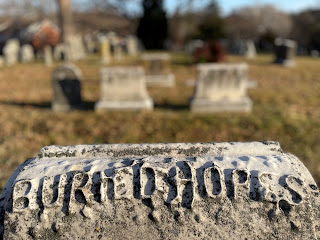
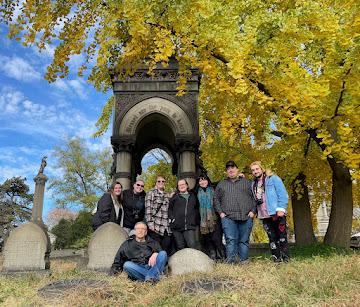
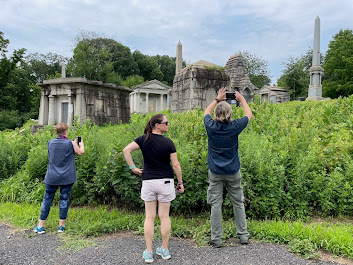
Back in the fall of 2021 (when we were thinking that we were all successfully pulling out of the COVID-19 pandemic, pre-Omicron variant), I got this idea in my head that it would be a cool social exercise to get some Instagram cemetery photographers together for an outing at Mount Moriah Cemetery in Philadelphia. I invited mostly people I’ve never physically met. About ten of us showed up – several whom I invited, and some people who THOSE people invited. The only commonality was that these were seriously good photographers who shared a common interest – posting cemetery photography on Instagram.

Mount Moriah Cemetery, Yeadon, PA side

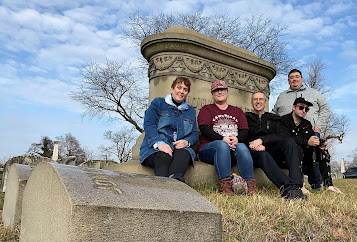
Our initial outing at Mount Moriah went so well that we all decided to do it again. After some conversation, we all realized that we each had explored many cemeteries that the others had not. Thanks to Jenn O’Donnell (IG link), our member who organized an IG Meetup link, we all stayed in close contact with each other and took a vote on the next cemetery location at which to meet. Three additional meetups have occurred since that initial one, in cemeteries in southeastern PA and central and south Jersey. We number about twenty “members,” if you want to call us that.
A few things I’ve learned from my fellow necrogeeks (kudos to Timothy for that term!):

  • Cemetery nerds have the BEST stories!
  • There are funeral strippers in China.
  • If you ask at the office for the key to the community mausoleum, they might just give it to you.
  • Santeria-type offerings at a gravesite could easily involve live animals.
  • There are FAR MORE deaths-head and angelhead gravemarkers outside of New England than I thought.
  • Zinc monuments are still controversial.
  • Snapseed is a cool, in-phone photo-editing ap - and its free.

Mount Moriah Cemetery, Philadelphia and Yeadon, PA.
The photo you see directly above was the first group photo we made. Or rather, I made, actually, to sort of document our initial meetup at Mount Moriah. We only began staging the group shots at our second meetup, at Philadelphia’s Laurel Hill Cemetery. We didn’t really know each other well enough, I think, at Mount Moriah, for anyone to suggest a group photo. Plus there was the issue of who was vaccinated and who wasn’t. Also, it might not have occurred to us at the time that we would continue our adventure. I’m not sure who suggested the group photo a month later at Laurel Hill, but it has since become a staple of our gatherings. As more people got vaccinated and boosted, spreading COVID became less of an issue.


Cemeteries need not be places where dreams go to die. As we re-envision what social gatherings should look like in this evolving pandemic, there is one thing that everyone agrees on: outdoor gatherings are safer than indoor ones. So these cemetery meetups appear to be a healthy way to maintain our interactivity as social beings while staying physically safe.

While many cemeteries host official events that draw throngs of people (I realize there might be some of you who are surprised to learn that), such events are carefully planned and quite focused. Our IG meetups are anything but! We just stroll through the cemeteries and graveyards talking, photographing, and perhaps being led to some points of interest by someone who had been there before. We greatly appreciate the hospitality offered by the many open cemetery gates throughout the region, that allow us this opportunity. We also do appreciate the more focused events such as hearse shows, The Market of the Macabre, movie nights, concerts, the Darksome Art and Craft Market, and so on. Such events are all wonderful ways to bring people together, promote small business, and to raise money for the upkeep of the cemeteries.

Evergreen Cemetery, Camden, New Jersey

Victorian-era garden cemeteries of course were designed for large groups of people to visit and enjoy. Before there were parks and museums in the United States, cemeteries were the places you would go to get away from the noise and grit of the cities. They were meant to be calm, contemplative locales, beautifully landscaped in arboreal splendor - a place to revitalize, a place conducive to better physical and mental health. People recognized early in the current pandemic (and especially during lockdown) that cemeteries were in fact the ONLY safe place to congregate. I for one am grateful to all the cemeteries for keeping their gates open and welcoming throughout this time. Hopefully the trend will continue and more people will visit regularly - and I encourage people to donate money to their favorite cemetery to help keep those gates open in the future.
There is, of course, no socially redeeming purpose to cemetery photography itself (or photography in general). As with any art form, it must be shared to offer its greatest value. Interacting with people who share this common interest is exhilarating, at times. Meeting them personally is an added dimension and doing so during the COVID crisis is one of the best things we can do for our mental health. As I write this on the first day of the new year, 2022, the Omicron variant is so widespread that unless we force ourselves into lockdown again, it cannot be avoided. We’ll all get it sooner or later.

COVID has made death more real for many of us (death toll as of January 2, 2022 in the U.S. is 828,732; worldwide it is nearly 5.5 million (ref.)). Probably not since the last pandemic a hundred years ago has death been this concrete. Mentally, this is probably healthier for us – we are now forced to be much more pragmatic about death. Its almost like the present pandemic switched things up: pre-pandemic, death was abstract and society was real (for the most part). During the pandemic, death became more real and society became abstract.

But now with our evolving understanding of COVID-19, we are trying to work our way back to being a society that interacts physically – less screentime and more facetime. Ironically, virtual tools like social media can help us attain this goal. Though Instagram, Facebook, and other social media are quite abstract, we can use these tools to form concrete relationships – to create actual reality from the virtual. Granted, there are situations in which virtual meetings are the only option due to geographic distance, transportation, or the need to reach a larger audience. However, social media can successfully be used as an invitation, an entrĂ©e into more fulfilling in-person relationships.
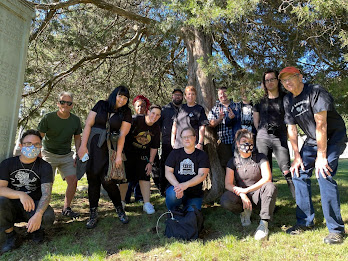
Laurel Hill Cemetery, Philadelphia

Sometimes timing keeps all the members of our IG group from getting together. I’ve missed a couple meetups, but when I see the results others have posted on IG, it makes me wish I had been able to attend. Creatively, for many of us, these meetups will be a seminal influence on what is yet to come (little inside reference to the hooking tree we discovered in Camden).

We share our knowledge of specific cemeteries we have visited, and benefit greatly from the knowledge of others. These people bring a wealth of research and experience to bear in their work and all have their own reasons for doing what they do. It is evident by the joy and camaraderie at our physical meetups that everyone shares a deep interest in those who have gone before us. But why this interest? Perhaps it has something to do with a comment made by Dave Grohl (of Nirvana and The Foo Fighters) in his autobiography, The Storyteller ...

  “We all carry traits of people we have never met somewhere deep within our chemistry.”
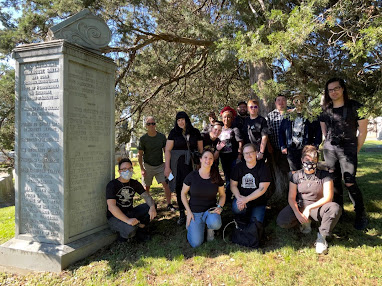
Another view of the photo above in the shade of an immense zinc gravemarker


Sunday, February 28, 2021

The Winter of Our Discontent (Shakespeare, not Steinbeck)

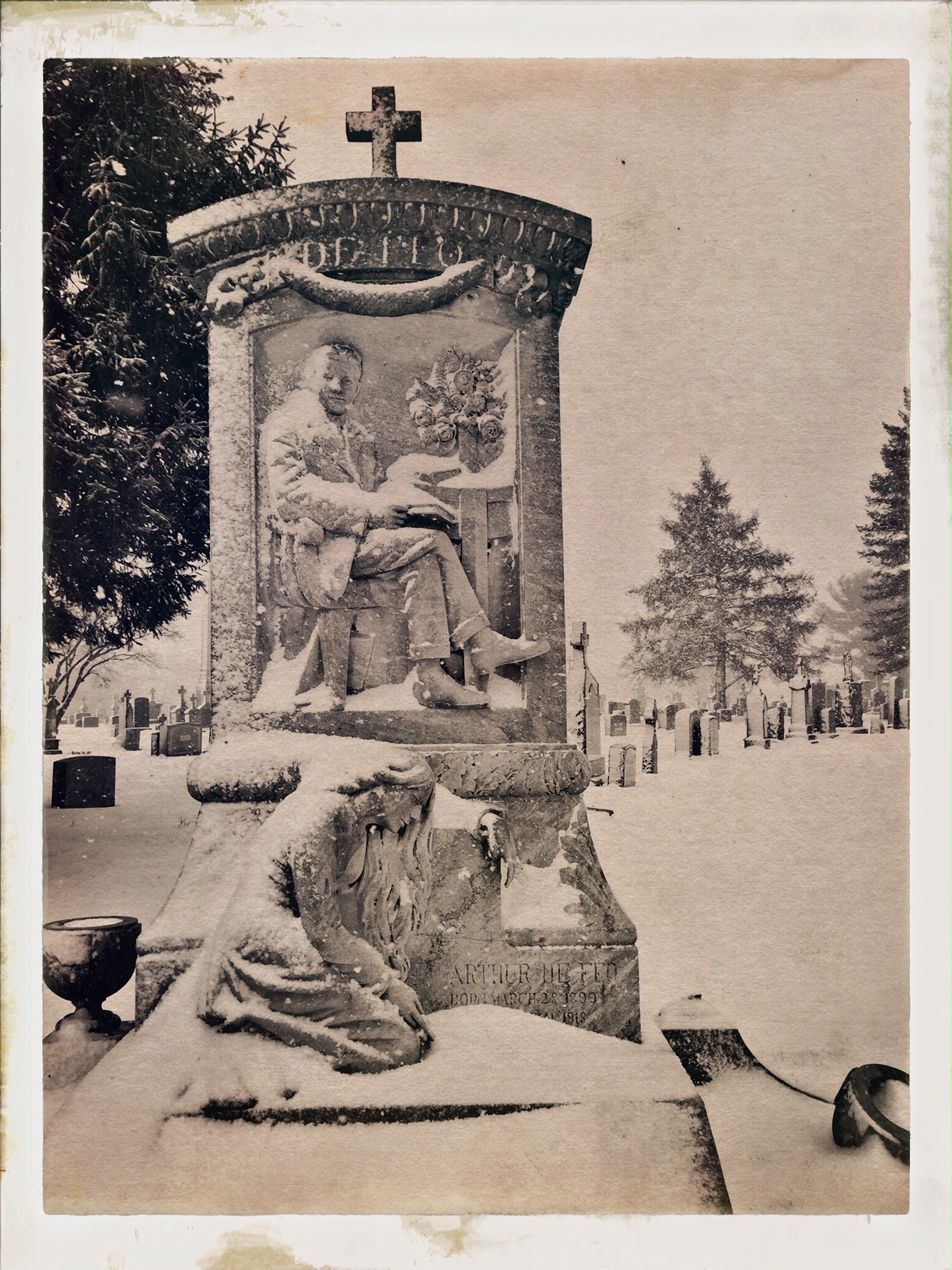
My artistic experiences this winter (it is still technically winter here in Philadelphia – Feb. 2021 as I write this) have not been one of discontent. Rather, reckless winter has allowed me the opportunity to photograph cemeteries and their statues under a blanket of snow. Standing in a blizzard with an umbrella and camera may seem ridiculous, but I assure you, it is anything but a fool’s errand. Numb fingers are simply a sign of weakness leaving the body.

Tintype Hipstamatic App image

The zeitgeist of a Victorian snowfall creates a mood of singular isolation. And freedom, of sorts - it takes one out of the literal social isolation forced on us by the current pandemic. And Paul Simon was wrong – everything does NOT look worse in black and white.

Why Shakespeare and not Steinbeck? Shakespeare’s lines from Richard III are lines of opportunity, versus Steinbeck’s, which are pure misery. Granted, the euphoria of photographing a snowfallen cemetery in below-freezing temperatures can be quickly replaced by misery if you mistakenly lock yourself out of your warm, running vehicle (which I have been known to do). However, Shakespeare is optimistic about the future. As am I. The playwright is saying that even though we may now be miserable (‘Now is the winter of our discontent’), better days are coming (’Made glorious summer by this sun …’).  (Cue the song, "Better Things" by the Kinks.)

But I digress (which is one of the qualities you find most endearing about me). My limerence with cemeteries is boosted when it snows. It just is. I have to get out there fast, while it is still snowing, if possible. Primae noctis, as it were. Not than anyone else is even considering doing the same thing, but it does give me the feeling of being first in, a unique time in a place where I can be ultimately alone with my passion. And in the middle of a pandemic, its rather liberating to not concern myself with social distancing or wearing a mask.

So would I recommend this nostrum of shooting angels in the snow? Well, it is certainly easier if you live in a polar climate zone. Its not something I can easily demonstrate to you, however. You just need to get out there in your gloves, boots, and hand warmers, and let the snow muses guide you. Helps to have an SUV, too, so you don’t get stuck. 


I photographed graveyards in the snow quite often this winter. The Snow Demons were appeased last year – they made no appearance. Apparently, COVID must have royally pissed them off, because they have been out in full force, whiting out my world since even BEFORE winter began (our first snowfall was on December 16, 2020)!

Please realize that cemeteries are places of respect - an obvious consideration when you are photographing in them. While there may be no one else around you there in the snowstorm, burial grounds and monuments mean many things to many people. Be respectful as you work. And be careful. Don’t climb on the monuments. Don’t lean on them. I’ve seen a person who had a large gravestone fall on her. She nearly lost her leg. It was crushed, but was later saved. Luckily there were several people around to lift the thousand-pound granite grave marker off her. So consider the possibility of a monument falling on you in a snowstorm. Think anyone would find you before you died of exposure or trauma?

Defunct crematorium in a snow squall

The Gear
So if I have not scared you off the topic at this point, let’s talk about the gear. Obviously, you want your equipment to be either waterproof or well-protected. I own neither. Which is why I typically carry only one camera with me, protected by a snow umbrella. I leave the rest of the photographic arsenal in the car, running back to swap them as needed. This way, I’m guaranteed to lose such things as lens caps and filters in the snow.

Cross-processed E6 image

Do I use real cameras or the camera in my cell phone? As time goes on, this distinction becomes less relevant. I do have an old iPhone 6 which I use quite a bit. Not bad images except the battery peters out in the cold. If I use it outdoors in winter, I have to keep it connected to an external battery. The apps are interesting as well, I use basic Hipstamatic and Hipstamatic Tintype in addition to straight shooting. I do drag conventional cameras out in the snow with me as well. Certainly, digitals are easiest to use. However, I’ve been shooting quite a bit lately with a 120mm (film) Holga and running outdated slide film through a Nikon F3 35mm film camera, then cross-processing the E-6 film as C-41 (which is kind of standard practice now, since E-6 chemistry is no longer widely available). I like to surprise myself. Digital can be too exacting. At right, you can see an example of a cross-processed image.

Hipstamatic Tintype App image 

It has not, historically, snowed often in the Philadelphia area (at least during the current geological epoch). So when it does, I attempt to make the most of it. It helps to have a plan. Which cemeteries are easiest to access? Are the roads plowed? Luckily for me, the graveyard at left is within walking distance of my house! I have some go-to locations and some go-to statues that I like to check in with during a snowfall – some take on the white cloak better than others...

You can see the same cemetery angel dozens of times, but there might be this one time, as you approach it in the hush of a snowfall, bootfalls crunching, that you seem to be seeing it as it had looked long ago. The more modern mass-produced gravestones mostly hidden, the bespoke, Victorian statuary gently “shrouded in white, allowing the outlines of something older to emerge.” The quote is from science fiction writer William Gibson’s novel, Pattern Recognition. A strange book to be reading during a pandemic, when old patterns are nowhere to be found, new ones emerging all around us.

Actual lychgate shot with Hipstamatic Tintype App

So if this seems to be a winter of discontent for you because of the new patterns that life has assumed, consider COVID-19 as a sort of lychgate, a gateway to another world. I wrote a blog for the website of New York’s Absynthe Gallery recently, entitled "Artist in Residence," which is about creating art during lockdown in a pandemic. Challenging, to make art in the Time of COVID. But as Gibson says in Pattern Recognition, "There are times when you can only take the next step. And then another.” If you’re interested in seeing how other artists are adapting, the gallery is hosting an online “Drink and Draw” Zoom meeting with many of its artists on March 6, 2021 (5 to 7 pm). I am in their corral of artists, but I don’t draw (I do drink, however, so I meet half the criteria). Demonstrating how I make photographs or how I write blogs would be about as entertaining as watching gesso dry; therefore, I will be in attendance solely drinking and learning. Here’s the link to register: https://absynthegallery.com/drink-draw/


Learning, you ask? Well yes. One of the best ways for an artist to progress and improve is by expanding boundaries - watching other artists create in mediums other than your own. I leave you with an old image (all that you’ve seen so far in this blog, I created in the past ten months), the Mount Moriah Cemetery gatehouse. This is in Philadelphia. I was truly honored to have it chosen to represent February in the 2021 fund-raising calendar published by The Friends of Mount Moriah Cemetery, Inc. Being on the Board of Directors of this volunteer organization and helping to save a formerly abandoned cemetery from total ruin has also been a learning experience. 

Sunday, December 27, 2020

"I Returned Your Skulls."

Image by Michael Kauffman
 
“What the world needs right now is another endless musing on staying at home during the coronavirus pandemic; the C.D.C. has declared these pieces to be a symptom of COVID-19 that can be treated only by gentle snoring.” -  Libby Gelman-Waxner in her New Yorker article “If You Ask Me: The Last Quarantine Think Piece” (May 18, 2020)

While I agree with the above statement, I’m still going to write this blog. As my friend Mike Spak would say, “Anything worth doing is worth overdoing.”

This past summer I was walking up the street toward my house, end of the day, coming home from work. A few neighbors were outside their homes chatting (from an appropriate COVID social distance) – I live on a tiny street of row homes in an old nineteenth-century Philadelphia neighborhood. My neighbor Michael, who lives around the block, addressed me in a relatively loud voice, “Hey Ed, I returned your skulls … left them with your wife.” Ok, that’s a wee bit embarrassing – but in a good way, lol.

I am very selective when it comes to my choice of friends – they have to be anything but normal and boring. And they say the darndest things. One time a few years back I got together after work with a friend to have a beer. We were walking down the street on a Friday evening, lots of people on the sidewalks, summer. I asked him how his day went, as he appeared to be tired out. He sighed and said, “Well, we got all six bodies out of the ground.”  Couldn’t help notice the startled looks we got from those around us! Frank worked in a graveyard, and I knew he was working on a project to move some graves.

Michael, my neighbor, is an artist. He appreciates Caravaggio, a Baroque era painter who seemed to rather enjoy painting people getting their heads chopped off. Some of his art evokes Caravaggio. Over the course of the last few years, Michael and I have each learned a bit about each others’ art. As an aside, I shared with him the fact that I pick up skulls in abandoned graveyards – everyone needs a hobby, right? 

Just to be clear, my skulls are not human skulls. You just don’t run across those as often as you do skulls of other animals - even in abandoned graveyards! 

During the spring/summer 2020 coronavirus lockdown, Michael had been stuck in the house, so he’d spent some of that time creating art. Either he asked to borrow some of my skulls, or I offered them to him, I don’t remember exactly how that went, but he created some startlingly gorgeous photographs with them, which he planned to use as components of larger digitally collaged art work. Michael has a glorious light tent in his garage in which he does digital macrophotography. I was jealous so I had Amazon send me one. Not a garage, a light tent. An inexpensive version of his (mine is shown below).


It was probably in May that I lent Michael my skulls. May was an absurd month, full of fear and coronavirus. Lockdowns and masking. A lot of artists spent this time holed up, creating. In November, Michael shared some of the final results with me, one of which you can see at the top of this blog.

My skulls formerly belonged to an assortment of animals – fox, pitbull, deer, cat, bird, groundhog, etc. They were all found in abandoned cemeteries. I never spent much time photographing them, but after I got my skulls back and saw some of Michael’s preliminary results, I decided to take a stab at it myself. 

Here you see one of my first experiments. This one at left is based on the rainbows everyone had hanging from their homes during the Summer of COVID. Finding and counting rainbows seemed apropos of the time – a way to pretend that you again had some control over your life, and that there was eventually going to be a positive outcome. This image represents both possible outcomes. 


During the lockdown, I was one of the few people allowed on the roads, being a healthcare worker. Every once in a while, I’d stop by a local graveyard to do some photography. Graveyards were one of the only public areas people could visit during lockdown - you were lucky if there was one within walking distance of your home. I wasn’t confined to my house, like most people, but when I was home, I decided to use the time wisely and creatively. Actually, more experimentally and experientially. 

I’m writing this at the tail end of December, 2020. Since March, artists have been lamenting their situation. No galleries or public spaces to display or sell their work. For those who depend on this for income, for a livelihood, this has been devastating. But wait – we all create art in private anyway, right? During lockdown (when was that, mid-March to June?), we were FORCED to work in private, and forced to use whatever we had on hand to create. Hopefully, artists had supplies (yet another advantage of digital over film photography, huh? Otherwise we’d all be stuck with bags of undeveloped film).

COVID is like an entropy puzzle, a puzzle we have to assemble without the benefit of having a picture on the box showing the end result. And just when some of the pieces seem to fit together, they magically change, so they no longer fit. Who knew the pandemic would continue into August, when I began writing this blog? That was two weeks before virtual school began for the world’s children. Distance learning, two words that I am now convinced are mutually exclusive. Now it’s the end of December, 2020, and we don’t even have the border of the puzzle completed. The new normal, life in a pandemic.


As artists, we sometimes need to get out of our old wheelhouse – we need a kick in the ass to get those creative juices flowing. For some artists, COVID is that KITA. It seemed to influence Michael Kauffman’s work – see his gorgeous tombstone image below!


I intended to close this piece by bookending the opening New Yorker quote with these lyrics from the band Cracker’s song, “Teen Angst (What the World Needs Now):”

“…what the world needs now

Is a new kind of tension, …

'Cause the old one just bores me to death…”

So that’s good for artists (and maybe others) who needed the COVID KITA to move their art (or their lives) to the next level. However, I watched musician Devin Townsend’s Christmas Concert performance the other day, and this quote from his song “My Life,” is a kinder, gentler way to say goodbye to 2020:

“How long can this life go on? Who we are, what we are. See you on the other side."
- (Devin Townsend - Acoustic Christmas Special (Live 12-23-2020) - YouTube) 


Further Adventures:

See Michael Kauffman’s artwork on Flickr: Michael Kauffman | Flickr


Thursday, May 7, 2020

Cemetery Photography and the “Stay at Home” Order


I have a post-Coronavirus graveyard bucket list (what, don’t you?). My friend Loren Rhodes published a wonderful book in 2017 called, “199 Cemeteries to See Before You Die” which has been on my mind recently. I have been reading and writing more since the “Stay-at-Home” order was issued across the United States in March of 2020. Here it is, the beginning of May, and we’re still at home. Things are s-l-o-w-l-y starting to reopen, albeit very tentatively. Other than explore your local cemetery (hopefully you have one) by walking or biking to it, there’s not much else to do outside your domicile. Everything is closed. Cemeteries are open - just not for funerals (see my previous blog post on that).

“The future is no more uncertain than the present.” – Walt Whitman

Photo by Olivia Snyder
My bucket list right now is not so much comprised of specific cemeteries as it is of specific people. I miss you guys. While its true that cemetery photography is typically a solo sport (like skiing, surfing, or skateboarding), I do miss the interaction with other photographers. There are people I’ve become closer to, virtually, during Corona-times, and I look forward to meeting up with them in person. Also, there are many others to whom I’ve said in the past, “Let’s go do a shoot together!” – and it never happened. I want to hang out with those people too, once this is over. I miss you all.

“I have learned that to be with those I like is enough.” – Walt Whitman

I have been tentatively invited to give a few virtual cemetery lectures in place of my cancelled events, and I don’t know if those will happen. Not really sure how my sparkling personality and natural prolixity will come across in a Zoom session (although I have figured out how to use the “mute” feature better than most). We’re all coping the best we can. “OODA” loops, however, don’t necessarily come to your aid when you have zero control over a situation. OODA, by the way, stands for “Observation, Orientation, Decision, and Action.

“Be curious, not judgmental.” – Walt Whitman

As Derek Thompson explains in his book, Hit Makers (2017, a wonderfully insightful treatise on marketing given to me by my son, Chris Snyder), OODA is “a strategic approach in which information was constantly funneled back to the decision maker to construct a new theory of attack.” This was devised by air force pilot John Boyd, to provide fighter pilots with “a facility for learning and changing strategy quickly … the speed of adaptation was the key factor in whether you could win or lose in a dogfight.” As of this writing, 76,000 U.S. citizens have died in this COVID dogfight (and 265,000 worldwide).

Rainy spring day at the Woodlands Cemetery, Philadelphia

While instant feedback has helped me navigate the “mute” feature on Skype, I’m not sure its that helpful in combating Coronavirus. Think about how difficult it is trying to correct a skateboard position error in mid-air just as you drop into the bowl. At least in that case, you may KNOW how to correct it, but you just don’t have the ability or the time. With the pandemic, we don’t have any IDEA what we need to do to correct our course – but we know enough now that we must avoid dropping into the bowl until we know more about our situation. This is a dogfight in slow motion – after two months in the “Observation” stage, we’re now just trying to attempt “Orientation.” Years from now, maybe we'll be able to put this all in perspective, but it will probably end up like Calvin says below in Bill Watterson's comic strip. (This is why its important to document what's REALLY happening now.)


“Re-examine all that you have been told… dismiss that which insults your soul.” – Walt Whitman

But more to the subject of death and dying - Kubler-Ross’ Five Stages of grieving and loss may be more useful in our current situation than OODA loops. COVID-19 is all about loss, isn’t it? Some have lost more than others. Some have lost a paycheck, some have lost a loved one. Beginning with denial, we proceed through anger, bargaining, depression and acceptance. I’ll hazard a guess that we’re between anger and bargaining right now, as the world contemplates reopening businesses and relaxing the social distance rules. So keep calm, and explore a cemetery, as my Facebook friend Mark Morton suggests.


Springtime in a graveyard near my house, Old Swedes' Church, Philadelphia

“Will you come travel with me? Shall we stick by each other as long as we live?” – Walt Whitman

So is the Cemetery Traveler traveling to cemeteries during the Coronavirus global pandemic? Well, yes, he says sheepishly. Local ones. I have traveled a good deal around Philly, to paraphrase Henry David Thoreau.

There is a stay-at-home order and while my wife and ten-year-old daughter are in fact staying home, I have been deemed an essential healthcare worker (my car is placarded a South Jersey “ESF - #8 Healthcare Worker/Essential Employee Vehicle”). So what this allows me to do every few days, is stop on the way home (to Philadelphia) from work (in New Jersey) to visit a cemetery or two. A far cry from my original spring plan, which was to visit the magnificent cemeteries of New Orleans while there for a conference (which has been cancelled). I am luckier than most cemetery photographers, who don’t even have the option of using public transit (which has been scaled back to bare bones scheduling). On the road, I even get to eat free greasy McDonald's healthcare worker meals - just kidding - I drink the coffee that comes with it and discard the food (do they really expect healthcare workers to eat that food? LOL!)

Turns out you don't have to travel far to find beauty and wonder - its everywhere (though maybe not in homeschooling – now that’s gotten to be downright ugly). On my way home from work last week I stopped in Harleigh Cemetery, in Camden, New Jersey. Harleigh is home to America’s greatest poet – Walt Whitman. Its a quiet, serene place, and it can be very contemplative to be standing in front of Walt’s family mausoleum, peering at his burial vault. A lot of his writing came back to me as I walked under the nearby blooming pink dogwood trees. I’ve sprinkled some Whitman quotes throughout this essay. This one I think is especially apropos of our Corona-times:

“I like the scientific spirit—the holding off, the being sure but not too sure, the willingness to surrender ideas when the evidence is against them: this is ultimately fine—it always keeps the way beyond open—always gives life, thought, affection, the whole man, a chance to try over again after a mistake—after a wrong guess.” – Walt Whitman