Showing posts with label New Jersey cemeteries. Show all posts

Friday, June 24, 2022

Allentown Presbyterian Church Graveyard

And we find ourselves in Allentown - not the one that Billy Joel sings about in southeastern Pennsylvania, but the one in central New Jersey. You probably wouldn’t know it was there unless you saw the exit sign off the New Jersey turnpike. On my way from Philly up to the Freehold area in mid-April, 2022 (to meet a large group of people for a cemetery tour), I had a discretionary hour along the way, so I thought I’d check out A-Town. A quick one while he’s away, as the song by The Who goes. My neighbor told me the town was totally quaint, with Victorian style homes and old mills. 

Well, my neighbor was right. Cool old small town, great place to retire to. More of a draw for me, though, was that Google Maps showed a cemetery there. A full course in noetics would be required to understand what drives me to do such things. 

So about 9 A.M. one sunny spring Saturday, I jumped off the turnpike and headed into Allentown. The town itself is a couple miles off the highway, but certainly worth a cemetery road trip. The Allentown Presbyterian Church (founded 1756) has one of the most lovely and cared for graveyards I’d ever seen. Meticulously maintained, this relatively small (a few acres) plot of land has gravestones from all the major eras, beginning with colonial times, all the way to the present day. And by the way, a churchyard burial place is technically called a graveyard, not a cemetery.

Allentown Presbyterian Church

But I’m getting ahead of myself here. Finding the graveyard was a bit challenging, as Google Maps got confused as to which side of the millpond the property was actually located. After three U-turns in the middle of the downtown area (which gave me ample opportunity to scope out the many coffee shops and diners open this fine morning), I finally spotted the tombstones through the trees, up on the hill across the pond.


Maybe you’ve been in this situation yourself – a new cemetery presents you with so many fresh opportunities, you’d don’t quite know where to start. The old church was an architectural gem, gleaming wooden white steeple, well-preserved, surrounded by dogwood trees in pink and white bloom. I immediately began photographing the wolf-table grave markers under its side windows, but then realized people were looking out at me from inside the church. Oops - there was a service was going on!  

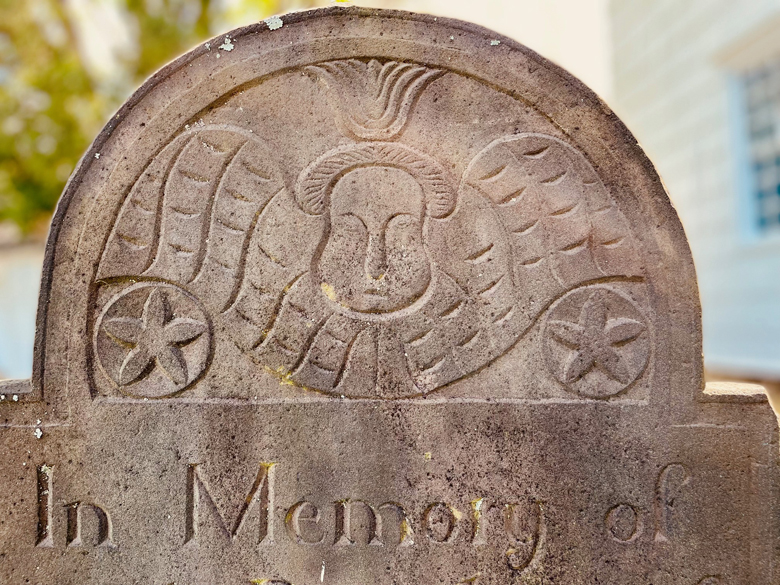
Soul effigy stone, 1762
By the way, wolf tables are called that because the design prevented wolves from digging up the freshly buried bodies for food. (See photo at end for a better look at this open-pillared style grave marker.) Luckily, there were many interesting things to see and photograph away from the church. I really got carried away by the wonderful colors of the blooming dogwoods, and so veered toward the back of the church, overlooking the pond. This old brownstone death's head angel grave marker was probably the oldest on the property, and the ages of the various stones spanned the mid-1700s to the present day. There was a zinc monument from the late 1800s, many intricately-carved bespoke white marble markers from the Victorian era, and several old stones that had been carefully repaired. 

Zinc, granite, and marble grave markers

The gentle grassy hillside was perfectly manicured, the turf clipped neatly around each grave marker and monument – no small feat - and no grass clippings anywhere. Truly, as great an effort is put into preserving this remarkable graveyard, as is put into the preservation of the church building itself. It just invites people to explore and enjoy.

Shot with Leica R5 film camera

I spent my entire discretionary hour here in this graveyard, walking, reading the stones, enjoying the view. I got to test out my new forty-year-old Leica R5 film camera with some black and white film. Here’s an image of headstones behind the church – overlooking the millpond – lit by the morning sun. I’m really happy with the way it turned out.

"Jesus is Condemned."
Many of the carved marble headstones were quite unique, as were the Stations of the Cross signs placed throughout the graveyard. The latter was a first for me – my visit being just after Lent and Easter, it appeared that the church would hold stations in the graveyard, with small groups of praying congregants moving from one station to the next, amidst the tombstones. Each station had a sign with the religious precis describing that particular station. Interesting way to give people the opportunity to explore the church’s burial ground – something not everyone would think of doing, or might even avoid doing.

You typically won’t see a crucifix in a Presbyterian church (or its graveyard, I assume), as they are not totally acceptable here. Why, you may ask? Presbyterians, like most Protestants, will typically use a cross, but not a crucifix. Their theology focuses on the risen Christ as opposed to the crucified Lord. (ref.)

When I first began printing my cemetery photography (which was initially only black and white images of stone angels) back in the early 2000s, I tried to get art galleries to exhibit my work. Many turned me down saying the work was “too religious.” Now, twenty years later, I come across this 2022 article in the National Review, “The Specter of Christianity,” in which the author, Kevin Williamson, opines that “Western civilization is Christian civilization.” He states that “Christian culture, Christian philosophy, and Christian themes dominate our art, literature, and political thinking.” So, really, there is no getting away from religion.

I suppose I could photograph the plain grave markers in non-religious cemeteries, “Strangers’ Burial Grounds,” as they used to call them. However, that would STILL refer to Christianity in much the same way that demonic metal bands like Judas Priest would have no basis for their rebelliousness if they did not have Christianity to rebel against. 

Judas Priest in their current 2021-22 Fiftieth Anniversary Tour (yes, I went!)

Williamson’s perspective on anti-religious subjects is interesting. Rob Halford, singer and songwriter for the band Judas Priest, for all their doom metal, totally define themselves in terms of what they reject. Same for Black Sabbath, Slayer, and so on. Their symbol, seen here above the stage, is of course, a variation of the cross. “The underside of Christian civilization is still Christian civilization: The Omen is a scary movie because of its religious context; we don’t have scary movies about liberal humanism or yoga, says Williamson.” We are “powerless before the cross,” he adds. To paraphrase Williamson, Halford can mock the cross or reject it, but he cannot escape it, because he has nothing to put it its place.

Wolf table graves alongside church
Soon, the congregation let out and so I ambled up the hill to the church to make some photographs of it. Noticed this historic sign nearby – I had walked right by the grave of William A. Newell (1817 – 1901) – Father of the United States Coast Guard. I walked past the few people who were gathered outside the church, chatting. Jumped in the car and took off so I could reach my next cemetery destination on time. Grab coffee at the smalltown diner in the center of town and then head out to the highway, I got nothing to lose at all...

Saturday, May 14, 2022

Old Tennent Church and Graveyard

While procursive behavior can potentially lead to defenestration, running to the cat lady posed no such issue. When our informal tour guides led us to her final resting place in the graveyard at Old Tennent Church in Tennent, New Jersey, I just had all these catastrophic thoughts going through my head. I could not help but think of Mark Twain’s cat story, “A Cat Tale,” in which he composes a bedtime story for his young daughters based on words beginning with “cat.” They would pick a word from the dictionary, and he would use it in the fictitious story, even if he did not know its meaning. Then the daughters would catch him in his fib and make him alter the story to make the word fit into the story! I actually know the meaning of the two five-dollar words in the first sentence, by the way.

Cat Lady

Old Tennent resides in Manalapan Township in Central New Jersey (my Jersey-native neighbors can actually pronounce “Manalapan”). This is near Freehold, which I suppose is where Bruce Springsteen’s ranch is – I probably drove past it on the way. 

Zinc memorial marking family plot
I don’t know the story of the woman who has cat reliefs carved in her granite memorial, it was just our first stop on our wonderful spring walk through a colonial-era graveyard. There was so much more to see – the old church which was built in 1753 (https://www.oldtennent.org), the death’s head soul effigy gravemarkers, the mausoleums, and so on. The Old Tennent graveyard was established in 1731, and is STILL an active cemetery, i.e., there are still new burials. 

Old Tennent Presbyterian Church, Tennent, New Jersey
The property is quite large, and the grave markers are arranged in sort of a timeline, with the oldest around the church, and branching out by era (and that era's symbolism) as the stones appear to orbit the church. The newest stones are in the outermost orbit. There are even a few zinc, or "white bronze" markers to be found near the church (these were popular from the late 1800s until about 1930).

"Starfish" angel soul effigy?
Most fascinating for me were the soul effigy brownstone carved stones. I had never seen so many in one place – there were dozens. Most seemed to be carved by two or three carvers, as the styles were all quite similar. The state of preservation of most of these stones is intriguing. Some have lichens growing on them, but are for the most part in great condition. There is a caretaker of the graveyard, and that person obviously does a wonderful job. Simply keeping the grass cut between all these stones and monuments is, well, a monumental task!

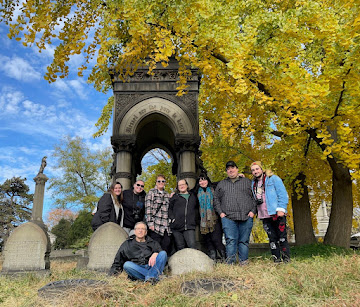
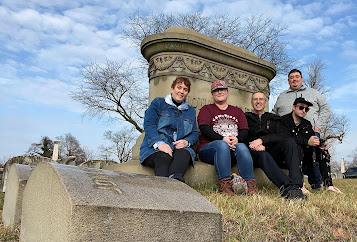
I must mention the reason I was here in the first place. Some friends who are part of the Instagram Cemetery Meetup group we formed last year live in the area and have suggested we all meet there for a walking tour. The group has done this about six times so far, congregating in various cemeteries between Philadelphia and Perth Amboy, New Jersey. About fourteen of us met on this sunny spring Sunday in Tennent – one of the largest attendances we’ve had. There are about twenty people who are part of the group and maybe ten on average will attend a meetup.

Some members of our meetup group outside church

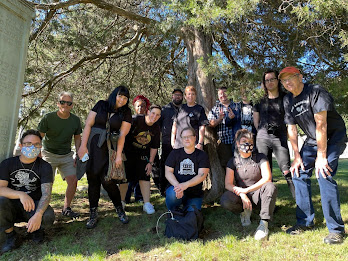
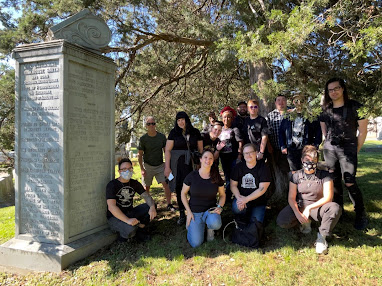
We had hoped, as our guide had planned, to see the inside of the church. We arrived as a service was letting out and we asked if we could go inside. The people in the church politely declined, so we went about the grounds exploring and photographing. I made these group photos with my iPhone 12 on self-timer. I also brought my new old camera, a forty-year-old Leica R4 35mm film camera, which I needed to test before the warranty expired. A few members of our group graciously posed for photo portraits, as I wanted to test out the camera’s (with Leica 28-70mm f3.5 lens) ability to capture humans, which I have seen can be done with astounding crispness on a shallow depth of field.

Someone asked me how the camera has been performing, and I said, “I’ll let you know in a week when I get the film back.” I don’t photograph live people, generally, so the results will also reflect my paucity of skill in that regard. I say “live” people, because I intend to visit the dead as well at Saint John Neumann church in Philadelphia soon. One of our group mentioned that in addition to his headless corpse which is preserved in state behind glass under the altar at this national shrine in Philadelphia  (https://stjohnneumann.org/our-st-john-neumann/about-st-john-neumann), they’ve also put on display Neumann’s personal collection of saint’s skulls. I mean, what’s not to like there?! Oh, and if you go, this IS the place “where prayers are answered” (https://stjohnneumann.org).

A bit later, I was surprised to see members of our group filing into Old Tennent church! It seemed that our guide somehow convinced one of the church volunteers to not only let us in, but to also give us a half-hour tour! This was wonderfully educational and totally appreciated by everyone. The old wooden structure has been kept in fine shape, inside and out. The subscription pew boxes are labelled with small bronze plaques indicating the name of the person or family who pays “rent” on the box. 

Notch in church pew caused by saw used in amputation

The church had been used as a hospital for the American army (led by General George Washington himself) during the Battle of Monmouth, which was fought on the hill opposite the graveyard on June 28, 1778. As you would expect, then, there are many Revolutionary War soldiers buried in Old Tennent. Our guide pointed out blood stains on a wooden pew seat and another pew with a notch in it’s seat – supposedly this was made by a saw as a soldier’s leg was being amputated.

So that’s all very sobering, right? There was also a display case with cannonballs, rifle shot, and other historic memorabilia from the local battle. The Monmouth fight was pivotal in Washington’s career, as he, personally, along with his army, successfully drove the British farther from Philadelphia (which the British had occupied), a victory which prompted people to begin describing Washington as the Father of Our Country (https://en.wikipedia.org/wiki/Battle_of_Monmouth).

After our tour of the church, our group continued its exploration of the grounds. We all posed for a group photo (again, taken with my iPhone 12) in front of a mausoleum. I’ve noticed that many members of the group sport great T-shirts and other items of clothing which serve as an effective starting point to begin a conversation with someone you’ve only ever met on Instagram! The social media platform is being used to create and nurture actual social in-person relationships. I look forward to our next planned meetup, which may be around Elizabeth or Newark, New Jersey. Our friends (and we truly have all become friends) from that area are anxious to show us two cemeteries that boast even more gravemarkers with angel and death’s head soul effigy carvings. 

In parting, let me just say that it always pays to look inside mausoleums. You can see some amazing stained glass, or even engraved crypt covers such as the one you see below. Seriously, would you ADVERTISE that you were a descendant of witch burners Cotton and Increase Mather? This Puritan clergy father/son duo was responsible in large part for the witch hunts and resulting murders in New England during the late 1600s. But seriously, if it hadn’t been for the Salem Witch Trials, how would we ever have known that witches can’t swim? Turns out that the Monty Python witch trial scene from the movie, “Monty Python and the Holy Grail,” was a fairly accurate depiction of how skewed this Puritanical logic was (https://www.youtube.com/watch?v=rJFA6uEfUlM). As an aside, “Cotton Mather” is also the name of a pretty cool power pop band. 


Saturday, January 8, 2022

Cemetery Meetups

Cemetery Meetup at The Woodlands Cemetery, Philadelphia

Back in the fall of 2021 (when we were thinking that we were all successfully pulling out of the COVID-19 pandemic, pre-Omicron variant), I got this idea in my head that it would be a cool social exercise to get some Instagram cemetery photographers together for an outing at Mount Moriah Cemetery in Philadelphia. I invited mostly people I’ve never physically met. About ten of us showed up – several whom I invited, and some people who THOSE people invited. The only commonality was that these were seriously good photographers who shared a common interest – posting cemetery photography on Instagram.

Mount Moriah Cemetery, Yeadon, PA side

Our initial outing at Mount Moriah went so well that we all decided to do it again. After some conversation, we all realized that we each had explored many cemeteries that the others had not. Thanks to Jenn O’Donnell (IG link), our member who organized an IG Meetup link, we all stayed in close contact with each other and took a vote on the next cemetery location at which to meet. Three additional meetups have occurred since that initial one, in cemeteries in southeastern PA and central and south Jersey. We number about twenty “members,” if you want to call us that.

A few things I’ve learned from my fellow necrogeeks (kudos to Timothy for that term!):

  • Cemetery nerds have the BEST stories!
  • There are funeral strippers in China.
  • If you ask at the office for the key to the community mausoleum, they might just give it to you.
  • Santeria-type offerings at a gravesite could easily involve live animals.
  • There are FAR MORE deaths-head and angelhead gravemarkers outside of New England than I thought.
  • Zinc monuments are still controversial.
  • Snapseed is a cool, in-phone photo-editing ap - and its free.

Mount Moriah Cemetery, Philadelphia and Yeadon, PA.
The photo you see directly above was the first group photo we made. Or rather, I made, actually, to sort of document our initial meetup at Mount Moriah. We only began staging the group shots at our second meetup, at Philadelphia’s Laurel Hill Cemetery. We didn’t really know each other well enough, I think, at Mount Moriah, for anyone to suggest a group photo. Plus there was the issue of who was vaccinated and who wasn’t. Also, it might not have occurred to us at the time that we would continue our adventure. I’m not sure who suggested the group photo a month later at Laurel Hill, but it has since become a staple of our gatherings. As more people got vaccinated and boosted, spreading COVID became less of an issue.


Cemeteries need not be places where dreams go to die. As we re-envision what social gatherings should look like in this evolving pandemic, there is one thing that everyone agrees on: outdoor gatherings are safer than indoor ones. So these cemetery meetups appear to be a healthy way to maintain our interactivity as social beings while staying physically safe.

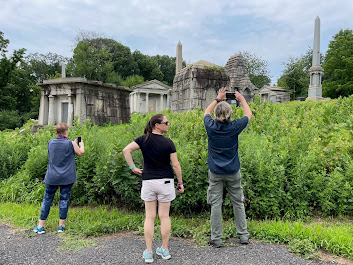
While many cemeteries host official events that draw throngs of people (I realize there might be some of you who are surprised to learn that), such events are carefully planned and quite focused. Our IG meetups are anything but! We just stroll through the cemeteries and graveyards talking, photographing, and perhaps being led to some points of interest by someone who had been there before. We greatly appreciate the hospitality offered by the many open cemetery gates throughout the region, that allow us this opportunity. We also do appreciate the more focused events such as hearse shows, The Market of the Macabre, movie nights, concerts, the Darksome Art and Craft Market, and so on. Such events are all wonderful ways to bring people together, promote small business, and to raise money for the upkeep of the cemeteries.

Evergreen Cemetery, Camden, New Jersey

Victorian-era garden cemeteries of course were designed for large groups of people to visit and enjoy. Before there were parks and museums in the United States, cemeteries were the places you would go to get away from the noise and grit of the cities. They were meant to be calm, contemplative locales, beautifully landscaped in arboreal splendor - a place to revitalize, a place conducive to better physical and mental health. People recognized early in the current pandemic (and especially during lockdown) that cemeteries were in fact the ONLY safe place to congregate. I for one am grateful to all the cemeteries for keeping their gates open and welcoming throughout this time. Hopefully the trend will continue and more people will visit regularly - and I encourage people to donate money to their favorite cemetery to help keep those gates open in the future.

There is, of course, no socially redeeming purpose to cemetery photography itself (or photography in general). As with any art form, it must be shared to offer its greatest value. Interacting with people who share this common interest is exhilarating, at times. Meeting them personally is an added dimension and doing so during the COVID crisis is one of the best things we can do for our mental health. As I write this on the first day of the new year, 2022, the Omicron variant is so widespread that unless we force ourselves into lockdown again, it cannot be avoided. We’ll all get it sooner or later.

COVID has made death more real for many of us (death toll as of January 2, 2022 in the U.S. is 828,732; worldwide it is nearly 5.5 million (ref.)). Probably not since the last pandemic a hundred years ago has death been this concrete. Mentally, this is probably healthier for us – we are now forced to be much more pragmatic about death. Its almost like the present pandemic switched things up: pre-pandemic, death was abstract and society was real (for the most part). During the pandemic, death became more real and society became abstract.

But now with our evolving understanding of COVID-19, we are trying to work our way back to being a society that interacts physically – less screentime and more facetime. Ironically, virtual tools like social media can help us attain this goal. Though Instagram, Facebook, and other social media are quite abstract, we can use these tools to form concrete relationships – to create actual reality from the virtual. Granted, there are situations in which virtual meetings are the only option due to geographic distance, transportation, or the need to reach a larger audience. However, social media can successfully be used as an invitation, an entrée into more fulfilling in-person relationships.

Laurel Hill Cemetery, Philadelphia

Sometimes timing keeps all the members of our IG group from getting together. I’ve missed a couple meetups, but when I see the results others have posted on IG, it makes me wish I had been able to attend. Creatively, for many of us, these meetups will be a seminal influence on what is yet to come (little inside reference to the hooking tree we discovered in Camden).

We share our knowledge of specific cemeteries we have visited, and benefit greatly from the knowledge of others. These people bring a wealth of research and experience to bear in their work and all have their own reasons for doing what they do. It is evident by the joy and camaraderie at our physical meetups that everyone shares a deep interest in those who have gone before us. But why this interest? Perhaps it has something to do with a comment made by Dave Grohl (of Nirvana and The Foo Fighters) in his autobiography, The Storyteller ...

  We all carry traits of people we have never met somewhere deep within our chemistry.”

Another view of the photo above in the shade of an immense zinc gravemarker


Thursday, July 8, 2021

Cemetery in the Pine Barrens of New Jersey

What’s a Jersey shore vacation without a trip to a local graveyard? As my family frequents the area around Long Beach Island, I’ve visited most of the local cemeteries. On this trip, I thought I’d see what’s up with the “closed” pet cemetery, noted on my iPhone’s Google Maps. Looked to be in Manahawkin between the on ramp to the Garden State Parkway and Whispering Oak Circle. So I left Beach Haven about 7:30 a.m. on an overcast Saturday morning, drove the seven miles north up the island, over the causeway and onto the mainland. About five miles west on Route 72 is where the Garden State Parkway crosses it. I cut off 72 toward Whispering Oak Circle. 

Try as I might, back and forth on this small residential street, and I just could not find the place. It was woods on one side, residences on the other. The woods just looked like they butted up to the parkway. Maybe Google Maps was in error. Ah well, good fail, as the skateboarders say.

Even though it was a further drive than I wanted to make on this early Saturday morning, I thought I might finally check out Reevestown cemetery, about an eight-mile drive north on Route 72. 

For several years, I had known about this remnant of the Pinelands, but had never visited. One reason being the inherent spookiness of the pine barrens. People living off the grid, down sand roads deep in the forest. Makes you feel a bit like Hansel and Gretel with the Jersey Devil playing the part of the wicked old witch. Especially after seeing mailboxes like this one along the road.

The pineys, as they are called, rather cultivate this mystique, in order to maintain their isolation from the masses, and probably especially from tourists. 

"WARNING..."
Google maps showed me where the Reevestown Cem was supposed to be. Passes a crumbled roadside memorial at the intersection of 72 and Warren Grove Road, where I made a left. I got to where Google Maps said the cemetery was, but …. Damn. Just a patch of woods. Oh well, maybe there’s something in there. So I pulled over, got out of my SUV, sprayed my shoes, socks (damn! Forgot to wear socks!), and pant legs with tick spray, and took one last look at Google Maps before venturing into the thicket. What? Now it shows the cemetery off an access road up ahead! Jump into the vehicle and head up the road a piece. And there it was off to the right, a sand road leading into the woods, with a rain puddle at the entrance to greet me. A very weathered “Warning” sign was nailed to a tree where the road led into the trees.

Sand road entrance to Reevestown Cemetery

As I write this, I’m sittin’ on the dock o’ the bay, cappuccino and raspberry scone in hand. Yesterday at this time, however, I was in full explorer mode. And truth be told, I was a bit uncomfortable there, having recently read the book, “The Pine Barrens,” by John McPhee (1978). All the legends, all the history, all the fables of the pine barrens – including the pineys, are covered in the book.

Reevestown Cemetery


I drove into the woods. The road took a few twists and then opened up onto a perfectly maintained small cemetery with old graves (starting around 1862) on the left, newer graves on the right. I imagine people continue to be buried here, even though there is no town for miles. Reevestown itself is no more – not even a ghost town. 

Reevestown Cemetery in Stafford Township, New Jersey, is deep in the heart of the pine barrens – just a few miles from the Pinelands unofficial “capital city,” Chatsworth. Reevestown is not exactly a ghost town - it’s actually no longer there. Destroyed by a massive forest fire in 1936, this small sawmill settlement (which I assume was called Reevestown, there really is no evidence of this that I could find) consisted of the mill, some houses, and a schoolhouse. The fire was the worst forest fire up to that point in the history of the Pinelands - it left five firefighters dead and 20,000 acres of forest, dwellings, and businesses burned (ref.). Reevestown was destroyed but the cemetery remained, and continues to be used, by locals I assume. There have been burials here in the past decade.


See the clipping below from “Union Township,” a report written by the Barnegat Historical Committee: (https://www.state.nj.us/dep/hpo/hrrcn_sandy_OCE_GB_147_148_PDF/OCE_GB_148_v34.pdf)

"A small sawmill settlement once was located near Reevestown Cemetery [which I assume was called Reevestown]. Today only cellar holes mark where buildings once stood. Only the cemetery remains intact. Saw mill, dwellings, and a schoolhouse were located here prior to a fire in 1936." 

Lone sentinel at sand road exit of cemetery

Somewhere online I read that if you live in the general area, you can be buried here. The cemetery has maybe a hundred plots, with many more people than that residing below. It seems to be kept up, but then, there is no grass or weeds to cut. Its all sand. The rules posted on the sign at the entrance to the property suggest a governing body of some sort, mentioning a Cemetery committee with officers and trustees, but there is no contact information. 

Grave decor


Note tree stand at top left.
Some graves here are recent, with lots of kitschy mementos. One even had deer antlers nailed to a nearby tree, with a hunter’s tree stand attached to the tree next to it! Deer hunting for food has long been a standard activity of the people who live in the pine barrens. They are for the most part isolated and self-reliant. Many of them work in the local cranberry bog and blueberry farms, and have for decades since the region’s main industries, glass making, lumber, and iron forging went bust.

Reevestown Cemetery is a serene place, that is, if you can get over your fear. Its just a little too quiet. That guy’s shotgun shell mailbox made me think of the scene from the Sopranos where they take the guy out to the pine barrens to kill him, where they try to get him to dig his own grave first. Out here, no trace would ever be found of you. But that’s Hollywood; whereas the pine barrens – and its inhabitants - are real.

Entrance to Reevestown Cemetery


Monday, August 29, 2016

Ebeneezer Price, Colonial-era Gravestone Carver

My knowledge of eighteenth-century American headstone carvers is rather limited. What I do know has been gleaned from my relationship with the Association for Gravestone Studies. This organization publishes such scholarly information in their quarterly journal (see link at end). So when I personally happened upon evidence of such a headstone carver right before my eyes, I became immediately interested.

Pennington Presbyterian Church, Pennington, New Jersey.

Walking through the Presbyterian Church graveyard in Pennington, New Jersey, I noticed seven red sandstone grave markers all in a row – six large (standard-sized), and one small. Recognizing them as the oldest on the site, I thought perhaps they might have the old “angel-head” carving at top (I initially spotted them from behind). I walked around the thick (three inch) slabs with the roughly carved backs and, lo and behold, three of the large stones had angel heads carved at top, while two had a sunrise! I get rather excited to find these as they are quite uncommon outside New England. New Jersey cemeteries seems to be the southern cutoff point. Why is this?

Rear view of red sandstone grave markers

Well, New England was one of the first areas of the north American continent to be settled by Europeans and the first to become densely populated. Therefore, the oldest graveyards are there. The Puritanical flair of the headstone artisans and craftsmen is evident on early headstone carvings throughout that region. As time went on, populations grew and spread out from New England. Belief systems changed, different materials were used for grave markers, and this particular type of angel head was replaced with other symbolism (or none at all).

"Sunrise" symbolism

White marble became a popular choice as a replacement for red and brown sandstone, as Vermont and Philadelphia quarries boomed in the late 1700s. Angel heads appear on old marble stones too, but marble wears easily and detail is quickly lost. Sandstone retains detail better, but cracks more easily. Central and northern New Jersey’s sandstone quarries supplied the need for grave marker material from the end of the seventeenth century until the beginning of the nineteenth century.

Small headstone, perhaps a child's
While red sandstone grave markers can be found geographically south of central New Jersey, they are usually devoid of ornamentation (i.e., angel heads, flowers, and other designs). The reason is that Philadelphia-area stone carvers (from 1785 onward) usually did not exhibit the artistic flair, or skill, of their northern counterparts. Still, fanciful headstones from the northern and central New Jersey carvers found their way to cemeteries all over the east coast.

"E. Price" signature engraved at bottom of 1775 headstone

Ebeneezer Price

As I photographed the seven red sandstone markers in Pennington’s Presbyterian Church graveyard, I realized two things: one, they all marked graves of members of the same family, the Muirheids; and two, the markers were all signed by the same stone carver! This latter point is rather unusual in my experience.

“E. Price,” as you can see in this photo, stands for Ebeneezer Price, “New Jersey’s most prolific eighteenth century gravestone carver” (so described by Nonesteid and Veit in their fascinating 2011 publication, Carrying On the Stone Cutting Business.) FindaGrave.com describes Price as a “Master Craftsman, Folk Artist. One of the most skilled and prolific gravestone carvers in colonial America, Price's work began to appear in the burial grounds of northern New Jersey in 1757… 

Ebeneezer Price, this engraver from Elizabeth, New Jersey, was born in 1728 and created masterpieces such as those you see here from 1744 through 1787. These intricate soul effigy engravings, lettering, and other designs were amazingly done by his own hand and chisel. His style influenced many other stone carvers of his time.

Note "E. Price" engraving at bottom right

It happens to be well-documented that Price signed, or initialed his work, which was unusual in that industry, or craft. I found it interesting that during the Revolutionary War-era that Price was in business, he would barter for payment of a carved headstone. Barbara Schaffer’s 2013 Quilts, Gravestones, and Elusive Ancestors blog post, “Signed by Carvers,” reproduces a 1786 newspaper advertisement for Price’s engraving business. He would accept any of the following in exchange for an engraving job: “timber, stone, brick, boards, window-frames, doors, sashes, shutters, hinges, carting, labor.” The article shows further examples of Price’s intricate carvings of angels, flowers, and letters.

Seven Ebeneezer Price-engraved sandstone grave markers, Pennington, New Jersey

Ebeneezer Price’s workshop was in Elizabeth, New Jersey, but his engraved headstones – wonderful examples of early American folk art - traveled to such places as New York City, Long Island, the Carolinas, Georgia, and the Caribbean (ref.)


Price died in 1788 and is buried at the First Presbyterian Churchyard in Elizabeth, New Jersey.

References and Further Reading: