Friday, June 13, 2014

Funeral in the Rain

I arrived at the cemetery half an hour before the service was to begin. I planned my trip this way partly because I had never been to this cemetery (and was not sure how to get there) and partly because I was curious to check it out). My friend’s father died and he was being buried today. It was pouring. The service was to be held at 2:30 pm in Har Nebo, a large Jewish cemetery in northeast Philadelphia.


The green tent was set up over the grave, but the visitors had not yet arrived. I drove around in the hot rain (my air conditioning was not working), taking a few pictures here and there. Landscaping is sparse, a small red azalea bush in bloom here and there. It is spring, a time for rebirth. Old headstones, cracked, lying on the ground. Har Nebo is an expansive cemetery, Philadelphia’s oldest privately-owned Jewish cemetery, which dates back to 1890.
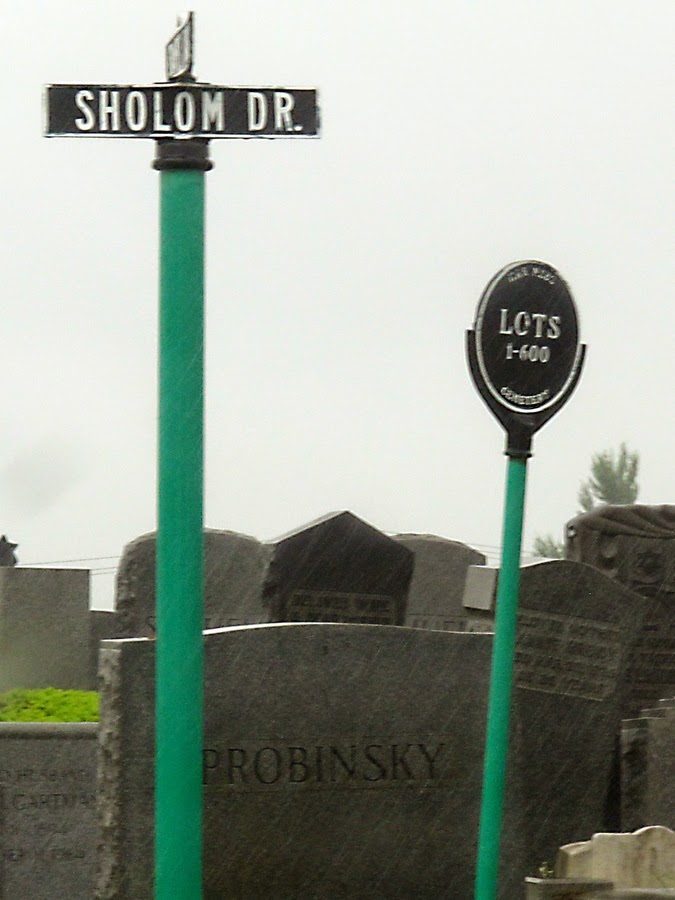
After about ten minutes I saw headlights at the cemetery entrance. The guests (?? attendees? mourners?) and grave attendants began to arrive. Next the silver hearse. As there appeared to be no chapel, I assumed this was to be a graveside ceremony. I parked my car along the road and got out with my coat and umbrella. It was pouring. The grave site was along Shalom Drive in the cemetery. "Shalom" is the Hebrew word meaning "peace." It was far from peaceful here that day, with the wind and the rain.


After saying hello to my friend and his wife, I went under the green tent. The rabbi was the only person there. This would be a small service, with about fifteen people. Small family. Some friends. I said hello to the Rabbi and she said, “The sky is crying.

If you think I took pictures during the ceremony, I am sorry to disappoint you. That would not have been respectful. Some things need to be kept private. People began to come in out of the rain. The wooden casket was brought from the hearse and placed onto the metal support frame over the grave. The wind howled and blew the rain in on the assembled. My friend’s yarmulke blew off and flew out of the tent onto the nearby grass. I retrieved it for him. Rain speckled the casket’s rich wood surface with its Star of David design on top. The prayers began. Oddly, the wind and rain died down for the entire length of the half-hour ceremony.

When the deceased was still alive last month, his son (my friend) gave me his “first alert” type device to try with my Mom, since I felt she could use one after falling and breaking her hip (read more about that here). His Dad had used it for a few months before being admitted to a hospice. So although I did not know the deceased personally, I certainly felt connected to him. Not only because of the “first alert,” but also because, supposedly, he developed a taste for beer during the last few months he was alive!

The rabbi said a few things about the departed, based on sparse facts gained from family and friends. Typical stuff. Then the grandson read a eulogy he had written, a remembrance of his grandfather. He was sorry he hadn’t made more frequent visits to see his grandfather while away at college. Very difficult for him. Regrets. Tears all around. He got through it like a trooper, though. Afterward, the rabbi sang a mournful dirge. She quoted some passage about the departed not being gone, just in “another room,” and that we can all honor his memory when we continue to do the things he enjoyed doing with us. The recurring theme was that this gentleman put everyone’s needs ahead of his own.


The rain began again, almost as heavily as before. Since I was standing near the edge of the tent, my pant legs were soaking wet. The rabbi invited the two relatives closest to the deceased (brother and sister), to drop a scoop of mud onto the casket. It is tradition at Jewish burials to throw a scoop of dirt onto the casket before it is lowered into the grave. My friend and his sister declined. They may have done it, had the dirt not turned to mud, but maybe not. When my wife’s grandmother buried her son, she declined to throw the dirt as well. Sure, its part of the ceremony, and it is symbolic – but not just symbolic. You’re literally helping to bury the person. You’re throwing the first shovelful of dirt onto the casket in the grave. Throwing that scoop of dirt on a loved one’s casket must be an incredibly difficult task. Like Moses descending from Mount Nebo after his final look at the Promised Land, never to see it again in his lifetime.

I drove out of the cemetery in the rain, taking a few pictures here and there.

Further Reading:
Read more about Philadelphia's Har Nebo Cemetery at this link.

Tuesday, June 10, 2014

"Dont Fear the Reaper" - The Story of Jearum Atkins, Inventor

Back in 2011, as I was crawling through the weeds, trawling for interesting gravestones in Philadelphia’s Mount Moriah Cemetery, I came upon a most curious monument. It was in the hinterlands of Section 149, which is on the Yeadon (PA) side of the cemetery. (For those readers unfamiliar with this formerly-abandoned 300-acre Victorian cemetery, it actually spans two counties – Philadelphia and Delaware.) The Friends of Mount Moriah Cemetery, Inc. has made great strides in the past few years in keeping the grass, weeds, trees, and other foliage cut and maintained over about 25% of the grounds. However, Section 149 is in the 75% that remains overgrown.

The 3-foot high granite square monument upon which I stumbled marks the grave of one "Jearum Atkins, Inventor(1815 - 1897). I had never heard of him, so I photographed the four sides of the marker and looked him up on the Internet. The curious inscriptions seemed to indicate his inventions.

Jearum Atkins is not a household name like that of Thomas Edison and Henry Ford. However, he was responsible for important, incremental improvements in engineering technology during the Industrial Revolution. One reason for his lack of fame might be due to the fact that he sold his most potentially profitable invention to Cyrus McCormick. Atkins, in 1852, perfected the design of Cyrus McCormick's original grain reaper, allowing McCormick to build the fully automated harvester, for which McCormick eventually became famous (he bought the "raking" design from Atkins!)

"Atkins Automaton Reaper" (ref.)

 From the book: Cyrus Hall McCormick, by Herbert Newton Casson (1909)"

"Of all the varieties of difficulties that confronted Cyrus H. McCormick during his strenuous life, the most baffling and disconcerting difficulty was when his Reaper began to grow. For fifteen years—from 1845 to 1860—it had remained unchanged except that seats had been added for the raker and the driver. It did no more than cut the grain and leave it on the ground in loose bundles. It had abolished the sickler and the cradler; but there yet remained the raker and the binder. Might it not be possible, thought the restless American brain, to abolish these also and leave no one but the driver?
 
As early as 1852 a fantastic self-rake Reaper had been invented by a mechanical genius named Jearum Atkins. This man was a bed-ridden cripple, who, to while away the tiresome hours of his confinement, bought a McCormick Reaper, had it placed outside his window, and actually devised an attachment to it which automatically raked off the cut grain in bundles."


Atkins monument, Mount Moriah Cemetery
Atkins lived during the Industrial Revolution – when machines were invented to replace manual labor and automate as many processes as possible.  The device mentioned above, the “Self-Raking Harvester,” was an improvement upon the McCormick reaper – the latter simply cut the grain. This saved the effort exerted by people with sickles, but the greater work was that of raking the cut grain so it could be bundled. Atkins’ redesign was such a success that after production began in 1860, farmers seldom bought any other machine.

Described as “one of the most remarkable men ever born in this country,” which nature endowed with “a phenomenal capacity for mathematical and physical inquiry” (Cassier’s Magazine, Vol. 5, 1893-4), Atkins applied for and received many patents from the U.S. Patent Office. His original inventions did not fare as well as his improvements on other people’s work. For instance, he improved the design for the steering mechanism of steam ships (“Hydraulic Steering Apparatus, patent issued 1890), using an application of hydraulics. Atkins’ list of engineering inventions, patents, and patent applications seems endless. Most of these in fact were contrived as he lay in bed, an invalid for twenty years due to a spinal problem. His fame and fortunes waxed and waned, but he continued to design, redesign, and strove to achieve.

Jearum Atkins’ patented inventions are inscribed on the four sides of his small, granite monument in Mount Moriah Cemetery. They are (followed by their patent award dates):

Self-Raking Harvester  1852 – 1868
Safety Valve Regulator 1868
Smoke Stacks 1868
Hydraulic Steering Apparatus 1890
Calipers 1868


Atkins' caliper improvement (ref.)
Atkins' caliper patent was a simple improvement on the mechanical measurement caliper. His smoke stack design was intended for steam locomotives, to improve the efficiency of the exhaust of steam. The safety valve regulator was intended for steam boilers, through which high-pressure steam could be vented so as to keep the pressure vessel from exploding. If this sounds too technical for the reader, go look in your basement and find the brass safety valve on the side of your water heater – same idea! Back in Atkins’ time, many were killed by accidental explosions of pressure vessels in locomotives and steamships. Possibly, his invention helped prevent such incidents. (Mark Twain’s younger brother, by the way, was killed in 1858 when the boiler blew on the paddlewheel steamboat on which he was a passenger.)

Quite a bit of history there behind an unassuming little grave stone in the weeds. As we consider the contributions of Jearum Atkins to engineering design and technological advance, let us realize that many original inventions are not necessarily all that useful. They are in many cases springboards for further development and improvement, often by people other than the original inventor!


Read more about Jearum Atkins’ inventions here:


Wednesday, May 28, 2014

The Nanny's Photographs

"Finding Vivian Maier"
Okay, so unless you’re an avid photographer, well no - a true photo nerd - you probably have not heard of the movie currently making the art house rounds called Finding Vivian Maier
(http://www.vivianmaier.com/film-finding-vivian-maier).

The most succinct introduction to this topic is to quote the website www.vivianmaier.com:

 “This intriguing documentary shuttles from New York to France to Chicago as it traces the life story of the late Vivian Maier, a career nanny whose previously unknown cache of 100,000 photographs has earned her a posthumous reputation as one of America’s most accomplished and insightful street photographers.”

So why am I writing about this in The Cemetery Traveler? Well, there's a strange connection here if you will allow me. I saw the movie a few weeks ago and it is more than just a documentary – it is almost a psychological thriller. In addition to being an amazingly talented street photographer, Vivian appears to have also been mentally disturbed. But then so was VanGogh. The reason I bring Maier up in this blog is because of a story related to me by an attendee on a photography tour of Mount Moriah Cemetery last year (Mount Moriah is in Southwest Philadelphia). Also because it is now May, and all the Catholic school children are receiving First Holy Communion. Stay with me on this. I’ll eventually tie it all together!

First, you might want to view the trailer of the movie, to get a better idea of what Maier was about. Click this link to view. The photo at the beginning of this blog is one of her many self-portraits; the young girl in the reflection is one of her charges. The image is titled "Self-Portrait, 1953," though Maier never titled her work. In fact she never even printed her negatives. As you will learn from the documentary, she even left thousands of exposed, undeveloped film behind after her death!

So back to the photo tour at Philadelphia’s Mount Moriah Cemetery. The woman on the photo tour (who was in her sixties, as I recall) told me that her family lived across the street (Kingsessing Avenue and Cemetery Road) from Mount Moriah when she was around eight years old. This would have been in the 1960s, I suppose. Her parents had a nanny to take care of her and her brother. The brother was about the same age. Their nanny, it seems, was an avid photographer and would from time to time – I swear I’m not making this up – have the boy and girl dress in their white First Holy Communion outfits and walk over to the cemetery with her. Right in front of the old brownstone gatehouse, she would have the children lie on their backs – on graves – with their hands folded as if praying, and photograph them.

Ed Snyder (in green cap) giving tour of Mount Moriah Gatehouse
The photo above shows some of the headstones in front of the gatehouse, perhaps the same ones the nanny had the children lie near. The woman who relayed the story to me said nothing ever happened beyond that – she and her brother just thought it was a bit weird, but they were not afraid. As I listened to her story with my jaw dropped open, she delivered the knockout punch – she told me she still has the photos! The nanny gave them copies! Unfortunately, I lost contact with her and have never seen the photos, but how bizarre is that!

I thought of this situation while watching the movie Finding Vivian Maier, specifically toward the end of the film when it becomes evident that the quirky nanny may have been slightly deranged. One of Maier’s charges (now in her sixties) is interviewed and says that once she and her brother were with Maier and playing in the street when her brother got hit by a car! When the police and ambulance came, the nanny took pictures of the scene!

Image by Vivian Maier, New York City, 1954 (ref.)
Unlike the nanny who worked near Mount Moriah Cemetery, Vivian Maier never showed anyone her photographs. The work was only discovered after her death (in 2009) when the contents of her storage unit was auctioned off. A fascinating story, which is the origin of the documentary film, Finding Vivian Maier. I quote from the website:

Mount Moriah gatehouse as it appears now (2014)
“Vivian Maier (February 1, 1926 – April 21, 2009) was an American street photographer born in New York City. Although born in the U.S., it was in France that Maier spent most of her youth. Maier returned to the U.S. in 1951 where she took up work as a nanny and care-giver for the rest of her life. In her leisure however, Maier had begun to venture into the art of photography. Consistently taking photos over the course of five decades, she would ultimately leave over 100,000 negatives, most of them shot in Chicago and New York City. Vivian would further indulge in her passionate devotion to documenting the world around her through homemade films, recordings and collections, assembling one of the most fascinating windows into American life in the second half of the twentieth century.”

Thursday, May 22, 2014

4th Anniversary of "The Cemetery Traveler" Blog!

As I write this blog posting, I begin my FIFTH YEAR of writing The Cemetery Traveler! Can you believe that?!). I’ve posted 248 blogs in the past four years and I truly thank you for reading them! There will be a quiz at the end. (Actually, a few have been guest-written by friends, at my invitation, and I thank them for sharing their knowledge and experience!)

A few of the blogs had to do with two new Facebook pages I started, based on my experiences with the varied personalities taken on by cemeteries during the different seasons of the year. The first one I did was called Cemeteries in the Snow which was received with wild enthusiasm the world over! This was quite exciting and produced some amazing images, as well as expanding readers' awareness of the beuaty of a graveyard under a blanket of snow.

The next page I started at a friend's request, Cemeteries in the Rain. I thought it would be an interesting experiment. The page has a whole different feel to it, as the general idea of a cemetery in the rain is rather depressing! The page has had limited upload participation because, well, other than me, who would be in a cemetery during a rainstorm?! still, I am intrigued at how a cemetery landscape changes drastically with the seasons.

As a fairly prolific writer, I can’t help but share an ironic experience with you, which has to do with writing, and with me, specifically. A few months ago my wife and I took our four-year-old daughter to a “play date” at a local (Philadelphia) Quaker school to see if we might send her there for kindergarten. While the kids were off playing (and being evaluated), the parents were gathered in a separate room for chatties and snacks (and most likely also being evaluated, though more discretely). As about thirty of us sat there in comfy chairs listening to the speakers extoll the virtues of the school, the dreaded ice breaker was thrust upon us.

Daughter Olivia learning her "ABCs"
We were each given a slip of paper on which were typed different questions. We were to go up to a stranger and ask them our question. After the person answered, that person would ask you their question. You would then trade slips of paper and go find another stranger to accost. It was a way of learning about each other that was effective and sort of eye-opening. I was asked this question:


“If you found yourself on a desert island, what three things would you want with you?”
Now, dear reader, before you continue, I invite you to jot down three things that first come to your mind – what would YOU take? I’ll go off on some little tangent and then come back with my response. Then we will compare and contrast.

So it has been four years of writing The Cemetery Traveler and I am STILL working on my first book of collected blogs. Its not so much procrastination – life gets in the way when you’re busy planning other things. Occasionally I sit in front of my laptop thinking Jack Kerouac thoughts, having “... an awful realization that I have been fooling myself all my life thinking there was a next thing to do to keep the show going ....” (from his book, Big Sur). But the book has to come out. I want it. I think it would be well received.

Occasionally I get writer’s block, but that only lasts a few days at most. Because as you all know, down every road, there’s one more graveyard! And sometimes, beneath a graveyard lies yet another graveyard - I mean, literally. After all, this was how Rome, Paris, London, Seattle, and San Francisco were built – a layer of a new city on top of its buried predecessor. Still, we don’t think of digging further down into a graveyard and expect to find headstones and monuments. Yet this is exactly what is occurring at Mount Moriah Cemetery, in Southwest Philadelphia.

Face-down, fallen headstone in process of being resurrected

It's interesting how the gravestone excavation is proceeding here at Mount Moriah. The Friends of Mount Moriah Cemetery, Inc., in their attempts to locate grave stones for plot holders and descendants, realized that many of the apparent "missing" stones are actually buried! For the past century, stones have fallen and been buried during ground subsidence, soil erosion, under layers of fallen leaves, etc. Stones buried a foot below ground are typically found with a steel poker driven into the ground. In this place of over 80,000 graves, the chances of hitting a buried stone are quite good.

Harry Houdini at Heller's grave (ref)
That's how the headstone of noted nineteenth century magician Robert Heller was located. The photo at the beginning of this article is me standing next to it. Directly above (in an early 1900s photo) is Harry Houdini standing next to it! The stone had been lying in the dirt, face down, for may years. Now it is upright, and the grounds around it have been cleared so people can visit. 

So my point (and sometimes I do indeed have one) is, that since there are stories within stories, graves below graves, I may never run out of subject matter! And as long as I can get around and travel to all these interesting graveyards, I am hopeful that I can do my part to keep the memories of the occupants alive. And I well appreciate you following my blog, if only to avoid being reproached by friends for an uncalled for lack in your graveyard education!

Now then, about the three things I would want with me if I found myself on a desert island - I responded, “A guitar, a very long novel, and my wife.” This in itself may be telling in some way. However, what REALLY got me thinking about my answer was the comparative answers of other people who were asked this same question. Some I asked personally, others I overheard in the room. EVERYONE else included in their list of three items some electronic device with which to communicate with the outside world! That never occurred to me! I found this to be ironic and hilarious at the same time, since normally, I cannot shut up. So I guess if I found myself on a desert island, after reading the book and playing the guitar, I might just talk my wife to death about cemeteries.

Wednesday, May 14, 2014

Friends of Mount Moriah Cemetery - "Urning" Our Respect

Whenever I’m looking for something to write about, I’ll take a drive out to Mount Moriah Cemetery in southwest Philadelphia to see what’s up. Something always is. Since the weather broke and the insanely snowy winter loosened its grip on the region, The Friends of Mount Moriah Cemetery, Inc. has been hosting restoration events every weekend. There are so many volunteer organizations wanting to participate in this effort, that every time I visit, a new previously-forested area seems to be cleared!

The obvious large-scale cleanup has been the inner “Circle of Saint John,” the Masonic plot which can actually now be seen and easily accessed for the first time in ten years. (The lead photo in this article was made in May 2014, after substantial clearing had occurred.) Various groups of people have participated in the restoration of this particular area of the cemetery, including local Masonic lodge members and students from Drexel University. I had seen photos of the cleared area but until you see it in person, you cannot appreciate the magnitude of the job. The photo below shows the same area in 2011.

Circle of St. John at Mount Moriah Cemetery, Philadelphia, winter 2011

My focus of this article, however, is less on the magnitude of this work than on the meticulous CARE involved. Obviously, the people involved are focused on more than just the brute force work of clearing the area of invasive trees, vines, and knotweed. They’re doing this because they’re interested in what’s under the brush – the graves of our ancestors. This is about respect for the dead and keeping their memory alive.

On walking through the Circle, this granite draped urn (at left) caught my eye. It was placed at the foot of a large memorial, the one it had fallen from. It seems a rather small detail, but it exemplifies the great care that the volunteers take to ensure this statuary continues to exist, and the memories remain strong. The urn can be viewed as a simple design accent on a grand Victorian memorial, but in past times, it was viewed as much more than that.

This particular urn was found embedded in the ground, having fallen about ten feet from the top of the monument behind it, god knows how many years ago. The Friends (Bill Warwick, Bill McDowell, and Ken Smith) dug it out and carefully placed it where you see it in the photo. My estimate of the weight of this thing is three hundred pounds. No small feat. To give you an idea of the size of this objet d’art, take a look at the photo below of me crouched behind a similar urn a few plots away. I weight two hundred pounds and am six foot two.
 
Author Ed Snyder with fallen granite urn

The urn was a very common piece of Victorian funerary art. However, designers did not use the urn as a literal symbol of a cinerary urn (which holds ashes, or cremated remains), simply because cremation was far less common then.They meant for it to symbolize a container of sorts, like the human body, which holds inside it, the soul.

Douglas Keister, in his book, Stories in Stone,” says:
“The draped cinerary urn is probably the most common nineteenth-century funerary symbol." The drape may symbolize the veil between earth and heaven. Since cremation was seldom practiced in the 1800s, the urn likely does not signify a literal vessel for ashes (or cremains). More likely it symbolizes the human body, a simple vessel for the spirit. Keister goes on to state that the urn and the willow tree “were two of the first funerary motifs to replace death’s head …. effigies when funerary symbolism started to take on a softer air after the [American] Revolutionary War.

Keister tells us that the phrase “gone to pot” may have originated as a reference to a cinerary urn.

Cleared section of the Circle of St. John


Friends' treasurer Ken Smith, with chain saw
So the fallen urns are not just adornments on the larger monuments – they very personally signify the bodies of the deceased. The care with which they are handled and treated by the volunteers who are restoring Mount Moriah Cemetery should not go unnoticed. Another thing that should not go unnoticed is the fact that these incredibly heavy objects are not even attached to the monuments! You can see that the base of the urn I am crouched near is smooth! It was just sitting up there, ten feet off the ground! This one may have fallen 50 years ago when the monument tilted off level due to ground subsidence. I wonder if such things are more securely attached in earthquake-intensive areas like California?

Visit the Friends of Mount Moriah Cemetery, Inc. website to learn more and find out how you can help! (Click here!)

Thursday, May 8, 2014

Spring Blooms in the Cemetery

For many people, flowers and funerals are as natural a pairing as ashes and urns. So while we may think more often of cut flower arrangements in a funeral parlor or a “grave blanket” on a grave, we may not think about all the wonderful live flowers blooming in cemeteries in the spring. The seemingly staid statuary and dismal grey gravestones get dressed up in vivid shades of pinks, violets, reds, and whites – truly a beauty to behold. The azaleas, dogwoods, and magnolias of the northeastern United States add stunningly colorful accents to the magnificently sculpted landscapes of our memory gardens. The Victorians knew a thing or two about creative landscaping, and designed their cemeteries to be cheerful in springtime.

Being native to the northeastern United States, I have no experience with the seasonal changes of flora in other lands. In the general area in which I live, the lively and colorful flowering season of rebirth lasts about a month. Magnolias first burst forth near the end of April, while the others follow in their wake (pun intended). Over the course of the next few weeks and in rapid succession come tulips, dogwoods, lilacs, and the pink and white tufted cherry and crabapple trees that look for all the world like Dr. Seuss’ truffula trees (from The Lorax). Azaleas are the icing on the cake, finally resplendent in bright reds, pinks, lavenders, and whites, until they are gone by mid-May.

Dr. Seuss' pink-tufted truffula tree at Philadelphia's Woodlands Cemetery
I mentioned that all this flora is commonly seen in Victorian cemeteries (which is why they are called “garden” cemeteries), but the sight is far less common in the modern cemetery or memorial park. The main reason being that it is quite labor-intensive to cut the grass around large bushes and trees. Same reason you don’t see a modern cemetery landscaped like a garden cemetery with rolling hills and glens – it is much easier to cut the grass with the riding mowers if you have a large flat lawn with flat-to-the-ground grave markers. Sure, a flowering tree or a hedge may be installed for accent, but it isn’t quite the same as a Victorian cemetery, many of which were, essentially, arboretums.

Example of florid overgrowth in a cemetery

Boxwood of outlandish size
Now, as much as I enjoy buttercream roses on a birthday cake, a rose bush the size of a car can prohibit any access to the actual grave site. This can happen if the rose bush grows wild for decades. So before you plant that rose on Granny’s plot, consider the fact that someone needs to prune it. Perpetual care of a grave seldom includes any horticultural tasks aside from mowing grass and trimming weeds around a headstone. This is why cemeteries have regulations regarding what you adorn a grave with, be it tulip bulbs or a Christmas tree. Consider the diminutive boxwood, a small, slow-growing ornamental shrub sold at many nurseries. This miniscule example of arborvitae can, if left to its own devices for a few decades, grow into a sizable tree!

As an aside, regulations can sometimes go too far, and cemetery owners can change their rules from time to time. Possibly you might not be able to plant any flowers at Granny’s grave at all. A friend of mine, whose parents are buried in a particular cemetery, was recently faced with a rule change that prohibited decorations of any kind at the gravesite. She has had to resort to carrying the small angel statues and other decorations in her car. She takes these to the cemetery and decorates the graves for her visit, after which she collects the decorations and places them back in her car. Sure, it makes cutting the grass easier, but at what cost?

Magnificent flowering magnolia tree in Philadelphia's Laurel Hill Cemetery

There are many cemetery companies, however, whose efforts must be applauded. Those are the companies that care for the old Victorian garden cemeteries, respecting the wishes of the original landscape architects and continue to tend the exotic trees, the hundred-year-old azaleas, the landscaping in general. We may think this is incidental work, but it is not. A monstrous elm or mighty oak looks very stately, but branches fall, damage can be done to the monuments and headstones around it. 

Damage caused by fallen tree

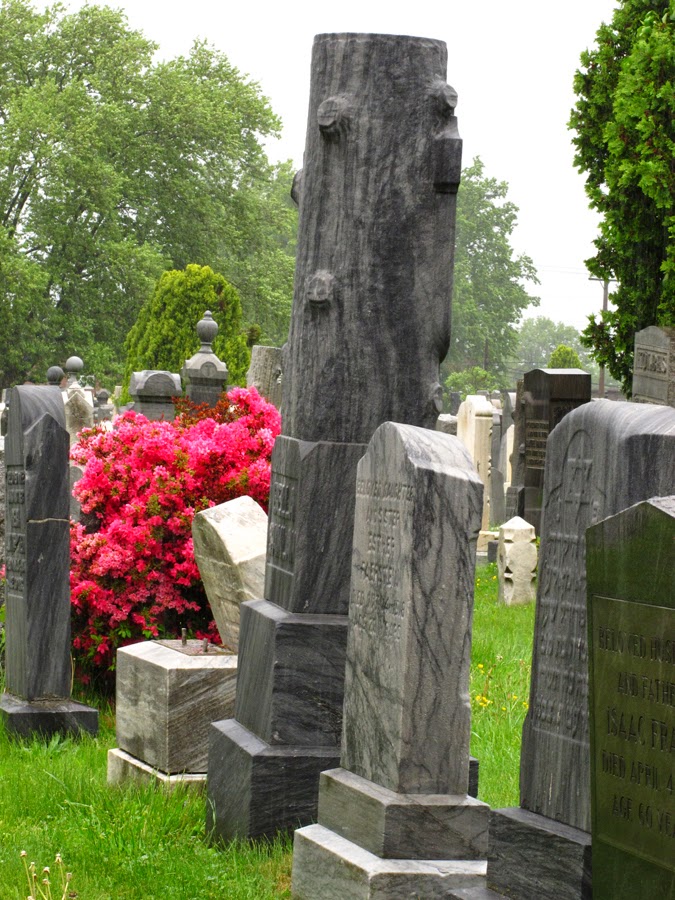
While imitation tree trunk monuments (example at right) do far less damage than real trees, there are less intrusive options of the living, flowering variety. Smaller, flowering ornamental trees are more practical. Cherry trees with their lovely pink blossoms do not grow to immense proportions, and therefore the roots won’t wreak havoc on those sleeping peaceably below. 
Likewise with small flowering plants. Floral symbolism, rather than the flowers themselves, may be much gentler on our seasonal allergies, entail less maintenance, and last year round, but they are merely a shadow of the life lost. Perennial bulb plants like tulips, crocuses, and daffodils offer us a much more vivid symbol of a memory kept alive. They also take up a very small amount of space and do not spread easily, if at all. Even a small yellow daffodil can add some happiness to the sparest grave site.

So get out there and enjoy the spring flowers – smell them, photograph them, paint them, let your children pick them! And remember to remember those who have gone before us. Maybe plant a flower in their memory. Since I am not a horticulturist, I leave the practical aspects of cemetery plants to the more knowledgeable:

 From the blog, A Grave Interest:
Serene and Evergreen - Cemeteries Allowing Plants and Flowers” and
eHow’s “How to Plant at the Cemetery.


Sunday, April 27, 2014

Cemetery Lovers: Sex and Death

You were waiting for this, weren’t you? I mean, how could I write a blog about cemetery travels without discussing sex? Well, I have, on occasion, but not as directly as I am now. Whatever could sex and cemeteries have in common? Turns out sex and death are very closely related in our psyches. We seem to be simultaneously death phobic and sexually driven - death and desire seem to conjugate in some fashion in our minds, a philosophy of opposites. But do they conjugate in our cemeteries? That is, does live sex (I mean, between people) occur in our memory gardens? On our hallowed grounds? Sure it does. I’ve seen it, I’ve heard about it, I’ve done it. (There, I finally said it. Happy?)

While teenagers may use our cemeteries as trysting places because it’s the only way they can get privacy, adults do it for many other reasons. Its exciting, its forbidden (sort of, I guess, though I’ve never actually seen any signs posted …), and it is the closest many of us can get to experiencing human nature’s two basic instincts at the same time: Eros and Thanatos. Sure there’s autoerotic asphyxia (strangulation during sex), but that’s going off the deep end. Most people don’t need to go to such extremes to get off. Sigmund Freud theorized that Thanatos, the instinct of death, or aggression, drives us as strongly as Eros, our instinct for life. Eros drives us toward attraction and reproduction while Thanatos drives us to our destruction.

Found in a cemetery
If you accept this, it explains why so much of our entertainment (movies, books, and television) keeps us riveted with a teetering balance of sex and death. We enjoy this, for the most part. Sometimes, real life mimics fiction. Take for instance the couple who shows up at the cemetery’s “night photography” event without cameras. As the group heads off into the cemetery with the instructor, the couple disappears. (Do I need to draw you a picture?)

Doing it in a cemetery must be titillating to a rather small portion of the population. I can’t imagine that hordes of people would WANT to do this, although sometimes, business demands it. Take for instance the prostitute who recently approached several cemetery grounds keepers (separately, but on the same day) while in the course of their duties. This was her line: “Are you single? Because I don’t want any wives involved in this. My apartment has ghosts. Can you come with me to check it out for me?” After her third attempt failed, she left. She was making house calls, so to speak.

Old Camden Cemetery
So while some of my research depends on secondary sources, my primary research corroborates the data. Also, I trust my sources. I’ve written about being solicited by prostitutes in Camden, New Jersey cemeteries, and this is a weird experience, I must say (read more about that at this link). Being solicited, that is. (Happy to say my actual sexual encounters in graveyards did not involve prostitutes! And I was between marriages, for the record.) I realize that prostitution in graveyards is strictly business - the parties are not looking for thrills, its just cheaper than getting a room. (Do you know that some no-tell motels offer rooms by the hour!? If it does not appear to the clerk at check-in that you and your companion will be spending the night, the clerk might actually offer you an hourly rate!)

So, maybe cemeteries should have “No soliciting” signs on their gates? Or “No Engaging” signs …. I know of another cemetery where guys have driven onto the grounds with prostitutes in their cars, found a secluded spot and ….. you may think I’m going for the full Pinocchio on this topic but its true - I’ve seen this. I’ve unfortunately and accidentally, driven by this. Several times. A friend of mine who volunteers at a cemetery saw a taxi parked on the grounds recently, so she approached it, and then noticed that it was bouncing up and down! Two people were on the back seat while the DRIVER sat patiently behind the steering wheel! (No doubt the meter was ticking away.)

The author, photographed by Frank Rausch
But getting away from the business at hand, let us return to the Eros versus Thanatos thrill of sex in a cemetery. Personally, I was too scared of being caught to be, shall we say, effective? A partner and I were actually arrested once in a similar situation, having to pay a fine only for trespassing – they dropped the indecent exposure charge as there were no witnesses other than the cop who caught (and was no doubt watching) us. So while I’m a bit more careful these days, others obviously find the inherent danger of sex in cemeteries to be very stimulating. Not only because of the chance of getting caught, I suppose, but also because of the very real possibility of being eaten by zombies.

Then of course, there is nude cemetery photography. It happens. On occasion, I’ve seen exhibits of such work, though you’d be hard-pressed to find any examples of it were you to actually search (try searching the Internet right now, unless you're at work, that is!). It’s a rather taboo subject, for all the reasons you can possibly imagine.We seem as obsessed with death as we are with sex, but less openly. We fear death, though it fascinates us. These inner drives, as Freud says, both coincide and conflict. I know a guy who works at a cemetery and he occasionally sees a clandestine shoot here and there. He politely asks the photographer and model to pack up and leave, as it may upset other visitors who may be at the cemetery for other reasons. In one instance, he chased a vehicle from spot to spot over the course of a day as a woman dressed only in a cape would throw it over herself, jump into the passenger side of the vehicle and the driver would speed off.

If I was attending a burial ceremony or visiting the grave of a loved one I would not want a photo shoot of any kind happening nearby. Maybe those cemeteries who have signs saying “No Photography” are really trying to stop nude photography. I know of one cemetery in northern New Jersey that has a “No Photography” policy simply because the unauthorized rock band photo shoots and the motion picture crews do damage to the grounds and the monuments.

So obviously, nude cemetery photography is titillating to some, but then what do you do with the photos afterwards? Like I said, you very seldom see any in public. I’ve never done this myself, but then who would want to see photos of me naked in a cemetery?

Psyche, wakened by Cupid, her lover's kiss
So the life force in us is as strong as the death force, and while the drives may not be equal in everyone, they are certainly present, and often intermingle. This was never so prevalent as it was in the Victorian era, when artists had seemingly free reign to sculpt nude or partially nude statues for use as cemetery monuments. I've written about this in the past (see The Art of Sensual Statues in Cemeteries), and while the sculptures aren't exactly arousing, sexually, they are indeed suggestive. Perhaps their intent was to get our minds off dismal death, and to think rather about life and its beauty, and the joys of reproduction.