Saturday, July 12, 2014

Cemetery Surprises in the Athenaeum

It’s a bit unusual for me to be surprised - I’m usually the surpriser. In my fifteen years of cemetery travel, I’ve seen a lot of death-related things, so I’m usually ready for the shocker when it is delivered. However, I was taken aback recently when a strange woman revealed something to me.

It was at an art opening reception at the Philadelphia Athenaeum (more on the Athenaeum later). I was holding my four-year-old daughter near the display case which houses Napoleon’s death mask (see photo above - his head was larger than I expected) when this woman next to us struck up a conversation. I was wearing my “artist” name tag so she asked which work on display was mine. When I told her there were two photographs, one made in Philadelphia’s Laurel Hill Cemetery and the other in Woodlands Cemetery, the floodgates just burst forth. She had many cemetery stories of her own, but strangely led off with this comment: “You know how when you stick your hand through the door grate of a mausoleum, it feels colder inside than out?

I don’t know that I would open a conversation with a complete stranger with a line like that, but I was amused. A few other unusual things happened in relation to that Athenaeum exhibit. Before I continue, I should explain what exactly is an “athenaeum.” It’s a library of sorts, a private repository for documentation and historical artifacts. Most major cities in the U.S. have them. The Philadelphia Athenaeum was one of the city’s early libraries (established 1814), predating the massive Philadelphia Free Library which was not established until 1894. Ben Franklin actually originated the idea of subscription libraries in 1731 when he formed the Library Company of Philadelphia. Wikipedia and the Philadelphia Athenaeum’s own website describe it as:

“a special collections library and museum founded in 1814 to collect materials "connected with the history and antiquities of America, and the useful arts, and generally to disseminate useful knowledge" for public benefit. The Athenaeum's collections include architecture and interior design history, particularly for the period 1800 to 1945. The institution focuses on the history of American architecture and building technology, and houses architectural archives of 180,000 drawings, over 350,000 photographs, and manuscript holdings of about 1,000 American architects.”

Now, it isn’t much of a stretch to imagine that such a place houses cemetery-related relics, books, prints, etc. That was my first question to the extremely helpful Circulation Librarian during my first visit. Now, don’t get the mistaken impression that I knew exactly what I was looking for. After my two photographs were juried into the show, I simply stopped by to see the exhibit space at the Athenaeum before the exhibit opened. Honestly, I had no idea what an Athenaeum even was. This was weird because I have worked four blocks away from it for the past thirty years!

Page from the Monumental Bronze Company 1882 catalog of grave markers

Basically, the Philadelphia Athenaeum is one of the few remaining “pay” libraries in the United States. They have some basic fare, popular reading, and a most impressive Renaissance Revival reading room. However, they also have a massive collection of historic and architectural books, documents, portfolios, and trade journals the likes of which I never knew existed. I was actually able to page through an original copy of the (view the pages online here) 1882 catalog for the Monumental Bronze Company of Bridgeport, Connecticut (one of two manufacturers of zinc, or “white bronze” grave markers)! In addition to the Monumental Bronze catalog, they have Sleeping Beauty.


Not the Disney Sleeping Beauty, but the book by Stanley Burns, MD. The first and only time I ever saw this book (and only but briefly thumbed through its deeply disturbing reproductions of nineteenth century postmortem photographs) was in Asbury Park, New Jersey’s Paranormal Books and Curiosities shop. This oversized, coffee table book was $300, new. A steal at the time, in 2007; now they're $300 used, and $700 for a collectible, i.e., an autographed copy, as shown above. Its a coffee table book in the sense that you would never leave it on your coffee table for anyone to see. I was even reluctant to return to the Athenaeum to browse through its pages; I almost felt like requesting a small dark private room in which to do so.

Paging through the book, "Sleeping Beauty"
Here’s a link to the book Sleeping Beauty on Amazon.com (you’ll notice there’s no “look inside!” link on the site, to view sample pages.)

It turns out that the Athenaeum has many, many cemetery-related books, or rather, “sepulchral” materials. “Sepulchral,” the librarian told me, is the official library designation search term for such things. And, it turns out, if you search the Internet with that word, you turn up different information than if you search on terms like, “cemetery,” “monuments,” “grave stones,” or “graveyards.” Very useful information for one such as myself.

The Athenaeum of Philadelphia, print by John Notman, 1847
As I mentioned earlier, The Philadelphia Athenaeum was established in 1814. So what, pray tell, has it been doing with itself for these past two hundred years? And why have so few people heard of it, so few enthralled by its hidden wonders? Turns out the organization was a rather closed society until 2007 when a new director took over. Since then, the Philadelphia Athenaeum has been much more open and welcoming to the public and is totally worth a visit. Where else will you find a vintage brass inkwell formed into the shape of Napoleon’s burial crypt?

Athenaeum exhibit image, Laurel Hill Cemetery, Philadelphia by Ed Snyder

To celebrate its Two Hundredth Anniversary (in 2014), the Athenaeum decided to host an art exhibition, featuring renditions of historic buildings and sites around Philadelphia. I was fortunate to have two of my photographs juried into the show. One of them, incidentally, was an image I made in Philadelphia’s Laurel Hill Cemetery (which won third place in the exhibition, see above). Laurel Hill was designed in 1836 by the same man who designed the Athenaeum building in 1845 - Scottish architect John Notman (1810-1865). Laurel Hill was the nation’s second rural garden cemetery (Mount Auburn in Cambridge Massachusetts was the first).

"Woodlands," by Ed Snyder
Here is the second of my two photographs which were juried into the “PhiladelphiaAthenaeum: 200th Anniversary Art Exhibition." The exhibit features the work of local artists portraying Philadelphia’s rich collection of historical places. This image was made during a heavy snowfall at Philadelphia's Woodlands Cemetery. If you plan to visit the Athenaeum, the exhibit (which ends August 8, 2014) features about sixty truly delightful images in various media (the gallery is the first room on the right as you enter the building). Enjoy the Philadelphia Athenaeum's other offerings as well - it may hold as many surprises for you as it did for me.

For a good introduction of the Athenaeum of Philadelphia, this article from Philly.com describes how old world, yet cutting-edge it is!

Wednesday, July 2, 2014

Fourth of July at Christ Church Burial Ground

Benjamin Franklin's grave, Christ Church Burial Ground
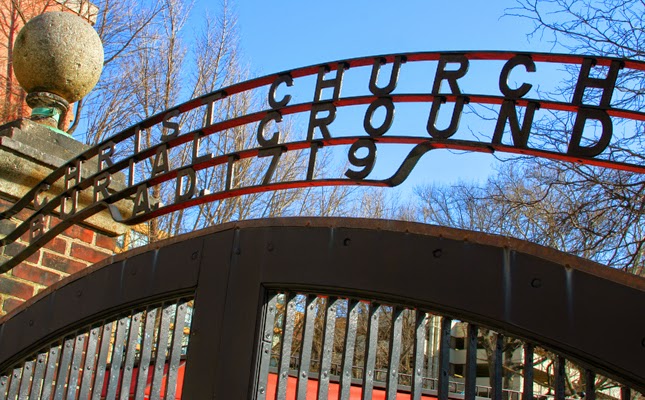
For the Fourth of July, I thought it might be appropriate to “Welcome America” to Christ Church Burial Ground, in the heart of Philadelphia’s historic district. If you’re here to visit, you almost cannot help stumbling upon this old (and I mean OLD, established 1719), brick-walled cemetery across from the U.S. Mint (Fifth and Arch Streets). It’s but a stone’s throw from the Liberty Bell and Independence Hall.

Ironwork sign over main gate

It is one of the nation’s few surviving Colonial and Revolutionary War-era burial grounds, and right in the midst of the tourist district. While I’m sure this cemetery has many a first-class tale to tell, I’m approaching it from the tourist’s perspective. This is where Ben Franklin’s grave is, and on it visitors toss pennies (“A penny saved is a penny earned”). But there’s a lot more to Christ Church Burial Ground than that. For one thing, you have to pay to get in! Three dollars! If you arrive at the right times, however, you may hit one of the guided tours.

One of the odd and quirky things about Franklin’s grave is his self-penned epitaph, which is engraved on a bronze plaque near the grave (you can only see it from the inside of the cemetery):


“The Body of
B. Franklin, Printer;
Like the Cover of an old Book,
Its Contents torn out,
And stript of its Lettering and Gilding,
Lies here, Food for Worms.
But the Work shall not be wholly lost:
For it will, as he believ’d, appear once more,
In a new & more perfect Edition,
Corrected and amended
By the Author.”

While Christ Church Burial Ground is the only cemetery I know of that charges an admission fee, don’t hold it against the city (there are certainly worse things you can rant about, such as the Parking Authority). The City of Philadelphia does not own Christ Church Burial Ground – it is owned and operated by Christ Church, which is a few blocks away at Second and Market Streets. The money goes to the upkeep of BOTH cemeteries – the older one surrounding the church (which was established in 1695). The one near the mint was opened in 1719 as an expansion of the churchyard cemetery “on the outskirts of town.” Interesting to note that Philadelphia only stretched from the Delaware River to Sixth Street at that time!

Weathered marble headstones at Christ Church Burial Ground
Christ Church Burial Ground is small (only two acres), but is a charming cemetery. Its ground holds many statesmen and other luminaries such as Dr. Benjamin Rush and several signers of the Declaration of Independence. It is fascinating to watch people from the inside gather outside the fence to peer at Franklin’s grave. While the cemetery is surrounded by a high brick wall, Franklin’s grave can be seen for free (even when the cemetery is closed), thanks to his descendants. Back in 1858, they requested that part of the wall be removed so people could view the grave (this is on Arch Street, near the corner of Fifth).

Bronze plaques help identify badly worn stones

The cemetery is gated and locked outside visiting hours (11:30 am – 3:30 pm). During visiting hours, a stand is set up at the entrance with many books for sale, including a reprint of the book compiled in 1864 by the warden of Christ Church, Edward Lyon Clark, “of all the inscriptions that were still visible on the fading soft marble markers.”


If you’re in the historic area, the burial ground is a solid and tangible piece of our nation’s history, and should be visited. An historian friend of mine once said that if Philadelphia's historical attractions are not within six blocks of the Liberty Bell, tourists will not visit them. Therefore, no one visits Fort Mifflin (near the International Airport) or Betsy Ross' grave (Mount Moriah Cemetery). Christ Church Burial Ground, however, is not only convenient - its the real deal. It isn't fictional history like "Thomas Jefferson's house" or "Betsy Ross' house." The clip-clop of hooves from horse-drawn carriages moving along Fifth Street help to conjure a mental image of how this young nation may have seemed centuries ago. Just close your eyes, stand in the graveyard, and listen.

References and Further Reading:
Welcome America website
The Graves of Christ Church Burial Ground

Saturday, June 28, 2014

Summer Shore Cemeteries

Ah, the Jersey shore in summer! I had my family at Long Beach Island for five days in mid-June and the weather was glorious. Beach, sun, pool, everything was perfect (except for the ticket I got for not wearing my seat belt) – the only thing missing was a trip to a graveyard!

I’m sure I’m one of a select few people who think of such things while on vacation. To make it easier on my wife and four-year-old daughter, I usually head out early before they wake up. So I planned a sunrise trip up the island and over to the mainland to hit the Staffordville Cemetery near Tuckerton (across the bay from LBI).


I’ve photographed a few cemeteries in this area but had never been to Staffordville Cemetery. Other than its simple existence on a map, I could find nothing about it on the Internet. So I made the trip on a Monday morning, shortly after sunrise. Sunrise over the Atlantic Ocean can be breathtaking, but of course, I missed it. Got to the beach at 6 a.m. and sunrise must have been 5:30. So I jumped into my wife’s Toyota RAV4 and headed north up the island. Cops all over the place here trying to nab speeders and folks not wearing seatbelts, so I really had to crawl the five miles or so to the causeway to Manahawkin.

Manahawkin, New Jersey coastline at dawn
The ride was peaceful, not many people about yet. After crossing onto the mainland, Manahawkin, New Jersey is the first major town you get to. If you head north or south on Route 9, there is a cemetery within a half mile either way of the intersection. I’ve been to both in the past, and they are worth the visit: Manahawkin Baptist Cemetery (north) and Greenwood Cemetery (south). Since I was driving past Greenwood, I figured I might stop there on the way back if I had time. Staffordville was about two miles south of here.

I was on the lookout for “Cemetery Road,” as the Staffordville Cemetery appeared (on the map) to be off Route 9 down this road a few blocks. Found the street sign with no problem, though it was almost hidden by all the other signs around it. I drove down the quiet road alongside a trailer park and saw the cemetery at the end. Very unassuming little place. As my grandmother might have said, “it was a small, sad little graveyard.”


This is the pine barrens, as they call it – pine trees and sand. A cemetery sign made out of timber, no gate or fence. One large marble monument to Rev. Samuel Parker’s wife, the rest regular smaller stones. A fenced-in family plot, veterans markers, flags, weather-worn lawn and garden statues, a penny on a headstone. Someone had placed a few stone fragments together in the sand to spell out the words “FATHER HE.”


The graveyard was only about 150 feet deep and 200 feet wide, clean, no trash, no graffiti. Some old Christmas decorations here and there. Old grave markers from the mid-1800s to a few newish ones, including a Vietnam Vet who died in 2006. Some old sea shells adorned a few of the graves. Weird, yellowish-green plant life covered most of the sand.

I began to wonder how many thousands of these small graveyards must exist, and how many thousands of people drive past them without a second thought. These graveyards house tiny memorials to hundreds of thousands of individual lives that have passed. The lives spent in Staffordville, perhaps, may have been spent fishing, farming, sailing – even being a reverend’s wife in the 1850’s. What must that have been like, I wonder, being a reverend’s wife back then?

On my way back to LBI, I did spend some time in Greenwood, a larger and fancier burial ground. The traffic picked up a bit of volume by then, mostly mainlanders going to work Monday morning in Manahawkin or to LBI to work the tourist trade. I would be following them soon, headed back to life after spending a bit of time here with death. These regular drivers probably all know where Greenwood is because of its large wrought iron sign. By the same token, most of them are probably unaware of the existence of the smaller, Staffordville Cemetery. Out of sight, out of mind. Which is why it seems so important to me to hunt down these small, hidden cemeteries. They exist, after all, to honor - and help us remember - the dead.


Wednesday, June 18, 2014

The Postmortem Group Photo

Though I’ve seen such images as this over the years, the group postmortem photograph is rather unusual. More typically one sees a simple portrait of the deceased, or at most, the deceased surrounded by family members. Also, this particular image is special since I actually own it. Bought it, framed in a vintage gold-tone metal frame (see photo below), at the Punk Rock Flea Market in Philadelphia, June 7, 2014.

This is my first postmortem photograph. Maybe it’s the start of a new obsession, but I doubt it. The main problem with collecting such work is its relative scarcity, and therefore, it’s prohibitive price. The retail value of this mourning art collectible is probably $250. I paid $20. While I have friends who attend estate sales of funeral homes and have greater access to such ephemera, the occasional flea market find is about all I’m capable of.

I originally posted the images you see here on Facebook, proclaiming, with no great authority, that the photograph was from the late 1800s. I only said this because postmortem photography was wildly popular in the Victorian era (1837-1901), and all the people in the photo are dressed in old-style clothing. An astute reader quickly pointed out that the clothes put the image in the 1910s.

The other hint regarding its age that should have jumped out at me is that large, matted, paper photographs were not available until after 1900. Between 1840 and 1900, metal plate (Daguerrotype) and glass plate (ambrotype) images were for the most part the only type of photographic images created for the consumer (the average person did not own a camera). While paper prints were available after 1851, the “cabinet card” (4 x 5 inch photograph pasted on a slightly larger card) was the most popular photographic medium up to about 1900. The photograph I purchased measures 8x10 inches. Therefore, it must have been made after 1900.

By 1910, cameras were becoming quite common and consumers began taking their own photographs. The only way professional portrait photographers could remain in the postmortem business was to produce “large elaborately designed mats for memorial images to be framed and displayed”  (according to Stanley B. Burns, M.D., in his book, Sleeping Beauty III – Memorial Photography, The Children). So my image was probably made around this time. The photograph is mounted on an 11x14 inch mat on which is embossed “E. Stern, Northampton, PA,” presumably a photographic studio in Northampton, Pennsylvania (which is in southeast PA).


I’m curious as to whether the 13x17 inch metal frame dates back to the same era. I'm also curious as to where I might display this dark treasure. A friend of mine who I ran into at the Punk Rock Flea Market saw me on the street a few days later and asked if I had hung it in my house. I replied that the only place that my wife would probably allow it would be in the basement behind the water heater.  
 

Replica of mourning ribbon
So back to the vintage photograph at hand. We see the deceased in his coffin (nice touch having the coffin lid propped against the fence at right!), surrounded by family and an honor guard, of sorts. By the look of the crowd, and the building they’re posed before, it appears that the deceased was a member of some fraternal or veterans organization. All the men are wearing mourning ribbons on their lapels, similar to the reproduction of one such item I’ve shown here (the replica ribbon says: "Meade Post 1, GAR, Philadelphia." At top, it says "Honor the Noble Dead"). Possibly they were GAR (Grand Army of the Republic) members or Freemasons. The women and children at center are probably family members of the deceased. The deceased himself is holding an official-looking cap, so perhaps he was a leader of some sort in this organization, or maybe a military veteran.

This extraordinary scene is a rare example of group postmortem photography, a memorialization practice that began to die out (no pun intended) by 1940 in the United States (though it continued to be popular for several more decades in Europe). I am interested in knowing what the building is and what the possible fraternal organization was. So if any reader has some idea, please let me know! I assume that since the photographic studio was in Northampton, Pennsylvania  (in the Lehigh Valley, north of Philadelphia), then the building in the photo was in the same geographic area. The photographer "E. Stern," or his studio in its entirety, was involved in postmortem photography on a regular basis. A quick search on the Internet provides a few examples of postmortem photographs made by the "E. Stern Studio." (Click the links at the end of this blog to view them.)

New Orleans woman attends her funeral social! (ref.)

As an aside, it does seem that contemporary postmortem photography may actually be on the rise in the United States. On June 12, 2014, a woman in New Orleans (photo above) was propped up at a table as the guest of honor at her own going-away party (click link for story). Presumably, guests had their pictures taken with her. On January 31, 2014, a family had their dead boxer son propped up in a mock boxing ring (photo below) and posed with him for photographs (click link for story)


Puerto Rican family poses with dead boxer son (ref.)

Further Reading:
Postmortem photographs made by the "E. Stern studio:"

Friday, June 13, 2014

Funeral in the Rain

I arrived at the cemetery half an hour before the service was to begin. I planned my trip this way partly because I had never been to this cemetery (and was not sure how to get there) and partly because I was curious to check it out). My friend’s father died and he was being buried today. It was pouring. The service was to be held at 2:30 pm in Har Nebo, a large Jewish cemetery in northeast Philadelphia.


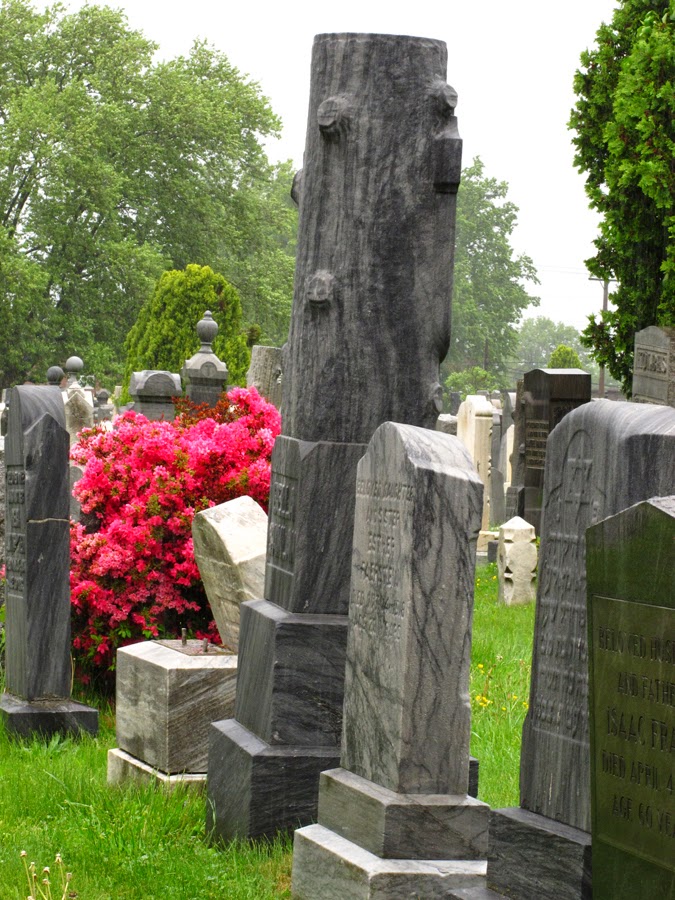
The green tent was set up over the grave, but the visitors had not yet arrived. I drove around in the hot rain (my air conditioning was not working), taking a few pictures here and there. Landscaping is sparse, a small red azalea bush in bloom here and there. It is spring, a time for rebirth. Old headstones, cracked, lying on the ground. Har Nebo is an expansive cemetery, Philadelphia’s oldest privately-owned Jewish cemetery, which dates back to 1890.

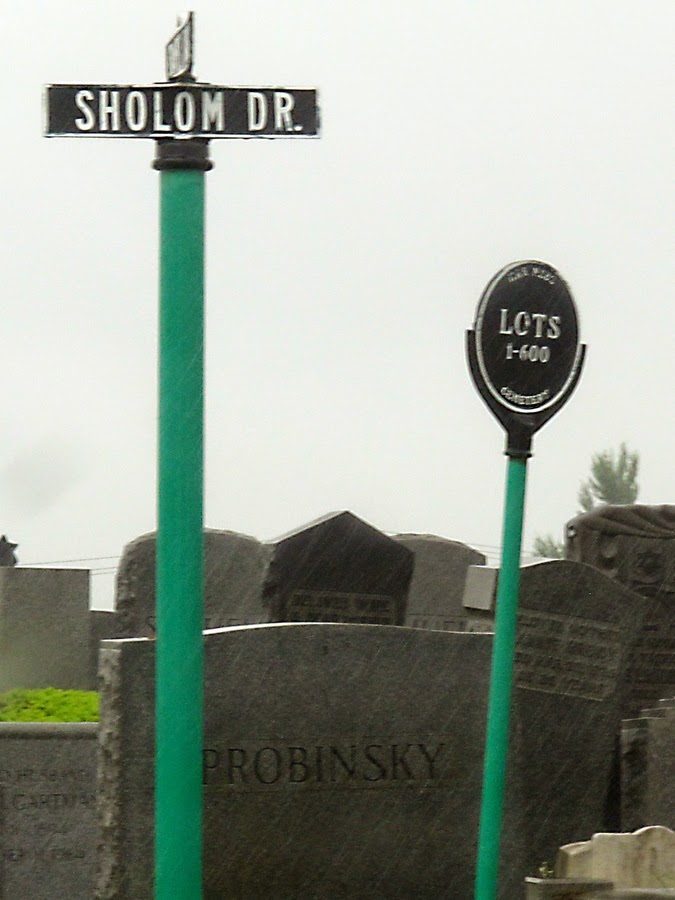
After about ten minutes I saw headlights at the cemetery entrance. The guests (?? attendees? mourners?) and grave attendants began to arrive. Next the silver hearse. As there appeared to be no chapel, I assumed this was to be a graveside ceremony. I parked my car along the road and got out with my coat and umbrella. It was pouring. The grave site was along Shalom Drive in the cemetery. "Shalom" is the Hebrew word meaning "peace." It was far from peaceful here that day, with the wind and the rain.


After saying hello to my friend and his wife, I went under the green tent. The rabbi was the only person there. This would be a small service, with about fifteen people. Small family. Some friends. I said hello to the Rabbi and she said, “The sky is crying.

If you think I took pictures during the ceremony, I am sorry to disappoint you. That would not have been respectful. Some things need to be kept private. People began to come in out of the rain. The wooden casket was brought from the hearse and placed onto the metal support frame over the grave. The wind howled and blew the rain in on the assembled. My friend’s yarmulke blew off and flew out of the tent onto the nearby grass. I retrieved it for him. Rain speckled the casket’s rich wood surface with its Star of David design on top. The prayers began. Oddly, the wind and rain died down for the entire length of the half-hour ceremony.

When the deceased was still alive last month, his son (my friend) gave me his “first alert” type device to try with my Mom, since I felt she could use one after falling and breaking her hip (read more about that here). His Dad had used it for a few months before being admitted to a hospice. So although I did not know the deceased personally, I certainly felt connected to him. Not only because of the “first alert,” but also because, supposedly, he developed a taste for beer during the last few months he was alive!

The rabbi said a few things about the departed, based on sparse facts gained from family and friends. Typical stuff. Then the grandson read a eulogy he had written, a remembrance of his grandfather. He was sorry he hadn’t made more frequent visits to see his grandfather while away at college. Very difficult for him. Regrets. Tears all around. He got through it like a trooper, though. Afterward, the rabbi sang a mournful dirge. She quoted some passage about the departed not being gone, just in “another room,” and that we can all honor his memory when we continue to do the things he enjoyed doing with us. The recurring theme was that this gentleman put everyone’s needs ahead of his own.


The rain began again, almost as heavily as before. Since I was standing near the edge of the tent, my pant legs were soaking wet. The rabbi invited the two relatives closest to the deceased (brother and sister), to drop a scoop of mud onto the casket. It is tradition at Jewish burials to throw a scoop of dirt onto the casket before it is lowered into the grave. My friend and his sister declined. They may have done it, had the dirt not turned to mud, but maybe not. When my wife’s grandmother buried her son, she declined to throw the dirt as well. Sure, its part of the ceremony, and it is symbolic – but not just symbolic. You’re literally helping to bury the person. You’re throwing the first shovelful of dirt onto the casket in the grave. Throwing that scoop of dirt on a loved one’s casket must be an incredibly difficult task. Like Moses descending from Mount Nebo after his final look at the Promised Land, never to see it again in his lifetime.

I drove out of the cemetery in the rain, taking a few pictures here and there.

Further Reading:
Read more about Philadelphia's Har Nebo Cemetery at this link.

Tuesday, June 10, 2014

"Dont Fear the Reaper" - The Story of Jearum Atkins, Inventor

Back in 2011, as I was crawling through the weeds, trawling for interesting gravestones in Philadelphia’s Mount Moriah Cemetery, I came upon a most curious monument. It was in the hinterlands of Section 149, which is on the Yeadon (PA) side of the cemetery. (For those readers unfamiliar with this formerly-abandoned 300-acre Victorian cemetery, it actually spans two counties – Philadelphia and Delaware.) The Friends of Mount Moriah Cemetery, Inc. has made great strides in the past few years in keeping the grass, weeds, trees, and other foliage cut and maintained over about 25% of the grounds. However, Section 149 is in the 75% that remains overgrown.

The 3-foot high granite square monument upon which I stumbled marks the grave of one "Jearum Atkins, Inventor(1815 - 1897). I had never heard of him, so I photographed the four sides of the marker and looked him up on the Internet. The curious inscriptions seemed to indicate his inventions.

Jearum Atkins is not a household name like that of Thomas Edison and Henry Ford. However, he was responsible for important, incremental improvements in engineering technology during the Industrial Revolution. One reason for his lack of fame might be due to the fact that he sold his most potentially profitable invention to Cyrus McCormick. Atkins, in 1852, perfected the design of Cyrus McCormick's original grain reaper, allowing McCormick to build the fully automated harvester, for which McCormick eventually became famous (he bought the "raking" design from Atkins!)

"Atkins Automaton Reaper" (ref.)

 From the book: Cyrus Hall McCormick, by Herbert Newton Casson (1909)"

"Of all the varieties of difficulties that confronted Cyrus H. McCormick during his strenuous life, the most baffling and disconcerting difficulty was when his Reaper began to grow. For fifteen years—from 1845 to 1860—it had remained unchanged except that seats had been added for the raker and the driver. It did no more than cut the grain and leave it on the ground in loose bundles. It had abolished the sickler and the cradler; but there yet remained the raker and the binder. Might it not be possible, thought the restless American brain, to abolish these also and leave no one but the driver?
 
As early as 1852 a fantastic self-rake Reaper had been invented by a mechanical genius named Jearum Atkins. This man was a bed-ridden cripple, who, to while away the tiresome hours of his confinement, bought a McCormick Reaper, had it placed outside his window, and actually devised an attachment to it which automatically raked off the cut grain in bundles."


Atkins monument, Mount Moriah Cemetery
Atkins lived during the Industrial Revolution – when machines were invented to replace manual labor and automate as many processes as possible.  The device mentioned above, the “Self-Raking Harvester,” was an improvement upon the McCormick reaper – the latter simply cut the grain. This saved the effort exerted by people with sickles, but the greater work was that of raking the cut grain so it could be bundled. Atkins’ redesign was such a success that after production began in 1860, farmers seldom bought any other machine.

Described as “one of the most remarkable men ever born in this country,” which nature endowed with “a phenomenal capacity for mathematical and physical inquiry” (Cassier’s Magazine, Vol. 5, 1893-4), Atkins applied for and received many patents from the U.S. Patent Office. His original inventions did not fare as well as his improvements on other people’s work. For instance, he improved the design for the steering mechanism of steam ships (“Hydraulic Steering Apparatus, patent issued 1890), using an application of hydraulics. Atkins’ list of engineering inventions, patents, and patent applications seems endless. Most of these in fact were contrived as he lay in bed, an invalid for twenty years due to a spinal problem. His fame and fortunes waxed and waned, but he continued to design, redesign, and strove to achieve.

Jearum Atkins’ patented inventions are inscribed on the four sides of his small, granite monument in Mount Moriah Cemetery. They are (followed by their patent award dates):

Self-Raking Harvester  1852 – 1868
Safety Valve Regulator 1868
Smoke Stacks 1868
Hydraulic Steering Apparatus 1890
Calipers 1868


Atkins' caliper improvement (ref.)
Atkins' caliper patent was a simple improvement on the mechanical measurement caliper. His smoke stack design was intended for steam locomotives, to improve the efficiency of the exhaust of steam. The safety valve regulator was intended for steam boilers, through which high-pressure steam could be vented so as to keep the pressure vessel from exploding. If this sounds too technical for the reader, go look in your basement and find the brass safety valve on the side of your water heater – same idea! Back in Atkins’ time, many were killed by accidental explosions of pressure vessels in locomotives and steamships. Possibly, his invention helped prevent such incidents. (Mark Twain’s younger brother, by the way, was killed in 1858 when the boiler blew on the paddlewheel steamboat on which he was a passenger.)

Quite a bit of history there behind an unassuming little grave stone in the weeds. As we consider the contributions of Jearum Atkins to engineering design and technological advance, let us realize that many original inventions are not necessarily all that useful. They are in many cases springboards for further development and improvement, often by people other than the original inventor!


Read more about Jearum Atkins’ inventions here:


Wednesday, May 28, 2014

The Nanny's Photographs

"Finding Vivian Maier"
Okay, so unless you’re an avid photographer, well no - a true photo nerd - you probably have not heard of the movie currently making the art house rounds called Finding Vivian Maier
(http://www.vivianmaier.com/film-finding-vivian-maier).

The most succinct introduction to this topic is to quote the website www.vivianmaier.com:

 “This intriguing documentary shuttles from New York to France to Chicago as it traces the life story of the late Vivian Maier, a career nanny whose previously unknown cache of 100,000 photographs has earned her a posthumous reputation as one of America’s most accomplished and insightful street photographers.”

So why am I writing about this in The Cemetery Traveler? Well, there's a strange connection here if you will allow me. I saw the movie a few weeks ago and it is more than just a documentary – it is almost a psychological thriller. In addition to being an amazingly talented street photographer, Vivian appears to have also been mentally disturbed. But then so was VanGogh. The reason I bring Maier up in this blog is because of a story related to me by an attendee on a photography tour of Mount Moriah Cemetery last year (Mount Moriah is in Southwest Philadelphia). Also because it is now May, and all the Catholic school children are receiving First Holy Communion. Stay with me on this. I’ll eventually tie it all together!

First, you might want to view the trailer of the movie, to get a better idea of what Maier was about. Click this link to view. The photo at the beginning of this blog is one of her many self-portraits; the young girl in the reflection is one of her charges. The image is titled "Self-Portrait, 1953," though Maier never titled her work. In fact she never even printed her negatives. As you will learn from the documentary, she even left thousands of exposed, undeveloped film behind after her death!

So back to the photo tour at Philadelphia’s Mount Moriah Cemetery. The woman on the photo tour (who was in her sixties, as I recall) told me that her family lived across the street (Kingsessing Avenue and Cemetery Road) from Mount Moriah when she was around eight years old. This would have been in the 1960s, I suppose. Her parents had a nanny to take care of her and her brother. The brother was about the same age. Their nanny, it seems, was an avid photographer and would from time to time – I swear I’m not making this up – have the boy and girl dress in their white First Holy Communion outfits and walk over to the cemetery with her. Right in front of the old brownstone gatehouse, she would have the children lie on their backs – on graves – with their hands folded as if praying, and photograph them.

Ed Snyder (in green cap) giving tour of Mount Moriah Gatehouse
The photo above shows some of the headstones in front of the gatehouse, perhaps the same ones the nanny had the children lie near. The woman who relayed the story to me said nothing ever happened beyond that – she and her brother just thought it was a bit weird, but they were not afraid. As I listened to her story with my jaw dropped open, she delivered the knockout punch – she told me she still has the photos! The nanny gave them copies! Unfortunately, I lost contact with her and have never seen the photos, but how bizarre is that!

I thought of this situation while watching the movie Finding Vivian Maier, specifically toward the end of the film when it becomes evident that the quirky nanny may have been slightly deranged. One of Maier’s charges (now in her sixties) is interviewed and says that once she and her brother were with Maier and playing in the street when her brother got hit by a car! When the police and ambulance came, the nanny took pictures of the scene!

Image by Vivian Maier, New York City, 1954 (ref.)
Unlike the nanny who worked near Mount Moriah Cemetery, Vivian Maier never showed anyone her photographs. The work was only discovered after her death (in 2009) when the contents of her storage unit was auctioned off. A fascinating story, which is the origin of the documentary film, Finding Vivian Maier. I quote from the website:

Mount Moriah gatehouse as it appears now (2014)
“Vivian Maier (February 1, 1926 – April 21, 2009) was an American street photographer born in New York City. Although born in the U.S., it was in France that Maier spent most of her youth. Maier returned to the U.S. in 1951 where she took up work as a nanny and care-giver for the rest of her life. In her leisure however, Maier had begun to venture into the art of photography. Consistently taking photos over the course of five decades, she would ultimately leave over 100,000 negatives, most of them shot in Chicago and New York City. Vivian would further indulge in her passionate devotion to documenting the world around her through homemade films, recordings and collections, assembling one of the most fascinating windows into American life in the second half of the twentieth century.”