Friday, June 7, 2013

Funerary Music

June 6 marks the anniversary of the founding (in Britain, 1586) of the Guild of Funerary Violinists. How do I know this and why should you care? Well, I know this because I read it in an obscure book I purchased last year called, An Incomplete History of the Art of Funerary Violin (Overlook Press, 2006), by Rohan Kriwaczek. Show of hands - how many of you have read it?

And to the point of why you should care -  funeral music is obviously a major component of the mourning arts, yet not one which is given much consideration. Other than “Taps", Chopin’s Funeral March, or the occasional dirge, can you think of any piece of funerary music?

Contemporary accounts from ancient Egypt, Greece, and Rome indicate that musicians were an integral part of funerary processions. The instrument usually played was a flute-like device, to create plaintive melodically-based music to express grief and mortality. Due to its association (by Christians) to pagan ritual, all funerary music (played on instruments) was banned by the Vatican throughout Europe from about the third century A.D. through the next thousand years.

This all changed with the Reformation (sixteenth century) and the arrival of the Violin in England. Led almost singularly by George Babcotte (1542 - 1607), the first of the funerary violinists, the age of the funerary violin flourished for the next 150 years, i.e., until the Great funerary Purges of the 1830s and 1840s.

From the book, An Incomplete History of the Art of Funerary Violin
The great WHAT, you say? Kriwaczek (who happens to be the current Acting President of the [British] Guild of Funerary Violinists) tells us in his book:

“The Great funerary Purges of the 1830s and 1840s [by agents of the Vatican] were to spell the wholesale destruction of this venerable practice and drive the few remaining artists underground, but not before a last grand flourish of creativity had fixed the form of the seven-movement Funerary suite and, within that suite, had defined the morbidly ambiguous and secretly symbolic funeral march once and for all.”

The Vatican in about 1830 began to condemn Funerary Violin as the music of the Devil, slowly wiping out all trace of it throughout Europe. The extent of the purge was devastatingly efficient – almost no trace of the art’s 300-year history (up to the 1830s) exists today.

In consideration of what we have lost, then, this synopsis of Kriwaczek's book (from the Amazon.com website) describes the matter quite well:

Rohan Kriwaczek's book, available Amazon.com
"During the Protestant revolution in Europe, a new kind of music emerged, one that ultimately sought to recognize the deceased and to individuate the sense of loss and grief. But the tradition was virtually wiped out by the Great Funerary Purges of the 1830s and 40s. Kriwaczek tells the fascinating story of this beautiful music, condemned by the Catholic Church for political as much as theological reasons, and of the mysterious Guild of Funerary Violinists that, yes, defends its secrets in our time. This is unquestionably one of the strangest books any publisher has ever risked publishing. Discussing the evolution of European culture, musical forms and society's changing attitudes to mortality and the emotional effects of music upon the soul, this is a dark and magical history."

So the idea of the violin in funerary music has a long and checkered past, from its origin in 1580 to 1915, when it totally died out. Though the work of better known composers of music in the form of the classical funerary march have survived (Chopin, Beethoven, and Mahler), that of the shunned progenitors of funerary violin have not (Hieronymous Gratchenfleiss and Charles Sudbury, for example).

The Theramin

Image from Divine Hand website
Why I bring this all up now is partly because of my neighbor from across the street, Robin. She stopped me outside my house last week and (knowing my penchant for cemeteries), asked if I saw the Internet-advertisement for the musical concert to be held at Philadelphia’s Laurel Hill Cemetery on June 22 (2013). She thought I would find it interesting. So I checked the web and sure enough, a musical ensemble called “The Divine Hand” is playing a concert at Laurel Hill: "Their music can only be described as ethereal, eloquent and mezmerizing.” Instruments consist of the violin, harpsicord, guitar, harp, and theramin. Now, if you’ve never heard a theramin before, you’re in for a weird treat. Invented by Leon Theramin in 1912, this electric instrument is the precursor to electronic synthesizers, such as those made famous by Robert Moog. If there is a creepier sound to be heard in a cemetery, I cannot imagine what it might be.

The theramin is actually played by holding your hand NEAR it (see photo above), kind of like the EBow from the 1970s that was used to make an electric guitar sound like an ethereal violin (you wouldn't actually touch the strings with the device). What does a theramin sound like?  Playing the saw, is the best I can come up with. Or that weird sound throughout the Beach Boys' song Good Vibrations. But give this video a play - it shows Russian inventor Leon Theramin himself coaxing eerie sounds out of this marvelous instrument (which he patented in 1928).

I think you’ll agree that a night concert of funerary music in a cemetery might be quite riveting, if not downright frightening. Add to that a master practitioner of the theramin, and you have a truly unique experience, not to mention a history lesson in a widely-neglected aspect of the funerary arts.

The Divine Hand Ensemble
Leon Theramin with his invention (ref)
Laurel Hill’s website describes a previous concert played in the cemetery (fall, 2012) by The Divine Hand Ensemble as the “musical event of a lifetime. Their performance comprised the first time in 250 years that a program of funerary music was performed publicly and the first time ever in America.” It goes on: “Witness Mano Divina, leader of the Ensemble, harness electricity with his fingertips and draw music out of the air as master of the Theremin, an early electronic musical instrument controlled without discernible physical contact from the player. In addition to this rare instrument, the Ensemble includes a string quartet, classical guitar, two harps, a glockenspiel, a soprano and a tenor, together rendering an unforgettable listening experience.

The Divine Hand has its own website, which is truly entertaining in its own right. You can watch video clips of performances and hear the wonderful music. Some quotes from their site:

“Breathless entertainment that leaves you hanging on every note and gesture as Divina hypnotizes electricity to release the voices of angels from the air with this finger tips” -www.allaboutjazz.com

"Classical music does not change very often, but we're always in for a shock when it does. The Divine Hand Ensemble has done exactly this through the works of Mano Divina and a few radical Americans. The extremely talented group from Philadelphia, The Divine Hand Ensemble, consists of a Thereminist, string quartet, classical guitarist, two harpists, a soprano, and a tenor. These musicians give a flawless performance; their fine musicianship and incredible talent is ever apparent throughout the entire concert. For music lovers of all ages, The Divine Hand Ensemble is a must see experience that will leave a remarkable impression for a lifetime." - International review board

I conclude this article on funerary music with this interesting accolade, directed to the Divine Hand Ensemble:
"Congratulations to your fine violinist, for a sensitive and expressive portrayal of our fine Art"
-The Guild of Funerary Violinists

References and Further Reading:


A General Introduction to the Art and History of Funerary Violin
The Divine Hand Ensemble website
What's a Theramin?
You Tube video of Leon Theramin playing the instrument he invented
Read on Laurel Hill Cemetery's website, "MUSIC for the HEARING EYE: CONCERT ATOP the CRYPTS presented by THE DIVINE HAND ENSEMBLE."

Monday, May 27, 2013

Forgotten on Memorial Day

On this Memorial Day, I cannot help but think about the trademarked slogan of the Wounded Warrior Project (see link at end), “The greatest casualty is being forgotten,” and how the phrase is so descriptive of Graceland Cemetery.


Entrance to Graceland Cemetery, Yeadon, Pennsylvania

Graceland, that full city block-sized, um, field in Yeadon, Pennsylvania supposedly has thousands of United States veterans of many wars buried beneath its grass. The place looks like one of those memorial parks with the flush-to-the-ground grave markers – except there very few grave markers of any kind. On this Memorial Day in 2013, the bare flag poles behind the entrance sign stare at you in mute witness to what had been and what might have been. Honestly, if it were not for the oddly striking white marble monuments scattered here and there across the field, you would think it was just a park.


There’s a community athletic field alongside Graceland Cemetery, and housing on the other two sides. An industrial company sits near the entrance to the grounds, at Ruskin Lane and Bailey Road (Map). The cemetery is off the beaten path, a few blocks from the center of town. Yeadon, by the way, is a small town in Delaware County, which borders Philadelphia on Philly’s southwest side. I used to live nearby, and I never knew the cemetery was there.

Graceland, which was established in 1774, has been referred to as North Mount Moriah Cemetery since around 1895. This was due mainly to its geographic proximity to the much larger Mount Moriah Cemetery (established in 1855), which is about a half mile away. Graceland was not, and is not part of Mount Moriah Cemetery. It has, however, been known by other names, e.g. Buren Hill Cemetery and Sylvan Memorial Park.


Civil War headstone lying in Graceland Cemetery
The sign at the entrance to “Graceland Memorial Burial Ground” (as it is called on the Delaware County History website) says that 1600 Civil War veterans are buried here. So why no fanfare? Why the bare flagpoles? Did they move the bodies as some websites indicate? My question is this: if all the bodies were removed, why is it still called a ‘cemetery” on the sign?


Some burial records exist, but not all. As the entrance sign indicates, Graceland is home to an “unknown number of civilian burials.” On the Delaware County History website, a few hundred names are listed. Among them, eleven veterans. If the records exist, the federal government can be petitioned to have new grave markers made to be placed on these veterans’ graves. If worn stones exist, they will be replaced for free. Why the town of Yeadon has not requisitioned the federal government for new stones for the veterans’ graves is beyond me. According to these records, the locations of eleven veterans’ graves are known, based on a 1936 survey of the remaining headstones. 

This 1938 account of the burial situation indicates that the body count of veteran “soldiers” is closer to 5600. It goes on to state “Many of the old stones have been damaged and carried away and broken by the boys who frequent the cemetery as a play-field. Others have been used to form a wall at the rear of the cemetery. I should judge about fifty of the old fashioned marble, three inches thick type, made up the wall.” According to court documents, the Borough of Yeadon condemned the cemetery in 1964 because it was a “public nuisance.” It was closed to future burials and most of the head stones were removed. I assume the handful of large marble and granite monuments still on the grounds were left there simply because they were too large to move.

One of a handful of lone monuments left in Graceland Cemetery
I cannot help but wonder if one of the reasons for building the athletic field - Kerr Field - next door (a basketball game was in progress during my visit), was to discourage continued use of the graveyard as a playing field. At least the sacredness of the ground has is being observed – there appears to be no ball-playing of any kind in Graceland. Even though there are no gates or fencing, the locals obviously avoid walking through the cemetery to reach the basketball courts. There are also no paths worn in the grass. Signs warn of a $300 fine for dumping.

On my first journey out to this place where the journey of so many others ended, I instinctively began walking toward the distant corner of the cemetery field, toward a lone eight-foot marble obelisk. Too preoccupied with the surrounding rowhomes (and their quaint graffiti), I hadn’t noticed the stubs of white marble sticking out of the grass here, there, everywhere. You can see that the grounds were at one time densely populated with headstones and other grave markers. White marble nubs, headstone bases, and an occasional section marker are scattered all over the field, flush with the ground. The stones that stick up more than an inch have been clipped and worn by the blades of riding mowers. The grass is cut routinely here, I assume by the town. At least this form of respect continues to be afforded the dead.  

Graceland is supposedly the home of reinterred bodies from various condemned cemeteries in Philadelphia (Macpelah in South Philly and Hanover Cemetery in Kensington, to name two). By 1938, Graceland still had an owner, but the property was not taken care of. Headstones were stolen and smashed. “By the time Yeadon took over the care of the cemetery, many of the stones had already been stolen or broken throughout years of neglect and were piled to the side or were decorating neighborhood gardens.

Lone monument on the edge of Graceland Cemetery
According to this Ancestry.com reference, the town of Yeadon cleared the derelict cemetery in the 1960, dumped all the headstones somewhere, and [maybe] moved the bodies to Rockledge. Lawnview Cemetery in the Rockledge section of northeast Philadelphia had reportedly been the recipient of various cemetery reinterments, with mass graves being the burial method of choice. So much for a "blissful immortality." 

Whether there are 5600 veterans buried at Graceland, or even 1600, or just eleven, can we at least mark the eleven known graves of our war veterans? Flush-to-the-ground memorial plaques would not impede the grass-cutting. 

Naval Plot, Mount Moriah Cemetery, Philadelphia
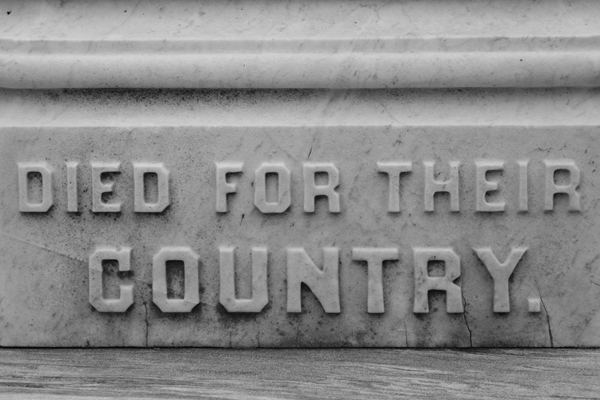
So on this Memorial Day, 2013 – one hundred and fifty years after the Battle of Gettysburg – the lives of so many veterans have been forgotten. These were not unknown soldiers – the grave markers were originally there – we just, as a people, allowed them and their memory to be destroyed. Ironic that the original purpose of Memorial Day was to commemorate the lives of Union and Confederate soldiers who died in the American Civil War. It was originally known as Decoration Day, a day on which veterans’ graves would be decorated with flowers. The veterans’ graves in this particular cemetery will not be decorated as long as the locations of the graves remain unmarked. This disrespect to the veterans rests with us as the nation that created this memorial cemetery in the first place.

References and Acknowledgements:
Wounded Warrior Project
Thanks to Robert Hobdell for historical information.

Tuesday, May 21, 2013

Homeless in the Cemetery

Well, this was one of the weirdest cemetery experiences I have had. I was photographing Mikveh Israel Cemetery in west Philadelphia (55th and Market Streets) through the fence the other day and this guy came up to me saying his name was Marco Polo. He kept telling my friend John and I that he walks past this cemetery every day on his way to work and that we should call Channel 29 television about the deplorable conditions in the cemetery. Other than some uncut grass, it really didn’t look that bad.

Mikveh Israel Cemetery, 55th and Market Streets, Philadelphia


John (L) and "Marco Polo"
So after taking a few photos of some monuments and headstones, Marco Polo finally told us why he likes this cemetery so much. “I slept in here when I was homeless - by that red bush over there.” We didn’t ask how long he camped out in the cemetery, but we all agreed that he was safer inside than he would have been outside. He seemed to have a genuine fondness for the cemetery and would not stop talking about how it should be "fixed up."

Market Street wall and gated entrance to Mikveh Israel Cemetery

If you know Philadelphia, you know that 55th and Market is right under the elevated train tracks that follow Market Street. And you might also guess this is inner city at its best (or worst, depending on your point of view). As in most major cities, this is where you find the cemeteries with the most character. Congregation Mikveh Israel keeps the grass cut and the fencing in place, which is about all that is needed to keep troublemakers out. 

Building near 55th and Market Streets, Philadelphia

The original Mikveh Israel Cemetery (the first Jewish cemetery in Philadelphia, established in 1740) is located at Eighth and Spruce Streets in Philadelphia, near Pennsylvania Hospital (the nation’s first hospital, established in  1751 by Benjamin Franklin). Two additional plots of ground were added by Congregation Mikveh Israel – a second one at 11th and Federal Streets and a third one, which is the subject of this blog, at 55th and Market Streets. While I can find no information on the years in which the second and third cemeteries were established, the 55th and Market Street cemetery has headstones marked from as early as 1868 to as recent as 2008. This cemetery is actually labeled “inactive” on the website of the Jewish Genealogical Society of Greater Philadelphia (JGSGP). 

The tall marble obelisk you see in the photo above marks the grave of Rev. Isaac Leeser (1806 - 1868), "the most famous leader and spokesman of traditional Judaism in Antebellum America" (ref). He was a minister in Congregation Mikveh Israel, as well as founder and publisher of The Occident, a monthly anti-discriminatory periodical "devoted to the diffusion of knowledge on Jewish literature and religion." He translated the Hebrew bible into English in 1853.

 If you’d like to visit any of these three Jewish cemeteries, please note that you cannot actually get inside any of them without either A) having someone from Congregation Mikveh Israel unlock the gates (good luck with that); or B) climbing over the fence or wall (which I would not recommend). All three cemeteries are quite secure, though not actually guarded. All are well-maintained.

Further Reading and References:


Find-a-Grave link to each of the three Philadelphia Mikveh Israel cemeteries in Philadelphia

History of Philadelphia’s Congregation Mikveh Israel Cemetery

Thursday, May 16, 2013

Sleeping, Resting, Waiting ...

We see these words on tombstones and cemetery monuments all the time. If you’re like me, you think its just a way to soften the blow of death for those left behind. The child is dead, for instance, but to make us feel better, we think of it as the long sleep. The implication of course is that (if you’re a Christian) you’ll be together once again in heaven. Seems to go hand-in-hand with Victorian sensibilities relating to death and the mourning arts. However, the idea of death as "sleep" has much older origins.

"Koimeterion" is the ancient Greek word for "sleeping room." The verb "koiman" means "to sleep." A cemetery, then, originally may have been thought of as "sleeping quarters," temporary lodging. This “temporary sleep” is put into perspective by Mark C. Taylor in his book Grave Matters: (2004) "In the Early Christian tradition, which has been so important in shaping the space and determining the significance of cemeteries and graves in the West, the cemetery was seen as a temporary resting place where the dead awaited resurrection.

So what’s wrong with thinking we’ll all see our loved ones in heaven after we die? Seems kind of innocuous, right? Makes us feel better when we lose someone. What’s wrong with this picture hadn’t occurred to me until very recently. In the book, Good Omens (by Neil Gaiman and Terry Pratchett, 1990), the twelve-year-old antichrist gone good, states the following: “If you stopped tellin’ people its all sorted out after they’re dead, they might try sorting it all out while they’re alive.

So telling us Christian sheep to roll over and die, because things will be better in heaven, is like saying, “you have no control over this, so just accept it.” How can such passivity change the world for the better? Doesn’t that fly in the face of what Christianity is all about – love your neighbor as yourself? Isn’t that a mixed message (even a bit hypocritical)? If we really loved our neighbors as ourselves, we would try to work out our differences while we’re alive, not just let the differences continue hurting us. Saying someone will “burn in Hell for what he did” is the same thing. It might make us feel better to think that they'll get what’s coming to them after they die, if it seems like they can't be punished sufficiently for their deeds while still alive. 

So, after reading all this, everyone out there who feels we’ll get our “just rewards” after we die, raise your hand. Wake up people. A more practical epitaph is seen on the headstone below: "She hath done what she could." The phrase may seem trite at first glance, but really, maybe she really did do all that she could to make this world a better place. Shouldn't we be following in those footsteps?


Final Notes:
The first and last photos were taken at Philadelphia's Mount Moriah Cemetery. The "Resting" and "Waiting" stones were photographed in Wilmington, Delaware's Wilmington and Brandywine Cemetery.

Friday, May 10, 2013

No Dentists in the Afterlife

The best thing I can think of to look forward to when I die is this: no more root canals. For that matter, no more dental visits, ever! I thought of this as I was having my mouth tortured by Dr. Gorgon and his hygienist/assistant, Nurse Ratchett, this past Monday afternoon.

It should come as no surprise to you that my overactive imagination tends toward the morbid. But, ah, what bliss to look forward to an eternity of zero dental visits! This must have been my fifth or sixth root canal in my lifetime. Whoever dies with the most, wins. Actually, everyone who dies, wins, because there are no dentists in the afterlife! Hall-e-freaking-luia!!

Why Gorgon let me glimpse the goddam drill bit with my peripheral vision is beyond torture. Sweet Angry Jesus, doesn’t my imagination conjure up enough sadistic imagery without that?! Gorgon is usually good with the slight-of-hand, the léger de main. Freaking thing must have been an inch-and-a-half long!

So then of course I thought of the tallest cemetery monument in America, the 150-foot obelisk at the Woodlands Cemetery in Philadelphia. This space needle of a monument memorializes a dentist! I swear to god! The thing is like a giant root canal needle! The obelisk, like a smaller version of the Washington Monument in D.C., memorializes the guy who started the Dental School at the University of Pennsylvania in West Philly, one Thomas Evans (1823-1897). 

Actually, according to the Woodlands’ website, “At his death in 1897, Evans' left his estate to the University of Pennsylvania to found a Dental School…” Evans pioneered such dental advances as using gold for filling cavities (“Dr. Bling?”) and using nitrous oxide as an anesthetic. (So wait - if Evans was using nitrous in the late 1800s, why was my childhood dentist still using ether in the 1960s?! Freaking dentists.)


I suppose if you really were a masochist, you could visit the Penn Dental Museum, the existence of which is  indicated on the large bronze plaque (no pun intended) at the base of Evans' monument. So hey dental professionals out there, heed the words of philosopher John Stuart Mill (1806-1873): “Work while it is called Today; for the Night cometh, wherein no man can work.” Get it all in now, while you can, cuz there ain't no dentists in the afterlife!!!

It’s day two now, and I’m going to make myself a Motrin smoothie and lick my wounds. If I sound a little bitter and have made some sweeping generalizations, that's because I'm viewing it from the pain perspective. Maybe it all began when I first saw Dustin Hoffman in Marathon Man  (1976).... Naw, I hated dentists since I was a kid. By the way, if you dislike having dental work as much as I do and have never seen Marathon Man, do yourself a favor - don't.

Laurence Olivier and Dustin Hoffman in Marathon Man (1976)

Tuesday, May 7, 2013

Cemetery Traveler Celebrates 3rd Anniversary!


I find myself this month on the precipice of a fourth year writing the Cemetery Traveler blog. Yes, its been three solid years of my dark tourism adventures. By my count, 132 articles have been published since I began in May of 2010. Have I run out of things to say? No, but my laptop gave up the ghost last week. Had to go out and get a new one. All that lives is born to die, sigh (except sourdough yeast, I suppose). Hopefully, I won’t upset this one as much as I abuse it verbally while I am forced to learn Windows 8.

I have over 100 followers now, a fact that humbles me and of which I am deeply honored. Thank you all for reading and I dare say, you are now prepared for your next step in the indoctrination.

At the beginning of April, 2013, I had an exhibit of my work in Philadelphia that I called “Symptoms of Cemetery Photography" (click link to go to that blog posting). I meant it as a nod toward the way cemetery photography has influenced my art and techniques in the photographic medium. That in itself is a later blog. For now, I just want to acknowledge how making cemetery photography has opened up tangential doors for me. I also want to acknowledge the people who have made these opportunities possible for me.

So, here are a few highlights from last season, places I’ve gone both literally and figuratively, through The Cemetery Traveler – symptoms, as it were, of my cemetery photography:

•Grandma's New Headstone

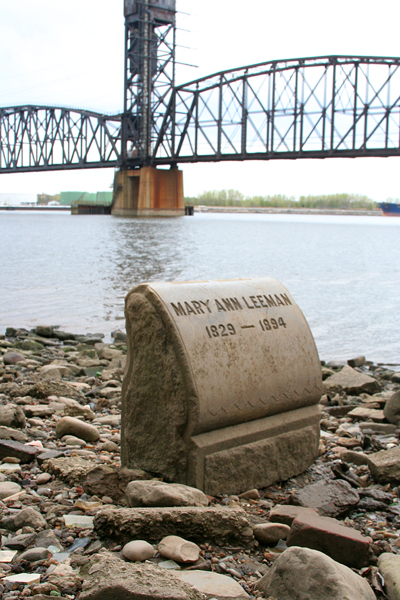
I wrote a blog “My Grandmother’s Grave,” in June of 2012 about how my grandmother (who died in 1964 when I was six) never had a headstone on her grave. I felt pretty strongly that she should have one to mark her history for future generations. We should all have some anchor to the past, as became evident to me last year when so many people contacted me about the headstones dumped under the Betsy Ross Bridge in Philadelphia (see "Resting in Pieces Along the Delaware River"). My Mom and I got together and she had a stone made for Anna Jones, her mother. It was placed on her grave this past fall.

•The Friends of Mount Moriah Cemetery

Ed (L) with "Find-a-Grave" administrator, Russ Dodge (photo by A. Selletti)
After my years of adventures at the (formerly abandoned) Mount Moriah Cemetery in West Philadelphia, I was I’ve evolved from an awed bystander to an involved conservator. This past year I applied for a position on the Board of Directors of The Friends of Mount Moriah Cemetery (a nonprofit organization). I was voted in as the Communications and Technology Committee Chair. I’m glad I can put my writing and photographic skills to good use, honoring the memory of those interred in the cemetery through restoration, historic research, education and community engagement. I’ve been writing and posting photographs about the cleanup events on the Friends’ website, which you can see here (an odd sub-specialty of “event photography” which you don’t normally think about!).

•Publications

Book cover – I had given permission to the British Centre for Freudian Analysis and Research organization to use one of my photographs for the cover of its February 2013 Journal (JCFAR)  issue “On Love.” Cupid and Psyche never looked so fine!

•Imaging Technology

Diana (top) and Holga cameras
This past year, my DSLR forgot how to autofocus, so I had to replace it. This was a mere week after I made the momentous decision to plunk down $400 on a high quality digital point-and-shoot camera (or, as I call these little miracles in my book, Digital Photography for the Impatient, DPS cameras). That was a load of money, but the Canon G9 DPS and the Canon XTi DSLR are working out just fine. Oh, and I bought another Holga at the Philly Punk Rock Flea Market around Xmas time for six dollars (!), so I plan to do more lo-fi work with that. Speaking of new gear, we bought our three-and-a-half-year-old daughter Olivia an iPad, since all her nannies have had one. She’d been clamoring for her own and we didn’t want her to get too far behind the technology curve. I plan to take cemetery photos with it.

•Genealogy

B'nai Israel/Hebrew Mutual Burial Ground in West Philadelphia
Genealogy never was my strong suit (it still isn’t), but I’ve gotten myself involved in a few related situations which I wrote about last year. After posting a blog about the (formerly abandoned) B’nai Israel Cemetery in West Philadelphia (see "Abandoned Jewish Cemeteries"), I was contacted by a descendant who asked for help photographing the inscriptions on the stones so he could enter the information onto the JewishGen Worldwide Burial Registry (JOWBR), so I did this. There were about a hundred headstones.

Monument cemetery stone
Recently, a graduate History student asked me if she could use my photos and information about Philadelphia’s defunct Monument Cemetery in a presentation on the effect of urban renewal on rural cemeteries in Philadelphia, using Monument Cemetery as one case study. This Victorian cemetery was condemned by the City of Philadelphia in 1956 and the tombstones and monuments were all dumped into the Delaware River. So many people responded to my two 2011 blog postings (see "How Monument Cemetery was Destroyed") about this atrocity that I decided to make a third visit (read about this in "Beachcombing in Hell") in 2012 to document as many names and dates from the discarded headstones as I could. In addition to writing about this visit back to the Delaware Riverfront under the Betsey Ross Bridge, I subsequently uploaded twenty-five separate names, with photos of the headstones, to the Find-a-Grave website.

Finding lost graves
I’d like to add that my postings about Monument Cemetery have generated considerable public interest and media coverage, which will hopefully result in a more respectful final resting place for these stones. As I said in my blog at the end of April, 2013, "Finding Lost Graves", people need a tangible link to their past. These discarded memorial stones may be the only tie some of the descendants have to their ancestors.

The aforementioned experiences are after the fact, retrospective studies. Finding graves in the here and now is a new experience for me, and one which I wrote about in the aforementioned blog, “Finding Lost Graves.” I have been afforded this opportunity through my involvement with the Friends of Mount Moriah Cemetery, and I must say that it is a truly rewarding experience.

In Summary


So, these are just a few things I’ve covered this past year in the Cemetery Traveler blog. If you missed any postings, I invite you to go back into the archives and look them up (you can type in a keyword or phrase in the “Search” box at the top left corner of the page).


 “The world is a lot more complicated than most people believe,” wrote Neil Gaiman and Terry Pratchett in their novel, Good Omens (1990). Cemetery photography, for me, has been a good omen, which has resulted in a variety of complications, or symptoms, about some of which you have just read. (By the way, since I had to create a password for my new laptop, I incorporated the words “Good Omen” into it.)

What, There’s More?

Yes. I intend to continue to draw aside the veil and explore the mysteries of dark tourism for as long as I possibly can. I’ll continue to ask the hard questions and point out the ironies in our attitudes toward death and mourning, calling it the way I see it. Occasionally this gets me into hot water with the irascible types, but the investigative reporter side of me steps in and tries to point out both sides of the argument (if there are any). 

Happy to say that my three-and-a-half-year-old daughter Olivia seems to be following in my footsteps. I took her gallery-hopping this past First Friday in Philadelphia and as we walked into a particular moodily-lit place, she spoke her mind. The gallery was showing photographic “scenes from the Chelsea Hotel” (in New York) and a sign outside said they were going to be showing Warhol’s movie “Chelsea Girls.” The gallery was crowded with serious-minded bohemian-looking mods, talking art as only artists of that type can. As we walked into their midst, Olivia said in a loud voice, “Do they have snacks?” Man, did THAT cut through the affectation!

    --------------------------------------------------------------------------

Purchase Ed's book, Digital Photography for the Impatient, from Amazon.com.


Tuesday, April 30, 2013

Finding Lost Graves

Not being a professional cemetery worker, I don’t often find myself helping people find the grave sites of their loved ones. In my present role on the Board of Directors of the Friends of Mount Moriah Cemetery (in West Philadelphia), I occasionally find myself performing this service. It’s quite rewarding in a place like this, when descendants may not have visited a grave for thirty years.

The reason for people avoiding Mount Moriah for the past few decades is usually that it was not safe to be here. The weeds had overgrown the place and even in the 1960s, half of the cemetery’s 300+ acres had grown into a forest. Throughout the 1970s and 80s, it apparently got worse. Visitors stayed away in droves.

Cleanup Day
But now they return regularly during the cleanup days sponsored by the Friends of Mount Moriah Cemetery. Other large organizations get involved too, Asplundh, Comcast, the City of Philadelphia, for example. Colleges send students to clean for the day as part of their Civic Engagement courses in community involvement. Drexel, LasSalle, Cheney and other local universities have sent busloads of volunteers to the cemetery. Descendants return to help clear their ancestor’ graves, as well as the graves of others lost to time and thicket.

The people who show up to clean and look for ancestors’ graves are usually in their forties and beyond. They may have spent their childhood living near Mount Moriah, learning how to ride a bike or ski down its gentle hills. The members of the Friends Board go out of their way to help them find the graves of their familial ancestors. The Friends group has access to cemetery records and maps – the latter are on the Friends’ website, the former still not yet available to the public (contact us at info@fommc.org).
Yeadon side of Mount Moriah during "Comcast Cares" Cleanup Day

People want to see the gravesite of their forebears – it gives people a sense of their place in a larger history. We all need a tangible anchor to the past. I’ve helped folks look for graves a few times myself - it can be a truly rewarding experience, or terribly frustrating when you can’t actually find the grave. Why would you not be able to find it with a section map and plot coordinates? As of this writing, although many of the sections in Mount Moriah Cemetery have been cut back and are being kept clear by volunteers and family members, about two thirds of the grounds are still overgrown with trees and high weeds.

Map: Friends of Mount Moriah Cemetery website
Having a map is one thing, but trying to claw your way through a thicket rife with fallen headstones entangled by “mile-a-minute” weeds seldom yields a satisfactory outcome. Usually a visitor has done some preparatory research and contacted the Friends group to request information as to the whereabouts of a certain plot. If they want help finding the plot, they may request this of the Friends group or wait for a cleanup day when scores of people are around.

One time an experienced cemetery worker and I spent about an hour trying to find a woman’s grandparents’ graves, but gave up for two reasons: 1) it was summer and the foliage was dense; and 2) though we found the proper area in the proper section, most of the headstones had been pushed over and were lying face down. (You would think vandals would have the common decency to push them the other way so people could still read the inscriptions.)


Northern border of Naval Asylum Plot (graves in woods beyond)
With plot number in hand and even grave row and number, you would think it would be easy enough to find a grave. That’s typically the case in a well-maintained cemetery. However, Mount Moriah has not been maintained. Sometimes you can find a grave if it is one of the historically well-maintained (by the Veterans’ Organization) military plots e.g. the Civil War Soldiers’ Plot or the Naval Asylum Plot. Civilian graves prior to about 1913 are in the older areas of the cemetery and are more likely to be grown over with wild rose bushes, poison ivy, or any number of invasive, spreading plant such as knotweed. These include massive monuments and dynasty plots. This year in particular, the Friends group has organized some highly effective cleanup days and these areas are slowly but surely coming under control.

A few weeks ago during a cleanup day, a woman asked me if I could help her find her husband’s great uncle and great-grandfather’s graves. Looking at the section and plot information, I was afraid it would be a jungle. Someone must have warned her about the florid overgrowth at Mount Moriah, as she was dressed appropriately and had even brought her own machete!

We found the general area of the plot in Section 148 (which, according to the map (at right), contained around 204 graves – 17 columns by 12 rows), but finding the actual grave was quite another matter. The obvious obstacle was the dense forest which had grown up in Section 148. In addition, because the paths or roadways indicated on the map surrounding each section are not obvious in the middle of the woods, finding a starting point can be challenging. Section markers have long disappeared (but this is on the Friends’ to-do list). The only bearing I could get was that Section 148 was just north of the nicely manicured Naval Asylum Plot and just east of the G.A.R. plot which had just been identified and cleared that day in Section 142!

G.A.R. Plot, Mount Moriah Cemetery
The search took about forty minutes in an area roughly half the size of a baseball diamond. The woman had driven here from somewhere in New Jersey and was on a quest for her husband, who was unable to make the trip. As she slashed through the vines and ivy, I climbed from plot to plot checking names. There did not appear to be any damaged or fallen headstones in this section, so that was a good thing.

Visitor nearing ancestor's grave in Section 148
After restarting from what I thought was the southwestern section corner a third time, I found the stone in question. Linda was about fifty feet away talking with another member of the Friends group. I couldn’t actually see them, so I made my way out of the thicket and joined them. I told Linda I had found it. She brightened up and followed me into the woods. The plot in question was so thick, you had to be almost right on top of the stone to see it. It wasn’t a large stone, standard-sized about two feet high by two feet wide. As she approached the stone, I held away some vines so she could see the name. On reading the inscription, she said “This is a truly momentous occasion.

Now, I have to admit that other members of the Friends group and even certain volunteers know the lay of the land far better than I. One or more of them may have been able to find the grave more quickly than I did, so I do appreciate Linda's patience. It’s a learning experience, with improvements all the time. Sam Ricks from the Friends joined us momentarily and accessed the GPS app on his cell phone. Anticipating her next question, which was, “How will I find this when I bring my husband back to clear the grave site?” Sam gave her the GPS coordinates.

Masonic symbolism
As Gwen looked down on the stone, she said, “My husband told me there was some sort of strange carving on it.” I examined it and told her he was a Mason. She called her husband and took photos with her iPhone. She told me that her husband’s great uncle (who died in 1913) used to tell all his nephews and children that they each needed to go to school to at least learn a trade.

Linda relayed the information to me from her husband that said this was a family plot and there should be other graves nearby. Without too much difficulty, I pulled back some vines from a larger stone about six feet away to reveal the headstone of her husband’s great-grandfather. Here's a photo of Linda chopping through the vines with her machete to access his headstone. She vowed to return with her husband to not only clear the area, but to keep it clear. The whole idea of "perpetual care" went out the window when Mount Moriah Cemetery was abandoned in 2011, but the fact is, the majority of the cemetery was left to run wild for decades prior to that.

What's past is past, though, and currently the Friends of Mount Moriah Cemetery is making great strides to bring the grounds under control. Hopefully within a year the cemetery will have an official legal owner and more concerted efforts will be made to make it a viable cemetery one again. Until such time, if you are looking for a grave in Mount Moriah Cemetery, please contact the Friends group at info@fommc.org. Provide us with as much information as you can, and we’ll help you to the extent of the resources available to us.