Showing posts with label Julie Esty. Show all posts

Monday, October 6, 2014

The Dearly Departed Players

2013 Performance of The Dearly Departed Players
This coming Sunday, October 12, 2014, the Cemetery Traveler will be traveling to Scranton, Pennsylvania (from Philadelphia, where I live) to attend the annual “Dunmore Cemetery Tour.” This is actually in Dunmore, PA, a suburb of Scranton. And it’s really not so much a tour, as it is a a tour-d-force performance by the Dearly Departed Players, a theatrical troupe headed by Julie Snell-Esty.

Julie Esty (r) with daughter Megan during a performance

"Dearly Departed" cast member
The free tour is held on two weekends every October. This year, it was held on Sunday, October 5; next weekend, it will be held on Sunday, October 12. To give you an idea of the size of this event, about 400 people showed up last Sunday! This is typical. The Dearly Departed Players are a cast of about fifteen amateur and professional theatrical performers who enact scenes at different spots in the cemetery. The crowd is led to each of maybe eight sites where it stops to witness a (audio amplified) short play, monologue, reenactments, ballet, or a Spoon River Anthology-type presentation.

Wendy Conrad Belaski performing at Dunmore Cemetery
The crowd enjoys a witty and historically accurate script written (a new one each year!) by the troupe's artistic director Julie Esty. Some of the stories of those interred here in the Dunmore Cemetery have been published in Julie’s two books, listed below. As with her books, Julie bestows upon the audience an abundance of humor, tears, and history, all the while raising the public's awareness to the importance of cemeteries. The enthusiastic cast of Dearly Departed Players brings her script to life - so to speak.

Books by Julie Snell-Esty
Stories in Stone: Tales of Life from the Dunmore Cemetery
Stories in Stone Volume II: Tales of Life from the Dunmore and Forest Hill Cemeteries
(Please contact Julie Esty directly to purchase.)
      
This will be the third year I have attended the tour, officially as a guest artist, but I do tag around after the crowd to enjoy some of the entertainment. I set up on the lawn near the entrance about an hour before the crowd arrives (noon), along with a few other artist/vendors. So basically, I create a freestanding exhibit of my photographs, greeting cards, jewelry, books, etc. on a table and display racks on the lawn at the cemetery entrance. Then, busloads of people show up. It is in this short interval of time that I try to make my sales! I do spend quite a bit of time, however, chatting with folks about cemeteries in general. The tour begins at 2 pm.

Ed Snyder's "Stone Angels" sales display at the Dunmore Cemetery

Ballet during 2012 Dunmore Cemetery Tour

It is fascinating to see how many people show up for the performance, attesting to the quality of the production and the dedication of the Dearly Departed Players! You may notice from my photos that the performers typically dress in period costume, with the Victorian era being a quite popular one.

Performer entertaining an audience of hundreds at Dunmore Cemetery

After the two-hour tour/performance, the main thing on the minds of those hundreds of people is a bathroom! So while the cemetery for the most part clears out quickly, I tend to chat with many hangers-on, whether they be genealogists, actors, historians, or just regular people sharing ghost stories! There has traditionally been a dinner afterword and I am grateful for the invitations I have been extended by the Dearly Departed Players. They are such a joy to spend time with!

2013 cast of the Dearly Departed Players at the Dunmore Cemetery

More information!

Around the Towns, Sept. 28, 2014
The Dearly Departed Players on Facebook
The Dunmore Cemetery Tour on Facebook

Friday, January 24, 2014

Death's Playhouse

John McCullough
This week's Cemetery Traveler blog was written at my invitation by my good friend and historical interpreter, Julie Esty. She is the artistic director for the Dunmore (Pennsylvania) Cemetery Tour/Dearly Departed Players and is the author of the books: Stories in Stone, Tales of Life from the Dunmore Cemetery, Murder in Scranton, and recently with daughter Megan, the one act play "An Evening at Ford's Theatre."

The majority of the public has at least once in their life experienced a stage performance, be it a Broadway performance or a local theatrical. Audiences see what is presented to them superficially – the lines, lights, props, costumes, entrances and exits. What most viewers rarely see are the bonds of friendship that are formed between the actors and crew while working on a stage production. My daughter Megan and I have had the good fortune of working on theatricals regularly and experiencing what we refer to as “the camaraderie of the stage.” Two men at rest in Philadelphia’s Mount Moriah Cemetery, both with stellar theatrical careers, experienced this camaraderie of the stage. They shared a bond of friendship in life which was formed in playhouses across the country and in death they share an unbreakable bond etched in stone.


Front of John McCullough's monument depicting sculpted masks of Tragedy and Comedy

American born actor Edwin “Ned” Adams began his theatrical career in the early 1850’s.  By the mid 1860’s he was a member of the famed Edwin Booth’s theatrical company. Gifted at comedic performances, Adams was also quite successful with Shakespearian roles as well.


McCullough family crypt cover
British born “Genial” John McCullough came to the United States in 1848.   Like Adams, McCullough also began his stage career in the 1850’s.  At the age of twenty five McCullough began appearing in theatrical roles on stages in Philadelphia.  Again, like his contemporary, Edwin Adams, McCullough also played the stage with Edwin Booth and was noted for his Shakespearean portrayals. [Ed. note: Photo of  John McCullough at top is from the book, In Memory of John McCullough ... by William Winter, 1889.]

"Manliness and meekness in him were so allied that they who judged him by his strength or weakness saw but a single side." (The quote is from the John Greenleaf Whittier poem, In Remembrance of Joseph Sturge.)


John McCullough (ref.)
During the course of their careers Adams and McCullough crossed paths regularly. There are at least two instances of the actors working together in the summer of 1871, which can easily be found.  In June of that year, both men appeared in Wine Works Wonders at the California Theatre in San Francisco (Ref. 1). The following month they acted together appearing in what was deemed “legitimate” or Shakespearean roles at the Salt Lake Theatre in Utah (Ref. 2).Working, and most likely traveling together, the two thespians developed a great friendship. In describing the relationship between Adams and McCullough, drama critic, poet and author William Winter stated in his Sketch of the Life of John McCullough, “a close friendship had for many years subsisted between Adams and himself (McCullough), and indeed it would be difficult to imagine two human beings more accordant in generosity of temperament and gentleness of life” (Ref. 3).

"The Eminent Tragedian, John McCullough"

In the mid 1870’s Edwin Adams' health declined due to consumption. Unable to perform or travel, this left Adams without an income.  A number of benefit performances were held to raise funds to aid the ailing actor.  On October 12, 1877, benefit performances were held at the Academy of Music in New York. John McCullough participated in support of his dear friend and colleague. Less than two weeks later, Edwin Adams was dead.


Edwin Adams' grave, Mount Moriah Cemetery, Philadelphia
Following the death of Adams, McCullough was asked to supply an inscription for the late thespian’s memorial stone in Mt. Moriah Cemetery.  McCullough selected the following line from Shakespeare’s Julius Caesar, Act 5, Scene 5 –

His life was gentle, and the elements so mixed in him that Nature might stand up and say to all the world, “This was a man.”


McCullough monument, 1888, Mt. Moriah Cemetery
[Photo from the book, In Memory of John McCullough ... by William Winter, 1889.]
John McCullough continued his stage career but by the mid 1880’s his stage performances took a severe decline due to failing health.  McCullough began to experience increased memory loss which made him unable to render his lines on stage. This memory loss was possibly due to advanced syphilitic infection. He died in November 1885.

After the death of John McCullough, a memorial was erected to his memory in Mount Moriah Cemetery.  This substantial monument at one time housed a sizable bronze bust of the late actor as he appeared in his favorite role of Virginius. The south side of the monument bears a quote from the John G. Whittier poem, In Remembrance of Joseph Sturge. The east side of the monument appropriately bears the masks of comedy and tragedy.  The north side bears an inscription that links McCullough to his dear friend Edwin Adams. The McCullough memorial bears the same line from Julius Caesar, Act 5, Scene 5 that appears on the memorial to Edwin Adams ---

His life was gentle, and the elements so mixed in him that Nature might stand up and say to all the world, “This was a man.”


Two men, not only players on stages across the United States, but also on the stage of life are linked together – etched in stone in Death’s playhouse in Philadelphia’s Mt. Moriah Cemetery.

References and Further Reading:
(Ref. 1) “Amusements,” Daily Alta California, June 22, 1871, p.4. 
(Ref. 2)  “Amusements,” The Sunday Morning Appeal, July 30, 1871, p.4. 
(Ref. 3)  In Memory of John McCullough, The DeVinne Press, New York, 1889, p. 21

In Memory of John McCullough ... by William Winter, 1889
John McCullough as Man, Actor and Spirit by Susie Champney Clark, 1905

Julie Esty on Facebook  
The Dunmore Cemetery Tour on Facebook
The Dearly Departed Players on Facebook 


Saturday, October 27, 2012

"I Have Felt a Presence in the Cemetery"

Julie Esty
This week on The Cemetery Traveler I present a guest writer, my good friend Julie Esty. Julie heads up the annual theatrical production The Dunmore [Pennsylvania] Cemetery Tour and is herself one of the Dearly Departed Players who brings the tour to life. With Halloween just around the corner, I think you’ll enjoy this!

 (I’ve added my photos to her text, which were taken in the Dunmore Cemetery.)

~~~~~~~~~~~~~~~~~~~~~~~~~~~~~~~~~~~~~~~~~~~~~~~

In the spirit of the approaching holiday, your host and fellow taphophile Ed Snyder has asked me to share with his readers my “otherworldly” experiences.  As a historian I have spent the better part of my life in cemeteries, as well as handling funerary ephemera and memorabilia.  For this reason I am constantly questioned about the existence of ghosts.  Unfortunately, I have no tales to relay that will strike fear in your hearts or send chills down your spine. My story is one of comfort, solace and hope.

For me the word “ghost” summons images of Dan Ackroyd in full ghostbusting regalia chasing ectoplasmic blobs.  In cemeteries I have seen no such thing, no ectoplasm, no ghosts and certainly no Dan Ackroyd.

From funerary objects there has been nothing.  No flashes, haunts, spirits of the dead or glimpses of an afterlife.  Perhaps this is because many of the objects were held by the skillful hands of an undertaker, a man or woman who took pride in their task of aiding the mortal remains of the deceased to their eternal rest.

Have I gotten a glimpse of what lies beyond the veil that separates this life from the next?  I would like to think that I have not only seen it but felt, heard and smelled it.  The experiences have come without the aid of microphones, meters or modern technology.  All encounters have taken place not under the cover of darkness but in the bright light of day.

Yes, on more than one occasion I have been in a cemetery in the “dead” of winter and gotten the scent of perfume from a spirit unseen.  Yes, I have heard the frantic cries of a woman perhaps seeking her lost child as I rested on a tombstone in the “Potter’s Field” section of a cemetery.  Yes, I have seen the flashes of a Union blue uniform peek from behind a tree as I tended to my research.  And yes I have felt a presence in a cemetery and received its wonderful message.

My encounter with a presence began one day as I looked up a hill in a cemetery.  There was something fixed squarely at the hill’s apex.  Initially I thought it was the sun reflecting off a tombstone but realized whatever it was it was definitely not a reflection.  Whatever “IT” was, was strong, powerful and male.  “IT” wanted something.  For more than a year I avoided that section of the cemetery and refrained from looking in its direction.  Curiosity always got the better of me.  Eventually I would look and the presence was there, silently occupying its position on the hill.  When it became obvious that the presence was not going to go away I resolved to find out exactly what it was and wanted. 

I spent the next year and a half on that hill.  There was something “IT” wanted me to know, I just had to figure out what that was.  In the autumn I watched the leaves cover the hill.  In the winter I sat in the car and gazed at snow.  In the spring I watched the trees bud and flowers bloom.  No closer to an answer with the coming of summer, finally I trudged up the hill and stood silently staring off into the cemetery damning myself for not be able to figure it out.  And then – someone tapped me on the shoulder.  I turned around expecting to see a cemetery visitor seeking the grave of an ancestor but there was no one there.  It was then that all became very clear.  I had been looking in the wrong direction and needed to turn around.  Within days of the shoulder tap, the story and message “IT” wanted me to know unfolded.

While the tale is much to lengthy to relay here, I will tell you it involved a group of men, strong, strong powerful men who formed a bond of loyalty, friendship and love well over one hundred years ago.  The placement of their eartly remains created a symbol and coincided with the rising and setting of the sun and cycles of the moon.  In life the men had met regularly by the light of a full moon, not for any supernatural reason, but for strengthening their bonds of friendship.  In death, they still meet by that lunar light.  The position of their final resting places leaves a tangible message that in life these men were united and in death their bond would remain unbroken.


What I learned from this group of men from years gone by is that as surely as the autumn leaves flit to the cold ground in their dance of death, life will again flourish as it does every Spring - and go on in this life and the hereafter.  No ectoplasmic masses, orbs or strange mists have crossed my path in a cemetery.  I have seen only goodness, love and light shining brightly through the veil that separates this life from the next.  

Further reading and reference: 

The Dunmore Cemetery Tour on Facebook
The Dearly Departed Players on Facebook
Julie Esty's first book, "Stories in Stone," is shown below. Her latest, “Murder in Scranton: A Trilogy,” details four murders in three stories. It is available by contacting Julie at elzbththrn@aol.com.

Order Julie Esty's book, Stories in Stone

Sunday, November 20, 2011

Dunmore Cemetery and the Dearly Departed Players


I guess those of us living in the northeastern part of the U.S. get to enjoy a unique aspect of our cemeteries that people in other parts of the country cannot – the rainbow of colors brought on by leaves changing colors in the fall. (I have this ridiculous notion that you can never see Minnesotan cemeteries because the ground is always covered with snow!). If you happen to pair up the fall foliage extravaganza with a truly beautiful cemetery, the result can be breathtaking. I experienced this at the beginning of November at the Dunmore Cemetery in Dunmore, Pennsylvania.

Dunmore is in the northeastern part of PA, an old coal mining region, two miles north of Scranton (made famous on the TV show “The Office”). The reason I was in Scranton was because I was invited to participate as an artist in Scranton’s First Friday Arts Walk. Most cities have them – once a month, galleries change their exhibits, stay open late, and offer free wine and cheese doodles. Sometimes other businesses get involved, hanging artwork, hosting live bands, etc. You see bookstores, restaurants, bars, ever even churches participating. The good people at St. Luke’s Episcopal Church in Scranton were my hosts for the evening. 

Prior to arriving at the church, I spent a few hours photographing in the Dunmore Cemetery, at the recommendation of the two fine people who were responsible for my being invited − Julie Esty and Wendy Belaski, members of the Dunmore Cemetery’s “Dearly Departed Players” theatrical group. This group offers a stone by stone walk though the history of the residents of the cemetery (sponsored by the Lackawana Historical Society).

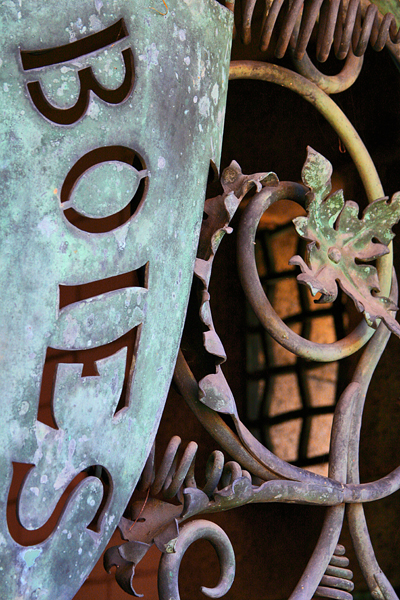
Established in 1828, Dunmore Cemetery offers unique and well-preserved ironwork, headstones, statuary, and mausoleums. Across its hilly 35 acres, you'll see a pyramid, a lovely chapel, ornate crypts, even a zinc memorial thrown in for good measure – all blending art with the preservation of memories. Many memorials are quite unique, e.g. the castle-like crypt of the Boies family - with its filigree metalwork inside the entrance. its every bit as extravagant as anything you'd see in Paris' Pere Lachaise Cemetery.


Boies Mausoleum, Dunmore Cemetery

Julie Esty's book
Many cemetery companies strive to be what the Dunmore Cemetery is − a destination spot for all sorts of activity. It is a wonderfully landscaped and meticulously attended to Victorian-era sculpture garden. As I drove through and walked around on this gorgeous fall day, I was taken by the fact that there were so many other people here on a Friday afternoon! There were walkers, drivers, visitors tending to the graves of their loved ones, groundskeepers, and so on. Just a bevy of activity – in fact, more people than I’ve ever seen in any cemetery anywhere! The place is obviously a source of great community pride. Its office was immaculate, the sole worker very cordial and helpful. I noticed they were selling copies of Julie Esty’s book, Stories in Stone – Tales of Life from the Dunmore Cemetery, so I purchased a copy, figuring I would later ask her to autograph it. (You can purchase your own copy here.)

As cemeteries revitalize and try to earn more money to stay in business, a major thrust is to get more live people to spend time in them. Why would that matter? Well, if you can offer novel and interesting attractions to people (such that they’ll pay money to come to the cemetery), you can generate income from:
  • ·         Historic tours
  • ·         Concerts
  • ·         Beer tastings (!)
  • ·         Special events such as Halloween parties and presentations
But there’s a subtle yet very important reason to attract people to cemeteries, which Julie and Wendy pointed out to me later that evening − the more people who are around, the less likely vandals and thieves will be to damage and steal. As the founder and artistic director of the Dearly Departed Players, Julie Esty has figured out a way to get people into a cemetery (live people, i.e.). Over the course of two Sundays this past October, her two-hour tours of the Dunmore Cemetery drew eight hundred people! She is quite passionate about what her group does in this very popular form of historic preservation (there is actually no fee for the tour).

Photo by Tim Snyder
Early that evening, my brother Tim met me at St. Lukes, where he helped me with the load in and load out. I was given the front room in the church hall − a beautiful space in which to set up my books, photographs, and greeting cards. Inside the hall itself were a half dozen other artists and exhibitors, and a choir performed in the connected church. These people really know how to throw a party! They had a separate room set up with free coffee, cookies, bottles of water, and so on. 

Wendy Belaski, Ed Snyder, and Julie Esty
The whole affair was well attended and the visitors were great fun to talk to. Such a warm welcome! New friends and old stopped by, teens, people who were familiar with my work on Facebook, members of the Scranton Photography Club. People had suggestions to visit various local cemeteries, some discussed photographic techniques and camera gear, others asked me the stories behind certain images in my book as I autographed copies for them.

Stained glass from Dunmore mausoleum
Julie Esty and Wendy Belaski (who specializes in the art of mausoleum stained glass), arrived in Victorian hoop dresses and bonnets, as they were exhibiting pieces of funeral history, including post-mortem photographs, mourning clothing, and other artifacts. They’re as much into dead things as I am, so we hit it off well. I appreciate all the tips on nearby cemeteries to visit (especially the run down and nearly abandoned ones) and will definitely head back to Scranton soon. All in all, it was a fabulous visit, and I thank everyone for their hospitality!

References and Further Listening and Reading:
Hear Julie Esty’s podcast interview on the Dunmore Cemetery (hear what goes into planning a historical cemetery tour!)