Showing posts with label Dunmore Cemetery. Show all posts

Monday, October 6, 2014

The Dearly Departed Players

2013 Performance of The Dearly Departed Players
This coming Sunday, October 12, 2014, the Cemetery Traveler will be traveling to Scranton, Pennsylvania (from Philadelphia, where I live) to attend the annual “Dunmore Cemetery Tour.” This is actually in Dunmore, PA, a suburb of Scranton. And it’s really not so much a tour, as it is a a tour-d-force performance by the Dearly Departed Players, a theatrical troupe headed by Julie Snell-Esty.

Julie Esty (r) with daughter Megan during a performance

"Dearly Departed" cast member
The free tour is held on two weekends every October. This year, it was held on Sunday, October 5; next weekend, it will be held on Sunday, October 12. To give you an idea of the size of this event, about 400 people showed up last Sunday! This is typical. The Dearly Departed Players are a cast of about fifteen amateur and professional theatrical performers who enact scenes at different spots in the cemetery. The crowd is led to each of maybe eight sites where it stops to witness a (audio amplified) short play, monologue, reenactments, ballet, or a Spoon River Anthology-type presentation.

Wendy Conrad Belaski performing at Dunmore Cemetery
The crowd enjoys a witty and historically accurate script written (a new one each year!) by the troupe's artistic director Julie Esty. Some of the stories of those interred here in the Dunmore Cemetery have been published in Julie’s two books, listed below. As with her books, Julie bestows upon the audience an abundance of humor, tears, and history, all the while raising the public's awareness to the importance of cemeteries. The enthusiastic cast of Dearly Departed Players brings her script to life - so to speak.

Books by Julie Snell-Esty
Stories in Stone: Tales of Life from the Dunmore Cemetery
Stories in Stone Volume II: Tales of Life from the Dunmore and Forest Hill Cemeteries
(Please contact Julie Esty directly to purchase.)
      
This will be the third year I have attended the tour, officially as a guest artist, but I do tag around after the crowd to enjoy some of the entertainment. I set up on the lawn near the entrance about an hour before the crowd arrives (noon), along with a few other artist/vendors. So basically, I create a freestanding exhibit of my photographs, greeting cards, jewelry, books, etc. on a table and display racks on the lawn at the cemetery entrance. Then, busloads of people show up. It is in this short interval of time that I try to make my sales! I do spend quite a bit of time, however, chatting with folks about cemeteries in general. The tour begins at 2 pm.

Ed Snyder's "Stone Angels" sales display at the Dunmore Cemetery

Ballet during 2012 Dunmore Cemetery Tour

It is fascinating to see how many people show up for the performance, attesting to the quality of the production and the dedication of the Dearly Departed Players! You may notice from my photos that the performers typically dress in period costume, with the Victorian era being a quite popular one.

Performer entertaining an audience of hundreds at Dunmore Cemetery

After the two-hour tour/performance, the main thing on the minds of those hundreds of people is a bathroom! So while the cemetery for the most part clears out quickly, I tend to chat with many hangers-on, whether they be genealogists, actors, historians, or just regular people sharing ghost stories! There has traditionally been a dinner afterword and I am grateful for the invitations I have been extended by the Dearly Departed Players. They are such a joy to spend time with!

2013 cast of the Dearly Departed Players at the Dunmore Cemetery

More information!

Around the Towns, Sept. 28, 2014
The Dearly Departed Players on Facebook
The Dunmore Cemetery Tour on Facebook

Sunday, November 20, 2011

Dunmore Cemetery and the Dearly Departed Players


I guess those of us living in the northeastern part of the U.S. get to enjoy a unique aspect of our cemeteries that people in other parts of the country cannot – the rainbow of colors brought on by leaves changing colors in the fall. (I have this ridiculous notion that you can never see Minnesotan cemeteries because the ground is always covered with snow!). If you happen to pair up the fall foliage extravaganza with a truly beautiful cemetery, the result can be breathtaking. I experienced this at the beginning of November at the Dunmore Cemetery in Dunmore, Pennsylvania.

Dunmore is in the northeastern part of PA, an old coal mining region, two miles north of Scranton (made famous on the TV show “The Office”). The reason I was in Scranton was because I was invited to participate as an artist in Scranton’s First Friday Arts Walk. Most cities have them – once a month, galleries change their exhibits, stay open late, and offer free wine and cheese doodles. Sometimes other businesses get involved, hanging artwork, hosting live bands, etc. You see bookstores, restaurants, bars, ever even churches participating. The good people at St. Luke’s Episcopal Church in Scranton were my hosts for the evening. 

Prior to arriving at the church, I spent a few hours photographing in the Dunmore Cemetery, at the recommendation of the two fine people who were responsible for my being invited − Julie Esty and Wendy Belaski, members of the Dunmore Cemetery’s “Dearly Departed Players” theatrical group. This group offers a stone by stone walk though the history of the residents of the cemetery (sponsored by the Lackawana Historical Society).

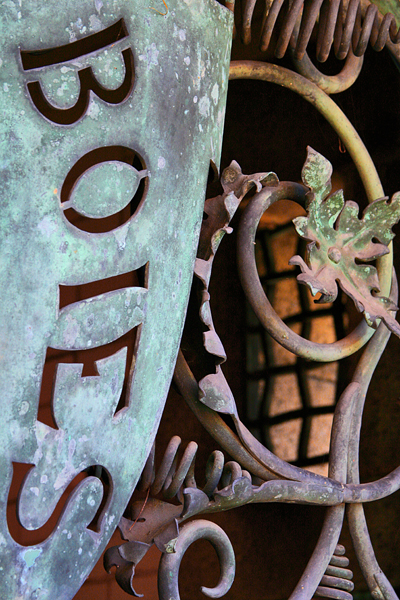
Established in 1828, Dunmore Cemetery offers unique and well-preserved ironwork, headstones, statuary, and mausoleums. Across its hilly 35 acres, you'll see a pyramid, a lovely chapel, ornate crypts, even a zinc memorial thrown in for good measure – all blending art with the preservation of memories. Many memorials are quite unique, e.g. the castle-like crypt of the Boies family - with its filigree metalwork inside the entrance. its every bit as extravagant as anything you'd see in Paris' Pere Lachaise Cemetery.


Boies Mausoleum, Dunmore Cemetery

Julie Esty's book
Many cemetery companies strive to be what the Dunmore Cemetery is − a destination spot for all sorts of activity. It is a wonderfully landscaped and meticulously attended to Victorian-era sculpture garden. As I drove through and walked around on this gorgeous fall day, I was taken by the fact that there were so many other people here on a Friday afternoon! There were walkers, drivers, visitors tending to the graves of their loved ones, groundskeepers, and so on. Just a bevy of activity – in fact, more people than I’ve ever seen in any cemetery anywhere! The place is obviously a source of great community pride. Its office was immaculate, the sole worker very cordial and helpful. I noticed they were selling copies of Julie Esty’s book, Stories in Stone – Tales of Life from the Dunmore Cemetery, so I purchased a copy, figuring I would later ask her to autograph it. (You can purchase your own copy here.)

As cemeteries revitalize and try to earn more money to stay in business, a major thrust is to get more live people to spend time in them. Why would that matter? Well, if you can offer novel and interesting attractions to people (such that they’ll pay money to come to the cemetery), you can generate income from:
  • ·         Historic tours
  • ·         Concerts
  • ·         Beer tastings (!)
  • ·         Special events such as Halloween parties and presentations
But there’s a subtle yet very important reason to attract people to cemeteries, which Julie and Wendy pointed out to me later that evening − the more people who are around, the less likely vandals and thieves will be to damage and steal. As the founder and artistic director of the Dearly Departed Players, Julie Esty has figured out a way to get people into a cemetery (live people, i.e.). Over the course of two Sundays this past October, her two-hour tours of the Dunmore Cemetery drew eight hundred people! She is quite passionate about what her group does in this very popular form of historic preservation (there is actually no fee for the tour).

Photo by Tim Snyder
Early that evening, my brother Tim met me at St. Lukes, where he helped me with the load in and load out. I was given the front room in the church hall − a beautiful space in which to set up my books, photographs, and greeting cards. Inside the hall itself were a half dozen other artists and exhibitors, and a choir performed in the connected church. These people really know how to throw a party! They had a separate room set up with free coffee, cookies, bottles of water, and so on. 

Wendy Belaski, Ed Snyder, and Julie Esty
The whole affair was well attended and the visitors were great fun to talk to. Such a warm welcome! New friends and old stopped by, teens, people who were familiar with my work on Facebook, members of the Scranton Photography Club. People had suggestions to visit various local cemeteries, some discussed photographic techniques and camera gear, others asked me the stories behind certain images in my book as I autographed copies for them.

Stained glass from Dunmore mausoleum
Julie Esty and Wendy Belaski (who specializes in the art of mausoleum stained glass), arrived in Victorian hoop dresses and bonnets, as they were exhibiting pieces of funeral history, including post-mortem photographs, mourning clothing, and other artifacts. They’re as much into dead things as I am, so we hit it off well. I appreciate all the tips on nearby cemeteries to visit (especially the run down and nearly abandoned ones) and will definitely head back to Scranton soon. All in all, it was a fabulous visit, and I thank everyone for their hospitality!

References and Further Listening and Reading:
Hear Julie Esty’s podcast interview on the Dunmore Cemetery (hear what goes into planning a historical cemetery tour!)

Wednesday, October 19, 2011

Cemetery Exploring: Scranton PA and its Environs

It seems I’ll be allowed to go on being Ed Snyder for a while longer. Just got home from having surgery on my inner ear and am waiting for the power headaches to kick in. Pass the Darvocet, please. As I write this, I’m flying higher than angels.

When you go under general anesthesia, you’re never a hundred percent sure you’ll wake up, you know? (That is, unless you checked the appropriate box on the “Advanced Directive” form.) But hey, aren’t these the best conditions under which to write a cemetery blog? I certainly can’t go exploring in a local graveyard– my equilibrium is off and I might fall over a cliff or something. Boneyards around here are like that. Of the literally scores of them in the Philadelphia area, many are not kept up that well. There are the ones with sunken graves, open crypts, tombstones spilling into the river, the ones with dealers and hookers and burned out cars, voodoo offerings and long rusty saws and knives hidden in weeds. As for this last one, I’m not referring to the self-defense weaponry with which I typically arm myself when I explore such places. I’m referring to the giant carving knife I found stuck inside a child’s grave monument (shown above) in an abandoned Philadelphia cemetery. Intertwined with the memorial ’s faded and soggy stuffed animals was a melon vine. So I’m sure some homeless guy was using the knife only for good. The only thing worse than abandoned cemeteries is abandoned people.

Too bad you don’t dream under anesthesia. You have no brain capacity for that − they basically kill you, while keeping you alive. Thanks to Tommy for that comforting thought, and for driving me to the hospital this morn − Whoops – I was listing to port for a moment there, felt a bit of my brains leaking out my ear. Better right myself and prop up with some pillows. There. Any “Distance Reiki” practitioners out there willing to send some positive energy my way?

I need to recuperate well, you see, and not lose any white matter. The Cemetery Traveler will be heading up to Scranton, PA in a few weeks and he needs all his faculties. He also plans to stop talking in the third person, as it gets on his nerves. I was offered a spot at St. Luke’s Church as an exhibitor during Scranton’s First Friday Art Walk for November. I will be showing my photography (prints framed and unframed), greeting cards, and books – all for sale. As it will be in a church, I may need to go easy with my usual tongue-in-cheek banner ads, like “Death Images – Just in Time for Xmas!

I don’t have a lot of work from the Scranton area (even though I grew up around there), but I do intend to show some of the images sprinkled throughout this article from the nearby towns of Wilkes-Barre and associated environs. In fact, my signature image, “Folded Hands” (which you see at the beginning of this article, on my Facebook page, business cards, and the cover of my “Stone Angels” book) was made in the Exeter Cemetery, across the Susquehanna River from Wilkes-Barre. I shot it some years ago around seven o’clock one misty morning, roughly twenty minutes after I left a sleeping woman in bed to zip back to Philadelphia. As I closed her locked front door behind me, I realized I left four pounds of fresh Polish kielbasa in her freezer. Damn!


Slovak Cemetery, Exeter, PA
Occasionally I post images on the Facebook page, “Cemetery Iron,” like this gate from the Exeter cemetery. (“Cintorin” is Slovak for ‘cemetery.’) The wrought iron fencing reminds me that for the next few months, all my food will have a metallic taste. Side-effect of the stapedctomy (ear surgery). My doting wife Jill just allowed me to devour a hot dog, which tasted much like one would expect a piece of cemetery iron to taste, were it served up on a bun. Maybe later, I’ll try a metallic Nutella sandwich.
Oww! Sorry − just tore off an errant ECG electrode they left on my right leg. Funny how when they were monitoring my vital signs, they complimented me on how “normal” I was! Hah! Me! Normal! If only they were to read this blog! Anyway, I’m glad I had the bionic ear installed (my hearing acuity will be so amazing I’ll be able to hear what people are thinking! Imagine that.). A benefit of hearing well is that when I do shows now and meet people face-to-face, I’ll actually be able to hear what you’re saying (instead of faking it, as I’ve been doing.  No that’s not true – I’ve learned to read lips. Again, not true. I can kind of hear, but I do sometimes allow my imagination to fill in the gaps. Much like how I write, since my memory is less than perfect. I’ve had considerable hearing loss since I was twenty years old, when I spent way too much time next to the PA speakers at several KISS concerts. I’ve also come to suspect that my parents may have dropped me on the head as a small child.

So anyway, while in Scranton for the Art Event, I intend to spend some time in the nearby Dunmore Cemetery, as recommended by my Facebook Friend,Wendy Conrad Belaski, who is a member of  The Dearly Departed Players (who give tours of the cemetery while reenacting the personalities buried there).

Angel, Hollenback Cemetery
Another favorite graveyard of mine in the area is the Hollenback Cemetery, which is across the street from the Wilkes-Barre General Hospital (click here for a view of its rather unique entryway). My Dad died there in 2004 (the hospital, not the cemetery). Hollenback is a quaint old hilly Victorian cemetery along the river, which is where I shot this angel. As for the cemetery where my Dad‘s ashes reside, that’s an unassuming little back-mountain graveyard in an area north of Wilkes-Barre that is so “out there” it’s just called the “Back Mountain.” I don’t believe there’s even a town associated with it, just a sand pit.

"Damaged Woman with Dog"
Here’s a photo a little statue near my Dad’s grave. Looks like the woman had some surgery done to her head. Which prompts me to break here and apologize since I, your favorite content provider, seem to be jumping around a bit, ah, content-wise. It’s the drugs. But hey, if it worked for Hunter Thompson (Fear and Loathing in Las Vegas, etc.), should work for me, right? Gee, I wonder if Microsoft Word has a plug-in for correcting dyslexic text? (Try to say that quickly three times! .. or just ONCE, actually…) It’s taking me much longer than usual to type this article since the effector neurons sending impulses from my brain to my fingers seem to be regularly misfiring. Have to keep going back to make corrections. Maybe I’ll lighten up on the next load of painnkilerz.

"Old Man"
You look at pictures like this “Old Man”  (double-exposed and cross-processed Ektachrome) from the Hollenback Cemetery, and you wonder if this guy had anything to live for when he reached the stage in his life when the sculpture was made.  Me, I certainly do have a lot to live for and to be thankful for – a wonderful wife, four lovely children. Oh, and the ability to go on being Ed Snyder for a while longer, until my peep-hole into the world is finally closed, as Kurt Vonnegut would say (or said, rather, as he’s dead). Vonnugut’s work, by the way, is one of the few things you can read when you’re drugged up and loopy, and still have it all make sense! This last image is for him:

Epitaph, Hollenback Cemetery, Wilkes-Barre, Pennsylvania