Showing posts with label mourning arts. Show all posts

Saturday, February 17, 2024

The Sad Hour

Oddly, after twenty years of hanging around in cemeteries, photographing, researching, and writing about them, I have only this past year learned about “the sad hour.” And I have my friend Sarah Amendola of Mockingbird Lane Artistries to thank for it.

Sarah and I have exhibited and sold our cemetery-related art and art objects at various shows and events (both physical and online), like "Market of the Macabre," at Philadelphia's Laurel Hill Cemetery and the "Darksome Art and Craft Market." We've been friends for about ten years. Sarah creates jewelry and objets’ d’art that run toward the dark side.

Sarah (rear) at "Market of the Macabre," Laurel Hill Cemetery, Phila., 2023

Sometime in 2023 I saw her Instagram posts for an object she was casting from a 3D print of a Victorian artifact. It was a clock face of some sort. The “Sad Hour… ?” I’d seen and heard of some obscure Victorian-era mourning artifacts, but this was one of the oddest.

Laurel Hill Cemetery, Phila.
Every once in a while I’ll see a grave stone or marker of some sort with some time-related symbolism, or even actual clock times. The hourglass is classic, but I’ve also seen clock faces and mentions of time, such as on this zinc monument at right. I’d wondered for years why the time of death was something a person would record on their grave marker ….

The coffin plaque in itself is rather interesting. Later in this post, you’ll find links to Sarah’s online business where you will find examples of many such objects from Sarah’s collection. I thought it would be informative to transcribe for you my interview with Sarah, concerning “The Sad Hour,” so you can have a privileged look into her world. 

"The Sad Hour"

The Sad Hour: Hand Painted, Working Clock (link)

What exactly is this object I see on your website, Sarah?

This coffin plaque replica is called The Sad Hour. In Victorian times, death was beautified more than it is today. Very decorative hardware was used on the coffins, postmortem photos were taken, and hair was collected and made into framed art and jewelry for the family to keep as remembrance. The women wore beautiful black dresses and accessories when they were in mourning. 

The Sad Hour clock is a rare coffin plaque that was used to display the deceased’s time of death. Victorians were superstitious; they believed if the clocks weren’t stopped at the time of death, their soul couldn’t pass on, and they would be stuck to haunt the living. 

How and when did you first learn about the "sad hour?"

I have been collecting Victorian era coffin hardware for a handful of years and have a friend that has been collecting and reselling all types of funerary items for over a decade. He was the reason I learned of The Sad Hour.  I have been actively searching for and wanting one to add to my collection ever since. 

Sarah's collection of vintage coffin hardware

I wondered why I had never heard of this. You say it's rare?

It is definitely rare, though I have 3 close friends who each have one in their collections. More common coffin plaques used during that era have inscriptions that read “At Rest,” "Mother," "Father," or “Our Darling” (which was often used for children and babies). 

"At Rest" necklace, made from an original coffin plaque. (link)

So, you’ve scanned and copied one of the originals? Where is the original?

The original Sad Hour that we scanned is owned by my friend Dan Cogliano of Klopek’s (https://www.instagram.com/klopeks_offerings). [Below is a photo of] the original that resides in Dan Cogliano’s personal collection, which is the piece that was 3D scanned by Jason and I. 

Vintage Sad Hour from Dan Cogliano’s personal collection (link).

Can you describe the process you used?

Jason Welsh of First Density Material and I used a custom programmed rig that hooks to a digital SLR to take photos of any object. The object rotates and the camera takes around 155 shots in 3 different camera positions. Software is used to stitch the camera angles into a 3D mesh using matched vector points in the scene. The 3D mesh is then brought into software that allows the mesh to be cleaned up and post processed for 3D Print. (Click here for Instagram Reel showing this process.)

Oversized working clock replica of "The Sad Hour," Special Edition Gold (link)

Sounds unique, super-technical, and historically accurate. If I remember your exhibit at Market of the Macabre in Philadelphia’s Laurel Hill Cemetery, you had a Sad Hour clock on your table that was maybe eight inches high [see photo at beginning]. Was that the size of the original coffin plate?

The original size of the Sad Hour is approximately 5.5 inches tall and 4 inches wide. 

Once Jason and I scanned Dan’s original, we resized the clock to a much larger size so it could be hung on the wall and used as a working clock. The working clock measures approximately 9.75 inches tall and 7 inches wide. 

And what else do you plan to make, based on your scans?

We have scanned a huge portion of my coffin hardware collection. I have been creating and selling this type of jewelry on my website for several years. 

Sample coffin hardware jewelry made by Mockingbird Lane Artistries (link)

Is your version made of metal?

The objects are electroformed, a process that has been around since 1838 which allows an object to be coated with a very thick layer of metal. Unlike electroplating which only allows a thin deposit, electroforming can be deposited as thick as your equipment allows. So 3D prints are made of the replicas with a certain surface thickness removed so that it can be replaced with electroformed copper. Its a reverse molding process that uses the 3D print as the form.

What was the original made of?

The original seems to be made from castable metal with a nickel plating.

How does this item fit in with your other hand-crafted products at Mockingbird Lane Artistries?

A lot of my jewelry is Victorian inspired, so the sad hour jewelry fits in perfectly with the other coffin hardware replica jewelry I have created. 

Sad Hour necklaces from Mockingbird Lane Artistries (link)

Are you planning other 3D projects?

Coffin hardware necklaces
Recently we have been scanning many vintage Halloween objects, such as blow molds and ceramics which will make another unique collection of jewelry. Halloween and Victorian style are two of my favorite things. I also make jewelry from actual, original coffin hardware, as you see here. These are Victorian escutcheon plates for thumbscrews; I also use vintage coffin nails in my jewelry. You can see many examples on my Instagram site (click here to see).

Vintage, original coffin hardware
How can people check out your products?

I do have a website, which is 

https://mockingbirdlaneartistries.com/

I can also be found on Instagram 

https://www.instagram.com/mockingbirdlaneartistries

And Facebook 

https://m.facebook.com/MockingbirdLaneArtistries

This is Jason's website, First Density Material - he offers scanning services for replicating objects in 3D.

Coffin hardware jewelry from Mockingbird Lane Artistries 

Sarah, I greatly appreciate the time you and Jason spent with me creating this blog post. Experiencing the creative process behind your art has been a truly unique experience! 


Sunday, November 20, 2011

Dunmore Cemetery and the Dearly Departed Players


I guess those of us living in the northeastern part of the U.S. get to enjoy a unique aspect of our cemeteries that people in other parts of the country cannot – the rainbow of colors brought on by leaves changing colors in the fall. (I have this ridiculous notion that you can never see Minnesotan cemeteries because the ground is always covered with snow!). If you happen to pair up the fall foliage extravaganza with a truly beautiful cemetery, the result can be breathtaking. I experienced this at the beginning of November at the Dunmore Cemetery in Dunmore, Pennsylvania.

Dunmore is in the northeastern part of PA, an old coal mining region, two miles north of Scranton (made famous on the TV show “The Office”). The reason I was in Scranton was because I was invited to participate as an artist in Scranton’s First Friday Arts Walk. Most cities have them – once a month, galleries change their exhibits, stay open late, and offer free wine and cheese doodles. Sometimes other businesses get involved, hanging artwork, hosting live bands, etc. You see bookstores, restaurants, bars, ever even churches participating. The good people at St. Luke’s Episcopal Church in Scranton were my hosts for the evening. 

Prior to arriving at the church, I spent a few hours photographing in the Dunmore Cemetery, at the recommendation of the two fine people who were responsible for my being invited − Julie Esty and Wendy Belaski, members of the Dunmore Cemetery’s “Dearly Departed Players” theatrical group. This group offers a stone by stone walk though the history of the residents of the cemetery (sponsored by the Lackawana Historical Society).

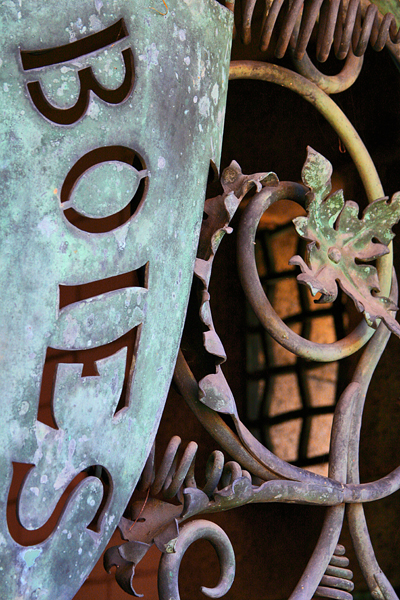
Established in 1828, Dunmore Cemetery offers unique and well-preserved ironwork, headstones, statuary, and mausoleums. Across its hilly 35 acres, you'll see a pyramid, a lovely chapel, ornate crypts, even a zinc memorial thrown in for good measure – all blending art with the preservation of memories. Many memorials are quite unique, e.g. the castle-like crypt of the Boies family - with its filigree metalwork inside the entrance. its every bit as extravagant as anything you'd see in Paris' Pere Lachaise Cemetery.


Boies Mausoleum, Dunmore Cemetery

Julie Esty's book
Many cemetery companies strive to be what the Dunmore Cemetery is − a destination spot for all sorts of activity. It is a wonderfully landscaped and meticulously attended to Victorian-era sculpture garden. As I drove through and walked around on this gorgeous fall day, I was taken by the fact that there were so many other people here on a Friday afternoon! There were walkers, drivers, visitors tending to the graves of their loved ones, groundskeepers, and so on. Just a bevy of activity – in fact, more people than I’ve ever seen in any cemetery anywhere! The place is obviously a source of great community pride. Its office was immaculate, the sole worker very cordial and helpful. I noticed they were selling copies of Julie Esty’s book, Stories in Stone – Tales of Life from the Dunmore Cemetery, so I purchased a copy, figuring I would later ask her to autograph it. (You can purchase your own copy here.)

As cemeteries revitalize and try to earn more money to stay in business, a major thrust is to get more live people to spend time in them. Why would that matter? Well, if you can offer novel and interesting attractions to people (such that they’ll pay money to come to the cemetery), you can generate income from:
  • ·         Historic tours
  • ·         Concerts
  • ·         Beer tastings (!)
  • ·         Special events such as Halloween parties and presentations
But there’s a subtle yet very important reason to attract people to cemeteries, which Julie and Wendy pointed out to me later that evening − the more people who are around, the less likely vandals and thieves will be to damage and steal. As the founder and artistic director of the Dearly Departed Players, Julie Esty has figured out a way to get people into a cemetery (live people, i.e.). Over the course of two Sundays this past October, her two-hour tours of the Dunmore Cemetery drew eight hundred people! She is quite passionate about what her group does in this very popular form of historic preservation (there is actually no fee for the tour).

Photo by Tim Snyder
Early that evening, my brother Tim met me at St. Lukes, where he helped me with the load in and load out. I was given the front room in the church hall − a beautiful space in which to set up my books, photographs, and greeting cards. Inside the hall itself were a half dozen other artists and exhibitors, and a choir performed in the connected church. These people really know how to throw a party! They had a separate room set up with free coffee, cookies, bottles of water, and so on. 

Wendy Belaski, Ed Snyder, and Julie Esty
The whole affair was well attended and the visitors were great fun to talk to. Such a warm welcome! New friends and old stopped by, teens, people who were familiar with my work on Facebook, members of the Scranton Photography Club. People had suggestions to visit various local cemeteries, some discussed photographic techniques and camera gear, others asked me the stories behind certain images in my book as I autographed copies for them.

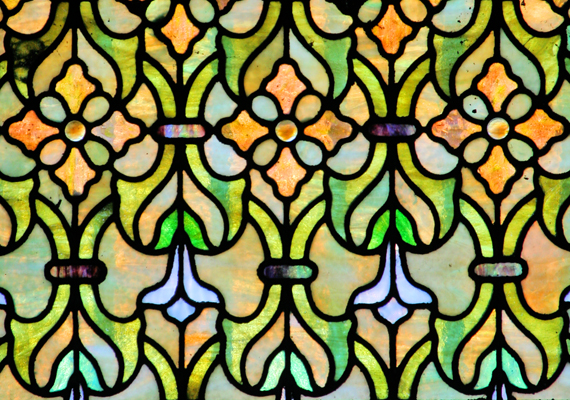
Stained glass from Dunmore mausoleum
Julie Esty and Wendy Belaski (who specializes in the art of mausoleum stained glass), arrived in Victorian hoop dresses and bonnets, as they were exhibiting pieces of funeral history, including post-mortem photographs, mourning clothing, and other artifacts. They’re as much into dead things as I am, so we hit it off well. I appreciate all the tips on nearby cemeteries to visit (especially the run down and nearly abandoned ones) and will definitely head back to Scranton soon. All in all, it was a fabulous visit, and I thank everyone for their hospitality!

References and Further Listening and Reading:
Hear Julie Esty’s podcast interview on the Dunmore Cemetery (hear what goes into planning a historical cemetery tour!)