Thursday, April 7, 2016

Weird N.J. in Smithville!

"The Bishop"
Back in the day (which, I believe, was a Thursday), I had a few photos and stories published in Weird N.J. (i.e., Weird New Jersey). If you don’t know what that is, you’ve been missing out. If you DO know what Weird N.J. is, you’ll be tickled to know that my next public hanging will involve the creators and publishers of that magazine, those books, and the hosts of the (2005) History Channel television series, Weird U.S.! Yes, Mark Moran and Mark Sceurman, the creators and masterminds of all that Weirdness will be in attendance on April 16, 2016, at the annual Smithville (New Jersey) Art Walk! (To visit various Weird N.J. sites, please see links at end.)


Samplings of the Weirdness of Mark Moran and Mark Sceurman

Child's grave in Allegheny Cemetery, Pittsburgh, PA

Yours truly, Ed Snyder, will be there at an art booth with my friend Susan Agiro Spitz, another accomplished artist. We will be exhibiting our very weirdest cemetery photography. There will be books, matted photographs, and lovely greeting cards featuring our original images, all available for purchase. Some may even match your sofa.

A sampling of Susan’s work can be seen on her Susan's Secret Garden Facebook page.

Ed Snyder’s work can be seen on Ed Snyder's StoneAngels Photography Facebook page and on Ed's website, EdSnyderPhoto.com

Reclining Granite Woman, Holy Sepulchre Cemetery in East Orange, N.J.

I’ve never been to Historic Smithville, New Jersey, and I am quite looking forward to the event. My map shows it to be a lucky seven miles north of Atlantic City on Route 9. If you’ve never driven on Route 9, it is a photographer’s paradise of classic Jersey roadside attractions - like miniature houses and two-story milk bottles. And apparently, Smithville is haunted by the undead, if you can believe the paranormal experts (see this NYDaily News article!).

One thing that never seems to die is peoples' interest in death, and as a result, stories about and photos of cemeteries intrigue people. I will have quite a bit of my work there, including some of the images you see here. I chose them because they were all published at one time or another in a Weird N.J. publication. The color photos were made in Allegheny Cemetery in Pittsburgh, Pennsylvania, and were featured (pages 240-1) in the book, Weird Pennsylvania.

The black and white images were made in Holy Sepulchre Cemetery in East Orange, N.J. These were published in the Oct. 2004 issue of Weird N.J. magazine (“Your travel guide to N.J.’s local legends and best kept secrets”). On pages 42-3 you’ll find “The Parkway as Road to the Necropolis?” - a short narrative about my first visit to Holy Sepulchre. The Marks title this recurring section of their magazine “Cemetery Safari.” (This image at right is rather curious. I assume the statues were made in the likenesses of the woman (foreground) and man buried below. Someone once asked me, "Why are there statues of George Washington and Stalin in that cemetery?")

So please stop by the Historic Smithville Art Walk if you're in the neighborhood of Atlantic City on Saturday, April 16 (Rain Date April 17), 2016! Come see the fruits of our cemetery travel - photographs, greeting cards, books, and other death goodies! All for sale! Come and trade cemetery stories! Susan and I would love to meet you!

Smithville Art Walk

Date:
April 16th, 2016 (Rain Date 17th)
Time:  
10 a.m. to 5 p.m. 

References and further Reading:
Historic Smithville (New Jersey) website
What is Weird NJ?

Tuesday, March 29, 2016

Easter Egg Hunt in a Graveyard?

One of many areas decorated for West Laurel Hill Cemetery's Easter egg hunt

So here’s a short blog about an Easter egg hunt in a graveyard. Sounds kind of morbid, I will admit. However, cemeteries are doing anything they can these days to engage the community, to bring people through the gates (live people, that is), with the expectation that perhaps they will garner business at a later date.

West Laurel Hill Cemetery in Bala Cynwyd, Pennsylvania (a suburb of Philadelphia) has been having Easter egg hunts for the past fourteen years, if I heard the announcement correctly at the March 19, 2016 egg hunt.

Indoor activities for 350 kids at West Laurel Hill's Easter Egg Hunt, 2016

Another benefit of public engagement is that you help people accept death, as inevitable as death is. Come to the cemetery with your kids, have a fun time, see the pretty spring blossoms on the trees and flowers. Subconsciously you think, hey, this is not so bad. Not scary at all. Kind of like all the techniques used by childrens’ dentists these days to allay kids’ anxiety and yes, fears.

We fear death. However, Rachel Wolgemuth, in her book, Cemetery Tours and Programming (2016, Rowman and Littlefield), suggests ways to increase a community’s respect for these spaces. She describes “the reuses of both historic and contemporary burial grounds through the lenses of recreation, education, and reflection.” Rachel happens to be a friend of mine and coincidentally, works at West Laurel Hill Cemetery – so she speaks with authority.

Children waiting to dash, just before the tower bell struck eleven o'clock.

Why authority? Because West Laurel has obviously found ways to generate good will toward the community and to help “reimagine what burial grounds can be through the creation of innovative tours and programming.” The first Easter egg hunt I ever attended was here, with my wife and not-quite-two-year-old daughter, in 2011. It was fun, and I wrote about it in this blog (click link to take you there).

I must say that five years later, this event has become something extraordinary. There were about 350 kids this time, and 8,000 eggs! (They had 3,000 eggs in 2011).) The coordination, parking, scheduling, announcements, and pre-hunt activities for kids were much improved from the last time. Greatest improvement? Sections of lawn designated by signage for all the different age groups! This way, the little tykes didn’t get bowled over by the bigger kids and end up with no eggs. EVERYBODY got a bag full of big colorful plastic eggs filled with candy.

Easter Egg Hunt at West Laurel Hill Cemetery

After the hunt, there were prizes drawn for those who registered when they first arrived – golden eggs with a five-dollar-bill inside! There was music over the P.A. system outside and announcements were made to let everyone know what was happening next. But I’m getting ahead of myself here (that’s kind of how exciting it all was).

Daughter Olivia with Easter Bunnies!
The event was well-advertised locally. Registration began at 10 a.m., with TWO costumed (human) Easter Bunnies greeting visitors at the door to the conservatory (a building at the back of the cemetery, near the oldest graves). As you registered, you got to pick out a giant Zitner’s candy Easter egg. (Zitner's donated TONS of Easter candies to West Laurel for this event.) There was someone making balloon animals outside, as well as an artist drawing kids’ caricatures.

Registration for Egg Hunt

If it was too chilly for some outside, a huge room was set up inside for kids to create all kinds of Easter-themed arts and crafts. There were people doing face-painting as well.

Kids having fun at one of the indoor arts and crafts tables

Mausoleum walkway lined with candy!
When eleven o’clock approached, everyone went outside. It was a cool, overcast morning, and the lawns were littered with thousands of colored eggs as well as clear cellophane-wrapped chocolate eggs. I rather liked how they lined the walkway of this mausoleum with candies! The announcement was made that when the bell tower struck eleven o’clock, children were free to run amidst the mausoleums and monuments and collect as many eggs as they could carry in their bags and baskets! My now six-year-old daughter had a wonderful time.

Leaving the cemetery was well-coordinated, with orange traffic cones lining the roads and helpful cemetery employees pointing the way. West Laurel Hill Cemetery is a rather confusing place, but thanks to the dedicated professionals running it, a very welcoming place.

Monday, March 21, 2016

HEY JOE – A Rather Unusual Roadside Memorial

People mourn, grieve, remember, and memorialize the dead in countless ways. I can respect that. Recently, I happened upon a rather unusual rural memorial to the dearly departed. Rural roadside memorials have an advantage over urban memorials in the matter of sheer real estate. In the city, you’re pretty much contained to a telephone pole with a few bouquets of flowers placed around it. Out in the country, you can go large.

Author Ed Snyder (photo by Susan Argiro Spitz)
This week, we visit a memorial gorilla in south Jersey. Not just any gorilla, but a 25-foot high Fiberglas statue of a gorilla. Here's a photo of me (taken by my friend Susan Argiro Spitz) standing in front of the primate, just for size reference - I am six feet, two inches tall. When you see the name, "Mighty Joe," you might think of the King Kong-style giant gorilla, "Mighty Joe Young," star of the silver screen (1949). However, this is a memorial to a different Mighty Joe. The text on the gorilla's sign speaks for itself, a sad reminder of a lost son. I have transcribed the sign's text below.
Hello, 
My name is Mighty Joe
I have been placed here by the Valenzano family as a memorial
And to pay tribute to their son Joseph who now lives in the kingdom of heaven.
Joe was a big part of this family business and he was also a body builder
and won many awards. He was called “MIGHTY JOE” at times by
his family and friends. Joe was not only mighty in his appearance
but also in courage, spirit and love of family.
Joe is truly missed by his family and friends, but not forgotten,
And he is always in their thoughts and prayers.
My job is to look up to heaven from time to time and say
“HEY JOE WE WILL ALWAYS LOVE YOU” and to welcome you to our family business.
God bless you all and thanks for coming to see me.
Mighty Joe


The son may not have been more that eighteen when he died (by the look of the photo at the bottom of the sign) of a brain tumor in 1999. The family, who owns “Mighty Joe’s” gas station, grill, and deli on Route 206 in Shamong, New Jersey, purchased the gorilla from a South Jersey amusement park that closed. According to the good folks at Roadtrippers.com:

"Mighty Joe was previously located in Wildwood, NJ. He was installed at the Islander Raceway and Amusement Park where he was known as George the Gorilla. Today, a sign covers the two holes in his chest that had slides projecting from them."

Larry Valenzano, Mighty Joe's father, purchased the gorilla around 2003, had it restored, and installed it at the family business to serve as a mascot and memorial. Larry had seen the derelict gorilla in the broken down amusement park many times during trips to Wildwood and he said it always reminded him of his bodybuilder son. According to RoadsideAmerica.com:

"My wife thought I was crazy," Larry said. "She told me, 'That guy's not gonna sell you that gorilla. You're out of your mind. What makes you think he would sell that to you?'" But the guy did sell Larry the gorilla, bypassing 15 higher bidders. "'I don't need the money,'" Larry remembered him saying at the time. "'And the reason you want it is more important.'"

Mighty Joe’s actual address, should you want to meet him, is 1231 US Hwy 206, Shamong, New Jersey. Our kind friends at RoadsideAmerica.com give these specific directions: “Mighty Joe's Gas, Grill & Deli. On the west side of US Hwy 206, a little over four miles south of Hwy 70, and about a half-mile south of Tuckerton Rd."

The giant gorilla just appears out of nowhere as you're flying south on 206 through the Jersey Pine Barrens. Like so many of New Jersey’s roadside attractions, all of a sudden its just THERE! – and its up to you to decide whether you want to hit the brakes and investigate!

Thursday, March 10, 2016

Headstones – My Favorite Non-paved Surfaces

The weather mavens said on the radio the other day that snow was being forecast for the following morning, with a one to two-inch accumulation expected on non-paved surfaces. It continues to baffle me how the snow itself can actually discern a paved surface (roadway, parking lot, etc.) from a non-paved surface, and adjust its accumulation characteristics accordingly. One of MY favorite non-paved surfaces, by the way, happens to be grave markers.

Conditions were perfect on the morning in question – lightly snowing, about half an inch of heavy, wet snow covering my car, 39 degrees, no wind. With any luck, the monuments and tombstones at Philadelphia’s Laurel Hill Cemetery were also lightly covered, and would stay that way for a while. Being two weeks before Easter, this was probably the last snow of winter. I wanted to take advantage of it and make some photographs to post on my ”Cemeteries in the Snow” Facebook group page.

My friend Frank, who works at Laurel Hill, called me saying “It’s a winter wonderland up here!” This confirmed my suspicions that I was making a worthwhile run. The cemetery is about eight miles from where I live, and takes about forty minutes to drive there.

I arrived at the cemetery about 9:30 a.m., and shot for about two hours. The paved surfaces – the roadways – were clear of snow, which is key to me getting good photographs. My Saab convertible is about as effective in snow as a hoverboard. Someday I’ll get an SUV so I can plow through the snow and get all those great photos I’ve been missing.


What kind of photographs can you get in graveyards in the snow that you can't get when there is no snow? For one thing, snow allows you to create temporary graffiti on headstones (do clean them off after you are done so as not to irk other visitors).

Snow also adds contrast to the degree that it forces your eye in directions it may not have taken without the snow. For example, as many times as I’ve been to Laurel Hill Cemetery, I had never noticed this moth carving. I’ve only ever seen the moth on rare occasions on cemetery statuary. Consider this interesting passage from the Recoleta Cemetery (Buenos Aires) website:


"Moths are perfect symbols for cemeteries… Just think about it. As a caterpillar wraps itself in a cocoon, it appears to be dead. But after metamorphosis takes place, it is reborn as a winged creature that is attracted to light. The life cycle of a moth is therefore a wonderful allegory for a loved one who passes away, is transformed & later reborn… heading to the light."

"Heading to the light" - I like that description.You typically only see moths at twilight, flitting around a light of some sort. Death - in Western cultures - is typically seen as a nighttime thing, after which we eventually hope to see the heavenly light. Below is another depiction of spiritual release - the soul of the departed with wings, leaving the coffin and floating heavenward.

My buddy Frank, who had been busy working all morning, phoned me in the early afternoon to see if I had been there. When I told him I had been there and gone, he said, “You’re lucky you came early, there’s nothing left on any of the statues!” It had warmed up and most of the snow had melted away. Not all my photographic endeavors have been this successful!

Temporary graffiti, and a comment on mortality

Zinc monument, Laurel Hill Cemetery
Photographically, I made images that day with an assortment of cameras. For this blog post, I purposely used only those I made with my Apple iPhone 6. I get slightly different perspectives with the camera phone (phone camera?). The image at right came out rather well - a very unusual zinc (or "white bronze" - see my previous blog post about this) grave marker. This is about eight feet high and is inscribed on all four sides with information about the husband and wife who are buried beneath it. The snow makes the metal stand out more than it would against a grassy background.  

I posted several of the iPhone photographs I made during my visit on Instagram, having just opened one of these photo-based social media accounts. (Find me, Ed Snyder, as "mourningarts" on Instagram: https://www.instagram.com/mourningarts/)

As a photographer, it’s good to have destination sites in mind for when the weather decides to cooperate with your artistic tendencies. It's also good to be familiar with the site. It gives you the opportunity to use clever captions like this one for your photos:

March certainly came in like a lion this year!

If I had a handy cemetery lamb photo I would post that here. However, I don't, so that’s probably a wrap for my snowy cemetery excursions this year. Here in Philadelphia, we probably won't get any more snow on my favorite non-paved surfaces until next winter. Time to adjust my photographic endeavors accordingly. Next up - spring! Make hay while the sun shines, as they say!

Friday, March 4, 2016

The Reverend George Duffield

If you walk or drive around the Society Hill section of Philadelphia, you may have recently noticed something odd in the graveyard of the Old Pine Street Church. The church entrance is on Pine, and the graveyard surrounds this monstrous yellow church building on three sides. On the west side of the church, you can see an unusual object towering above the old iron fence along Pine Street. At first glance, it appears to be a black and tan statue on a pedestal.

Old Pine Street Church, Philadelphia

If you look at it from either side, you see a man’s face at the top. His back, or rather, his black cloak, faces Pine Street, so you can’t clearly see the object unless you are in the graveyard. I, for one, welcome any opportunity to enter a graveyard.


Originally, Old Pine Street Church, founded in 1764, was known as the Third Presbyterian Church of Philadelphia and has come to be known as the “church of the patriots.” John Adams was one of the many members of the parish who loyally stood with George Washington during this tense, pre-Revolutionary War period in American history. The church’s pastor at the time, Reverend George Duffield, preached the “no taxation without representation” motto to his congregation – one of the rallying cries of the thirteen colonies. (Separation of church and state, by the way, is not actually addressed in the United States Constitution, as is popularly believed.) Because of his inflammatory patriotic tendencies, King George III offered 50 British pounds for Duffield, dead or alive.

Reverend George Duffield
Defying British arrest, Duffield served as chaplain to the First Continental Congress in 1774 and, with many of his parishioners, joined Washington at Valley Forge in the winter of 1776-77. He served as pastor of the church from 1772 until his death in 1790” (ref). That’s him you see carved from a hundred-year-old Norway maple along the fence in the church’s graveyard. Kind of ironic that he is sculpted making a peace sign with his left hand.

13-star U.S. flags wave by the hundreds
From his sculpted stance against Pine Street, Duffield seems to be addressing his parishioners, the inhabitants of this old graveyard. And it is old - quite old. This historic colonial churchyard contains burials of about 3,000 late 18th and early 19th century Philadelphians. The graveyard is home to the remains of a signer of the U.S. Constitution, 285 Revolutionary War soldiers, and the first ringer of the Liberty Bell. For the most part, burials ceased in 1830.

Why is the Rev. George Duffield statue here?

During 2015, I had noticed the slow transition from tree to patriot, but I had no idea what the final product was to be. For many years prior, I noticed that the big tree on the west side of the church yard was pushing on the black iron fence and bowing the old stone wall. At some point, it looked as though the tree might fall onto Pine Street and destroy the wall, fence, and sidewalk. A minor disaster, this would have been, especially if the church were to lose the beautiful cast and wrought iron fence, which dates back to 1835. The fence is now off level and bowed, however, as you can see from the photo above.
Detail of fence of Old Pine Street Church

Around the summer of 2015 I noticed the tree had been cut down - except for it's tall trunk. As the months went by, I noticed changes to that trunk (I live in the area, so I see it quite often). First off, it appeared to be burnt, charred! Then, no, it had been painted black! I finally stopped in the fall of 2015 when I realized that it had been carved into the likeness of a person. Recently I stopped by to investigate further.

Placard on fence of Old Pine Street Church

The church had commissioned sculptor Roger Wing to carve a larger-than-life-sized statue of a bible-toting Rev. George Duffield out of the Norway maple tree trunk! He wears the vehement expression you would expect of a Revolutionary-era patriot engaging his congregation, inciting them to revolt against the King of England. The description of his oratory prowess in this Philly.com article is interesting:

"Though Duffield is buried within the church rather than in the churchyard, his likeness in battlefield pose is fitting. On those grounds are interred 285 veterans of the Revolutionary War, men who likely heard Duffield's fiery battlefield sermons in person." - In Society Hill, a Revolutionary War minister emerges from a stump

Roger Wing's masterful carving of Duffield
In the same article, sculptor Roger Wing's work on this project is described in fascinating detail. When I read that he also sculpts ice, I realized he was the fellow I met at the beginning of February, 2016, creating ice sculptures at an art benefit. Turns out, Roger Wing and I are both members of InLiquid, a non-profit art and design organization based in Philadelphia. At InLiquid's 16th annual Benefit Auction in February, Roger was sculpting ice with a chainsaw in front of the Crane Arts Building (Fishtown section of Philadelphia). My six-year old daughter and I watched him work in rapt fascination.

The Duffield maple tree likely has its roots entangled in the iron fence and wall of the churchyard, so it probably would have been impossible to remove the tree without destroying the fence. In a sense, the Reverend George Duffield continues to support his church, physically, 200 years after his death! The statue is a very fitting memorial to Duffield, and our patriotic, forefathers in general. The statue was dedicated on November 18, 2016. Stop by and see this memorial to our nation's birth - to liberty - on Pine Street in Philadelphia, midway between Fourth and Fifth Streets.

Thursday, February 25, 2016

Slaughter House

About twenty-five years ago (say, the mid-1990s), my ex-brother-in-law (I was married to his sister at the time) told me kind of a chilling story. Although it has nothing to do with cemeteries, I thought I’d share it with you anyway, since it is about death. I thought of it the other day as I was browsing the bourbon section at my local liquor emporium. I don’t recall ever seeing this brand, “Slaughter House” American whiskey, but when I saw the label, I immediately recalled the story he told me.

So my brother-in-law was working for a roofing company in northeast Pennsylvania at the time and his crew had a job installing a new roof on a warehouse out in the boondocks. Off and on throughout the day, strange noises would filter through the trees.

At lunch time, when all the hammering and generators stopped, the noises became more apparent. At the end of the day as the crew was packing up, the job foreman said, "Crazy sounds coming from that slaughterhouse back there in the woods, huh?"

But that's not the end of the story! My brother-in-law, who was a musician (played electric guitar in a band at the time) said to me, "I'm seriously thinking about sneaking back into the woods there with a tape recorder and recording those sounds, then using them as an ambient background track for a song."

I never heard the sounds myself, but he described them as "animal-like." I don’t know if he ever made the recording

As an aside, when I was working on this post, I mistakenly left the leading "S" off the title (blame the "cut and paste" function - I always do), so it read "laughter House." Amazing how one letter can make all the difference! I made the photo above, by the way, at the Point Pleasant, New Jersey, boardwalk amusement park. We will assume no slaughtering occurred inside ...

Saturday, February 20, 2016

Architectural Cemetery Treasure In Danger of Collapse

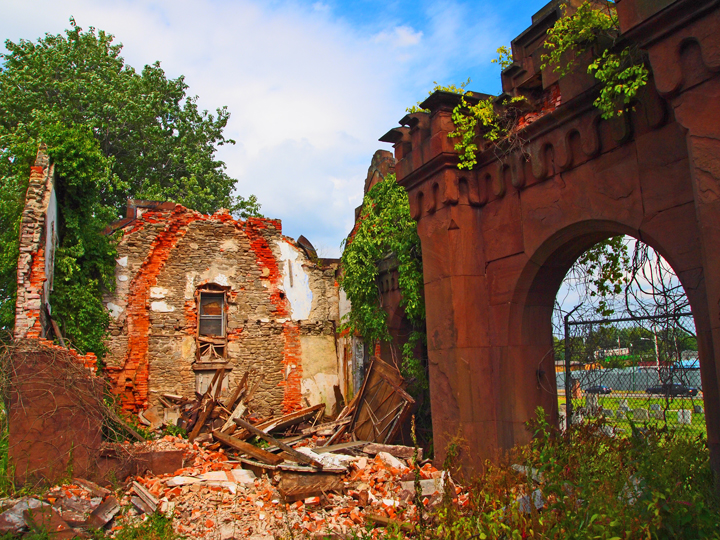
The Friends of Mount Moriah Cemetery, Inc. (FOMMCI) in Philadelphia currently has a “Go Fund Me” page up on the Internet. The goal is to raise $10,500 to stabilize the façade of the historic 1855 gatehouse facing Kingsessing Avenue at Cemetery Avenue

The page was posted on February 15, 2016, and by Saturday, February 20, $11,630 was raised! At that point, 157 people had donated. Here is the link to the page, which is headed by my February 2016 photograph of the gatehouse (the one in the snow, shown above):

Mount Moriah Cemetery gatehouse, Philadelphia, c. 1855.

I spread the call on February 15, all over my own social media sites and those of all my cemetery-lover friends. People on the FOMMCI Facebookpage shared the invitation multiple times. The result is an unqualified success!

Rather than reiterate the purpose of the fundraising program, I will quote the FOMMCI Go Fund Me page. I have included more of my gatehouse photos throughout. Please consider donating to this worthy cause – we greatly appreciate your help!


Architectural Treasure In Danger of Collapse


Historic brownstone Gatehouse designed by Stephen Decatur Button, the architectural designer of the Gettysburg Gatehouse is in imminent danger of collapse. This iconic structure built in 1855 was the grand entryway to the 200 acre Mount Moriah Cemetery located in Pennsylvania's Philadelphia and Delaware Counties. The cemetery was privately owned but it was abandoned in 2011. The Friends of Mount Moriah Cemetery, a nonprofit grassroots organization of determined volunteers immediately stepped in to honor those who are buried in the cemetery's hallowed ground, including over 5,000 veterans.

Inside of gatehouse, showing collapsed internal building (Sept. 2014)

Our goal is to stabilize the facade of the brownstone so that a columbarium for cremains can be built behind it in the future. It will cost $35,000 to stabilize this magnificent structure and we now have $24,500 from a grant and donations. We need $10,500 to keep this treasure from becoming a pile of rubble. We need your help!

Author leading tour in front of gatehouse, 2013.

If our fundraising goal is exceeded, donations will be used for additional Mount Moriah Cemetery capital improvements. Your donation is tax deductible. To learn more about the Mount Moriah Cemetery and the work of the Friends of Mount Moriah Cemetery, visit our website.