Thursday, March 10, 2016

Headstones – My Favorite Non-paved Surfaces

The weather mavens said on the radio the other day that snow was being forecast for the following morning, with a one to two-inch accumulation expected on non-paved surfaces. It continues to baffle me how the snow itself can actually discern a paved surface (roadway, parking lot, etc.) from a non-paved surface, and adjust its accumulation characteristics accordingly. One of MY favorite non-paved surfaces, by the way, happens to be grave markers.

Conditions were perfect on the morning in question – lightly snowing, about half an inch of heavy, wet snow covering my car, 39 degrees, no wind. With any luck, the monuments and tombstones at Philadelphia’s Laurel Hill Cemetery were also lightly covered, and would stay that way for a while. Being two weeks before Easter, this was probably the last snow of winter. I wanted to take advantage of it and make some photographs to post on my ”Cemeteries in the Snow” Facebook group page.

My friend Frank, who works at Laurel Hill, called me saying “It’s a winter wonderland up here!” This confirmed my suspicions that I was making a worthwhile run. The cemetery is about eight miles from where I live, and takes about forty minutes to drive there.

I arrived at the cemetery about 9:30 a.m., and shot for about two hours. The paved surfaces – the roadways – were clear of snow, which is key to me getting good photographs. My Saab convertible is about as effective in snow as a hoverboard. Someday I’ll get an SUV so I can plow through the snow and get all those great photos I’ve been missing.


What kind of photographs can you get in graveyards in the snow that you can't get when there is no snow? For one thing, snow allows you to create temporary graffiti on headstones (do clean them off after you are done so as not to irk other visitors).

Snow also adds contrast to the degree that it forces your eye in directions it may not have taken without the snow. For example, as many times as I’ve been to Laurel Hill Cemetery, I had never noticed this moth carving. I’ve only ever seen the moth on rare occasions on cemetery statuary. Consider this interesting passage from the Recoleta Cemetery (Buenos Aires) website:


"Moths are perfect symbols for cemeteries… Just think about it. As a caterpillar wraps itself in a cocoon, it appears to be dead. But after metamorphosis takes place, it is reborn as a winged creature that is attracted to light. The life cycle of a moth is therefore a wonderful allegory for a loved one who passes away, is transformed & later reborn… heading to the light."

"Heading to the light" - I like that description.You typically only see moths at twilight, flitting around a light of some sort. Death - in Western cultures - is typically seen as a nighttime thing, after which we eventually hope to see the heavenly light. Below is another depiction of spiritual release - the soul of the departed with wings, leaving the coffin and floating heavenward.

My buddy Frank, who had been busy working all morning, phoned me in the early afternoon to see if I had been there. When I told him I had been there and gone, he said, “You’re lucky you came early, there’s nothing left on any of the statues!” It had warmed up and most of the snow had melted away. Not all my photographic endeavors have been this successful!

Temporary graffiti, and a comment on mortality

Zinc monument, Laurel Hill Cemetery
Photographically, I made images that day with an assortment of cameras. For this blog post, I purposely used only those I made with my Apple iPhone 6. I get slightly different perspectives with the camera phone (phone camera?). The image at right came out rather well - a very unusual zinc (or "white bronze" - see my previous blog post about this) grave marker. This is about eight feet high and is inscribed on all four sides with information about the husband and wife who are buried beneath it. The snow makes the metal stand out more than it would against a grassy background.  

I posted several of the iPhone photographs I made during my visit on Instagram, having just opened one of these photo-based social media accounts. (Find me, Ed Snyder, as "mourningarts" on Instagram: https://www.instagram.com/mourningarts/)

As a photographer, it’s good to have destination sites in mind for when the weather decides to cooperate with your artistic tendencies. It's also good to be familiar with the site. It gives you the opportunity to use clever captions like this one for your photos:

March certainly came in like a lion this year!

If I had a handy cemetery lamb photo I would post that here. However, I don't, so that’s probably a wrap for my snowy cemetery excursions this year. Here in Philadelphia, we probably won't get any more snow on my favorite non-paved surfaces until next winter. Time to adjust my photographic endeavors accordingly. Next up - spring! Make hay while the sun shines, as they say!

Friday, March 4, 2016

The Reverend George Duffield

If you walk or drive around the Society Hill section of Philadelphia, you may have recently noticed something odd in the graveyard of the Old Pine Street Church. The church entrance is on Pine, and the graveyard surrounds this monstrous yellow church building on three sides. On the west side of the church, you can see an unusual object towering above the old iron fence along Pine Street. At first glance, it appears to be a black and tan statue on a pedestal.

Old Pine Street Church, Philadelphia

If you look at it from either side, you see a man’s face at the top. His back, or rather, his black cloak, faces Pine Street, so you can’t clearly see the object unless you are in the graveyard. I, for one, welcome any opportunity to enter a graveyard.


Originally, Old Pine Street Church, founded in 1764, was known as the Third Presbyterian Church of Philadelphia and has come to be known as the “church of the patriots.” John Adams was one of the many members of the parish who loyally stood with George Washington during this tense, pre-Revolutionary War period in American history. The church’s pastor at the time, Reverend George Duffield, preached the “no taxation without representation” motto to his congregation – one of the rallying cries of the thirteen colonies. (Separation of church and state, by the way, is not actually addressed in the United States Constitution, as is popularly believed.) Because of his inflammatory patriotic tendencies, King George III offered 50 British pounds for Duffield, dead or alive.

Reverend George Duffield
Defying British arrest, Duffield served as chaplain to the First Continental Congress in 1774 and, with many of his parishioners, joined Washington at Valley Forge in the winter of 1776-77. He served as pastor of the church from 1772 until his death in 1790” (ref). That’s him you see carved from a hundred-year-old Norway maple along the fence in the church’s graveyard. Kind of ironic that he is sculpted making a peace sign with his left hand.

13-star U.S. flags wave by the hundreds
From his sculpted stance against Pine Street, Duffield seems to be addressing his parishioners, the inhabitants of this old graveyard. And it is old - quite old. This historic colonial churchyard contains burials of about 3,000 late 18th and early 19th century Philadelphians. The graveyard is home to the remains of a signer of the U.S. Constitution, 285 Revolutionary War soldiers, and the first ringer of the Liberty Bell. For the most part, burials ceased in 1830.

Why is the Rev. George Duffield statue here?

During 2015, I had noticed the slow transition from tree to patriot, but I had no idea what the final product was to be. For many years prior, I noticed that the big tree on the west side of the church yard was pushing on the black iron fence and bowing the old stone wall. At some point, it looked as though the tree might fall onto Pine Street and destroy the wall, fence, and sidewalk. A minor disaster, this would have been, especially if the church were to lose the beautiful cast and wrought iron fence, which dates back to 1835. The fence is now off level and bowed, however, as you can see from the photo above.
Detail of fence of Old Pine Street Church

Around the summer of 2015 I noticed the tree had been cut down - except for it's tall trunk. As the months went by, I noticed changes to that trunk (I live in the area, so I see it quite often). First off, it appeared to be burnt, charred! Then, no, it had been painted black! I finally stopped in the fall of 2015 when I realized that it had been carved into the likeness of a person. Recently I stopped by to investigate further.

Placard on fence of Old Pine Street Church

The church had commissioned sculptor Roger Wing to carve a larger-than-life-sized statue of a bible-toting Rev. George Duffield out of the Norway maple tree trunk! He wears the vehement expression you would expect of a Revolutionary-era patriot engaging his congregation, inciting them to revolt against the King of England. The description of his oratory prowess in this Philly.com article is interesting:

"Though Duffield is buried within the church rather than in the churchyard, his likeness in battlefield pose is fitting. On those grounds are interred 285 veterans of the Revolutionary War, men who likely heard Duffield's fiery battlefield sermons in person." - In Society Hill, a Revolutionary War minister emerges from a stump

Roger Wing's masterful carving of Duffield
In the same article, sculptor Roger Wing's work on this project is described in fascinating detail. When I read that he also sculpts ice, I realized he was the fellow I met at the beginning of February, 2016, creating ice sculptures at an art benefit. Turns out, Roger Wing and I are both members of InLiquid, a non-profit art and design organization based in Philadelphia. At InLiquid's 16th annual Benefit Auction in February, Roger was sculpting ice with a chainsaw in front of the Crane Arts Building (Fishtown section of Philadelphia). My six-year old daughter and I watched him work in rapt fascination.

The Duffield maple tree likely has its roots entangled in the iron fence and wall of the churchyard, so it probably would have been impossible to remove the tree without destroying the fence. In a sense, the Reverend George Duffield continues to support his church, physically, 200 years after his death! The statue is a very fitting memorial to Duffield, and our patriotic, forefathers in general. The statue was dedicated on November 18, 2016. Stop by and see this memorial to our nation's birth - to liberty - on Pine Street in Philadelphia, midway between Fourth and Fifth Streets.

Thursday, February 25, 2016

Slaughter House

About twenty-five years ago (say, the mid-1990s), my ex-brother-in-law (I was married to his sister at the time) told me kind of a chilling story. Although it has nothing to do with cemeteries, I thought I’d share it with you anyway, since it is about death. I thought of it the other day as I was browsing the bourbon section at my local liquor emporium. I don’t recall ever seeing this brand, “Slaughter House” American whiskey, but when I saw the label, I immediately recalled the story he told me.

So my brother-in-law was working for a roofing company in northeast Pennsylvania at the time and his crew had a job installing a new roof on a warehouse out in the boondocks. Off and on throughout the day, strange noises would filter through the trees.

At lunch time, when all the hammering and generators stopped, the noises became more apparent. At the end of the day as the crew was packing up, the job foreman said, "Crazy sounds coming from that slaughterhouse back there in the woods, huh?"

But that's not the end of the story! My brother-in-law, who was a musician (played electric guitar in a band at the time) said to me, "I'm seriously thinking about sneaking back into the woods there with a tape recorder and recording those sounds, then using them as an ambient background track for a song."

I never heard the sounds myself, but he described them as "animal-like." I don’t know if he ever made the recording

As an aside, when I was working on this post, I mistakenly left the leading "S" off the title (blame the "cut and paste" function - I always do), so it read "laughter House." Amazing how one letter can make all the difference! I made the photo above, by the way, at the Point Pleasant, New Jersey, boardwalk amusement park. We will assume no slaughtering occurred inside ...

Saturday, February 20, 2016

Architectural Cemetery Treasure In Danger of Collapse

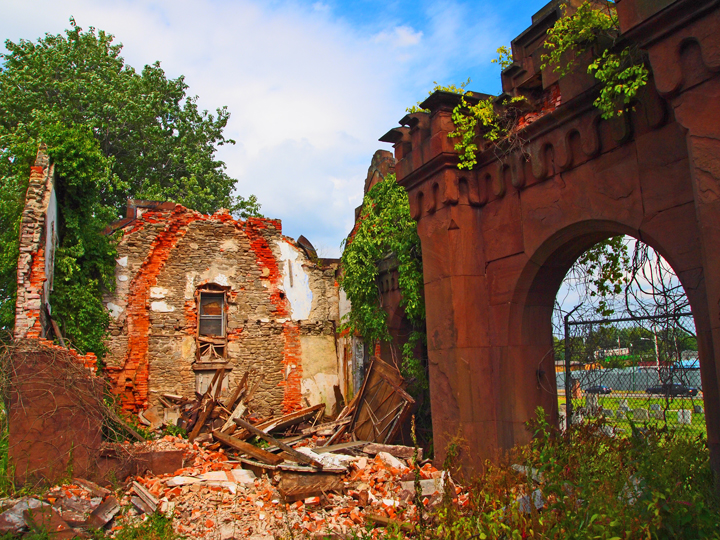
The Friends of Mount Moriah Cemetery, Inc. (FOMMCI) in Philadelphia currently has a “Go Fund Me” page up on the Internet. The goal is to raise $10,500 to stabilize the façade of the historic 1855 gatehouse facing Kingsessing Avenue at Cemetery Avenue

The page was posted on February 15, 2016, and by Saturday, February 20, $11,630 was raised! At that point, 157 people had donated. Here is the link to the page, which is headed by my February 2016 photograph of the gatehouse (the one in the snow, shown above):

Mount Moriah Cemetery gatehouse, Philadelphia, c. 1855.

I spread the call on February 15, all over my own social media sites and those of all my cemetery-lover friends. People on the FOMMCI Facebookpage shared the invitation multiple times. The result is an unqualified success!

Rather than reiterate the purpose of the fundraising program, I will quote the FOMMCI Go Fund Me page. I have included more of my gatehouse photos throughout. Please consider donating to this worthy cause – we greatly appreciate your help!


Architectural Treasure In Danger of Collapse


Historic brownstone Gatehouse designed by Stephen Decatur Button, the architectural designer of the Gettysburg Gatehouse is in imminent danger of collapse. This iconic structure built in 1855 was the grand entryway to the 200 acre Mount Moriah Cemetery located in Pennsylvania's Philadelphia and Delaware Counties. The cemetery was privately owned but it was abandoned in 2011. The Friends of Mount Moriah Cemetery, a nonprofit grassroots organization of determined volunteers immediately stepped in to honor those who are buried in the cemetery's hallowed ground, including over 5,000 veterans.

Inside of gatehouse, showing collapsed internal building (Sept. 2014)

Our goal is to stabilize the facade of the brownstone so that a columbarium for cremains can be built behind it in the future. It will cost $35,000 to stabilize this magnificent structure and we now have $24,500 from a grant and donations. We need $10,500 to keep this treasure from becoming a pile of rubble. We need your help!

Author leading tour in front of gatehouse, 2013.

If our fundraising goal is exceeded, donations will be used for additional Mount Moriah Cemetery capital improvements. Your donation is tax deductible. To learn more about the Mount Moriah Cemetery and the work of the Friends of Mount Moriah Cemetery, visit our website.

Sunday, February 14, 2016

Roadkill Photography - A Manifesto

"Noah"  03/19/2005 - Center Point, PA

I purchased this photograph (above) from Joy Hunsberger’s display at the Philly Punk Rock Flea Market in December, 2015. Why, you may ask. I can’t tell you, because I don’t always understand my motivations. I suppose I purchased it to make an emotional and artistic connection to someone who ALSO photographs dead animals. There, the truth is out – I photograph dead animals. Have been, off and on, for ten or more years. And I don’t know why.

Joy’s rationale for photographing dead animals – roadkill, specifically – was conveniently included in the clear plastic envelope behind this beautiful 12x18 inch color photograph of the dead bunny. I was totally intrigued by this “ROADKILL MANIFESTO,” which describes her thought process over the course of “a decade of documenting roadkill.” Throughout this article, I have included some of the animal images from her website. I’m also going to use her manifesto as sort of an outline for this article.

After reading Joy’s manifesto and later interviewing her, I may be a bit closer to understanding my own motivations. (It took me ten years, by the way, to be able to answer the question of why I make photographs in cemeteries. The reason? To get closer to death, to come to terms with my own mortality and to soften the blow when loved ones die – I think.) So what is Joy’s motivation? Get closer to death? Become more in tune with her mortality? No she says, she’s always had a clear understanding of that. She photographs dead animals as a way of defining her - and their - place in nature. She sees animals as her relatives - our relatives – beings that deserve our respect. Perhaps one reason she feels so grounded in this idea is because she views animals as very clearly part of our extended family. The fact that she personally has very few blood relatives may have influenced her thought process.  


(Bold Quotes are from Joy Hunsberger’s ROADKILL MANIFESTO:)

“A lot of people don't understand my art. They think I'm trying to shock people, or that I'm romanticizing death or dark ideals. None of these is the case. My work is actually a very deep, ancient conversation. My obsession with taking pictures of roadkill is rather complex.

In its simplest form, it is a deeply spiritual ritual that pays homage to our four-legged ancestors, a practice in compassion, and also a raw energetic connection to the natural world. It also assumes a more complex vantage point as a critical dissection of our/my place in the current world, and an apology for our/my disruptive influence upon it.”

"Melanie" 02/10/2006 - Worcester, PA
Many people would rather not look at images of dead animals, but I, for one, am strangely compelled to observe roadkill. I am also compelled to photograph it ... them?  I never really thought about why this is. Joy has conjectured that people are turned off by these visual reminders of death for a number of reasons. For one, it is because it reminds us of our own mortality. In addition, I believe, because it also makes us feel guilty for killing them.

Does Joy go out looking for roadkill? No, she says, she always just happens on it. Such occurrences are fairly common in the suburbs, she states. Based on my own experiences, it is not an altogether safe practice to be running out into traffic to photograph a dead raccoon or deer. Again, I don’t fully understand why I do it. Maybe this could be part of the reason:

“Hovering over these precious vessels that once held life, shining a light in the dark, I have slowly been transforming my camera into a shamanic tool all these years. In many ways, my work creates opportunities for transformation for both the deceased and also for the viewer, and raises further questions about the separation and integration of art, life cycles, and spirituality, from one another. All of life is a delicate balance, with our time in this realm balanced by our passing from it.

As a society, we fear death because we do not fully understand it, but even more so because we cannot control it. This is an imbalanced view. Current societal ideals state that we must control as much as possible, shunning any symbiotic relationship with nature, any ideas of impermanence, and anything that is not immediately gratifying to the ego, in favor of the illusion of security, born from control. This upsets the balance of life.”

The preceding paragraph may sound familiar, if you read my January 3, 2016 blog post, “The Death Salon.” What Joy writes is in accord with what Caitlin Doughty, founder of Death Salon and The Order of the Good Death tells people. “The Order of the Good Death is a group of funeral industry professionals, academics, and artists exploring ways to prepare a death phobic culture for their inevitable mortality … [it] is about making death a part of your life… accepting that death itself is natural, but the death anxiety and terror of modern culture are not.- (http://www.orderofthegooddeath.com/about)


“In truth, anything that we cannot control becomes almost morally unacceptable, eventually becoming intolerable. In our casual conversations, we tend to shy away from any prolonged observation of our mortality, as it is considered distasteful, vulgar, and sometimes dangerous. The topic of mortality is generally considered to be uncomfortable in the current culture as a whole, and as such, is even sometimes used as a means to steer public opinion.”

From the Death Salon website:  Death is sanitized and hidden in contemporary culture to the point of becoming a taboo subject. We aim to subvert this death denial by opening up conversations with the public about death and its anthropological, historical, and artistic contributions to culture” (http://deathsalon.org/). This makes me think of how popular the Mexican Day of the Dead has become in non-Mexican culture. Do all these people appreciate the meaning behind Día de Muertos or is it just a good excuse for a party while wearing skull-design fashions?

Joy thought it ironic that the punk rock girls at the Philly Punk Rock Flea Market with all their skull-and-crossbones clothing appeared rather squeamish and shied away from her large photographic display of death. Reactions to her work vary. She came across a customer in a bar once where she was one of several artists who had their work set up to sell. The person - a fine arts painter - was drawn to her work but did not understand why. He told her, “I can’t stop looking at your work, it will haunt me if I don’t buy it.” Finally, he had to make the decision with the money that remained in his pocket – buy that last drink or buy one of Joy’s photographs. He opted for the latter, stating that he did not understand why, but he had to own it. I may have a clue as to why he felt that way.

Something I’ve noticed in doing research to help people find their ancestors’ graves at (the formerly abandoned) Mount Moriah Cemetery in Philadelphia, is that many people need a tangible link to their past. They need to feel a greater connection to their human family. Might this be part of the reason people are drawn to Joy’s photographs? A subconscious kindred association with these animals? A need to include them as part of a larger family?

"Paul"  05/26/2007 - Souderton, PA
If the images in this article speak to you in some way, and you need to have a deeper association with them, please visit Joy Hunsberger’s website to view many more examples. You may see something that speaks to you, something that urges you to have a deeper conversation with yourself about man’s place in the “hierarchy” of the animal kingdom. All 12 x 18 inch color photographs are available for purchase by contacting Joy at joy@joyh.com


When I first walked up to Joy’s large exhibit and realized what the subject matter was, I immediately wondered about people’s reactions to her images. People react to my own cemetery photography in certain ways, but my work is more about abstract death - Joy’s is graphic and real. Observers may behave one way, yet cannot, or will not allow themselves to verbalize (or even understand) what it is that deep down really bothers them about her roadkill photographs.

“In the end, people seem to be afraid to think of their bodies as merely temporary arrangements of atoms which house an eternal life-force. They are attached to their limited, constructed ways of thinking, and any change scares them. For this reason, my work is often not well-received.”

I wonder if people are better able to accept the death of an animal if it appears peaceful, versus one that has suffered a tragic, blood-spattered demise? I wonder if the people that react most violently to Joy’s work are those steeped in the denial of their own mortality? I wonder if they’re the kind of people who buy way more books than they could ever possibly read due to the subconscious belief that if there are books to be read, their lives will be extended to allow that to occur.

What are Joy Hunsberger’s own reactions to seeing dead animals in person? She told me that she does not know why she started making such photographs, but she has learned to appreciate the beauty of these animals from her close vantage point. For instance, she was astounded by the sheer size of a roadkilled elk hit by a tractor trailer. “Four people could have sat on its back, each of it’s hooves was a big as my head.”

My own reaction to roadkill has changed since seeing Joy’s work and reading her Manifesto. This winter, I stopped by the side of the road to photograph a dead white-tailed deer in northern New Jersey. I was fascinated by the dead gray, pupil-less eyes and the doe’s long, snow-frosted eyelashes, details I had never looked for in the past.

When Edward S. Curtis photographed Native Americans in the late 1800s, he no doubt grew to appreciate the detail his subjects had to offer. His goal was to photograph and document as much of Native American life as possible before that way of life disappeared. Ironically, it was to disappear because of the White Man’s presence. Our ancestors, the European settlers, mowed down the indigenous people on the North American continent much the same way as we now mow down animals on our highways, except the latter have even less of a say. Progress and capitalism, damn anyone or anything that gets in our way.


"Many artists create idyllic imagery of beautiful moments and pleasing aesthetics. This has its place, and serves its purpose. However, we understand from experience that desiring for things to ALWAYS be easy, happy and controllable (comfortable) is unrealistic, unbalanced, and unnatural. It affords no opportunity for growth or reflection, and therefore circumvents the very root of compassion, empathy and resilience."

That last statement reminds me of my own desire to photograph crumbling, gothic cemetery angels rather than the pristine, unblemished white marble ones. I suppose I see the worn ones as more “realistic,” less idyllic. Most people like to view the world through rose-colored glasses.

I choose to spend a lot of my time around dead things – I have been doing cemetery photography for about fifteen years and have written about my experiences in my weekly Cemetery Traveler blog for the past five years. The more time you spend around dead things, the more you realize that you cannot avoid the inevitable. Once you realize that certain things are beyond your control, perhaps you can instead focus on bringing more beauty and understanding into the world while you occupy a place in it.

“This expectation of ease has become a silent agreement in society that makes us manic, mentally unstable, sick, oppressed and depressed. It turns us into control freaks to the point that we ignore our own ethics and the balance required of life, and actually pushes us towards death even faster at an unnatural pace.

Our current practices in consumption, gratification, and apathy are unbalanced and destructive. However, their nature has been aesthetically transformed by a social agreement to focus solely on their pleasurable, attractive short-term attributes as if only they existed. This way of thinking acts as a social lubricant, binding us together in a common mindset, but in reality, the long-term effects of this type of denial quietly rob us of our souls, break down our bodies, and weaken our minds.

It leads us to make unconscious choices that we might not sanction with our conscious minds. For example, currently in suburban culture, many people need to drive to get to their jobs. Driving = job = money = food & shelter. Without food & shelter we would die.

The short equation is: Driving = Life and its counterpart, 
Not Driving = Death.”

"Maxine" 10/26/2003 - Williamsburg, VA

Why is it bothersome to us when we are reminded that we kill animals with our motor vehicles? Is it the guilt that we feel as a result of the killing or the fact that we cannot totally control our environment? Joy believes that the capitalist vision of our interaction with nature does not allow us to confront the reality that we, like roadkill, will eventually come to the end of our lives.

She tells me that today [Western] society is death-phobic or suffering-phobic – we avoid anything related to suffering or death. She believes that if we accepted death for the natural place it has in our lives, we would all make more rational decisions. Inevitable death should be, she believes, a reminder for us to make the most of our time on earth. Death is the punctuation mark, she states, the period at the end of our life’s sentence. With this way of thinking, our challenge, I suppose, is to complete the sentence as best we can.

Is this abhorrence of death learned or innate? Joy relates the story of an eight-year-old boy who ran up to her display of dead animal photographs and expressed shock at what he saw. In her calm, soothing voice, she said “You don’t have to be afraid, they can’t hurt you. They’re dead.” “Oh,” said the young boy, and his demeanor changed. Kids in general usually have less of an issue with her work.  

"Alexander" 04/08/2008 - Trooper, PA

"So many people drive each day in order to "avoid death" that there are traffic jams and accidents. They are willing to play the odds of taking the life of an animal, a human, or even themselves, in order to try to circumvent a more probable demise, given the above equation.

What this boils down to is that those people are willing to swap the (perceived) more probable, eventual risk of losing their own lives, with the (perceived) less probable, more immediate risk of taking another’s life.

In this way, roadkill has become an unconscious form of proxy. When we see an animal in the street, most people do not think about this substitution, or recognize them for the sacrifices that they truly are."

This brings the idea of value to the fore – is the life of a common housecat more valuable than the life of an elk? Since we are more closely connected to domesticated animals like cats and dogs, do we place greater value on their lives?  Why is the life of a deer less valued than the life of Cecil the lion (http://cecilthelion.org/)? We assign values to different lives – human lives included. Joy’s opinion is that all life matters. The more she studies roadkill, the better she understands the idea of the end of our own human existence. We should plan a “good death,” she believes, a preparation for the end through, dare I say, enlightenment? How can the average person reach a place of equanimity about dying?

The writer Jiddu Krishnamurti (regarded as one of the greatest philosophical and spiritual figures of the twentieth century) said:
Most of us have fear in one form or another; and where there is fear there is no intelligence. … Do you know what intelligence is? It is the capacity, surely, to think freely, without fear, without a formula, so that you begin to discover for yourself what is real, what is true; but if you are frightened you will never be intelligent.”
-  From the book, Think On These Things

"Homer" 03-18-2009 - Kulpsville, PA

As a way of helping us make a personal connection to the animals she photographs, Joy Hunsberger, the artist/interpreter, gives proper NAMES to her subjects. For example, “Homer” the opossum, and “Eden” the deer. If you look at her website (http://joyh.com/), you’ll see this. I have captioned her photographs in this article with the names she gave these deceased animals. I find this naming process fascinating. I asked her about it and she feels it is a way to put the animals on an equal footing with us, to help us make a cerebral connection with them. 

I thought about Mark Twain’s The Diaries of Adam and Eve, and how he wrote that it was Eve who gave names to all the animals. Adam was confounded by the whole process. In Twain's description of Eve, she is the one truly engaged in this glimpse into Eden. Eve is fully engaged in the life process - the thinker, seeker, the emotionally active being. It is no wonder that it is Eve who names the animals (and discovers fire, by the way), while Adam sits in a tree and complains, “I wish it would not talk. It is always talking.


Twain's Eve states at one point, “I have taken all the work of naming things off his hands, and this has been a great relief to him, for he has not gift in that line, and is evidently very grateful.” Eventually, Adam comes to appreciate her wisdom. After she dies, Adam says, “Wheresoever she was, there was Eden.”

Wednesday, February 10, 2016

Cemeteries across the Commodore Barry Bridge

Ed Snyder (Photo by Robert Reinhardt)
Back in the fall and out of the blue, my friend Bob and I found ourselves with a few hours open in our schedules. We planned a road trip into South Jersey for the next Sunday morning (not terribly far as we both live in Philadelphia). Always in search of the interesting old graveyard, I suggested we drive across the Commodore Barry Bridge to see what that area had to offer.

The Greater Philadelphia area is replete with cemeteries, big and small. I’ve traveled quite a bit around the area in the past fifteen years and have not visited them all! Back in the olden days – like ten years ago – you had to rely on paper maps and written directions to find the graveyard you were after. One of the new technologies that makes these sacred tracts of land easy to locate these days are the GPS map Apps in smart phones. For example, with the Apple iPhone 6, simply type in the words “cemetery near Philadelphia” and the map lights up with little red push pins all over (indicating cemeteries in this region) and a cursor showing your location (let’s assume you are driving a car). Simply drive toward one of the red pins, and your cursor on the map will follow!

When you find yourself somewhere in the swamps of Jersey, you need all the help you can get. Guardian angels notwithstanding, the smart phone map app can be very useful. As we drove south across the Barry Bridge on Route 322, we didn’t see any cemetery dots for about twelve miles, until we came to the Swedesboro/Mullica Hill area. We found and tramped through three cemeteries that day.

Lake Park Cemetery

Our first stop was Lake Park Cemetery, a smallish suburban cemetery in the town of Woolwich, “situated high on a wooded hill and overlooking the placid waters of Lake Narriticon,” according to the Swedesboro cemetery guide brochure, “Alive with History.” This informative text goes on to say that Lake Park “has been considered one of the most beautiful and enduring cemeteries in the state.” Hmm. Perhaps winter is not the peak season here. I should probably return when the trees and flowers are in bloom.

Toy cars on a child's grave

Water pump, Lake Park Cemetery
The place was pretty desolate, although well cared for. There was a car at the office building and a quaint red water pump nearby. A few mausoleums stood on the high ground (that's a photo of me in the doorway of one at the beginning of this article), and most of the stonework was covered with lichens. This damp, shady cemetery would have looked great photographed with color infrared Ektachrome film, back in the day. With an orange filter, the lovely green lichens would be red, the stone would be grey, and the leaves would be, perhaps yellow? I used to shoot this stuff all the time, and although you can digitally simulate black and white infrared film, simulating color IR is a bit trickier.

Photo by Robert Reinhardt
But I digress. Like the lichens, there were many interesting details if one took the time to look. The leaf-covered cars on a child’s grave that you see in the photo above was quite a sobering scene. On the lighter side, I asked Bob to make a few photos of me here at Lake Park (like the one at left) for scale – where else but in New Jersey would you find a plastic leaf rake as part of the decorative grave installation?


Trinity Episcopal Church Cemetery

Trinity Episcopal Church and grave yard
Our next stop – the nearest red stick pin on my iPhone map App, was Trinity Episcopal Church Cemetery, about a mile away. The original “Old Swede’s” church sits across Second Street from the current and much larger church, its large graveyard alongside it. Colonial Swedes (hence the name Swedesboro) settled in the area in the late 1600s. According to Wikipedia, “The congregation was founded as a Swedish Lutheran parish in 1703 after local residents tired of crossing the river to Delaware or Philadelphia to worship.Rowing across a river to attend church! Now THAT is religious fervor!


The church’s graveyard has been here since 1703. According to the informative online brochure Swedesboro NJ – Alive with History,Many graves of the early Swedes, Finns, Native Americans and African Americans are now un-marked but plots are shown on a parchment map dating to the mid-1800s.However, headstones dating back to 1721 are still standing. One of the grave stones no longer standing is that of Eric Mullica, who arrived on this continent in 1638. His sons founded the nearby town of Mullica Hill. A commemorative plaque stands in the graveyard in memory of these pioneer settlers.


Mortonson-Schorn Log Cabin, Swedesboro
We don’t see a lot of ornamentation here in the old Trinity Church grave yard, just standard headstones. The first thing I noticed was a newer red marble headstone inscribed, “My Mother’s Grave” near the church, and a small old log cabin on the far (east) side of the graveyard. Turns out this cabin is “one of the oldest original log cabins of early Swedish-Finnish architecture in the United States” (ref.). Known as the Mortonson-Schorn Log Cabin, it was built in 1654 by “Morton Mortonson, the grandfather of John Morton, who signed the Declaration of Independence … Prior to and during the Civil War, the Mortonson-Schorn Cabin was used as a station for the Underground Railroad.”


Ivy, ferns, flowers, and other leafy designs
Across a small street from the graveyard is the “new” Trinity Episcopal Church Cemetery, which was created in 1812 when the original one near the church filled up. We see lot of floral-motifs on many of the stones here – marble-carved flowers, vines, and leaves. In fact, this row of four white marble stones above (members of same family, I believe) had distinctly different flowers, leaves, and vines carved on them!

The “new” cemetery’s most striking detail, I thought, was the brick-columned entrance way, with rusting iron ornamental lamps atop the columns. Flags from a previous Memorial Day lay inside the gate, near a rusty old water faucet.


St. Joseph’s Roman Catholic Church Cemetery

Directly across Church Street from the “new” Trinity Episcopal Church Cemetery we found St. Joseph’s Roman Catholic Church Cemetery. Originally I thought it might be yet another extension of Trinity, until I noticed the congregation on nearby Broad Street letting out, with the Catholic priest greeting those holier than I, those who chose to worship mass on Sunday.


Reverend Antonio Cassese's grave marker, St. Joseph’s Church Cemetery
In the mid-nineteenth century, Catholics found it difficult to buy ground for a cemetery here in Woolwich Township due to anti-Catholic animosity that reached its peak in America at this time. In the midst of this persecution, the cemetery was established in 1857, and St. Joseph’s Church was built in 1860. It’s first resident priest, the Reverend Antonio Cassese, is buried under the stone memorial you see in the photo directly above. Born in Naples, Italy, he served the parish from 1872 to his death in 1886.

Passion Flower engraved in granite
The floral motifs continued in this cemetery, with several granite examples of the passion flower. My friend Bob indicated that this symbol is quite prevalent on monuments in Warriston Cemetery in Edinburgh, Scotland. I had to look up it's funerary, mourning art, or religious significance, as I was unfamiliar with this flower. Here's what The Cemetery Club.com's website says:

“Passion flower - The elements of the passion of Christ: the lacy crown—the crown of thorns; the five stamens—the five wounds; the 10 petals—the 10 faithful Apostles."

Hmm. “Ten” faithful apostles? I thought it was eleven (twelve minus Judas)? Oh well, you learn something every day. After our cemetery tours, Bob and I adjourned to a local diner for a late lunch. Jersey diners are typically worth the trip. Visually, I include them in the garish roadside attractions for which New Jersey is well known. The food on the other hand, can be hit or miss. After ordering the breakfast burrito at this place I realized that I too, could easily prepare a breakfast burrito. What they served was pretty much what I would have made with basic ingredients found in the fridge – sausage links, onions, and store-bought salsa. About as basic and plain as you would expect from the Swiss and Finns, I suppose. But hey, at least they didn't use swiss cheese in the burrito!

References and Further Reading: