Thursday, December 6, 2012

A Monumental Challenge

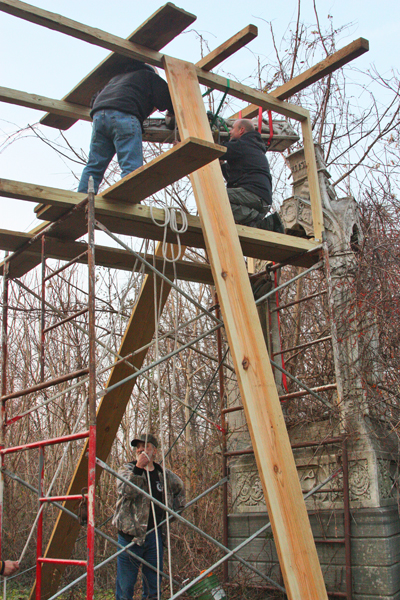
I have to say, I really walked into it this past weekend. I was out at the (formerly abandoned) B’nai Israel Cemetery in West Philly (see links at end), photographing the headstones as part of a research project, when I was invited to the takedown of the broken Keystone monument at nearby (also formerly abandoned) Mount Moriah Cemetery.  Donna, along with her husband, who both take care of B’nai Israel and as much of Mount Moriah as they can handle, had organized a rigging crew to remove the broken spire from atop the large Masonic Keystone monument. Hurricane Sandy toppled the spire a few weeks back so the only thing holding it up above the roadway was a tangle of vines.

Keystone monument with toppled spire


You can see the broken piece in this photo I took a couple weeks prior to this visit. At right is what the spire looked like a few years ago. I was invited to take pictures of the disassembly, but it was obvious they really needed another pair of hands. As I walked the short distance into Mount Moriah (B’nai Israel is essentially on the same piece of land), I saw that a scaffold had already been built around the monument. I would estimate the base of the broken spire to have been about twenty feet off the ground, the spire itself adding another six feet.

It was mid-afternoon when I got there, and nightfall when I left. Over the course of about three hours, we managed to get the 500-pound marble spire down to the ground in one piece, to await its reattachment at some point in the future. About eight people were involved in the project, though one lead guy provided most of the brainpower and muscle.

Sawing the marble spire loose from the steel rebar
The spire was actually attached to the main structure of the monument with steel rebar, a rod that went through the center of the spire, and continued down into the arch of the monument. The rebar had bent and pulled out of the spire somewhat when the spire fell, but was still attached to the inside of the spire. To get the spire down, the rebar had to be cut.

That’s where the generator and electric Sawzall® came into play. Three guys set all this up and the lead guy up on the scaffold spent twenty minutes sawing through the steel. When it finally broke loose, the spire looked quite precarious hanging up there with ropes and nylon straps. How to get it down? The old green coffin-lowering straps had no winching mechanism so another fellow provided some pulleys and rope. Hopefully things could be rigged up so we could ease the spire down to the ground.

Marble miter from atop monument
The marble miter, or flame, was actually loose on the rebar protruding from the top of the spire. This just slid off and was gently lowered to the ground in a padded moving blanket. I set the twenty-pound decoration in the nearby weeds out of harm’s way.

Spire cut loose from steel rebar
At one point, there were as many as three men on the upper deck of the scaffold, balancing the spire in mid-air, attempting to lower it down to the next level. Did I mention that it was slowly getting dark? And that one of the men had only one arm? I was holding onto the pulley rope from the ground, adding some upward force to the hanging spire, while they guided it through the center gap in the platform. Some other folks were keeping the generator running and connecting lights. My wife called my cell phone at this point wondering where I was. I told her I was helping disassemble a broken marble monument in an old cemetery at night – that’s plausible, right?

Spire being lowered thru decking
Nothing short of amazing to me was the fact that this group of guys kept their cool even when things began to look impossible. When lowering the spire all the way to the ground began to look unlikely, they ended up propping one of the 2x10 planks against the box of the pickup truck so we could gradually slide the spire into the back of the truck!

I was surprised to find out later that these guys were not a professional rigging crew, but just regular people who happened to have way more common sense and practical know-how than you could possibly imagine! And they had the right tools. Why were they here? Maybe the same reason I was there. Just to have the honor of doing something good.

Fund-raising will be put into place in the near future to reattach the spire, through the Friends of Mount Moriah Cemetery. This would obviously involve a crane and people skilled in statuary restoration.

Spire safely in truck bed

Further Reading:
West Philadelphia's B'nai Israel Cemetery

Wednesday, November 28, 2012

Visit Mount Moriah Cemetery Now!

Gatehouse, Mount Moriah
It’s sort of traditional for me to write about Philadelphia's Mount Moriah Cemetery in the fall -  since that’s when everything begins to die. Formerly Pennsylvania’s largest abandoned cemetery (it is no longer abandoned, having been adopted by the recently-formed Friends of Mount Moriah Cemetery in 2011), fall and winter were the best times to see this opulent Victorian masterpiece, when the secret cloak of its forest green fell to the ground.


Easily half of Mount Moriah’s (approximately) 380 acres were covered by forest – an astounding sight for the uninitiated. About ten percent of the grounds was clean-cut, as active burials were taking place there up until 2011 (there are none allowed, at this time). The rest of the place was a wildly overgrown thicket of invasive vines, poison oak and ivy, and thorns that could pierce through armor.


But this year is different. Thanks to the tireless efforts of a handful of individuals − leaders in the restoration effort − the progress toward freeing this beautiful cemetery from its forest confines is astounding. Looking at the photo above may give you the impression that Mount Moriah Cemetery is is mess. However, this cluster of mausoleums and monuments was buried in trees up until this past summer. You couldn't see any of this architecture before!

The Friends group has organized many official volunteer cleanup days with busloads of college students from the likes of (Philadelphia area) Cheyney and Villanova Universities, with the result being huge areas of the cemetery (both the Philadelphia and the Yeadon sides) looking neat and trim. I was rather shocked to see the condition of the Yeadon side (photo at left) in October, with the weeds all cut back and the mausoleums unobstructed by trees! Looking at this from the road, it looked like, well, a cemetery - one that you could easily enter and walk around in, safely.

Much of the praise goes to the handful of concerned citizens who work the cemetery not only every weekend, but daily (many who are members of the Friends). They’ll chainsaw some trees crowding out a family plot or machete their way to a hidden tombstone to help a visitor locate an ancestor’s grave. Patches of tall weeds have been hacked away to provide at least visible access to some giant monuments as well as smaller grave stones that I can only assume have been hidden for decades. I’m not used to being able to photograph small details (see right) on monuments and stones at Mount Moriah, but this is very possible now.

Circle of  St. John
Yeadon side
One thing that elated me about a recent (November 2012) trip to Mount Moriah was the presence of makeshift access roads that several individuals have created by plowing down weeds and trees through various areas of the cemetery. You now have easy access (do take a map, however!) to such grand sites as the Circle of Saint John, Betsy Ross’ grave (the one with the flagpole behind the Circle), and the area behind the mausoleums (on the Yeadon side). The latter has a wonderful Japanese maple tree that turns an amazing red color in the fall.

Fall foliage at Mt. Moriah
Recently, I introduced my friends Karen and Bob to the splendors of Mount Moriah. As we hiked across the grounds, I was happy to be able to show them the sights without too much effort. Still, there are wildly overgrown portions of the cemetery − the place is huge and will continue to require work for a long time to come. But there is beauty in this, as well. We were all rather shocked to see a ten-point buck trotting out of the weeds near the Naval Asylum Plot on the Yeadon side. I had wondered why the sign at the entrance gate had recently been changed to say, “No Hunting,” in addition to "No Dumping!" (Good call, Donna!)

Ten-point buck at Mount  Moriah Cemetery

So to sum up, Mount Moriah is worth a visit, now more than ever. See it in its fascinating state of recuperation, with noticeable improvements on almost a daily basis. In fact, many more people are visiting these days. Quite a few visitors with whom I’ve spoken have relatives buried here. They’ve stayed away for decades because of the steady decline of the cemetery’s conditions. Though I am certainly grateful to the Friends of Mount Moriah Cemetery for clearing the way for me to make interesting photographs, the most grateful people seem to be the descendants of those buried here. Maintaining this as an active, open, and safe memorial park is certainly in keeping with the original intent of the Victorian cemetery planners - to keep memories sacred.

Further Reading:

Historic Mt. Moriah to be Brought Back from the Dead
Some wonderful genealogical reading here related to findings at Mt. Moriah.
Friends of Mount Moriah Cemetery on Facebook

If you're interested in purchasing one of the bright yellow "Friends of Mount Moriah" t-shirts depicted at the beginning of this article, please contact Friends' President Paulette Rhone. They are $16, funds which will aid the restoration effort.

To make a financial contribution to the upkeep of Mount Moriah Cemetery, click here.

Monday, November 19, 2012

Lance Richardson, R.I.P.

Lance Richardson, 1974 - 2012
This is the closest thing to an obituary I've ever written. If you’re a cemetery photographer on Facebook, you may have known Lance Richardson. On August 8, 2012, we lost one of our own. It’s an odd situation when a Facebook “Friend” dies. Social media is requiring us to recalibrate our mourning strategies. Lance was someone with whom I communicated briefly over the past three years, prior to his death in August 2012. He was a fellow cemetery photographer.

One day at the end of this past summer, quite out of the blue, his wife posted a comment on Lance’s Facebook page saying that Lance had unexpectedly passed away. An immense shock - he was 38. His wife, his widow, knew of his passion for cemetery photography and his social involvement with Friends on Facebook, so she kindly broke the news. Certainly she had other things to deal with, so we are grateful that she took the time to do this.

Postings of sympathies and condolences poured onto Lance’s page, certainly blurring the line between virtual friends and flesh-and-blood friends. Virtual friends can care as much as actual ones. A week or so ago, through a mutual Facebook Friend, I was made aware of the Lance Richardson Monument Fund. Its purpose can best be explained by Dawn Richardson, Lance’s wife:

My name is Dawn Richardson. I am Lance's wife. I lost Lance on August 3. He passed away unexpectedly. He was 38 years old. He was my best friend, my soul mate, my everything. We spent every moment very much in love.   One of the things that Lance and I enjoyed doing was visiting cemeteries. We would photograph all these beautiful monuments. Some of the places we would visit seemed as if time had forgotten. I do not have the money to get the headstone that he deserves. I don't have the money to get him one period at this point.   I would like to raise $4000 to get him something that he would love to have photographed. Any more than this amount will go towards the funeral costs that still have to be paid. That amount is $6750. Thank you so much for helping me make this dream a reality.

I’m sure many of us cemetery photographers and taphophiles have thought about our own eventual demise and therefore, our grave markers. The idea that Lance should have one that he would have loved to photograph himself is one that resonates with all of us. I made a donation; a very worthwhile cause, as I see it. I think deep down many of us hope someone cares this much about us when we ourselves die. All the more reason to help Dawn Richardson meet her goal.

Facebook provides us with a way to touch people’s lives in a very personal way, and Lance touched many people’s lives. Social media is often criticized for being a poor substitute for face-to-face human involvement, insinuating that the interactions are less real, less human. When you think about it, social media is just a new technology. Did the telephone make us all less personal? I don’t think so. How about the Internet in general? No, these technologies brought us closer together.

So Rest in Peace, and thank you Lance Richardson – even in death you continue to bring many of us closer together.

Friday, November 16, 2012

Scanning Old Cemeteries

I bought a flatbed scanner this past year, with the intention of scanning the thousands of cemetery negatives I shot between 1998 and 2005. I haven’t been scanning everything, but selecting specific images to print and post on Facebook and other social media.

Daughter Julie holding umbrella
Looking at a contact sheet has the ability to pull me back to the day I made the images. Digital photography does not have this effect on me. Sure, an individual digital image may conjure up the memories, but the contact sheet (shoot this) can present you with your entire body of work for the day in one glance. It’s an interesting feeling.

 Julie enjoying a sno-cone
One of the sheets I was scanning the other day had my daughter Julie in some of the frames. She was about eighteen at the time (2000) – she’ll be thirty this December! Julie would visit cemeteries with me once in a while, often assisting me with my gear, but also making photographs herself. The images you see here were from a particularly snowy day at Holy Cross Cemetery in Yeadon, Pennsylvania (just outside Philadelphia, on the southwest side). Holy Cross was a few miles from the house in which we used to live, and was my destination of choice during inclement weather.

Why inclement weather? Living near a cemetery was great – if it rained or snew, I’d be right there. Cemetery statues just look very interesting and different when they’re under the duress of storm clouds or swirling snow. From time to time, Julie would come with me to help carry my tripod and other equipment so I wouldn’t be freezing my hands (or other body parts) off. She would also hold a reflector or a rain umbrella over my head (and camera) so I could get the shot I wanted.

Photo of Scarlet by Julie Snyder (see her website)
It seems that dragging Julie around to cemeteries had a weird effect on her – she lives near a different cemetery now and walks her dog there (she is very responsible, and picks up after her dog). Not so unusual, you may be thinking; however, she plays hide-and-seek with the dog by lying down in sunken graves! She’ll be playing with the dog and when the dog looks away at a squirrel or something, Julie will dive down into one of those depressions in the ground (ground settles over time as a casket deteriorates if it’s not inside a concrete vault) and hide. The dog will whip back around looking frantically for her and so on. You would certainly guess correctly that this is my child.

Friday, November 9, 2012

Bones in the Trees

Tree root with bones (photo Melissa Bailey/New Haven Independent)
I was just sitting here in the kitchen on this cold November morning, sipping Italian coffee and listening to Miles, when I saw an interesting post on Facebook. Amidst all the photos of mass destruction wrought by Hurricane Sandy, the post referred to an odd news article about a tree that was uprooted in a Connecticut cemetery.

I’ve written about cemetery trees in the past, about how they seem to have their own character - somehow lecherous and slightly macabre, their gnarled old branches reaching out to grab something or someone. You always suspect that the roots of those mighty oaks get tangled around unmentionable things deep beneath the surface. Well, wonder no more. When this large tree in an old New Haven, Connecticut cemetery was uprooted during Hurricane Sandy’s reign (end of October, 2012), there were human skulls and rib cages found tangled in its roots!


Visible among the roots of the giant oak tree, planted in 1909 on the 100th anniversary of Abraham Lincoln's birth, was the back of an upside-down skull with its mouth still open. The skull was attached to a spine and rib cage.

"I noticed what I thought was a rock at first, I kind of poked it and a piece came off in my hand, and I noticed it was bone fragments. So I took a stick and knocked some of the dirt away and noticed it was an entire skull and body and vertebrae, ribs."


Human rib cage tangled in tree roots (Melissa Bailey/New Haven Independent)
When I shared this news story with Facebook friends, I got two interesting comments related to cemetery trees. One was, “A friend & I were talking just the other day about how cemetery trees are really our ancestors.” That’s pretty profound. Another person added, “There was a superstition in the South that when a tree planted over a grave blows over, the ghost of the grave's occupant is set loose. That's the starting premise of Gene Wolfe's PEACE.”  [Wolfe is a science fiction/fantasy writer.]

Laurel Hill Cemetery, Philadelphia
I’ve seen many instances of arboreal overgrowth in many cemeteries, some of which may have resulted in a spirit being freed. When an old tree fell over in a storm recently in Laurel Hill Cemetery in Philadelphia, the grounds keeping crew was surprised to find a headstone in the middle of the tree trunk! Obviously, this was the work of maybe fifty years of tree growth that had gone unchecked. They sawed off the tree trunk around the headstone and left it that way.

Princeton Cemetery, Princeton, NJ
In a similar scenario, I was walking through Princeton Cemetery in Princeton, New Jersey when I came upon the toppled tree you see in this photo at right. Not one, but two small marble headstones can be seen in the center of the tree trunk! The roots of the tree most likely wound their way through the bones of those buried below. I originally thought this to be a good reason for placing a casket inside a protective concrete vault, to keep the tree roots from messing with the bones. However, the strength of tree roots cannot be underestimated.

Trees can damage monuments and headstones by lifting them off the level ground, or even push them over, as you can see in this photo from Philadelphia’s Mount Moriah Cemetery. Here, the roots didn’t do the damage, but a low-hanging tree branch actually grew out about twenty feet away from the trunk, slowly but surely knocking a six-foot-tall granite obelisk off its base! Ironically, the inscription on the base said, “See that my grave is kept green.”

So the lesson? If you’re responsible for taking care of a grave, don’t let that nearby tree get too big. Oh, and another lesson, this one more subtle - if you read the account of the bones tangled up in the New Haven tree (link below) you’ll note that the tree was actually in a park, not a cemetery. 

More accurately, it was in a cemetery that had been converted into a park in 1821! When such projects are implemented by towns, cities, and municipalities, the newspapers always say that the bodies were relocated to such-and-such cemetery. However, many times there is evidence to the contrary. Even if they attempt to dig up all the graves, they could miss a few. In my personal experience, the architects and planners must expect this, as the typical new construction project involves a level-with-the-ground playground or parking lot – something that does not require digging a foundation! 

The situation in New Haven was this (according to the New Haven Independent): “The last bodies were buried there in the 1700s ... In 1821, the stones were moved to the Grove Street Cemetery, and the ground was raised to level off the Green. The bodies remained behind.” (For the complete story on the New Haven cemetery tree, click here: