Saturday, July 23, 2011

Mt.Moriah Cemetery Rising from the Dead?

Well, the big Clean-Up happened today, Saturday, July 18, 2011, and boy am I beat! Through the mayor’s office, the City of Philadelphia organized a volunteer day clean-up through the organization ‘SERVE Philadelphia’ at Mt.Moriah Cemetery. I registered on-line the week before and showed up today at 8 a.m.

 
Since the place was officially abandoned a few months ago, Mt. Moriah's 380 acres (Pennsylvania’s largest cemetery, opened in 1855) have met spring and summer with a vengeance. Trees, grass, honeysuckle and poison ivy grow rampant, all but covering even the part of the cemetery that was sort of being maintained. When some plot owners recently filed a lawsuit against this inner city cemetery for negligence, the man and woman who worked in the office packed up and left. As the city has not been able to identify any actual owners, my guess is that these people who were taking money for burials over the past however many years (some say since the 1970s), were just squatters! What a way to make a buck! Find an abandoned cemetery and bury people! You pay for the backhoe, keep the grass cut on a few acres, and pocket the profits! No taxes or license fees, nothing! So the city finds itself with a huge eyesore with many irate citizens and plotholders on its hands.

Trash collecting in the cemetery
Last week I stopped by to see what the place looked like, as I hadn’t been here in the couple months since the city padlocked and barricaded the entrances. Looks like the city has really taken over, investing money into its clean-up and security, as it waits for some group to step forward and take it over. In addition to confiscating all the records from the office they apparently weed-whacked the tall grass in this (non-overgrown forest) section of the cemetery (tho the weeds had not been cut on the Cobbs Creek side and that just looked wild). 

Tires and Tombstones
The piles of old tires were gone from behind the gatehouse façade (shown at beginning of this article), dirt roads were scraped clear of trash and heaps of old building materials. In fact while I was there, a city garbage truck flew by me on its way to the entrance on Kingsessing Ave. As I turned my car to follow it a few minutes later, I was surprised to find the front gate chained shut! Not to worry, as large sections of fencing are missing, so I just drove my car up the embankment, out over the sidewalk and into the street. But I still got that panic-y feeling you get when you first realize you’re locked in a cemetery!

Registering for the Mount Moriah Cemetery Clean-Up Day
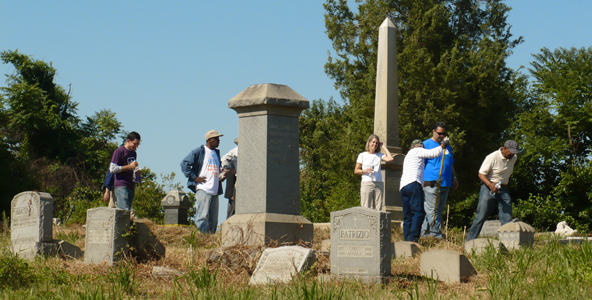
Saturday, July 18 was when a hundred people showed up to see what they could do. After registering and signing waivers (so you don’t sue the city if you get hurt), we were assigned to work crews and told not to lift any headstones and be careful not to fall into sunken graves. The city provided police protection, an ambulance for first aid, rakes, trash bags, gloves, and water and juice for the duration. It was supposed to be hotter than hell and they really didn’t want people overexerting themselves.

Raked piles of dried grass
The majority of the work involved raking up the dried grass cut by the weed-whackers over the past few weeks. Everyone raked it into piles, pushed the piles onto tarps, then dragged them down to one of the cemetery roads where city workers would later load them into trucks to be hauled away. We joked about whether this would happen before some jackass set them on fire!

I started thinking that maybe a controlled burn in the place would make more sense than all this raking (which was tough work, by the way, given all the tangles of vines and other ground cover). Really, all we were doing was removing the dead grass and giving breathing space to the live grass and weeds below − so that it would all grow faster! A sort of prairie fire would renew the place, burn the trees and weeds, which I was told was actually suggested by the fire department. They wouldn’t have to worry about hurting the wild pit bulls – one of the SERVE volunteers told me the city had them removed (not sure about the coyotes, though). The burn idea was shelved not because it was technically unfeasible, but because it was esthetically, shall we say, Armageddon-like. The sight of a cemetery on fire might not sit too well with the public, or the neighbors, for that matter. (Besides, Philadelphia doesn’t need another out-of-control ‘MOVE-style’ inferno.) Also, it was pointed out that the tombstones and monuments would be blackened in the process, and then would require cleaning.
 

So about 8:30 a.m. everyone started into it. About 8:45, the grunting and groaning began. More than one person said, “I should’ve worked out for a week before doing this!” Really, it was hard work, especially in the hot sun. My group was working around the old gatehouse where the Fox News truck was filming. My wife asked me later that day if it was emotional, doing this kind of work. 

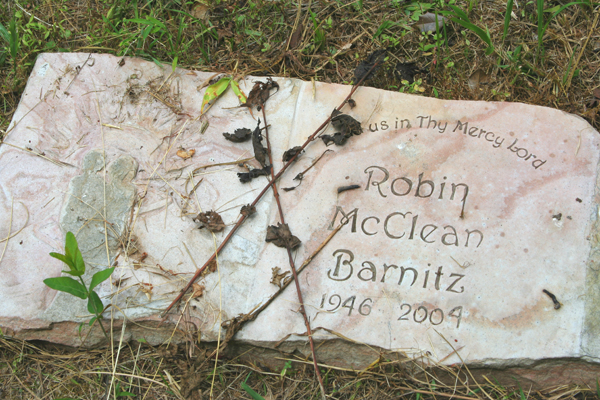
I’m not a real emotional kind of guy, but it did give me an odd feeling scraping unseen headstones with a rake - a strange sound that always caught me off guard. They'd been toppled over and lay buried in the grass. I never thought about the insensitivity of vandals in this way – if you’re going to knock over a gravestone, how about doing it so it lands face-up? That way when people come looking for their ancestors’ graves (as many people did today), they’d be more likely to find them. 

Filling a Sunken Grave
There were people here of all ages, and all walks of life − all with their own personal reasons for coming. (Oddly, I couldn’t really put my own reasons for being here into words, when asked.) From the few people I spoke with and conversations I overheard, some were registered members of the volunteer organization, SERVE, some were war veterans or Civil War enthusiasts. Some came from as far as thirty miles away.There were Freemason and Rotary club members. One ex-funeral director I know was there filling in a sunken grave. An old woman who had family buried here and was just observing the spectacle was very thankful. Most people didn’t really chat much, just worked hard  to do what they were assigned. Mayor Michael Nutter stopped by and chatted with us a bit, thanking everyone. 

Mayor Nutter, at right

Father Time, engulphed
I spoke with one of the volunteer organizers about the many millions of dollars it would take to get this place into shape. I’m not talking about restoring it to its original grandeur – it may be beyond that. Why not try to get other professional organizations to volunteer or donate their specific expertise? Wouldn’t that be great publicity for them? Have arborists come in and cut down the forest of trees that encroach upon the monuments, have a fencing company replace parts of the missing main fence on Kingsessing Avenue, cemetery restoration companies provide crews to right all the toppled tombstones.

But what might happen is local labor unions would balk, like the Streets Department did when the idea was brought up to use prisoners to do the grounds crew clean-up and grass cutting we were doing. That would go against the contract, take work away from them! The fact that the city doesn’t have the money to pay people to do this doesn’t enter into the equation.


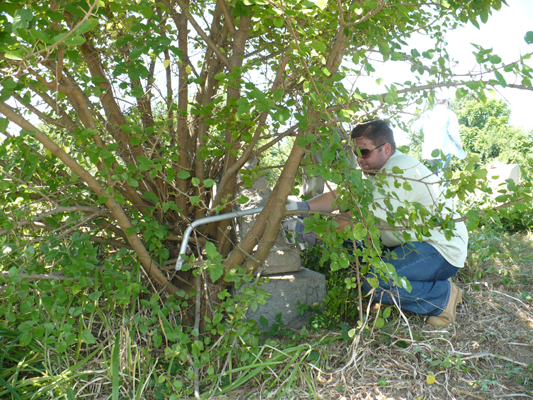
Freeing tombstone from its arboreal prison
Freed Tombstone
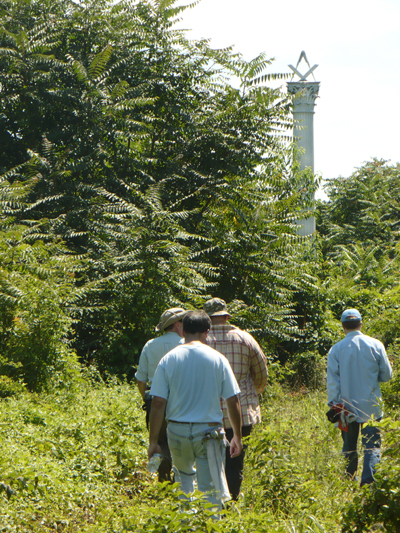
Around noon, one of the guys from a group that was cutting overgrown trees from around monuments called out to me. He asked if I wanted to take a break and go over to the Circle of Saint John, through the trees on the other side of the cemetery. Everyone was sweaty and tired, but it wasn't like you could just drop down and rest in the shade of a tree - the deer ticks would eat you alive, so we all took a hike. 

Our tour leader had been here many times with two of his Masonic lodge members to hack out trees growing around various monuments in that area, so he knew the terrain as well as I did. It seemed there were a few guys in the group who had never been back there in the deep woods, so we all took a hike. Always interesting to see the facial expressions and hear the exclamations of first-timers here when they see the magnificent family memorials in the woods, the crazy foliage smothering giant monuments. 

Burned-out car, hung up on tombstone
The access roads leading to the back part of the cemetery had been widened a bit as the city’s heavy equipment had barreled through – these little dirt roads were not made for giant trash trucks and front-loaders carrying burned-our cars out of the cemetery. As a result, unfortunately, some roadside monuments were knocked out of place and others were side-swiped. 


Land of the Lost
As we approached the circle and could see the top of its central marble column about thirty feet above  the trees, we cut into the tangle of dense growth, poison ivy, and raspberry vines as several people wanted to see it up close. Wresting our way through the jungle, one guy ahead of me said, “I feel like I should be carrying an M-16.” The column is part of an enormous 1871 monument to the late Masonic Grand Tyler, William B. Schnider. Just to give you an appreciation for the size of this amazing marble sculpture, the photo at right shows one of our volunteers standing at its base.

For the past eight years, these three guys from the local Pennsylvania Masonic lodge would come here a few times each year to saw down trees from around various monuments and carry away trash from the area. One time two of them were in the circle working  with machetes and a chainsaw, and unwittingly provided some visitors with a close encounter they’ll never forget. For years, hookers would bring their johns to
the Circle of Saint John (no pun intended) by car to do their thing (which you can't help seeing if you spend any time in this cemetery). While they were there, a pickup truck appeared out of nowhere as they were working. They looked up – while brandishing the machete and chainsaw – only to see the horrified look on the faces of the couple in the truck! They said the hooker started screaming and the driver hit the gas and you never SAW a vehicle go so fast in reverse!

As we headed back through the wooded cemetery roads, we came upon two small groups of our fellow  volunteers who were lost. People think I exaggerate the dangers of this place, but even on a bright sunny day, you can feel strangely vulnerable here. As this thought occurred to me, I realized this is one of the few times in recent memory that I’ve ventured into Mt. Moriah without a weapon! Maybe if the cleanup continues (as its scheduled to) each month, there may come a time when people can safely visit this place and enjoy the history, nature, art, and architecture it has to offer.

After the clean-up, I was exhausted. Although I brought all my serious cameras, they sat in the trunk of my car parked on 62th Street. The photos you see here were taken with my little digital Panasonic point-and-shoot, between swigs of water or bandaging the calluses on my hands.


Important Sites to Visit for further Reading:

News Coverage:

Thursday, July 14, 2011

Lost Cemetery Found ! (…maybe)

Kind of a miserable afternoon here in Philadelphia. Raining like all get out. Sitting in the living room thinking that taking half a day off from work is the only right decision I’ve made in years. Certainly, the decision last weekend to find a certain old abandoned cemetery was not one of my best. In retrospect, I should have done a bit more research, but the thrill of the hunt was upon me. What I won't go through to find an abandoned cemetery...

Upfront, I thank Kim Thompson for the information on the lost cemetery of Pennypack Nature Preserve, and the detailed map she drew for me. (You did say there was probably an easier way to access the cemetery, but I didn’t bother to check into that – my bad.) So, armed with a hand-drawn map, my friend Frank, water, beer, and snack bars, we set out to find this strange place in 95-degree weather. Her description of it being lost in the woods screamed “abandoned!” to me, and as you may know from reading my blog, I have more than a passing interest in abandoned cemeteries. Also, being an artist, I'm not as detail-oriented as I should be.

However, I did look up the Pennypack area and found that the Pennypack Ecological Restoration Trust (the location in question), was not to be confused with Pennypack Park in northeast Philly (although Pennypack Creek runs through both). I’d heard of the park over the years I’ve lived in Philly, but had never been there. Philadelphia is an enormous area, twenty miles across, with just so much nature, city, and everything in between (like water ice, which I’d have given anything for during this hike), that after twenty years, I still haven't taken it all in.

Tracks to Nowhere
Kim and her husband had come upon the cemetery (in retrospect, I’m not sure how you come upon something hidden on a cliff above you and totally out of sight) during a hike through the Pennypack nature preserve, here in northeast Philadelphia. Actually, they went off the grid when they found a set of abandoned railroad tracks leading off into the woods (points for them - I'm not even sure that I would have done that). According to her map, I should follow the tracks about half a mile and I should see a couple houses up on a hill to the right, and the cemetery would be opposite them, on a hill to the left.

Pennypack Creek
I parked my car at the Pennypack Road entrance (as the map indicated, near the intersection of Davisville and Terwood Roads) and Frank and I loaded up for the hike. It really was a beautiful area, with Pennypack Creek running alongside the main trail. About a quarter mile into the woods, Frank nonchalantly mentioned  that he hoped we didn’t come across any rabid beavers. Say what? At the beginning of the month (June), three people had been bitten in and around Pennypack Creek. “You mean that happened HERE?” I yelped. I made a mental note not to get too close to the water.

I hadn’t paid much attention to this seminal beaver event at the time, but now that I read up on it, I find it highly amusing, though for the folks involved, I’m sure it was not unlike the opening scene in the movie JAWS. According to an NBC news article, ‘Rabid Beavers Bite Folks in NE Philly,’ "[The beaver] kind of went underwater and came up." Czech said "The wife started screaming and the husband looked over and saw the beaver biting on her leg." The article goes on to say this happened in Pennypack Creek near 'Ax Factory Road,' which I think you’ll admit is the best street name ever!

The whole thing seems kind of stupid if you have no concept of how big beavers get. I for one, was shocked some years ago when I came across this stuffed beaver in a Baltimore thrift shop. The thing was huge, maybe four feet long including the tail! Throughout the day, Frank and I saw deer, snakes, and chipmunks, but met with no beavers (or bears, for that matter, as did the unfortunate hiker in Yellowstone Park last week).

It’s odd how major roadways cut through the Pennypack Preserve. Not unlike Philadelphia’s Pennypack Park and Fairmont Park, both of which go on for miles in haphazard directions, with roads cutting through them every which way. They’re not like New York’s Central Park, in which no cars are allowed on its roadways. A couple times Frank and I came to a park entrance gate at a road. The creek went under a bridge and the trail continued on the other side. According to the trail maps on Pennypack’s website, I count seven of these separate entrance gates. There would be parking for half a dozen cards, and there were always people about – joggers, bicyclists, families with children.

Old stone bridges and remnants of foundations of houses and prehistoric toll booths from the first Pennsylvania Turnpike appear along the trails. One of these bridges across Pennypack Creek, a few miles south of here in the Holmesburg section of Philadelphia, is in fact the oldest surviving roadway bridge in the United States, erected in 1698 and in continual use since then! The nature preserve, which actually came into being in 1970, is located in Huntingdon Valley, where the “Pennypack Ecological Restoration Trust manages the 725-acre (2.93 km2) Pennypack Preserve which is open to the public and includes 10 miles (16 km) of pedestrian, equestrian, and bicycle trails.” (Ref.)

Tracks leading off the grid
After making our way along the trail for about an hour, we came upon a particular and “surprisingly large stone bridge," as Kim wrote, which was our roadmark that the abandoned train tracks lay just on the other side. According to her map, we were about half way to the cemetery. The bridge was most likely one of those old turnpike bridges, and the unused tracks, I’ve come to find out, are from the old Reading Railroad.

The track foundation was about six feet above the natural ground, sloping down to the creek on the right, and down to a drainage ditch on the left. Except for the initial thousand feet or so, where the left side was lower than the tracks, a sixty-foot wooded hillside stayed with us for the remainder of the trip. Here’s a PHOTO of what it looked like, with Frank walking ahead. Everything was old growth forest, with tulip trees, hickory, tangles of raspberry bushes and more poison ivy than you could shake a stick at! Luckily, not much of anything grew in the gravel between the railroad ties, so we were able to progress relatively quickly through the dense forest. As you can see, weeds were overgrown on both sides of the tracks, so you really couldn't see much through the trees.

At one point two huge red deer came through the thicket and disappeared again. Deer ticks would abound, so we were careful to stay on the tracks and not brush up against any deer-high bushes.Which was not easy, especially the two times we came to areas where trees had fallen across the old tracks, and we had to make our way up the embankment and back down to the tracks. We were encouraged by this "666" carving in a tree, so we continued on. Even though I had on hiking boots, the loose dry dirt made it seem like I was climbing in rollerblades. Old telegraph poles still lined the railway from god knows what era. As I was checking out the wooden wire insulators on one at the top of the slope, the ground gave out from under me and I went sliding down to the railbed past Frank in a cloud of dirt, tree branches, and poison ivy.As I gathered myself up, I looked across the tracks and saw the scene in the photo below. It looked for all the world like a cemetery monument! Upon closer investigation, it was just a reasonable facsimile.

We were at least a half mile down the tracks when we came to an amazing stone throughcut hill, where the tracks were totally blocked by boulders that had come loose off the excavated rock walls. I offered to Frank that we can turn back anytime he felt like it, but he said, “No, we’ve come this far…” Truthfully, this Bataan Death March was wearing me out and I was beginning to think we took the tracks in the wrong direction. I was exhausted, and dying for one of the chilled beers I offered to carry in Frank’s ungodly heavy cooler, but hey, there’s a time and place to man up, so we made our way over and around the ten-foot high boulders and continued on up the tracks. It was in the nineties and sunny, but at least we were shaded by the majestic old forest for most of our hike.

According to the Pennypack Ecological Restoration Trust website, there were two stone quarries in this area, so I imagine we were in that vicinity. It was kind of spooky in the shade of all these hickory trees, with no sound but the creek down below us in the mossy forest. We hadn’t seen any people since veering off the hiking trail onto the tracks, and I was a bit concerned when I saw these signs on trees here and there. I joked with Frank about this being one of those exotic game preserves where they hunt people. He started humming the theme song from the movie Deliverance.

Only a few hundred feet after we passed the boulder avalanche, Frank saw the three houses up on a hill to the right, which were our supposed markers – the cemetery was supposed to be opposite the houses on the left side of the tracks. We trudged on a few more minutes but only saw steep embankment to our left, about thirty feet above the railway. But wait…was that rusty barbed wire and poles along the cliff up there? I was seriously considering fording the creek, finding the nearest road, and taking a cab back to my car – but as I thought of the angry beavers in the water, Frank began to scurry up the hillside. I followed. He got to the top first and yelled, “We found it!

Lone Tombstone in the Woods
Though we hadn’t discussed it beforehand, I know we both expected ancient tombstones covered in weeds, with a forest grown up around them. As I climbed over the barbed wire, I saw a clearing about a city block in size, trees on all sides, punctuated with small groupings of tombstones. Tombstones which looked rather … modern. We sat down and broke out the beer and joked about our travails, and the possibility that none of these graves looked older than a decade. Strangely juxtaposed with these gravemarkers was a century-old hand water pump in a corner of the cemetery. As we walked around the headstones we were rather shocked to find that their dates only ranged from about 2006 back to maybe 1970! Amidst the twenty-five or so headstones, there were a couple family plots, but this didn’t seem like a public cemetery. Most notably, I suppose, was the family of Philadelphia Orchestra composer Richard Yardumian. Very curious.

By the age of the water pump, Frank (who works at a cemetery), thought that maybe this was an old cemetery that had fallen into disrepair and in the late-1960s someone decided to put it to use once again. So we’re both wondering if some astute local historian knows the story and would post some explanatory comments at the end of this blog. All I can offer is that there are small groupings of Armenian family names.

I noticed what appeared to be wooden guardrails uphill at the back of the cemetery, which I took to be a road. Thinking we’d hitchhike back to the car, we climbed a set of stone steps up to the road, which turned out to be not a road at all, but a driveway. Curiouser and curiouser. Seemed to be an estate of some sort. Strange-looking building with many uniformly sized windows along the side facing us, woods all around. Not a soul to be seen, which was good, as we were on their front lawn. We walked up the driveway toward the house, thinking it led past the house and out to a road. Nope. Just went up to a sort of parking area. I suggested it might be the clubhouse of the human-game hunting club. We headed off in the opposite direction, down the driveway into the woods away from the house. The road meandered through a field and signs that said, 'Private Drive.' Yeah, we knew that – we’re just trying to get the hell out of here.

Cemetery access road, leading to Creek Road
Finally, we came to a main road, and saw one of the gates leading into the Nature Preserve. About fifty feet from the driveway was a chained gravel road, leading to the cemetery we just left. Meaning that we could’ve driven right to this gate (had we known where it was), parked the car, walked down the chained road for four minutes and come to the cemetery!

As we approached the gate, a young guy walking a dog came down the road. We asked him if he knew the way back to Pennypack Road and he said just follow the trail on the other side of the creek. The return trip only took an hour or so, as we were on an established trail and back on the grid. Strange how this Creek Road Trail sort of meandered through the backyards of farmhouses, estates, and a big country retreat-looking place called something like Lords of the New Church (not to be confused with the punk supergroup, I suppose). On returning to the car, we were both exhausted and my feet ached. We finished off the remaining cold ones and headed home.

After all that, it turns out that we hadn't found the cemetery we were looking for! I saw Kim and Brad Thompson a week later at an art event and Kim reminded me that the graves in the cemetery they had found were sunken, with old stones covered with graffiti. I had forgotten that part. So SOMEWHERE between where the tracks began and the boulders covered them, is an old abandoned cemetery nestled in the woods. Sounds like another trip, but it will have to be in the winter, when the trees are bare, the poison ivy is dead, and the beavers are safely under the ice-covered creek.

References and Further Reading:

Pennypack Ecological Restoration Trust
Rabid Beavers Bite Folks in NE Philly
Kim Thompson's Dark Mind Design


Thursday, July 7, 2011

How to Paint Tombstones

Moonlit scene, Laurel Hill Cemetery, Philadelphia
I thought that might get your attention! I’m actually referring to the photographic technique, "painting with light." Over the years, I’ve toyed with the idea of going into a cemetery at night to take time exposure photographs of statues and monuments, illuminating them solely with a flashlight. The idea is to essentially photograph the darkness, while gradually illuminating the object by “painting” it with a flashlight beam. The only real gear you need is an SLR camera, tripod, and flashlight. Oh, and a cemetery at night.

That last issue was resolved for me last month when my friend Frank, who works at Historic Laurel Cemetery in Philadelphia, suggested getting a group of photographers together for a full moon shoot on the grounds.

Before I went, I could have read up on painting with light techniques, but as is my nature, I prefer to learn from my own mistakes. At the time, a laser pointer seemed like a cool idea – you know, outlining the statue, drawing fine designs. Well, as you can see from this image at right, such technique requires much practice! And since I have the patience of a gnat, I’d be better off next time just illuminating the entire statue with a broad flashlight beam, like my friend Zen Bojczuk did with this image below.

Photo by Zen Bojczuk
Before I get all technical on you, let me share some images with you from Zen Bojczuk’s Facebook album from that evening's shoot, "Graveyard Shift." (His gear and settings: Camera: Pentax K10D; Lens: Pentax 18-55 at F8 - F11; ISO 100). Also, being in a graveyard at night is a bit unsettling, even if you are there with a group of people. We all sort of wandered off in different directions as we waited for the full moon to appear (hoping of course, that it would not be accompanied by werewolves). I chose to make some photographs behind Millionaire’s Row, the hillside stretch of fancy Gilded Age mausoleums. Peering into the rear windows of these buildings (like the one at the top of this article) at night is enough to give you the willies – and it certainly doesn’t calm your nerves when you scare a bunch of bats off their roost in a nearby tree!

While we all waited for it to get dark enough to start our light painting, I played around with ghost images of myself (long shutter speed, hit the self-timer, then run over and get in the scene).

Photograph by Frank Rausch
Other photographers like Frank were somewhat more productive, making wonderful moonlit images like the one above. (His gear and settings: Camera: Nikon D90; Lens: AF-S Nikkor 18-105mm f3.5-5.6G; ISO 400; 30 - 40 second exposures). About 10 o’clock the full moon seemed to just appear. Since I didn’t know exactly where it would be, it was difficult to plan on what statues to photograph. You can photograph them lit by the moon itself, but that’s not really what I wanted. If the scene is evenly lit, albeit dimly, your camera will just compensate for the low light and provide you with a best possible exposure, which will probably just look like a very grainy daylight photograph. When you paint with light, you illuminate a specific object or objects, while everything around it will be dark (unless lit by other sources, e.g. street lights). The moon itself is best used as a compositional element, a point light source to add interest to your scene.

Shooting the Moon
 
When you look at my photo at left, why is the moon just a bright ball of light? Shouldn’t a rising moon (think wolf moon or harvest moon) be big and yellow, allowing you to see its crater details? You’ve seen the photos − a properly-exposed moon rising above a dim landscape like the one below. Well guess what?  Such photographs are impossible to take. They are all doctored!

Yosemite Moon stock photo (ref)
They’re either double exposures (two separate images sandwiched together) or Photoshopped to dim down the bright moon and/or boost the brightness of the landscape (this is the principle behind HDR, High Dynamic Range, which essentially evens out the range of an image’s brightness extremes). If you’re a photographer, you know you can’t have a properly-exposed bright object and a properly-exposed dim object in the same image. Photography doesn’t work that way. Neither do your eyes, by the way. Your brain compensates for such differences in brightness almost immediately, making you THINK you see everything with even brightness. Consider those times you’re driving and are blinded by the headlights of an oncoming car – overpowers your ability to see anything else, doesn’t it? Well, that’s how a camera reacts to exposing for a bright moon – all other dimmer detail is lost.

What Camera Should You Use when Painting with Light?

While you can hypothetically set a point-and-shoot digital to make a 60-second exposure, its image sensor is not very light sensitive. This will result in grainy, mottled images. You’d have much better results with a DSLR, whose larger image sensor is much more light sensitive. (A film SLR will work fine too, only you won’t see your images immediately). Put the camera on a tripod and lock the shutter up or set the shutter speed to ‘B’ (shutter stays open as long as the shutter release is held), bathe the statue with your flashlight beam, then close the shutter. Of course to do this, you need a cable release or remote for the shutter – you can’t hold your finger on the shutter release for a minute because you’ll move the camera. You need the camera to be perfectly still during the exposure. Since I forgot my shutter release cable, I used the camera’s self-timer to initiate the exposure. The image above was made with a thirty-second exposure, which gave me time to trace the walkway with my laser. The weird colors are a result of ambient skylight and my camera's image sensor misbehaving in its non-linear region (different image sensors will respond differently to low light situations). My gear, by the way, is a Canon Rebel XT DSLR with a Canon 28 -135mm lens. I shot at ISO 1600, which in retrospect, was a mistake. I should have used a lower light sensitivity, which would've underexposed the ambient-lit parts of the scene.

Exposure Settings

A reasonable point at which to start your experimentation is the "Auto" mode on your camera, though your results will vary widely from one camera to the next. In my book, Digital Photography for the Impatient, I refer to the prime determinants of a successful photograph (besides composition, which only the photographer can control) as LAFSLight sensitivity (ISO), Aperture, Focus, and Shutter speed. Outside in the sun, you can usually set your camera on ‘Auto’ and let it make all these adjustments for you. However, for painting with light, the ‘Auto’ setting probably won’t work that well. LAFS are critical when making photographs in low-light conditions, so it makes sense to know how to adjust all of them. You might even want to experiment with all manual settings, though I prefer to use aperture-priority. Let’s look at each of the settings individually.

Light Sensitivity (ISO)

Photo by Frank Rausch
You would think that to achieve a properly exposed image you’d want your ISO cranked to max in a situation where the light is extremely dim. Not so fast, 60-Wattson..You really don't want a properly-exposed image, you want the background to be black, and the subject to be well-lit. You’re being very selective here. Think about shooting fireworks – you really just want to record light trails on a black sky, right? You don’t want the sky to be “properly exposed.” So you really don’t want an ISO of 1600 or higher. Try ISO 400, like Frank did for the image shown here, or even ISO 100 like Zen Bojczuk uses! Seems counter-intuitive, doesn't it? But it works.

Aperture

This one’s a bit tricky. You would think shallow depth of field, wide open aperture, right? After all, You don’t need anything in front of or behind the statue to be in focus, just the statue itself. Also, a wide open aperture (f-stop) would allow your lens to gather more light. Ah, but this works against you. You actually want a small, closed-down aperture for two reasons. One, exposure time should be at least half a minute allowing you time to paint the object – a small aperture will force this (small aperture requires longer shutter speed). Two, a small aperture will allow your lens focus to be more forgiving. What do I mean by that? Read on!

Focus

Ever try to focus in the dark? Not so easy, is it? Automated cameras have different ways of doing this, and some focus better than others. Some focus ultrasonically or with an infrared beam, invisible methods which could conceivably give you a properly focused image. Others use a burst of the camera’s own on-board flash to illuminate the object, allowing the lens’ optical focusing system to make the necessary adjustment. You can also manually focus your lens by pacing off the approximate camera-to-monument distance then rotating your lens barrel to that distance (its handy to have a small flashlight to assist you in this process!). I actually had to manually focus because one of the people in our group had epilepsy, and an attack can sometimes be triggered by strobed light.

What I plan to do on my next light-painting expedition is bring a bright flashlight to illuminate the statue while I allow my camera to auto-focus on it. Then I'll turn the auto-focus to manual, locked at that proper focus, and start taking pictures. Another practical tip for manually focusing in the dark: after you estimate the distance the best you can, shoot at a small aperture (i.e., a high f-stop). The smaller the aperture, the greater your depth of field – which means that there will be more things in focus around your set focus point. A wide angle lens also works to your focus advantage –  a 28mm lens inherently has greater depth of field than a 50mm or longer lens, for example.

Shutter Speed

Lasered statue
Shutter speed, or your exposure time, needs to be long enough for you to paint the tombstone, statue, or monument. Generally, this might need to be 15 seconds or more, depending on how wide a swath of light your flashlight provides and how large the statue is. My shutter speed for the image shown here was about forty seconds – cut a bit short when a helicopter appeared out of nowhere! (In case you're unaware, you can get thrown in the slammer for such an irresponsible act as aiming a laser at an aircraft. Check out this Philly news item from April 2011: Man Gets 33 Months for Aiming Laser Pointer at Helicopter.)

Though you can paint with light using a film SLR, the beauty of digital is that an LCD display gives you instant feedback on your technique. You just need to understand LAFS so that you know what you need to adjust to make your next image better! As I was leaving Laurel Hill that night, it occurred to me for next time, why not get a few people with flashlights – and various colored gelatin filters – to bathe a statue in various colors while I photograph it! Psychedlia!

References and Related Links:

Read about Ed Snyder's book, Digital Photography for the Impatient
 
Zen Bojczuk attributes his knowledge of light painting to photographer Harold Ross. View Ross' "Night Portfolio" on his website.

Learn more about HDR - "High Dynamic Range"

Man Gets 33 Months for Aiming Laser Pointer at Helicopter


Friday, July 1, 2011

Haunted Texas Graveyard

Many apologies to my readers for being tardy with my weekly blog. I just flew in from Texas, and my arms are really tired. Sorry, old joke. So, the question is, are there cemeteries in Texas? You bet. No one ever talks about them, those graveyards of the old west, except for maybe Boot Hill (and that’s in Tombstone, Arizona, anyway). I can unequivocally say that there are cemeteries in Texas – simple ones, abandoned ones, even opulent Victorian ones, family cemeteries, and haunted graveyards. I found some of each right around San Antonio, where I was teaching for a few days this past weekend.What I want to write about here is one in particular, a haunted one – the Loma China Cemetery south of San Antonio, in Bexar County.

In preparation for my trip, I surfed the Web for interesting local cemeteries. Through a Facebook Friend, Melissa Dean, I found this gem:

San Antonio - Chinese Graveyard - Go down Zarzamora after you pass Loop 410 keep going the road will make a slight turn to the right and on the right (it is hard to see so go slow) there will be a big white cross. Pull in turn the car off along with lights its better with the windows down. Quickly flash your lights five times and look and listen for talking and white apparitions around the very small graveyard. (ref)

And this entry from www.lostdestinations.com (who I also thank for the photo above of the sign):

There are "No Trespassing" signs posted, including a sign that reads "No Witchcraft". We've been told that people will pull up at night,turn off the car, open their windows and flash the car headlights five times. White figures will begin to run around, and the sound of voices can be heard.

Heaven on the front seat of my car.
Your favorite Cemetery Traveler could not resist a temptation like that! In fact the “Chinese Graveyard” (also known as Loma China Cemetery) was my first stop after deplaning, as they say. Well, actually, my first stop was to check out the local cuisine. Munching on alligator nuggets and frogs legs, rockin’ to Mexican radio, I headed south through San Antonio last Friday afternoon.

About the weather: I wrote in my last blog that the coldest weather I’ve ever experienced was on Sodus Bay, New York, on Lake Ontario. Well, I just experienced the torrential Texan sun and I have never been so hot in my life! Jesus H. Chrissmus, how do you people TOLERATE that? A hundred and seventeen degrees in Lubbock this weekend?! San Antone was was so hot that birds were bursting into flame as they flew through the sun beams reflected off the tall, glass-windowed office buildings (*see note at end). The digital temp readout on my rental car's dashboard blanked out after it hit a hundred, it just started flashing out of range. Thank the gods for air conditioning!

Anyway, Zarzamora street runs north-south through San Antonio. After crossing 410 south of the city, it heads off into rural Texas as a sparsely traveled four-lane lost highway. About a quarter mile from that intersection, I came upon the small graveyard on the right side of the road. I pulled into the space in front of the gate (oddly, there was only room for one car to park) and got out to survey the opportunity.  It looked like new cyclone fence had been erected around the old entrance gate since the lostdestinations photos were taken (the author’s account was published in the book, Weird Texas).

My rental at the gate
At the top of the gate in faded paint you could read something like “Guzman Burial Ground.” Given the fact that I didn’t see a “big white cross,” I began to wonder if I was in the right place. The gate was locked but not insurmountable. Still, if I don’t have to scale a fence, I won’t, so I checked for an opening. The left side of the cemetery was fenced off to an industrial equipment site and the right side was open to woods. The front fence on the right actually ended at the woods, so all I had to do was go around the fence, climb over a pile of old cemetery decorations, and enter the grounds. I didn’t see any “No Trespassing” signs, so I didn’t feel like I was. I grabbed my DSLR and a couple Holgas and went inside.

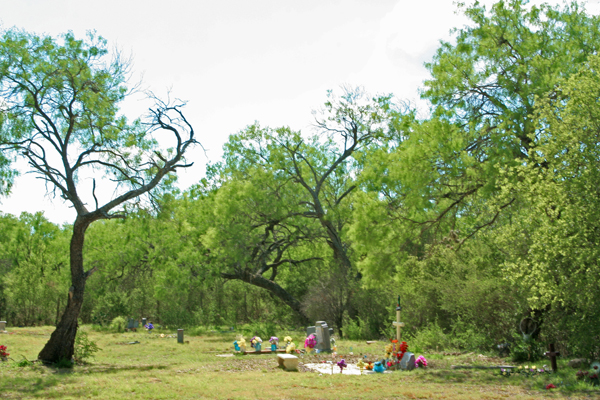
It was a cemetery alright, but a very meager and informal one. The grounds themselves were only about sixty feet wide, maybe two city blocks deep. Certainly not the type of affluent cemetery that would invite grave robbers, though such an atrocity did happen here in 2009 (link to video, "Vandals Desecrate Corpse"). There were tombstones, but not very elaborate ones, wooden crosses with names carved into them, mortar grave borders mixed with sea shells (a la New Orleans). Many of the graves on the left were members of the Guzman family, which made me think the place was a private family burial ground. There are some Chinese graves on the right, but not really that many. Those had trinkets and ornaments around the stones, along with brightly colored plastic flowers, which could have been new, could have been twenty years old, hard to say. There were headstones as recent as 1996, some so old you couldn’t read the dates. I grabbed a few pieces of shell, some broken glass ornamentation, and rocks for souvenirs.

I really was thinking I was in the wrong place until I came upon this sign in the weeds, amidst old beer bottles and other trash.  It’s the same sign you see on the lostdestinations site. Toward the back of the cemetery I found this concrete bench on which was painted “Loma China Cemetary” [sic], which confirmed that I had found the right place. To my utter disappointment, the "No Witchcraft" sign must have been stolen. 

When I eventually made it to the back of the graveyard where the bench is, I found some old headstones covered in cacti, all shaded by a couple great old cemetery trees – you know, the kind of gnarly old things that seem to only grow in cemeteries. Across from them was a grave with a rectangular wooden headstone with this painted plaster angel on it! The angel's  face was so startlingly lifelike that as I was photographing it, I half expected it to open its eyes. Creepy.

The absence of traffic on the four-lane Zanzamora street was weird. Even though the Chinese Cemetery bordered some sort of construction equipment supply place on one side, all was quiet there on Friday afternoon.  I comforted my uneasiness with the fact that other than the tourists, the locals must be too smart to go out in this weather. At a 114 degree 'real feel' temperature, I was sweating like crazy. It dripped off my sunburned face as I lay on my back in the sand, photographing the cacti-covered headstones. Red ants were everywhere − I shook them off the Holgas. I felt that if the cemetery were really haunted, this is exactly where you would experience the weirdness. But I thought the ghosties wouldn’t be around in broad daylight in this heat. You know, if you were to see one, it would be lying in the shade, weakly holding up a small sign that said “Boo.” With the creepy angel face and the painted bench behind me, I thought I felt something inside the leg of my shorts.

Back section of the "Chinese Cemetery"
Now, in all candor, I must say I had forgotten all about rattlesnakes. It wasn’t until days later as I’m writing this blog that it even occurs to me to look that up! Who knew Texas has TEN varieties of rattlesnake? More than any other state besides Arizona? Had I known this, I would’ve exercised a bit more caution.

But no serpents, thank you very much. However, as I looked down, I saw six-inch lizards scurrying everywhere! Yaahhhh !!!! Jump up, shake pant leg. Nothing. Wait – the lizards were actually all … heading for the angel head. This is too weird. Maybe time to go. I gathered up all my camera gear and was ready to head out of there when I realized the lens cap was missing from my DSLR. I had been snapping it on between shots to keep the sweat from dripping onto the lens. Now, years ago I used to lose these things left and right, until I started buying those elastic bands that stretch around the lens base with the button at the end of a tether that sticks to the lens cap. You pop the cap off and drop it – the tether lets it dangle until you’re ready to put it back on the lens. Haven’t lost a cap in ten years. Until now, that is. In fact, the elastic band was gone too!

With some reluctance, I retraced my steps and searched for about twenty minutes, to no avail. It wasn’t like it fell into bushes or tall grass, its just basically sand there. A four-inch black lens cap should be easy to locate, but the sweat was pouring off me and my glasses were a mess. Under the unrelenting Texas sun, I felt like that line from the Fountains of Wayne song, “And the sun is beating me senseless, I feel defenseless like a dying lamb….” (click for video). I gave up and headed back to the car. Threw my gear in the trunk with the suitcases and pulled away from Loma China Cemetery.

A mere twenty feet down Zarzamora I see one of those roadside memorials. At some point I intend to blog about them, so I pulled off the road into the drainage ditch to grab a few photos. As the memory card in my DLSR was almost full I decided to change it. I popped the full one out, and it fell between the seat and shifting console! After spewing some imprecations, I moved the electric seat forward, got out and crawled into the back and fished around for it. Finally got it. Jeez Louise.

I went down to shoot the memorial, and the word “Brother” was facing the wrong direction, so I clambered around to the other side. I grabbed a handful of what I thought was just bracken, to pull it out of the way so I could photograph the front of the memorial, and my left hand was bloodied by dozens of invisible thorns! Holy shit, did that hurt! (You can see the innocuous little fern-like plants at the bottom of the sign in the photo). 

I began to seriously think the spirits of Loma China Cemetery were messing with me for nicking some souvenirs. Bugger all, man, it’s worth the price of a lens cap! So off I went to check into my hotel.

After a shower a few hours later, I began unpacking my bags. When I got to the bottom of one of my locked suitcases, guess what was in there? My lens cap with the tether! WTF!?  − ghosts that like to play parlor tricks? I guess it was a sign that they really could harm me if they wanted to! But that wasn’t the end of the weirdness. My bad luck streak continued for six days.

One of the reasons I’m late posting this blog is because after writing it the first time, my laptop decided to “Restart,” and I apparently did not save my document. So what you’re reading is Version 2.0 (which reminds me to hit “Save” at this point…). As I left San Antonio, my plane was delayed so I nearly missed my connecting flight in Houston (remember those TV commercials of O.J. Simpson running through the airport?). Upon my arrival in Philadelphia, the announcement that it was 79 degrees and cloudy made it seem like paradise compared to what I had endured over the past four days! Texans must be a hardy people. So around midnight, in relatively high spirits, the airport shuttle dropped me off in front of my car – which had a flat tire.

When I got into work the next day, I noticed that the hard drive with all my blogs and years of photographs was missing. No big dealI had disconnected it, put it in my bag and took it home with me last week. I spent the last several days looking for that damned thing, everywhere! I had given it up for lost. My bad luck ended (I hope) yesterday when I walked into my office and found the drive under a sheet of paper. Now, this is one of those instances where it wasn’t there the LAST four times you looked there, but now its there. Plausible explanation? My wife thinks it must have decided that I had worked hard enough to find it, so it decided to reappear. The quantum physicists might say that it’s waveform had just temporarily collapsed. My advice? If you decide to visit Loma China Cemetery, be sure to take your lucky amulet or anti-witchcraft talisman with you.

Epilogue

It was really difficult finding information on this cemetery on the internet before I visited, but when I returned home and searched for “Guzman Burial Ground” (the words painted on the entrance sign),  I found something that explained a bit of the place’s history. In a 2009 interview ("Horror haunt in San Antonio unearths ghostly tales"), local  citizen Joey Guzman says that the Chinese Cemetery is in fact his family’s private burial ground, which had originated over a hundred years ago. And the Chinese connection? The ghostly apparition you supposedly see when you flash your headlights? Read on:

“Supposedly, a Great uncle of mine was seeing a Chinese woman and they were in love,” said Guzman who oversees the cemetery. ”My Great grandfather forbade him from seeing her.” According to Guzman, what’s now a burial ground was a rendezvous spot for his great uncle and his Asian love. The curse: continue to see her and lightning will strike you down.

[Folklorist for the Institute of Texan Cultures, Mr. Rhett] Rushing said this was the Romeo and Juliet story of Bexar County at the time. The woman, whose name has never been unearthed, was reportedly a Chinese immigrant.“She was remarkable,” said Rushing. “She was very, very tall even being described as being seven feet.”

Guzman said family accounts claim the curse came to fruition. His great uncle was killed on the very horse he rode in on. In fact, familiar legend said great uncle Guzman was buried with his horse. Folklore said his Asian love died too. The two reportedly doomed to aimlessly search for each other throughout eternity.


References and Further Reading:

* Just kidding about the birds bursting into flame.

My thanks to Melissa Dean and Lostdestinations.com for background material, and to the Marks at Weird NJ/US/Texas for their wonderfully informative publications!
 
Lost Destinations: Chinese Graveyard
News Video: Vandals Desecrate Corpse