Thursday, January 17, 2013

A Retrospective Show

While it is certainly true that artists exhibit their work to show it off and to sell it, there is a more subtle reason: to see how it affects other people. I don’t do this consciously myself, but after a recent exhibit, it was apparent to me that many people were affected by my photographs in various ways. The show was a retrospective spanning 15 years of my cemetery photography, though I hadn’t planned it that way. I just gathered together all the framed pieces I had lying around and set them up at a gallery for a one-night show. It was ad hoc, initiated at the request of a friend.

The gallery owner, Richard Prigg of Sycamore Studio in Lansdowne, Pennsylvania (a southwestern suburb of Philadelphia) needed art in a hurry as his scheduled artist backed out at the last minute. Each month, he has a one-day exhibit of his own paintings and stained glass work along with that of a guest artist. So I delivered about seven each 16x20 and 11x14 framed photographs, some images of which I've included here in this article.

"Stone Emotion," Holy Cross Cemetery, Yeadon, PA, 1997.
"Blessing," 2012
A few days later at the reception, I was quite pleased at how he hung my work in his gallery. One side of the white room were his original paintings and stained glass art, the other side had my photography. As I viewed the hodge-podge of my work on display, I realized that it was a loose retrospective of the cemetery photography that I've done over the past 15 years. From “Stone Emotion” - one of the very first stone angel images I’d made, back in say, 1997, to very recent work in the abandoned Gladwyne Jewish Cemetery ("Blessing," see right). There were also pieces from near and far – many from the Philadelphia area (where I live) to California and Rome, Italy. Looking at some of my more recent work, I could easily see some photographic miscegenation, which is just a nice way of saying that everything is derivative.

"Eros and Psyche"
A few nights later when people began showing up for the opening reception , I was frankly amazed at how most of them came up to me and asked me about my work, either in general or about some specific aspect. Oddly, no one but the gallery owner asked me the most obvious question, which is “Why do you photograph cemeteries?” (I really have no good answer to this.) But all topics and questions brought up were astute observations or probing questions, such as those related to the image at left: "What is this?" and "How did you manage the lighting?" It was very enjoyable discussing my work at both the artistic as well as technical levels. (This image, by the way, will be used as the front cover for the January 2013 issue of the [British] Journal of the Centre for Freudian Analysis and Research - the issue topic will be "Love.")

Sometimes people just show up at these opening receptions for the cheap wine and cheese doodles. This did not happen at Sycamore Studio (for the record, the gallery owner actually served craft beer, good wine, and fine crudités!) Most of the attendees were friends of his, and most were involved somehow in the arts - even the retired police officer/artist who used to sketch nudes on the backs of his reports. (Once when the judge was reading one of his reports at a hearing, the district attorney started laughing because everyone could see the nude on the back!) Since it was really an unusual experience for me to literally talk myself hoarse to dozens of people about so many aspects of my work, I thought I'd blog about it. Here are some of the topics and questions raised:

"Angel Face"
  • "How do you title your work?" Not well, I'm afraid. Descriptive titles work better for me than artist gibberish. For example, "Angel Face" to describe the image at right, versus, oh I don't know, something like "Space and the Passage of Time.
  •  "How do you print your work?" Well, I pay other people to do it. In my book, Digital Photography for the Impatient (available from Amazon.com), the chapter on printing is the shortest! That's because its really difficult to do it yourself and trying to explain how and where to get professional prints made from digital media is an enormous topic. Also, the technology changes rapidly.
  • "Have you photographed the wonderful oceanic view cemeteries of Ireland or Hawaii?" Um, no, but I have been to Baltimore.

By Ed Snyder (Amazon link)
I really appreciate the fact that some old friends of mine came too. It certainly takes some of the pressure off! There were also people in attendance who are involved with the Lansdowne Arts Board, a group of people exemplifying and promoting various artistic endeavors in the town. One project they are currently funding is an “art house,” in which people can take classes in the arts. The plan is for it to be staffed by three artists-in residence: a poet, a painter, and a sculptor. The fact that such a vibrant arts community exists in Lansdowne,  Pennsylvania was surprising to me, as I used to live nearby and had no idea this was all happening!  

    "Under the Betsy"
  • Have you visited the abandoned buildings in Centralia [Pennsylvania]?” No, but it is on my bucket list. Along with the cemetery there. I think this came up as we were discussing my images of the discarded tombstones under Philadelphia’s Betsy Ross Bridge (click here for that bizarre story!). A photographer at the opening wondered if I thought it possible to film the  tombstones from underwater!
  • Would you like to do a show of your work in the old one-room schoolhouse in St. Paul’s cemetery?” [This is in Ardmore, PA, a suburb of Philadelphia]. Why certainly, thank you for asking.
  •  “How do you achieve these photographic effects, Photoshop?” I'm always flattered when people ask this as I rely mostly on my skills to achieve the best initial image capture; very rarely will I Photoshop something afterwords.

Perhaps one of the most fascinating conversations I had was with a woman who was on the board of a non-profit organization called “In Company with Angels.” For those of you who appreciate Tiffany stained glass, this is noteworthy. She told me the fascinating story of how seven early-1900s Tiffany angel stained glass windows were found in a barn near West Chester, PA, in 2001. "In Company with Angels, Inc. was founded by people from a small town in Pennsylvania who were inspired to share their rediscovery of a unique set of seven Tiffany angel windows with the world." The angels are part of a traveling exhibit, currently at the Montgomery [Alabama] Museum of fine Arts. I'm sure these are amazing and hope to see them (and photograph them!) one day.


Rick Prigg, the owner of Sycamore Studio, is in fact a stained glass artist in addition to being a PAFA-educated painter (Pennsylvania Academy of Fine Arts). As I have photographed and written a bit about mausoleum stained-glass windows (and had a photograph of one in the exhibit, see above), I was able to discuss such things with him on at least a peripheral level. He shared some fascinating stories about retrieving valuable stained glass windows from old churches for the Archdiocese of Philadelphia which it had been closed by the Archdiocese over the years. Trying to remove stained glass windows as vandals were actively throwing bricks through them from the outside must have been a trying experience!


So, sometimes you do a show of your art work to score a point or just stay even. Sure, you might make a few sales, but perhaps the best reason for showing your work publicly is to stimulate discussion. This may (or perhaps should) result in the stirring of your own creativity. It may reinforce what you're doing right and make you consider ways to improve your weaker areas. So my advice to anyone who publicly exhibits their artwork: don't ever pass up an opportunity. As for an answer to the question sometimes posed to me of “Why do you photograph cemeteries?” The best answer may very well be to stimulate discussion in related areas. And since cemeteries are really all about us, I suppose anything and everything can be a related area!


Sunday, January 6, 2013

Photographing Cemetery Snow

I’m not one of those people who accepts the lemons life gives you and makes lemonade. I’d rather just smash them against a wall, then take a photograph. Still, I do manage to recognize an opportunity when it presents itself. Last Saturday they were forecasting snow, so I wanted to make a quick trip to a local cemetery and shoot some snow angels. Unfortunately, I had a “million things to do,” as my father used to say.

The roof leaked water the day before during a rainstorm, so I needed to get up there with a ladder to investigate. So the morning of the snow, I was up there searching for shingle damage when I noticed a ten-foot length of rain gutter missing. Wind must have blown it off. After it landed on the ground, the old Chinese woman who collects aluminum cans from our trash must have spirited it away. So off I went to Home Depot for a gutter and accessories.

It was on my way home from Home Despot that it began to snow. Decisions must be made − photography or more water damage to my house? Normally, I’d choose the former. But guilt is a prime motivator, and since several pair of my wife’s shoes were ruined by the water leak, I must resolve this first. The cemetery would have to wait.  I took solace in the words of  the (third century B.C.) philosopher Mencius: "I desire fish and I desire bear's paws. If I cannot have both of them, I will give up fish and take bears' paws."

Entrance Gate, Woodlands Cemetery, Philadelphia
After about a half hour of sliding around on the roof attaching the gutter, I packed up my photo gear and headed out to Woodlands Cemetery in West Philly. A gorgeous Victorian sculpture garden, with two hours of daylight left. Woodlands holds the distinct honor of being the first cemetery that I got myself accidentally locked into – see my blog posting “Trapped in a Cemetery.” That was a decade ago, I believe. Since then, I pay close attention to the “Closing Time” noted at front entrances of cemeteries. In fact, Woodlands has a lovely big old iron entrance gate with an hourglass design. This reminds me that my time is short, in more ways than one.

Drexel Mausoleum
I spent about an hour slowly driving slowly around Woodlands in the snow, thoroughly enjoying the experience. From the old eroded marble monuments to the Gothic mausoleums, snow just makes everything look better, cleaner, prettier (a notion that I, incidentally, did not hold when I lived in snowbound upstate New York). Woodlands even boasts the family mausoleum of one of America’s only three (American-born) saints. The Drexel family mausoleum, behind the Neoclassical estate house, contains relatives of Saint Katharine Drexel. Her body itself resides not here, but at the Saint Katharine Drexel Shrine in Bensalem, PA (northeast Philadelphia).

Woodlands in West Philadelphia is situated near 40th Street and Baltimore Avenue (click here for map), by the Veterans Hospital at the edge of the campus of the University of Pennsylvania. I’ve seen more pedestrians stroll this old graveyard than any other in the city. I suppose this is because it is situated in a densely-populated area and is the closest “park,” of sorts, in that vicinity. It more than serves its original intended purpose –a bucolic getaway, a beautiful sculpture garden and park, where bodies just happened to be buried (Woodlands was established in 1840). In the fifteen years I’ve been coming here, I have yet to see anyone actually visiting a grave! So on this cold, late December afternoon, I shared the roadways with at least half a dozen people – joggers, strollers, and people walking their dogs – through snow squalls.

Fast shutter speed (1/125 sec.)
It was snowing rather lightly during the hour of my visit, and I made several photographs from inside my car (heat on, windows down). However, there was a ten-minute interlude in which the snow fell hard. These were exactly the conditions under which I wanted to make photographs.

Slow shutter speed (1/8 sec.)
I’ll admit I was caught up in the moment. I wasn’t in precisely the exact location where I wanted to be to shoot the statuary I wanted, but when the snow began falling harder, I figured it could stop any minute.  So I had better start shooting. I composed a few scenes and clicked them off. Shot at ISO 400 as I wanted good resolution. Lighting was rather dim so I was using an aperture around f8. This allowed a shutter speed of  1/125 second, which, as you can see from the photo above, fairly successfully froze the falling snow. I intentionally slowed the shutter speed down to 1/8 second to allow the falling snow to form streaks (see photo at right), just to see what this effect was like.

Pretty much everyone knows that auto-focus cameras can be tricked, and need to be tricked under certain circumstances.Why? Sommetimes they will focus on something other than your intended subject. These are the situations in which you want to make them focus on something other than what they prefer. For example, if you’re shooting out of a car window and the window is wet or dirty, the camera will likely close-focus on the rivulets of water or the dirt, not the deer out in the field you wanted it to. Or with the photo at left, you would really have to do some work to get your camera to focus on the foreground headstones instead of the background tree.

The fact is that auto-focus cameras tend to focus on contrasty things, rather than the position of a particular subject. To trick the camera (or perhaps, behave the way you want it to), you can either switch to manual focus and adjust accordingly, or choose one of your camera’s pre-focused “Scene” modes. In the example of shooting out the dirty window at a distant subject, you could choose the camera's "landscape" mode (usually indicated by a small icon of a mountain range). Your choice may not be perfect, but you need to make some compensation to override the camera’s auto-focus system. This is precisely what I did not do during the snow squall.

It was not until I was reviewing my images on the computer that I realized the focus was off in the falling snow shots. My intent was to focus on the angel statue (in the two images above). What I didn’t realize at the time was that the falling snow would throw off the camera’s auto-focus. Now this seemingly trivial bit of information can be crucial if you find yourself in a similar situation. Therefore I selflessly share with it with you, my fellow Cemetery Travelers. So take it and may it serve you well.

So why does the falling snow throw your auto-focus into a tizzy? The same way the dirty glass window does. When I pointed my camera lens at the angel statue and expected the focusing system to lock onto it (through the open window of my car), there was a wall of falling snow between it and my camera. I’ll estimate the statue was thirty yards away. That means there was a thirty-yard-thick wall of randomly falling snow between the statue and my camera. Let’s call it an infinite number of potential focusing points. The fact that I got anything worthwhile is simply astounding.

Amtrak train zipping by Woodlands Cemetery
How should I compensate for this in the future, and why did I not notice the unsharpness on my DSLR’s image display? Well first of all, even if you have a three-inch LCD display on your camera back, you’d be hard-pressed to tell if something was in focus or not – the display is too small and the resolution is too low. What I should have done was crank my ISO up higher (maybe to 1600) so that I could use a smaller aperture (f16, perhaps, instead of f8).  At the shutter speeds I was using, this would have allowed a greater depth of field, which would have made it more likely that more of the objects in the scene would be in focus (including the angel statue). Of course, with all this modern technology, I’m not sure why the camera cannot be programmed to just say, “There’s no way I can focus through this, Dave.”
 
The Woodlands' Neoclassical Estate House

An ISO of 1600 would decrease my resolution, of course, but with an image as busy as the snow falling around the angel statue, you’d be hard-pressed to notice even on a large print. Also, the larger your digital camera’s image sensor, the less of an issue this becomes (bigger sensor, better resolution). During the time I was at Woodlands, I photographed out the window of my car as it was very cold, windy, and snowing most of the time. The only exception was when I got out with an umbrella over my head to shoot down at this reclining female form. When I posted the image on the Facebook site, “Sensual Cemetery Art,”the famous cemetery photographer and writer Doug Keister commented, “Accomplished photographers go out when others go in.

So, to sum up the Woodlands as a destination site: any cemetery photographer would revel in the plethora of architectural details here – grave art abounds. From the hourglass with wings on the entrance gate to the restored estate house in the back, there is plenty of interesting subject matter here – add snow and it becomes a 54-acre-wonderland. And if you just want to jog around the place, you can do that too.


If you choose to visit:
Woodlands Cemetery website

Monday, December 24, 2012

Christmas in Wilmington


I bought my car a new water pump for Christmas - a surprise gift for both of us. It had been slowly leaking coolant for the last few months so I’ve been slowly considering having it checked out. It was one of those situations familiar to any car owner - you expect it to be a leaking hose and it turns out to be a $450 repair.


Riverview Cemetery, Wilmington, Delaware
Anyhow, I have my car maintained by Sports Car Service, a Saab specialty shop in Wilmington, Delaware. Its twenty-five miles from where I live in Philly, but tearing down I-95 in a turbo Saab puts me there in an almost embarrassingly short amount of time. I typically take my camera with me and walk around the neighborhood while my car is being attended to. There’s also a cemetery about a quarter mile away. (Put me in a cemetery with a camera and you’ve just killed a quick hour!)


When they broke the news to me that I needed a new water pump, I was easting brefass at McDonald’s down the road. Not my first choice, but since the wonderful greasy-spoon old Post House Diner across the street closed (!) since my last visit, I had no choice. The Post House was actually a Pony Express stop back in the 1800s, if you can believe that! I don’t think they’d scraped the grease off the grills since that time (which, of course, added extra flavor to the food). So there I was with an extra two hours on my hands. May as well walk up to Riverview Cemetery, there on Market Street in Wilmington. Restaurants may close up shop, but you can rely on a cemetery to keep its doors open for you.


Riverview is actually about two miles from the Delaware River, so there is no actual river view. It’s bisected by North Market Street, the north side of the cemetery being newer with some grand monuments and mausoleums. The south side is older, with quite meager stones and grave markers. I’d never spent much time on the south side, but seeing as I had a couple hours, why not?


Dupont Nemours Mansion, Wilmington, DE (ref)
The old office/gatehouse on the south side was being renovated, getting a new roof for Christmas. The entire cemetery was under new management, as the signs indicated. They’d apparently also participated in a local city garden competition, which tells you the new owners are serious about the upkeep of the cemetery (with all the local Dupont family estates, competition in this regard must be rather stiff!).


Old and new (condos) construction, Riverside Cemetery, Wilmington, DE

Riverview has been in operation since 1872, with a few glitches along the way. Most recently, the cemetery had been abandoned (I’m guessing for at least a decade between the mid- 1990s to the mid 2000s). In 2009 it was taken over by a Friends group which is, of course, the best Christmas present an abandoned cemetery can receive. Since then, it has been cleaned up and there are active burials occurring.


I remember walking around the newer side of the cemetery ten years ago and the weeds were a couple feet high. There are early-2000s accounts on the web of descendants trying in vain to get information about family interred at Riverview. Supposedly, people were being buried with no records being kept at all, and several homeless people were sleeping in the cemetery. Typical occurrences in an abandoned cemetery. All that appears to have changed.


It was cold on water pump day as I walked around the old side of Riverview Cemetery, so I only spent about an hour there. However, something unusual caught my eye the moment I set foot on the grounds. There were many – and I mean scores of − old marble headstones lying face up in the ground, carefully excavated out of the sod. Some were flush with the grass, with their edges carefully weed-whacked, others obviously dug out of several inches of soil and cleaned off – possibly for the first time in decades.


Excavated headstone, Riverview Cemetery
It’s not unusual to see this sort of thing in most cemeteries, but it was obvious that something of a project had recently occurred at Riverview. The cemetery has recently been taken over by a Friends group, with actual transfer of legal ownership to the group. Therefore, it is no longer abandoned. The volunteers appear to be digging out many of the old toppled stones and making them visible - quite a Christmas present to the descendants of people buried here. And there are many buried here – about 36,000 interments on Riverview’s 87 acres (according to Riverview's website). The soil may have protected the stones to some degree, as most inscriptions are readable.


If I had not given my cemetery sleigh a new water pump that day, I would not have had the time to make such a studied visit to Riverview Cemetery. While I wasn’t thrilled to drop $450, I’m glad to have spent so much time here, to appreciate the small details I could have easily missed. The visit subsequently gave me a reason to do some related web searching. It was so heartening to discover the existence of the Friends group, an on-line presence for the cemetery, and contact information – all evidence that people care a great deal about their history. Merry Christmas − I’ll leave you with this notation from the Riverview Cemetery website (http://www.riverviewcem.com/news07.htm):


"INTERESTING FACT:

Riverview's early interment books list cause of death and some terms such as Apoplexy, Dropsy, Bright's Disease, and La Grippe were not familiar to us. So we have defined a few terms: Apoplexy was used to describe any sudden death that began with a sudden loss of consciousness; heart attack and ruptured cerebral or aortic aneurysms fall under this category. Dropsy or edema refer to the same condition; an increase in interstitial fluid in any organ resulting in swelling. Bright's disease is a historical classification of kidney diseases first described in 1827. La Grippe was one of several names used to describe the influenza that caused a flu pandemic in 1918."


References and Further Reading:
Riverview Cemetery website

Monday, December 17, 2012

A Photographer’s Dream


I had a fever-induced epic dream last night that I thought I’d share with you. Since many people try to interpret their dreams, I’ve offered some clues which I've stated in the numbered references at the end. My wife is a psychotherapist so I thought I’d do some amateur analysis along the way.But first, a bit of background material.

I was trying to wean myself off a corticosteroid/antibiotic cocktail my doctor prescribed for my sinus infection. After two doses, my nose began running like a faucet, I had a fever, chills, cough, you name it. Naturally, when I phoned the doctor to notify him of the side effects he couldn’t be reached. So I decided to stop the meds. I waited until the next dose was due and instead took something that would stop my nose from running and control my coughing fits. So the dream came as I was riding the Green Dragon (Nyquil), which was bucking against the retreating forces of the prescription meds. Also, I don’t remember my dreams very often, so this entire experience was quite notable for me.

The dream began with me trying to figure out how I would pick up a used bed1 from a friend,2 in my car3 on my way back from Cape Hatteras, NC, with an old girlfriend.4 I decided I would drive my car through the big city (whatever that was) to my friend's house, remove the bed from the wall (it was attached to the wall), and then pick it up on my way back from Hatteras a few days later.

The morning of the big trip, I wake up in my bedroom in my parents’ old house5 and begin to pack my bags. I have my cell phone with me. I’m in the bathroom sitting on the toilet, and I hear my father (who is deceased), shuffling up the hall to the closed bathroom door. Without saying anything, he slowly slides a new smallish bathroom rug under the door (my wife, the psychotherapist, will have a field day with that one, I’m sure).

So now I’m on the road, driving through the congested traffic of a big, multi-lane inner city traffic circle. I get pissed that the traffic is not moving so I turn down the next street, even though I don’t know where that goes (my wife will testify that this is quite normal behavior for me).  A few block away, I come to an intersection (and this is where the fun begins) with what looks like a rocky vacant lot on the right. It’s quite hilly, narrow, like a double-deep rowhome lot, let’s say 15 feet wide and about a hundred feet deep. The terrain gradually increased in height from the road until it reached about twenty feet toward the back.

As I squinted at the large rocks protruding out of the ground, I realized they were old, worn tombstones! Yay! Park the car, out with the cameras. I put down all my gear where the embankment was about ten feet high and just grabbed my DSLR to take with me.6 I scrambled up the hill, to the curiosity of a couple teenaged girls walking by, and spent about ten minutes photographing worn designs and inscriptions on the granite stones.  Most of which were about three by four feet in size – granite, for you cemetery purists.7 I happened to look down toward my car, and there were two men, about in their mid twenties, fiddling with my cameras that I had left at the bottom. Just as I started to scramble down and yell, “Hey!” one of the guys tossed my film SLR8 to the ground. I watched as pieces broke off it.

I got down to where they were and started yelling, “What the hell’s wrong with you? Why would you do that?” I noticed the guy who tossed my camera was holding his own digital Mamiya medium format camera (worth about $30,000), so I added, “ … and to a fellow photographer?!” They were both very apologetic and moved away to discuss the situation in private. I waited until they came back. They were still arguing between themselves until finally the guy who broke my camera pulled two paper sketches out of a bag and handed them to me, as if I were to accept these as payment for my broken camera. They were each about twenty inches square and had hand-drawn random geometric shapes all over them. I assumed they were the Mamiya-owner’s original artwork. I also noticed on the back of each sketch was handwritten “$11.00.”

Next thing I knew, I was back up on the hill photographing through an endoscope. An endoscope is a long hose (they come in varying thickness) with fiber optic and instrument channels for performing non-invasive medical procedures.9 I work with these in my job at a hospital, and in fact, the Ear Nose and Throat doctor ran one up my nose a few days ago to check my sinuses. You can look through them as well as photograph through them. I got kind of bored with photographing the tombstones this close-up when I realized there was a tiger mask hanging on the fence bordering the hilly lot.

I made a few photographs of the tiger face mask while I shaded the sun over the lens with my hand. I think my hand became a lampshade and I found that that if I moved it into just the right position, it looked like the tiger was wearing a hat. I took a few pictures of this and was quite pleased with myself. There were two artsy-crafsy twenty-something women watching my technique with great interest.

I woke up on drenched pillow cases and bedclothes. Apparently, I sweated the toxins out of my body. Now I’m back to my old sick self, complete with head congestion – the only thing different is that my back hurts (either from climbing all over that cemetery hill or because all my ligaments are dissolving, which is one of the side-effects of the steroid I took). If you’ll excuse me, I must go and burn the sheets.

Reference notes to the above text:

1. Our daughter just turned three and we just bought her a new bed.
2.  The friend was the adult version of a boy I  who I knew in grade school – I have had no contact with him since eighth grade.
3. Impossible, as I own a Saab convertible.
4.  I’ve never been to Cape Hatteras and to my knowledge, neither has the ex-GF.
5. House is demolished now, we lived there in the 1960s.
6. Odd, I would never leave anything unguarded like that in the real world.
7. The interesting thing I see here is that granite typically does not wear and crack like the stones in this dream, which leads me to think this was not a cemetery at all, but a dumping ground for the tombstones from an actual cemetery.
8. Pentax ME-Super, which has been broken for ten years, but I still hang on to it.
9. I’m trying to keep some sense of decorum here, so suffice it to say an endoscope is used to examine an internal body cavity. Let your imagination run wild.

Thursday, December 13, 2012

Hunting for Rare Coins in the Cemetery

Coins in St. Lucy's bowl
Back in the summer of 2012, I attended the “World’s Fair of Money,” the annual convention of the American Numismatic Association. Actually, I just attended the exhibit hall to ogle the rare coins. I’ve collected coins since I was a child, basically for the beauty and artistry of the objects, their intrinsic value. (I must add that my entire collection is rather mundane, since the extrinsic value of these objects has prevented me from making my collection more interesting!)

"Classic Head" Large Cent (U.S.)
Though silver and gold are the precious metals to which we typically assign greater value, this story is about the lowly copper coins. I decided to write about finding old coins in cemeteries when a friend recently pulled an 1814 United States large cent (copper penny) out of his pocket. He told me he found it in a small cemetery just lying in the grass a few years back. My initial reaction upon seeing the condition of the coin was to beg him to wrap it in something protective and not to drop it back in his pocket with the other change. I have no firsthand knowledge of early American coins because I could never afford to buy them; however, something in that good condition, and that old, had to be quite valuable! I looked it up on the Internet the next day and want to inform him that it retails for between $1,000 and $2,400, based on its officially-graded condition. The coin appeared to me to be in extremely fine shape. (The photo above is of the actual coin he showed me.)


I assume there are other stories like this, and I would be interested in hearing them from readers. However, I understand there might be some reluctance to sharing, as the flags of ownership may be raised, in which I don’t want to be involved.


Penny lodged between the clover leaves
Ben Franklin's grave
I myself have found coins on headstones – albeit worthless ones. People sometimes place them there for good luck or as some form of remembrance. For a long time people believed that placing pennies (face up) over the eyes of the dead "was a means of paying their way to cross over to the other world" (ref). Below we see people throwing pennies on Ben Franklin’s grave in (Christ's Church Burial Ground) Philadelphia – “A penny saved is a penny earned.


Tour guide instructing school children about tossing pennies on Ben Franklin's grave

So if you saw all those coins in St. Lucy's eyeball bowl (at beginning of this article), would you be temped to pocket a few dollars? Well, I often think back to finding pennies on mobster Angelo Bruno’s headstone (link to my blog posting, "Graves of the Mob Bosses"), and how uncomfortable I would have felt were I to snitch a penny as a memento!
 
The fact that people place coins on tombstones today makes it quite plausible that people have been doing so for as long as there have been tombstones – and coins. Which of course makes it quite possible that there are rare old coins lying around old colonial and Victorian U.S. cemeteries.


Image from U.S. Coin Values.com
So after mentioning to a friend that I had been to the World's Fair of Money, he told me this story. Back around 2007, he was working in a cemetery with a crew of guys righting a large obelisk that had fallen over in a storm. A crane was to be used to lift the obelisk upright, into the air, so it could be lowered back down onto its base. One of the guys set to the task of clearing the channel in the marble base on which the obelisk sat. As he brushed away leaves and sticks, he found a 1799 ("Draped Bust") United States large cent (copper penny), like the one shown above. He showed it to his coworkers (including my friend) and stuck it in his shirt pocket. On the way back to the truck later, he removed his shirt. That was the last anyone saw of the coin.


After I was told that story, I looked up the value of a 1799 United States large cent. By my friend’s description, its condition was at least as fine as the 1814 coin mentioned above. How these copper coins remain untarnished and uncorroded after so many years in the elements is beyond me. Ready for the value of this coin? After I checked it out on U.S. Coin Values.com, I was tempted to buy a metal detector and head out to that cemetery myself! In worn, barely recognizable condition, it would retail for $4,000. In the condition the coin was described to me? – about $40,000! Turns out this is the rarest U.S. large cent ever minted. Ever.


U.S. Mint Chief Engraver William Barber's grave
Seated Liberty half dollar (1839 - 1891)
And speaking of minting, after all this talk of rare coins, you may be tempted to buy a metal detector yourself and paw around William Barber’s grave in Philadelphia’s Mount Moriah Cemetery, looking for some silver "Barber" dimes. Barber was the Chief Engraver at the U.S. Mint in Philadelphia from 1869 to his death in 1879. He is responsible for the Seated Liberty coinage design (shown below). 


Barber dime (1892 - 1916)
This series actually pre-dates what is known as the "Barber" design coinage (example at end is from my own fine collection).William's son, Charles Barber, was actually responsible for the "Barber" coin design. Charles succeeded his father as Chief Engraver in 1879 and is also buried in Philadelphia (Mount Peace Cemetery). Just to give you some perspective, the Barber dime (1892 - 1916) preceded the more popular “Mercury” dime design (1916 - 1945).


Thursday, December 6, 2012

A Monumental Challenge

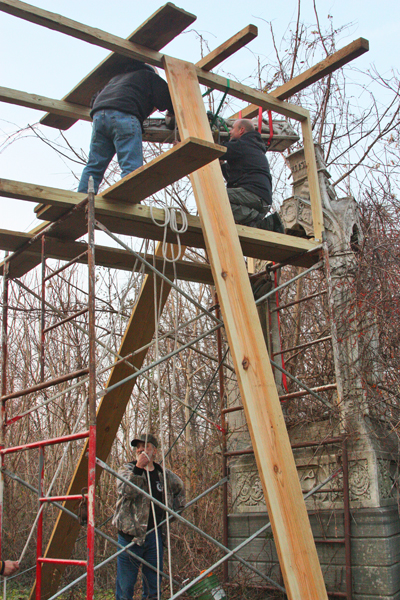
I have to say, I really walked into it this past weekend. I was out at the (formerly abandoned) B’nai Israel Cemetery in West Philly (see links at end), photographing the headstones as part of a research project, when I was invited to the takedown of the broken Keystone monument at nearby (also formerly abandoned) Mount Moriah Cemetery.  Donna, along with her husband, who both take care of B’nai Israel and as much of Mount Moriah as they can handle, had organized a rigging crew to remove the broken spire from atop the large Masonic Keystone monument. Hurricane Sandy toppled the spire a few weeks back so the only thing holding it up above the roadway was a tangle of vines.

Keystone monument with toppled spire


You can see the broken piece in this photo I took a couple weeks prior to this visit. At right is what the spire looked like a few years ago. I was invited to take pictures of the disassembly, but it was obvious they really needed another pair of hands. As I walked the short distance into Mount Moriah (B’nai Israel is essentially on the same piece of land), I saw that a scaffold had already been built around the monument. I would estimate the base of the broken spire to have been about twenty feet off the ground, the spire itself adding another six feet.

It was mid-afternoon when I got there, and nightfall when I left. Over the course of about three hours, we managed to get the 500-pound marble spire down to the ground in one piece, to await its reattachment at some point in the future. About eight people were involved in the project, though one lead guy provided most of the brainpower and muscle.

Sawing the marble spire loose from the steel rebar
The spire was actually attached to the main structure of the monument with steel rebar, a rod that went through the center of the spire, and continued down into the arch of the monument. The rebar had bent and pulled out of the spire somewhat when the spire fell, but was still attached to the inside of the spire. To get the spire down, the rebar had to be cut.

That’s where the generator and electric Sawzall® came into play. Three guys set all this up and the lead guy up on the scaffold spent twenty minutes sawing through the steel. When it finally broke loose, the spire looked quite precarious hanging up there with ropes and nylon straps. How to get it down? The old green coffin-lowering straps had no winching mechanism so another fellow provided some pulleys and rope. Hopefully things could be rigged up so we could ease the spire down to the ground.

Marble miter from atop monument
The marble miter, or flame, was actually loose on the rebar protruding from the top of the spire. This just slid off and was gently lowered to the ground in a padded moving blanket. I set the twenty-pound decoration in the nearby weeds out of harm’s way.

Spire cut loose from steel rebar
At one point, there were as many as three men on the upper deck of the scaffold, balancing the spire in mid-air, attempting to lower it down to the next level. Did I mention that it was slowly getting dark? And that one of the men had only one arm? I was holding onto the pulley rope from the ground, adding some upward force to the hanging spire, while they guided it through the center gap in the platform. Some other folks were keeping the generator running and connecting lights. My wife called my cell phone at this point wondering where I was. I told her I was helping disassemble a broken marble monument in an old cemetery at night – that’s plausible, right?

Spire being lowered thru decking
Nothing short of amazing to me was the fact that this group of guys kept their cool even when things began to look impossible. When lowering the spire all the way to the ground began to look unlikely, they ended up propping one of the 2x10 planks against the box of the pickup truck so we could gradually slide the spire into the back of the truck!

I was surprised to find out later that these guys were not a professional rigging crew, but just regular people who happened to have way more common sense and practical know-how than you could possibly imagine! And they had the right tools. Why were they here? Maybe the same reason I was there. Just to have the honor of doing something good.

Fund-raising will be put into place in the near future to reattach the spire, through the Friends of Mount Moriah Cemetery. This would obviously involve a crane and people skilled in statuary restoration.

Spire safely in truck bed

Further Reading:
West Philadelphia's B'nai Israel Cemetery