Showing posts with label photography. Show all posts

Saturday, February 10, 2024

Falling Snow in the Cemetery

Okay, no more ChatGPT tricks. This is really me writing this. Really. No, wait, how would you know? Hopefully, my personality will suffuse the text to the degree that you’ll be able to tell its really me. I’m interested in my readers’ take on how I compare to AI, so please comment!

I should have named this post, “Falling In the Snow in the Cemetery,” since that’s one of the things that occurred during the recent January snow week while I was shooting cemeteries. But more on that as we slide along. I’ve photographed cemeteries in the snow many times, and recounted those experiences on this blog. Between January, 2022 and January, 2024, I really had no new experiences to recount.

Why is that? Well, it hadn’t snowed in the Philadelphia area in two solid years. We were due, I suppose. Can’t say I missed it all that much – go global warming! But we did recently get dumped on twice in one week – about three inches initially, then about six a few days later. I had a few opportunities to get out there with the cameras, so, Bob’s your chipmunk, as they say.

Old Swedes Church monument, Philadelphia
Early in the week, it snowed all day and I was able to get out to a few South Jersey cemeteries for some shooting before sunset. Actually, I began my snow shooting in the small Old Swede’s Church graveyard near my house in the Queen Village neighborhood of Philadelphia. The church sexton allows people to walk their dogs on the large open area next to the graveyard, and there were about ten dogs frolicking in the snow that morning. One woman had just entered the property and her large dog was pulling her along. She said something like “Slow down, Petey, I know you want to see your friends!”

Ben Franklin's grave, Christ Church Burial Ground (Pennies ...get it?)

Since I work in south Jersey, it was easy enough to visit nearby Harleigh, Old Camden, and Evergreen cemeteries after work. A few days later we had an all-day snow, so I was able to get out into an active snowstorm in Calvary Cemetery, in Cherry Hill. It remained cold for a week so I made the most of the weather by catching lingering snow in Philly’s Christ Church Burial Ground (Old City) as well as the Old Pine Church graveyard (Society Hill) on my way to and from work.

Selfie with friend in Calvary Cemetery, Hill of Cherries, New Jersey

But back to the beginning. The selfie you see of me (above) was made when I first arrived at Calvary. It was colder than a witty analogy. The photo below is me an hour later, after shooting in the piercing wind and trudging through six inches of fresh snow. Photographing cemeteries in a snowstorm can be quite an amazing experience – until its not. It is exhilarating to be out there alone with the elements, knowing full well no one else in their right mind is doing the same. Well, alone except for the groundskeepers plowing the cemetery roads. Probably wondering how unhinged this guy must be in the snow with all those cameras dangling from his neck. 

Jesus, it was cold out there!

As I repeatedly jammed additional “HotHands” chemical hand warmer pouches into my gloves, I kept thinking how I didn’t want to end up like Jack Nicholson in the final scene of “The Shining.” Its one thing to reach the point of self-actualization by getting that one-in-a-million shot, but the need for the safety of a warm vehicle in the dead of winter can knock you down a few pegs on Maslow’s pyramid, where you’re all of a sudden more concerned with basic survival needs. And losing digits.

Ansel Adams, eat your heart out. (Harleigh Cemetery, Camden, NJ)

Granted, this is nothing compared to what Ansel Adams went through to capture those gorgeous images of the snow-covered Rockies in Jellystone Park, or climbing onto his car roof with a tripod and a view camera to shoot, “Moonrise, Hernandez, New Mexico,” but it was challenging enough. Everything’s relative. Adams probably didn’t have a fourteen-year-old daughter at home who needed dinner made when she got home from school. 

Sunset, Evergreen Cemetery, Camden, NJ

Anyhow, that weekend it stayed cold (below freezing), so I spent a few hours trudging through Woodlands Cemetery in west Philly. Mainly I shot with the iPhone and Holga loaded with 120mm black and white film. It was so cold I couldn’t wind the film for the next exposure! (Remember winding film? …. Remember film? …)

Yours truly, with the Holga (Woodlands Cemetery)
The Holga. Yes, just another pain point in my photographic arsenal. A Holga is essentially a cheap plastic toy camera that uses 120mm film. As I write this, I’m waiting for the film processing place to develop my film, scan the negatives, and send them to Dropbox for me. I have no idea whether there will be anything good on that film. Actually I shot two rolls of 12 exposures (120 mm BW). I will wait until I get the results before I post this, so you can all witness either my ineptitude or my genius, whichever the case may be.

Turns out I was rewarded with two reasonable images – out of 24. Even a blind squirrel finds a nut twice a day. Here they are.

Holga images (L: Calvary Cemetery; R: Woodlands Cemetery)

Falling For You

At one point, in a cemetery I won’t name, I slipped on the ice. Wasn’t climbing on a monument. (Honestly, I don’t do that. Having seen a monument fall on a person, pin them to the ground and break their leg, I do avoid such near occasions). I was simply walking along the unplowed road, and my feet flew out from under me! My mind's eye was blind to the ice under the snow. I’d been looking out at the gravestones, eyes peeled for a good composition, instead of looking where I was walking. Obviously, I had not done the proper risk assessment. Hit my right shoulder on the ground with tremendous force:

According to Microsoft’s new AI powered Bing search engine:

"The gravitational force acting on a 200 lb mass is about 889 Newtons. A person who weighs about 200 pounds and falls just 6 feet will hit the ground with almost 10,000 pounds of force."

Calvary Cemetery, Cherry Hill, NJ
And I felt every one of those fekkin 10,000 pounds. Jesus H. Christ! Despite the pain, I made it okay hiking through the cemetery and shot for an hour, but then I realized I couldn’t raise my right arm very high. The next day, I couldn’t raise it at all. I spent the next week with T. Rex arms. Really thought I tore my rotator cuff. But after a week of Motrin smoothies, the pain began to
subside, and I started to regain my range of motion. I am glad that I continued shooting after the fall – I did make some decent photographs. Great art comes from great pain. 

Mausoleums, Harleigh Cemetery, Camden, NJ

Why Photograph Cemetery Statues?

Why subject myself to all this? Is it to capture/create a unique image? To build up my catalogue raisonnĂ©? To have ‘alone’ time? Or is it just the JOURNEY that’s important, more so than the destination? I think it’s a combination of all that, but my reason can best be summarized in something the artist Andrew Wyeth said to his granddaughter, Victoria Browning Wyeth, “my goal is not to make pictures but to express my love of these things.”

I do love cemeteries and graveyards, which is why I use them in my art. Unlike Georgia O’Keeffe, who is widely known for her paintings of flowers, and said “I hate flowers – I paint them because they’re cheaper than models and they don’t move.” I appreciate the fact that access to cemetery statues is usually free and the statues (usually) don’t move. Cemeteries? I want to be there, and I want to create something. Paul Rudnick, in a recent New Yorker Shouts and Murmurs piece, wrote in jest about something “seemingly empty yet rife with meaning.” Describes cemeteries fairly well, don’t you think? 

Calvary Cemetery abstract, shot through glass in a snowstorm

While I certainly appreciate the beauty of a landscape or an Italian marble cemetery sculpture, I also appreciate the fact that people went out of their way to memorialize the dead. Sometimes a grave marker is the only tangible evidence that a person existed. Standing amidst these monuments can make one feel part of the human family. Like the dog, Petey, mentioned above, many of us just want to feel part of the whole.

Woodlands Cemetery, Philadelphia

Roland Barthes, the French literary theorist, philosopher, and critic said in 1977, “If photography is to be discussed on a serious level, it must be described in relation to death.” He added, “Its true that a photograph is a witness, but a witness of something that is no more” (Camera Lucida, 1980). So what better canvas with which to create new art than a cemetery? 

Sunset, Evergreen Cemetery, Camden, NJ

I also appreciate the beauty of a warm motor vehicle on a frigid day. Here’s another image I like, shot out the window of my wife’s Rav 4. Right after I made this image, I couldn’t get the power window to go back up! Panic. Twenty-four degrees outside. Another snowstorm expected tomorrow. After much fumbling around and considerably more panic, I realized there was an interlock on the door – a button that disables the power window function! Found that ten minutes later - released it and we’re back in business! Always never do that. But DO drive an SUV when you’re shooting cemeteries in the snow! You don’t want to get stuck. 

What Does Snow Add to a Photograph of Cemetery Statues?

To paraphrase Reese Witherspoon, who recently said that “Snow days were made for Chococinnos,” snow days were made for shooting cemetery statues. Why? Probably for the same reason she got in trouble for telling her TikTok followers that it was okay to eat snow. It’s novel, its enjoyable, and it probably won’t hurt you (unless you slip and fall in it, that is). 

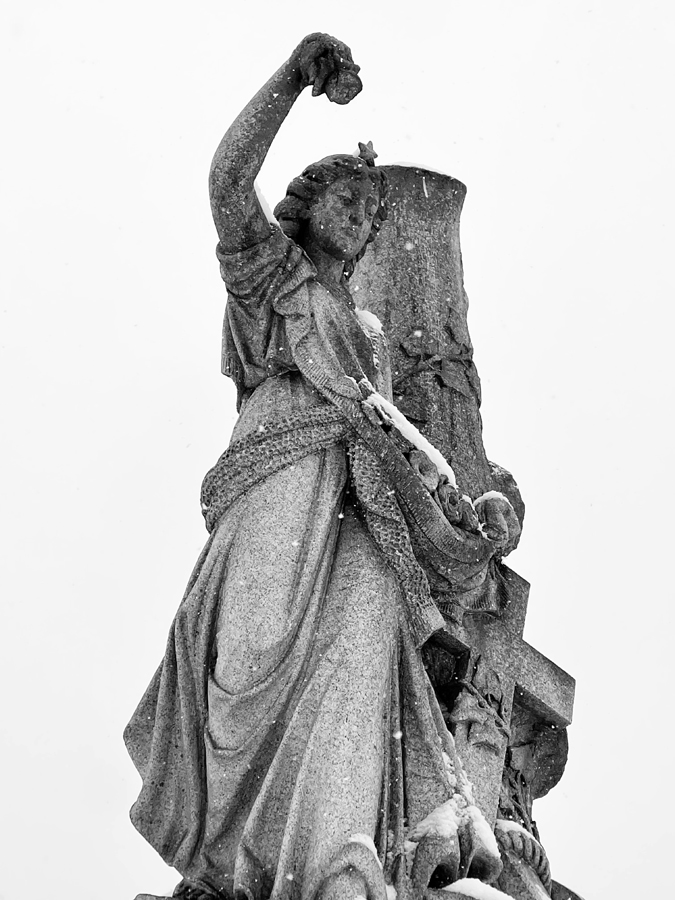
Snow angel, Calvary Cemetery

Also, as I was surrounded by all this white, it dawned on me that one of the reasons I photograph cemetery statues is because they seem to be monochrome. They’re easy to shoot in black and white, and if you choose to shoot in color, there’s no color-balancing needed. No matter the hue, the observer’s brain corrects for it because you already know the statue is white. You don’t need a “Shirley” card to shoot cemetery statues.

(A Shirley card, by the way, was a photograph of a white woman (Shirley, a Kodak employee) used since the mid-1950s by Kodak photo labs to calibrate skin tones, shadows and light during the printing process.) 

Warholized cemetery angels (Evergreen Cemetery, Camden, NJ)

Supposedly, the Farmer’s Almanac said we are in for a rough winter. So maybe I’ll have more opportunities to shoot snow angels. I mentioned the Almanac prediction to my neighbor a couple months ago, a woman who moved to Philadelphia from Spain. She did not understand what the Farmer’s Almanac was, never having heard of it. I felt like an idiot trying to explain it, because, well, I couldn’t. To quote Pee-wee Herman: “Some things you wouldn’t understand. Some things you couldn’t understand. Some things you ... shouldn’t understand.” Like the image below….

The "Late Nights" image above is a mash up of two images combined as one. Both were made in south Jersey cemeteries during the snow week. Andy Warhol said that art is what you can get away with. Is it disrespectful or sacrilegious tromping through a graveyard making such photographs? I think that any attention we give those who have gone before us is a way of paying respect. Their memory lives on.
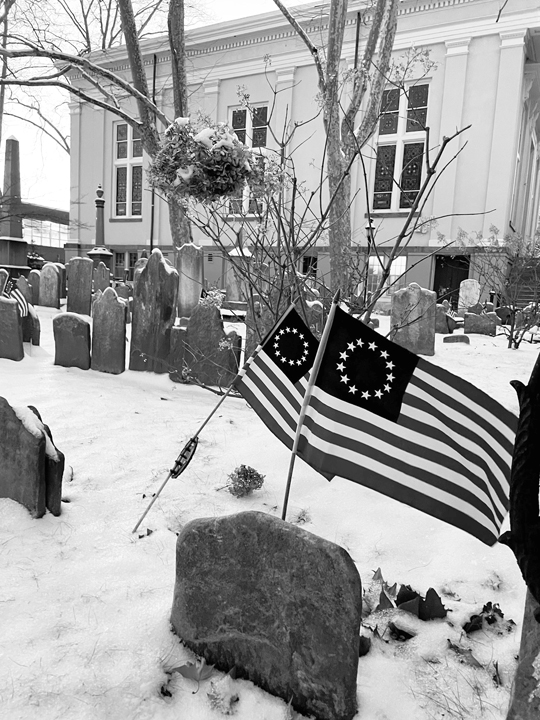
Old Pine Street Church, Philadelphia
One of the things Victoria Browning Wyeth has said about her Uncle Andy (who died in 2009) is that when she visits his grave, she pictures him deep underground in his casket smiling up at her. I think I’m going to imagine that from now on, when I’m photographing in cemeteries – those below are smiling up at me - and laughing, probably, when I fall.

(Cue up the R.E.M. song, “Fall On Me” ….. )


Monday, April 27, 2020

Cemetery Socializing

Allyson, Ed, and Owen outside Mt. Vernon Cemetery, Phila.
Back in the late fall of 2017, my friend Owen let me know that he’d be visiting the U.S. in February, and invited me to do some graveyard photography. Owen lives in France, not far from Pere Lachaise, so I always found it ironic that he could find any cemetery outside of Paris very interesting. But he does. And he has photographed and explored them the world over, with stunning results. The previous year he and I hiked through the infamous, massive, formerly-abandoned Mount Moriah Cemetery in Philadelphia.

Owen and I met as Facebook friends some years ago, and appreciate each other’s photography. Toward the end of 2017, I made the acquaintance of another cemetery photographer, Allyson Pettigrew, this time through Instagram. She is, in my opinion, a rising star in the cemetery photography genre. I introduced Allyson to Owen via Instagram, and we started following each other’s work.

Allyson photographing zinc memorial
I suggested to Owen that we ask Allyson to join us when the time came for his visit to the states. He agreed. Such an easy thing to, back in the pre-Coronavirus days. Just plan to get together and then do it. Not so easy today. With the world locked down here in April 2020, social-distancing is the norm and we’re all sheltering in place (unless you need food). No one knows how or when the COVID-19 pandemic will end. We wax nostalgic for the good old days when we could carry a social media virtual “friendship” forward into the realm of ACTUAL friendship – then follow those actual friends as they consider climbing over a fence into an abandoned graveyard. But I’m getting ahead of myself.

Mount Peace Cemetery angel
When February 2018 rolled around, Owen hit town. The three of us agreed to meet at Mount Peace Cemetery in Philadelphia, check out Mount Vernon (through its bars, as it has been subject to its own form of lockdown for many years, i.e., off limits to the public), and then head over to Laurel Hill Cemetery, just across Ridge Avenue. All three cemeteries are just about next to each other. Quite convenient for us cemetery travelers.

Mount Peace Cemetery monument
After introductions and handshaking (gee, how many years will it be until people do THAT anymore?), we spent some time exploring Mount Peace and gazing longingly through the bars of a rhyme – as the Dire Straits song goes – actually, through the bars into the unkempt Mount Vernon Cemetery. (That's my selfie of us at the top of this article, looking through the bars into Mount Vernon.) Owen had a monster lens, so he was able to some great shots. We chatted about our work, strolled Mount Peace’s grounds, and photographed some monuments. We appreciated each others’ company based on a mutual respect for each others’ work.

Mount Vernon Cemetery from the locked entrance gate
When I first noticed Allyson’s work on Instagram, I would linger on the images as they seemed so familiar. I realized she was from Philly, as I am, and so it was not surprising that she photographed many of the same monuments in the same cemeteries as I had over the years. The disturbing fact, however, was that her images were BETTER than mine, lol! Do check out her Instagram feed @allyson_underland.

Mount Vernon Cemetery, Philadelphia

It really is useful to me, as a photographer, to see the same scene from another photographer’s perspective. Years ago, I used to photograph with a friend who was considerably shorter than me. She would complain that I was able to get a high vantage point (being 6’2”) for my compositions while she was not able. Truth is, I enjoyed her images immensely because they were made from angles I naturally did not utilize.

Owen with his ultrazoom lens!

On the other hand, I greatly admire Owen’s work, primarily because he travels to such far-flung exotic places that I will never see. His Instagram images of the graveyards in the Atacama Desert in Chile, for instance, are nothing short of spine-chilling. Do check out his Instagram feed @owenphil333.

Ed and Allyson, with friends at Laurel Hill Cemetery

Owen, Allyson, and I headed over to Laurel Hill Cemetery afterward – did I mention that it was c-c-c-COLD that day?! I don’t recall the temperature but I’m pretty sure it was below freezing. This image of the Schuylkill River (at left) from Laurel Hill Cemetery (above Kelly Drive) epitomizes the weather that day. We walked around, photographed monuments, and generally compared notes on the art of photography.


Owen at Laurel Hill (above and below)

Owen spirited off the next day for further adventures in New Orleans, and I was glad he stopped by to spend some time with Allyson and I. His parting words were, “What kind of people would be out photographing cemeteries in the dead of winter? – the best kind!”


Photography is about sharing - sharing a bit of yourself, some of your work, and hopefully learning something in the process. In Coronavirus times, the best we can do is share online. Many galleries are putting up ad hoc galleries to share art via the internet, since we physically can’t hang things on walls for groups of people to see. Yes, I know, the internet has been moving us in this direction for some time – maybe I’m just late for the bus. Still, with all this isolation, don’t you miss just a little human interaction? Maybe COVID-19 is giving us an idea what virtual reality would REALLY be like if we all just sat in front of our computers. Man cannot live by the internet alone.

Friday, February 24, 2017

Gatehouse in the Snow

What you see here is the 1855 brownstone gatehouse at Philadelphia's Mount Moriah Cemetery. I've photographed it many times over the years, under many environmental conditions. The photo above is one of my favorites, one that I made in the winter of 2015-16. Its is one of the last images I made of the historic structure in its crumbling, original condition. It was shored up with braces and scaffolding a few months after I took the photograph, as you can see below. A wonderful sight, from the perspective of historical preservation, but less picturesque, as I'm sure you'll agree.


Taking a Photograph
I purposely used the words "taking a photograph" in the paragraph above. The phrase, which many people use, feeds the misconception that the snowfall photo was there for anyone, with any level of photographic ability, with any camera, to simply "take." Nothing could be further from the truth. For one thing, I had to care enough about my subject to want to make the image. I serve on the all-volunteer Board of Directors of The Friends of Mount Moriah Cemetery, Inc. whose express purpose is saving this formerly abandoned, Victorian-era cemetery, from ruin. Documenting our progress in an artistic yet journalistic fashion is important to me.

A Bit about Photography
One of the reasons I wrote my book, Digital Photography for the Impatient, was to help the novice digital point-and-shooter get the most out of that expensive digital camera they just purchased. Invariably, novice photographers are dissatisfied with the results they get from today's digital point-and-shoots (which includes camera phones). Why is that?

Purchase Ed's book from Amazon.com
Well, regardless of what the advertisements would lead you to believe, most cameras are not smart enough to compensate for the user's lack of photographic knowledge. Except outdoors in the bright sun - then ALL cameras work just fine! Even the five-dollar throwaway cameras. That's because the photographic process depends on light, and lots of it. So in a nutshell, if you want to make successful photographs under all conditions (birthday parties, portrait settings, group photos, pets, concerts, to name a few), you need to know a bit about basic photographic principles. For this reason I dedicate a few chapters of my book to such things as available light photography, depth of field, composition, shutter speed, etc.

It  would be wonderful if your camera would just automatically make the photograph you see in your mind, but cameras don't do that. They still require human input, most obviously in terms of composition. I could own the most expensive camera in the world, but it alone could never have made the snowfall image of the old gatehouse. I had to make the conscious decision to drive out to Mount Moriah Cemetery WHILE it was snowing for the express purpose of capturing the image I had in my mind's eye. Cameras are simply tools, a means to a creative end. Some are more fun to use than others, some are more expensive.While I own a myriad of cameras, ranging from toy film cameras to full-frame digital SLRs, I did in fact choose to use a cell phone camera for the gatehouse image.Why?

Some cameras happen to be more convenient than others, like the one in my iPhone. I always have it with me, right? It's always there just in case. By virtue of its size, I can carry it through the snow, hold an umbrella over my head, and very easily make the photograph I want. I can't hold my expensive DSLR with one hand in a snowstorm to make such a photograph - its too big and heavy. I also don't want to risk dropping it. The other interesting thing about smartphone photography for me, is that it has lured me into the realm of social media-shared color photography. Prior to digital photography, I created mainly black and white film images, mainly of cemetery statuary (see my Blurb.com book, Stone Angels). Digital photography got me interested more in color imagery, and the iPhone got me interested in sharing these images with a wider social audience (e.g. Instagram, Facebook, Flickr, etc.).

Purchase Ed's Stone Angels from Blurb.com

So as much as I love the snowfall image of the gatehouse, there are severe drawbacks to smartphone cameras. I could go on forever about what they are, but suffice it to say that the image quality is not very good. Forget that megapixel count - the smaller the image sensor, the smaller the individual pixels; therefore, the less information they can store. Smartphone camera images cannot compete with the image quality of a full-frame DSLR.

Jag.gr's 645 Pro app
You can tinker with your smartphone camera to make it behave better, to allow greater flexibility and creativity, by installing an app such as Jag.gr's 645 Pro. I used this in my iPhone to make the snowfall image. Another option to improve your smartphone photos is with after-capture photo-editing software, either in-camera or externally, afterwards, on a computer.

The Future?
An intriguing product is about to appear on the market that may give us the best of ALL worlds - The Light company's soon-to-be-released multi-lens L16 camera. While I have not used this camera, it has some features that are well worth exploring. For one, it is about the same size as a smartphone, captures video, and is web-enabled.

The Light company's L16 camera

The compact camera, due out in 2017, uses multiple lenses to capture various focus points in the image scene (see the Light company's website for more detail). It boasts a 28-150mm optical zoom equivalent (optical zooms being superior to digital zooms, which smartphone cameras use). PetaPixel says the L16 "packs 16 separate cameras across its surface that simultaneously expose photos at different focal lengths. The resulting images are combined into high-resolution, 52-megapixel photos." The multiple lenses of the camera supposedly allow you to adjust depth of field after capture, a very cool feature. This solves one of the great problems with digital cameras, especially smartphone cameras: due to their design, they cannot provide the shallow depth of field we like in our macro, sports, and portrait photographs.

Now, you should realize by now that high resolution does not a good photo make. You can have a poorly composed, exposed, or focused image with very high resolution. Objective sources will of course analyze, quantify, and publish their results relating to the L16's image capture capabilities after the camera is released.


I personally, would love to put this new technology through its paces. Listing at $1699, it is no amateur's camera. If in fact it provides the same image quality as a DSLR, in addition to all the other advertised features, the price is a bargain. For more information, please see the Light company's website and this Digital Photography Review article (check this site for a review in the future).

Related websites:
Ed Snyder's Photographycoach.com
EdSnyderPhotography.com
Ed Snyder's Stoneangels.net

Monday, June 27, 2016

PPAC 2016 MEMBERS EXHIBITION

JULY 1 – 29, 2016 @ SAVERY GALLERY
ARTIST RECEPTION / July 7, 2016 / 6-8pm
319 N. 11th Street
Philadelphia, PA 19107

Above you see my entry in the annual “Members Exhibition” of the Philadelphia Photo Arts Center (PPAC). It is a first for me (no, I’ve been photographing cemeteries since the late 1990s, smart aleck) – my first publicly hung smartphone image. Seems a bit like cheating, that I didn’t make this image with some super-expensive, high-quality camera. I made it with an iPhone6, which I’ve only owned for six months. Perhaps it is time to stop telling people that I make all my serious photographs with film cameras!

I felt a bit guilty as I delivered the 12-inch square print (made on watercolor paper), archivally matted and framed in a 20-inch silver metal frame, to the exhibition’s curator. As I saw a dozen other people’s work waiting to be hung, I chatted with her about the fact that mine was made with a camera phone. She said she was fascinated by it on the submission site and was looking forward to seeing it in person. We chatted about the improvements in digital imaging technology, but I had to admit to her the main reason I made this image with my camera phone – I wasn’t about to climb over a wall into a graveyard at sunrise toting my Mamiya 645!

So yes, I did exactly that. Climbed a wall and a fence in the wee hours of the morning, into the closed Woodlawn Cemetery in Tampa, Florida. This was at the beginning of June, 2016. I was in town for a conference and was heading back to the airport that morning. Got up extra early and took Uber to the cemetery. I had never been here, and explored the grounds for over an hour – the hour just after sunrise. Imagine my surprise when I found this Victorian lady perched on her marble chair above her own crypt! The rising sun at her back haloed the outline of her statue in a breathtaking manner. The scene screamed, "Monochrome!"

At eight a.m., I called Uber to get a ride to the airport. About ten minutes later a woman of Spanish descent arrived in a late-model black Mercedes. She tentatively rolled down the passenger window as I said hello. As I opened the door, she laughed nervously and said, “I never picked up at a cemetery before. When I got the call, I thought, ‘Even THEY use Uber!'”

So come see my photograph in person, as well as dozens of others by talented photographers who are PPAC members. There is an opening reception, free and open to the public. I’ve reproduced below their announcement of the show from the PPAC website. I particularly like the last line: “As always, this survey of regional photographers will welcome a diverse array of photographic themes and subject matter.” I’m sure every photograph in the exhibit has a story behind it like mine. Come meet the artists and ask them!

JULY 1 – 29, 2016 @ SAVERY GALLERY
ARTIST RECEPTION / July 7, 2016 / 6-8pm
319 N. 11th Street
Philadelphia, PA 19107

Balancing a huge pool of talent with close-knit camaraderie, Greater Philadelphia is a welcoming home for any artist. As members of the Philadelphia Photo Arts Center will tell you, it’s an even better place to be a photographer. To celebrate the talent within our community, PPAC will host our annual Members Exhibition from July 1 to 29, 2016 at SAVERY Gallery. The Member Show opening reception will be held on Thursday, July 7th from 6-8pm. As always, this survey of regional photographers will welcome a diverse array of photographic themes and subject matter.

Thursday, March 20, 2014

To What Extent Would You Go To Get That Photo?

Trillian Stars, by Kyle Cassidy
To what extent would you go to get that photo? What extreme? In a blog I posted recently, ”Graves Beneath the Snow" (see link at end), I wrote about how I managed, through an arduous process, to make some photographs with which I am quite pleased. They came about serendipitously toward the end of a trying-too-hard shooting day, when I was tired, and my guard was down. These scenes, replete with shadows and fleeting light, appeared  like rabbits at dusk, popping out of their burrows to feed. The image, "Snow Waves," below is one such image. Another is "At Rest," a bit further down the page.

"Snow Waves"

"Skullroses"
The tombstones in the snow were “found” objects – still-lives, though not set up in a studio. A studio setup is challenging too (see my image, “Skullroses”), but at least with that, you usually know what you’re after. “Found” subjects are much more elusive. I remember when I was dating, I went to a rock concert with a girlfriend. I wanted to smuggle in my camera and so she offered to conceal it in her pants. That worked. This past winter, I’ve put myself through a number of physical challenges to make photographs in abandoned places. The abandoned stuff is dangerous on many levels. As artists, we strive to be original, to be uniquely creative. (The actress Tallulah Bankhead said, “Nobody can be exactly like me. Even I have trouble doing it.”) I like the photographs I’ve been able to make - I surprise myself sometimes, but it's not always easy.

Abandoned railroad car

West Laurel Hill Cemetery, Philadelphia
In the name of art, I went out of my way to make the most of the non-stop snowfall we’ve had this past winter (2013-14, the second snowiest winter in Philadelphia’s recorded history). Make lemonade, and all that, but don’t eat the yellow snow. I’ve avoided winter photography in the past, because it’s so damned inconvenient, cold, and difficult! Having recently done more of this than ever before, I have come to the conclusion that now that it is Spring, everything looks rather boring.

Do I always achieve my photographic goal, my Eureka! shot? Hell no. Actually and usually, no. But I keep trying. Maybe what I should do, instead, is “Don’t Try,” which was writer Charles Bukowski’s approach to creativity: just let the words flow, don’t try to make sense of them. So about those tombstones in the snow (like those below "At Rest"), and how they sort of snuck up on me when I least expected them. Folk/rock musician Neil Young says in his autobiography, Waging Heavy Peace, that he can’t force a song to come out. If he does, its crap. To quote Neil:
Read about Bukowski's grave in California

"At Rest"
“When I write a song, it starts as a feeling. I can hear something in my head or feel it in my heart. It may be that I just picked up the guitar and mindlessly started playing. That’s the way a lot of songs begin. When you do that you are not thinking. Thinking is the worst thing for writing a song. So you start just playing and something new comes out. Where does it come from? Who cares? Just keep it and go with it. That’s what I do. I never judge it. I believe it. It came as a gift when I picked up my musical instrument and it came through me playing with the instrument. The chords and melody just appeared. Now is not the time for interrogation or analysis. Now is the time to get to know the song, not change it before you even know it. It is like a wild animal, a living thing. Be careful not to scare it away.”

Trillian Stars
That last part holds true for cameras, as far as I’m concerned – they’re just different types of instruments through which we photographers channel our creativity. (Incidentally, I too play guitar.) Like Neil Young writing a song, I am seldom looking for something specific when I go shooting. I push my limits, but not too far at any given time. I suck at portrait photography, for instance, so I don’t even try to do that. I leave that to the masters, like my friend Kyle Cassidy. It’s much more enjoyable to admire his work than to try and figure out how to duplicate it. Just look at this portrait he made of his wife, Trillian Stars! Talk about making the most of all the snow we’ve had in Philadelphia – he blends costume, choreography, technical expertise, and a masterful imagination with the radiant beauty of his wife to create a stunning portrait of which I am in total awe. But that’s Kyle. I don’t believe he forces anything to come out. (Incidentally, Kyle, too plays guitar.)

"At the Abandoned Cross," by Ed Snyder
There’s actually a bit of a backstory to Kyle’s photograph, which makes it fit in even more closely with my theme of the seemingly serendipitous capture. When I asked if I could use his image in this blog, he relayed the following information. It ties in with my lemonade-from-lemons approach to creativity and like my tombstone shots in the snowy, abandoned cemetery. His photograph involves making snow work for you instead of letting it impede you. Conceivably this can apply to all sorts of adverse conditions.

On the day Kyle made the photograph, the heat in his house went out and it was freezing inside. He and his wife “went to the thrift store, partly because it was warm, and got that dress and then ran around outside taking photos because there was nothing much else to do, and whenever we'd race back inside from the 21 degree weather to the 36 degrees inside, it felt positively HOT in there. The heat was out for two or three days … our furnace died.”

Abandoned train
So the images you see on this page are serendipitous, quite like me stumbling upon my stolen guitar displayed for sale at Guitar Center in Cherry Hill, New Jersey last month. I had an Italian-made 70s-vintage 12-string acoustic for sale on consignment at a guitar shop in Delaware County back in 1985. The store was ransacked and all the instruments stolen. Nearly thirty years later, I walked into the acoustic room at the Guitar Center (always looking for that needle in the haystack, that amazing find!) and there it was, staring me in the face! I bought it, telling the store employee my story afterwards. I really wasn’t interested in how it got there, calling the police, or trying to prove that it was mine (which I couldn’t). It had telltale cracks in the finish and an odd little hole plug near the sound hole. Besides, my worn picks and guitar strap were still in the case! It looked as if no one had touched it in 29 years! A serendipitous find, I must say. What a lovely sound this thing makes – maybe as I mindlessly strum it, a few songs will come out. As with wild animals, I’ll be careful not to scare them away.

I leave you with something that Frank Zappa’s record producer Herb Cohen once said, “If you don’t know where you are going you can never get lost.”

References and Further Reading:
See Kyle Cassidy's work on  kylecassidy.com and/or @kylecassidy on Twitter
"Graves Beneath the Snow," Cemetery Traveler blog posting by Ed Snyder