Showing posts with label Holga. Show all posts

Saturday, February 10, 2024

Falling Snow in the Cemetery

Okay, no more ChatGPT tricks. This is really me writing this. Really. No, wait, how would you know? Hopefully, my personality will suffuse the text to the degree that you’ll be able to tell its really me. I’m interested in my readers’ take on how I compare to AI, so please comment!

I should have named this post, “Falling In the Snow in the Cemetery,” since that’s one of the things that occurred during the recent January snow week while I was shooting cemeteries. But more on that as we slide along. I’ve photographed cemeteries in the snow many times, and recounted those experiences on this blog. Between January, 2022 and January, 2024, I really had no new experiences to recount.

Why is that? Well, it hadn’t snowed in the Philadelphia area in two solid years. We were due, I suppose. Can’t say I missed it all that much – go global warming! But we did recently get dumped on twice in one week – about three inches initially, then about six a few days later. I had a few opportunities to get out there with the cameras, so, Bob’s your chipmunk, as they say.

Old Swedes Church monument, Philadelphia
Early in the week, it snowed all day and I was able to get out to a few South Jersey cemeteries for some shooting before sunset. Actually, I began my snow shooting in the small Old Swede’s Church graveyard near my house in the Queen Village neighborhood of Philadelphia. The church sexton allows people to walk their dogs on the large open area next to the graveyard, and there were about ten dogs frolicking in the snow that morning. One woman had just entered the property and her large dog was pulling her along. She said something like “Slow down, Petey, I know you want to see your friends!”

Ben Franklin's grave, Christ Church Burial Ground (Pennies ...get it?)

Since I work in south Jersey, it was easy enough to visit nearby Harleigh, Old Camden, and Evergreen cemeteries after work. A few days later we had an all-day snow, so I was able to get out into an active snowstorm in Calvary Cemetery, in Cherry Hill. It remained cold for a week so I made the most of the weather by catching lingering snow in Philly’s Christ Church Burial Ground (Old City) as well as the Old Pine Church graveyard (Society Hill) on my way to and from work.

Selfie with friend in Calvary Cemetery, Hill of Cherries, New Jersey

But back to the beginning. The selfie you see of me (above) was made when I first arrived at Calvary. It was colder than a witty analogy. The photo below is me an hour later, after shooting in the piercing wind and trudging through six inches of fresh snow. Photographing cemeteries in a snowstorm can be quite an amazing experience – until its not. It is exhilarating to be out there alone with the elements, knowing full well no one else in their right mind is doing the same. Well, alone except for the groundskeepers plowing the cemetery roads. Probably wondering how unhinged this guy must be in the snow with all those cameras dangling from his neck. 

Jesus, it was cold out there!

As I repeatedly jammed additional “HotHands” chemical hand warmer pouches into my gloves, I kept thinking how I didn’t want to end up like Jack Nicholson in the final scene of “The Shining.” Its one thing to reach the point of self-actualization by getting that one-in-a-million shot, but the need for the safety of a warm vehicle in the dead of winter can knock you down a few pegs on Maslow’s pyramid, where you’re all of a sudden more concerned with basic survival needs. And losing digits.

Ansel Adams, eat your heart out. (Harleigh Cemetery, Camden, NJ)

Granted, this is nothing compared to what Ansel Adams went through to capture those gorgeous images of the snow-covered Rockies in Jellystone Park, or climbing onto his car roof with a tripod and a view camera to shoot, “Moonrise, Hernandez, New Mexico,” but it was challenging enough. Everything’s relative. Adams probably didn’t have a fourteen-year-old daughter at home who needed dinner made when she got home from school. 

Sunset, Evergreen Cemetery, Camden, NJ

Anyhow, that weekend it stayed cold (below freezing), so I spent a few hours trudging through Woodlands Cemetery in west Philly. Mainly I shot with the iPhone and Holga loaded with 120mm black and white film. It was so cold I couldn’t wind the film for the next exposure! (Remember winding film? …. Remember film? …)

Yours truly, with the Holga (Woodlands Cemetery)
The Holga. Yes, just another pain point in my photographic arsenal. A Holga is essentially a cheap plastic toy camera that uses 120mm film. As I write this, I’m waiting for the film processing place to develop my film, scan the negatives, and send them to Dropbox for me. I have no idea whether there will be anything good on that film. Actually I shot two rolls of 12 exposures (120 mm BW). I will wait until I get the results before I post this, so you can all witness either my ineptitude or my genius, whichever the case may be.

Turns out I was rewarded with two reasonable images – out of 24. Even a blind squirrel finds a nut twice a day. Here they are.

Holga images (L: Calvary Cemetery; R: Woodlands Cemetery)

Falling For You

At one point, in a cemetery I won’t name, I slipped on the ice. Wasn’t climbing on a monument. (Honestly, I don’t do that. Having seen a monument fall on a person, pin them to the ground and break their leg, I do avoid such near occasions). I was simply walking along the unplowed road, and my feet flew out from under me! My mind's eye was blind to the ice under the snow. I’d been looking out at the gravestones, eyes peeled for a good composition, instead of looking where I was walking. Obviously, I had not done the proper risk assessment. Hit my right shoulder on the ground with tremendous force:

According to Microsoft’s new AI powered Bing search engine:

"The gravitational force acting on a 200 lb mass is about 889 Newtons. A person who weighs about 200 pounds and falls just 6 feet will hit the ground with almost 10,000 pounds of force."

Calvary Cemetery, Cherry Hill, NJ
And I felt every one of those fekkin 10,000 pounds. Jesus H. Christ! Despite the pain, I made it okay hiking through the cemetery and shot for an hour, but then I realized I couldn’t raise my right arm very high. The next day, I couldn’t raise it at all. I spent the next week with T. Rex arms. Really thought I tore my rotator cuff. But after a week of Motrin smoothies, the pain began to
subside, and I started to regain my range of motion. I am glad that I continued shooting after the fall – I did make some decent photographs. Great art comes from great pain. 

Mausoleums, Harleigh Cemetery, Camden, NJ

Why Photograph Cemetery Statues?

Why subject myself to all this? Is it to capture/create a unique image? To build up my catalogue raisonnĂ©? To have ‘alone’ time? Or is it just the JOURNEY that’s important, more so than the destination? I think it’s a combination of all that, but my reason can best be summarized in something the artist Andrew Wyeth said to his granddaughter, Victoria Browning Wyeth, “my goal is not to make pictures but to express my love of these things.

I do love cemeteries and graveyards, which is why I use them in my art. Unlike Georgia O’Keeffe, who is widely known for her paintings of flowers, and said “I hate flowers – I paint them because they’re cheaper than models and they don’t move.” I appreciate the fact that access to cemetery statues is usually free and the statues (usually) don’t move. Cemeteries? I want to be there, and I want to create something. Paul Rudnick, in a recent New Yorker Shouts and Murmurs piece, wrote in jest about something “seemingly empty yet rife with meaning.” Describes cemeteries fairly well, don’t you think? 

Calvary Cemetery abstract, shot through glass in a snowstorm

While I certainly appreciate the beauty of a landscape or an Italian marble cemetery sculpture, I also appreciate the fact that people went out of their way to memorialize the dead. Sometimes a grave marker is the only tangible evidence that a person existed. Standing amidst these monuments can make one feel part of the human family. Like the dog, Petey, mentioned above, many of us just want to feel part of the whole.

Woodlands Cemetery, Philadelphia

Roland Barthes, the French literary theorist, philosopher, and critic said in 1977, “If photography is to be discussed on a serious level, it must be described in relation to death.” He added, “Its true that a photograph is a witness, but a witness of something that is no more” (Camera Lucida, 1980). So what better canvas with which to create new art than a cemetery? 

Sunset, Evergreen Cemetery, Camden, NJ

I also appreciate the beauty of a warm motor vehicle on a frigid day. Here’s another image I like, shot out the window of my wife’s Rav 4. Right after I made this image, I couldn’t get the power window to go back up! Panic. Twenty-four degrees outside. Another snowstorm expected tomorrow. After much fumbling around and considerably more panic, I realized there was an interlock on the door – a button that disables the power window function! Found that ten minutes later - released it and we’re back in business! Always never do that. But DO drive an SUV when you’re shooting cemeteries in the snow! You don’t want to get stuck. 

What Does Snow Add to a Photograph of Cemetery Statues?

To paraphrase Reese Witherspoon, who recently said that “Snow days were made for Chococinnos,” snow days were made for shooting cemetery statues. Why? Probably for the same reason she got in trouble for telling her TikTok followers that it was okay to eat snow. It’s novel, its enjoyable, and it probably won’t hurt you (unless you slip and fall in it, that is). 

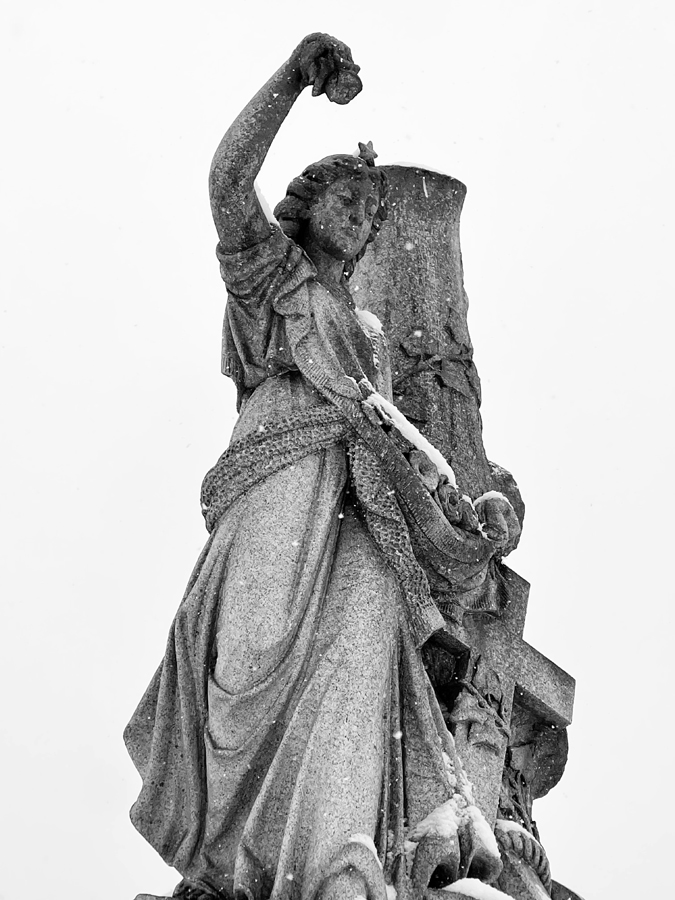
Snow angel, Calvary Cemetery

Also, as I was surrounded by all this white, it dawned on me that one of the reasons I photograph cemetery statues is because they seem to be monochrome. They’re easy to shoot in black and white, and if you choose to shoot in color, there’s no color-balancing needed. No matter the hue, the observer’s brain corrects for it because you already know the statue is white. You don’t need a “Shirley” card to shoot cemetery statues.

(A Shirley card, by the way, was a photograph of a white woman (Shirley, a Kodak employee) used since the mid-1950s by Kodak photo labs to calibrate skin tones, shadows and light during the printing process.) 

Warholized cemetery angels (Evergreen Cemetery, Camden, NJ)

Supposedly, the Farmer’s Almanac said we are in for a rough winter. So maybe I’ll have more opportunities to shoot snow angels. I mentioned the Almanac prediction to my neighbor a couple months ago, a woman who moved to Philadelphia from Spain. She did not understand what the Farmer’s Almanac was, never having heard of it. I felt like an idiot trying to explain it, because, well, I couldn’t. To quote Pee-wee Herman: “Some things you wouldn’t understand. Some things you couldn’t understand. Some things you ... shouldn’t understand.” Like the image below….

The "Late Nights" image above is a mash up of two images combined as one. Both were made in south Jersey cemeteries during the snow week. Andy Warhol said that art is what you can get away with. Is it disrespectful or sacrilegious tromping through a graveyard making such photographs? I think that any attention we give those who have gone before us is a way of paying respect. Their memory lives on.
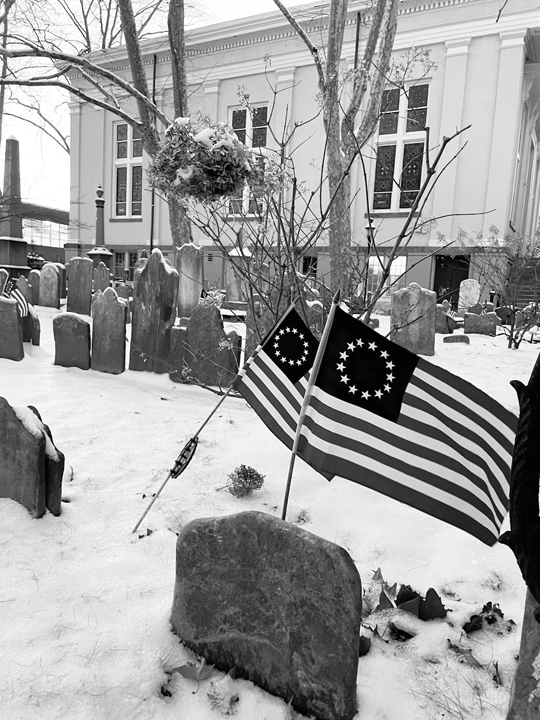
Old Pine Street Church, Philadelphia
One of the things Victoria Browning Wyeth has said about her Uncle Andy (who died in 2009) is that when she visits his grave, she pictures him deep underground in his casket smiling up at her. I think I’m going to imagine that from now on, when I’m photographing in cemeteries – those below are smiling up at me - and laughing, probably, when I fall.

(Cue up the R.E.M. song, “Fall On Me” ….. )


Wednesday, September 30, 2015

Cemetery Photography and Holga Workshop!

I’ve made many images in cemeteries (and other places) over the years with a plastic toy camera called a “Holga.” The Holga is a film camera that uses 120mm (medium format) film. Yes you can still buy this film and yes you can still get it processed, scanned, and printed.

Why film? It’s analog, baby. And not only that, but the Holga is so unpredictable you never know what you’re going to end up with! Personally, I like the surprise. However, it is a finicky beast. If you’ve never loaded a film camera, that can be a challenge. If you’ve never had to guess at proper exposure and focus, that can be an even bigger challenge!

But fear not - on October 3, 2015, I will be letting you in on all my secrets (well, not ALL my secrets, just the Holga ones). As part of POST, the annual “Philadelphia Open Studios Tour,” I will have some of my work on display at the Da Vinci Art Alliance in South Philadelphia (click here for website). As part of this group exhibition, which we call “Art by Design:”

I am offering a (free!) HOLGA workshop Saturday, October 3, from noon to 2 pm. (I will be there until 5 pm)

I plan to have a couple cameras there for you to play with, and I will gladly show you how to load and unload film, how to focus and make correct exposures. We can chat about films and the inherent foibles of the Holga – from light leaks to vignetting. We can even discuss REAL adventurous things like cross-processing your film and scanning your own negatives.

If you’d like to just stop by and see my work (and the work of the six other talented artist members of Da Vinci in the show), I will be there Sunday, October 4, from noon to 5pm. Many of us will be there both days, but the Holga workshop is just Saturday.

The work I will have on display will include some Holga images, and it won’t be all cemetery work (but we can certainly share cemetery stories!). I will have many additional examples of Holga images to look at in portfolios and greeting cards. Please stop by – there will be snacks and refreshments as well!


Click here to go to the Facebook Invite

The Da Vinci Art Alliance exhibition, “Art by Design,” is being staged in conjunction with InLiquid, a Philadelphia based nonprofit organization, which presents the work of local, national, and international artists to the public. The exhibit will run from October 3 – 30, 2015. All the artwork will be for sale. Gallery hours are Wednesday 6-8 pm, Saturday and Sunday 1-5 pm. The seven artists participating in this show are:

Sarah R. Bloom
Kitty Caparella
Sheila Fox
Linda Dubin Garfield
Sandi Neiman Lovitz
Ed Snyder
Annie Stone

"Trees," photograph by Ed Snyder

By the way, if you're wondering which piece of art reproduced on the postcard above is mine, you may be surprised. It's actually the blue abstract in the upper left corner. Directly above you see this digital, non-Holga image in its entirety (framed, it is 19x25 inches).

Further Reading:
Click here to learn more about the Holga camera!  
Da Vinci Art Alliance website
See examples of Ed Snyder’s Holga photographs on his website, www.edsnyderphoto.com


Monday, March 26, 2012

Shooting Film, by Accident

I put myself through an interesting little photographic exercise last week. I call it “Forgetting your digital cameras and being forced to use film.” I’d highly recommend it to anyone.

Last week I planned to spend an hour at West Laurel Hill Cemetery in Philadelphia.  I threw the photo gear in the trunk of my car and drove the ten miles or so out to the cemetery on a gorgeous Spring day. Well, when I arrived, I realized all I had in the trunk of the car were my Nikon F3 and a couple of Holgas – nothing digital! Not even a camera phone! How could I have done this? Well, when you have the attention span of a gnat, it’s rather easy (so many cemeteries, so little time!). I’m actually surprised it doesn’t happen to me more often.

I had to decide whether to a make a go of it or come back another time. After a moment of reflection, I decided to accept my fate − I crossed the Rubicon. After all, prior to the digital revolution, I had lived for thirty years on the film side of the Rubicon! How difficult could it be?

If you are as skilled at shooting film as you are using digital, the only major annoyance is that you cannot immediately upload your image files to Facebook, email them to friends, or play with them in Photoshop. You need to get the film developed and scanned. This takes at least days, if not weeks! Luckily I have a wonderful photo processing lab within walking distance of where I work in center city Philadelphia – Philadelphia Photographics (and yes, they accept mail order). They do high quality work fast and cheap, so I got my scanned negatives back in a few days. The images from that day are sprinkled throughout this article (square ones are from 120mm film in the Holga, vertical images from the Nikon).

Film Can be Annoying!

There are a number of minor annoyances associated with film:
  • There is no instant feedback via an LCD display to show you how badly you messed up. 
  • Your ISO is limited to the film you just loaded in the camera. 
  • You have a finite number of images on a roll of film.  
  • It’s expensive to get film processed, printed, and/or scanned – not to mention time-consuming. 

Holga image, West River Drive
However, if you turn those annoyances around, they can easily be seen as advantages (I can rationalize just about anything). Not knowing what you’ve just shot (and whether anything will come out) can add an element of nervous excitement and surprise to your work (still, do yourself a favor and bracket your exposures!) Having to choose a film with appropriate speed for your lighting conditions makes you appreciate the flexibility of digital, where one image can be made at ISO 100 and the next at 1600. (I had to forgo some great mausoleum stained glass images as I had chosen to use 100 speed film.) Having a finite number of exposures (36 for my Nikon SLR and 12 in my Holga) forced me to pace myself and make each shot count.

I realized at the outset that I would have to concentrate on not wasting film − essentially by composing shots, focusing critically, and metering for proper exposure. These are things we tend not to bother with anymore – we just set the digital on auto and blast off a string of images.

What I Learned Using My Film Cameras

Having shot both film and digital for the past seven years, I have become quite reliant on digital for my documentary and snapshot images, using only the more expensive film gear for serious work. It is amazing that in 2012 you still need to spend thousands of dollars on digital equipment in order to replicate the image quality of a five-dollar disposable film camera with ISO 100 film! 

Film Cameras and Lenses

And speaking of image quality, my Holgas create fabulous lo-fi distortion that would cost hundreds of dollars in DSLR attachments to replicate. My Nikon F3 SLR has a lens assortment that is unparalleled in my digital world. I never purchased digital equivalents of my 28mm or 55mm Macro Nikkor lenses, as the cost would be astronomical. So it was with great pleasure that I got to use a true wide angle and a sharp macro that focuses down to an inch! The vertical image of the names on the Irish memorial was made with the 28mm lens – not something I could have done with my 28mm - 135mm digital lens (whose wide end has about a 38mm film lens equivalency). [That conversion business is rather complicated – I have a good explanation of it in my book, Digital Photography for the Impatient, available from Amazon.com.]

Focus

The Nikon F3 has a fabulously big, bright viewfinder that makes manual focusing a joy. Digital doesn’t come close. Unless you’ve shot film extensively, you wouldn’t remember that old film lenses had nearly a full-barrel focus rotation (from close-up to infinity), meaning you have very critical control over the exact focus of your image. Digital lenses typically don’t allow that – in an effort to drain less battery power as a lens auto-focuses, lens manufacturers have minimized the barrel rotation distance from close-up to infinity. So if you’ve ever tried to manually focus a “digital” lens, you quickly realize it’s next to impossible – the range of barrel rotation from close-up to infinity is usually only a quarter of the full 360-degree rotation.  

Depth of Field

Shooting with my fast “film” lenses also gives me much better control over depth of field. That is, I can shoot at f2 and have certain objects in focus while making those in the background blurry. This is usually not possible with digital cameras, since the lenses aren’t as fast. For other optical reasons, point-and-shoot digitals are notorious for having an infinite depth of field (everything from 3 feet to Mars is sharply in focus), which you really don’t want all the time. (Manufacturers have begun making faster digital lenses; however, they are very expensive. An f2.8 28mm “digital” version of my Nikkor film lens costs $500!)

More about Film

Mausoleum at 28mm
There are mysteries and dangers involved in film use. The mystery is whether or not your film will come out the way you want it to. The danger, that you have far less control over salvaging a bad film image than you do a digital one (photo editing programs can manipulate the extensive digital information of a RAW or JPEG file much more effectively than they can the relatively limited digital information acquired from a scanned negative). Also, slide film (which I use) has far less exposure latitude (has higher contrast) than digital images so it’s way more difficult to tweak a scanned Ektachrome image if you need to make minor adjustments in a photo editing program. (The images you see here were made on Kodak Ektachrome color slide and Kodak T-Max 100 black and white films).

Changing film slows you down. Another way to look at this is it forces you not to burst off ten digital images of everything you see! Multiply this by different angles, different exposures, and choosing monochrome and color, and you can easily see how people can shoot twenty digital images of the same scene. Since a roll of film holds way fewer images than a memory card, film forces you to concentrate on the final image. So as an alternative to ripping off a burst of twenty digital snapshots, why not just concentrate on making one good photograph? (I write about this in the chapter, “Possibilities Beyond the Snapshot,” in Digital Photography for the Impatient.) There really is no need to fill up all those hard drives with bad photos, now is there?

One last thing about film: unless you’re using a full-frame DSLR (in the five thousand dollar range), the resolution of your digital images is far lower than what you get with film. When I shoot a roll of 120mm film in my twenty-five-dollar Holga, I get resolution comparable to that created by a $40,000 medium format digital camera. Film has INFINITE resolution. Forget that 2300 x 3400 pixel stuff – film grain is analog and infinite!

Epilogue (Rest in Peace?):  

"Kodak stops producing slide film due to lack of demand" (March 3, 2012)


Purchase Ed's book,  “Digital Photography for the Impatient,” from Amazon.com

Friday, July 29, 2011

Photographing Cemeteries with Ansel Adams

I figured a title like that would make the search engines happy. So just to put it out there, I’m not old enough to have photographed anything with Ansel Adams (though I could have possibly caddied for him). However, a friend of mine did photograph with him, when he participated in one of Adams' photography workshops before Adams died in 1984. My friend from the Photographic Society of Philadelphia had some 120mm film left over from this workshop that he'd kept in his freezer for the past 27 years! He gave it to me a week before I was headed to Texas on business. With such perfect timing, I decided that the gods had intended for me to photograph with Ansel Adams. Call it six degrees of separation.

"The Tetons - Snake River," Ansel Adams
So I took a few rolls with me out west last month, and shot them in a Holga. A Holga, as you may know, is a plastic toy camera. Adams would rather have died than use something like this, so on one hand, its good that he’s already dead. And speaking of death, I actually used the film to photograph some cemeteries around San Antonio. Everyone is familiar with Adams’ mountain vista images, but his singularly most famous and successful image is actually of a cemetery (entitled 'Moonrise, Hernandez, N.M,' shown below)! This, I reluctantly admit to myself, may have inspired me years ago to do cemetery photography. Something about those little glowing crosses in the foreground...

"Moonrise, Hernandez, N.M." (1942), by Ansel Adams
I say ‘reluctantly' because I’m not a big fan of Adams’ work. Maybe I felt he was too commercial, and hadn’t enough of the ‘starving artist’ in him. Moonrise, in fact, was made on a government grant. Was Adams the Maxfield Parrish of photography? Cranking out product that the average citizen could enjoy and afford? 'Good enough for government work...?' Don’t get me wrong, I love Parrish’s work, but both his and Adams' seem a little too – perfect. At least with Parrish, I thought, “Ooh, this stuff came out of his crazy wonky head.” Years ago, I thought that Adams simply took pictures of mountains, very calculated, technically perfect pictures of mountains. 

"Daybreak," by Maxfield Parrish

Dignowity Cemetery, San Antonio, TX
While this may be true, Adams shot Moonrise on the fly, on Halloween, jumping out of his car to set up and click off just one negative before the setting sun ceased to illuminate the crosses in the foreground cemetery. Sort of like how the rest of us average photographers sometimes shoot spur-of-the-moment images (which is exactly how I saw and shot the iron cross at left). For Adams, this was unusual, and perhaps ironic that his most famous photograph required far less calculation than anything else in his entire body of work. Typically, he'd backpack into the mountains of Yellowstone on specific days and times of year, toting his 8x10 view camera, to make specific photographs of, say, a sunrise over the mountains. I guess its this aspect of his work that I find a bit too calculated. And if that weren't enough, getting a great negative was only the beginning of the creative process for him.

Typically Adams would spend hundreds of hours in the darkroom laboring over the making of his prints, altering the look of his original negatives very much like people today spend hours with photo editing software programs. He turned what he considered to be water into wine for the masses. I was kind of surprised when I learned this years ago, as I had thought Adams to be such a purist, with the Zone System and all that. In fact, a straight print of the Moonrise negative shows the sky being much lighter. Adams would darken it because this is how he 'visualized' the scene.

In his book, Celebrating the Negative, John Loengard quotes Ansel Adams: "During my first years of printing the Moonrise negative, I allowed some random clouds in the upper sky area to show, although I had visualized the sky in very deep values and almost cloudless." So the next time you feel you've "manipulated" an image too much with Photoshop, consider Loengard's comment:

"Photographers do this and more. Since light shines through a negative but is reflected off a print, making a print from a negative is a bit like translating a novel from French to English. Such translation is an art, and it is wise to remember that what is translated is the original work of art." - John Loengard

One of the things I like about using a Holga (or any analog camera) is that the film original really is a work of art, in the sense that it would require a 40 MP digital camera to produce an image with the resolution of a 120mm negative! I also like the fact that with a Holga, you simply cannot be very calculated (which is why Adams would have hated them.) The camera has no controls to speak of, so your results are based solely on a wing and a prayer. Do I succeed? Not often. I'm lucky to get one or two usable images off a 12-exposure roll. My four images in this article come from two rolls. Sometimes I have to tweak the image of the scanned negative to achieve what I intended when I snapped the shutter, to achieve the result I 'visualized.'

San Jose Burial Park, San Antonio, TX
So while the print (or an electronically published image) is actually what the viewer sees, a Holga forces you to pay way more attention to creating a successful negative. There's only so much you can do after-capture with a poor original. Given the amount of work involved to make a great print back in the pre-digital age, you have to hand it to Adams for his perseverance. He was dedicated to reproducing what he SAW (as opposed to what was actually THERE) – so in that sense, he was more an artist than a photojournalist or documentarian. When I shoot with a Holga, I view things similarly. Film allows me to be a photographer – I don't have to worry about also being a digital imaging computer technician. I don't really spend a lot of time on the image after-capture, and experience with the Holga has helped me create better originals (which I can later tweak in Photoshop if I really need to). I put a lot more thought into what I want the image to be, rather than just firing off scores of automatically bracketed JPEGs.


The Alamo (San Antonio, TX)
Images made with a Holga are like a photographic Haiku - not much there to go on, but if you ponder awhile, you'll realize there's more of the artist in a crappy Holga image than in many a finely-crafted digital print. Why do I think that? Well, partly because its only six o'clock in the morning and I'm barely awake - and its the first thing that popped into my head. What I'm actually trying to say is that composition is what a Holga image is all about, its the only thing the photographer can control. Aperture, shutter speed, light leaks, lens distortion  - all inherent 'features' of the camera that cannot be changed. So a successful image requires a lot more effort on the part of the photographer, which Ansel Adams would have appreciated. Like a haiku, the resulting photograph lends itself to one simplistic idea, characterized by a familiar object presented in a sort of dream-like manner, such as the images you see here of tombstones and the Alamo.

And what better way to end this article than with a photograph of the latter, as a tribute to Ansel Adams' creativity. In addition to mountains, he photographed many of the mission churches in the southwest - the Alamo, or Mission San Antonio de Valero, being one of the more famous ones.

Further Reading:

Ansels Adams' photography in the Public Domain
Shooting Cemeteries with a Holga
Learn about "The Alamo" 


Sunday, January 16, 2011

Hell Hounds of the Abandoned Cemetery

As I hunch through the underbrush while keeping my cameras from falling into the snow, I’m trying to visualize, then compose, creepy photographs within this inner circle of abandoned mausoleums. Death beneath the permafrost is not as unnerving as the relatively close barking of wild dogs. After half an hour, I hear Veronika call out “Ed!” Then silence. Shit. I call her cell phone—no answer. What the—then my phone rings. It’s her. Christ. I tell her, “Let’s stay close to each other, okay? YOU’RE the one with the tazer!

How did I get myself into this? The question is, how could I NOT get myself into this? The cemetery is so overgrown that it’s essentially a forest. A forest punctuated with monuments, tombstones, and mausoleums—so bizarre, you'd half expect you were on a movie set. The thrill of urban exploration notwithstanding, think of the photographs! In other seasons, the dense foliage of trees and bushware obscure the statuary and granite memorials, to the degree that you must hack your way through the graveyard. Thorns and brambles, full of life, rip your skin right through your clothing. In winter, however, when the foliage is as dead as the bodies below, one finally gets a clear view (through the trees) of all the freakishness of this abandoned 380-acre cemetery.

Ed, as BatBoy
Yesterday morning, as I waited for the Snow Demons to unleash their fury, I pondered whether or not to take my lovely Nikon F3 out into the elements. On most cemetery photographic excursions, the main questions are: which camera(s) to bring? Film or digital? If the former, what kind of film? Tripod? For this visit, my main concern was a different type of equipment—weapons. When I make a trip to one of Philadelphia’s abandoned cemeteries, my concern is more about PPE—Personal Protective Equipment, in healthcare parlance. My own arsenal of PPE consists of an antique ice hook and an aluminum baseball bat. Since I don’t have a license to carry, I usually leave Grandma’s Winchester at home. For the upcoming excursion I didn’t expect to run into any people, what with the snow and lack of hiding places, so I just took the bat. However, as the resident wild pit bulls of Mt. Moriah have definitely NOT gone south for the winter, I asked along a friend with a tazer.

Honestly, I thought they would’ve gone to Lauderdale or something, but last week I saw one of the little scamps trot up the steps and around the back of one of the old mausoleums. Same area, in fact, where this little beauty of a pit bull skull greeted me! So in planning my visit following the storm, I thought a tazer might be in order. If one of the little beasties goes for your leg in the underbrush, you really have no room to swing a bat.

Veronika’s boyfriend gave her the tazer for Christmas—quite the sentimental gift! Part of the reason actually was so that she would have reasonable protection for visits to Mount Moriah Cemetery! Apparently on her last visit, she was alone and exploring the back wooded area when she heard some noises ahead. As she continued to push her way through the thicket, she came upon a shovel, some rope, and bag of lye! Not wishing to be part of some unhappy event, she beat a hasty retreat and hadn’t been back since. Today there is snow—so forgiving, it hides the fact that this cemetery has been degraded to base uses.

So there I was, clambering out from inside the circle of grafittied, blocked-up mausoleums so I could meet back up with her. Almost stepped in a huge groundhog hole, that was burrowed under some granite coping. Its dining area padded down outside the hole, the eerie remains of its dinner scattered on the packed snow. A woodpecker perched strangely close tapping at a small tree. We rejoined and went off in a seemingly rudderless fashion, yet going deeper into the cemetery. Stepping into 2-foot drifts, beautiful blue sky, great light, 35 degrees, packs of wild dogs. What’s not to like? We decided to head off toward the area where she had seen the shovel and other implements of destruction. Then we heard the dogs again—deep, throaty barking—only this time they were closer. We wondered if it would be more dangerous to be attacked in the open or in the woods, but then we figured we’d risk it for the good of photography.

Tunneling under dead vines and pickers, we soon came to what had once been a dynasty (family) plot with a 15-foot high cast iron monumental funerary urn, listing to port in the uneven ground, rusted to the point where little of its original green paint remained. As we were swooning over this find, Veronika looked over my shoulder and froze, saying, “Look….” I turned slowly around to see a pair of small dog-sized creatures turn tail and disappear deeper into the woods. At first glance I thought they were a couple of the pit bull puppies I had seen a few months before, trotting back to alert their over-protective mother. However, Veronika pointed out that these had bushy tails. Hmmm, yeah, couldn't be pit bulls. I tried to convince myself that they were really cute furry red foxes, a scene right out of Mutual of Omaha’s “Wild Kingdom.” We joked about the “pit bull foxes” for a half a moment, when we heard the barking again … I had a visceral hallucination of a wild dog clamping its jaws around my ankle. You get distracted from the dangers of this place when you come across some interesting monument to photograph. Then abruptly, all your little nightmares bring you back to reality. Steady, old soldier.

Tracks of attack dogs (right) following Veronika's
Veronika with Taser
Having second thoughts about our second thoughts, we decided it would be safer out in the open. As we plodded up the long snowdrift-filled road around the center wooded area of the grounds, Veronika noticed her footprints from her earlier walk. I humorously noted the three sets of dog tracks alongside hers, and asked if they were there when she entered the area. She said, “No…you think they were…following me?” I intimated that that was a distinct possibility, and asked her if she could keep her tazer out and ready. When she almost lost her balance in a drift, she pointed out that if she dropped the weapon in the snow, it might short out. Even to a pair of intrepid explorers, this scenario lacked appeal.

As we ventured out into the wider open spaces, it became obvious that the dogs were circling us and periodically asserting themselves. At first we would hear the barking chorus. At one point we saw them all together, watching and barking at us from across an open patch of desolate graveyard. Soon after, their relatively close barking startled us—we turned to find them facing us at the end of a snow-filled road. Too far to photograph, but close enough to make out the three of them, different shapes and sizes—junkyard dogs! We were being circled by the Hounds of Hell, Philadelphia branch! Probably got loose from one of those reclamation sites behind the Auto Mall. These were definitely NOT pit bulls, but that did nothing to ease the tension—legend has it that staring into a Hound's eyes causes you to, uh...die.

After the stand-off, we were kind of rattled and were about to call it a day when I realized my Holga (cheap 120mm plastic toy camera) was no longer hanging from my arm. Damn. Must back-track to where we just were, back toward the dogs. I found the lowly Holga mostly buried in the powder (better it than the Nikon). For a camera that allows prodigious light leaks, it seemed to block the snow fairly well! It was getting late. Tired, we plodded through drifts down to my car, loaded the weapons and photo gear in the trunk, and said goodbye to no one. I drove up Cemetery Road past the crumbling gatehouse and off to find some alcohol to steady our nerves.

Gatehouse, Mount Moriah Cemetery
Do I really need this? Why do I keep coming back here? Surely not for the photo ops, which are only marginally interesting, at best. Do I just do it for the thrill of it all, or is there some deep-seated psychological reason? I keep thinking how people continually buy more books than they can possibly read in a lifetime with the subconscious purpose of prolonging that lifetime. Obviously, my obsession has something to do with death—maybe its this: If you’ve ever wondered what it would be like to be forgotten after you die, visit Mt. Moriah Cemetery.