Showing posts with label cemetery angel. Show all posts

Sunday, June 9, 2024

Solar Eclipse in the Cemetery - 2017

Dimming of the light during the eclipse

As promised in my previous blog post (“The Day the Sky Went Dark (sort of),” which was about the less-than-stellar partial eclipse on April 8, 2024 in the Philadelphia area, I am finally publishing an account of the much more dramatic partial eclipse on August 21, 2017. Both partial eclipse events were 80% sun coverage, but the event was ruined by cloud cover in 2024. The 2017 event occurred during a mostly clear, blue-sky day. The main reason I went to all the trouble to photograph the 2024 event in Philadelphia’s Laurel Hill Cemetery was because of the grand experience my friend Bob and I had in 2017, at Laurel Hill’s sister cemetery, West Laurel Hill Cemetery in Bala Cynwyd, PA. 

Bob Reinhardt in Westminster Cemetery, prior to eclipse

The sun being covered by the moon itself wasn’t so much the reason I was out to observe the 2024 event – you KNOW what’s going to happen, right? Everyone has a prescient knowledge of the event due to photos of past eclipses and you’ll see photos of this one after the fact. What I REALLY looked forward to was the light show on the ground, on terra firma. 

When Bob and I experienced the partial solar eclipse in 2017, it was my first rodeo. I had no idea what to expect, it was like visiting a new cemetery, you know? All wide-eyed and wonderment. We’d both been to West Laurel many times, but today, everything looked … different. We were just walking around when the eclipse happened. We had spent a bit of time before the eclipse at Westminster Cemetery, which is next to West Laurel Hill. We had our safety glasses, as did the picknickers on the grass at West Laurel, seated on their red-and-white checkered tablecloth. They were staring into the sky through protective shades, surrounded by bottles of wine and sandwiches. 

What was most stirring in the minutes of sun coverage was the quality of light on the ground. The way everything looked was virtually indescribable. But I will try. The photos you see here don’t really do it justice because as you may or may not know, under eclipse conditions there’s more going on that meets the eye.

Grand Canyon, by Rich Jolly

Capturing the light during a solar eclipse is as difficult as photographing the Grand Canyon. Okay, bad analogy – my friend Rich Jolly did a pretty decent job of photographing the Grand Canyon. I, however, had a difficult time capturing the ambient light at ground level during the eclipse. Why did everything look so odd? Science News says, “During a total solar eclipse, the moon blocks the sun, so most of the light hitting and reflecting off objects on the ground is indirect light.” Indirect light casts no shadows! 

Selfie with "Solar Viewer" - don't want to burn out those retinas!

That was easily one of the strangest things. Before and after the eclipse, cemetery statues cast shadows due to their side illumination by the sun. But for the few minutes of maximum sun coverage by the moon – no shadows. However, other things happen …

The crowning moment of the solar eclipse
During a solar eclipse, colors change – the colors of things around us. Grass, cemetery angels, peoples’ clothing. The brain has difficulty accepting this because it happens so fast. Ever hear the phrase, “once in a blue moon?” Well, that’s just a red herring I threw in there to keep you on your toes. Let’s explore some more.

According to Scientific American:

“[Observers experience] what is called the Purkinje effect, or a natural shift in color perception caused by fluctuating light levels. In bright light, colors such as red and orange are rich and vibrant to the human eye, compared with blue and green. But in dim light, red and orange become dark and muted, while purple, blue and green brighten. Sunlight’s rapid, dramatic dimming during a total solar eclipse can heighten this phenomenon, making such events all the more surreal."

Science News tells us:

“For a few minutes, as the moon blocks the sun’s rays, colors fade to silvery gray in the false twilight. Usually vibrant reds may appear dark or even black, while blues and greens will pop.”

Colors appear to fade at twilight, yes, but our brains handle this differently under those daily circumstances. Sunset is a gradual thing, as is sunrise, and our eyes (and brains) adjust so gradually to this color shift that we barely notice – unless its too dark to even discern colors. So you know, of course, that at night your eyes are less capable of discerning colors, right? Its all about our rods and cones. 


According to Science News:

Dimming of the light ...
“In bright light, light-gathering cells in the retina called cones provide color vision. The majority of cones are tuned to detect red or green, with a small percentage devoted to blue. The three together produce red-green-blue color vision. With fully active cones, reds usually appear brighter than blues during daylight. In the dark, very sensitive light-gathering rod cells responsible for night vision take over. But there’s only one type of rod, so people don’t see colors in dark or very low-light conditions.”

So our eyes adjust from bright to dim light before and during a solar eclipse, then from dim back to bright after the eclipse, but this occurs unusually quickly causing our brains to wonder what’s going on.

Eclipse through the "Solar Viewer," August 21, 2017
When the moon began its slow coverage of the sun (about 1:30 pm) that day in 2017 at West Laurel Hill Cemetery, the ambient light on the ground became soft, more diffuse. Even though maximum sun coverage during that eclipse occurred around 3 pm, there was no shadow detail on my part of the earth. The sun ceased, temporarily, to be a point source of light. As mentioned above, objects cast shadows when illuminated by a point source of light. No point source, no shadows. Its just a very weird experience for everything to be bright and sunlit, then almost immediately and for a short period of time, less bright with a color shift, and no shadows. 

This continued until about 4 p.m. when the moon ceased to block the sun. Shadows reappeared and colors shifted back to normal. The world brightened up. It was like experiencing philosopher Immanuel Kant’s phenomenal world while catching a glimpse of his noumenal world (a world we can never directly know, independent of our senses and cognitive faculties)(ref.). 

What puzzled me was that my photos that day did not accurately record what I saw. Maybe because I don’t have a “Purkinje” exposure mode on my camera? 

Science News also tells us that “More of that indirect light is easily scattered blue waves, so objects reflect more blue light. That causes an apparent shift in the color spectrum toward blue, Takeshi Yoshimatsu says [Yoshimatsu is a color vision researcher at Washington University School of Medicine in St. Louis]. Something similar happens in other dim-light conditions, like sunset.”

Chalk it up to the Purkinje Effect - our eyes’ sensitivity to luminance to shift from red to blue in low light. In Space and Astronomy NewsRafal Mantiuk, a computer and vision scientist at the University of Cambridge, says:  

“This color effect won’t be visible in pictures... It’s a matter of perception, not just optics, so it has to be experienced in person. For those who want to see the Purkinje effect in action but aren’t in the path of totality, Mantiuk offers an experiment. Take a square of red cloth and one of blue and look at them in the light. Then dim the lights, maybe put on a pair of sunglasses and look again. The brightness of the squares should be reversed.”

So if you are alive for the next solar eclipse, I recommend spending it with the dead. The surroundings offer a staid setting, so you can experience the light show with limited distraction. Although it occurs to me now that a solar eclipse in a cemetery might be a prime setting to stage a theatrical production of Edgar Lee Masters’ Spoon River Anthology. You know, with ghosts of the dead townspeople popping up from behind headstones, lamenting their earthly trials. If timed properly, the eclipse can provide the light show.

References:

https://philly.curbed.com/2017/8/4/16091074/solar-eclipse-2017-philadelphia-view

https://www.scientificamerican.com/article/why-do-colors-change-during-a-solar-eclipse/

https://www.quora.com/How-can-we-exist-in-both-a-phenomenal-and-noumenal-world-according-to-Kant

https://www.sciencenews.org/article/why-colors-different-total-eclipse

During a total solar eclipse, some colors really pop. Here’s why - (spaceandastronomynews.org)

Saturday, February 10, 2024

Falling Snow in the Cemetery

Okay, no more ChatGPT tricks. This is really me writing this. Really. No, wait, how would you know? Hopefully, my personality will suffuse the text to the degree that you’ll be able to tell its really me. I’m interested in my readers’ take on how I compare to AI, so please comment!

I should have named this post, “Falling In the Snow in the Cemetery,” since that’s one of the things that occurred during the recent January snow week while I was shooting cemeteries. But more on that as we slide along. I’ve photographed cemeteries in the snow many times, and recounted those experiences on this blog. Between January, 2022 and January, 2024, I really had no new experiences to recount.

Why is that? Well, it hadn’t snowed in the Philadelphia area in two solid years. We were due, I suppose. Can’t say I missed it all that much – go global warming! But we did recently get dumped on twice in one week – about three inches initially, then about six a few days later. I had a few opportunities to get out there with the cameras, so, Bob’s your chipmunk, as they say.

Old Swedes Church monument, Philadelphia
Early in the week, it snowed all day and I was able to get out to a few South Jersey cemeteries for some shooting before sunset. Actually, I began my snow shooting in the small Old Swede’s Church graveyard near my house in the Queen Village neighborhood of Philadelphia. The church sexton allows people to walk their dogs on the large open area next to the graveyard, and there were about ten dogs frolicking in the snow that morning. One woman had just entered the property and her large dog was pulling her along. She said something like “Slow down, Petey, I know you want to see your friends!”

Ben Franklin's grave, Christ Church Burial Ground (Pennies ...get it?)

Since I work in south Jersey, it was easy enough to visit nearby Harleigh, Old Camden, and Evergreen cemeteries after work. A few days later we had an all-day snow, so I was able to get out into an active snowstorm in Calvary Cemetery, in Cherry Hill. It remained cold for a week so I made the most of the weather by catching lingering snow in Philly’s Christ Church Burial Ground (Old City) as well as the Old Pine Church graveyard (Society Hill) on my way to and from work.

Selfie with friend in Calvary Cemetery, Hill of Cherries, New Jersey

But back to the beginning. The selfie you see of me (above) was made when I first arrived at Calvary. It was colder than a witty analogy. The photo below is me an hour later, after shooting in the piercing wind and trudging through six inches of fresh snow. Photographing cemeteries in a snowstorm can be quite an amazing experience – until its not. It is exhilarating to be out there alone with the elements, knowing full well no one else in their right mind is doing the same. Well, alone except for the groundskeepers plowing the cemetery roads. Probably wondering how unhinged this guy must be in the snow with all those cameras dangling from his neck. 

Jesus, it was cold out there!

As I repeatedly jammed additional “HotHands” chemical hand warmer pouches into my gloves, I kept thinking how I didn’t want to end up like Jack Nicholson in the final scene of “The Shining.” Its one thing to reach the point of self-actualization by getting that one-in-a-million shot, but the need for the safety of a warm vehicle in the dead of winter can knock you down a few pegs on Maslow’s pyramid, where you’re all of a sudden more concerned with basic survival needs. And losing digits.

Ansel Adams, eat your heart out. (Harleigh Cemetery, Camden, NJ)

Granted, this is nothing compared to what Ansel Adams went through to capture those gorgeous images of the snow-covered Rockies in Jellystone Park, or climbing onto his car roof with a tripod and a view camera to shoot, “Moonrise, Hernandez, New Mexico,” but it was challenging enough. Everything’s relative. Adams probably didn’t have a fourteen-year-old daughter at home who needed dinner made when she got home from school. 

Sunset, Evergreen Cemetery, Camden, NJ

Anyhow, that weekend it stayed cold (below freezing), so I spent a few hours trudging through Woodlands Cemetery in west Philly. Mainly I shot with the iPhone and Holga loaded with 120mm black and white film. It was so cold I couldn’t wind the film for the next exposure! (Remember winding film? …. Remember film? …)

Yours truly, with the Holga (Woodlands Cemetery)
The Holga. Yes, just another pain point in my photographic arsenal. A Holga is essentially a cheap plastic toy camera that uses 120mm film. As I write this, I’m waiting for the film processing place to develop my film, scan the negatives, and send them to Dropbox for me. I have no idea whether there will be anything good on that film. Actually I shot two rolls of 12 exposures (120 mm BW). I will wait until I get the results before I post this, so you can all witness either my ineptitude or my genius, whichever the case may be.

Turns out I was rewarded with two reasonable images – out of 24. Even a blind squirrel finds a nut twice a day. Here they are.

Holga images (L: Calvary Cemetery; R: Woodlands Cemetery)

Falling For You

At one point, in a cemetery I won’t name, I slipped on the ice. Wasn’t climbing on a monument. (Honestly, I don’t do that. Having seen a monument fall on a person, pin them to the ground and break their leg, I do avoid such near occasions). I was simply walking along the unplowed road, and my feet flew out from under me! My mind's eye was blind to the ice under the snow. I’d been looking out at the gravestones, eyes peeled for a good composition, instead of looking where I was walking. Obviously, I had not done the proper risk assessment. Hit my right shoulder on the ground with tremendous force:

According to Microsoft’s new AI powered Bing search engine:

"The gravitational force acting on a 200 lb mass is about 889 Newtons. A person who weighs about 200 pounds and falls just 6 feet will hit the ground with almost 10,000 pounds of force."

Calvary Cemetery, Cherry Hill, NJ
And I felt every one of those fekkin 10,000 pounds. Jesus H. Christ! Despite the pain, I made it okay hiking through the cemetery and shot for an hour, but then I realized I couldn’t raise my right arm very high. The next day, I couldn’t raise it at all. I spent the next week with T. Rex arms. Really thought I tore my rotator cuff. But after a week of Motrin smoothies, the pain began to
subside, and I started to regain my range of motion. I am glad that I continued shooting after the fall – I did make some decent photographs. Great art comes from great pain. 

Mausoleums, Harleigh Cemetery, Camden, NJ

Why Photograph Cemetery Statues?

Why subject myself to all this? Is it to capture/create a unique image? To build up my catalogue raisonné? To have ‘alone’ time? Or is it just the JOURNEY that’s important, more so than the destination? I think it’s a combination of all that, but my reason can best be summarized in something the artist Andrew Wyeth said to his granddaughter, Victoria Browning Wyeth, “my goal is not to make pictures but to express my love of these things.

I do love cemeteries and graveyards, which is why I use them in my art. Unlike Georgia O’Keeffe, who is widely known for her paintings of flowers, and said “I hate flowers – I paint them because they’re cheaper than models and they don’t move.” I appreciate the fact that access to cemetery statues is usually free and the statues (usually) don’t move. Cemeteries? I want to be there, and I want to create something. Paul Rudnick, in a recent New Yorker Shouts and Murmurs piece, wrote in jest about something “seemingly empty yet rife with meaning.” Describes cemeteries fairly well, don’t you think? 

Calvary Cemetery abstract, shot through glass in a snowstorm

While I certainly appreciate the beauty of a landscape or an Italian marble cemetery sculpture, I also appreciate the fact that people went out of their way to memorialize the dead. Sometimes a grave marker is the only tangible evidence that a person existed. Standing amidst these monuments can make one feel part of the human family. Like the dog, Petey, mentioned above, many of us just want to feel part of the whole.

Woodlands Cemetery, Philadelphia

Roland Barthes, the French literary theorist, philosopher, and critic said in 1977, “If photography is to be discussed on a serious level, it must be described in relation to death.” He added, “Its true that a photograph is a witness, but a witness of something that is no more” (Camera Lucida, 1980). So what better canvas with which to create new art than a cemetery? 

Sunset, Evergreen Cemetery, Camden, NJ

I also appreciate the beauty of a warm motor vehicle on a frigid day. Here’s another image I like, shot out the window of my wife’s Rav 4. Right after I made this image, I couldn’t get the power window to go back up! Panic. Twenty-four degrees outside. Another snowstorm expected tomorrow. After much fumbling around and considerably more panic, I realized there was an interlock on the door – a button that disables the power window function! Found that ten minutes later - released it and we’re back in business! Always never do that. But DO drive an SUV when you’re shooting cemeteries in the snow! You don’t want to get stuck. 

What Does Snow Add to a Photograph of Cemetery Statues?

To paraphrase Reese Witherspoon, who recently said that “Snow days were made for Chococinnos,” snow days were made for shooting cemetery statues. Why? Probably for the same reason she got in trouble for telling her TikTok followers that it was okay to eat snow. It’s novel, its enjoyable, and it probably won’t hurt you (unless you slip and fall in it, that is). 

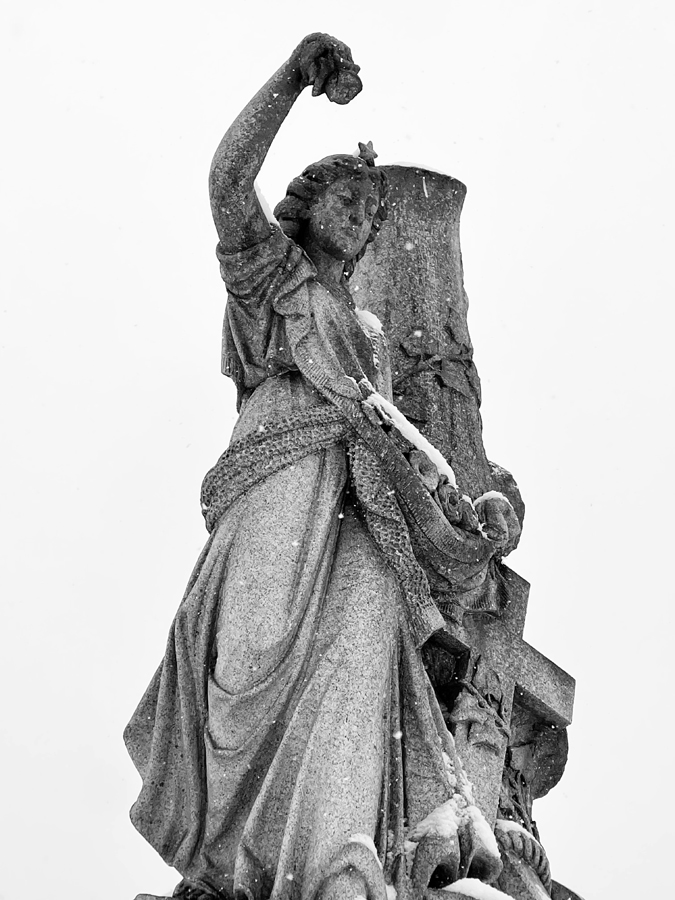
Snow angel, Calvary Cemetery

Also, as I was surrounded by all this white, it dawned on me that one of the reasons I photograph cemetery statues is because they seem to be monochrome. They’re easy to shoot in black and white, and if you choose to shoot in color, there’s no color-balancing needed. No matter the hue, the observer’s brain corrects for it because you already know the statue is white. You don’t need a “Shirley” card to shoot cemetery statues.

(A Shirley card, by the way, was a photograph of a white woman (Shirley, a Kodak employee) used since the mid-1950s by Kodak photo labs to calibrate skin tones, shadows and light during the printing process.) 

Warholized cemetery angels (Evergreen Cemetery, Camden, NJ)

Supposedly, the Farmer’s Almanac said we are in for a rough winter. So maybe I’ll have more opportunities to shoot snow angels. I mentioned the Almanac prediction to my neighbor a couple months ago, a woman who moved to Philadelphia from Spain. She did not understand what the Farmer’s Almanac was, never having heard of it. I felt like an idiot trying to explain it, because, well, I couldn’t. To quote Pee-wee Herman: “Some things you wouldn’t understand. Some things you couldn’t understand. Some things you ... shouldn’t understand.” Like the image below….

The "Late Nights" image above is a mash up of two images combined as one. Both were made in south Jersey cemeteries during the snow week. Andy Warhol said that art is what you can get away with. Is it disrespectful or sacrilegious tromping through a graveyard making such photographs? I think that any attention we give those who have gone before us is a way of paying respect. Their memory lives on.

Old Pine Street Church, Philadelphia
One of the things Victoria Browning Wyeth has said about her Uncle Andy (who died in 2009) is that when she visits his grave, she pictures him deep underground in his casket smiling up at her. I think I’m going to imagine that from now on, when I’m photographing in cemeteries – those below are smiling up at me - and laughing, probably, when I fall.

(Cue up the R.E.M. song, “Fall On Me” ….. )


Friday, May 20, 2016

Melbourne General Cemetery, Australia

For this week’s Cemetery Traveler installment, I would like to introduce my guest blogger, Samantha Kent. Samantha lives in Australia and posted some interesting photographs on Instagram recently. They piqued my curiosity and so I asked her if she would share her experience at this particular cemetery with our readers. Enjoy! – Ed Snyder


Melbourne General Cemetery, Australia 
by Samantha Kent

My interest in photographing historic cemeteries began in August 2015 and has turned me into a serious taphophile and admirer of ironwork and stonemasonry. The beauty and history leaves me in awe and I have to make sure I have at least two hours to explore each cemetery because I get so enthralled in what I find. The majority of the cemeteries I have explored and photographed have been in and around my home town of Brisbane, Australia but recently on a trip to Melbourne, Australia I made a visit to the Melbourne General Cemetery and within minutes of being there it became my current favourite historic cemetery! I adore the statues and crosses within the grounds with most still in excellent condition despite being decades old.


Melbourne General Cemetery was opened in 1852 covering 43 hectares (106 acres) and is now considered one of the most important and historically significant cemeteries in Australia. The cemetery has different sections including chapels, gardens, 3 mausoleums added in the 1990’s, and religion sections specifically for individuals of different faiths including Church of England, Roman Catholic, Baptists, Methodist and Presbyterian. The cemetery holds several notable interments including Prime Ministers, Premiers, explorers and entertainers. The cemetery holds 300,000 burials which will mean several more visits by me in future.

Claude Cricket Williams' headstone

On this visit I came across several graves of interest. The first is that of Claude Cricket Williams. Claude’s grave inscription says he was “accidentally killed at the Bijou Theatre fire in 1889.” He was 28 years of age. My research has revealed that Claude was the hall porter at the theatre and Claude died along with Captain Parsons, 33 years old, of the East Melbourne Brigade. The inquest found that there was “abundant evidence to show that both men came by their deaths through disobedience of order.” In Captain Parsons’ case, he was with a group of fire fighters who placed a ladder over a narrow gangway in an attempt to get onto the stage. Despite being warned by others that the walls could be heard cracking from the heat, the men proceeded with the ladder until the east wall gave way, striking Parsons in the head. In the case of Claude it was deemed he stayed in the burning building in an attempt to assist with the fire “without any right as he was not a member of the fire brigade.”

A "Father" of the Australian Labour Day

The second grave I came across is that of James Stephens who the founder of the “8 hour system” in Victoria, Australia. James was a stonemason, Trade union official and Chartist who on 21 April 1856 lead a group of stonemasons who walked off the job demanding the 8 hour system (8 hours of work, 8 hours of recreation, 8 hours of sleep) be introduced in Victoria, with the same pay. The movement worked and a public holiday called “Labour Day” is now held every year to remember this achievement.

This grave really caught my eye because it is the grave of a local undertaker, John Allison. I look forward to my next visit and what other stories I will find.

**************************************
Check out Samantha's photographs on Instagram. Just click that link and log on with your Facebook ID (if you're not already on Instagram). Cut and paste Samantha’s Instagram identifier into the search box: "sammy_eternityandchurch_pics." Please visit and enjoy her work!

Sources:

Sunday, December 27, 2015

Pottstown, Pennsylvania Cemeteries

Edgewood Cemetery, Pottstown, Pennsylvania
If you travel from one geographic region to another in America, you’re likely to notice subtle differences in architecture. You’ll see differences not just in bridges and buildings, but in cemetery monuments, mausoleums, and grave markers. Headstones themselves vary by shape, inscription lettering styles, and other aspects of design. When I say this varies by geographic region, this may entail areas only fifty miles apart. Different stone carvers, different quarries, different religious sects are but a few of the variables that contribute to differences in stone memorials. This was certainly the case in three cemeteries I visited recently in Pottstown, Pennsylvania – a rural town about forty miles northwest of Philadelphia.

Edgewood Cemetery, Pottstown, Pennsylvania
The main objective of my trip was to see Edgewood Cemetery (on High Street, see map), a twelve-acre property that had been abandoned and recently adopted by a group of concerned citizens, a Friends group. I arrived in Pottstown a bit early so I decided to try out my new Apple iPhone 6 by using it to find other local cemeteries. There were several. The closest one to me was Saint Aloysius Parish’s “Old” Cemetery on High Street on the east side of town. (The Parish has a “New” cemetery in another section of Pottstown.)

Saint Aloysius is wonderfully quaint and wonderfully old – I would guess it was established around the same year the parish was established – 1856. Marvelous decorative iron gates hang from massive stone entrance pillars, giving the impression of total security. However, even with no fence whatsoever at the residential end of the property, I saw no evidence of vandalism or disarray. This was in fact the case in all three cemeteries I visited.

Gold painted marble headstone, St. Aloysius
Saint Aloysius Cemetery is only a few acres, and you can get an appreciation for the cemetery by simply driving around its well-maintained roads. I did get out of my car a number of times, however, to examine more closely some of the grave stones. It became evident to me that simply forty miles from Philadelphia (where I live), there were marked differences in the styles of headstones here compared to what I am used to seeing in the Greater Philadelphia area. For instance, I think I’ve only ever seen one headstone painted like this gold one.

Marble headstone, St. Aloysius Cemetery, Pottstown, PA

Local artisans left their unique and indelible mark on many shapes and styles of headstones. Also, the vicinity may be less susceptible to acid rain as many examples of white marble sculpture seemed oddly well-preserved. Lettering and other engraved designs were clearly recognizable, something I’m not used to seeing in this part of the country.

Rock of Ages headstone with cut sheaves of wheat (symbolizing death)

After a half hour or so in Saint Aloysius, I drove about ten minutes west on High Street to meet my friend at Edgewood Cemetery. He’s one of the volunteers who helps keep the place maintained and getting groups of volunteers to cut grass, clear trees, etc. Edgewood doesn’t have the quaintness quotient of Saint Aloysius, but it is well-maintained and boasts some rather unique memorial sculpture. I don’t remember ever seeing “Rock of Ages” inscribed on a memorial ANYWHERE. The stone is rather old, so I don’t think it refers to the Def Leppard song of that name. More likely the 1763 Christian hymn that refers to the rock that shelters Christians from the storm.

I was surprised to see, as I walked around, a small headstone with a carved angel atop, about six inches wide. Such detail, along with most lettering, is usually eroded away. Established in 1862, the Edgewood Cemetery was abandoned in the 1930s. Local volunteers keep it tidy, and there seem to be occasional burials. There is some damage, apparently from ground subsidence. Some headstones have eroded off their bases, some have fallen due to groundhogs burrowing beneath them. A few have been uprighted and repaired.


Recent burial, Edgewood Cemetery
In the 2014 article, "Pottstown council ponders the future of Edgewood Cemetery," “Todd Dawson of Todd’s Tree Service, became so upset about the overgrown conditions at the cemetery, that he volunteered over the course of several days to cut the grass.” In addition, “Some citizens, who have asked to remain anonymous for now, have expressed an interest in forming a non-profit organization to take possession and responsibility for the cemetery ….

Whatever its future, Edgewood seems stable for now. Enough people are devoted to keeping it maintained and intact until a more formal arrangement can be made. If the local government can declare it abandoned, progress would have greater potential. Walking through the cemetery is a lesson in stone carving, monument craftsmanship, and history. Maintaining the history of these stones, along with that of the people beneath them, is of great importance to the volunteer group (see the Facebook Group page, “Edgewood Historic Cemetery”).


This amazing white marble arch, which stands about six feet high and spans about ten feet marking the entry to a family plot, is inscribed with the words,In Death They Are Not Divided.” I thought this to be a good motto for the Friends group – in death, the deceased should not be divided from, or forgotten by, the living.


Elks Club, Pottstown, Pennsylvania

My third and final stop in the area was Pottstown Cemetery, after grabbing a coffee at the lovely “Potts and Penn Family Diner” nearby, across High Street from the Elks Club (there are a lot of Victorian structures like this in the vicinity). I got the feeling that the Pottstown Cemetery was a factory cemetery, as there is an old factory next to it. Similar to cemeteries next to coal breakers, one can only assume that many who had toiled in the factory in the late 1800s and early 1900s ended up dead and buried next to it. This angel on a high pedestal next to the factory seemed to bear witness to such difficult lives.


Factory Angel, Pottstown Cemetery
The “old” cemetery (next to the factory) is on a hill directly across N. Hanover Street from the “new” Pottstown Cemetery. The old one has quite a bit more character. The sun was low on the horizon when I got there as it was just around noon and close to the winter solstice. I have a thing for silhouettes and driving up the hill into the cemetery I was presented with this lovely silhouette (below) directly in front of me.

Pottstown Cemetery, Pottstown, Pennsylvania

The simple fact that such fine detail remains on these soft marble grave markers is uncommon in this geographic area – an area of harsh winters and dramatic seasonal climate swings. I was surprised to see, as I walked around, a headstone with this little carved cherub, about four inches in diameter. Such detail, along with most lettering, is usually eroded away.  In the base of the factory angel was the three-dimensional marble scene below, about fourteen inches long and eight inches high. Tree symbolism – the weeping willow, along with a burial crypt with cover removed – the symbol for resurrection, and a heavenly afterlife.


The headstones in these Pottstown cemeteries are much more ornate and interesting than most headstones made in the past hundred years. Check out this marble tree stump memorial from 1892, for instance. I saw several examples of this – with the roots of the stump carved out very plainly. The symbolism is intense – not only has the life been cut short (a severed tree), but the stump itself has been torn away, uprooted, from the mortal earth. Reminds me of the Emily Dickinson quote,“To be remembered is next to being loved, and to be loved is Heaven.”