Showing posts with label mourningarts. Show all posts

Sunday, October 26, 2025

New Orleans' Cast-Iron Tombs!


Okay, so don’t let the heat dissuade you from visiting New Orleans’ wonderful cemeteries in the summer. If the opportunity presents itself, jump on it. Remember, great art comes from great pain. They say there’s no such thing as bad weather, just bad clothing choices. That said, long pants and dress shoes may not have been the best choices for walking through New Orleans’ cemeteries in 92 degree weather. Now 92 degrees didn’t sound THAT hot, but here’s what Weather Atlas had to say about New Orleans’ tropical climate for June, 2025 when I was there:

“The average heat index in June is estimated at a very hot 102.2°F (39°C). Undertake extra safety actions, heat cramps and heat exhaustion are expected. Heatstroke may result from lengthy activity. Be advised, the heat index considers values for conditions in shade and with a light breeze. Direct sunlight might cause an increase of up to 15 Fahrenheit (8 Celsius) degrees in the heat index.”

Perhaps the weather would have been more tolerable had I been on a riverboat out on the Mississippi, but I wasn’t. I have to say, I’ve never appreciated large mausoleums more than when I was in NOLA, for the merciful shade they offer! I was there for a work conference in June, 2025, so I planned to take in a few cemeteries at the time. Scheduling was inopportune, as the annual conference for the Association for Gravestone Studies was happening at the same time, in York, PA, which is only about an hour’s drive from where I live in Philadelphia. Really would have liked to attend that, even virtually, but the gestalt was not now. Or then. So, given I would be in Nawlins for three days, I needed to hit some of those marvelous cemeteries. 

A few months prior, I got in touch with Nancy Jaynes who posts a lot about New Orleans cemeteries on Instagram (as @new_orleans_cemeteries) to help plan my trip. I had been to New Orleans twice, but decades ago, pre-Katrina. I was grateful for Nancy’s guidance as to which cemeteries to visit, on what days, hours of operation, etc. I had told her that one place I really wanted to see was the chapel inside St. Roch Cemetery, the one with all the antique prosthetics hanging on the walls! Unfortunately, when I checked St. Roch’s website, it said the chapel is only open the first Friday of each month from 11:00 am to Noon! That is one tight window. Again, my schedule would not permit visiting.

St. Roch Chapel, photo by Nancy Jaynes (@new_orleans_cemeteries)

But since you’re lathering with anticipation at that, here’s a photo Nancy made a few weeks after my visit. After I returned home, I got in touch with Nancy who graciously agreed to write a blog on St. Roch’s for the Cemetery Traveler, with her wonderful photos, so look for that coming soon!

But back to my June visit. Nancy and I planned to meet at St. Patrick’s Cemetery No. 2 on my second day. Therefore, I figured I’d hit St. Roch’s and another one on my first day. Even though I knew I could not get into the chapel, the St. Roch’s website makes the cemetery looks incredibly interesting. 

I thought it would make sense to visit two cemeteries each morning, before it got really hot. So I mapped out a few places I wanted to visit and made a plan. I would Uber/Lyft early in the mornings to arrive at the usual 8 a.m. opening time (most cemeteries here are gated and locked), do some photography for a couple hours, then rideshare to the convention center. A good thing is that all of these cemeteries are within twenty minutes of the convention center. New Orleans has about forty cemeteries to choose from! Many are large and would take hours to walk through. A few are open for guided tours only, but most are open to the public, from about 8 a.m. to 3 p.m.

On the first day, Thursday, I called a Lyft driver to take me to St. Roch’s. I stopped in a convenience store in the Quarter and picked up a couple bottles of cold water and snacks, shoved them in my camera backpack and took to the streets to get my ride.

After driving awhile, my driver pulls over. We’re in front of Cypress Grove Cemetery, Canal Street, nowhere near St. Roch’s. Ah well, I figured I’d spend the morning here and put off St. Roch’s for my third day. Across City Park Avenue from Cypress Grove is the very large Greenwood Cemetery, with the massive Metairie two blocks away. I had intended to see all these anyway.

What I hadn’t expected was that it would be unbearably hot at 8 a.m. … each day. I’m talking sweat pouring down my face, stinging my eyes. Then it would rain every afternoon, so the humidity was omnipresent. After an hour, I felt like pouring the two bottles of cold water on my head instead of drinking them. But I didn’t want to die, so I drank in the shade of Cypress Grove's impressive entranceway. I could see down the rows that its old tombs were not all that interesting. All above ground, which is the New Orleans way. As Mary LaCoste says in her book, Death Embraced - New Orleans Tombs and Burial Customs, this is as much a European tradition as it is a physical necessity due to New Orleans being at sea level (can’t dig due to the high water table). I only spent a half hour in here, because the much more opulent Greenwood was beckoning to me from across the street, with its towering monuments. 

Leeds Tomb, Cypress Grove Cemetery

But Cypress Grove will always have a special place in my heart – it was here that I saw my first cast iron tomb, the Leeds Tomb! This is one of NOLA’s oldest cemeteries, established in 1838 by the Fireman’s Fund, to honor New Orleans’ volunteer firemen and their families. When that cemetery became full, the Firemen’s Charitable & Benevolent Association opened the much larger cemetery in 1842 across the street, called Greenwood. The cast iron tomb is essentially a mausoleum, made of brick, and plated with cast iron panels. Sometimes the iron is rusted like the tomb you see here, and sometimes they are well-maintained and painted! 

Mer-lion downspout!
I owe my knowledge of these unique architectural marvels to Nancy Jaynes, who has posted on Instagram many photos of them with wonderful historic information. This one with the fish (or mer-lion, if you look closely!) downspouts is simply spectacular. In all of NOLA’s forty cemeteries, there are only 16 cast iron tombs. I feel honored that during my short, whirlwind visit, I think I saw five of them! You can read more about them at this link.

There are of course many small details throughout these cemeteries which add very personal touches to the grave sites – small angels, plaques, sparkly beaded necklaces. The six-foot tall tomb buildings themselves are usually very similar, with only the names and dates varying from one to the next, and the next, and the next, as you peer down rows and rows of these above-ground burial buildings. Whitewashing seems to be popular. Which of course makes them blinding to the eyes in the torrential Louisiana sunshine. This photo above just seems to be of a bright white tomb. I really cannot fully express the pain these things cause when you are trying to squint at and photograph them! And no, it did not occur to me to bring sunglasses.

Burned-out van with Greenwood Cemetery in background

As I walked out to City Park Avenue, I noticed a burned out van right in front of Greenwood Cemetery. Odd. Fried chicken parts on the back seat springs. I crossed over and entered Greenwood. I was taken by its beautifully ornate – and dry – fountain. I climbed inside to do a little shooting – inside the fountain, that is. Workers driving by didn’t seem to care. As it was getting hotter by the second, I realized I needed to plan my time better so I climbed out of the fountain and began roaming around the grounds. I got some ok photos of the fountain, but it was a pyrrhic victory. 

Miltenberger cast-iron clad tomb, Greenwood Cemetery

Greenwood has a few cast iron tombs as well – the most amazing of which is this recently-painted silver one! The figures on the door are actually cast iron as well. I tugged a bit on the angel, but the door did not open (yes, I know, my sins are a stench in the nostrils of God, as Billy Graham would say). On Greenwood’s webpage, you can see a photo of this Family Tomb in its prior state. Emily Ford, in her blog post () tells us that Greenwood Cemetery has six cast-iron tombs, five of which were produced by Wood & Miltenberger & Co., a branch of Wood & Perot Ironworks. At six iron-clad tombs, Greenwood has the most of any cemetery in New Orleans. And one of them is for the Miltenberger iron works family.

But Greenwood has many wonders besides its cast iron architecture, such as the tall and stately fireman memorial and various Civil War monuments. All along the fencing facing the roadway are banners extolling the fact that it is “Still Affordable!” Affordable is key, as Greenwood is situated right next to Metairie Cemetery, where a plot will cost you double the amount of money! $5,000 versus $10,000 for a basic plot. In fact, the market for trading cemetery property seems to be a hot one in New Orleans, as you can see from these sites:

https://www.buriallink.com/cemeteries/greenwood-cemetery-and-mausoleum-la

https://thecemeteryexchange.com/tce-metairie-la.htm

https://thecemeteryexchange.com/25-0423-4-featuredlisting-la.htm


I really wanted to get to the Metairie, so after only about half an hour in Greenwood, I exited and began walking down City Park Avenue, away from the tempting chicory coffee and powdered-sugar-covered beignets at the Morning Call Coffee Stand and toward Metairie. More about my adventures in that fabulous place coming soon!


Tuesday, February 18, 2025

Skull Art and Other Transgressive Behavior


One frigid morning in January, I headed out to my local cemetery to do some photography. There was snow and ice all over the place, so why would I not head out to my local cemetery to do some photography. In fact, weeks later an ice storm was forecast for the following day and my brother told me to be careful - I told him I was prepared: I knew which cemetery I was going to visit.

On this particular January day, I was rather careful each time I stepped out of the car, cautious with each step. Last year, I slipped on the ice in a cemetery and tore my rotator cuff. Took eight months for that to heal. Had my hip replaced at the end of April 2024, so I really did not want to break any more body parts. Still, I am always looking for a new place to spend the rest of my sins.

I did not want to slip, fall, and crack my skull. Actually, either of my skulls. Today was BYO Skull Day at the cemetery, and I had two of my largest with me. One might be a quondam deer, the other a pit bull. Of the roughly ten skulls I own, all but one was found in an abandoned cemetery. The largest, an antlered deer, I severed from its spinal column with an ice chopper (in an abandoned cemetery). Yes, I know, you have questions. Really wasn’t as dramatic as it sounds – most of the flesh had been either eaten away or rotted off the bones by the time I got to it. Most of the other skulls were picked clean and bleached white by the sun by the time I found them. Takes forever for that to happen. It intrigues me that people go to such extremes to strip flesh from bones. 


Assuming I haven’t lost you by this point or severely grossed you out, lets get to the photography part. I was hoping there would be snow on the statues but there was very little. Still, the snow on the ground lent a stark, uncluttered backwash for the photography I’d planned. Well, “planned” is a strong word. Planned in the sense that I brought my skulls and some cameras. I began by looking for skull settings, i.e. statues of appropriate scale to maybe hold one of the skulls. That’s a photo of St. Lucy above holding a skull as opposed to holding her own disembodied eyeballs (look that up, I’ll wait…… I think my image is actually less bizarre than what the statue is really meant to portray.) 

For what I was doing in this cemetery today I wished I could have visualized the end product or at least recognized what step I was at in the process. Pursuing a new artistic endeavor like this is like brushing your teeth with your less dominant hand. Awkward. But you know, nothing great ever came from people who operated solely in their comfort zone. My friend Jason calls this “leaning into your limitations.”

Physically, being there that day was far from comfortable. It was almost too cold to think. Temperature was about twenty degrees Fahrenheit and even though I was wearing long underwear and had chemical warming pouches in my shoes and gloves, my fingers got cold, red, and numb on many occasions. I had to repeatedly jump back into the running SUV and blast hot air out the dashboard vents onto my numb fingers.

I would drive to a statue, decide whether it was skull-worthy, then perhaps spend twenty minutes staging a photo. On two occasions, police cruisers drove by. I assume they just figured I was some photography nut photographing statues. And of course they would be right. I kept the skull of the moment close to my chest so they wouldn’t see it as they drove by. I assume, I hope, they would’ve stopped to question me if they thought any skullduggery was afoot.

Maybe I’m channeling my inner Joel-Peter Witkin with all this, but I’m sure Witkin did all his startling, grotesque, and macabre body parts-photography in a fancy studio, with assistants - not outdoors in below-freezing winter. Maybe we’re searching for a similar grail here, I don’t know. The process of arranging skulls on cemetery statues got me thinking about Witkin’s process, what he may have been thinking or planning. The viewer typically only sees the final product. 

But art “is an event in itself, something that comes into being,” says Karl Ove Knausgaard, in his New Yorker (Feb. 3, 2005) article, Private Eye. The piece is about how a particular artist creates presence in her painted portraits. Without a doubt, a Witkin still life, or one of my images here clearly imply presence of the artist in the creation of the piece. What I’ve done should elicit a different reaction from the viewer, different from the viewer seeing a simple photograph of a gravestone. The viewer certainly can feel my “presence” in these images.

As with any still life, the material world is supposed to suggest something else. If Witkin’s and my photographs seem about as joyous as the Doomsday Clock to you, consider this other skull fun: see how artist Filip Hodas creates “cartoon fossils.” There are in fact, people even more deviant than I. Visit this website to see his lovely work!

Glenn Hendler asks in his book, Diamond Dogs, is there any way to ‘use’ a medium without being at the same time ‘in’ it? He wrote this about the David Bowie album of that name. He describes Bowie’s music on this album as having “randomness balanced with an assertion of control.” I think that might be an honest description of my own photographs. Like Bowie as he was writing these songs, I think I’m trying to stimulate my own imagination. Maybe what you see here is merely a step in a much longer process, rather than a final product. I’m not a U2 fan, but I still haven’t found what I’m looking for.

Staged still lifes can be beautiful, but random beauty can be startling. A week after my photo shoot at this cemetery, I visited another snow-covered one, where I saw the most beautiful red fox break the stillness of the snowscape with its gentle trotting. It was so fluid and graceful as it padded through the snow between the tombstones, it seemed random, but for the fox, it was probably the same path it took every afternoon. The fox trotted up the small hill toward a mausoleum. It turned around, looked at me, and flopped down in the sun alongside the mausoleum. Seemingly random nature can be more beautiful than anything a human can create.

It made me feel better about my progress, transgressive as my behavior may be. As Douglas Adams said in his novel, The Long Dark Tea-Time of the Soul, I may not have gone where I intended to go, but I think I have ended up where I needed to be.” 


For reference and further examination:

Joel-Peter Witkin | Artnet

Karl Ove Knausgaard Latest Articles | The New Yorker

A 3D Artist Imagines the Realistic Fossilized Skulls of Endearing Cartoon Characters — Colossal


Sunday, April 14, 2024

Do You See Faces in the Cemetery?

Faces – besides having been a great rock and roll band in the 70s, what do we know about OUR human faces? I wrote a blog on The Cemetery Traveler in 2015 called “Tombstone Faces” where I posted images like the ones you see here. I didn’t delve very deeply into the subject. Then in April, 2024, my fourteen-year-old daughter said something quite profound, which has prompted me to write this new piece on faces in the cemetery.

We were sitting on the sofa watching her favorite serial killer series on television when she said, “You know how people sometimes see faces in inanimate objects?” I said yes. She proceeded to relate to me a theory she read about recently that suggests that this is a common occurrence and relates to our survival instinct!

"Face pareidolia is the phenomenon in which people see faces or other patterns in ambiguous images, such as Jesus on toast or the man in the moon."https://www.livescience.com/25448-pareidolia.html

According to what she read, seeing faces in inanimate objects is a survival technique, an evolutionary advantage, according to the UNSW (University of New South Wales, Sydney, Australia):

“There is an evolutionary advantage to being really good or really efficient at detecting faces, it's important to us socially. It's also important in detecting predators. So if you’ve evolved to be very good at detecting faces, this might then lead to false positives, where you sometimes see faces that aren't really there. Another way of putting this is that it’s better to have a system that's overly sensitive to detecting faces, than one that is not sensitive enough.” 

The graphic design site, Grapheine adds, “this ability may derive from an evolutionary advantage that has led to a hypersensitivity to detecting presence, which favors survival but not necessarily accuracy.” 

Click link to purchase
Better safe than sorry, right? I’d rather see false faces in an abandoned cemetery to keep me alert to the possibility of actual ne'er-do-wells who might be lurking about. Or are there more supernatural reasons for seeing faces here? I always thought that if I didn’t believe in them, they wouldn’t try to get me. This generally works – it has only been on the rarest occasion that I’ve experienced the unexplainable. I’ve been rattled, yes, but never when it had anything to do with a face that wasn’t there. I’ve written about these experiences, by the way, in my book, The Cemetery Traveleravailable from Amazon.

There are many examples I know of in local cemeteries where such faces exist. They appear on the old marble posts used to fence off Victorian-era family plots. If the tubular metal cross members are still in place, you don’t see the face, because the tubes fit into the metal channels in the side of the post. Pipe fencing, or gas pipe fencing this was called. The pipes were about two inches in diameter. The channels may have rusted and fallen off, leaving circular “eyes.” With one eye in place, you might see a man with a monocle, or the man in the moon with a rocket in his eye. The fixity of their stare can be unnerving.


Decorative angel, joining two pieces of pipe fencing

The images you see here are from various old cemeteries. In many cases the piping may have rusted off, fallen, and been discarded. Or stolen, if they were of a decorative design. The purpose of the fence is not security, but rather to mark the boundaries of a particular plot. The fence itself is not high, maybe two feet. If the cross members were still there, they would be at just the right height to trip you, as Sharon Pajka says on her website post,
Cemetery Pipe Fencing:  

“I always think of pipe fencing as just the right height to trip you if you’re not paying attention. They are nice reminders to stay off the grass and the flowers.” 

Marble post showing green patina bronze channels, which hold pipe

“The phenomenon of pareidolia can be very disturbing for some people, who may consider it a sign of a deceased person, for example.” - https://www.grapheine.com/en/graphic-design-en/pareidolia-art-of-seeing-faces-everywhere 

Easy to do in a graveyard, right? Scary, perhaps, for the superstitious person who upon visiting a cemetery sees not only faces, but the emotional states in those faces! Angry, shouting, moaning faces. And what's with the nose and mouth on these posts? Or is it just me that sees that? I honestly don't know what purpose those carved gouges in the marble serve. Other than to give me the willies, I suppose.

Lachlan Gilbert tells us, “What this means, say the researchers, is if you feel like a pareidolia object is looking at you, or conveys some sort of emotion, “it may be because the features of the object are activating mechanisms in your brain that are designed to read that kind of information from human faces.” -https://www.unsw.edu.au/newsroom/news/2020/08/why-brain-programmed-see-faces-everyday-objects

So if you really want to catch a fright, I suppose, you can watch some horror movies then go check out these faces in your local graveyard. But since I do not relish the thought of leaving you fearful, face pareidolia has other, more constructive, evolutionary advantages. Jesse Thompson, in the article, Pareidolia: seeing faces in random, inanimate objects could be survival technique, tells us:

"The infant that recognizes the face and smiles back at it, and hence bonds with its parents or caregivers, is more likely to be nurtured and survive.”

------------------------------

References:

https://www.abc.net.au/news/2019-02-17/pareidolia-explains-seeing-faces-in-objects/10813426

https://www.unsw.edu.au/newsroom/news/2020/08/why-brain-programmed-see-faces-everyday-objects

https://www.grapheine.com/en/graphic-design-en/pareidolia-art-of-seeing-faces-everywhere

https://www.sharonpajka.com/2021/09/cemetery-pipe-fencing.html


Thursday, April 4, 2024

Cemeteries in the Rain

I am so wet. Just returned home after shooting cemeteries in the rain on this gloomy Saturday morning. I thought I dressed appropriately. Forty degrees, layers, rain parka. Umbrella to keep the rain off the cameras. 

Why photograph cemeteries in the rain? I noticed some new images my friend Rachel posted on Instagram (@photosofcemeteries) – darkly brooding, slick and wet images of gravestones and monuments. Treacherous sky, the whole nine yards. I was a bit envious! I needed to get out there in some rain and see if I could produce something half as good! The work of other artists can stimulate you to push yourself.

Years ago, I started a public Facebook page called “Cemeteries in the Rain,” (link) and many people post images on it. I like the whole idea, but had kind of gotten out of practice. I mean, it can be a rather grim experience to be out there slogging around in the mud. And sometimes it doesn’t pay off.

"I wanted the rain to come," says Greg Jackson in his novel, The Dimensions of a Cave, "- for the way it closed and narrowed the scope of a world gone too large, dissolving dreams like crusts of dirt that settle on the streets." So when I heard the Saturday weather forecast, I planned to get out there. And so I did, the day before Palm Sunday. Hit the highway at 8 a.m. and hit the first cemetery in the pouring rain at 8:30, Westminster Cemetery in Bala Cynwyd, PA. Turns out my rain parka was not waterproof. Why even make such a thing? Reminds me of the time, years ago, with my first family, I bought a large tent and we went camping in Cape May, NJ, for a week. Three little kids. Third night, and as the 1970s band Atlanta Rhythm Section sang, “It was an all night rain….” Why they would make a tent that is not waterproof will forever puzzle historians. Needless to say, I got camping out of my system at a relatively early age.

I spent an hour at Westminster shooting the slick bronze angels, capturing the reflections, the water pooling on granite, and then drove out to West Philly to shoot in Cathedral Cemetery. I chose these two locations because I thought each would have a number of flat, horizontal monuments that would slick up or collect water that would artistically reflect the surroundings (as Rachel has done). Shooting such things, bent over, umbrella over the camera, exposed my backside to the elements. I began to get wetter. It was also kind of painful jumping in and out of the car, as my left hip has been giving me problems. Having it replaced on April 29. No cartilage left – bone on bone. Not only does great art come from great pain, but mediocre art does as well.

I was also familiar with the layout of these cemeteries, so I mainly drove around to the various spots I thought would look good in the rain. I wanted to shoot the iron angels on the gate to this family plot in Cathedral, but to my surprise, the gate was gone. Stolen, maybe. I had been here a couple years ago and the gate was still there. One of the uniquely interesting details in this graveyard, or, it was. Victorian decorative art now in someone's private collection. Sad. The patina stain in the photo of the crypt cover below suggests a missing bronze cross. Stolen as well, I assume.

I have photographed cemeteries in the snow much more frequently, and you may not be too surprised to learn that I also started a public Facebook page called, you guessed it – “Cemeteries in the Snow” (link). Even though the weather and accumulated snow make this type of shooting quite challenging, I think shooting in the rain is even more so. So total credit to Rachel for creating such wonderful images under these conditions! And thank you for igniting that spark of creativity for me – which is one thing artists provide for each other, right? Also, you can better appreciate any art form, any media, after trying to do it yourself. 

And speaking of water, I knew my shoes would get wet and muddy, but I hadn’t planned on getting soaked through to bare skin, despite three layers of clothing! Even my belt was wet. After about three hours of slogging around these two cemeteries, I headed home. Gave up on the third stop, which was going to be West Laurel Hill Cemetery. Drove back to my neighborhood, parked a block from my house, unloaded the car and stomped down the little street. My neighbor, jumping into his car, probably wondering what in the world I was up to now. This is the fellow who during Covid, knocked on my front door (I wasn’t home) and handed a large shopping bag to my wife, saying, “I’m returning Ed’s skulls.”

Got inside the house, turned up the heat, took off all the layers and hung them to dry. Jeans, socks, even my underwear was wet. Dry clothes, hot coffee, toasted bagel and crème cheese from the little Jewish bakery on Passyunk, Essen. Looking at my images, I got some decent ones. One compositional element I had no control over was the sky. Dark clouds would have been preferable, though for most of the images, all I had was white, a nitid sky. Not terribly interesting. But, this is just another detail to pay attention to in the future. I used to call a dark cloudy sky front-lit by a setting sun an “angel sky,” because I would wait for such conditions to present themselves, then I would run out to a cemetery to photograph white marble angel statues against the black sky. Next time.

And for that next time, I shall dress more appropriately. It’s supposed to rain on Tuesday.  I do have a parka that actually is waterproof. Now I’m sneezing. Great. 


Saturday, February 10, 2024

Falling Snow in the Cemetery

Okay, no more ChatGPT tricks. This is really me writing this. Really. No, wait, how would you know? Hopefully, my personality will suffuse the text to the degree that you’ll be able to tell its really me. I’m interested in my readers’ take on how I compare to AI, so please comment!

I should have named this post, “Falling In the Snow in the Cemetery,” since that’s one of the things that occurred during the recent January snow week while I was shooting cemeteries. But more on that as we slide along. I’ve photographed cemeteries in the snow many times, and recounted those experiences on this blog. Between January, 2022 and January, 2024, I really had no new experiences to recount.

Why is that? Well, it hadn’t snowed in the Philadelphia area in two solid years. We were due, I suppose. Can’t say I missed it all that much – go global warming! But we did recently get dumped on twice in one week – about three inches initially, then about six a few days later. I had a few opportunities to get out there with the cameras, so, Bob’s your chipmunk, as they say.

Old Swedes Church monument, Philadelphia
Early in the week, it snowed all day and I was able to get out to a few South Jersey cemeteries for some shooting before sunset. Actually, I began my snow shooting in the small Old Swede’s Church graveyard near my house in the Queen Village neighborhood of Philadelphia. The church sexton allows people to walk their dogs on the large open area next to the graveyard, and there were about ten dogs frolicking in the snow that morning. One woman had just entered the property and her large dog was pulling her along. She said something like “Slow down, Petey, I know you want to see your friends!”

Ben Franklin's grave, Christ Church Burial Ground (Pennies ...get it?)

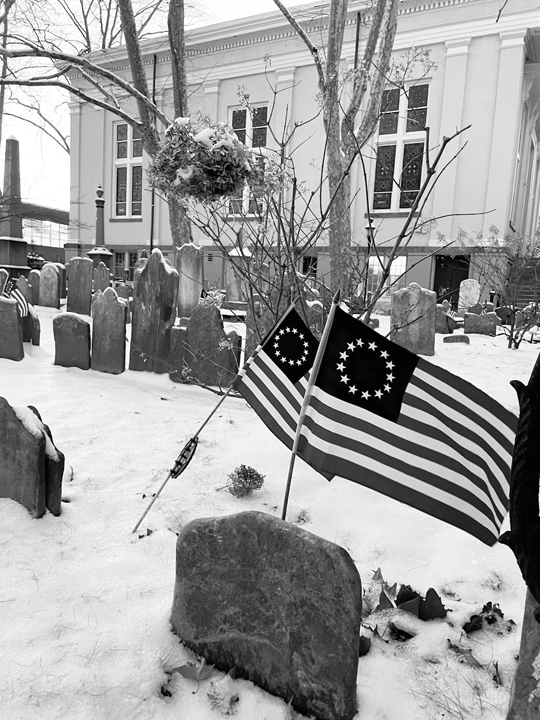
Since I work in south Jersey, it was easy enough to visit nearby Harleigh, Old Camden, and Evergreen cemeteries after work. A few days later we had an all-day snow, so I was able to get out into an active snowstorm in Calvary Cemetery, in Cherry Hill. It remained cold for a week so I made the most of the weather by catching lingering snow in Philly’s Christ Church Burial Ground (Old City) as well as the Old Pine Church graveyard (Society Hill) on my way to and from work.

Selfie with friend in Calvary Cemetery, Hill of Cherries, New Jersey

But back to the beginning. The selfie you see of me (above) was made when I first arrived at Calvary. It was colder than a witty analogy. The photo below is me an hour later, after shooting in the piercing wind and trudging through six inches of fresh snow. Photographing cemeteries in a snowstorm can be quite an amazing experience – until its not. It is exhilarating to be out there alone with the elements, knowing full well no one else in their right mind is doing the same. Well, alone except for the groundskeepers plowing the cemetery roads. Probably wondering how unhinged this guy must be in the snow with all those cameras dangling from his neck. 

Jesus, it was cold out there!

As I repeatedly jammed additional “HotHands” chemical hand warmer pouches into my gloves, I kept thinking how I didn’t want to end up like Jack Nicholson in the final scene of “The Shining.” Its one thing to reach the point of self-actualization by getting that one-in-a-million shot, but the need for the safety of a warm vehicle in the dead of winter can knock you down a few pegs on Maslow’s pyramid, where you’re all of a sudden more concerned with basic survival needs. And losing digits.

Ansel Adams, eat your heart out. (Harleigh Cemetery, Camden, NJ)

Granted, this is nothing compared to what Ansel Adams went through to capture those gorgeous images of the snow-covered Rockies in Jellystone Park, or climbing onto his car roof with a tripod and a view camera to shoot, “Moonrise, Hernandez, New Mexico,” but it was challenging enough. Everything’s relative. Adams probably didn’t have a fourteen-year-old daughter at home who needed dinner made when she got home from school. 

Sunset, Evergreen Cemetery, Camden, NJ

Anyhow, that weekend it stayed cold (below freezing), so I spent a few hours trudging through Woodlands Cemetery in west Philly. Mainly I shot with the iPhone and Holga loaded with 120mm black and white film. It was so cold I couldn’t wind the film for the next exposure! (Remember winding film? …. Remember film? …)

Yours truly, with the Holga (Woodlands Cemetery)
The Holga. Yes, just another pain point in my photographic arsenal. A Holga is essentially a cheap plastic toy camera that uses 120mm film. As I write this, I’m waiting for the film processing place to develop my film, scan the negatives, and send them to Dropbox for me. I have no idea whether there will be anything good on that film. Actually I shot two rolls of 12 exposures (120 mm BW). I will wait until I get the results before I post this, so you can all witness either my ineptitude or my genius, whichever the case may be.

Turns out I was rewarded with two reasonable images – out of 24. Even a blind squirrel finds a nut twice a day. Here they are.

Holga images (L: Calvary Cemetery; R: Woodlands Cemetery)

Falling For You

At one point, in a cemetery I won’t name, I slipped on the ice. Wasn’t climbing on a monument. (Honestly, I don’t do that. Having seen a monument fall on a person, pin them to the ground and break their leg, I do avoid such near occasions). I was simply walking along the unplowed road, and my feet flew out from under me! My mind's eye was blind to the ice under the snow. I’d been looking out at the gravestones, eyes peeled for a good composition, instead of looking where I was walking. Obviously, I had not done the proper risk assessment. Hit my right shoulder on the ground with tremendous force:

According to Microsoft’s new AI powered Bing search engine:

"The gravitational force acting on a 200 lb mass is about 889 Newtons. A person who weighs about 200 pounds and falls just 6 feet will hit the ground with almost 10,000 pounds of force."

Calvary Cemetery, Cherry Hill, NJ
And I felt every one of those fekkin 10,000 pounds. Jesus H. Christ! Despite the pain, I made it okay hiking through the cemetery and shot for an hour, but then I realized I couldn’t raise my right arm very high. The next day, I couldn’t raise it at all. I spent the next week with T. Rex arms. Really thought I tore my rotator cuff. But after a week of Motrin smoothies, the pain began to
subside, and I started to regain my range of motion. I am glad that I continued shooting after the fall – I did make some decent photographs. Great art comes from great pain. 

Mausoleums, Harleigh Cemetery, Camden, NJ

Why Photograph Cemetery Statues?

Why subject myself to all this? Is it to capture/create a unique image? To build up my catalogue raisonné? To have ‘alone’ time? Or is it just the JOURNEY that’s important, more so than the destination? I think it’s a combination of all that, but my reason can best be summarized in something the artist Andrew Wyeth said to his granddaughter, Victoria Browning Wyeth, “my goal is not to make pictures but to express my love of these things.

I do love cemeteries and graveyards, which is why I use them in my art. Unlike Georgia O’Keeffe, who is widely known for her paintings of flowers, and said “I hate flowers – I paint them because they’re cheaper than models and they don’t move.” I appreciate the fact that access to cemetery statues is usually free and the statues (usually) don’t move. Cemeteries? I want to be there, and I want to create something. Paul Rudnick, in a recent New Yorker Shouts and Murmurs piece, wrote in jest about something “seemingly empty yet rife with meaning.” Describes cemeteries fairly well, don’t you think? 

Calvary Cemetery abstract, shot through glass in a snowstorm

While I certainly appreciate the beauty of a landscape or an Italian marble cemetery sculpture, I also appreciate the fact that people went out of their way to memorialize the dead. Sometimes a grave marker is the only tangible evidence that a person existed. Standing amidst these monuments can make one feel part of the human family. Like the dog, Petey, mentioned above, many of us just want to feel part of the whole.

Woodlands Cemetery, Philadelphia

Roland Barthes, the French literary theorist, philosopher, and critic said in 1977, “If photography is to be discussed on a serious level, it must be described in relation to death.” He added, “Its true that a photograph is a witness, but a witness of something that is no more” (Camera Lucida, 1980). So what better canvas with which to create new art than a cemetery? 

Sunset, Evergreen Cemetery, Camden, NJ

I also appreciate the beauty of a warm motor vehicle on a frigid day. Here’s another image I like, shot out the window of my wife’s Rav 4. Right after I made this image, I couldn’t get the power window to go back up! Panic. Twenty-four degrees outside. Another snowstorm expected tomorrow. After much fumbling around and considerably more panic, I realized there was an interlock on the door – a button that disables the power window function! Found that ten minutes later - released it and we’re back in business! Always never do that. But DO drive an SUV when you’re shooting cemeteries in the snow! You don’t want to get stuck. 

What Does Snow Add to a Photograph of Cemetery Statues?

To paraphrase Reese Witherspoon, who recently said that “Snow days were made for Chococinnos,” snow days were made for shooting cemetery statues. Why? Probably for the same reason she got in trouble for telling her TikTok followers that it was okay to eat snow. It’s novel, its enjoyable, and it probably won’t hurt you (unless you slip and fall in it, that is). 

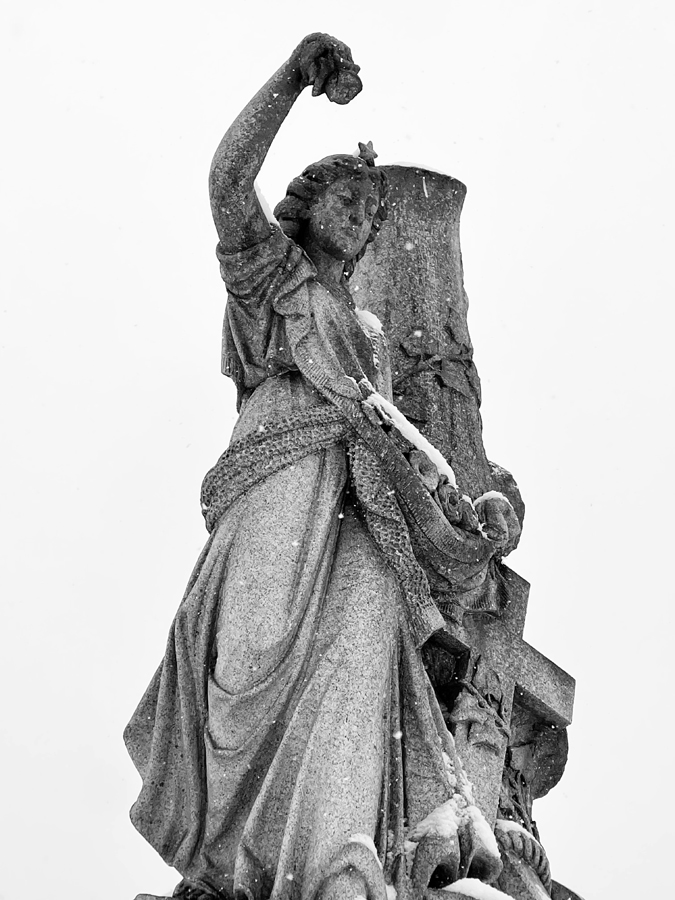
Snow angel, Calvary Cemetery

Also, as I was surrounded by all this white, it dawned on me that one of the reasons I photograph cemetery statues is because they seem to be monochrome. They’re easy to shoot in black and white, and if you choose to shoot in color, there’s no color-balancing needed. No matter the hue, the observer’s brain corrects for it because you already know the statue is white. You don’t need a “Shirley” card to shoot cemetery statues.

(A Shirley card, by the way, was a photograph of a white woman (Shirley, a Kodak employee) used since the mid-1950s by Kodak photo labs to calibrate skin tones, shadows and light during the printing process.) 

Warholized cemetery angels (Evergreen Cemetery, Camden, NJ)

Supposedly, the Farmer’s Almanac said we are in for a rough winter. So maybe I’ll have more opportunities to shoot snow angels. I mentioned the Almanac prediction to my neighbor a couple months ago, a woman who moved to Philadelphia from Spain. She did not understand what the Farmer’s Almanac was, never having heard of it. I felt like an idiot trying to explain it, because, well, I couldn’t. To quote Pee-wee Herman: “Some things you wouldn’t understand. Some things you couldn’t understand. Some things you ... shouldn’t understand.” Like the image below….

The "Late Nights" image above is a mash up of two images combined as one. Both were made in south Jersey cemeteries during the snow week. Andy Warhol said that art is what you can get away with. Is it disrespectful or sacrilegious tromping through a graveyard making such photographs? I think that any attention we give those who have gone before us is a way of paying respect. Their memory lives on.

Old Pine Street Church, Philadelphia
One of the things Victoria Browning Wyeth has said about her Uncle Andy (who died in 2009) is that when she visits his grave, she pictures him deep underground in his casket smiling up at her. I think I’m going to imagine that from now on, when I’m photographing in cemeteries – those below are smiling up at me - and laughing, probably, when I fall.

(Cue up the R.E.M. song, “Fall On Me” ….. )