Showing posts with label Ben Franklin. Show all posts

Saturday, February 10, 2024

Falling Snow in the Cemetery

Okay, no more ChatGPT tricks. This is really me writing this. Really. No, wait, how would you know? Hopefully, my personality will suffuse the text to the degree that you’ll be able to tell its really me. I’m interested in my readers’ take on how I compare to AI, so please comment!

I should have named this post, “Falling In the Snow in the Cemetery,” since that’s one of the things that occurred during the recent January snow week while I was shooting cemeteries. But more on that as we slide along. I’ve photographed cemeteries in the snow many times, and recounted those experiences on this blog. Between January, 2022 and January, 2024, I really had no new experiences to recount.

Why is that? Well, it hadn’t snowed in the Philadelphia area in two solid years. We were due, I suppose. Can’t say I missed it all that much – go global warming! But we did recently get dumped on twice in one week – about three inches initially, then about six a few days later. I had a few opportunities to get out there with the cameras, so, Bob’s your chipmunk, as they say.

Old Swedes Church monument, Philadelphia
Early in the week, it snowed all day and I was able to get out to a few South Jersey cemeteries for some shooting before sunset. Actually, I began my snow shooting in the small Old Swede’s Church graveyard near my house in the Queen Village neighborhood of Philadelphia. The church sexton allows people to walk their dogs on the large open area next to the graveyard, and there were about ten dogs frolicking in the snow that morning. One woman had just entered the property and her large dog was pulling her along. She said something like “Slow down, Petey, I know you want to see your friends!”

Ben Franklin's grave, Christ Church Burial Ground (Pennies ...get it?)

Since I work in south Jersey, it was easy enough to visit nearby Harleigh, Old Camden, and Evergreen cemeteries after work. A few days later we had an all-day snow, so I was able to get out into an active snowstorm in Calvary Cemetery, in Cherry Hill. It remained cold for a week so I made the most of the weather by catching lingering snow in Philly’s Christ Church Burial Ground (Old City) as well as the Old Pine Church graveyard (Society Hill) on my way to and from work.

Selfie with friend in Calvary Cemetery, Hill of Cherries, New Jersey

But back to the beginning. The selfie you see of me (above) was made when I first arrived at Calvary. It was colder than a witty analogy. The photo below is me an hour later, after shooting in the piercing wind and trudging through six inches of fresh snow. Photographing cemeteries in a snowstorm can be quite an amazing experience – until its not. It is exhilarating to be out there alone with the elements, knowing full well no one else in their right mind is doing the same. Well, alone except for the groundskeepers plowing the cemetery roads. Probably wondering how unhinged this guy must be in the snow with all those cameras dangling from his neck. 

Jesus, it was cold out there!

As I repeatedly jammed additional “HotHands” chemical hand warmer pouches into my gloves, I kept thinking how I didn’t want to end up like Jack Nicholson in the final scene of “The Shining.” Its one thing to reach the point of self-actualization by getting that one-in-a-million shot, but the need for the safety of a warm vehicle in the dead of winter can knock you down a few pegs on Maslow’s pyramid, where you’re all of a sudden more concerned with basic survival needs. And losing digits.

Ansel Adams, eat your heart out. (Harleigh Cemetery, Camden, NJ)

Granted, this is nothing compared to what Ansel Adams went through to capture those gorgeous images of the snow-covered Rockies in Jellystone Park, or climbing onto his car roof with a tripod and a view camera to shoot, “Moonrise, Hernandez, New Mexico,” but it was challenging enough. Everything’s relative. Adams probably didn’t have a fourteen-year-old daughter at home who needed dinner made when she got home from school. 

Sunset, Evergreen Cemetery, Camden, NJ

Anyhow, that weekend it stayed cold (below freezing), so I spent a few hours trudging through Woodlands Cemetery in west Philly. Mainly I shot with the iPhone and Holga loaded with 120mm black and white film. It was so cold I couldn’t wind the film for the next exposure! (Remember winding film? …. Remember film? …)

Yours truly, with the Holga (Woodlands Cemetery)
The Holga. Yes, just another pain point in my photographic arsenal. A Holga is essentially a cheap plastic toy camera that uses 120mm film. As I write this, I’m waiting for the film processing place to develop my film, scan the negatives, and send them to Dropbox for me. I have no idea whether there will be anything good on that film. Actually I shot two rolls of 12 exposures (120 mm BW). I will wait until I get the results before I post this, so you can all witness either my ineptitude or my genius, whichever the case may be.

Turns out I was rewarded with two reasonable images – out of 24. Even a blind squirrel finds a nut twice a day. Here they are.

Holga images (L: Calvary Cemetery; R: Woodlands Cemetery)

Falling For You

At one point, in a cemetery I won’t name, I slipped on the ice. Wasn’t climbing on a monument. (Honestly, I don’t do that. Having seen a monument fall on a person, pin them to the ground and break their leg, I do avoid such near occasions). I was simply walking along the unplowed road, and my feet flew out from under me! My mind's eye was blind to the ice under the snow. I’d been looking out at the gravestones, eyes peeled for a good composition, instead of looking where I was walking. Obviously, I had not done the proper risk assessment. Hit my right shoulder on the ground with tremendous force:

According to Microsoft’s new AI powered Bing search engine:

"The gravitational force acting on a 200 lb mass is about 889 Newtons. A person who weighs about 200 pounds and falls just 6 feet will hit the ground with almost 10,000 pounds of force."

Calvary Cemetery, Cherry Hill, NJ
And I felt every one of those fekkin 10,000 pounds. Jesus H. Christ! Despite the pain, I made it okay hiking through the cemetery and shot for an hour, but then I realized I couldn’t raise my right arm very high. The next day, I couldn’t raise it at all. I spent the next week with T. Rex arms. Really thought I tore my rotator cuff. But after a week of Motrin smoothies, the pain began to
subside, and I started to regain my range of motion. I am glad that I continued shooting after the fall – I did make some decent photographs. Great art comes from great pain. 

Mausoleums, Harleigh Cemetery, Camden, NJ

Why Photograph Cemetery Statues?

Why subject myself to all this? Is it to capture/create a unique image? To build up my catalogue raisonnĂ©? To have ‘alone’ time? Or is it just the JOURNEY that’s important, more so than the destination? I think it’s a combination of all that, but my reason can best be summarized in something the artist Andrew Wyeth said to his granddaughter, Victoria Browning Wyeth, “my goal is not to make pictures but to express my love of these things.

I do love cemeteries and graveyards, which is why I use them in my art. Unlike Georgia O’Keeffe, who is widely known for her paintings of flowers, and said “I hate flowers – I paint them because they’re cheaper than models and they don’t move.” I appreciate the fact that access to cemetery statues is usually free and the statues (usually) don’t move. Cemeteries? I want to be there, and I want to create something. Paul Rudnick, in a recent New Yorker Shouts and Murmurs piece, wrote in jest about something “seemingly empty yet rife with meaning.” Describes cemeteries fairly well, don’t you think? 

Calvary Cemetery abstract, shot through glass in a snowstorm

While I certainly appreciate the beauty of a landscape or an Italian marble cemetery sculpture, I also appreciate the fact that people went out of their way to memorialize the dead. Sometimes a grave marker is the only tangible evidence that a person existed. Standing amidst these monuments can make one feel part of the human family. Like the dog, Petey, mentioned above, many of us just want to feel part of the whole.

Woodlands Cemetery, Philadelphia

Roland Barthes, the French literary theorist, philosopher, and critic said in 1977, “If photography is to be discussed on a serious level, it must be described in relation to death.” He added, “Its true that a photograph is a witness, but a witness of something that is no more” (Camera Lucida, 1980). So what better canvas with which to create new art than a cemetery? 

Sunset, Evergreen Cemetery, Camden, NJ

I also appreciate the beauty of a warm motor vehicle on a frigid day. Here’s another image I like, shot out the window of my wife’s Rav 4. Right after I made this image, I couldn’t get the power window to go back up! Panic. Twenty-four degrees outside. Another snowstorm expected tomorrow. After much fumbling around and considerably more panic, I realized there was an interlock on the door – a button that disables the power window function! Found that ten minutes later - released it and we’re back in business! Always never do that. But DO drive an SUV when you’re shooting cemeteries in the snow! You don’t want to get stuck. 

What Does Snow Add to a Photograph of Cemetery Statues?

To paraphrase Reese Witherspoon, who recently said that “Snow days were made for Chococinnos,” snow days were made for shooting cemetery statues. Why? Probably for the same reason she got in trouble for telling her TikTok followers that it was okay to eat snow. It’s novel, its enjoyable, and it probably won’t hurt you (unless you slip and fall in it, that is). 

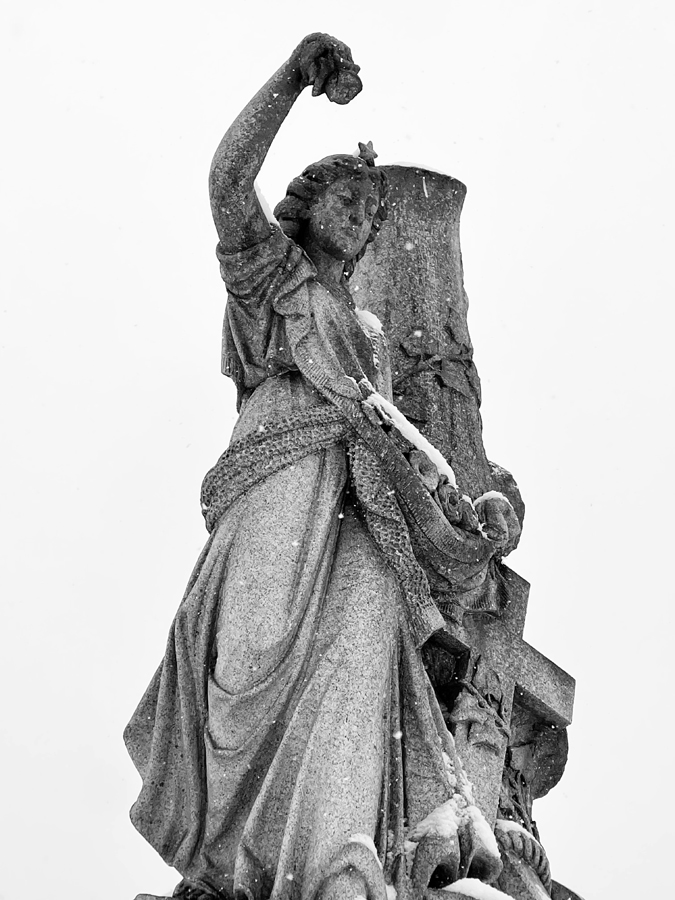
Snow angel, Calvary Cemetery

Also, as I was surrounded by all this white, it dawned on me that one of the reasons I photograph cemetery statues is because they seem to be monochrome. They’re easy to shoot in black and white, and if you choose to shoot in color, there’s no color-balancing needed. No matter the hue, the observer’s brain corrects for it because you already know the statue is white. You don’t need a “Shirley” card to shoot cemetery statues.

(A Shirley card, by the way, was a photograph of a white woman (Shirley, a Kodak employee) used since the mid-1950s by Kodak photo labs to calibrate skin tones, shadows and light during the printing process.) 

Warholized cemetery angels (Evergreen Cemetery, Camden, NJ)

Supposedly, the Farmer’s Almanac said we are in for a rough winter. So maybe I’ll have more opportunities to shoot snow angels. I mentioned the Almanac prediction to my neighbor a couple months ago, a woman who moved to Philadelphia from Spain. She did not understand what the Farmer’s Almanac was, never having heard of it. I felt like an idiot trying to explain it, because, well, I couldn’t. To quote Pee-wee Herman: “Some things you wouldn’t understand. Some things you couldn’t understand. Some things you ... shouldn’t understand.” Like the image below….

The "Late Nights" image above is a mash up of two images combined as one. Both were made in south Jersey cemeteries during the snow week. Andy Warhol said that art is what you can get away with. Is it disrespectful or sacrilegious tromping through a graveyard making such photographs? I think that any attention we give those who have gone before us is a way of paying respect. Their memory lives on.
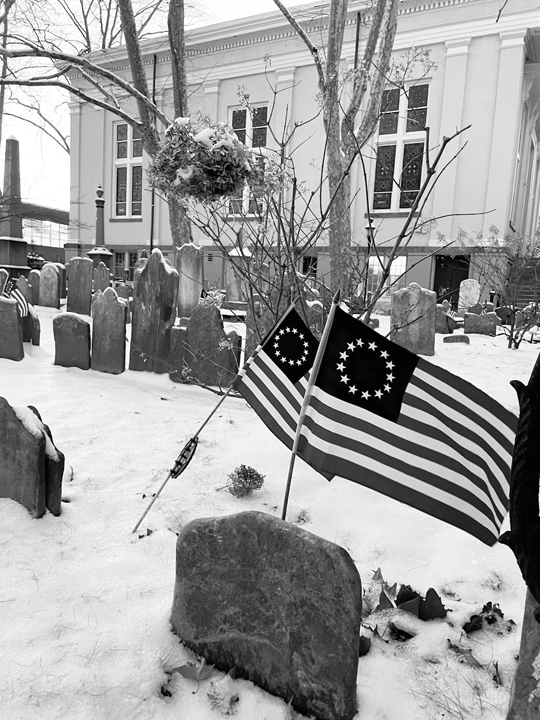
Old Pine Street Church, Philadelphia
One of the things Victoria Browning Wyeth has said about her Uncle Andy (who died in 2009) is that when she visits his grave, she pictures him deep underground in his casket smiling up at her. I think I’m going to imagine that from now on, when I’m photographing in cemeteries – those below are smiling up at me - and laughing, probably, when I fall.

(Cue up the R.E.M. song, “Fall On Me” ….. )


Wednesday, July 2, 2014

Fourth of July at Christ Church Burial Ground

Benjamin Franklin's grave, Christ Church Burial Ground
For the Fourth of July, I thought it might be appropriate to “Welcome America” to Christ Church Burial Ground, in the heart of Philadelphia’s historic district. If you’re here to visit, you almost cannot help stumbling upon this old (and I mean OLD, established 1719), brick-walled cemetery across from the U.S. Mint (Fifth and Arch Streets). It’s but a stone’s throw from the Liberty Bell and Independence Hall.

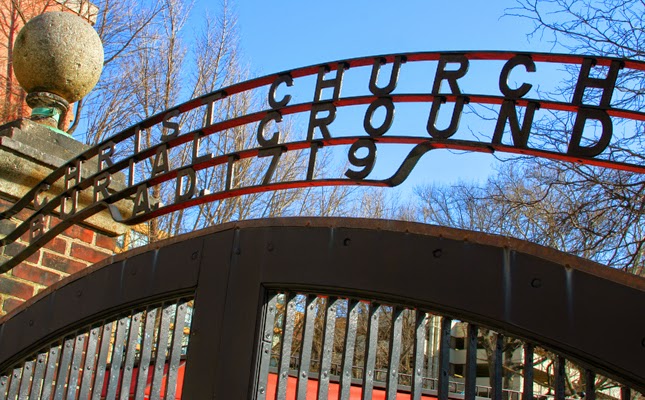
Ironwork sign over main gate

It is one of the nation’s few surviving Colonial and Revolutionary War-era burial grounds, and right in the midst of the tourist district. While I’m sure this cemetery has many a first-class tale to tell, I’m approaching it from the tourist’s perspective. This is where Ben Franklin’s grave is, and on it visitors toss pennies (“A penny saved is a penny earned”). But there’s a lot more to Christ Church Burial Ground than that. For one thing, you have to pay to get in! Three dollars! If you arrive at the right times, however, you may hit one of the guided tours.

One of the odd and quirky things about Franklin’s grave is his self-penned epitaph, which is engraved on a bronze plaque near the grave (you can only see it from the inside of the cemetery):


“The Body of
B. Franklin, Printer;
Like the Cover of an old Book,
Its Contents torn out,
And stript of its Lettering and Gilding,
Lies here, Food for Worms.
But the Work shall not be wholly lost:
For it will, as he believ’d, appear once more,
In a new & more perfect Edition,
Corrected and amended
By the Author.”

While Christ Church Burial Ground is the only cemetery I know of that charges an admission fee, don’t hold it against the city (there are certainly worse things you can rant about, such as the Parking Authority). The City of Philadelphia does not own Christ Church Burial Ground – it is owned and operated by Christ Church, which is a few blocks away at Second and Market Streets. The money goes to the upkeep of BOTH cemeteries – the older one surrounding the church (which was established in 1695). The one near the mint was opened in 1719 as an expansion of the churchyard cemetery “on the outskirts of town.” Interesting to note that Philadelphia only stretched from the Delaware River to Sixth Street at that time!

Weathered marble headstones at Christ Church Burial Ground
Christ Church Burial Ground is small (only two acres), but is a charming cemetery. Its ground holds many statesmen and other luminaries such as Dr. Benjamin Rush and several signers of the Declaration of Independence. It is fascinating to watch people from the inside gather outside the fence to peer at Franklin’s grave. While the cemetery is surrounded by a high brick wall, Franklin’s grave can be seen for free (even when the cemetery is closed), thanks to his descendants. Back in 1858, they requested that part of the wall be removed so people could view the grave (this is on Arch Street, near the corner of Fifth).

Bronze plaques help identify badly worn stones

The cemetery is gated and locked outside visiting hours (11:30 am – 3:30 pm). During visiting hours, a stand is set up at the entrance with many books for sale, including a reprint of the book compiled in 1864 by the warden of Christ Church, Edward Lyon Clark, “of all the inscriptions that were still visible on the fading soft marble markers.”


If you’re in the historic area, the burial ground is a solid and tangible piece of our nation’s history, and should be visited. An historian friend of mine once said that if Philadelphia's historical attractions are not within six blocks of the Liberty Bell, tourists will not visit them. Therefore, no one visits Fort Mifflin (near the International Airport) or Betsy Ross' grave (Mount Moriah Cemetery). Christ Church Burial Ground, however, is not only convenient - its the real deal. It isn't fictional history like "Thomas Jefferson's house" or "Betsy Ross' house." The clip-clop of hooves from horse-drawn carriages moving along Fifth Street help to conjure a mental image of how this young nation may have seemed centuries ago. Just close your eyes, stand in the graveyard, and listen.

References and Further Reading:
Welcome America website
The Graves of Christ Church Burial Ground

Tuesday, October 15, 2013

Christ Church Burial Ground and the Government Shutdown

I’d long thought that Christ Church Burial Ground in Philadelphia was government-run, and therefore I figured it might be closed due to the current government shutdown. Nearby Independence Hall and the Liberty Bell are both closed as they are operated by the National Park Service (even the Park Service’s website is down!). Naturally, I was wrong. Turns out that the historic burial ground is run by, surprise, surprise: Christ Church. And it was open today, Columbus Day, a legal holiday. (See link at end for list of what is open and what is closed in Philly during the federal government shutdown.)

Christ Church is the only cemetery I’ve ever visited that charges admission. Yes, two dollars (as of October, 2013) to get in. It’s right across Arch Street from the Philadelphia Mint, so the fact that you have to pay money to see an historic national landmark that’s right across the street from where they make the nation’s money is kind of ironic.

I’d always been put off by the admission fee, but I suppose this is a more palatable way for the Episcopal Church to make money from its cemeteries than to actually LEASE them like the Roman Catholic Church is doing with its cemeteries in the Philadelphia Archdiocese (see link). The saving grace of Christ Church Burial Ground (established in 1719) is that Ben Franklin’s grave is visually accessible through the iron fence near the corner of Fifth and Arch Streets. So you don’t actually have to pay to see Benjamin and Deborah Franklin’s grave marker.  People throw pennies on his large, flat stone (“A penny saved is a penny earned,” Franklin said) and today, I even heard someone saying to his daughter, “Make a wish.

School children tossing pennies on Ben Franklin's grave (Christ Church Burial Ground)

I suppose the Church scoops up all the pennies each day and puts them to good use. The fact that we can see, touch, and walk amidst these historic graves is a tribute to the Church’s commitment to historic preservation. According to its website: “the Burial Ground was closed to the public from 1977 through 2003.  In 2002, The Christ Church Preservation Trust undertook a major program of renovation in order to reopen the Burial Ground.


There’s a tourist booth just inside the entrance gate where they sell books about the cemetery, and about our nation’s history as it relates to the few blocks around this area. Five signers of the Declaration of Independence are buried here, including Dr. Benjamin Rush. Dr. Philip Syng Physick (the “Father of Modern Surgery”) and George Ross (Betsy’s uncle), along with various Biddles, Bainbridges, and other historic names from our nation’s founding. (Wait – one of the Beatles is buried here too...?!) Unfortunately, you’d be hard-pressed to make out any inscriptions on the headstones. Most are smallish marble markers that have been worn smooth by acid rain. Bronze plaques now stand in front of the more famous headstones.

Worn grave markers in Christ Church Burial Ground

Still, everyBODY buried here was significant in his or her own right. The markers mark their lives, their mortal existence. Thankfully, someone had the foresight to transcribe all the engravings from the headstones in 1864, which has been reprinted in the book, A Record of the Inscriptions on the Tablets and Gravestones in the Burial Grounds of Christ Church,Philadelphia!


And speaking of printing, Franklin’s grave is by far the most popular, with people flocking to it with cameras and pennies in hand. A bronze plaque hangs on the brick wall near the grave. On it is the epitaph Frankin’s wrote for himself:

"The Body of
B. Franklin, Printer;
Like the Cover of an old Book,
Its Contents torn out,
And stript of its Lettering and Gilding,
Lies here, Food for Worms.
But the Work shall not be wholly lost:
For it will, as he believ’d, appear once more,
In a new & more perfect Edition,
Corrected and amended
By the Author."

Once I had backed up and was leaning on a crypt cover in order to get a longer view of the Franklins’ grave, when a guard ran over to me and asked me not to lean on the other monuments. I was a bit annoyed, thinking at the time, “This guy thinks this place is a museum!” But in retrospect, it is. And since that time I have witnessed a headstone falling on someone, so maybe safety was on his mind too.

Supposedly 4,000 people are buried in this 2-acre plot of ground. Interesting number, since an acre today typically holds 1200 to 1500 side-by-side graves. How did they jam in the extra thousand? Did they bury them standing up? Without burial vaults? At various depths? ? AND ….  this is still an active burial ground! My guess is that things have probably disintegrated below ground to the point where there’s probably nothing left of the 300-year-old wooden coffins, allowing room for additional burials. As you walk through the place, you do get the sense that it is rather dense with grave markers and headstones. Still, things were artfully arranged - I like the way these large flat crypt covers in the image below line the walkway from the gate off Fifth Street.

Crypts line walkway of Christ Church Burial Ground, Philadelphia

Outside Christ Church
If you visit, you may notice there’s no church here. So where is Christ Church? It’s actually two blocks away, near Second and Market Streets. It has a tiny graveyard surrounding the church, and the additional land at Fifth and Arch was purchased to expand the burial ground when the church property filled up. The church still has George and Martha Washington’s pew box roped off, where they sat during services. Other early American notables were parishioners of Christ Church, a veritable Who’s Who of the American Revolution:  Betsy Ross, John Adams, Absalom Jones, and the Franklins, to name but a few.

References and Further Reading: 
Christ Church website
National Park Service website
Click here for a list of what is open and what is closed in Philly during the federal government shutdown
U.S. Dept. of the Interior website

Thursday, December 13, 2012

Hunting for Rare Coins in the Cemetery

Coins in St. Lucy's bowl
Back in the summer of 2012, I attended the “World’s Fair of Money,” the annual convention of the American Numismatic Association. Actually, I just attended the exhibit hall to ogle the rare coins. I’ve collected coins since I was a child, basically for the beauty and artistry of the objects, their intrinsic value. (I must add that my entire collection is rather mundane, since the extrinsic value of these objects has prevented me from making my collection more interesting!)

"Classic Head" Large Cent (U.S.)
Though silver and gold are the precious metals to which we typically assign greater value, this story is about the lowly copper coins. I decided to write about finding old coins in cemeteries when a friend recently pulled an 1814 United States large cent (copper penny) out of his pocket. He told me he found it in a small cemetery just lying in the grass a few years back. My initial reaction upon seeing the condition of the coin was to beg him to wrap it in something protective and not to drop it back in his pocket with the other change. I have no firsthand knowledge of early American coins because I could never afford to buy them; however, something in that good condition, and that old, had to be quite valuable! I looked it up on the Internet the next day and want to inform him that it retails for between $1,000 and $2,400, based on its officially-graded condition. The coin appeared to me to be in extremely fine shape. (The photo above is of the actual coin he showed me.)


I assume there are other stories like this, and I would be interested in hearing them from readers. However, I understand there might be some reluctance to sharing, as the flags of ownership may be raised, in which I don’t want to be involved.


Penny lodged between the clover leaves
Ben Franklin's grave
I myself have found coins on headstones – albeit worthless ones. People sometimes place them there for good luck or as some form of remembrance. For a long time people believed that placing pennies (face up) over the eyes of the dead "was a means of paying their way to cross over to the other world" (ref). Below we see people throwing pennies on Ben Franklin’s grave in (Christ's Church Burial Ground) Philadelphia – “A penny saved is a penny earned.


Tour guide instructing school children about tossing pennies on Ben Franklin's grave

So if you saw all those coins in St. Lucy's eyeball bowl (at beginning of this article), would you be temped to pocket a few dollars? Well, I often think back to finding pennies on mobster Angelo Bruno’s headstone (link to my blog posting, "Graves of the Mob Bosses"), and how uncomfortable I would have felt were I to snitch a penny as a memento!
 
The fact that people place coins on tombstones today makes it quite plausible that people have been doing so for as long as there have been tombstones – and coins. Which of course makes it quite possible that there are rare old coins lying around old colonial and Victorian U.S. cemeteries.


Image from U.S. Coin Values.com
So after mentioning to a friend that I had been to the World's Fair of Money, he told me this story. Back around 2007, he was working in a cemetery with a crew of guys righting a large obelisk that had fallen over in a storm. A crane was to be used to lift the obelisk upright, into the air, so it could be lowered back down onto its base. One of the guys set to the task of clearing the channel in the marble base on which the obelisk sat. As he brushed away leaves and sticks, he found a 1799 ("Draped Bust") United States large cent (copper penny), like the one shown above. He showed it to his coworkers (including my friend) and stuck it in his shirt pocket. On the way back to the truck later, he removed his shirt. That was the last anyone saw of the coin.


After I was told that story, I looked up the value of a 1799 United States large cent. By my friend’s description, its condition was at least as fine as the 1814 coin mentioned above. How these copper coins remain untarnished and uncorroded after so many years in the elements is beyond me. Ready for the value of this coin? After I checked it out on U.S. Coin Values.com, I was tempted to buy a metal detector and head out to that cemetery myself! In worn, barely recognizable condition, it would retail for $4,000. In the condition the coin was described to me? – about $40,000! Turns out this is the rarest U.S. large cent ever minted. Ever.


U.S. Mint Chief Engraver William Barber's grave
Seated Liberty half dollar (1839 - 1891)
And speaking of minting, after all this talk of rare coins, you may be tempted to buy a metal detector yourself and paw around William Barber’s grave in Philadelphia’s Mount Moriah Cemetery, looking for some silver "Barber" dimes. Barber was the Chief Engraver at the U.S. Mint in Philadelphia from 1869 to his death in 1879. He is responsible for the Seated Liberty coinage design (shown below). 


Barber dime (1892 - 1916)
This series actually pre-dates what is known as the "Barber" design coinage (example at end is from my own fine collection).William's son, Charles Barber, was actually responsible for the "Barber" coin design. Charles succeeded his father as Chief Engraver in 1879 and is also buried in Philadelphia (Mount Peace Cemetery). Just to give you some perspective, the Barber dime (1892 - 1916) preceded the more popular “Mercury” dime design (1916 - 1945).


Wednesday, October 24, 2012

The Haunted Grave

There’s a little cemetery in the Old Swedes’ Churchyard complex near my house in South Philly. It’s an odd little graveyard, one of the oldest in Philadelphia. Some of the slate stones dating from the 1700s are oldest standing headstones of any cemetery in the city. In fact one of the pair below, dated 1708, was placed just seven years after the city was founded in 1701. (The stones, by the way, are toward the rear of the church, and mark the graves of Church minister Andreas Sandel’s two infant sons.)

This place is a sea captains’ burial ground, first and foremost. The part of the city in which it is located (near Penn’s Landing) was one of the region’s original waterfront settlements way before William Penn arrived on these shores − 1637 to be exact. Among the early European settlers, many sea captains are buried here – from Captain George Ord the Revolutionary War gunrunner to Captain Peter Cruse, who in 1918 first brought rubber from South America (galoshes were the first product made from it, by the way!). In fact, the area surrounding Old Swedes' (including my little neighborhood, Pennsport), was known as a sea captains’ village. Many seafaring gentlemen lived here and were members of the Old Swede’s congregation, which is also known as Gloria Dei.


Daughter Olivia at gunrunner Captain George Ord's grave
Although the cemetery is quite small, generations of local people are buried here. Over three hundred years worth of people! From sea captains to scientists, revolutionary and civil war soldiers, artists, ministers and common folk. There are even current burials taking place here in 2012! There's a staggering amount of American history condensed in this little graveyard. A bronze plaque set in a nearby stone that tells us that 27 cannon were erected here in 1748 by "Benjamin Franklin's Pennsylvania Associators" during "King George's War." This refers to the voluntary militia started by Franklin in 1747 to defend Philadelphia against river attack by French privateers and pirates, the "Associators" being the origin of our "National Guard."

Though separated by generations, I’ve always had the strange feeling that many of the people buried in this churchyard actually knew each other when they were alive. I never get that feeling in a modern cemetery. The inhabitants remind me of the dead townspeople in Edgar Lee Master’s Spoon River Anthology (1915).

Flea market outside the Old Swedes' gate
True to its neighborhood and community feeling, Old Swedes’ has one of the best flea markets in Philly (all parishioners, no retail vendors!), which I attended with my three-year-old daughter this past Saturday. Tables are set up outside the old brick wall surrounding the complex, most of the way around the block. You can see some vendors through the gate in the photo above. Strolling around the cemetery afterwards prompted me to write this blog, having recalled an incident that occurred here last spring.

Couple strolling amidst the old stones as well as the new
They have the flea market twice a year, spring and fall. Back in May, 2012, I went to the flea by myself, then walked around the cemetery afterwards, shooting pictures of the old stones and monuments. There were a few visitors here and there, touring the old church, checking out the graves, buying food in the church hall. A young boy, maybe seven years old, came up to me as I was photographing some headstones alongside the church. I had never seen him before. He just walked right up to me and said, “Do you want to see the haunted grave?”

My young ghost guide
Do I want to see a haunted grave? I always want to see a haunted grave! So I followed him toward the back of the building. I really didn’t know there were headstones back there by the church's basement entrance. He stood there proudly pointing to the grave of  Catherine and Anthony Duche. I asked him, “Why do you think it’s haunted?” He replied, “It just is.” Can’t argue with that logic, now can you? He trotted away.

Fast forward to last weekend when I was back at Old Swedes’ with my  three-year-old daughter. Olivia actually went to summer camp here this past summer, so she’s used to running around the cemetery. We went to the back of the church so I could photograph the Duche grave in better light than was available last time I was here. Olivia climbed up the old brick battlement that separates the complex from the Delaware River as I kicked through the leaves and made some photographs. Turns out that Anthony Duche arrived in the region with William Penn, so he really is one of the city’s founding fathers.

So, as I’m writing this a few nights later, I have my daughter on my lap, with my laptop alongside me on the sofa. We’re watching “educational” cartoons on television. She often asks what I’m doing as I type away, and I tell her “I’m writing.” So just now, totally out of the blue, she says, “Are you writing about Captain Wiccan?” Where did THAT come from? To my knowledge, she’s never heard the word “wiccan.” I swear, kids can sense things.

Further Reading and Reference:
Gloria Dei Old Swedes Church website

The church's history: Gloria Dei (Old Swedes' Church) National Historic Site

Read more about the WPA poster shown at the top of this blog:  http://www.wdl.org/en/item/9570/
“This poster depicting the Old Swedes Church in Philadelphia was made for the Work Projects Administration (WPA) Federal Art Program in Pennsylvania. One of the New Deal programs launched by President Franklin D. Roosevelt to combat Depression-era unemployment, in 1936–43 the WPA supported the creation of more than 2,000 posters by well-known artists. These posters were used to promote local tourism and to publicize a variety of programs from art to safety.”