Thirty-one cemeteries across 103 contiguous acres, in five hours. That was the goal, anyway. However, I only hit twenty-seven cemeteries before I hit the wall of exhaustion. I totally ran out of steam toward the end of this marathon, 95-degree afternoon in San Antonio, Texas. It was so hot that my iPhone 12 was intermittently fading in and out because of the heat. Just needed it to keep enough juice to call an Uber for the ride back to the hotel later that afternoon.
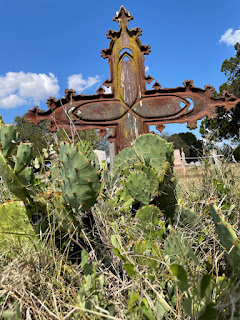 |
| St. Joseph's Catholic Cemetery |
Of the four days I expected to be in San Antone, this first day, Friday, was forecast to be the coolest, at 95 degrees. Temperature was expected to slowly rise in subsequent days so that by Monday, it would be 108! Certainly not going on a long explore in that heat. And those people who say, ”Well, it’s a DRY heat…” Well, no, its not. Relative humidity was 80 per cent. San Antonio is like a tropical rain forest (and it did actually rain Friday night into Saturday). The only other time I did a cemetery excursion of this magnitude was when a friend and I spent a day visiting about a dozen cemeteries in Brooklyn and Queens, NY. We drove from one to the next, all day long. In retrospect, having a car here in Texas would’ve made life easier. Even though the 31 cemeteries are contiguous (see map), it isn’t like you can easily leave one and enter the other at will.
Why is that? Well, when I was here about ten years ago I was driving a rental car. I did not recall the fact that all the individual cemeteries are either walled or fenced off from each other. Very rarely is the exit of one lined up with the entrance to the one next door. This, unfortunately, required much unproductive walking (sometimes as much as two city blocks) just to FIND the entrance! I did not have the luxury of having a map or photos showing WHERE the entrance and exits were located. Under normal circumstances, this would be no big deal. But with such unbearable heat that the ice in my thermos of ice water melted almost immediately upon arrival, it was quite aggravating. My suggestion? Drive. Even with gas prices over $5.00 per gallon for regular, drive. (By the way, there is a link at the end if you would like to read my 2012 blog, "The Cemeteries of Old San Antonio.")

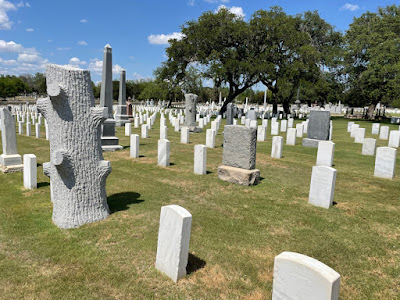 |
| Woodmen of the World gravemarker in the National Cemetery |
I walked through a bit of the National Cemetery first, thinking that if any of the 31 would be locked up at the end of the day, this would be the first. Most of the gravemarkers were regulation-size government-issue marble headstones, but I could see a few monuments off in the distance. I exited the cemetery thinking I’d investigate these few pieces later on. The two large Woodmen of the World marble tree sculptures were rather unusual, for any cemetery. Typically such monuments are carved from granite.
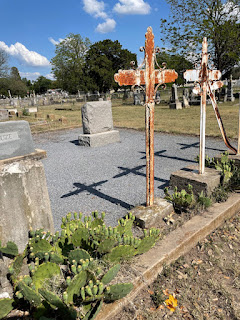 |
| Iron crosses in St. Joseph's Catholic Cemetery |
It is interesting how the city created its cemetery district in 1853 (Texas only became a state seven years earlier, in 1846). According to the San Antonio Parks and Recreation Department, new entities – fraternal organizations, churches, etc. - created their own cemeteries here on Powder House Hill, adding to it up until 1904 (ref.). After that, new cemeteries were established in various areas outside the city center, beginning with San Jose Cemetery in 1922. These are all much larger, Victorian-type sculpture gardens (which you can read about in my 2012 blog post, link at the end).I was as prepared as I thought I needed to be for the day’s excursion – sunblock, insulated water bottle with ice, baseball cap, shoulder bag with two real cameras in addition to my iPhone 12. I’m just going to give you a general overview of my day here, with specific experiences in certain cemeteries written up in future blogs. I will touch on some highlights, however. On the map above, you’ll see in red numbers the sequence of cemeteries I visited, starting with the National Cemetery. I did sort of plan this as far as seeing a few specific sites, some of which I found, others that I did not.
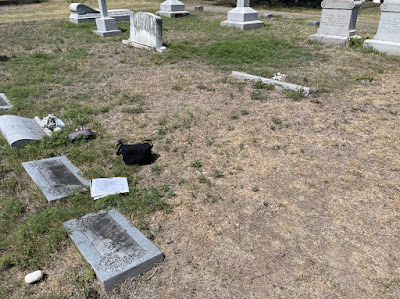 |
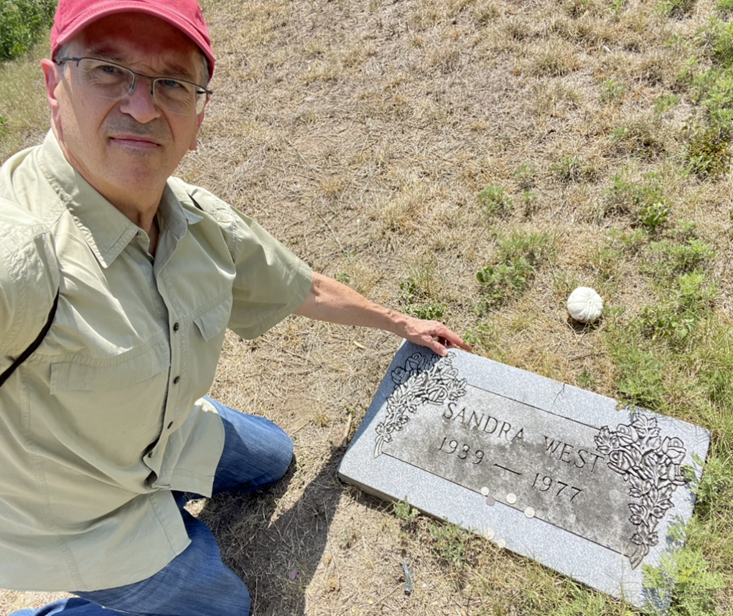
| Bare spot at lower right is where Sandra West is buried in her Ferrari |
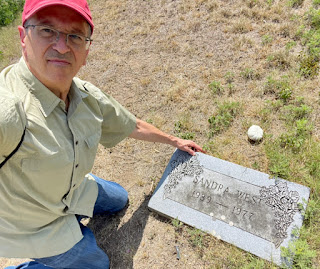 One of the first graves that I successfully located belongs to Sandra West - in which she is buried, behind the driver’s seat, of her 1964 Ferrari 330 America. In the photo below, you can see the concrete vault holding the car and body being lowered into her grave.
West, a wealthy Beverly Hills socialite, died in 1977. You’d never guess by looking at the barren ground in this photo that a car is buried beneath, now would you? There is a large open area at the foot of her headstone that is about the size of a car. Here's a selfie of me standing above that half-million dollar sports car. This is in the Masonic Cemetery, Alamo Lodge. Oddly, this is the only cemetery in San Antonio's Eastside Cemetery Historic District that does not have a fence around it - but more on that later.
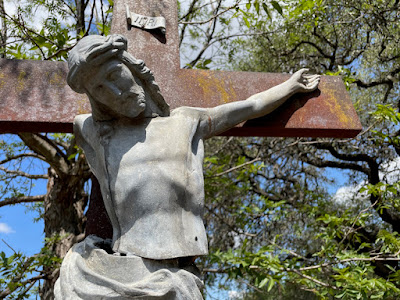 |
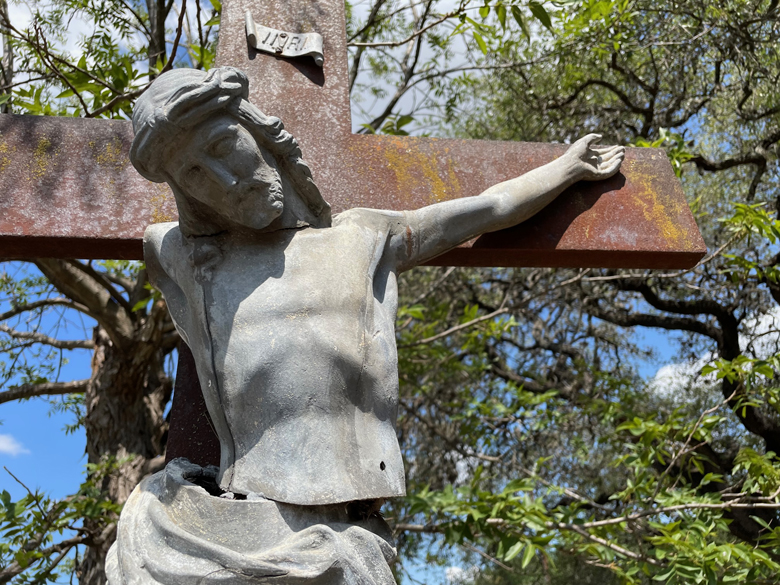
| Fractured zinc Jesus on an iron cross |
One of the things I did not locate was the large zinc, or “white bronze” angel with the wing broken off, which I had photographed on my last visit (see photos in my 2012 blog post, link at end). It was near the zinc Jesus on the iron cross in the Old German Lutheran Cemetery. Alas, the angel had flown. Stolen, maybe? It did adorn a grave on the ground, and was about four feet high. I’d like to think it was spirited away for safe keeping somewhere, possibly by the same person who did the body work on the zinc cradle crave a short distance away.
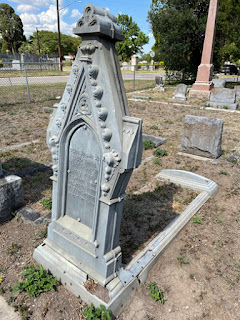 |
| Zinc cradle grave, with body work |
But let’s talk about the map for a bit. You can find it at this link, which is the site for St. John’s Lutheran Church (https://stjohnssa.org/archives/). St. John’s “Old Lutheran Cemetery,” which was Stop #20 on the map, was established in 1866. The map seems to have been created by the San Antonio Parks and Recreation Department, but I cannot find it on their website. They receive credit for its creation, I suppose, and if it is copyrighted, I will gladly remove it.There is a great variety of grave markers throughout these 31 cemeteries. From simple handmade concrete slabs to giant granite Victorian-era obelisks and other sculpture, there is just about everything you can imagine. There are tiny carved angels and large, finely sculpted marble and granite statuary. The different cemeteries have different styles of grave markers, for example the large iron crosses in the Old German Lutheran Cemetery and St. Joseph’s Catholic Cemetery.
There were also some pleasant surprises, like the German-inscribed white marble stones in German Lutheran. These were beautifully preserved and lovely to see.
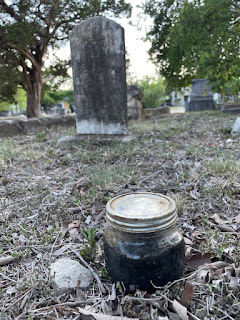 |
| Spell jar at the foot of a grave |
I also came across two graves (in two separate cemeteries) which had jelly jars half buried in the dirt in front of the headstone. These were not new jars of Smuckers jelly, but repurposed jelly jars, sealed, with some sort of unguent inside. Hoodoo offerings - ritual spell jars - I assume. One was in City Cemetery No. 1 and one in the Anchor Masonic Lodge Cemetery.For a fascinating look at such practices, do check out Sharon Moses’ paper, “Cemetery hoodoo: Culture, ritual crime and forensic archaeology” in the publication, Forensic Science International: Synergy (Volume 2, 2020, Pages 17-23 by Sharon K. Moses).
Below you see the portrait from Jack Harris' grave in City Cemetery No. 1. Harris was an entrepreneur who was shot to death in 1882 by the City Marshal of Austin, Texas, as a result of a gambling debt. In 1875, he had changed the name of his San Antonio saloon to the "Jack Harris Vaudeville Theater and Saloon," and is credited with popularizing the term "vaudeville" for variety theaters in the United States.
 |
| D.A. "Jack" Harris, 1834 - 1882 |
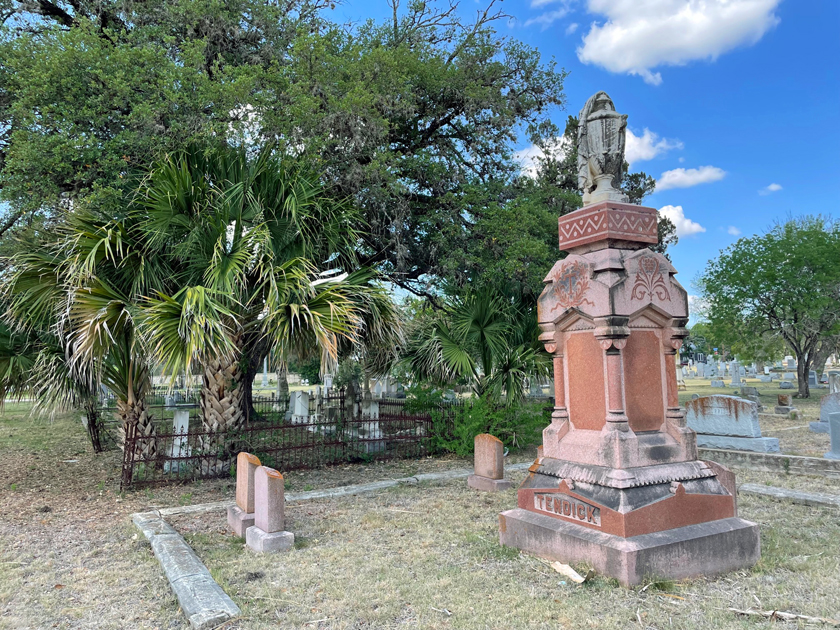
You can see from the map that these 31 cemeteries are all different shapes and sizes. Some were several city blocks in magnitude, some were only maybe ten by twenty feet. Most were in reasonably good condition, although a couple were trashed – broken walls, graffiti, garbage strewn about. The Dullnig Family Plot – stop #4 for me, was by far in the worst condition. Headstones were pushed over and broken, the stone walls were smashed and covered with graffiti. Not sure who, if anyone, maintains the cemeteries that are not owned by the city. Cutting grass is probably a non-issue, since in this heat, it doesn’t really look like any flora proliferates beside the palm trees and cacti. |
| Mausoleum in City Cemetery No. 5 |
City Cemetery No. 5 (again, at my stop #4) was tiny, with a few headstones and one graffiti-covered mausoleum. It was quite secluded, shaded with palm trees and walled-in with a locked gate. There appeared to be bedding laid in the shaded grass next to it. The two Jewish cemeteries, Temple Beth-El and Agudas Achim, along with the National Cemetery, were the best kept properties.
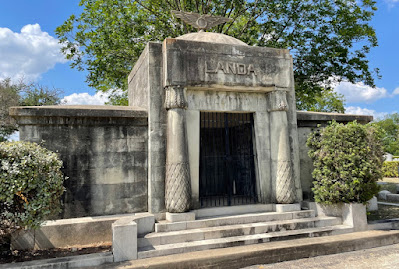 |
| The magnificent Landa mausoleum, Temple Beth-El Cemetery |
When I left St. Joseph’s Catholic Cemetery (stop #9) on my way to the IOOF (Independent Order of Odd Fellows) Cemetery, I hopped the wall at Center Street to cut through the National Cemetery. There were a few things I wanted to see in here that I noticed from outside the wall as I walked up Paso Hondo earlier. I found a large tree near the wall and took a water break in the shade. In retrospect, I should’ve rented a burro and thrown all my gear into a panier strapped across its back. But hey, that’s why there are erasers at the end of pencils – people make mistakes.
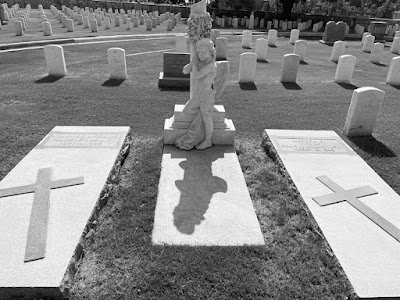 |
| Angel in the National Cemetery |
There can be many translations for “paso hondo.” The one I like is “warrior passage.” Certainly, this seems appropriate for the veterans of the many wars interred in this National Cemetery. One of these warriors had an angel standing guard over his grave, or accompanying him through the passage to the great beyond. Unusual to see such a sculpture in a military, National Cemetery. Around this time I entered No. 4, with the Confederate Cemetery at its center. Curious why this is separate from the National Cemetery, and I suppose there’s a story there.
 |
| Marble statuary atop the Winn monument |
The Winn monument greeted me, which was one of my planned destinations. This is a life-sized white marble statue on a pedestal, of a woman with three children. Last time I was here, I remember this being my last stop. I had snapped a photo of it, but didn’t examine it thoroughly. I don’t believe I had a map with me at that time, and I remember being so overwhelmed with the vast quantities of cemeteries that I think I got to this point and thought, “OMG – ANOTHER cemetery!” I never went in. 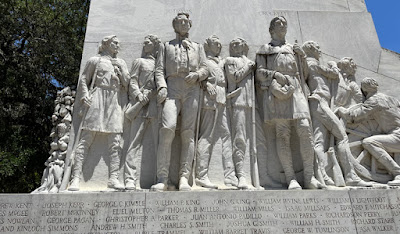 |
| Detail of the "Spirit of Sacrifice" memorial in front of the Alamo |
The Winn monument was created by the famous San Antonio sculptor, Pompeo Coppini. I really have no idea about the significance of the Winn sculpture – another bit of research for the future. That’s why they make tomorrows, right? Coppini’s most well-known work in this city is the sixty-foot high sculpture, “Spirit of Sacrifice,” a cenotaph in front of the Alamo honoring those who perished at the Battle of the Alamo (ref.).
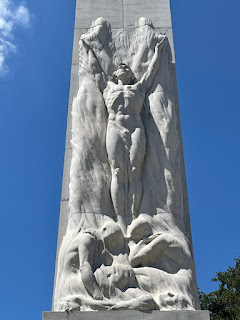 |
| Coppini's burning bodies |
A cenotaph, if you’ve not seen that word, is a monument to the deceased, who is/are buried elsewhere. In this case, the 200 men who died in 1836, defending the Alamo against Mexican General Santa Anna and his army of 4,000. The side facing the Alamo itself has bas reliefs of such Alamo heroes as Jim Bowie and Davy Crockett, while the sloped west side features a riveting marble relief of bodies on fire, their spirits ascending to the heavens. Bodies of the dead Alamo defenders were actually piled up and burned by Santa Anna’s army a few blocks from the Alamo. An historic marker currently indicates the site of that funeral pyre.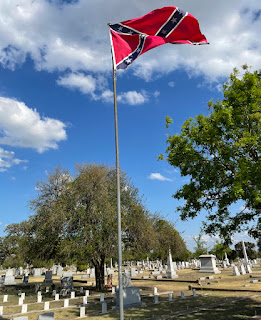 And speaking of battles, I also explored the Confederate Cemetery, which is sandwiched between City Cemeteries No.’s 6 and 4. With its high-flying Confederate flag at center, bordered by roadways named after military heroes of the Confederacy, this relatively large plot is the final resting place of many Texan soldiers who fought in the “War Between The States,” as they call it in the South. So the high-flying flag is not actually the official flag of the Confederacy. Did you know that?
What is commonly thought to be the official flag of the Confederacy is actually the Confederate battle flag. The battle flag design was adopted early on in the war because the original design of the flag of the Confederacy posed a problem on the battlefield. Due to its similarity to the "stars and stripes" flag used by the United States, it was difficult to tell the two apart unless the flags were unfurled in the wind! (Ref.) You can see the First National Confederate Flag in the photo below over a veteran's grave.
 |
| First National Confederate Flag |
 |
| Community mausoleum in City Cemetery No. 4. |
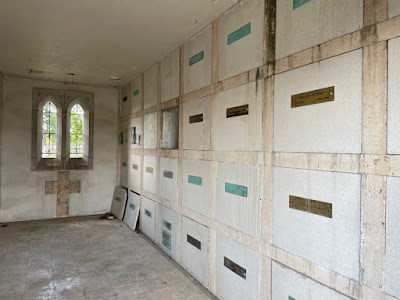
As I made my way through this block of three cemeteries on my stop #14, I entered City Cemetery No. 4. There was a community mausoleum ahead which proved interesting. The entrance gates were closed, but I could see two crypt covers propped against their openings at the far end. There was a window at that end, so I went around to the other side of the building, thinking I could peer inside and see what was in those open crypts. Unfortunately, there was a large bush below the window, blocking my access. I went back around to the front, and realized that the gated doors were only held closed by a stick! They were not locked. So I ventured inside (cue up creepy music...).
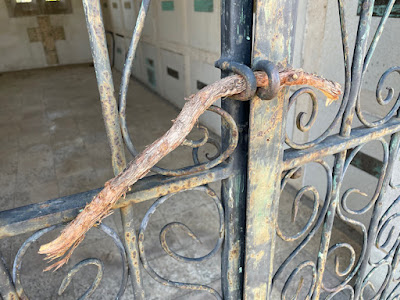 |
| Community mausoleum lock |
I reached the open crypts, their marble covers ajar, bent down and peeked inside. Nothing. Empty. Speaking of ajar, I noticed this empty peanut butter jar in the maw of a vacant crypt as I was leaving. (In comedian Jim Gaffigan's whispery voice: "He's going on and on about jars - what's his problem...?")
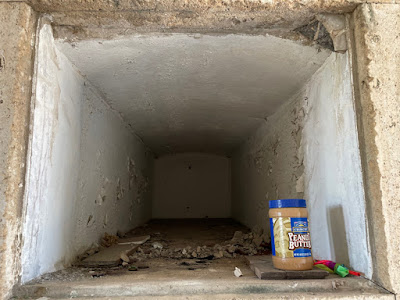 |
| Peanut butter crypt |

The shade in the mausoleum did my phone a world of good. It was so hot and bright, this torrential Texas sun, and as a result I was dripping with sweat. It was rather difficult to make a photo, to hit the right button on the iPhone. Half the time I accidentally put it in “Live View” when trying to take a still photo. When I would try to make a short video, I ended up with the display upside down! The ambient temperature was so hot that my phone would overheat if I kept it in my pocket. I had to carry it in my hand and try to walk in the few shady spots I could find. As you can see from the image at left, it was expected to get hotter as the days progressed, although the humidity mercifully would drop. Funny how my first iPhone, a model 7, would lose battery power outside if I was using it in the cold; this iPhone 12 is just fine in the cold, but flakes out if it gets too hot. I did have real cameras with me, so that was not an issue. What WAS concerning was losing battery power to the phone and not being able to get an Uber back to the hotel. While it was only about three miles away, it would’ve been a death march in this scorching heat.
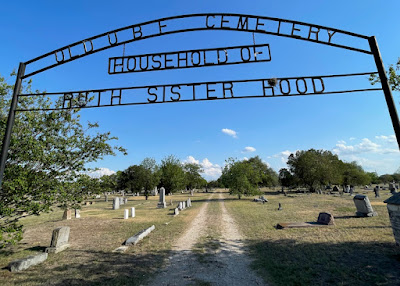 |
| Entrance into one of several African American cemeteries |
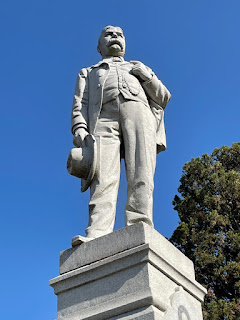 |
| Greeter at the gates of City Cemetery No. 3 |
I crossed Montana Street into City Cemetery No. 3. One of several African-American burial grounds within this cemetery is The Old United Brothers of Friendship. It's metal entrance sign, and those like it, are always interesting to me, for both style and content. You probably get the idea that most of these cemeteries are easy to maintain, with regard to grass-cutting. Not sure what time of year the grass grows, if at all. 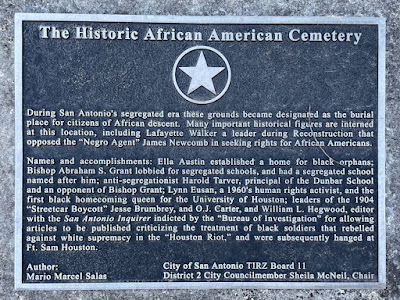 |
| Plaque at entrance to United Brothers of Friendship Cemetery |
About four hours after I began my adventure, I was shuffling my way through The Knights of Pythias Cemetery, thinking how the parched cowboys (knights, of a sort) might have felt as they crossed that Mexican desert in Cormac McCarthy’s book, “Blood Meridian.” Totally parched, no water left, I saw a distant strip mall and a gas station convenience store. As if it were a mountain spring on the horizon, I quickly traversed the sacred ground of the smaller cemeteries within City Cemetery No. 3, heading for the convenience store. I spent some final moments exploring The Grand United Order of Odd Fellows Cemetery on the corner of Montana and New Braunfels Avenue, but found nothing that I was looking for, e.g. the mortician’s grave that was supposedly there. I had originally studied the Historic Houston website showing this grave and thought the mortician was in the Odd Fellows Cemetery. However, as I peruse it now, I see that the grave is actually in the adjacent St. Elmo's Lodge 25 Knights of Pythias Cemetery. See how confusing thirty-one adjacent cemeteries can be?

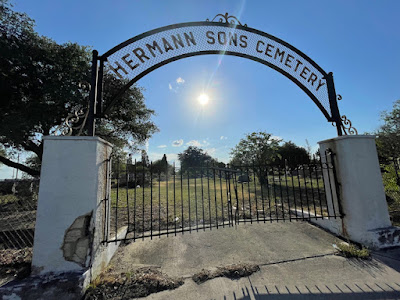 |
| Blazing sunset, San Antonio, Texas. |
A block or so away, I saw Church’s Chicken fast food joint. As I was still hungry and the air temp was still in the upper nineties, I decided to partake of their air conditioning. Here’s a selfie in the shadow of the last cemetery I didn’t visit, Hermann Sons, as I headed across the avenue for dinner. That cemetery, along with Immanuel Lutheran, both had locked gates and high fencing. I really didn’t feel like scaling the fence or walking the blocks looking for an entrance. My day was done. Whatever fascinating sights may lay in these last few burial grounds will remain unexplored. Supposedly, St. Mary’s Catholic Cemetery has quite an assortment of fine statuary (ref.)I entered Church’s, ordered, then went into the bathroom to see how badly my face was sunburned. Beet red, as they say. I had been wearing a hat, but the blazing sun had been low on the horizon, beating me in the face no matter which direction I faced, or so it seemed. My sunscreen had long run off. I grabbed my chicken sammie and diet Coke and sat down. I pleasantly realized this was not the same Church’s fried chicken chain from Philly. This stuff actually tasted good!
I called an UBER driver in a few minutes, who quickly zipped me west on Dakota, then north up Palmetto, the cemeteries I missed appearing as a blur out my window. As we sped by these burial grounds, it occurred to me that in the entire time I spent traversing these 27 cemeteries, I saw not one other person. Odd. Exhausted and with a full weekend conference and trade show ahead of me, I headed back to the hotel for a shower and rest. I do hope you enjoyed this little account of my trip, so go get yourself a drink and relax, I’m sure that reading this must have made you thirsty.
Further Reading:
Ed Snyder's 2012 Cemetery Traveler blog post, "The Cemeteries of Old San Antonio."
Eastside Cemeteries Historic District
https://www.sanantonio.gov/ParksAndRec/Parks-Facilities/All-Parks-Facilities/Historic-City-Cemeteries
Old San Antonio City Cemeteries | Historic Houston: (historichouston1836.com)


 One of the first graves that I successfully located belongs to Sandra West - in which she is buried, behind the driver’s seat, of her 1964 Ferrari 330 America. In the photo below, you can see the concrete vault holding the car and body being lowered into her grave.


 And speaking of battles, I also explored the Confederate Cemetery, which is sandwiched between City Cemeteries No.’s 6 and 4. With its high-flying Confederate flag at center, bordered by roadways named after military heroes of the Confederacy, this relatively large plot is the final resting place of many Texan soldiers who fought in the “War Between The States,” as they call it in the South. So the high-flying flag is not actually the official flag of the Confederacy. Did you know that?




 , as you may know, is a plastic toy camera. Adams would rather have died than use something like this, so on one hand, its good that he’s already dead. And speaking of death, I actually used the film to photograph some cemeteries around San Antonio. Everyone is familiar with Adams’ mountain vista images, but his singularly most famous and successful image is actually of a cemetery (


