Showing posts with label Philadelphia cemeteries. Show all posts

Monday, February 16, 2026

Philadelphia Cemeteries that Mark Our Nation’s 250th Birthday – Part 1


Did you know that there are about twenty cemeteries in the center city Philadelphia area that were actually in existence in 1776? As we celebrate our nation’s birth this year – 2026 – we’ll have a look at some historical landmarks that are actually land. Land, that is, that still holds the remains of the people who were alive when the Declaration of Independence was signed on July 4, 1776!

Betsy Ross' grave, Mount Moriah Cemetery
My goal is to write a short series of posts over the spring of 2026 so you can virtually visit many of these Colonial-era burial grounds with me. This initial post will serve as an introduction to more in-depth posts that will follow. I plan to discuss in detail many of these cemeteries, their history, their occupants, and their importance to the history of Philadelphia and America as a nation. We’ll also cover certain Philadelphia “landmarks” that are fake. Or perhaps I should call them reasonable facsimiles. Unlike the Betsy Ross House and the building where Jefferson authored the Declaration of Independence, these cemeteries are the real deal. These are the actual grounds that our forefathers walked on and are buried in. True history, zero fabrication. By the way, not only is the “Betsy Ross House” not Betsy Ross’ house, but she is also not buried there! (She’s buried at Mount Moriah Cemetery in southwest Philadelphia.)


Betsy Ross stone marker at the Betsy Ross House, Philadelphia

In January, 2026, I presented this material in a virtual lecture hosted by the Preservation Alliance of Greater Philadelphia. Thank you to everyone who attended and participated in the spirited Q&A session afterward! If anyone has comments or questions related to the post you’re reading now, please comment at the end, or you can reach me at Ed.Stoneangels@gmail.com.

Betsy Ross House, 239 Arch Street

The photo you see at the beginning of this article shows Washington Square, at Seventh and Walnut Streets. From 1704 to 1794, the square served as a Potters Field, a burial ground for people not associated with a church or other private organization. Thousands are buried beneath its fountain, monuments, and well-manicured lawns. Yellow fever victims, criminals, and strangers who died passing through town were buried here. It also served as a mass grave for Washington’s soldiers who died fighting the British prior to the British occupation of Philadelphia in 1777. (Read more here.)

The Potters Field that is Washington Square Park, Seventh and Walnut Streets

But lets go back a bit further in time. Our American ancestors buried their dead in the ground because this was the European tradition brought to America by our forefathers, mainly immigrants from Europe. This is one reason why we don’t have more sky burials of burn our dead on funeral pyres in the town square, as other cultures do. In-ground burial in America remains popular hundreds of years later.

Original 1761 Old St. Paul's Church building and graveyard (Third and Walnut Streets.)

The population of Philadelphia grew from 2,000 in 1700 to 30,000 by 1776. As the city grew, more and more burial grounds were needed. In 1776, the city itself was comprised of only 1200 acres! The entire city was bordered on the north by Spring Garden Street, the South by Christian Street, the west by Eighth Street, and the east by the Delaware River (click to see map). Outside those borders were farms and woods. And pirates, of course, who used Petty’s Island (off the coast of Pennsauken, New Jersey) as an anchorage point – but that’s another story. It is estimated that within these 1200 acres, 120 cemeteries existed in 1776!

Of these 120, many were small, like family plots on private land. But some were large like the First Baptist Church of Philadelphia Burial Ground (est. 1707, currently buried under the pavement at 218 Arch Street) with an estimated 5,000 graves. Now, just because a graveyard is only the size of a city block, this does not mean it only accommodates a few hundred burials. Palmer Burial Ground in Fishtown, for instance, takes up the area of one city block. It was established around 1732 and holds an estimated 40,000 burials! And it is STILL an active cemetery! Many colonial-era cemeteries and graveyards in Philadelphia not only remain active, but remain current and contemporary, as can be seen from this sign on the front of Old Pine Street Presbyterian Church at Fourth and Pine Streets (est. 1764).

Bob Weir of the Grateful Dead died January 10, 2026.

Only about twenty of these original 120 city cemeteries can still be visited. The fact that any of them exist at all is a credit to their owners (typically churches and synagogues). Most of the 120 were either moved or built over as the city grew. For a map of where all these burial grounds are located, I direct you to the website of the Philadelphia Archaeological Forum, and their interactive map of historic burial grounds. https://www.phillyarchaeology.net/historic-philadelphia-burial-places-map/

Not only can you see all the sites, but also the name of the burial ground, when and if it was moved, as well as where the graves were moved to – if they were moved at all. As I say, some graveyards, like the Bethel Burial Ground at 400 Catherine Street (in Queen Village), still lie undisturbed beneath our streets, playgrounds, and parking lots. Five thousand very quiet neighbors reside beneath Weccacoe Playground’s tennis court and community center (red building in the background in photo below).

Weccacoe Playground at 400 Catherine Street

Here's an interesting exercise - look for your residence (or workplace) in center city Philadelphia on the PAF interactive map and see if there is a burial ground beneath that location. You may even consider looking up your friends’ and neighbors’ homes to see if they might be living over a graveyard – always a fascinating topic for discussion.  

So as we go forward, and visit specific cemeteries, here are a few topics I will cover:

  • ·        Cemeteries as landmarks
  • ·        Significance of historic cemeteries
  • ·        Growth of the city and need for cemeteries
  • ·        Significance of gravemarkers (tangible reminders)
  • ·        Cemetries that disappeared
  • ·        Preservation - How cemeteries stay in business

Christ Church Burial Ground, Fifth and Arch Streets

So when friends and relatives come to Philadelphia this year to celebrate our nation’s 250th birthday, the United States' Semiquincentennial, consider a walking tour of its Colonial-era cemeteries and graveyards! (By the way, a graveyard is technically a burial ground associated with a church, while a cemetery is a secular, or non-religious burial ground.) Join me next time for Part 2 of Philadelphia Cemeteries that Mark Our Nation’s 250th Birthday!

Monday, April 27, 2020

Cemetery Socializing

Allyson, Ed, and Owen outside Mt. Vernon Cemetery, Phila.
Back in the late fall of 2017, my friend Owen let me know that he’d be visiting the U.S. in February, and invited me to do some graveyard photography. Owen lives in France, not far from Pere Lachaise, so I always found it ironic that he could find any cemetery outside of Paris very interesting. But he does. And he has photographed and explored them the world over, with stunning results. The previous year he and I hiked through the infamous, massive, formerly-abandoned Mount Moriah Cemetery in Philadelphia.

Owen and I met as Facebook friends some years ago, and appreciate each other’s photography. Toward the end of 2017, I made the acquaintance of another cemetery photographer, Allyson Pettigrew, this time through Instagram. She is, in my opinion, a rising star in the cemetery photography genre. I introduced Allyson to Owen via Instagram, and we started following each other’s work.

Allyson photographing zinc memorial
I suggested to Owen that we ask Allyson to join us when the time came for his visit to the states. He agreed. Such an easy thing to, back in the pre-Coronavirus days. Just plan to get together and then do it. Not so easy today. With the world locked down here in April 2020, social-distancing is the norm and we’re all sheltering in place (unless you need food). No one knows how or when the COVID-19 pandemic will end. We wax nostalgic for the good old days when we could carry a social media virtual “friendship” forward into the realm of ACTUAL friendship – then follow those actual friends as they consider climbing over a fence into an abandoned graveyard. But I’m getting ahead of myself.

Mount Peace Cemetery angel
When February 2018 rolled around, Owen hit town. The three of us agreed to meet at Mount Peace Cemetery in Philadelphia, check out Mount Vernon (through its bars, as it has been subject to its own form of lockdown for many years, i.e., off limits to the public), and then head over to Laurel Hill Cemetery, just across Ridge Avenue. All three cemeteries are just about next to each other. Quite convenient for us cemetery travelers.

Mount Peace Cemetery monument
After introductions and handshaking (gee, how many years will it be until people do THAT anymore?), we spent some time exploring Mount Peace and gazing longingly through the bars of a rhyme – as the Dire Straits song goes – actually, through the bars into the unkempt Mount Vernon Cemetery. (That's my selfie of us at the top of this article, looking through the bars into Mount Vernon.) Owen had a monster lens, so he was able to some great shots. We chatted about our work, strolled Mount Peace’s grounds, and photographed some monuments. We appreciated each others’ company based on a mutual respect for each others’ work.

Mount Vernon Cemetery from the locked entrance gate
When I first noticed Allyson’s work on Instagram, I would linger on the images as they seemed so familiar. I realized she was from Philly, as I am, and so it was not surprising that she photographed many of the same monuments in the same cemeteries as I had over the years. The disturbing fact, however, was that her images were BETTER than mine, lol! Do check out her Instagram feed @allyson_underland.

Mount Vernon Cemetery, Philadelphia

It really is useful to me, as a photographer, to see the same scene from another photographer’s perspective. Years ago, I used to photograph with a friend who was considerably shorter than me. She would complain that I was able to get a high vantage point (being 6’2”) for my compositions while she was not able. Truth is, I enjoyed her images immensely because they were made from angles I naturally did not utilize.

Owen with his ultrazoom lens!

On the other hand, I greatly admire Owen’s work, primarily because he travels to such far-flung exotic places that I will never see. His Instagram images of the graveyards in the Atacama Desert in Chile, for instance, are nothing short of spine-chilling. Do check out his Instagram feed @owenphil333.

Ed and Allyson, with friends at Laurel Hill Cemetery

Owen, Allyson, and I headed over to Laurel Hill Cemetery afterward – did I mention that it was c-c-c-COLD that day?! I don’t recall the temperature but I’m pretty sure it was below freezing. This image of the Schuylkill River (at left) from Laurel Hill Cemetery (above Kelly Drive) epitomizes the weather that day. We walked around, photographed monuments, and generally compared notes on the art of photography.


Owen at Laurel Hill (above and below)

Owen spirited off the next day for further adventures in New Orleans, and I was glad he stopped by to spend some time with Allyson and I. His parting words were, “What kind of people would be out photographing cemeteries in the dead of winter? – the best kind!”


Photography is about sharing - sharing a bit of yourself, some of your work, and hopefully learning something in the process. In Coronavirus times, the best we can do is share online. Many galleries are putting up ad hoc galleries to share art via the internet, since we physically can’t hang things on walls for groups of people to see. Yes, I know, the internet has been moving us in this direction for some time – maybe I’m just late for the bus. Still, with all this isolation, don’t you miss just a little human interaction? Maybe COVID-19 is giving us an idea what virtual reality would REALLY be like if we all just sat in front of our computers. Man cannot live by the internet alone.

Thursday, April 28, 2016

The Odd End to Philadelphia's Odd Fellows Cemetery

William Dick Elementary School, Philadelphia (former site of Odd Fellows Cemetery)
Coffin piece from Odd Fellows Cemetery?
A few weeks ago I received an email from a woman who was wondering about the resolution of this situation. In December of 2013, wooden coffins were surprisingly unearthed under a schoolyard in north Philadelphia. The Philadelphia Water Company was digging under the playground at the William Dick Elementary School (shown above) when caskets and other remains were found. When the story hit the news on Dec. 4 (see links at end), there was much media coverage. I went to the site to check it out. As far as I can tell, none of the graves that were excavated at that time were moved - seems like the Philadelphia Water Company just did their piping work and filled the ground back in. There were pieces of old pine board laying around in the mud of the site, one of which I picked up. Possibly part of an old pine box.

I lost track of the story and began wondering myself whatever became of this find. I see no further mention of it on the Internet. At the time of the incident, I missed an email from a reporter asking me to comment on the situation. Had I made the interview, I would have suggested he contact The Odd Fellows Cemetery Company in northeast Philadelphia for comment. The site in question (24th and Diamond Streets), was originally the site of Odd Fellows Cemetery, which had been established in 1848.

Latest occupant of the land once occupied by the Odd Fellows Cemetery

About a hundred years later, in 1951, the City of Philadelphia displaced Odd Fellows Cemetery and used the space to build a housing project and this public school. About 80,000 bodies were supposedly moved to Lawnview Cemetery in Rockledge (a Philadelphia suburb in Montgomery County), and Mount Peace Cemetery, at 3111 West Lehigh Avenue, Philadelphia. Both locations were, and are still, owned by the Odd Fellows Cemetery Company. The woman who wrote to me had a vested interest in the situation. It seems that many of her ancestors had originally been buried at Odd Fellows Cemetery.


Ironically, a few months prior to the unearthing of the coffins at Odd Fellows' original site, she had requested copies of her ancestors' burial records from the Odd Fellows Cemetery Company in Rockledge. Her ancestors had been buried there in the 1860s, 1870s, and 1880s. She received the records, which were stamped "Moved to Lawnview in 1951," complete with lot numbers of the graves. She had accepted all this as fact until the coffins were discovered. Now she's not so sure.

Plaque on monument in Odd Fellows Cemetery

When a cemetery or graveyard is moved, those in charge most likely try to move all the bodies. However, its fairly common that stragglers are left behind, and found years later by accident. But if stragglers are later found, should they not be relocated as well? The Philadelphia Water Company temporarily halted its work in December 2013 so archaeologists could examine the findings. As I was doing research for this article, I did see that an attempt was made by Philly.com to contact Odd Fellows Cemetery Company at the time of the schoolyard excavation. Calls were not returned.


Lawnview Cemetery field where tens of thousands of bodies were reburied

Why the name "Odd Fellows?"
"The Independent Order of Odd Fellows began in 18th Century England, it was deemed odd to find people organized for the purpose of giving aid to those in need without recognition and pursuing projects for the benefits of all mankind." - http://www.ioof.org/

Plaque at Odd Fellows Cemetery
Odd Fellows began as a fraternal organization in America in 1819, and continues to this day. Currently, the organization sees itself as a "...family of Odd Fellowship, composed of Men, Women, and Youth, believing in a supreme being, the creator and preserver of the universe, who have come together in our local communities having the same beliefs and values as others, that; Friendship, Love and Truth are the basic guidelines that we need to follow in our daily lives"(ref.). Friendship, Love and Truth are usually symbolized by the three chain links seen in the photo at left; sometimes the letters F-L-T are written within the links.


Sidewalk at 24th and Diamond Streets
The photo at right was taken in April 2016. It shows the new sidewalks at 24th and Diamond Streets which were poured after the opened graves had been filled back in, subsequent to the Philadelphia Water Company finishing its work. The fence encloses the playground of the William Dick Public School. There is no memorial plaque or anything to indicate that portions of the Odd Fellows Cemetery still exist under the playground.

Lawnview Cemetery, Rockledge, PA
Lawnview Cemetery has been the recipient of tens of thousands of relocated graves over the years, from other cemeteries besides Odd Fellows. The most notorious being the twenty thousand graves from Philadelphia's Monument Cemetery, which was razed in 1956. The rumor was that all these bodies were dumped into a mass grave. If you talk to the people at Lawnview, they tell you that they have a record showing the actual plot where each body was buried. No reason not to trust that, except that, as people found out in north Philly in 2013, not all the graves (from Odd Fellows) were actually moved.

If you drive through Lawnview Cemetery, there is a vast field with no grave markers. This is where the burials from Monument Cemetery and Odd Fellows Cemetery are. There are no monuments, headstones, or markers of any kind because most of them were dumped into the Delaware River (you can read about that here). Some markers from Odd Fellows Cemetery remained, albeit buried, at their original location. News reports say that marble headstones were found during the Philadelphia Water Company's excavation in 2013. If you drive through Lawnview, I will tell you that the sight is a bit unsettling. The field in question looks flat at first glance. But if you drive, the lateral view you get is a decidedly unflat grassy field. The peaks of the many trenches they must have dug to accommodate the tens of thousands of bodies are quite obvious.

Fields of Graves - Lawnview Cemetery, Rockledge, PA

I realize that I've posed more questions than answers in this blog post. If anyone can shed light on the topic, please post a comment here or email me at mourningarts@yahoo.com.


References and Further Reading:

Sunday, December 13, 2015

Union Cemetery Has Gone Missing ...

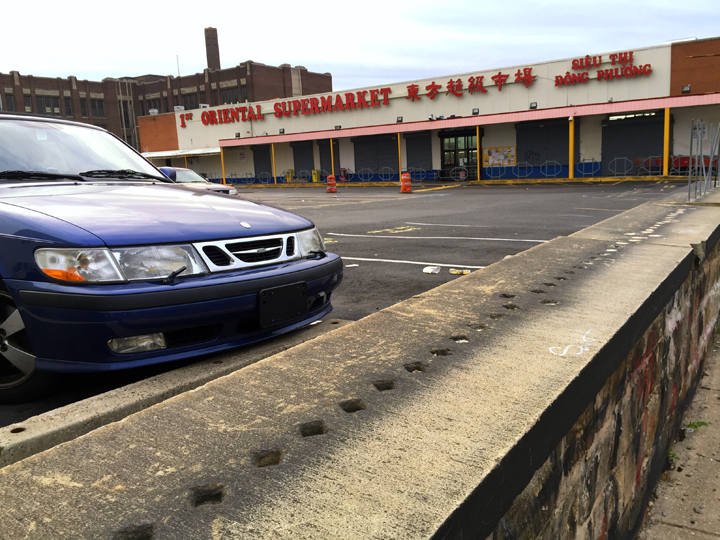
Here’s a short blog on an odd little situation I just discovered. I live in South Philadelphia near Third Street and Washington Avenue. At Sixth Street and Washington Avenue (running to Federal Street), there used to be a cemetery. It was called the Union Cemetery. The City of Philadelphia “removed” the cemetery around 1970 to further develop the commercial business corridor along Washington Avenue.

I have driven past the particular Asian supermarket you see in the photo above, which is at Sixth and Washington (Federal Street is behind it). I have driven past it hundreds of times since moving to the neighborhood in 2008. Until a few weeks ago, I had no idea that the stone wall along Sixth Street (on the south side of Washington) is the ACTUAL stone retaining wall of the Union Cemetery! Complete with holes in the granite top where the iron fence was anchored!

It is no wonder they would they destroy a cemetery to build a parking lot, but why KEEP the original retaining wall? If you’re expecting to find the answer here, you may as well stop reading – I don’t have it. There is quite a bit of information (and photos, as bizarre as that is!) on the cemetery’s demise all over the Internet, but I could not find out much about the wall. I suppose it will remain just one of those odd little cemetery facts.

Union Cemetery wall with fallen fencing, c. 1970 (Ref. 1)

I will quote a few of these sources and you can see more of the historic photos at the link to the Temple University Archives (at end). Temple, by the way, is no stranger to cemetery destruction. They conned the City of Philadelphia into condemning the city’s second Victorian cemetery in 1956 so the university could build a you guessed it – a parking lot. (Read more about that on my blog post, "How Monument Cemetery Was Destroyed," at the link at the end.)

Picking through human bones during excavation of Union Cemetery, c. 1970 (Ref. 2)

Historic map of South Philadelphia's Union Cemetery (Ref. 4)
But back to the little ol’ Union Cemetery, the graveyard in the Southwark section of Philadelphia which occupied land about the size of half a city block. The name "Union," perhaps, may have sprung from the fact that a union, or association, of people established it in 1841. Ironically, 100 Civil War soldiers - mostly Union Army veterans, I suppose - were later buried here. Where are they now? Under the parking lot of the Asian supermarket? Supposedly not. Above you see a photo of a young man picking through the bones in 1970 so they could be reinterred, in a mass grave, I expect, in Frazer, PA – a distant suburb of Philadelphia . Get those dead as far away from the living as possible! Make way for progress!

Original entrance gate from Union Cemetery resides at Philadelphia Memorial Park in Frazer, PA. (Ref. 1)

From the Find A Grave website (Ref. 1):

"The Union Burial Ground was located at the NE corner of 6th and Washington; Federal Streets in South Philly, was incorporated in 1841 as an "association" cemetery, catered to the poorer residence who as association members could obtain a decent family plot for $10.00. This cemetery was called Sixth Street Union to differentiate it from another Union Burial Ground at 10th and Washington Avenue. In 1970 the cemetery which contained the graves of over 100 Civil War Soldiers and Sailors and their families was neglected and vandalized. That same year the site was sold for use as a supermarket. About 2,000 graves were dug up, the remains boxed and then reburied in Philadelphia Memorial Park in Frazer, Chester County."
Casual onlookers during the demise of Union Cemetery, c. 1970 (Ref. 3)
 

Union Cemetery's decline began at the end of the nineteenth century, as the area's residents began to move away, edged out by commercialization. With no close relatives living nearby to care for the graves, the cemetery went to ruin (Ref. 4). As I said, by 1970, it was gone - gone, that is, except for one of it's retaining walls. Perhaps it was left intentionally as a reminder to future generations - a reminder of the ground's sacred past, or perhaps our callous handling of the dead.