Showing posts with label coronavirus. Show all posts

Sunday, December 27, 2020

"I Returned Your Skulls."

Image by Michael Kauffman
 
“What the world needs right now is another endless musing on staying at home during the coronavirus pandemic; the C.D.C. has declared these pieces to be a symptom of COVID-19 that can be treated only by gentle snoring.” -  Libby Gelman-Waxner in her New Yorker article “If You Ask Me: The Last Quarantine Think Piece” (May 18, 2020)

While I agree with the above statement, I’m still going to write this blog. As my friend Mike Spak would say, “Anything worth doing is worth overdoing.”

This past summer I was walking up the street toward my house, end of the day, coming home from work. A few neighbors were outside their homes chatting (from an appropriate COVID social distance) – I live on a tiny street of row homes in an old nineteenth-century Philadelphia neighborhood. My neighbor Michael, who lives around the block, addressed me in a relatively loud voice, “Hey Ed, I returned your skulls … left them with your wife.” Ok, that’s a wee bit embarrassing – but in a good way, lol.

I am very selective when it comes to my choice of friends – they have to be anything but normal and boring. And they say the darndest things. One time a few years back I got together after work with a friend to have a beer. We were walking down the street on a Friday evening, lots of people on the sidewalks, summer. I asked him how his day went, as he appeared to be tired out. He sighed and said, “Well, we got all six bodies out of the ground.”  Couldn’t help notice the startled looks we got from those around us! Frank worked in a graveyard, and I knew he was working on a project to move some graves.

Michael, my neighbor, is an artist. He appreciates Caravaggio, a Baroque era painter who seemed to rather enjoy painting people getting their heads chopped off. Some of his art evokes Caravaggio. Over the course of the last few years, Michael and I have each learned a bit about each others’ art. As an aside, I shared with him the fact that I pick up skulls in abandoned graveyards – everyone needs a hobby, right? 

Just to be clear, my skulls are not human skulls. You just don’t run across those as often as you do skulls of other animals - even in abandoned graveyards! 

During the spring/summer 2020 coronavirus lockdown, Michael had been stuck in the house, so he’d spent some of that time creating art. Either he asked to borrow some of my skulls, or I offered them to him, I don’t remember exactly how that went, but he created some startlingly gorgeous photographs with them, which he planned to use as components of larger digitally collaged art work. Michael has a glorious light tent in his garage in which he does digital macrophotography. I was jealous so I had Amazon send me one. Not a garage, a light tent. An inexpensive version of his (mine is shown below).


It was probably in May that I lent Michael my skulls. May was an absurd month, full of fear and coronavirus. Lockdowns and masking. A lot of artists spent this time holed up, creating. In November, Michael shared some of the final results with me, one of which you can see at the top of this blog.

My skulls formerly belonged to an assortment of animals – fox, pitbull, deer, cat, bird, groundhog, etc. They were all found in abandoned cemeteries. I never spent much time photographing them, but after I got my skulls back and saw some of Michael’s preliminary results, I decided to take a stab at it myself. 

Here you see one of my first experiments. This one at left is based on the rainbows everyone had hanging from their homes during the Summer of COVID. Finding and counting rainbows seemed apropos of the time – a way to pretend that you again had some control over your life, and that there was eventually going to be a positive outcome. This image represents both possible outcomes. 


During the lockdown, I was one of the few people allowed on the roads, being a healthcare worker. Every once in a while, I’d stop by a local graveyard to do some photography. Graveyards were one of the only public areas people could visit during lockdown - you were lucky if there was one within walking distance of your home. I wasn’t confined to my house, like most people, but when I was home, I decided to use the time wisely and creatively. Actually, more experimentally and experientially. 

I’m writing this at the tail end of December, 2020. Since March, artists have been lamenting their situation. No galleries or public spaces to display or sell their work. For those who depend on this for income, for a livelihood, this has been devastating. But wait – we all create art in private anyway, right? During lockdown (when was that, mid-March to June?), we were FORCED to work in private, and forced to use whatever we had on hand to create. Hopefully, artists had supplies (yet another advantage of digital over film photography, huh? Otherwise we’d all be stuck with bags of undeveloped film).

COVID is like an entropy puzzle, a puzzle we have to assemble without the benefit of having a picture on the box showing the end result. And just when some of the pieces seem to fit together, they magically change, so they no longer fit. Who knew the pandemic would continue into August, when I began writing this blog? That was two weeks before virtual school began for the world’s children. Distance learning, two words that I am now convinced are mutually exclusive. Now it’s the end of December, 2020, and we don’t even have the border of the puzzle completed. The new normal, life in a pandemic.


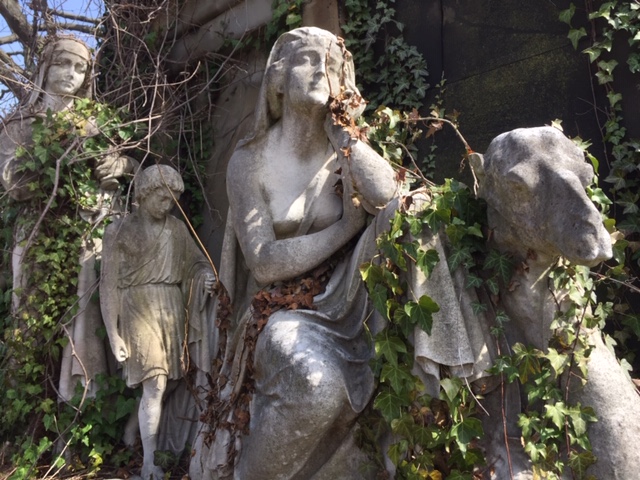
As artists, we sometimes need to get out of our old wheelhouse – we need a kick in the ass to get those creative juices flowing. For some artists, COVID is that KITA. It seemed to influence Michael Kauffman’s work – see his gorgeous tombstone image below!


I intended to close this piece by bookending the opening New Yorker quote with these lyrics from the band Cracker’s song, “Teen Angst (What the World Needs Now):”

“…what the world needs now

Is a new kind of tension, …

'Cause the old one just bores me to death…”

So that’s good for artists (and maybe others) who needed the COVID KITA to move their art (or their lives) to the next level. However, I watched musician Devin Townsend’s Christmas Concert performance the other day, and this quote from his song “My Life,” is a kinder, gentler way to say goodbye to 2020:

“How long can this life go on? Who we are, what we are. See you on the other side."
- (Devin Townsend - Acoustic Christmas Special (Live 12-23-2020) - YouTube


Further Adventures:

See Michael Kauffman’s artwork on Flickr: Michael Kauffman | Flickr


Saturday, August 8, 2020

New Devils Require New Gods

During the Corona spring and summer of 2020, I felt compelled to mask cemetery statues. A flaw in my personality, I suppose. I didn’t leave the masks on and I did no damage in the act. Initially, I don’t know why I did it. I published a few images and received a handful of comments from upset people. 

Comments like “I was saddened by our beautiful Angels with paper masks covering their exquisite faces - the angels should not be weighted down by human error.”

Exquisite faces, indeed. After months of people wearing masks, I miss all your exquisite faces. I meant no disrespect by masking angels. We created them in our own image, after all. Or more accurately, we created them in our idealized, Western world Christian image. Angels – both male and female, are the supermodels, the Barbie and Ken perfect versions of our white selves. Since we must now mask ourselves and hide our beautiful faces, I wanted to see what these icons looked like, masked. If we must mask, why shouldn’t they? But you know, if we all end up wearing masks for the next year, maybe we NEED unmasked, beautiful statues to remind us of the way things were? Of the goal, the way things should be? Are they a sign of hope? Optimism? Maybe I’m taking this away from people by masking them. 

“Go and make interesting mistakes, make amazing mistakes, make glorious and fantastic mistakes. Break rules. Leave the world more interesting for your being here.”― Neil Gaiman, Make Good Art

I suppose I need to be careful, though - blasphemy and heresy are no laughing matter. In past centuries, such an act could get you killed, defacing statues or paintings of the gods, or public figures. But as Louise Erdrich says in her novel, Tracks, (1989, Harper & Row), “new devils require new gods.” I’m not going to define this statement for you right now. Take from it what you will. Perhaps its about our response to the coronavirus pandemic. When I create art, I want the viewer to take what they can from it. Most likely it speaks to them differently than it speaks to me. I have always defined my art as minimally as possible – I want the viewer to find their own meaning in it. I don’t even like to title my photographic images. Even that narrows things down too much.

Erdrich’s novel, Tracks, is about Indian (yes, she uses that proper name) tribes “struggling to keep what remained of their lands” in last century America. Native American land and all other freedoms were slowly taken from them very much like our present freedoms are slowly being taken from us by coronavirus. We are struggling to keep what remains of our world. Big difference, however, is that while the white settlers of this “new” land benefitted greatly from the indigenous peoples’ loss, no one benefits from the loss due to COVID-19. Unless, of course, it is some evil plot hatched by the spotted lanternfly.

Would George Washington Wear a Face Mask in 2020? No!

People thought I would have more respect for angels and other works of art - I might just as well have “purchased a can of spray paint & had [my] way with these historic & immortal figures!” (“Immortal,” let’s come back to that thought later.) One could say the same of the person who doctored up this painting of George Washington, I suppose. But its all about having the freedom to express oneself, to make a point. Here’s an image below that should really rile up the masses. Old folks need to protect them selves from their kids, who may be asymptomatic COVID-carriers. 

One of the problems with freedom is that people are free to believe anything they like. For months, there was no consistent, insistent decree from our nation’s leaders that we should wear face masks to stop the spread of coronavirus. Should we or shouldn’t we? We were free to believe whatever suited us. Now, of course, it is becoming quite clear that face masks should have been worn all this time. (Wait – shouldn’t our guardian angels have appeared in masks to carry us to salvation? Sorry, getting a bit sarky there.) 


Tensions Mount 

The raw emotion that has surfaced over my masked statuary is a good thing. Isn’t that what art is supposed to do? Make you think? Make you emote? Maybe you love it, hate it, or are indifferent. Maybe that’s how you also view the whole face mask thing in general. 

The issues people have with wearing masks are multitudinous. George Hofmann in his Psych Central article, The Fight Over Facemasks, mentions a few of these. “The science behind wearing a mask seems pretty simple, and among scientists and doctors there’s near universal agreement that wearing masks will prevent transmission and greatly reduce the number of people who contract the virus.” If you don’t believe this, go watch movies about hospitals and research labs.

Hofmann adds, “That’s why I think there’s a lot more to the anger over masks than respect for the health of others or individual liberties.” People’s anger and rage is evident by the almost daily reports like this, an incident that occurred on July 31, 2020. A customer of a cigar store in Bethlehem, PA, shot at the clerk with a handgun when the customer got upset over the store’s masking policy (link to story).

In this chaotic time - new devils require new gods. New problems require new solutions (one interpretation of this statement). The masking quarrel reminds me of the story of Dr. Charles Meigs, a nationally recognized Philadelphia obstetrician, who in the 1850s singlehandedly transmitted infectious and sometimes deadly diseases to hundreds of his patients. Why? He didn’t believe in washing his hands! He didn’t believe he needed to clean his surgical instruments. He didn’t believe there were such things as infectious diseases. He felt that God was on his side, and he could do no wrong! God, can you believe that? Meigs inadvertently killed many of his obstetrical patients as a result of his stubbornness and grandstanding. He simply refused to believe what we all now know, that a basic way to prevent the transmission of infectious disease is good hand hygiene.  (Read the whole Meigs story in my blog post, “Infectious Diseases and Charles Meigs, M.D.”)

Dr. Charles Meigs's grave, Laurel Hill Cemetery, Philadelphia

As I write this in August 2020, we are really still in the discovery phase of this disease, coronavirus. We don’t know how to control it yet, so why argue about face masks? Why not just err on the side of caution? How many of our politicians remind you of Dr. Meigs? How much of our general population reminds you of Dr. Meigs?

George Hofmann offers that the real source of anger is usually hidden behind what we’re fighting over. He opines that “people have felt disaffected and forgotten by the society they see portrayed in the media for a long time.” Sound familiar? As average citizens, we just don’t measure up to the media ideal of ourselves. We are not, nor ever will be, Brad Pitt or Angelina Jolie. Hofmann feels that people generally feel ignored, mere background noise. Proles. He says that putting a mask over their faces, “making them anonymous and unheard [literally], can be a source of great anger.”

We created angels in our ideal image – maybe that’s one reason its so hard to see them masked. The goals of purity, perfection, and escape (perhaps only attainable in the afterlife?) all of a sudden may not seem possible. “Immortality,” as mentioned earlier, may now seem impossible. By masking angels, am I symbolically closing the Heavenly Gates on the viewer? Am I suggesting, as John Cale does in his song, Fear, that “we’re already dead, just not yet in the ground…?” 

But I want to end this missive on a high note, something optimistic. How about this: new devils require new gods. Think about that. 


Further Reading:

George Hofmann’s book Resilience: Handling Anxiety in a Time of Crisis (2020, Changemakers Books), is available here.

Thursday, May 7, 2020

Cemetery Photography and the “Stay at Home” Order


I have a post-Coronavirus graveyard bucket list (what, don’t you?). My friend Loren Rhodes published a wonderful book in 2017 called, “199 Cemeteries to See Before You Die” which has been on my mind recently. I have been reading and writing more since the “Stay-at-Home” order was issued across the United States in March of 2020. Here it is, the beginning of May, and we’re still at home. Things are s-l-o-w-l-y starting to reopen, albeit very tentatively. Other than explore your local cemetery (hopefully you have one) by walking or biking to it, there’s not much else to do outside your domicile. Everything is closed. Cemeteries are open - just not for funerals (see my previous blog post on that).

“The future is no more uncertain than the present.” – Walt Whitman

Photo by Olivia Snyder
My bucket list right now is not so much comprised of specific cemeteries as it is of specific people. I miss you guys. While its true that cemetery photography is typically a solo sport (like skiing, surfing, or skateboarding), I do miss the interaction with other photographers. There are people I’ve become closer to, virtually, during Corona-times, and I look forward to meeting up with them in person. Also, there are many others to whom I’ve said in the past, “Let’s go do a shoot together!” – and it never happened. I want to hang out with those people too, once this is over. I miss you all.

“I have learned that to be with those I like is enough.” – Walt Whitman

I have been tentatively invited to give a few virtual cemetery lectures in place of my cancelled events, and I don’t know if those will happen. Not really sure how my sparkling personality and natural prolixity will come across in a Zoom session (although I have figured out how to use the “mute” feature better than most). We’re all coping the best we can. “OODA” loops, however, don’t necessarily come to your aid when you have zero control over a situation. OODA, by the way, stands for “Observation, Orientation, Decision, and Action.

“Be curious, not judgmental.” – Walt Whitman

As Derek Thompson explains in his book, Hit Makers (2017, a wonderfully insightful treatise on marketing given to me by my son, Chris Snyder), OODA is “a strategic approach in which information was constantly funneled back to the decision maker to construct a new theory of attack.” This was devised by air force pilot John Boyd, to provide fighter pilots with “a facility for learning and changing strategy quickly … the speed of adaptation was the key factor in whether you could win or lose in a dogfight.” As of this writing, 76,000 U.S. citizens have died in this COVID dogfight (and 265,000 worldwide).

Rainy spring day at the Woodlands Cemetery, Philadelphia

While instant feedback has helped me navigate the “mute” feature on Skype, I’m not sure its that helpful in combating Coronavirus. Think about how difficult it is trying to correct a skateboard position error in mid-air just as you drop into the bowl. At least in that case, you may KNOW how to correct it, but you just don’t have the ability or the time. With the pandemic, we don’t have any IDEA what we need to do to correct our course – but we know enough now that we must avoid dropping into the bowl until we know more about our situation. This is a dogfight in slow motion – after two months in the “Observation” stage, we’re now just trying to attempt “Orientation.” Years from now, maybe we'll be able to put this all in perspective, but it will probably end up like Calvin says below in Bill Watterson's comic strip. (This is why its important to document what's REALLY happening now.)


“Re-examine all that you have been told… dismiss that which insults your soul.” – Walt Whitman

But more to the subject of death and dying - Kubler-Ross’ Five Stages of grieving and loss may be more useful in our current situation than OODA loops. COVID-19 is all about loss, isn’t it? Some have lost more than others. Some have lost a paycheck, some have lost a loved one. Beginning with denial, we proceed through anger, bargaining, depression and acceptance. I’ll hazard a guess that we’re between anger and bargaining right now, as the world contemplates reopening businesses and relaxing the social distance rules. So keep calm, and explore a cemetery, as my Facebook friend Mark Morton suggests.


Springtime in a graveyard near my house, Old Swedes' Church, Philadelphia

“Will you come travel with me? Shall we stick by each other as long as we live?” – Walt Whitman

So is the Cemetery Traveler traveling to cemeteries during the Coronavirus global pandemic? Well, yes, he says sheepishly. Local ones. I have traveled a good deal around Philly, to paraphrase Henry David Thoreau.

There is a stay-at-home order and while my wife and ten-year-old daughter are in fact staying home, I have been deemed an essential healthcare worker (my car is placarded a South Jersey “ESF - #8 Healthcare Worker/Essential Employee Vehicle”). So what this allows me to do every few days, is stop on the way home (to Philadelphia) from work (in New Jersey) to visit a cemetery or two. A far cry from my original spring plan, which was to visit the magnificent cemeteries of New Orleans while there for a conference (which has been cancelled). I am luckier than most cemetery photographers, who don’t even have the option of using public transit (which has been scaled back to bare bones scheduling). On the road, I even get to eat free greasy McDonald's healthcare worker meals - just kidding - I drink the coffee that comes with it and discard the food (do they really expect healthcare workers to eat that food? LOL!)

Turns out you don't have to travel far to find beauty and wonder - its everywhere (though maybe not in homeschooling – now that’s gotten to be downright ugly). On my way home from work last week I stopped in Harleigh Cemetery, in Camden, New Jersey. Harleigh is home to America’s greatest poet – Walt Whitman. Its a quiet, serene place, and it can be very contemplative to be standing in front of Walt’s family mausoleum, peering at his burial vault. A lot of his writing came back to me as I walked under the nearby blooming pink dogwood trees. I’ve sprinkled some Whitman quotes throughout this essay. This one I think is especially apropos of our Corona-times:

“I like the scientific spirit—the holding off, the being sure but not too sure, the willingness to surrender ideas when the evidence is against them: this is ultimately fine—it always keeps the way beyond open—always gives life, thought, affection, the whole man, a chance to try over again after a mistake—after a wrong guess.” – Walt Whitman

Saturday, May 2, 2020

Cemeteries and Funerals in the Time of Coronavirus

While it is true the dead cannot get coronavirus, their world is not spared the effects of the COVID-19 pandemic. If you’re lucky, you haven’t experienced anything related to death in these dark times. But you’ve probably heard bits and pieces related to things like pickup truckloads of bodies unceremoniously removed from nursing homes (click link to read), relatives mortally passing the virus on to their kin, or bodies being cremated along with all their identifying information (wallets, insurance cards, etc.). Graveyards and cemeteries have not been closed to visitors as most other public spaces have, but the kind of activity present in them has radically changed in the spring of 2020.

Woodlawn Cemetery, Bronx, NY
On a positive note, many more people are enjoying these green spaces in ways for which they were intended. They were designed in the Victorian era as serene getaways from the noisy cities, arboreal sculpture gardens to be strolled and picnicked in. The purpose was to help people accept death in a kinder, gentler fashion – enter all the angel statues. And people are strolling through cemeteries once again, being one of the few spaces open at this time when parks and museums, galleries and playgrounds are all closed.

Springtime in the Cemetery
As much beauty as I find in such places, I do sometimes lose sight of the grief inherent in their midst. Some years ago I was in West Laurel Hill Cemetery in Bala Cynwyd, PA (outside Philadelphia), and saw to my amazement, a wonderful black Victorian funeral carriage – complete with a pair of harnessed white horses! It was parked alongside the funeral home. I asked the gentleman who was tending the horses if I could photograph him and he graciously said yes. We chatted as I made photographs and I must have assumed the setup was there for show. Finally he said something that stopped me in my tracks – “The parents will be arriving shortly for the funeral.” (You can read more about this in my original blog post.)

Victorian funeral carriage, West Laurel Hill Cemetery, Bala Cynwyd, PA

I was similarly stopped in my tracks this past week when I read my friend Alexandra Mosca’s article, “A Funeral Home Director’s View of the Pandemic." Alexandra is a funeral director in New York City and writes of the current difficulties faced by families of the recently deceased, where the funeral director must turn the grieving away from the grave. Imagine watching your mother’s casket being lowered into her grave, while your family watches from their car windows. Worse yet, imagine all the funeral homes in your vicinity so busy with the dead that they cannot accommodate your family’s needs.  Read the article here for a part of life that is being tremendously affected by the health crisis.

So while I explore cemeteries as much as I can, I never lose sight of the fact that others may be there for altogether more serious reasons. Please be respectful.

For further reading (links thanks to my friend Bill McDowell):
https://www.inquirer.com/news/philadelphia-ivy-hill-cemetery-crematory-20200505.html?fbclid=IwAR3pYRLa7niPHH5GaIBVkN59QwcWJwr08Ckxlfy9mVuMLa2mLrgHkVKBoks

https://www.inquirer.com/news/coronavirus-black-deaths-philadelphia-terry-funeral-home-covid19-race-disparity-homegoing-burials-20200504.html?fbclid=IwAR2czFQ2p6xb34xkCXJCOA1YLZwc7VFXnnwQk7Yk9GyyO3cww7Iw_NRVzHg


Monday, April 27, 2020

Cemetery Socializing

Allyson, Ed, and Owen outside Mt. Vernon Cemetery, Phila.
Back in the late fall of 2017, my friend Owen let me know that he’d be visiting the U.S. in February, and invited me to do some graveyard photography. Owen lives in France, not far from Pere Lachaise, so I always found it ironic that he could find any cemetery outside of Paris very interesting. But he does. And he has photographed and explored them the world over, with stunning results. The previous year he and I hiked through the infamous, massive, formerly-abandoned Mount Moriah Cemetery in Philadelphia.

Owen and I met as Facebook friends some years ago, and appreciate each other’s photography. Toward the end of 2017, I made the acquaintance of another cemetery photographer, Allyson Pettigrew, this time through Instagram. She is, in my opinion, a rising star in the cemetery photography genre. I introduced Allyson to Owen via Instagram, and we started following each other’s work.

Allyson photographing zinc memorial
I suggested to Owen that we ask Allyson to join us when the time came for his visit to the states. He agreed. Such an easy thing to, back in the pre-Coronavirus days. Just plan to get together and then do it. Not so easy today. With the world locked down here in April 2020, social-distancing is the norm and we’re all sheltering in place (unless you need food). No one knows how or when the COVID-19 pandemic will end. We wax nostalgic for the good old days when we could carry a social media virtual “friendship” forward into the realm of ACTUAL friendship – then follow those actual friends as they consider climbing over a fence into an abandoned graveyard. But I’m getting ahead of myself.

Mount Peace Cemetery angel
When February 2018 rolled around, Owen hit town. The three of us agreed to meet at Mount Peace Cemetery in Philadelphia, check out Mount Vernon (through its bars, as it has been subject to its own form of lockdown for many years, i.e., off limits to the public), and then head over to Laurel Hill Cemetery, just across Ridge Avenue. All three cemeteries are just about next to each other. Quite convenient for us cemetery travelers.

Mount Peace Cemetery monument
After introductions and handshaking (gee, how many years will it be until people do THAT anymore?), we spent some time exploring Mount Peace and gazing longingly through the bars of a rhyme – as the Dire Straits song goes – actually, through the bars into the unkempt Mount Vernon Cemetery. (That's my selfie of us at the top of this article, looking through the bars into Mount Vernon.) Owen had a monster lens, so he was able to some great shots. We chatted about our work, strolled Mount Peace’s grounds, and photographed some monuments. We appreciated each others’ company based on a mutual respect for each others’ work.

Mount Vernon Cemetery from the locked entrance gate
When I first noticed Allyson’s work on Instagram, I would linger on the images as they seemed so familiar. I realized she was from Philly, as I am, and so it was not surprising that she photographed many of the same monuments in the same cemeteries as I had over the years. The disturbing fact, however, was that her images were BETTER than mine, lol! Do check out her Instagram feed @allyson_underland.

Mount Vernon Cemetery, Philadelphia

It really is useful to me, as a photographer, to see the same scene from another photographer’s perspective. Years ago, I used to photograph with a friend who was considerably shorter than me. She would complain that I was able to get a high vantage point (being 6’2”) for my compositions while she was not able. Truth is, I enjoyed her images immensely because they were made from angles I naturally did not utilize.

Owen with his ultrazoom lens!

On the other hand, I greatly admire Owen’s work, primarily because he travels to such far-flung exotic places that I will never see. His Instagram images of the graveyards in the Atacama Desert in Chile, for instance, are nothing short of spine-chilling. Do check out his Instagram feed @owenphil333.

Ed and Allyson, with friends at Laurel Hill Cemetery

Owen, Allyson, and I headed over to Laurel Hill Cemetery afterward – did I mention that it was c-c-c-COLD that day?! I don’t recall the temperature but I’m pretty sure it was below freezing. This image of the Schuylkill River (at left) from Laurel Hill Cemetery (above Kelly Drive) epitomizes the weather that day. We walked around, photographed monuments, and generally compared notes on the art of photography.


Owen at Laurel Hill (above and below)

Owen spirited off the next day for further adventures in New Orleans, and I was glad he stopped by to spend some time with Allyson and I. His parting words were, “What kind of people would be out photographing cemeteries in the dead of winter? – the best kind!”


Photography is about sharing - sharing a bit of yourself, some of your work, and hopefully learning something in the process. In Coronavirus times, the best we can do is share online. Many galleries are putting up ad hoc galleries to share art via the internet, since we physically can’t hang things on walls for groups of people to see. Yes, I know, the internet has been moving us in this direction for some time – maybe I’m just late for the bus. Still, with all this isolation, don’t you miss just a little human interaction? Maybe COVID-19 is giving us an idea what virtual reality would REALLY be like if we all just sat in front of our computers. Man cannot live by the internet alone.

Friday, March 27, 2020

Artists in the Time of Coronavirus

In March 2020, two weeks into quarantine lockdown of COVID-19, Artblog Philly sent out this announcement:

OPEN CALL for Virtual Exhibition ‘Artists in the Time of Coronavirus’
By Artblog March 19, 2020
ARTBLOG IS CALLING ALL ARTISTS, yes ALL makers and creators with a connection to Philadelphia, to participate in our online community project: "Artists in the Time of Coronavirus."
++++++++++++++++++++++++++++++++++
Assuming we haven’t all died by the time you read this, you can hit their link here.
https://www.theartblog.org/2020/03/open-call-for-virtual-exhibition-artists-in-the-time-of-coronavirus/

I submitted a 250-word piece with some photos and I don’t know if they’ll publish it (I’m not pithy or squee, a doomsayer or a highbrow artist), but I figured I’d publish my submission here so at least you can see it. I’m adding a bit to it, so don’t count the words. Of course, if you can’t buy toilet paper in this corona-era, you probably don’t care much about wordcount anyway.

So, “Art in the Time of Coronavirus…." 

I’ve been a practitioner of social distancing since before it was a thing - I photograph abandoned sites and graveyards. Sometimes I even explore abandoned graveyards. Truly isolated locales. Some of these images were made during such an exploration this past week - the six-foot social distancing rule is rather easy to achieve in a graveyard.

For me, creating art is a personal and solitary experience, but I’ve learned that sharing it with others is vital. Years ago when I began exhibiting my photographs of cemetery angel statues, people would tell me why they were purchasing certain pieces. It scared me that others could find meaning in my work. Greater meaning than what I thought was there. So I appreciate the effort Artblog is making to create an audience for artists at this trying time.


We may think ourselves insular, that we create art only for “ourselves,” but I don’t believe that is true. Creative people in this day and age rely on an audience – and increasingly, that is a web-based audience. If COVID-19 continues, that may be our ONLY audience. Pre-Internet writers, composers, and painters may truly have created work mainly to please themselves. If they had received instant feedback (in the form of Internet silence), some of the “great” work may never have seen the light of day (think of Ulysses or The Great Gatsby, neither of which was well-received at the time of publication, by either the critics or the public).

Death and decay are concepts I gravitate toward, whether denoted by abandoned buildings or made more tangible by cemeteries. These latter reminders of our mortality have seen an upswing in popularity - cemetery visits by “normal” people have increased this past week! The government has issued a “no public gatherings” order and most people don’t have to be at work, so why not enjoy a beautiful spring day in a Victorian sculpture garden? Just enjoy nature - you don't even have to contemplate mortality ...

When you think about it, this was the original purpose of nineteenth century “rural” cemeteries – beautiful getaways from the grimy, noisy city. Philadelphia’s luxuriant garden cemeteries, Mount Moriah, the Woodlands, and Laurel Hill were the go-to open-air art galleries and parks of the Victorian era (there WERE no art galleries or parks back then!).

John and Olivia
My daughter Juli told me she saw at least fifty people in Philly's Woodlands Cemetery last week when she was there walking her dog. I saw several people with little kids at Laurel Hill Cemetery when I stopped by. Last weekend, I happened on my neighbors walking through the graveyard of the Old Swedes’ Church – Gloria Dei – near my house in South Philly. Here’s their little girl running among the gravestones. Graveyards - a last vestige of greenspace.


Currently, all the stores and businesses are closed. Some are even boarding up, expecting the worst. What’s the worst that can happen? Amazon closes all its distribution centers and widespread looting begins? As we look to create Art in the Time of Coronavirus, consider the words of John Lennon: “Reality leaves a lot to the imagination.” Public gatherings have become non-existent with COVID-19, and so the city’s wonderful graveyard greenspaces have taken on greater value. Visit them – imagine them to be your next artistic muse – their residents are six-feet-under, a safe social distance. Now is a good time to contemplate life in general – not one of us is getting out of this alive. 

You can see a new post every day on my Instagram page:
IG: https://www.instagram.com/mourningarts/
Website: https://www.edsnyderphoto.com/