Showing posts with label abandoned. Show all posts

Sunday, August 10, 2025

Book Release: "Abandoned and Forgotten Cemeteries of Philadelphia and its Environs"

My new book has just been released! Thank you to everyone who pre-ordered Abandoned and Forgotten Cemeteries of Philadelphia and its Environs – you should all have your copies in hand at this point. As always, I welcome feedback on the book. 

I did an in-person book launch presentation on July 24, 2025 at the Athenaeum of Philadelphia, a week after the book was released. Head House Books was in attendance selling copies that I signed. It was great speaking with people about so many aspects of abandoned cemeteries – thank you all for coming! I do have five additional events scheduled throughout the fall in the Philadelphia area, so if you are interested in attending a lecture presentation or would like to chat or get a book signed, I’ve listed these at the end.

Now for a little bit about the book itself – here are the topics I cover:

Why and how are cemeteries abandoned?

City versus rural cemeteries and the demise of Lafayette Cemetery

The Watery Remains of Monument Cemetery

Genealogical challenges

The Surprise Below - 

        First Baptist Church and Weccacoe Playground/Burial Ground

Mount Moriah Cemetery – A Resurrection

The Cemetery business model, old and new

Mount Vernon and Har Hasetim Cemeteries - 

        Teetering on the edge of oblivion

Volunteerism and respect for the past

..............................

Were I to do it all over, I might subtitle my book, The Collapse of Eloquence. It’s a phrase from Kurt Vonnegut’s novel Bluebeard. The actual title of my new book is Abandoned and Forgotten Cemeteries of Philadelphia and its Environs, and it was released into the wild in July, 2025 (America Through Time). The Collapse of Eloquence aptly describes the not uncommon result of people’s efforts to memorialize themselves, their story, only to find that their monuments to immortality did not stand the test of time. Maybe their descendants discovered this, if they even cared. Sometimes our best efforts to preserve a memory ends with the monument disintegrating. Sometimes nature washes it away (as happened in the central Texas flood in July, 2025), and sometimes even our progeny make those memories disappear.

Abandoned community mausoleum, Plains, PA.

Cemetery History

Philadelphia is no different from any other major American city. Its residents die, so we bury them in a churchyard. (Everyone dies, even Ozzy.) The city grows and the churchyard becomes full. The land becomes too valuable for graves as the city expands so the graves are either relocated or built upon. Large rural cemeteries are created. A hundred years later, they are no longer rural – these same cemeteries find themselves now in the middle of the larger city, just as the small church graveyards once found themselves in the way of “progress.” Some cemeteries survive this evolution, others do not. When the cemetery disappears, sometimes the burial records disappear too. Then memories collapse.

ChesLen Preserve Potters Field, Chester County, PA

As I wrote the book, there were many ideas I wanted to get across, topics I wanted to cover, e.g. the history of cemeteries in Philadelphia, why some have disappeared, why cemeteries are abandoned. I was interviewed by Linda Gould of the Cemetery Chronicles podcast in July and she asked me an interesting question – were there any themes or topics that arose while I wrote the book, that I hadn’t planned. And yes, there were. Volunteerism was one, i.e. how historic preservation is so greatly dependent on volunteers! Another was one she put into words quite eloquently - the fragility and relative impermanence of cemeteries. We think of cemeteries as rather staid entities, not very dynamic. We may assume that the most dramatic thing that happens is a few graves get dug each week.

Cemeteries, however, are quite dynamic! It is very possible that the cemetery you drive past each day may be on the verge of bankruptcy. High grass is a sign, for sure, of potential problems, e.g. with Har Jehuda Cemetery in Upper Darby, PA. Or, in the case of Mount Vernon Cemetery at Ridge and Lehigh Avenues in north Philly, the absence of tall weeds and grass may be an indication of quite the opposite. THAT cemetery was purchased in the spring of 2025, by an individual who is in the process of restoring it and turning it into an active “green burial” ground! It had been locked up with its trees and other foliage growing wild for decades.

Gardel Monument, Mount Vernon Cemetery, 2021
In the introduction to the book I wrote that I’d been working on it for twenty years, although I didn’t realize it all that time. I’d been documenting my cemetery travels (which began at the turn of the century - the twenty-first) since 2010 in my blog,
The Cemetery Traveler. After photographing, exploring, volunteering in, researching and writing about hundreds of cemeteries across the United States, it occurred to me that the “abandoned” cemetery captivated my interest more than any other “type” of cemetery. When I would lecture about such places, people would invariably ask, how does a cemetery become ABANDONED? For many, this is incomprehensible. Hence, there is a chapter in the book exploring that phenomenon. Examples are given, e.g. Har Hasetim (est. 1890), the formerly abandoned Jewish cemetery in the woods of Gladwyne, PA (a Philadelphia suburb) and Mount Moriah Cemetery (est. 1855), a massive 200-acre property which was easily the nation’s largest abandoned cemetery when it was deserted in 2010. These also happen to be success stories, believe it or not – cemeteries that were saved from oblivion. Many Philadelphia cemeteries were not.

Mount Moriah Cemetery, Philadelphia, circa 2010

In Abandoned and Forgotten Cemeteries of Philadelphia and its Environs, I look at many cemeteries that have disappeared, or in some cases, just seem to have disappeared. Some have just been built over. Some, the bodies have been moved, others they have not. Monument Cemetery, the city’s second Victorian garden cemetery (est. 1837, after Laurel Hill, est. 1836) was destroyed in 1956 when Temple University acquired it to expand student parking. You can read about this travesty in my book, and see color photos of all the gravemarkers that were removed from the cemetery and dumped into the Delaware River under what is now the Betsy Ross Bridge. (The book is photograph-intensive, by the way, with 140 full-color images). Some large cemeteries like Monument and Lafayette Cemetery (which used to occupy the space that is now Capitolo Playground, near the cheese steak emporiums in south Philly) have barely left a trace. And where are the bodies? 47,000 from Lafayette and 28,000 from Monument? These are not pretty stories, but I cover them in the book.

Under the Betsy Ross Bridge
Many large cemeteries disappeared (sounds like someone just waved a magic wand, doesn’t it?), but scores of small ones did too. “Disappearing” could simply mean the graveyard was built over, like the Odd Fellows Cemetery under the playground of the William K. Dick Elementary School. It is fascinating to note that the Philadelphia Archeological Forum (PAF) has mapped out over 200 unmarked burial grounds throughout the city, with the intent that building developers take heed and do the right thing. Really, you cannot dig anywhere in Philadelphia without hitting a coffin, it seems. Temple found this out in March of 2025 when it tried to dig a foundation for a new building on the site of the old Monument Cemetery. Oops, they really DIDN’T move all the graves! And forget that “six feet under” idea. Burials were found eighteen inches under the blacktopped surface at Weccacoe Playground in Queen Village in 2014.

Weccacoe Playground, aka the Mother Bethel Burial Ground

Laws and Statutes

First Baptist Church plot at Mount Moriah Cemetery
Unfortunately, the laws that govern what happens when a backhoe accidentally crushes through buried wooden coffins are not well understood. They exist, but may not even be known to the parties involved. This is what happened at 218 Arch Street in 2017 when the foundation was being dug for a new condo complex. Legally, these thousands of full casket burials from the First Baptist Church of Philadelphia were on private property, so the developer had a certain responsibility. In Philadelphia, if human remains are found on private property, the landowner does not own any of the remains interred in that land. Under Pennsylvania law, such remains are under the control of next of kin/descendants and the courts. In this case, one would expect that the developer would have needed a court order to disturb these burials. He did allow about 500 burials to be excavated (and reburied at Mount Moriah Cemetery) but eventually the building went up - leaving an estimated 2,500 burials under the street. Apparently, this developer never saw the movie, Poltergeist.

Arch Street, where First Baptist remains were found to be not relocated to Mount Moriah

The PAF map was published in 2018, just after the Arch Street excavation, so this resource was not available for the developer to check for unmarked cemeteries before digging. The hope now is that developers WILL check the map first, then do the respectful thing. Or the legal thing. Hopefully both. Legally, in Philadelphia, if you do not “disturb” the human remains, you can build on, around, or over them. If you DO disturb the remains, then the Philadelphia Orphans Court has to get involved (along with the city coroner, police, archeologists, and so on) – but that’s only if the developer lets anyone know that human remains were discovered. 

(PAF) Philadelphia Historical Unmarked Burial Places Map

The Good, the Bad, and the Ugly

In Abandoned and Forgotten Cemeteries of Philadelphia and its Environs, I have tried to balance some good with the bad. Cemeteries that were saved, versus cemeteries that were destroyed, or just paved over like Bishops’ Burial Ground under Washington Avenue at 8th Street in South Philly. Or the previously unmarked Mother Bethel Burial Ground under the Weccacoe Playground in Queen Village, which is home to about 5,000 very quiet neighbors. After the accidental excavation of graves at Weccacoe in 2015, the Philadelphia Archaeological Forum (PAF) created its map of unmarked burial grounds. This fascinated me. I quickly looked at the area of the proposed Seventy-Sixers basketball arena in Chinatown to see if any unmarked graveyards would be disturbed … and yes there were two! The plan was abandoned though, so the arena is not being built. The burial grounds continue to rest quietly under the streets.

Southwark Community Garden, Queen Village (photo by Paul Wismar)

Back at the beginning of this piece, I said I’d been working on the book for the past twenty years. I didn’t realize it until last year when a publisher contacted me. When I was almost ready to upload the final edited manuscript in the fall of 2024, it occurred to me to look at the places I’d lived in Philadelphia to see if there were cemeteries in those areas. Eureka! The apartment building I used to live in on Queen Street was built over the Sixth Presbyterian Church Burial Ground! (Which could explain why one of the closets rained from time to time.) In addition, the community garden directly behind my apartment complex (shown in the photo above) was ALSO built over a different cemetery, the Ebenezer Church Burial Ground!! No wonder my neighbors’ vegetables are so plump and tasty, the flowers so vibrant. I find it amusing that they refer to their individual garden sections as plots.

That’s just one example of how new information bubbles to the surface and allows me to update the presentations I give from time to time. Here’s a link to that PAF map, if you’d like to see if you’re living on top of an old cemetery (or better yet, find out if a neighbor you dislike is living on top of one!): 

https://www.phillyarchaeology.net/wp-content/gismaps_maps/BurialMapV4/index.html#12/40.0102/-75.1089

I plan to do more speaking engagements this year, with book signings and so on. But these won’t be canned presentations. They will always be updated with current developments. People think cemeteries are fixed entities, unchanging pieces of property that simply get the grass cut every couple weeks. This is, oddly, not the case. Every time I lecture, there is new information, even if I’m discussing the same topic, the same cemetery. Consider the recent development where Temple University rediscovered graves under a parking lot excavation on April 12, 2025.

Temple's April 2025 excavation ends when they hit coffins six feet under.

Monument Cemetery, Gleason's Pictorial 1852
They were digging a foundation for a new building on the old Monument Cemetery site, whose graves were supposedly all moved in 1956. You can read about this “surprise” in the May 28, 2025 Philadelphia Inquirer article, “The discovery of human remains at Temple is a reminder of Philly’s history of careless cemetery removals.” Forget a collapse of eloquence, this is a collapse of respect. The article states, “We’ve long known about the careless, politically corrupt removal of cemeteries across the city from the mid-19th to mid-20th centuries, including Monument Cemetery at the site of the university.” Maybe you didn’t know this. It is my belief that you should, which is one of the major points of my book. Owning up to our mistakes of the past and striving to do better in the future will make us better people. 

On a positive note, Laurel Hill Cemetery recently completed (in May, 2025) a massive year-long restoration project of its 1836 John Notman-designed gatehouse. For all its beauty and elegance, few people realize that Laurel Hill narrowly averted disaster in the 1970s. At that point, it was nearly full, its condition steadily declining since WWII. Its grandiose monuments were covered with graffiti; all the Tiffany stained-glass windows had been stolen from its mausoleums. The savior of the cemetery arrived in 1978 when the Friends of Laurel Hill volunteer organization was formed. Laurel Hill now thrives, its collapse of eloquence halted, its story continuing in grand tradition. Many memory gardens were not so lucky. Some, like Mount Vernon Cemetery (est. 1856) across Ridge Avenue from Laurel Hill, have been hanging on by a thread, locked up and neglected for decades. Since my book went to press, there has been an interesting development with that cemetery, as I mentioned earlier. After famously being advertised for sale on Zillow for a million dollars in 2024, it has been purchased with plans to care for the grounds and make it not only a walkable green space for the neighborhood, but to also make it a green burial site!

Mount Vernon Cemetery, 2013

Impermanence vs. Perpetual Care 

Rest in peace. Perpetual care. What do those phrases even mean in light of all this tumultuous activity? One thing it means is that some people are now demanding legal clauses in their burial contracts that say their remains will NEVER be disturbed. But who’s to say what will happen in a hundred years’ time? As we ponder all this and move toward a better, more respectful future, consider what Ben Franklin said: “Show me your cemeteries and I will tell you what kind of people you have.“ 

So my book, again, captures the fragility, the impermanence of these entities we assumed would last forever. Our cemeteries are part of our history, and whenever we lose one, we lose a chapter in our city's history. Historic sites depend greatly on the efforts of volunteers, so if you are so inclined, please consider volunteering your time to help out at your local cemetery. 

References and Calendar of Events:

Abandoned and Forgotten Cemeteries of Philadelphia and its Environs is available at the online retailers:

https://www.barnesandnoble.com/w/abandoned-and-forgotten-cemeteries-of-philadelphia-and-its-environs-ed-snyder/1146630922

https://www.amazon.com/Abandoned-Forgotten-Cemeteries-Philadelphia-Environs/dp/1634995236

https://www.booksamillion.com/p/Abandoned-Forgotten-Cemeteries-Philadelphia-Its/Ed-Snyder/9781634995238

*********************

I will have books at several events in the fall, if you would like me to sign one. The first two are public lectures and the last three are events where I will also be selling my books and fine art cemetery photography:

(Lecture presentations below require online registration)

Ludington Library (Lower Merion Library System), 5 South Bryn Mawr Avenue, Bryn Mawr, PA 19010

October 9th, 2025 (7 pm)

https://lmls.libcal.com/event/14489528


Wissahickon Valley Public Library - Ambler Branch

209 Race Street, Ambler PA  19002 Sept. 17, 2025, 6:30 pm.

https://www.wvpl.org/abandoned-and-forgotten-cemeteries-phila-and-its-environs


Market of the Macabre at Laurel Hill Cemetery – Saturday, Sept. 20, 2025

https://laurelhillphl.com/events/annual-events/market-of-the-macabre/

Darksome Art Market at Mount Moriah Cemetery – Saturday, Oct. 4, 2025

https://www.darksomecraftmarket.com/mountmoriah

Chestnut Hill Arts Festival – Sunday, Oct. 12, 2025

https://chestnuthillpa.com/events/fallforthearts-2025/


Sunday, April 13, 2025

More Graves Unearthed on Temple's Campus

On April 11, 2025, the news announced that coffins and human remains were found during excavation for a new building on the Temple University campus in Philadelphia. Temple supposedly expected this. And they should have, since this former parking lot at Broad and Berks Streets had been home to 28,000 graves. Its kind of odd how NBC reports that the bodies were relocated in the 1950s to Lawnview Cemetery in Rockledge, a northeast Philly suburb. Well, obviously not all the bodies. The gravestones were not relocated there – they were dumped into the Delaware River.

Gravemarkers along the Delaware River, under Betsy Ross Bridge

Like so many other sites in Philadelphia formerly occupied by burial grounds, buildings that require deep foundations are seldom constructed. Guess why. Typically, a playground, ball park, or a parking lot is built on the land. Temple shelved plans for building a new football stadium where their Geasey Field is, most likely, because they were afraid to unearth graves. That complicates things. The current excavation has stopped. Temple was prepared, says the news, and immediately brought in the police, Philadelphia Coroner’s Office, a medical examiner, and an archeologist. 

Slogging around in the mud at the site I really had a sense that I had trodden on sacred ground. When we bury our people, we are bequeathing their remains to the earth. Handing it down, so to speak, in a reverent manner. This is not like throwing out the trash. When a cemetery is vacated, repurposed, not everything can be removed. It is just not possible. Remnants, no matter how small, remain. Bone fragments, coffins. 

When I reached into the mud to pick up a few pieces of the stone that had been broken away from the old cemetery wall, there was mud all over my hands. I got a jarring feeling as it covered my fingers – this is the same soil that held 28,000 bodies in 1956. 

Its like what Mark Twain said when he visited the Holy Land in 1867: you don’t need to be a Christian to realize and respect that something significant happened here. 

Current construction showing cemetery wall that borders North Broad Street

Why has Philadelphia abandoned and moved so many cemeteries throughout its history? We put forth great effort to memorialize ourselves, only to find that our monuments to immortality have not stood the test of time. As the city grew, cemeteries were unceremoniously destroyed. People actually now make stipulations in their burial contracts that their remains shall never be disturbed. There are, however, some recent and ongoing success stories in and around Philadelphia, where faltering cemeteries have been stabilized and restored by volunteers. Is it because we now care more than we used to?

Barnes and Noble link to preorder 
I cover many of these topics in my new book, Abandoned and Forgotten Cemeteries of Philadelphia and its Environs (Fonthill, 2025). In fact, what happened to Monument Cemetery is covered in great detail, with many photos of the gravestones under the Betsy Ross Bridge. One of them graces the cover of the book. (You can preorder the book from Amazon here - publication June 30, 2025.) In addition to the removal of cemeteries, the book – and upcoming public presentations –  will focus on recent discoveries, the frequent accidental unearthing of human remains, genealogical challenges, and the 200 unmarked burial grounds that silently sleep under Philadelphia’s streets, parking lots, and playgrounds. Ben Franklin said, “Show me your cemeteries and I will tell you what kind of people you have.”  

It will be interesting to see how this situation at Temple plays out. The coffins and bones were found about six feet below the surface of the original parking lot. As we all know, burials can be stacked. There could be layers of coffins deeper down. I am curious about Temple’s “protocol,” as they call it, for when human remains are found. I am curious about Temple’s “protocol,” as they call it, for when human remains are found. In Philadelphia, if the remains are found on private property, the landowner (in this case Temple University) does not own any human remains interred in that land. Under Pennsylvania law, such remains are under the control of next of kin/descendants and the courts. In this case, one would expect that Temple would have needed a court order to disturb these burials.

Original cemetery gatehouse on Broad Street

The plot of land where the discovery was made is to be the future home of Temple’s Klein College of Media and Communication, with planned completion in 2027. I wonder if the cemetery wall will remain, which still borders Broad Street? (You can see the wall in the gatehouse lithograph at left.) Current Temple students being interviewed find this all rather spooky. One student states that it's a weird history for a building where students will have to take classes. They will know that the building was constructed over a cemetery, and they did not remove all the bodies. Obviously the developer never saw the movie, Poltergeist.

As Temple’s online newsletter states, “This is a developing story, check back for updates.” (Click here for CBS News video.)

+++++++++++++++++++++++++++++++++++++++++++++++++++++++++++++

Please visit my previous posts on The Cemetery Traveler to read the history of Monument Cemetery, including its destruction and aftermath:

https://thecemeterytraveler.blogspot.com/2011/04/watery-remains-of-monument-cemetery.html

https://thecemeterytraveler.blogspot.com/2011/05/how-monument-cemetery-was-destroyed.html

https://thecemeterytraveler.blogspot.com/2012/03/beachcombing-in-hell-gravestones-of.html 

Saturday, March 8, 2025

The Grave of Rufus Weaver

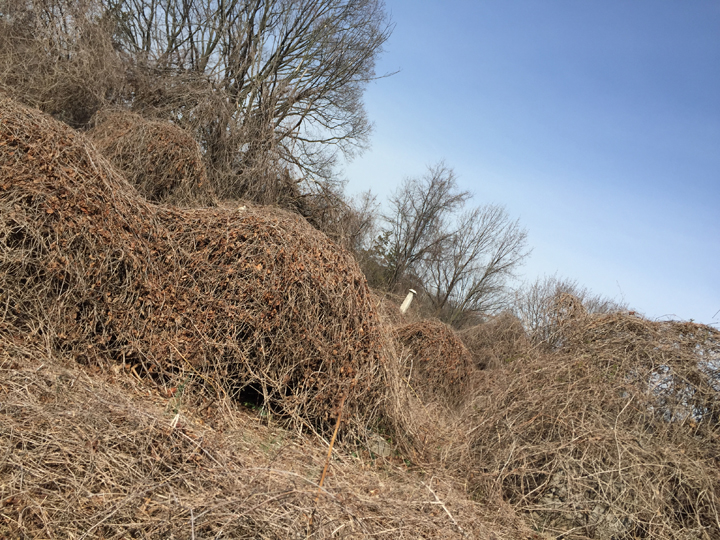
Chances are you have no idea who Rufus Weaver was. Or why I spent so much time trying to locate his weed-covered headstone in Philadelphia’s Mount Vernon Cemetery. You might not even be aware of the difficulties of doing ANYTHING in Mount Vernon Cemetery. This is because for the twenty years leading up to 2020, the cemetery had been locked up tight and neglected. Trees and weeds grew rampant, there were few visitors and fewer burials. The landscape in 2018 looked like what you see in the image below. Mile-a-minute weeds encapsulate all but the highest monuments, creating natural burrows for wildlife.

In winter, weeds form cage-like enclosures around the tombstones

"Harriet"
In 2018, I attended a lecture at the Drexel University College of Medicine in Philadelphia, where I first locked eyes with Harriet Cole. Among the amazing and varied archival holdings of the institution is the world’s first dissected and preserved nervous system, “Harriet.” Created by the anatomist Rufus Weaver (1841–1936), it was displayed at the 1893 Columbian Exposition in Chicago. More on Harriet later. For now, let’s talk about Dr. Weaver’s earlier pursuits.

Dr. Weaver is buried in Mount Vernon Cemetery, in Philadelphia. I am not sure how I found out the section he is buried in. Generally, it is a bit of a challenge finding ANY specific grave in a cemetery, no matter how accurate the plot map is, no matter how well the cemetery sections are physically marked. Mount Vernon, however, was a forsaken-by-the-owner overgrown Victorian cemetery with no access. But I gained access in 2020, determined to find his grave.

Cemetery map in Mount Vernon
I had a two-by-three foot paper map to go by, but since the place was so overgrown, I couldn’t tell where one section ended and the next began. Section markers were hidden by weeds. It took three visits to the cemetery to find Rufus. This over the course of six months – about the same amount of time it took Weaver to create Harriet in 1888. During each visit, I would hack through the ball of dried weed-webs to gain access to a particular gravemarker, usually to find that it belonged to someone else. I probably machete-hacked through nearly twenty such weedballs before I found him. 

Weaver's stone covered in weeds
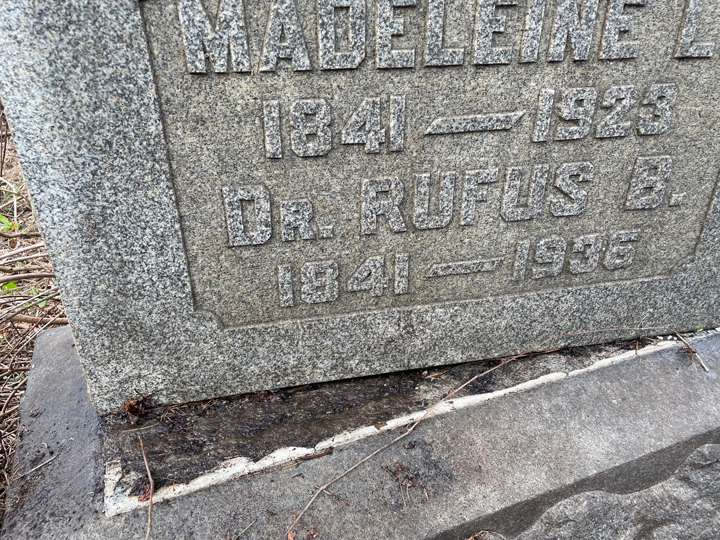
His is a basic stone, engraved with his and his wife Madeleine's birth and death dates. There is no indication that we was such a man of science. At right you see his stone prior to me uncovering it (when I made the photo, I wasn't sure it was his). Below, you see the stone after I cut away the weeds from its face. Click here for a link to the Instagram video of me in the act of uncovering Dr. Weaver's gravemarker.


Anatomist and Lecturer

Dr. Rufus B. Weaver, a native of Gettysburg, PA, was a professor of human anatomy at Hahnemann Medical College in Philadelphia from 1879 to 1897. Hahnemann Hospital no longer exists, by the way, and Hahnemann Medical College is now known as Drexel University College of Medicine. Weaver earned a BA degree from Pennsylvania College in 1862 and graduated with a degree in medicine from Pennsylvania Medical College in 1865. In 1869, he became involved in a gruesome project begun by his father – repatriating thousands of Confederate dead from their Gettysburg battlefield graves to their southern states of origin, which you will read about below. At Hanemann Medical College he was appointed Demonstrator and Lecturer of Anatomy in 1879 and went on to become chairman of the Department of Practical Anatomy in 1897.

Archival photo at Drexel University College of Medicine in Philadelphia

“Whenever a grave was opened…”

One of the projects Rufus was involved with was begun by his father. After the Civil War ended, the elder Weaver was contracted by South Carolina’s Ladies' Memorial Association to move the bodies of thousands of Confederate soldiers from their burial places in the north to Hollywood Cemetery in Richmond, VA. He died before completing the project. Rufus took over, even at great personal expense. I became aware of all this during a visit to Hollywood Cemetery in 2021.  It was there that I saw the bronze commemorative marker shown below, laid flat in the ground in the Confederate dead section. I photographed it at the time, and wanted to transcribe all the text here, for you, but then ….   

Who knew there was such a thing as the “Historical Marker Data Base?” Certainly not me. I searched online for a transcription of the marker, so I could just copy/paste and not have to type all that text. Not only did I find the transcription of the plaque’s wording here but also a photo of the same memorial plaque – this one standing in Gettysburg, PA!

"Rufus Benjamin Weaver, a native of Gettysburg, was a college student at the time of the battle in 1863. His father Samuel Weaver, a local photographer, supervised the collection and reburial of the Federal troops in the National Cemetery. Because of Samuel Weaver's experience and the fact that he and Dr. J.W.C. O'Neal had mapped all the known Confederate gravesites on the Gettysburg Battlefield, a number of Southern ladies memorial associations turned to him for help in returning the remains of fallen Confederate soldiers to the South. Unfortunately in 1869, before he could begin the hard work of disinterring and shipping the remains of Confederate soldiers, Samuel Weaver was killed in a railroad accident. The Southern ladies memorial associations then turned to his son to complete the task.

In 1871, now a doctor of anatomy, Dr. Rufus Benjamin Weaver took on the difficult job of exhuming, collecting, boxing, and shipping the remains of Confederate soldiers. Whenever a grave was opened, Dr. Weaver was present to ensure that all remains possible were recovered. Dr. Weaver was supposed to be paid the agreed price of $3.25 for each body he was able to recover, however the Southern ladies memorial associations were unable to pay more than 50% of what he was actually owed. Despite this fact, Dr. Weaver continued the noble work of repatriating the remains of 3,320 Confederate soldiers to the South. The majority of the remains, 2,935, went to Hollywood Cemetery in Richmond, VA. The remainder were dispersed between Raleigh, NC, Charleston, SC, Savannah, GA, and a few to other locations.

In grateful appreciation, Freeman's Battery Forrest's Artillery, Camp 1939 Sons of Confederate Veterans, acknowledges a debt of honor owed by all Southerners, and in appreciation of the generosity and humanity of his deeds, erects this marker to Dr. Rufus B. Weaver."

Rufus Weaver's gravemarker in Mount Vernon Cemetery

One would expect more than a modest tombstone to be erected to this man, who performed such a humanitarian and herculean task. One would also expect it not to be lost to history, lost in a neglected cemetery. The dried mile-a-minute weeds were stiff and strong enshrouding every headstone in the section of Mount Vernon where Weaver is buried. It was winter when I labored to locate his stone, so at least there were no leaves to hide what was beneath. You would think this would have been an advantage, but the dried weed cages were so thick, you could not see the headstone or monument through it. I had never seen a photograph of his stone, or monument, so I hacked through weed cages of various sizes in the area where I suspected it was located. 

I finally found the stone during my third trip to Mount Vernon and cleared the weeds from it on March 18, 2020. One can only hope that his grave secures a prominent place on the cemetery tours conducted by the Friends of Mount Vernon Cemetery

Weaver's stone askew on its base

In May of 2020, The Friends of Mount Moriah Cemetery, Inc. (of which I am a volunteer Board member) spent a day clearing the Drew and Barrymore plot near Rufus’ stone. Since I had last been to Mount Vernon two months prior, Rufus’ stone had become shifted off its base, likely knocked askew by heavy equipment that had been used to clear trees and brush. The stone was not damaged so the Friends volunteers reset it squarely back onto its base.

Repositioning Dr. Weaver's headstone, May, 2020

Nervous System – The Dissection of Harriet Cole

According to ScienceDirect.com:

About seventeen years after his grave repatriation work in Gettysburg, Weaver began work on the pièce de résistance of his anatomy career, his dissection of the entire cerebrospinal system. Weaver named the dissection “Harriet” after Harriet Cole, an African-American scrubwoman who worked in the anatomy lab at Hahnemann Medical College where Weaver instructed. "Harriet, who suffered from tuberculosis, donated her body to science just before her death in 1888 at the age of 35.”

It is interesting wording, “donated her body to science.” This would imply her conscious decision to do so. The literature actually states:

“At the time of Harriet Cole's death in 1888, laws set forth by the Pennsylvania State Anatomical Board and the Anatomy Act of 1883 governed unclaimed human remains. In accordance with these laws, unclaimed persons at PGH [Philadelphia General Hospital] were transferred to area schools for "the advancement of medical science."

"Harriet" dissection at Drexel University College of Medicine in Philadelphia
People generally do not know that the cadavers used in medical schools in the late 1800s were procured in this manner. Grave-robbing, body-snatching “resurrectionists” were no longer needed. So “unclaimed” people in effect “donated” their bodies to science. The records show that Harriet died and her body went unclaimed. Therefore, it became available for medical study. That may be how Weaver acquired it. As a result, Harriet’s is the first complete human nervous system ever dissected and preserved for study. As such, she has become famous in anatomical textbooks throughout the world.

The hundreds of Harriet’s hand-preserved and painted nerves reminded me of the complex, seemingly randomly-growing weeds that imprisoned Weaver’s stone – almost like the individual axons and dendrites of Harriet’s nervous system. Why was I driven to find and free his grave marker? Weaver needs to be more widely appreciated as his accomplishments furthered the scientific study of the human body. Now that Mount Vernon Cemetery in Philadelphia has its own Friends group caring for the cemetery, Weaver’s grave can become part of the historic tours conducted on the property. For access to Weaver’s and other gravesites at Mount Vernon Cemetery, please visit the Instagram and Facebook pages of “The Friends of Mount Vernon Cemetery.” Cleanup and tour dates are frequently announced.


References and MUCH Further Reading:

https://www.sciencedirect.com/science/article/pii/S2214854X17300250

https://drexel.edu/legacy-center/the-collections/historical-human-remains/harrietcole-details/
https://www.hmdb.org/m.asp?m=77608


Tuesday, February 13, 2024

Toy Story … in an Abandoned Cemetery

This is my gratuitous Valentine’s Day post – you’ll just have to bear with me. Valentine’s Day is not the subject of the post, but apparently, there is some love involved. Tough love, maybe? You only hurt the ones you love? Again, bear with me (nyuk nyuk). If you’ve ever walked through a cemetery, you’ve probably seen stuffed toy animals on graves. Usually childrens’ graves. A common practice, leaving such an offering, a remembrance, perhaps. But in abandoned cemeteries? 

Abandoned cemeteries are a form of dystopia, to be sure. The environment – meaning nature – is usually in the process of destroying what humans built. For the past twenty years a Victorian-era cemetery in Philadelphia has been in a sad state of disrepair, only accessible to those who the owner or caretaker allows in. Many wonder how it got this way, but the real question on everyone’s mind is:

Why are there so many toy stuffed animals lying about throughout Mount Vernon Cemetery? 

There are no visitors to place them on graves in loving memory of the deceased. There are no visitors. There is no visitor access. You can almost picture some hideous beast living in its burrow, periodically feasting on stuffed animals. The ones you see here, matted down with weeds and rain, well, don’t really belong here, do they? The trapped, partially dismembered clown fish above has a look of fear in its eye. 
Stuffed Animal Dystopia.

Its almost as if some beast killed them with its poisonous saliva and secreted a fluid to trap them in weeds until it later required a snack. Much like an insect that gets caught in a spider’s web. Perhaps this is simply attribution bias on my part. Perhaps not. One poor toy was in the process of being dragged into the beast’s lair as I stumbled upon the massacre scene. You can just hear Jennifer Lawrence singing, “The Hanging Tree,” right?

Into the lair of the beast ....

Do the toys get thrown over the fence by the caretakers of the active cemetery next door, as they clear graves prior to mowing? Then something, or some things, retrieve the toys and drag them through the fence into the abandoned graveyard. The mind wanders to Neil Gaiman’s The Graveyard Book ..and the toys Bod may have left lying around the cemetery in his formative years.

A fox, perhaps, requires such playthings? That, apparently, is the general thought if you read the Instagram posts by the volunteers now caring for the cemetery.

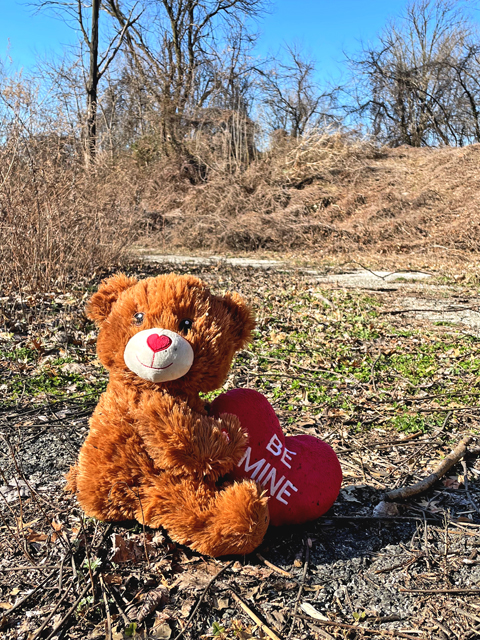
So, first off, Mount Vernon Cemetery in Philadelphia is no longer abandoned. Technically, it never was. It was simply ignored by its owner - for about twenty years. It is currently being maintained by many dedicated volunteers. There are regularly scheduled cleanup days and occasional tours, but access is closely controlled. Here’s a photo of my friend Kim posing with some bears during a recent tour.

Mount Peace Cemetery, next door, has always been well-cared for. It seems likely that somehow, these small grave decorations travel from there into unkempt Mount Vernon next door. Perhaps the wild foxes that prowl the wooded grounds of Mount Vernon steal these objects from Mount Peace in the night - they snitch Winnie-the-Pooh from a defenseless grave, and abscond through some hole in the cyclone fence into the wild next door. But to what end?

Mount Vernon’s twenty-seven acres is probably twenty percent cut back at this point, with nature having a twenty-year lead on the humans trying to tame the bush. So there are plenty of hiding places for fox, deer, and so on. I’ve seen small herds of white-tails leaping through the underbrush. Sometimes you’ll even see shredded toys, along with …. bones?

So, do the red foxes drag the stuffed critters into their burrows for padding? Groundhogs do this – but with them, its usually the flags from the little flagpoles people stick on graves. But then, why are they scattered all over the grounds? That’s like saying if humans are descended from apes, then why are there still apes?

What I don’t know about the housekeeping habits of small woodland creatures could fill volumes. Perhaps instead, UFOs are involved. Whatever the case may be, if you find yourself walking through a more-or-less abandoned cemetery alone and you round a bend to find this Ted smiling at you in the middle of the road, your brain does not race for a logical explanation. Your brain screams.


Friday, March 27, 2020

Artists in the Time of Coronavirus

In March 2020, two weeks into quarantine lockdown of COVID-19, Artblog Philly sent out this announcement:

OPEN CALL for Virtual Exhibition ‘Artists in the Time of Coronavirus’
By Artblog March 19, 2020
ARTBLOG IS CALLING ALL ARTISTS, yes ALL makers and creators with a connection to Philadelphia, to participate in our online community project: "Artists in the Time of Coronavirus."
++++++++++++++++++++++++++++++++++
Assuming we haven’t all died by the time you read this, you can hit their link here.
https://www.theartblog.org/2020/03/open-call-for-virtual-exhibition-artists-in-the-time-of-coronavirus/

I submitted a 250-word piece with some photos and I don’t know if they’ll publish it (I’m not pithy or squee, a doomsayer or a highbrow artist), but I figured I’d publish my submission here so at least you can see it. I’m adding a bit to it, so don’t count the words. Of course, if you can’t buy toilet paper in this corona-era, you probably don’t care much about wordcount anyway.

So, “Art in the Time of Coronavirus…." 

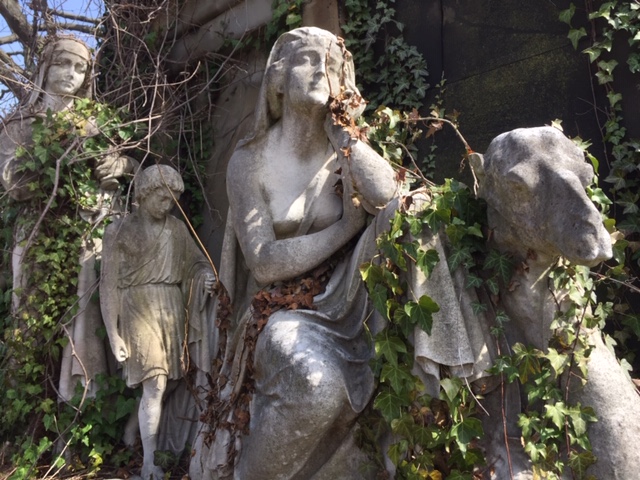
I’ve been a practitioner of social distancing since before it was a thing - I photograph abandoned sites and graveyards. Sometimes I even explore abandoned graveyards. Truly isolated locales. Some of these images were made during such an exploration this past week - the six-foot social distancing rule is rather easy to achieve in a graveyard.

For me, creating art is a personal and solitary experience, but I’ve learned that sharing it with others is vital. Years ago when I began exhibiting my photographs of cemetery angel statues, people would tell me why they were purchasing certain pieces. It scared me that others could find meaning in my work. Greater meaning than what I thought was there. So I appreciate the effort Artblog is making to create an audience for artists at this trying time.


We may think ourselves insular, that we create art only for “ourselves,” but I don’t believe that is true. Creative people in this day and age rely on an audience – and increasingly, that is a web-based audience. If COVID-19 continues, that may be our ONLY audience. Pre-Internet writers, composers, and painters may truly have created work mainly to please themselves. If they had received instant feedback (in the form of Internet silence), some of the “great” work may never have seen the light of day (think of Ulysses or The Great Gatsby, neither of which was well-received at the time of publication, by either the critics or the public).

Death and decay are concepts I gravitate toward, whether denoted by abandoned buildings or made more tangible by cemeteries. These latter reminders of our mortality have seen an upswing in popularity - cemetery visits by “normal” people have increased this past week! The government has issued a “no public gatherings” order and most people don’t have to be at work, so why not enjoy a beautiful spring day in a Victorian sculpture garden? Just enjoy nature - you don't even have to contemplate mortality ...

When you think about it, this was the original purpose of nineteenth century “rural” cemeteries – beautiful getaways from the grimy, noisy city. Philadelphia’s luxuriant garden cemeteries, Mount Moriah, the Woodlands, and Laurel Hill were the go-to open-air art galleries and parks of the Victorian era (there WERE no art galleries or parks back then!).

John and Olivia
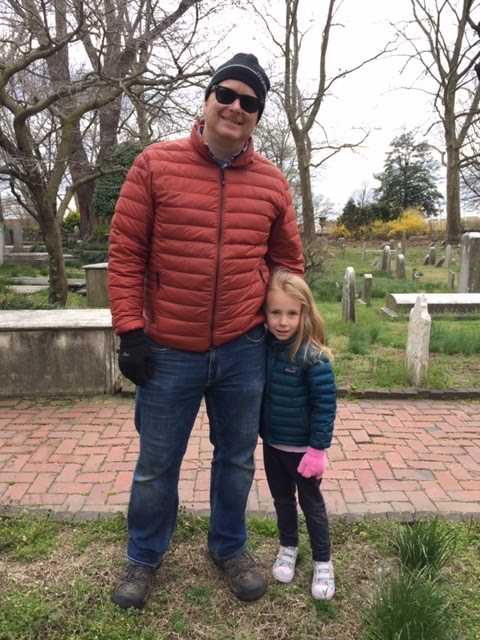
My daughter Juli told me she saw at least fifty people in Philly's Woodlands Cemetery last week when she was there walking her dog. I saw several people with little kids at Laurel Hill Cemetery when I stopped by. Last weekend, I happened on my neighbors walking through the graveyard of the Old Swedes’ Church – Gloria Dei – near my house in South Philly. Here’s their little girl running among the gravestones. Graveyards - a last vestige of greenspace.


Currently, all the stores and businesses are closed. Some are even boarding up, expecting the worst. What’s the worst that can happen? Amazon closes all its distribution centers and widespread looting begins? As we look to create Art in the Time of Coronavirus, consider the words of John Lennon: “Reality leaves a lot to the imagination.” Public gatherings have become non-existent with COVID-19, and so the city’s wonderful graveyard greenspaces have taken on greater value. Visit them – imagine them to be your next artistic muse – their residents are six-feet-under, a safe social distance. Now is a good time to contemplate life in general – not one of us is getting out of this alive. 

You can see a new post every day on my Instagram page:
IG: https://www.instagram.com/mourningarts/
Website: https://www.edsnyderphoto.com/