Showing posts with label confederate graves. Show all posts

Saturday, March 8, 2025

The Grave of Rufus Weaver

Chances are you have no idea who Rufus Weaver was. Or why I spent so much time trying to locate his weed-covered headstone in Philadelphia’s Mount Vernon Cemetery. You might not even be aware of the difficulties of doing ANYTHING in Mount Vernon Cemetery. This is because for the twenty years leading up to 2020, the cemetery had been locked up tight and neglected. Trees and weeds grew rampant, there were few visitors and fewer burials. The landscape in 2018 looked like what you see in the image below. Mile-a-minute weeds encapsulate all but the highest monuments, creating natural burrows for wildlife.
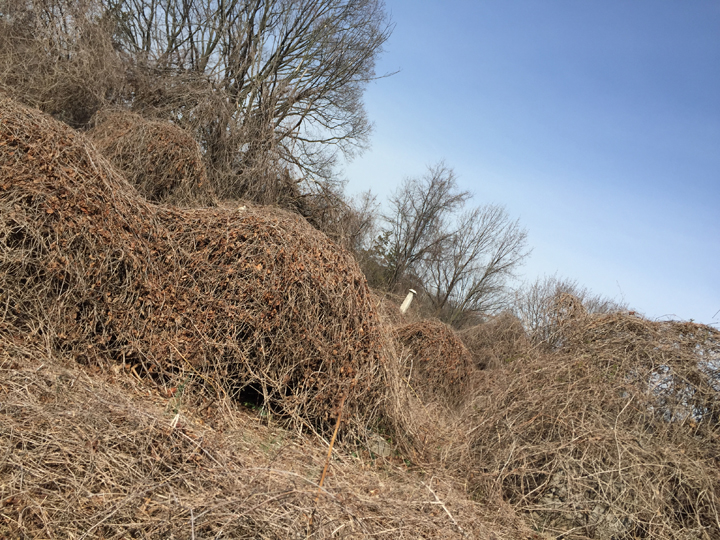
In winter, weeds form cage-like enclosures around the tombstones

"Harriet"
In 2018, I attended a lecture at the Drexel University College of Medicine in Philadelphia, where I first locked eyes with Harriet Cole. Among the amazing and varied archival holdings of the institution is the world’s first dissected and preserved nervous system, “Harriet.” Created by the anatomist Rufus Weaver (1841–1936), it was displayed at the 1893 Columbian Exposition in Chicago. More on Harriet later. For now, let’s talk about Dr. Weaver’s earlier pursuits.

Dr. Weaver is buried in Mount Vernon Cemetery, in Philadelphia. I am not sure how I found out the section he is buried in. Generally, it is a bit of a challenge finding ANY specific grave in a cemetery, no matter how accurate the plot map is, no matter how well the cemetery sections are physically marked. Mount Vernon, however, was a forsaken-by-the-owner overgrown Victorian cemetery with no access. But I gained access in 2020, determined to find his grave.

Cemetery map in Mount Vernon
I had a two-by-three foot paper map to go by, but since the place was so overgrown, I couldn’t tell where one section ended and the next began. Section markers were hidden by weeds. It took three visits to the cemetery to find Rufus. This over the course of six months – about the same amount of time it took Weaver to create Harriet in 1888. During each visit, I would hack through the ball of dried weed-webs to gain access to a particular gravemarker, usually to find that it belonged to someone else. I probably machete-hacked through nearly twenty such weedballs before I found him. 

Weaver's stone covered in weeds
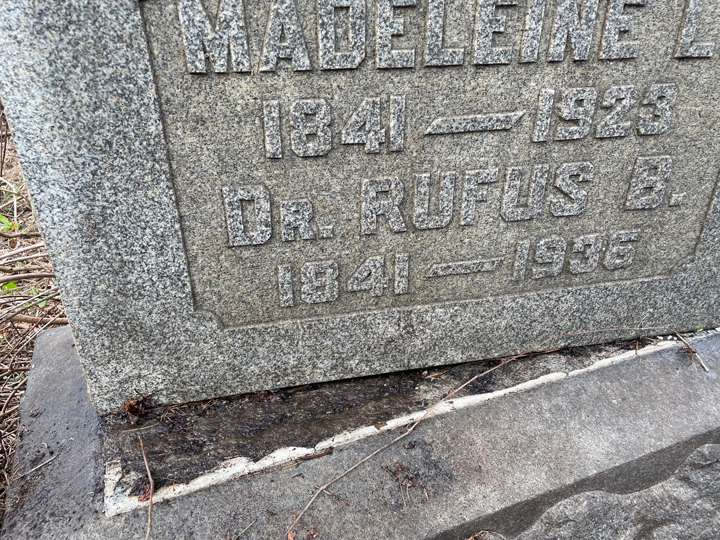
His is a basic stone, engraved with his and his wife Madeleine's birth and death dates. There is no indication that we was such a man of science. At right you see his stone prior to me uncovering it (when I made the photo, I wasn't sure it was his). Below, you see the stone after I cut away the weeds from its face. Click here for a link to the Instagram video of me in the act of uncovering Dr. Weaver's gravemarker.


Anatomist and Lecturer

Dr. Rufus B. Weaver, a native of Gettysburg, PA, was a professor of human anatomy at Hahnemann Medical College in Philadelphia from 1879 to 1897. Hahnemann Hospital no longer exists, by the way, and Hahnemann Medical College is now known as Drexel University College of Medicine. Weaver earned a BA degree from Pennsylvania College in 1862 and graduated with a degree in medicine from Pennsylvania Medical College in 1865. In 1869, he became involved in a gruesome project begun by his father – repatriating thousands of Confederate dead from their Gettysburg battlefield graves to their southern states of origin, which you will read about below. At Hanemann Medical College he was appointed Demonstrator and Lecturer of Anatomy in 1879 and went on to become chairman of the Department of Practical Anatomy in 1897.

Archival photo at Drexel University College of Medicine in Philadelphia

“Whenever a grave was opened…”

One of the projects Rufus was involved with was begun by his father. After the Civil War ended, the elder Weaver was contracted by South Carolina’s Ladies' Memorial Association to move the bodies of thousands of Confederate soldiers from their burial places in the north to Hollywood Cemetery in Richmond, VA. He died before completing the project. Rufus took over, even at great personal expense. I became aware of all this during a visit to Hollywood Cemetery in 2021.  It was there that I saw the bronze commemorative marker shown below, laid flat in the ground in the Confederate dead section. I photographed it at the time, and wanted to transcribe all the text here, for you, but then ….   

Who knew there was such a thing as the “Historical Marker Data Base?” Certainly not me. I searched online for a transcription of the marker, so I could just copy/paste and not have to type all that text. Not only did I find the transcription of the plaque’s wording here but also a photo of the same memorial plaque – this one standing in Gettysburg, PA!

"Rufus Benjamin Weaver, a native of Gettysburg, was a college student at the time of the battle in 1863. His father Samuel Weaver, a local photographer, supervised the collection and reburial of the Federal troops in the National Cemetery. Because of Samuel Weaver's experience and the fact that he and Dr. J.W.C. O'Neal had mapped all the known Confederate gravesites on the Gettysburg Battlefield, a number of Southern ladies memorial associations turned to him for help in returning the remains of fallen Confederate soldiers to the South. Unfortunately in 1869, before he could begin the hard work of disinterring and shipping the remains of Confederate soldiers, Samuel Weaver was killed in a railroad accident. The Southern ladies memorial associations then turned to his son to complete the task.

In 1871, now a doctor of anatomy, Dr. Rufus Benjamin Weaver took on the difficult job of exhuming, collecting, boxing, and shipping the remains of Confederate soldiers. Whenever a grave was opened, Dr. Weaver was present to ensure that all remains possible were recovered. Dr. Weaver was supposed to be paid the agreed price of $3.25 for each body he was able to recover, however the Southern ladies memorial associations were unable to pay more than 50% of what he was actually owed. Despite this fact, Dr. Weaver continued the noble work of repatriating the remains of 3,320 Confederate soldiers to the South. The majority of the remains, 2,935, went to Hollywood Cemetery in Richmond, VA. The remainder were dispersed between Raleigh, NC, Charleston, SC, Savannah, GA, and a few to other locations.

In grateful appreciation, Freeman's Battery Forrest's Artillery, Camp 1939 Sons of Confederate Veterans, acknowledges a debt of honor owed by all Southerners, and in appreciation of the generosity and humanity of his deeds, erects this marker to Dr. Rufus B. Weaver."

Rufus Weaver's gravemarker in Mount Vernon Cemetery

One would expect more than a modest tombstone to be erected to this man, who performed such a humanitarian and herculean task. One would also expect it not to be lost to history, lost in a neglected cemetery. The dried mile-a-minute weeds were stiff and strong enshrouding every headstone in the section of Mount Vernon where Weaver is buried. It was winter when I labored to locate his stone, so at least there were no leaves to hide what was beneath. You would think this would have been an advantage, but the dried weed cages were so thick, you could not see the headstone or monument through it. I had never seen a photograph of his stone, or monument, so I hacked through weed cages of various sizes in the area where I suspected it was located. 

I finally found the stone during my third trip to Mount Vernon and cleared the weeds from it on March 18, 2020. One can only hope that his grave secures a prominent place on the cemetery tours conducted by the Friends of Mount Vernon Cemetery

Weaver's stone askew on its base

In May of 2020, The Friends of Mount Moriah Cemetery, Inc. (of which I am a volunteer Board member) spent a day clearing the Drew and Barrymore plot near Rufus’ stone. Since I had last been to Mount Vernon two months prior, Rufus’ stone had become shifted off its base, likely knocked askew by heavy equipment that had been used to clear trees and brush. The stone was not damaged so the Friends volunteers reset it squarely back onto its base.

Repositioning Dr. Weaver's headstone, May, 2020

Nervous System – The Dissection of Harriet Cole

According to ScienceDirect.com:

About seventeen years after his grave repatriation work in Gettysburg, Weaver began work on the pièce de résistance of his anatomy career, his dissection of the entire cerebrospinal system. Weaver named the dissection “Harriet” after Harriet Cole, an African-American scrubwoman who worked in the anatomy lab at Hahnemann Medical College where Weaver instructed. "Harriet, who suffered from tuberculosis, donated her body to science just before her death in 1888 at the age of 35.”

It is interesting wording, “donated her body to science.” This would imply her conscious decision to do so. The literature actually states:

“At the time of Harriet Cole's death in 1888, laws set forth by the Pennsylvania State Anatomical Board and the Anatomy Act of 1883 governed unclaimed human remains. In accordance with these laws, unclaimed persons at PGH [Philadelphia General Hospital] were transferred to area schools for "the advancement of medical science."

"Harriet" dissection at Drexel University College of Medicine in Philadelphia
People generally do not know that the cadavers used in medical schools in the late 1800s were procured in this manner. Grave-robbing, body-snatching “resurrectionists” were no longer needed. So “unclaimed” people in effect “donated” their bodies to science. The records show that Harriet died and her body went unclaimed. Therefore, it became available for medical study. That may be how Weaver acquired it. As a result, Harriet’s is the first complete human nervous system ever dissected and preserved for study. As such, she has become famous in anatomical textbooks throughout the world.

The hundreds of Harriet’s hand-preserved and painted nerves reminded me of the complex, seemingly randomly-growing weeds that imprisoned Weaver’s stone – almost like the individual axons and dendrites of Harriet’s nervous system. Why was I driven to find and free his grave marker? Weaver needs to be more widely appreciated as his accomplishments furthered the scientific study of the human body. Now that Mount Vernon Cemetery in Philadelphia has its own Friends group caring for the cemetery, Weaver’s grave can become part of the historic tours conducted on the property. For access to Weaver’s and other gravesites at Mount Vernon Cemetery, please visit the Instagram and Facebook pages of “The Friends of Mount Vernon Cemetery.” Cleanup and tour dates are frequently announced.


References and MUCH Further Reading:

https://www.sciencedirect.com/science/article/pii/S2214854X17300250

https://drexel.edu/legacy-center/the-collections/historical-human-remains/harrietcole-details/

https://www.hmdb.org/m.asp?m=77608


Tuesday, January 24, 2012

The Graves of Old Tampa Bay

It’s so cold here in Philadelphia in mid-January that the veiled threat of snow makes me want to go to Florida for a while. So here we go. I was in Tampa a couple years ago, and spent some time in its quaint downtown Oaklawn Cemetery. If you think Florida has been northernized by all the tourists and retirees, a quick look at some of the gravestones will remind you of where you are (and where your ancestors have been!).

Oaklawn is Tampa’s oldest public burial ground, established in 1854, not long after the city itself came into being. Not having much in the way of stone quarries, the early graves had wooden markers. It was only later that residents became wealthy enough to afford “imported” (by ship) stone with which to mark their graves. 

It’s a small, lovely place – quietude in the midst of a commercial area about half a mile north of Tampa Bay’s convention center. Oaklawn is surrounded by mostly government buildings, a bus depot, and bail bondsmen – a typical urban area, yet with a startling number of vacant lots. It’s almost as if all of the cemetery’s surrounding urban decay was razed in the past ten years, leaving only the Baptist church across from the entrance.

Along with the old cemetery, the church’s mission bell (lodged into its front wall) is the only extant reminder of Tampa’s historic past. It’s a colorful past with a cast of characters that includes the Ybor cigar-making family (whose tomb is here), statesmen, businessmen, Confederate soldiers, scalawags and pirates. The latter, I must confess, is the main reason I sought the place out. Photos of its pirate graves were all over the Internet and I needed to see them!

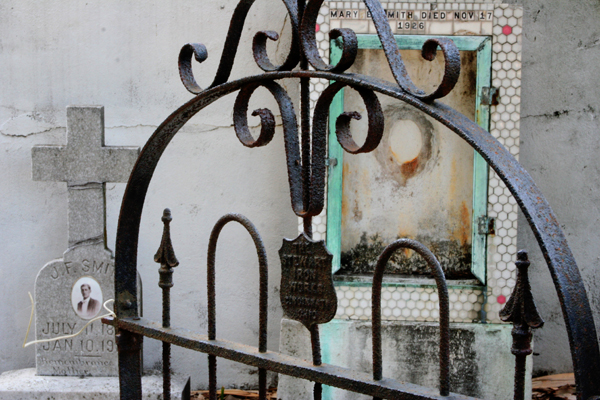
As you roam the grounds, you notice the strange old ironwork and mosaic tile unique to the craftsmen of the area (read more about that in a previous blog I wrote). Everything is shaded by trees with hanging Spanish moss. There’s an ancient oak on the side of the cemetery where the pirate graves were supposed to be (“Morgan” Street, I swear!), that is so ridiculously huge that its branches swoop down to the ground then back up again! 

The place is very quiet, still, and contemplative. Maybe a little spooky. A large, rolling, concrete bed-shaped family crypt is the first thing you see as you hop over the wall from the parking area. This large (twenty feet square?) concrete structure most likely has bodies buried under it, but I can’t for the life of me figure out how they would actually do that. Usually when you see an above-ground family monument, it marks the spot of an underground mausoleum. There has to be a way to access the opening in the roof of the mausoleum to add bodies. This thing didn’t seem to allow such access. Curious. 

More so than the impending snow storm, what prompted me to recall my visit to Oaklawn was a blog I just read yesterday by a woman who had visited the cemetery in 2008. Something she said rang true with me, though at the time I was there, I couldn’t really put the feeling I had into words. She writes:

I always got this feeling when I walked into this particular cemetery like you are being watched, but not by anything sinister necessarily.” (ref)

Without a doubt, I had the same feeling. Not a scary feeling, just a feeling like I was being watched. It didn’t seem to be anything worth noting at the time, but when I read the woman’s account of her visit, it brought back the feeling quite distinctly. I mentioned that Oaklawn is surrounded by a commercial area, but there weren’t many people around. It’s not a tourist site and the locals know better than to spend much time outdoors in 100-degree high-humidity heat. Not sure what was watching me.

The writer also thought she had captured orbs and apparitions on film, as she stood on the porch of the white sexton house (maintenance shed). This quaint little Victorian-type structure, whose porch overlooks a mass grave of yellow fever victims, didn’t appear on any of my memory cards, even though I photographed it. You can see a photo of it here.

As I mentioned earlier, my main reason for visiting Oaklawn was to cadge a few pics of the pirate graves, but damn if I could find them! I had directions off the Internet, I KNEW what they looked like, but I never found the blasted things! However, I might have caught a pirate spirit (below). 

The cemetery was very pleasant and relatively cool, what with the majority of it shaded by trees covered with low-hanging Spanish moss. I had a Holga with me, loaded with slow film, but there really wasn’t enough light to expose the film.  The only notable exception being this image of some grave markers in the vicinity of where the pirate graves were supposed to be. Now, if you want to think of the misty business in the photo as some sort of piratical apparition, be my guest. I just like it because its wonderfully creepy.

Pirate lore is rampant along the Florida coast, and for good reason.
"Florida, like all other states, has a fascinating and romantic history. Seven different flags have flown over her, not to mention the black flag of the pirates. Florida became the haven of many notorious pirates, including Blackbeard, Lafitte, Gasparilla, Kidd, Rackham, Bowlegs, Bonnett, and possibly even Morgan himself [Morgan Street  borders the west side of Oaklawn] . They roamed the waters of the Caribbean Sea, and captured every ship in sight. Often, they brought their loot back to Florida, and buried it on some lonely shore. When they finally died, the location of their hidden wealth died with them. The majority of all buried treasure in Florida is the work of pirates." (ref)

A few nights later I witnessed an unexpected squall on the bay that had palm trees bent over as sheets of rain pummeled the shore and six-foot waves rocked the docks. As lightning flashed it was easy to see how a treasure-laden ship could capsize just off shore in such a tempest. Pirates that made it to land could easily have buried their booty anywhere in the area. Maybe the phantom "watchers" of Oaklawn are just checking to make sure their buried treasure is still safe.


Further Reading: