Showing posts with label outdoor photography. Show all posts

Sunday, February 28, 2021

The Winter of Our Discontent (Shakespeare, not Steinbeck)

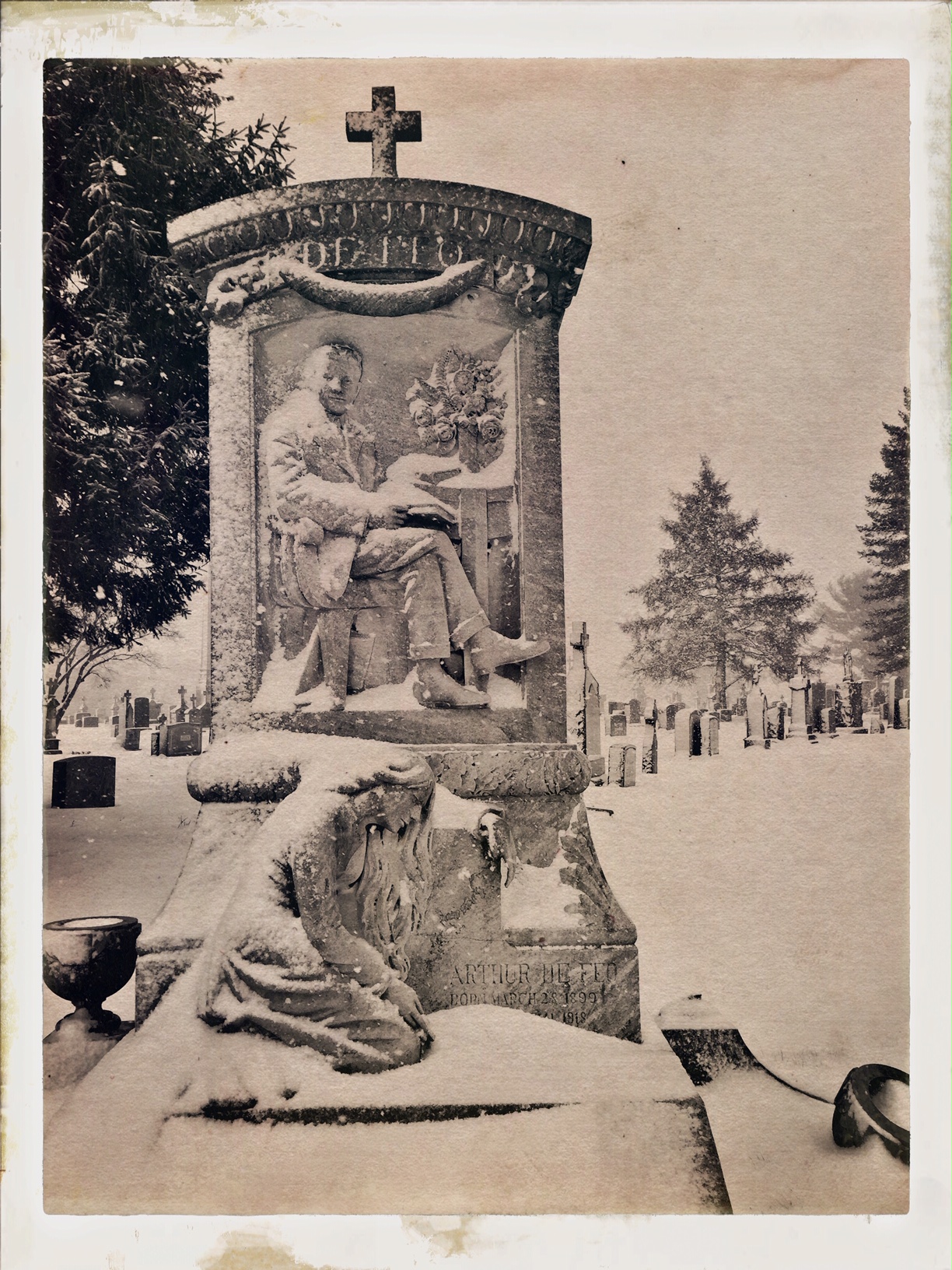
My artistic experiences this winter (it is still technically winter here in Philadelphia – Feb. 2021 as I write this) have not been one of discontent. Rather, reckless winter has allowed me the opportunity to photograph cemeteries and their statues under a blanket of snow. Standing in a blizzard with an umbrella and camera may seem ridiculous, but I assure you, it is anything but a fool’s errand. Numb fingers are simply a sign of weakness leaving the body.

Tintype Hipstamatic App image

The zeitgeist of a Victorian snowfall creates a mood of singular isolation. And freedom, of sorts - it takes one out of the literal social isolation forced on us by the current pandemic. And Paul Simon was wrong – everything does NOT look worse in black and white.

Why Shakespeare and not Steinbeck? Shakespeare’s lines from Richard III are lines of opportunity, versus Steinbeck’s, which are pure misery. Granted, the euphoria of photographing a snowfallen cemetery in below-freezing temperatures can be quickly replaced by misery if you mistakenly lock yourself out of your warm, running vehicle (which I have been known to do). However, Shakespeare is optimistic about the future. As am I. The playwright is saying that even though we may now be miserable (‘Now is the winter of our discontent’), better days are coming (’Made glorious summer by this sun …’).  (Cue the song, "Better Things" by the Kinks.)

But I digress (which is one of the qualities you find most endearing about me). My limerence with cemeteries is boosted when it snows. It just is. I have to get out there fast, while it is still snowing, if possible. Primae noctis, as it were. Not than anyone else is even considering doing the same thing, but it does give me the feeling of being first in, a unique time in a place where I can be ultimately alone with my passion. And in the middle of a pandemic, its rather liberating to not concern myself with social distancing or wearing a mask.

So would I recommend this nostrum of shooting angels in the snow? Well, it is certainly easier if you live in a polar climate zone. Its not something I can easily demonstrate to you, however. You just need to get out there in your gloves, boots, and hand warmers, and let the snow muses guide you. Helps to have an SUV, too, so you don’t get stuck. 


I photographed graveyards in the snow quite often this winter. The Snow Demons were appeased last year – they made no appearance. Apparently, COVID must have royally pissed them off, because they have been out in full force, whiting out my world since even BEFORE winter began (our first snowfall was on December 16, 2020)!

Please realize that cemeteries are places of respect - an obvious consideration when you are photographing in them. While there may be no one else around you there in the snowstorm, burial grounds and monuments mean many things to many people. Be respectful as you work. And be careful. Don’t climb on the monuments. Don’t lean on them. I’ve seen a person who had a large gravestone fall on her. She nearly lost her leg. It was crushed, but was later saved. Luckily there were several people around to lift the thousand-pound granite grave marker off her. So consider the possibility of a monument falling on you in a snowstorm. Think anyone would find you before you died of exposure or trauma?

Defunct crematorium in a snow squall

The Gear
So if I have not scared you off the topic at this point, let’s talk about the gear. Obviously, you want your equipment to be either waterproof or well-protected. I own neither. Which is why I typically carry only one camera with me, protected by a snow umbrella. I leave the rest of the photographic arsenal in the car, running back to swap them as needed. This way, I’m guaranteed to lose such things as lens caps and filters in the snow.

Cross-processed E6 image

Do I use real cameras or the camera in my cell phone? As time goes on, this distinction becomes less relevant. I do have an old iPhone 6 which I use quite a bit. Not bad images except the battery peters out in the cold. If I use it outdoors in winter, I have to keep it connected to an external battery. The apps are interesting as well, I use basic Hipstamatic and Hipstamatic Tintype in addition to straight shooting. I do drag conventional cameras out in the snow with me as well. Certainly, digitals are easiest to use. However, I’ve been shooting quite a bit lately with a 120mm (film) Holga and running outdated slide film through a Nikon F3 35mm film camera, then cross-processing the E-6 film as C-41 (which is kind of standard practice now, since E-6 chemistry is no longer widely available). I like to surprise myself. Digital can be too exacting. At right, you can see an example of a cross-processed image.

Hipstamatic Tintype App image 

It has not, historically, snowed often in the Philadelphia area (at least during the current geological epoch). So when it does, I attempt to make the most of it. It helps to have a plan. Which cemeteries are easiest to access? Are the roads plowed? Luckily for me, the graveyard at left is within walking distance of my house! I have some go-to locations and some go-to statues that I like to check in with during a snowfall – some take on the white cloak better than others...

You can see the same cemetery angel dozens of times, but there might be this one time, as you approach it in the hush of a snowfall, bootfalls crunching, that you seem to be seeing it as it had looked long ago. The more modern mass-produced gravestones mostly hidden, the bespoke, Victorian statuary gently “shrouded in white, allowing the outlines of something older to emerge.” The quote is from science fiction writer William Gibson’s novel, Pattern Recognition. A strange book to be reading during a pandemic, when old patterns are nowhere to be found, new ones emerging all around us.

Actual lychgate shot with Hipstamatic Tintype App

So if this seems to be a winter of discontent for you because of the new patterns that life has assumed, consider COVID-19 as a sort of lychgate, a gateway to another world. I wrote a blog for the website of New York’s Absynthe Gallery recently, entitled "Artist in Residence," which is about creating art during lockdown in a pandemic. Challenging, to make art in the Time of COVID. But as Gibson says in Pattern Recognition, "There are times when you can only take the next step. And then another.” If you’re interested in seeing how other artists are adapting, the gallery is hosting an online “Drink and Draw” Zoom meeting with many of its artists on March 6, 2021 (5 to 7 pm). I am in their corral of artists, but I don’t draw (I do drink, however, so I meet half the criteria). Demonstrating how I make photographs or how I write blogs would be about as entertaining as watching gesso dry; therefore, I will be in attendance solely drinking and learning. Here’s the link to register: https://absynthegallery.com/drink-draw/


Learning, you ask? Well yes. One of the best ways for an artist to progress and improve is by expanding boundaries - watching other artists create in mediums other than your own. I leave you with an old image (all that you’ve seen so far in this blog, I created in the past ten months), the Mount Moriah Cemetery gatehouse. This is in Philadelphia. I was truly honored to have it chosen to represent February in the 2021 fund-raising calendar published by The Friends of Mount Moriah Cemetery, Inc. Being on the Board of Directors of this volunteer organization and helping to save a formerly abandoned cemetery from total ruin has also been a learning experience. 

Monday, April 27, 2020

Cemetery Socializing

Allyson, Ed, and Owen outside Mt. Vernon Cemetery, Phila.
Back in the late fall of 2017, my friend Owen let me know that he’d be visiting the U.S. in February, and invited me to do some graveyard photography. Owen lives in France, not far from Pere Lachaise, so I always found it ironic that he could find any cemetery outside of Paris very interesting. But he does. And he has photographed and explored them the world over, with stunning results. The previous year he and I hiked through the infamous, massive, formerly-abandoned Mount Moriah Cemetery in Philadelphia.

Owen and I met as Facebook friends some years ago, and appreciate each other’s photography. Toward the end of 2017, I made the acquaintance of another cemetery photographer, Allyson Pettigrew, this time through Instagram. She is, in my opinion, a rising star in the cemetery photography genre. I introduced Allyson to Owen via Instagram, and we started following each other’s work.

Allyson photographing zinc memorial
I suggested to Owen that we ask Allyson to join us when the time came for his visit to the states. He agreed. Such an easy thing to, back in the pre-Coronavirus days. Just plan to get together and then do it. Not so easy today. With the world locked down here in April 2020, social-distancing is the norm and we’re all sheltering in place (unless you need food). No one knows how or when the COVID-19 pandemic will end. We wax nostalgic for the good old days when we could carry a social media virtual “friendship” forward into the realm of ACTUAL friendship – then follow those actual friends as they consider climbing over a fence into an abandoned graveyard. But I’m getting ahead of myself.

Mount Peace Cemetery angel
When February 2018 rolled around, Owen hit town. The three of us agreed to meet at Mount Peace Cemetery in Philadelphia, check out Mount Vernon (through its bars, as it has been subject to its own form of lockdown for many years, i.e., off limits to the public), and then head over to Laurel Hill Cemetery, just across Ridge Avenue. All three cemeteries are just about next to each other. Quite convenient for us cemetery travelers.

Mount Peace Cemetery monument
After introductions and handshaking (gee, how many years will it be until people do THAT anymore?), we spent some time exploring Mount Peace and gazing longingly through the bars of a rhyme – as the Dire Straits song goes – actually, through the bars into the unkempt Mount Vernon Cemetery. (That's my selfie of us at the top of this article, looking through the bars into Mount Vernon.) Owen had a monster lens, so he was able to some great shots. We chatted about our work, strolled Mount Peace’s grounds, and photographed some monuments. We appreciated each others’ company based on a mutual respect for each others’ work.

Mount Vernon Cemetery from the locked entrance gate
When I first noticed Allyson’s work on Instagram, I would linger on the images as they seemed so familiar. I realized she was from Philly, as I am, and so it was not surprising that she photographed many of the same monuments in the same cemeteries as I had over the years. The disturbing fact, however, was that her images were BETTER than mine, lol! Do check out her Instagram feed @allyson_underland.

Mount Vernon Cemetery, Philadelphia

It really is useful to me, as a photographer, to see the same scene from another photographer’s perspective. Years ago, I used to photograph with a friend who was considerably shorter than me. She would complain that I was able to get a high vantage point (being 6’2”) for my compositions while she was not able. Truth is, I enjoyed her images immensely because they were made from angles I naturally did not utilize.

Owen with his ultrazoom lens!

On the other hand, I greatly admire Owen’s work, primarily because he travels to such far-flung exotic places that I will never see. His Instagram images of the graveyards in the Atacama Desert in Chile, for instance, are nothing short of spine-chilling. Do check out his Instagram feed @owenphil333.

Ed and Allyson, with friends at Laurel Hill Cemetery

Owen, Allyson, and I headed over to Laurel Hill Cemetery afterward – did I mention that it was c-c-c-COLD that day?! I don’t recall the temperature but I’m pretty sure it was below freezing. This image of the Schuylkill River (at left) from Laurel Hill Cemetery (above Kelly Drive) epitomizes the weather that day. We walked around, photographed monuments, and generally compared notes on the art of photography.


Owen at Laurel Hill (above and below)

Owen spirited off the next day for further adventures in New Orleans, and I was glad he stopped by to spend some time with Allyson and I. His parting words were, “What kind of people would be out photographing cemeteries in the dead of winter? – the best kind!”


Photography is about sharing - sharing a bit of yourself, some of your work, and hopefully learning something in the process. In Coronavirus times, the best we can do is share online. Many galleries are putting up ad hoc galleries to share art via the internet, since we physically can’t hang things on walls for groups of people to see. Yes, I know, the internet has been moving us in this direction for some time – maybe I’m just late for the bus. Still, with all this isolation, don’t you miss just a little human interaction? Maybe COVID-19 is giving us an idea what virtual reality would REALLY be like if we all just sat in front of our computers. Man cannot live by the internet alone.

Saturday, November 15, 2014

Dying of the Light – Losing Daylight Saving Time


If you’re an outdoor photographer, the letters DST might be your nemesis. In the fall, in the northeast part of the United States, the switch from Daylight Saving Time (DST) back to “standard” time is when you run out of light early, an outdoor photographer’s worst nightmare. Since I photograph cemeteries (and most cemeteries are, for the most part, outdoors), it becomes more challenging to photograph them at this time of the year. Every once in a while I would stop by a cemetery on my way home from work to do some photography. Not so in the winter – its just too dark.

DST is the practice of advancing clocks during summer months by one hour so that light is extended in the evening hours, and sacrificing normal sunrise times. Which is fine, but I’ve always been too lazy to photograph sunrises anyway. (Sunsets, on the other hand, have been more my forte.) Spring forward, fall back, indeed. While it’s a documented fact that more outdoor photography is done during the summer months than in the winter (1), you may need to fall back on an alternate plan if you want to maintain your current outdoor photographic production during the months of waning light.

You notice the “dying of the light” (hats off to Dylan Thomas) around September – the days begin to get shorter. Then during the first week of November we’re off DST and back on standard time, the tripping point. It’s dark when you get up in the morning and its dark when you leave work. From here, there is a steady progression to the winter solstice (mid-December) as we continue losing our precious light. If you’re in the earth’s northern hemisphere, the winter solstice is the shortest day of the year.

Photography is all about light. We may not think of it that way, but given current imaging technology, photography depends on light to create an image. Film worked that way, and so does digital. The less available daylight, the less able we are to make daylight photographs.
 
Self-portrait of author at Point Lobos, California

The loss of light never affected me as much as it did during a trip to Point Lobos, near Big Sur on the California coast a few years ago. I took a break from photographing cemeteries and planned a side trip to Point Lobos State Natural Reserve. Within the park, on the coast below Monterrey, is the area with all the weird rocks where the famous photographer Edward Weston made many of his famous images (read more about Weston and view images here). I arrived late in the day as a fog rolled in. I barely had an hour’s light. As much as I was looking forward to being here, I was ill-prepared for actually making photographs. The beauty of the setting was overpowering. I lamely made some digital and some film images, while taking in the magnificent scenery. Every rock, every dead branch was glorious. It looked like nowhere else on earth. Which, I suppose, is why Weston spent so much time here. He photographed dried seaweed, dead logs, the surf, cypress trees, the beautifully eroded rocks - for years.
 
Point Lobos, near Big Sur, California

I realized, I think, as the day drew to a close, how Weston may have felt at the end of each day. When nature closes the curtain, it is almost like being robbed of something precious. You want it to last forever, this section of wild ocean shoreline is so captivating. It is also very difficult to describe WHY it is so spellbinding. If you’re an outdoor photographer and you appreciate form and shape, “Weston Beach” can be a wondrous experience.

The experience taught me a lesson, well, a few lessons, which apply to more than just photography:
 
1. Planning is paramount – too early is way better than too late, in the same way that over-studying for an exam is better than under-studying (if you want a good grade)
 
2. Be prepared – I was not expecting the very dim conditions, and I had only one roll of film.
 
3. Appreciate the scarce resources around you, e.g. light.
 
4. Allow yourself time to appreciate the beauty around you.
 
5. Nothing lasts forever (even cemeteries).
    
    Author in a cemetery at night, illuminating with an L.E.D. panel light

So as we face days of limited light, how can we best take advantage of this precious commodity? (And it is just that, as conflicting as it may seem: a commodity we take for granted, like electricity, yet precious in that we would be lost with it. Without light, in fact, we would quite literally be lost!) Must we “rage against the dying of the light?” With all due respect to Dylan Thomas (and his wonderful poem, Do not Go Gentle into that Good Night), there are alternatives.

Fall at Mount Moraih Cemetery, Philadelphia
 
Rather than be upset about such a situation or allowing Mother Nature to grind your work to a halt, plan to do your photography in a different way. Maybe take a day off work to exercise your skills. As a way of stocking up, I got as much photography in as I could in the past few weeks. I took a bit of time here and there to photograph the autumn leaves at Mount Moriah, Woodlands, and Laurel Hill cemeteries (Philadelphia). If you shoot mostly black and white, this is a good opportunity to capture the colors of the season! Assuming you don’t actually become clinically depressed with seasonal affective disorder (SAD), there are steps you can take, like consciously planning to do other types of photography during this time of the year.
 
Artificially-lit mausoleum at night

What are some other options for photographers, the “painters of light,” when the resource becomes scarce? If you photograph cemeteries, there ARE some that you can enter at dusk, or even night. Too spooky?  Try your hand at night photography in other locations, possibly experimenting with both existing and artificial light. Try taking a day off work just to do photography or maybe  adjust your schedule to accommodate getting more photography done during limited daylight.

Here’s one of the things I did last year when Mother Nature got in the way of my plans:  I let her lead me to places I’d not explored in the past. I began photographing cemeteries in the rain, and the snow. I started two Facebook Group pages called Cemeteries in the Rain, and, you guessed it -  Cemeteries in the Snow, both of with were well-received. People from all over the world posted their photographs on these pages. Cemeteries in the Snow, in particular, struck a powerful chord with many people. Why? Possibly because the time of year it usually snows (winter) is the time of year with – you guessed it – the shortest days! Maybe other photographers benefited from some creative nudging at this low-light time of the year.

I write this blog a week or so into November, back on standard time. The days get progressively shorter as we work our way toward the shortest day of the year, the winter solstice (which will occur on December 21 this year, 2014). For outdoor photographers, its all good news from there on out! The days progressively get longer as the earth continues (hopefully) its elliptical orbit around the sun. So maybe part of our energy now can be spent planning to take full advantage of that greater amount of light in the future. The summer solstice in mid-June will be the longest day of the year! Don’t spend it indoors!

References and Further Reading:

(1)   I made that up about more outdoor photography being done during the summer months than in the winter - just wanted to see if you were paying attention.

 In Point Lobos, Where Edward Weston Saw the World Anew