Monday, November 11, 2013

Veterans’ Day – Finding Uncle Tommy

All my Mom remembered about her favorite uncle, “Tommy Jacob,” was that he was in the Army and Navy, used to send her pineapples from Hawaii, and lost an eye somewhere along the line. She thought he died around 1988, because a check arrived in the mail back then. It was from his estate lawyer and was for $1500 - $500 for each of my Mom’s children, i.e. my brother, sister, and myself. There was some oddness to it all, something about his wife Millie not wanting him to associate with us or something. 

I never knew the man, but I accepted the money graciously and gratefully. Years later, in 2012, I was talking to my Mom about several genealogists I had met through Facebook. She wondered if we could find out where Uncle Tommy was buried. I tried off and on for over a year, until the search eventually paid off, thanks to Ancestry.com.
I tried the veterans’ sites first, but to get records, you needed the deceased’s social security number and be a next of kin. We didn’t have the former, and we weren’t the latter. Matter of fact, we weren’t even certain of his NAME! When it came right down to it, we really didn’t know WHEN he was in either branch of the military, or exactly when he was born or died. My Mom’s memory is a bit hazy on such details, she being 79.

I really wanted to do this for my Mom, but I was having no luck cracking the military burial records websites. With all the talk lately about family trees, I really thought this would be easier! Apparently I was barking up the wrong tree. I’m no genealogist, not even an amateur one. I was just futzing around, really, not knowing what I was doing. Which is exactly what many people are like, right? So kudos to Ancestry.com for understanding the needs of the layman!

Around May of 2013, I heard an ad for Ancestry.com on the radio (yes, I still listen to the radio, being “up in age” myself, at 54!). I decided to give it a try – I think it was free for ten days or something. Basically, all I had to input to their search engine were variants of his name and the approximate years he died. Other clues were asked for, like WHERE he died (luckily, my Mom knew this – it was Nanticoke, Pennsylvania) and the names of his siblings. My Mom knew the latter as well – “Thomas D. Jacobs” had five brothers and sisters, my Mom’s mother Anna (my grandmother) being one of them.

Burial record from Ancestry.com websearch

Detail from 1930 Census record (Ancestry.com)
So with the information above, not only did I get a copy of the 1930 U.S. census with the entire Jacobs (not “Jacob,” but “Jacobs”) family information on it, but I got Tommy’s Veterans’ Administration burial record, which indicates where he is buried. All within fifteen minutes! My mother was absolutely thrilled. Having her hear me read the names of her aunts and uncles, their ages in 1930, her grandparents’ names, was astounding to her. Her Mom, Anna (who I wrote about in a separate blog, "My Grandmother's Grave"), was 17 at the time; Tommy was 5. Tommy was actually the youngest of Michael and Mary’s five children. Besides Anna (my grandmother) and Tommy, there were Elizabeth, Helen, and Andrew. I myself have vague recollections of people mentioning “Aunt Helen” and “Uncle Andrew,” from back when I was very young. Andrew was the oldest child, 22 in 1930. The handwritten census record also indicated that my Mom’s grandparents were born in Czechoslovakia.

Full page of hand-written 1930 Census record provided by Ancestry.com
Tom Jacob's burial record showed the name of the cemetery in which he is buried, which happens to be just a few miles from where my Mom lives in northeast Pennsylvania. It also indicated he was a United States Army veteran, having been retired as a Staff Sergeant. Makes you wonder what kind of man would serve in three wars. He may have been drafted I suppose, but WWII, Korea, AND Vietnam? He and his wife Millie had no children.

I phoned Chapel Lawn Memorial Park in Dallas, PA, to see if I could get specific location information on Tommy Jacobs’ grave for my Mom. The woman who answered the phone was extremely helpful. She looked up the name and told me that it was a bronze government-issued grave marker in the veterans’ section. I was rather surprised when she told me that his wife Mildred was buried next to him, with her own plaque. I didn’t realize the government did this. 

The cemetery representative told me she could send me a map with the grave location marked, and that whenever we visited, someone from the office would gladly help us find the grave. I thanked her and received the map about a week later. I sent the map to my Mom.
 
Thomas and Mildred Jacob, Chapel Lawn Memorial Park, Dallas, PA
After several botched attempts to head north to the Wilkes-Barre area (from where I live in Philadelphia) to visit the grave with my Mom and my brother Tim, I finally had to just let them do it on their own. So on July 28, 2013, Tim took her to see her favorite Uncle’s grave. It was quite an emotional experience for her, an experience which I, unfortunately, missed. Luckily, Tim took all these photos with his smartphone and sent them to me.
 
My Mom, Beverly Snyder, at her Uncle Tommy's grave
My Mom called me after they returned from Chapel Lawn. She said, “That was such a good thing that you did, thank you!” She said they had asked for help from the office, and a man guided them to the grave. My Mom said, “It was heartbreaking when I saw it. He used to call my mother ‘Annie’.” As my Mom stood over her Uncle Tommy’s grave, she told me she said, “Annie’s daughter is here to see you.” 

The man who showed my mother and brother to the grave apologized that there was no American flag at his marker. He went back to the office and got one, returning to place it on his grave. We all need tangible links to our past. I will at some point physically visit my Great Uncle’s grave. With his Social Security Number (199-12-1756), we might now be able to access some of his military records, as my Mom may be the only next of kin. I’d like to find out where he was stationed throughout his twenty-year military career and if those pineapples really came from Hawaii! His army serial number was 13-335-094 if any kind soul out there might want to save me the trouble of searching; I’d really like a photo, to see what he looked like.

Rest in Peace:
Thomas D. Jacobs (a.k.a. Tommy Jacob)
Born July 30, 1924
Died January 22, 1993

Notes and References:
All photos of the Jacobs' graves were made by my brother, Tim Snyder.
The images of the various grave medallions were made in Cedar Grove Cemetery, Adamstown, PA.
Chapel Lawn Cemetery, Dallas, PA website
Ancestry.com website

Tuesday, November 5, 2013

Fall Festival at Mount Moriah Cemetery

On a crisp, clear, and cool Saturday (Oct. 26, 2013), The Friends of Mount Moriah Cemetery, Inc.  (FOMMCI) held its 2013 Fall Festival/Family and Friends Day. There was frost on the grass across the cemetery when the Friends’ Board members  arrived. Our Second Annual “Family and Friends Day” is a way to thank and acknowledge the hundreds of volunteers who worked so hard this past year to help us keep the grass cut, clear the trash, whack the weeds, cut the trees. Our president wanted us not to work, but celebrate. Well, you can’t keep good people down. Sixty or so volunteers wanted to work, so we provided them with hand tools and let them work.

Early morning setup by (L to R) Ken, Bill, and Peggy
Dawn at Mount Moriah Cemetery
Various Board members showed up at dawn (sunrise pic) to set up the central gathering site (Section 200), so hot coffee would be waiting for the first busload of volunteers when they arrived. Treasurer Ken Smith and his wife Peggy, along with Vice President Bill Warwick took care of this as well as running lines to a generator to provide power.

Treasurer Ken Smith leading the charge of Drexel student volunteers
Contrary to peoples’ perception of a VP and Treasurer being starched-shirt types, Bill and Ken are the guys with the pickup trucks and the chainsaws – people who can always be counted on to haul things around while providing folks with outlet strips, weed-whackers, or anything else that may be needed! Being the Communications and Technology Board member, my day would entail (in addition to helping with setup) running around documenting the activities with my camera and interviewing people.

Temple U. documentarians
As always, the day presented us with a varied group of participants - people from all walks of life showed up for many different reasons. Everyone has his or her own personal reason for helping to save and restore Mount Moriah Cemetery. A group of Temple University film students recognized this and spent the day filming and doing interviews with the people involved. The kids enjoyed the pumpkin-painting table!


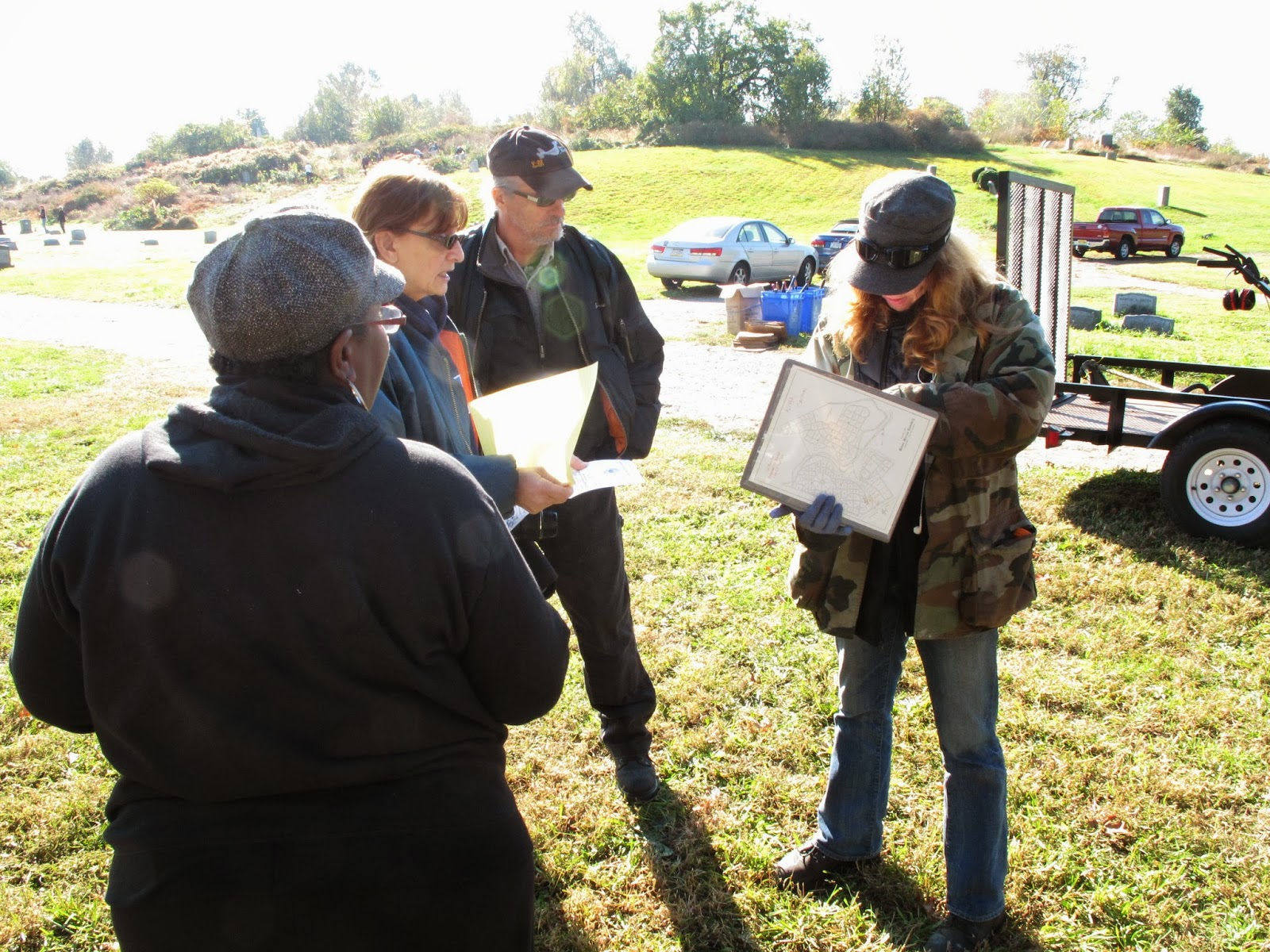
Several families came to find their ancestors’ graves, for which we were prepared with maps and laptop with database of burial records. Friends’ Board members Fred and Sue Facciolli ran the genealogy station. One of the services that Board members provide is physically helping visitors to find graves in the cemetery, if that is requested. Several such missions were accomplished, often by FOMMCI Board member Donna Morelli (who many people know as her Facebook persona “The Haunt of Mount Moriah”), who knows the site better than most.

Drexel students clearing hillside weeds from around graves
We had about sixty people show up to work from various organizations, among them: PowerCorpsPHL (Mayor's Office of Civic Engagement & Volunteer Service), The Church of Jesus Christ of Latter-Day Saints (LDS or Mormon Church), and Drexel University. Drexel sends its freshmen as part of its (required) Civic Engagement course. Students are able to decide where they want to volunteer their time and effort ; this busload of students chose Mount Moriah. We are immensely grateful for the work the Drexel students accomplished clearing the hillside brush and weeds in Section 15.

Askin mausoleum (Section 28) before and during excavation

Askin mausoleum after clearing!
Many volunteers working along with the LDS group tackled the Askin mausoleum and hillside in Section 28. As you can see from the photos above, the structure was not even visible prior to the day’s cleanup effort. Afterward – what a transformation! Everyone here today seemed driven to accomplish some good, and their efforts surely paid off. Our Board members and other volunteers set up and served hot food and drinks all day – we are grateful to KC, Dawn Dyer, and Jen O’Donnell for running the tables and keeping the lines moving.


Board member Sam Ricks leading "Congressional Medal of Honor" tour
Betsy Ross' grave
We coaxed the volunteer workers to take some breaks, and enjoy the tours provided by FOMMCI Board members Sam Ricks and Ed Snyder. Sam ran the lecture tour "Remembering our Congressional Medal of Honor Veterans" in the Naval Asylum Plot and provided information on Mount Moriah’s twenty-one Congressional Medal of Honor recipients. Ed provided an “Art and Architecture” tour, which included the 1855 gatehouse, the (Masonic) Circle of St. John, and Betsy Ross’ grave.

At day’s end, I was interviewed by the Temple University students who were making a documentary about the Friends’ involvement with Mount Moriah Cemetery. The last question went something like this: “Has your experience caring for this abandoned cemetery changed your view of how you want to be remembered after you die?” I wasn’t prepared for that one, but answered in all honesty: “I hope people care for my final resting place in the same way we are trying to do that at Mount Moriah. Its all about respect – respect for the person, respect  for that person’s memory.”

Board member Ed Snyder giving "Art and Architecture" tour (photo by Frank Rausch)
Paulette (L) and Donna (R) help locate graves
All in all, it was a fun, fulfilling, and enjoyable day. Thanks to all who came out to celebrate! In the words of FOMMCI President, Paulette Rhone, “Thank you all for joining us for our second Annual Family and Friends Fall Festival … More importantly, thank you for being a Friend of Mount Moriah … it was a great day to get to know each other….”

For more information on the Friends of Mount Moriah Cemetery, Inc., please visit us on Facebook and on our website.

Thursday, October 31, 2013

Flesh off the Bone

Some friends of mine were fortunate enough to visit Sleepy Hollow Cemetery in Tarrytown, New York last week. I’ve seen the photos and I must go there! Looks like a fabulous place. Washington Irving’s grave is there, of, course – the author of The Legend of Sleepy Hollow. The headless horseman idea got me thinking about another odd, though true Halloween-appropriate tale. While not as riveting as the Legend of Sleepy Hollow, it nonetheless involves missing body parts.
 
Read more at Amazon.com
I came across this story just a couple years ago when reading Allan Heller’s book, Philadelphia Area Cemeteries. The story concerns Mad Anthony Wayne, one of George Washington’s maniacal generals, a person to whom we owe our independence from Britain. Wayne is buried in St. David’s Cemetery in Radnor, Pennsylvania (near Wayne, PA, out side Philadelphia). Well, actually only half of him is buried there.


General Anthony Wayne (ref.)
Wayne's “fiery temper and battlefield bravado,” says Heller, earned him the title of “Mad,” and there was nothing he would not do to further the cause. His greatest triumph “was the capture of the nearly impregnable British fort of Stony Point, New York, in 1779 - "the beginning of the end of the American Revolution." (ref.). When General George Washington asked the brash general if he would be willing to attack the enemy stronghold, Wayne supposedly replied, ‘Issue the orders, sir, and I will lay siege to Hell.’” Now THAT’s patriotism. Or perhaps insanity. Or both.

American assault on British at Stony Point, NY (ref.)

"Mad" Anthony Wayne monument, Radnor, PA
When you’re standing in a graveyard, it is weird enough knowing that the bones of people are buried beneath your feet. And most of us assume there was flesh on those bones at the time of burial. However, Mad Anthony Wayne only had his bones buried at St. David’s Cemetery in Radnor, Pennsylvania. What happened to the flesh, you may ask? Or you may not think to ask (who would?). Well, this is such a juicy, creepy story that we must not let it go the way of Purgatory and Pluto - we must keep it alive. 

When Wayne died in 1796, his body was buried at Fort Presque Isle near Lake Erie, his final military post. according to UShistory.org, “He was buried in a plain coffin, his initials and date of death driven into the wood using round-headed brass tacks, at the foot of the blockhouse's flagstaff on garrison hill.” Twelve years after his death (1808), Wayne’s son Isaac decided that his father should be buried in the Wayne family plot at St. David’s (this graveyard actually pre-dates the Revolutionary War, having been established in 1715). So he traveled to the military base and paid to have his father’s body exhumed. He was met with a grisly surprise - twelve years after General Anthony Wayne’s death, his body was still intact! Remember, there was no embalming until much later, during the Civil War. (Embalming only became widely popular after Abraham Lincoln's embalmed body traveled from Washington, D.C. to Illinois, where at every train stop, thousands witnessed this new wonder of preservation.)

St. David's Churchyard Cemetery, Radnor, Pennsylvania

Isaac Wayne's "sulky" (ref.)
So an actual body presented a problem, as Isaac had only brought a small horse-drawn cart (known as a sulky) to carry the remains back to Chester County, PA, a 400-mile trek. A local physician, Dr. James Wallace (who had actually been at Wayne’s dying bedside), proposed to boil the flesh off Wayne’s bones, and give the bones to Isaac to be taken away. The flesh and the General’s uniform (along with Wallace’s surgical instruments) were reburied under the flagpole at the military base.

Then Isaac began his return journey, with his father's bones in a box in the back of the carriage. Along the rough road from Erie to Radnor, diagonally across the state of Pennsylvania, the box fell off a few times, supposedly scattering bones here and there. In 1809, the remainder of Mad Anthony Wayne’s bones were buried in the Wayne family plot you see in my photographs here, in Radnor, Pennsylvania. The story goes that every year on New Year’s Day - Mad Anthony Wayne’s birthday – “he rises from his grave at St. David’s and rides all the way across the state, looking this way and that for his missing parts.” (ref.)

Standing in St. David’s Cemetery, you are certainly tempted to believe this. The place has a “Sleepy Hollow” feel to it, and is a bit spooky in many ways. It’s old, it’s surrounded by woods, and seems to be away from civilization. The stone walls separating the nearby farmers' fields were standing while the War was being fought. You feel the spirit of the Revolution here. During a visit to this quite little graveyard last winter, I witnessed a fleeting spectral appearance inside the small church near Wayne's grave. I invite you to read about it in one of my prior blogs, "Anchored Souls in St. David's Cemetery.

Happy Halloween!

References and Further Reading:
Wayne Buried in Two Places

St. David's Episcopal Church website

Saturday, October 19, 2013

Black Cemetery Rain

The heavy cemetery rain hit my convertible top so hard it drowned out the music from the stereo. It was calling attention to itself, pushing everything else away – like the fact that I was here trying to make photographs. Couldn’t even open the window without getting soaked. You don’t want to get those leather seats wet. Shoot through the windows, the rivulets of rain distorting the picture – like the way your mind distorts reality sometimes. The rain is too much with us.

Death and severe illness can be like that too. They push everything else to the side. I can’t remember having an October like this before. My Mom had to have cysts surgically removed, after a several-months-long illness. Just found out they were not cancerous.

I tried to photograph through my car windows, the statues and monuments in the pelting rain, the saturated flags brought to full extension by the hurricane-like wind, or plastered against a granite headstone. May as well be abstract images – reality gets the day off.

My wife’s mother was diagnosed with breast cancer, and will be operated on next week. My Mom said she was praying for her. Amidst all this, a woman I worked with for thirty years died this past week. Retired in June, died in October. So unfair, to make it all that way just to die unexpectedly from cancer. She’ll be put in the ground like all these other people I’m driving over, or she’ll be in the arms of angels, depending on your belief system. 

Everybody in this place had a life, a life that meant something to someone else - even the prostitutes over in the “Home of the Friendless” section. Unless survivors conduct pointed and extensive research, the headstone often remains the only tangible evidence of most people’s existence.

The rain water ran down the steep roadways, flooding the small grave markers and plastic flowers, a river of death, stagnant pools trailing off the main river of flowing life. I drove down the hill, only to come to a flooded portion of the road. Should I drive through? I thought I remembered it being sort of shallow – but then, why would it pool? I heard a story recently about a friend who drove through a small flooded area in another cemetery and got stuck – sunk down into the mud up to his doors. No, I think I’ll back out of here, like when you’ve planned something in life and an obstacle forces you to back off and try another way.

Another fellow I’ve worked with for thirty years had his implantable pacer/defibrillator go on the fritz – had to have it surgically removed to make adjustments. He was shocked five times on the tennis court while playing a match with his daughter; luckily, she is a nurse. Another guy I know has lymphoma. With all these people around me so sick and dying, I’ve never felt so healthy. As you get older, you really feel like that could easily have been you. Why was it NOT you? It’s like taking photographs in a cemetery in the rain – you don’t just drive away without taking a part of the experience with you.

All this at a time when I’m still reeling from my wife’s latest MS attack this past summer. It isn’t easy backing your car up in an unfamiliar area in the pelting rain. I didn’t want to go off the road and sink into the lawn, or hit some sort of analogy. Caught a glimpse of a cemetery worker in a yellow parka watching me from a distance. He moved on, probably thinking, “What’s is that idiot doing here in this rainstorm?

The last time I spoke to Mary was a week before she died. She got such a kick out of buying things for my (now) four-year-old daughter – clothes and toys, mostly. She enjoyed seeing her at the office, where she would let her play with small toys at her desk. The monkey family that sang “The Banana Boat Song” was and still is one of Olivia’s favorites. Mary gave that to her about two years ago. Olivia doesn’t know Mary is gone. The monkey toy kind of provided her memory with immortality, maybe not for Olivia, but certainly for me. A week before she died I offered to bring Olivia by her place soon and Mary said, “I’d like that.” Then she was gone and I hadn’t brought Olivia by.


The rain eventually stopped, but I’ll live with this regret for quite a while. I could once again hear the music. Time to leave this place and head back to the living, as Gram Parsons sings a parting rainsong:

In my hour of darkness, in my time of need,
Oh Lord grant me rhythm, oh Lord grant me speed."

Postscript:
All images made in Dunmore Cemetery, Dunmore, Pennsylvania

Tuesday, October 15, 2013

Christ Church Burial Ground and the Government Shutdown

I’d long thought that Christ Church Burial Ground in Philadelphia was government-run, and therefore I figured it might be closed due to the current government shutdown. Nearby Independence Hall and the Liberty Bell are both closed as they are operated by the National Park Service (even the Park Service’s website is down!). Naturally, I was wrong. Turns out that the historic burial ground is run by, surprise, surprise: Christ Church. And it was open today, Columbus Day, a legal holiday. (See link at end for list of what is open and what is closed in Philly during the federal government shutdown.)

Christ Church is the only cemetery I’ve ever visited that charges admission. Yes, two dollars (as of October, 2013) to get in. It’s right across Arch Street from the Philadelphia Mint, so the fact that you have to pay money to see an historic national landmark that’s right across the street from where they make the nation’s money is kind of ironic.

I’d always been put off by the admission fee, but I suppose this is a more palatable way for the Episcopal Church to make money from its cemeteries than to actually LEASE them like the Roman Catholic Church is doing with its cemeteries in the Philadelphia Archdiocese (see link). The saving grace of Christ Church Burial Ground (established in 1719) is that Ben Franklin’s grave is visually accessible through the iron fence near the corner of Fifth and Arch Streets. So you don’t actually have to pay to see Benjamin and Deborah Franklin’s grave marker.  People throw pennies on his large, flat stone (“A penny saved is a penny earned,” Franklin said) and today, I even heard someone saying to his daughter, “Make a wish.

School children tossing pennies on Ben Franklin's grave (Christ Church Burial Ground)

I suppose the Church scoops up all the pennies each day and puts them to good use. The fact that we can see, touch, and walk amidst these historic graves is a tribute to the Church’s commitment to historic preservation. According to its website: “the Burial Ground was closed to the public from 1977 through 2003.  In 2002, The Christ Church Preservation Trust undertook a major program of renovation in order to reopen the Burial Ground.


There’s a tourist booth just inside the entrance gate where they sell books about the cemetery, and about our nation’s history as it relates to the few blocks around this area. Five signers of the Declaration of Independence are buried here, including Dr. Benjamin Rush. Dr. Philip Syng Physick (the “Father of Modern Surgery”) and George Ross (Betsy’s uncle), along with various Biddles, Bainbridges, and other historic names from our nation’s founding. (Wait – one of the Beatles is buried here too...?!) Unfortunately, you’d be hard-pressed to make out any inscriptions on the headstones. Most are smallish marble markers that have been worn smooth by acid rain. Bronze plaques now stand in front of the more famous headstones.

Worn grave markers in Christ Church Burial Ground

Still, everyBODY buried here was significant in his or her own right. The markers mark their lives, their mortal existence. Thankfully, someone had the foresight to transcribe all the engravings from the headstones in 1864, which has been reprinted in the book, A Record of the Inscriptions on the Tablets and Gravestones in the Burial Grounds of Christ Church,Philadelphia!


And speaking of printing, Franklin’s grave is by far the most popular, with people flocking to it with cameras and pennies in hand. A bronze plaque hangs on the brick wall near the grave. On it is the epitaph Frankin’s wrote for himself:

"The Body of
B. Franklin, Printer;
Like the Cover of an old Book,
Its Contents torn out,
And stript of its Lettering and Gilding,
Lies here, Food for Worms.
But the Work shall not be wholly lost:
For it will, as he believ’d, appear once more,
In a new & more perfect Edition,
Corrected and amended
By the Author."

Once I had backed up and was leaning on a crypt cover in order to get a longer view of the Franklins’ grave, when a guard ran over to me and asked me not to lean on the other monuments. I was a bit annoyed, thinking at the time, “This guy thinks this place is a museum!” But in retrospect, it is. And since that time I have witnessed a headstone falling on someone, so maybe safety was on his mind too.

Supposedly 4,000 people are buried in this 2-acre plot of ground. Interesting number, since an acre today typically holds 1200 to 1500 side-by-side graves. How did they jam in the extra thousand? Did they bury them standing up? Without burial vaults? At various depths? ? AND ….  this is still an active burial ground! My guess is that things have probably disintegrated below ground to the point where there’s probably nothing left of the 300-year-old wooden coffins, allowing room for additional burials. As you walk through the place, you do get the sense that it is rather dense with grave markers and headstones. Still, things were artfully arranged - I like the way these large flat crypt covers in the image below line the walkway from the gate off Fifth Street.

Crypts line walkway of Christ Church Burial Ground, Philadelphia

Outside Christ Church
If you visit, you may notice there’s no church here. So where is Christ Church? It’s actually two blocks away, near Second and Market Streets. It has a tiny graveyard surrounding the church, and the additional land at Fifth and Arch was purchased to expand the burial ground when the church property filled up. The church still has George and Martha Washington’s pew box roped off, where they sat during services. Other early American notables were parishioners of Christ Church, a veritable Who’s Who of the American Revolution:  Betsy Ross, John Adams, Absalom Jones, and the Franklins, to name but a few.

References and Further Reading: 
Christ Church website
National Park Service website
Click here for a list of what is open and what is closed in Philly during the federal government shutdown
U.S. Dept. of the Interior website