Thursday, August 18, 2011

Abandoned Jewish Cemeteries


Now here’s an odd little story, even by my terms. A friend of mine from West Philly told me about an abandoned Jewish cemetery near her house. It’s only a block away from Philadelphia’s most notorious abandoned cemetery, Mount Moriah. Though I used to live nearby, and have been to Mount Moriah many times, I never knew about this small, back alley graveyard.

So one hot summer afternoon, I followed her directions and found a fenced-in half acre of weeds near 65th Street and Chester Avenue (actual address is 1850 Cemetery Lane). I really couldn’t tell if it was a cemetery, but luckily one of the sides − an old stone wall − was easier to scale than the iron fencing along the other sides. Once on top of the wall, I could see tombstones along the inside of the wall and fencing. I heard a man’s voice say, “Can I help you?”

I looked back to the alley to see one of the neighbors (I presumed). You can’t just say. “Oh, no thanks, I’m fine,” when you’re caught trying to enter someone’s private property. So in some cases, honesty is the best policy. I told him I wanted to see the cemetery, and quickly added “How are you supposed to get into this place?” Always make it seem like you’re entitled to be in there. I had a big DSLR slung over my shoulder and I was dressed in a shirt and tie, so I don’t think I looked like a vandal.

In answer to my question, the man said, “An old guy who lived down the alley used to cut grass in here, but I haven’t seen him around in a couple years.” After a bit more small talk, I just said, “Well, I’m going in to look around, and dropped inside.” He walked off and no one bothered with me while I was there.

Strange little place. The iron fence looked kind of new and I could see a locked gate at the other side. While the weeds were high all over, headstones could be seen along all sides of the fence and wall. The place was small, barely half a city block in size, and had lived-in look despite the new fence. As I walked through the graveyard, a strange thing became apparent – there were no headstones on the majority of the property, just high weeds. The headstones were only located along the perimeter of the grounds. And not only THAT, but they were all set in concrete! And actually set in a little too deep, so that some of the names and dates were obscured. What’s up with THAT?

Headstones sunk into concrete
As the old wall bordered an ally, I was not surprised to see kids’ clothes, balls, and other toys in the graveyard weeds. Probably tossed over the wall by bullies for an unfortunate kid to retrieve. Kind of impossible for a little kid to scale this wall, as it was about eight feet high.

I photographed stones around the walls and fence as I made my way around (dates ranged in age from the 1870s to 1940s), and then came to a newish, professionally-made sign, the kind you see in historic parks! Turns out this place had been left for dead back way back when and brought back to life in 1999. Let’s look at what it says on the sign:


Who would have ever thought such an entity as the “Association for the Preservation of Abandoned Jewish Cemeteries” existed? THIS warrants further investigation, but for now, let’s see what else the sign says:

 
So the place had been established in 1856 by a Dutch Jewish congregation, B’nai Israel, then taken over by the “Hebrew Mutual Benefit and Benevolent Society of Brotherly Love.” This happened in 1879 when the B’nai Israel congregation disbanded. The Hebrew Mutual maintained the cemetery until the late 1960s when it too disbanded. The cemetery had been left to ruin over the ensuing thirty years. To quote the article, ‘Philadelphia Story − Learning Lessons from Eastern Europe, a Cemetery Emerges From Disarray:’

A cemetery “neglected, vandalized, and filled with trash, listed on the City’s roster of abandoned properties,” … nestled among the almost total disarray are toppled memorial stones, some vandalized, and with no surviving descendants dedicated to their maintenance.

People ask me, “How do cemeteries come to be ‘abandoned?’ Well, this is one way. The idea is so totally foreign to most people.

Stanley Barer - Jewish Leader

My guess as to why the headstones were set in concrete around the perimeter of the grounds is this: after thirty years of vandalism, they had gotten so knocked about that it was just easier to reset them this way. Most likely there were no records available to show where the bodies were buried anyway. The intent may have been to actually reconstruct the area more as a PARK, if you look at this satellite map (compliments of the Mount Moriah Cemetery website). A sidewalk can be plainly seen cutting through the center of the graveyard, though weeds obscured any trace of it when I was there. You can see the white tombstones along the sides, and the wall I climbed at the bottom on the photo.

 
So in 1999, along came Stanley Barer, the big clean-up and renovation happens, and then what? At least the fencing kept the place safe from further vandalism. According to the guy I met on the way in, someone had been cutting the grass up until a couple years ago. I decided to do some research, especially about this “Association for the Preservation of Abandoned Jewish Cemeteries.” I mean, how great is THAT?! If only such a service would catch on with other religions! (… and non-sectarians as well.)

After some Web searching, I was dismayed to find out that the Association, which was an official Agency of the Jewish Federation of Greater Philadelphia, no longer exists. (Its web links have expired and now point to a travel agency, of sorts (http://savejewishgraves.org/). Tangential links and news stories (shown at end of this article) indicate that the Association was initially formed to raise the $270,000 needed to restore B'nai Israel /Hebrew Mutual Cemetery. However, it doesn’t appear that it took on any additional projects. Apparently, the additional $200,000 in endowment funds was enough to keep the place in shape for another decade. Maintenance seems to have stopped a few years ago.

Shortly after my initial visit to B'nai Israel , I decided to stop by the Jewish Federation of Greater Philadelphia to see I could find out what happened to the Association. The security people in the lobby at 2100 Arch Street in Philadelphia had no listing of such an agency, even though this was its last published address. Stanley Barer, it seems, died in 2010.

I did find out that the 440 actual burials are merely represented by the perimeter headstones. MAYBE there are 100 stones in all. When the Association for the Preservation of Abandoned Jewish Cemeteries assumed ownership in 1999, most of the stones, which were either broken or weathered-to-obscurity, were bulldozed into a pile outside the actual burial area. These can still be seen in the woods near Cemetery Lane, which separates tiny B'nai Israel from the vast expanse of the abandoned Mount Moriah Cemetery.

The songwriter Shane MacGowan (of the Irish punk band, the Pogues) might have described B'nai Israel Cemetery as a ‘road apple,’ which he likens to “an apple that falls in the road…bruised and beautiful” (from the book, A Drink with Shane MacGowan).You just walk around this place and you can see it has character just by the feel of it, its inner city location, it’s old carved white marble and granite headstones. The sense of history is intense – where did the descendants of these Civil War and Spanish American War veterans go? Mainly due to persecution, you can almost sense the intense range of emotions in these peoples’ lives. It’s almost as if their graves have had as rough a time as they did (read more about the Dutch Jews who emigrated to Philadelphia).

The story has a relatively happy ending, however. After discussing the condition of the cemetery with my friend, she and her husband (who live near the cemetery), contacted the Jewish Federation and worked out a deal where they would cut all the weeds and keep the grass cut on a regular basis. I stopped by today and was astonished to find it all neatly trimmed like it appeared in the old aerial photograph! Relatives may no longer visit this resting place of their ancestors, but at least it has ceased to become an eyesore and a temptation for vandals.


Related Reading:

Jewish Graveyard Rabbit ("A blog on international Jewish cemeteries, preservation and restoration projects, reading Hebrew tombstones and more").


Wednesday, August 10, 2011

Mount Moriah Cemetery, on the Cusp

Who thinks about visiting an abandoned cemetery while in the dentist’s chair? Well, yours truly, for one. I apologize if I ever gave you the impression that I was normal. Yesterday afternoon, I drove out to Delaware County where I used to live, to let my dentist have his way with my teeth. Afterwards, I figured I would check out the Cobbs Creek Parkway side of Mount Moriah Cemetery.

This is the side of the massive abandoned cemetery that has been untamed by weedwhackers since last year. The city, as well as volunteer groups, are going in on a regular basis to try and clean up the other side (Kingsessing Avenue) of Mount Moriah, but 380 acres is a lot of land. Obviously due to limited manpower, the Cobbs Creek side is overgrown with weeds.

It’s an interesting sight, and not for the faint of heart. The densely wooded ridge off in the distance that is home to about seven huge, ornate (albeit abandoned, graffitied, and blocked up) mausoleums only allows a glimpse of one of these structures. While it peeks out like a Cyclops from the overgrown trees and bushes, the aggressive foliage camouflages the others. All but the very tops of fifty-foot obelisks are cloaked in green.

Mausoleums, Mt. Moriah Cemetery, Philadelphia

I pull my car into the lone parking area that’s not blocked with Jersey barriers and get out. The gate to the Cobbs Creek entrance across the street boasts this sign, which seems incongruous given the sad state of the grounds. Well-meaning, of course, and intended to stop the fuckheads who had been dumping loads of trash, old building materials, and old cars in here for years. The gate itself is meant to prevent vehicles from entering, but you can easily enter by foot.
The place is waist-high with weeds. Old tree branches lay on monuments, I trip over knocked-over headstones as I try to make my way through what the papers are calling a “public nuisance.” The crushed stone and broken blacktop roads are still walkable, the weeds not having totally covered them. Trying to capture the atrocity of this place photographically is like trying to photograph the Grand Canyon – it’s just too expansive to portray in one, all-encompassing image. One must simply experience it in person. What must families of recently-buried loved ones think of this place? (Some in fact want to remove their family members, but cannot do so until the cemetery's legal owners are found!) What can people in the cars zooming up and down the parkway possibly be thinking as they drive past this place? Probably nothing, they’re too busy honking their horns at each other.

 
Only two angels are left on this side of Mount Moriah. Most have abandoned ship. The remaining two are forever earthbound, caught in a tangle of vines. Kind of analogous, I suppose, to the red tape that must bind the city’s efforts to wrest control of Mount Moriah from its mystery owners via the Pennsylvania Orphan’s Court. (Kind of wish the dentist had used something that strong to bind up my mouth wounds, as I feel the stitches break loose.) The perceived “owners” of the cemetery flew the coup back in the Spring of 2011 when they were sued by plot owners for not maintaining the grounds in proper condition. For those readers new to my blog, my opinion is that these people were just squatters, taking money to bury bodies! If you can believe it, during the legal proceedings, it was not possible to determine the actual owners of Mount Moriah, the largest cemetery in Pennsylvania! Maybe the mafia is involved, as my father would have said. Certainly a great place to bury bodies.

I spent about an hour just on the front hillside of the cemetery - I didn’t want to lose sight of my car. About the time my stitches broke, I saw a red, late model Dodge Charger pull in next to my parking space. Realizing I was unarmed (not typical of me during visits to Mount Moriah), I picked up a piece of broken white marble just in case. As I came down the hill toward the road, I saw a guy get out of the Charger and pull out a bottle of car wax. He’s going to shine up his car in front of this atrocity of a cemetery, a cemetery that will probably never shine again.

Related News


Saturday, August 6, 2011

Atlantic City Cemetery

Its summer, and everyone goes to the shore. At least that’s what those of us on the east coast typically do. And Atlantic City, New Jersey is one of the popular destinations. What people don’t realize until they visit AC is that it isn’t all beaches and glitzy casinos – that’s just the actual boardwalk area. The rest of the city is really just a shanty town, like Hollywood, California. Kind of run down, with cheesy bars, pawn shops, and cheap motels. Just like me to go for the seamy underside of things, isn't it?

And speaking of Hollywood, the first time I was there, I was walking near Hollywood and Vine when I heard a man calling out, "Ten ninety-five! Fresh cut today!" I turned the corner to see him standing there selling mechanical severed hands that were slowly crawling around the sidewalk! But I digress.

 
Casino-intensive beach area of Atlantic City, NJ (ref.)

Atlantic City is like any other large town - its got laundromats, supermarkets, and ...cemeteries. People certainly don’t associate this beach resort with cemeteries, but such things are a part of life, right? Though you won't find it listed in the tour guide, a two hundred year old city (est. 1854), must have one. Established in 1865, its respectable Victorian-era, non-sectarian cemetery is rather off the beaten path. It’s actually on the mainland (AC itself is on Absecon Island), outside the main city area - in Pleasantville, NJ, to be specific (see map). The two-block long by two-block wide cemetery is nestled between the AC Expressway and the Black Horse Pike (Route 40). I was there back in 2005 and it is definitely worth a visit.

Though I didn't realize it at the time, this short visit to the AC Cemetery provided me with several jumping-off spots for what became related interests of mine – voodoo dolls, mausoleum stained glass, and fraternal organizations in cemeteries. Perhaps it was this Ganesh I came across which removed certain artistic obstacles for me, took the blinders from my eyes, as it were.
Jersey cemeteries - maybe not oddly -  are the only places I’ve ever personally seen dolls, dead chickens, candles, and other ritualistic voodoo-type accouterments. So here's a photo of the doll I came across in the AC Cemetery. You can't see it up close, but the fabric is printed with moons and stars. People do tend jump to the worst conclusion when they see such things, which is not necessarily warranted. We fear what we don’t understand. And I for one, didn’t understand the severed hands sticking up all over the cemetery (top photo). They freaked me out.
 
A ritual evocation of the Voodoo gods and spirits of the dead can be for good purposes as well as for evil. We’re just used to what we see on television, when we really know nothing about any of the various African-derived religions like Santeria and Vodun. However, with Western culture based heavily on movies and television (used to be the other way around), it’s easy to see how peoples’ imaginations can run wild.

It amuses me to see people’s reactions to such things. As I was walking through a cemetery in Camden, NJ back around 1997, I saw a dead chicken on a grave and mentioned this idly to my fifteen-year-old daughter as we walked by. She thought I was joking and physically JUMPED back when she actually saw it! If you search the Web for “Voodoo dolls in cemetery,” you’ll find lots of sensationalistic accounts. Headlines like, "Scouts Find Voodoo Dolls at St. Petersburg Cemetery" are sure to sell papers. This particular one in fact, is quite amusing:

"They looked nothing like dolls," said Bryan McDonough, 12. "They were kind of like ugly creatures that would eat you alive," added his 10-year-old brother, Kevin, a Webelos Cub Scout. - St. Petersburg Times, 2008
Even better than newspaper headlines are the dramatic-to-the-point-of-ridiculous television news stories, like this one from ABC, “Voodoo Dolls Found at Gravesite,” an account of jars of voodoo items found buried under a guy’s headstone in Houston, Texas.


Another item of interest I found and photographed in Atlantic City Cemetery is this broken stained glass window. The place has a smattering of mausoleums on one side. Up to that point in time, I’d never given mausoleums in general much notice. I knew they had stained glass windows and ornate metal doors, but I saw nothing photo-worthy in them. Call it a flaw in my personality. Enter the Ganesh. I guess what drew me to this particular structure was the unusual fact that the stained glass window was on the FRONT of the building, rather than the back, and its glass was smashed, its leading mangled. I guess I’m drawn to the forlorn and damaged more so than to the pretty and preserved. This came to be the beginning of my interest in stained glass mausoleum windows (many of which you can see in my "Mausoleum Stained Glass" album on my Facebook site, Ed Snyder’s StoneAngels Photography). I even wrote a blog about Photographing Mausoleum Stained Glass back in March, 2011.

Oh and the severed hands sticking up all over the cemetery? I found one that still had the Odd Fellows symbol on it - the interlocking rings at the fingertips with the letters "FLT." Mystery solved. I didn't know what it meant at the time, but I later looked it up, which is one of the most interesting things about Cemetery Travel - unravelling these little mysteries that confront you. "FLT" stands for Friendship, Love, and Truth, one of the symbols used by the Independent Order of Odd Fellows, a benevolent and social society (fraternal organization) which had its origin in England in the 1700s. The local lodge number is written on the palm in this photo.

So for me, the hour-long stopover at Atlantic City Cemetery with my ex-girlfriend was productive, informative, and inspiring. We later went surfing. Feels weird to have written that now, years later, as my two-year-old daughter falls asleep in my arms. Memory surely is not a simple recollection of the facts, is it now? Noted author Brillat-Savarin (see his book below, The Physiology of Taste, 1825) believed that one’s personal experience becomes wrapped up in, and affects how one remembers certain "facts." Remembering is, in part, reliving the situation. Its more than just, "Here's a picture of a voodoo doll I once found." A seemingly short visit to a cemetery can remind you of who you were, and help you to see your present life more clearly.

 For Further Reading:


Friday, July 29, 2011

Photographing Cemeteries with Ansel Adams

I figured a title like that would make the search engines happy. So just to put it out there, I’m not old enough to have photographed anything with Ansel Adams (though I could have possibly caddied for him). However, a friend of mine did photograph with him, when he participated in one of Adams' photography workshops before Adams died in 1984. My friend from the Photographic Society of Philadelphia had some 120mm film left over from this workshop that he'd kept in his freezer for the past 27 years! He gave it to me a week before I was headed to Texas on business. With such perfect timing, I decided that the gods had intended for me to photograph with Ansel Adams. Call it six degrees of separation.

"The Tetons - Snake River," Ansel Adams
So I took a few rolls with me out west last month, and shot them in a Holga. A Holga, as you may know, is a plastic toy camera. Adams would rather have died than use something like this, so on one hand, its good that he’s already dead. And speaking of death, I actually used the film to photograph some cemeteries around San Antonio. Everyone is familiar with Adams’ mountain vista images, but his singularly most famous and successful image is actually of a cemetery (entitled 'Moonrise, Hernandez, N.M,' shown below)! This, I reluctantly admit to myself, may have inspired me years ago to do cemetery photography. Something about those little glowing crosses in the foreground...

"Moonrise, Hernandez, N.M." (1942), by Ansel Adams
I say ‘reluctantly' because I’m not a big fan of Adams’ work. Maybe I felt he was too commercial, and hadn’t enough of the ‘starving artist’ in him. Moonrise, in fact, was made on a government grant. Was Adams the Maxfield Parrish of photography? Cranking out product that the average citizen could enjoy and afford? 'Good enough for government work...?' Don’t get me wrong, I love Parrish’s work, but both his and Adams' seem a little too – perfect. At least with Parrish, I thought, “Ooh, this stuff came out of his crazy wonky head.” Years ago, I thought that Adams simply took pictures of mountains, very calculated, technically perfect pictures of mountains. 

"Daybreak," by Maxfield Parrish

Dignowity Cemetery, San Antonio, TX
While this may be true, Adams shot Moonrise on the fly, on Halloween, jumping out of his car to set up and click off just one negative before the setting sun ceased to illuminate the crosses in the foreground cemetery. Sort of like how the rest of us average photographers sometimes shoot spur-of-the-moment images (which is exactly how I saw and shot the iron cross at left). For Adams, this was unusual, and perhaps ironic that his most famous photograph required far less calculation than anything else in his entire body of work. Typically, he'd backpack into the mountains of Yellowstone on specific days and times of year, toting his 8x10 view camera, to make specific photographs of, say, a sunrise over the mountains. I guess its this aspect of his work that I find a bit too calculated. And if that weren't enough, getting a great negative was only the beginning of the creative process for him.

Typically Adams would spend hundreds of hours in the darkroom laboring over the making of his prints, altering the look of his original negatives very much like people today spend hours with photo editing software programs. He turned what he considered to be water into wine for the masses. I was kind of surprised when I learned this years ago, as I had thought Adams to be such a purist, with the Zone System and all that. In fact, a straight print of the Moonrise negative shows the sky being much lighter. Adams would darken it because this is how he 'visualized' the scene.

In his book, Celebrating the Negative, John Loengard quotes Ansel Adams: "During my first years of printing the Moonrise negative, I allowed some random clouds in the upper sky area to show, although I had visualized the sky in very deep values and almost cloudless." So the next time you feel you've "manipulated" an image too much with Photoshop, consider Loengard's comment:

"Photographers do this and more. Since light shines through a negative but is reflected off a print, making a print from a negative is a bit like translating a novel from French to English. Such translation is an art, and it is wise to remember that what is translated is the original work of art." - John Loengard

One of the things I like about using a Holga (or any analog camera) is that the film original really is a work of art, in the sense that it would require a 40 MP digital camera to produce an image with the resolution of a 120mm negative! I also like the fact that with a Holga, you simply cannot be very calculated (which is why Adams would have hated them.) The camera has no controls to speak of, so your results are based solely on a wing and a prayer. Do I succeed? Not often. I'm lucky to get one or two usable images off a 12-exposure roll. My four images in this article come from two rolls. Sometimes I have to tweak the image of the scanned negative to achieve what I intended when I snapped the shutter, to achieve the result I 'visualized.'

San Jose Burial Park, San Antonio, TX
So while the print (or an electronically published image) is actually what the viewer sees, a Holga forces you to pay way more attention to creating a successful negative. There's only so much you can do after-capture with a poor original. Given the amount of work involved to make a great print back in the pre-digital age, you have to hand it to Adams for his perseverance. He was dedicated to reproducing what he SAW (as opposed to what was actually THERE) – so in that sense, he was more an artist than a photojournalist or documentarian. When I shoot with a Holga, I view things similarly. Film allows me to be a photographer – I don't have to worry about also being a digital imaging computer technician. I don't really spend a lot of time on the image after-capture, and experience with the Holga has helped me create better originals (which I can later tweak in Photoshop if I really need to). I put a lot more thought into what I want the image to be, rather than just firing off scores of automatically bracketed JPEGs.


The Alamo (San Antonio, TX)
Images made with a Holga are like a photographic Haiku - not much there to go on, but if you ponder awhile, you'll realize there's more of the artist in a crappy Holga image than in many a finely-crafted digital print. Why do I think that? Well, partly because its only six o'clock in the morning and I'm barely awake - and its the first thing that popped into my head. What I'm actually trying to say is that composition is what a Holga image is all about, its the only thing the photographer can control. Aperture, shutter speed, light leaks, lens distortion  - all inherent 'features' of the camera that cannot be changed. So a successful image requires a lot more effort on the part of the photographer, which Ansel Adams would have appreciated. Like a haiku, the resulting photograph lends itself to one simplistic idea, characterized by a familiar object presented in a sort of dream-like manner, such as the images you see here of tombstones and the Alamo.

And what better way to end this article than with a photograph of the latter, as a tribute to Ansel Adams' creativity. In addition to mountains, he photographed many of the mission churches in the southwest - the Alamo, or Mission San Antonio de Valero, being one of the more famous ones.

Further Reading:

Ansels Adams' photography in the Public Domain
Shooting Cemeteries with a Holga
Learn about "The Alamo" 


Saturday, July 23, 2011

Mt.Moriah Cemetery Rising from the Dead?

Well, the big Clean-Up happened today, Saturday, July 18, 2011, and boy am I beat! Through the mayor’s office, the City of Philadelphia organized a volunteer day clean-up through the organization ‘SERVE Philadelphia’ at Mt.Moriah Cemetery. I registered on-line the week before and showed up today at 8 a.m.

 
Since the place was officially abandoned a few months ago, Mt. Moriah's 380 acres (Pennsylvania’s largest cemetery, opened in 1855) have met spring and summer with a vengeance. Trees, grass, honeysuckle and poison ivy grow rampant, all but covering even the part of the cemetery that was sort of being maintained. When some plot owners recently filed a lawsuit against this inner city cemetery for negligence, the man and woman who worked in the office packed up and left. As the city has not been able to identify any actual owners, my guess is that these people who were taking money for burials over the past however many years (some say since the 1970s), were just squatters! What a way to make a buck! Find an abandoned cemetery and bury people! You pay for the backhoe, keep the grass cut on a few acres, and pocket the profits! No taxes or license fees, nothing! So the city finds itself with a huge eyesore with many irate citizens and plotholders on its hands.

Trash collecting in the cemetery
Last week I stopped by to see what the place looked like, as I hadn’t been here in the couple months since the city padlocked and barricaded the entrances. Looks like the city has really taken over, investing money into its clean-up and security, as it waits for some group to step forward and take it over. In addition to confiscating all the records from the office they apparently weed-whacked the tall grass in this (non-overgrown forest) section of the cemetery (tho the weeds had not been cut on the Cobbs Creek side and that just looked wild). 

Tires and Tombstones
The piles of old tires were gone from behind the gatehouse façade (shown at beginning of this article), dirt roads were scraped clear of trash and heaps of old building materials. In fact while I was there, a city garbage truck flew by me on its way to the entrance on Kingsessing Ave. As I turned my car to follow it a few minutes later, I was surprised to find the front gate chained shut! Not to worry, as large sections of fencing are missing, so I just drove my car up the embankment, out over the sidewalk and into the street. But I still got that panic-y feeling you get when you first realize you’re locked in a cemetery!

Registering for the Mount Moriah Cemetery Clean-Up Day
Saturday, July 18 was when a hundred people showed up to see what they could do. After registering and signing waivers (so you don’t sue the city if you get hurt), we were assigned to work crews and told not to lift any headstones and be careful not to fall into sunken graves. The city provided police protection, an ambulance for first aid, rakes, trash bags, gloves, and water and juice for the duration. It was supposed to be hotter than hell and they really didn’t want people overexerting themselves.

Raked piles of dried grass
The majority of the work involved raking up the dried grass cut by the weed-whackers over the past few weeks. Everyone raked it into piles, pushed the piles onto tarps, then dragged them down to one of the cemetery roads where city workers would later load them into trucks to be hauled away. We joked about whether this would happen before some jackass set them on fire!

I started thinking that maybe a controlled burn in the place would make more sense than all this raking (which was tough work, by the way, given all the tangles of vines and other ground cover). Really, all we were doing was removing the dead grass and giving breathing space to the live grass and weeds below − so that it would all grow faster! A sort of prairie fire would renew the place, burn the trees and weeds, which I was told was actually suggested by the fire department. They wouldn’t have to worry about hurting the wild pit bulls – one of the SERVE volunteers told me the city had them removed (not sure about the coyotes, though). The burn idea was shelved not because it was technically unfeasible, but because it was esthetically, shall we say, Armageddon-like. The sight of a cemetery on fire might not sit too well with the public, or the neighbors, for that matter. (Besides, Philadelphia doesn’t need another out-of-control ‘MOVE-style’ inferno.) Also, it was pointed out that the tombstones and monuments would be blackened in the process, and then would require cleaning.
 

So about 8:30 a.m. everyone started into it. About 8:45, the grunting and groaning began. More than one person said, “I should’ve worked out for a week before doing this!” Really, it was hard work, especially in the hot sun. My group was working around the old gatehouse where the Fox News truck was filming. My wife asked me later that day if it was emotional, doing this kind of work. 

I’m not a real emotional kind of guy, but it did give me an odd feeling scraping unseen headstones with a rake - a strange sound that always caught me off guard. They'd been toppled over and lay buried in the grass. I never thought about the insensitivity of vandals in this way – if you’re going to knock over a gravestone, how about doing it so it lands face-up? That way when people come looking for their ancestors’ graves (as many people did today), they’d be more likely to find them. 

Filling a Sunken Grave
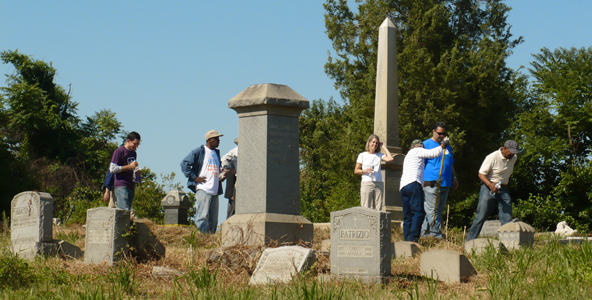
There were people here of all ages, and all walks of life − all with their own personal reasons for coming. (Oddly, I couldn’t really put my own reasons for being here into words, when asked.) From the few people I spoke with and conversations I overheard, some were registered members of the volunteer organization, SERVE, some were war veterans or Civil War enthusiasts. Some came from as far as thirty miles away.There were Freemason and Rotary club members. One ex-funeral director I know was there filling in a sunken grave. An old woman who had family buried here and was just observing the spectacle was very thankful. Most people didn’t really chat much, just worked hard  to do what they were assigned. Mayor Michael Nutter stopped by and chatted with us a bit, thanking everyone. 

Mayor Nutter, at right

Father Time, engulphed
I spoke with one of the volunteer organizers about the many millions of dollars it would take to get this place into shape. I’m not talking about restoring it to its original grandeur – it may be beyond that. Why not try to get other professional organizations to volunteer or donate their specific expertise? Wouldn’t that be great publicity for them? Have arborists come in and cut down the forest of trees that encroach upon the monuments, have a fencing company replace parts of the missing main fence on Kingsessing Avenue, cemetery restoration companies provide crews to right all the toppled tombstones.

But what might happen is local labor unions would balk, like the Streets Department did when the idea was brought up to use prisoners to do the grounds crew clean-up and grass cutting we were doing. That would go against the contract, take work away from them! The fact that the city doesn’t have the money to pay people to do this doesn’t enter into the equation.


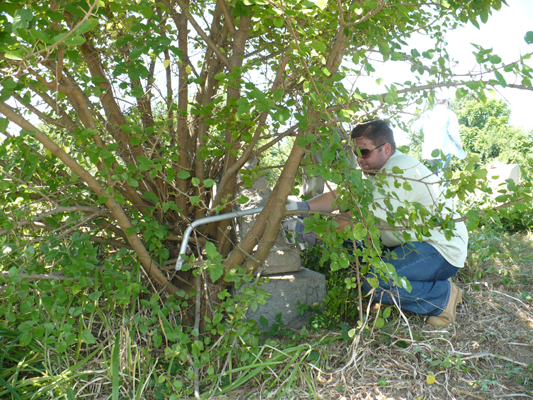
Freeing tombstone from its arboreal prison
Freed Tombstone
Around noon, one of the guys from a group that was cutting overgrown trees from around monuments called out to me. He asked if I wanted to take a break and go over to the Circle of Saint John, through the trees on the other side of the cemetery. Everyone was sweaty and tired, but it wasn't like you could just drop down and rest in the shade of a tree - the deer ticks would eat you alive, so we all took a hike. 

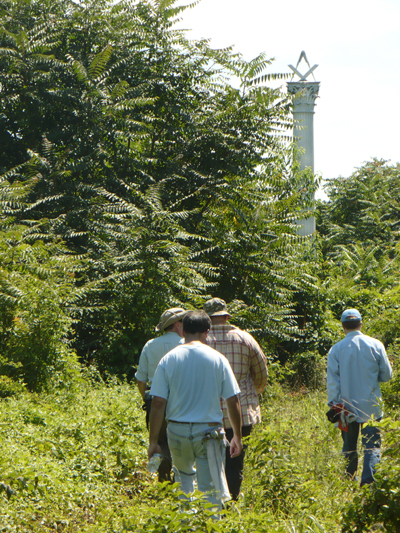
Our tour leader had been here many times with two of his Masonic lodge members to hack out trees growing around various monuments in that area, so he knew the terrain as well as I did. It seemed there were a few guys in the group who had never been back there in the deep woods, so we all took a hike. Always interesting to see the facial expressions and hear the exclamations of first-timers here when they see the magnificent family memorials in the woods, the crazy foliage smothering giant monuments. 

Burned-out car, hung up on tombstone
The access roads leading to the back part of the cemetery had been widened a bit as the city’s heavy equipment had barreled through – these little dirt roads were not made for giant trash trucks and front-loaders carrying burned-our cars out of the cemetery. As a result, unfortunately, some roadside monuments were knocked out of place and others were side-swiped. 


Land of the Lost
As we approached the circle and could see the top of its central marble column about thirty feet above  the trees, we cut into the tangle of dense growth, poison ivy, and raspberry vines as several people wanted to see it up close. Wresting our way through the jungle, one guy ahead of me said, “I feel like I should be carrying an M-16.” The column is part of an enormous 1871 monument to the late Masonic Grand Tyler, William B. Schnider. Just to give you an appreciation for the size of this amazing marble sculpture, the photo at right shows one of our volunteers standing at its base.

For the past eight years, these three guys from the local Pennsylvania Masonic lodge would come here a few times each year to saw down trees from around various monuments and carry away trash from the area. One time two of them were in the circle working  with machetes and a chainsaw, and unwittingly provided some visitors with a close encounter they’ll never forget. For years, hookers would bring their johns to
the Circle of Saint John (no pun intended) by car to do their thing (which you can't help seeing if you spend any time in this cemetery). While they were there, a pickup truck appeared out of nowhere as they were working. They looked up – while brandishing the machete and chainsaw – only to see the horrified look on the faces of the couple in the truck! They said the hooker started screaming and the driver hit the gas and you never SAW a vehicle go so fast in reverse!

As we headed back through the wooded cemetery roads, we came upon two small groups of our fellow  volunteers who were lost. People think I exaggerate the dangers of this place, but even on a bright sunny day, you can feel strangely vulnerable here. As this thought occurred to me, I realized this is one of the few times in recent memory that I’ve ventured into Mt. Moriah without a weapon! Maybe if the cleanup continues (as its scheduled to) each month, there may come a time when people can safely visit this place and enjoy the history, nature, art, and architecture it has to offer.

After the clean-up, I was exhausted. Although I brought all my serious cameras, they sat in the trunk of my car parked on 62th Street. The photos you see here were taken with my little digital Panasonic point-and-shoot, between swigs of water or bandaging the calluses on my hands.


Important Sites to Visit for further Reading:

News Coverage: