Showing posts with label Historic Laurel Hill Cemetery. Show all posts

Tuesday, July 10, 2012

Strange Adventures of a Cemetery Superintendent


Rocky Balboa at Laurel Hill Cemetery
Last week I attended a tour at Philadelphia’s Historic Laurel Hill Cemetery called ”Dishing Out the Dirt: The Strange Adventures of a Cemetery Superintendent.”(Laurel Hill is historic for two reasons, by the way: 1) it was designated a National Historic Landmark in 1998 and; 2) it is America’s second Victorian garden cemetery, established in 1836 – five years after Mount Auburn Cemetery near Boston, Massachusetts.)

Bill Doran, Laurel Hill’s maintenance superintendent has not been at his job since 1836, but he gives the impression that he has. Bill gave members of the Friends of Laurel Hill Cemetery an hour-and-a-half long guided tour of the cemetery, pointing out some of the strange aspects of the death-care industry that only a Cemetery Superintendent would know. (That's not Bill in the image above, by the way, that's Sly Stallone at Laurel Hill in a scene from the movie, Rocky Balboa (2006), but more on that later. Bill is the better-looking chap in the center of the image below)
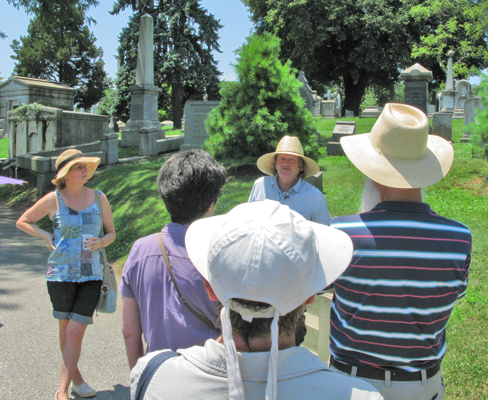
Cemetery Superintendent Dill Doran addressing crowd
Let’s first look at what Laurel Hill itself says about Dishing Out the Dirt (from its website) before I get into my own experience:
 “Not everyone is cut out for cemetery work... It can be a strange, emotional and unnerving venture. But, it also has its bizarre and often comical surprises. At a cemetery like Laurel Hill – a provocative historic site that works daily to put the rave back into graveyard – those surprises become ever more frequent. Encounters with the living – human and animal – are often as memorable as encounters with the dying and the dead."
I kind of thought, then hoped, this would be an indoor lecture. It was a hundred degrees on the Saturday afternoon of the presentation, and I was looking forward to sitting in a cool air-conditioned room. However, I was informed upon my arrival that it was a guided tour of the cemetery grounds, led by Bill Doran.

McDowell monument, 1891
About thirty people showed up and actually trudged through the graveyard with Bill for an hour and a half in the blazing heat –diehards! Worth the effort? Absolutely! Bill is riveting with his good-natured Irish brogue and workingman language. His knowledge of the business is vast, and he is quite effective as a public speaker. Obviously proud of his heritage, he was quick to point out that many of the fabulous statues and monuments at Laurel Hill were actually sculpted by Irish artisans, not Italians, as one might expect. Case in point is the enormous granite McDowell monument you see at left. Mr. Doran commented on the cost at the time to build various pieces, as Laurel Hill maintains these records. The McDowell monument, for example, cost $12,000 to make in 1891!

Headstone in tree!
Having access to all the cemetery’s records dating back to 1836 is rather fascinating. Our guide pointed out that lot sketches exist for a one-hundred foot-high pyramid that was planned for construction right near Laurel Hill’s gatehouse on Ridge Avenue! The structure, with underground mausoleums, was never built. Imagine the tourist attraction this would have been! For now, we must settle for subtler novelties, like this grave marker that was found to be embedded inside a tree when the tree fell down!

"Millionaires' Row"
Bill and his maintenance crew dig graves, move graves, and maintain graves. They plan the placement of monuments, shore them up, and maintain the mausoleums – both above ground and underground. I wondered if the rest of the audience was as surprised as I was years ago when I first found out that many cemetery monuments actually mark the spot of an underground mausoleum. These are accessed either through a door in the monument or by digging down to the roof of the underground structure. Bill said some families have their funeral services below ground, in the mausoleum, necessitating family members to scale a ladder down sixteen feet into a hole. Imagine that.

Vacant mausoleum at right
There were a number of interesting stories imparted to us by our host, but my favorite had to be the one about the father who came to the office complaining that his young son (I think maybe eight years old) was frightened by what he saw in a mausoleum on “Millionaire’s Row.” The father had peeked into the decorative holes in the door (as we all do, admit it!) and then invited his son to do the same. I’m guessing he said something like, “See, there’s nothing to be afraid of!” As his son peered into the building, the door opened from the inside and a man came out! The man proceeded to walk up the road. After vehement complaints to the office personnel by the man, the management apologized and told the visitors that homeless people sometimes take refuge in the mausoleums.

There is a vacant mausoleum here, by the way, which is for sale. Odd.  I suppose that if you can’t afford to buy, maybe you can get it on a thirty-year lease …? Picture a “VACANCY” sign on the door...!

Tour of portion of Laurel Hill Cemetery overlooking Schuylkill River
Mausoleums were the subject of a number of Bill’s stories. One bizarre one was how he saw a raccoon jump down an air vent into a mausoleum built into the side of a hill (they need air vents to allow for the escape for gases caused by the decomposition of bodies). Knowing there was no way out, Bill went and got the key, then opened the door to let the raccoon out. On opening the solid granite door, He was shocked to find the structure filled with the skeletons of all the other animals that had jumped in over time! Some had starved to death, probably, but some may have been baked to death. As Bill said, the temperature inside these structures can reach 300 degrees in summer. Subsequent to the raccoon episode, a screen was placed over the mausoleum’s vent to keep animals out. Strange adventures, indeed.

If you’re a bit put off by the stories so far, I am writing about a CEMETERY, after all, which has as its primary focus, death. Sometimes we cemetery fans forget that, in all our exuberance to learn about odd burial practices and photograph the beautiful statuary.  For others, a cemetery might have a more fleeting, yet final meaning for them. Some years ago, a man’s suicide note said “You can find me at Laurel Hill.” Police found his body lying on his family plot where he had shot himself. Another time, one of Bill’s workers found a small lifeless form, wrapped in a blanket behind one of the mausoleums. He poked at it and saw blonde hair. He panicked and went to get Bill. Upon closer examination, the bundled form turned out to be a dead poodle. Someone had cared enough about their dead animal to wrap it up and reverently deposit it inside a cemetery.

Cemeteries will do just about anything these days to generate income. This is especially true at Laurel Hill, which has a very minimal amount of space left in its 78 acres for new burials. You have to give the management credit for being so creative as to negotiate with film companies to use the cemetery as a destination location for making motion pictures. Laurel Hill has been host to a variety of big-budget Hollywood films over the last six years, including Rocky Balboa (2006) and Transformers 2: Revenge of the Fallen (2009) (and yes, cemetery personnel do get to meet the stars!).

Transformer at Laurel Hill Cemetery (ref.)
Rocky's chair at Adrian's grave
Rocky’s wooden folding chair from the movie stands vigil at Adrian’s headstone (near the gatehouse) and some of the cemetery’s asphalt roadways were a gift from Transformers 2 producer Michael Bay. Why? Because all the staged explosions in the film melted the original roadway! The film company told Laurel Hill this in advance and that the options were: protect the roadway with steel sheets or repave the roads afterwards. In keeping with Laurel Hill Cemetery’s drive to improve, it chose the latter.

Revenue generated by movies and tours, along with donations by the Friends of Laurel Hill Cemetery, is used to continually improve and restore this National Historic Landmark. Bill Doran showed us another example of this on our final stop of tour. When little or no trust fund money exists for such large projects as the restoration of this Egyptian style mausoleum, the money needs to come from somewhere. This mid-1800s marble mausoleum was falling apart. Most of the individual pieces of the structure had shifted over the years so that both the outside and the inside were falling apart. One of the surprising finds inside the structure was the absence of wall vaults, into which coffins are typically placed. For all its grandeur, this particular family had an unfinished basement! Built into the hillside, the interior had a simple wooden floor where about sixteen wooden coffins were just stacked on top of each other!

If you have the opportunity to attend any of the Laurel Hill tours, they are fascinating, The cemetery people are great hosts. As is their usual practice after an event such as this, we were presented with an area in which to relax and socialize, completing the tour with complementary wine, beer, and crudités. Thankfully, this relaxing wind-down at the conclusion of Bill’s “Strange Adventures of a Cemetery Superintendent” tour was not held in a 300-degree mausoleum – it was held in the air-conditioned gatehouse.

References and Further Reading:

Source of Transformer image in Laurel Hill Cemetery
See Laurel Hill scenes in the trailer for Transformers 2: Revenge of the Fallen

Source of Rocky Balboa image at Laurel Hill Cemetery
Rocky Balboa filming locations

Thanks to Bob Reinhardt, member of the Friends of Laurel Hill Cemetery, for inviting me along as his guest.

Monday, December 12, 2011

175 Years of Reflections, Laurel Hill Cemetery

This year, the commemorative book 175 Years of Reflections, Laurel Hill Cemetery, 1836 – 2011 was published. It’s lovely, coffee table-sized, and hard-bound, filled with personal reflections on Laurel Hill by scores of (mostly live) people. A few years prior, I was asked if I would donate one of my Laurel Hill photographs to be in it − quite an honor. My image, “Colder than Ice on a Tombstone (2008)” appears on page 125.

Ed Snyder's "Colder than Ice on a Tombstone"

Available at Blurb.com
It’s one thing to force your own art on the world by writing your own book, but to be asked to be in someone else’s book is very flattering and meaningful. I do want to thank all the people involved in putting the book together, and for recognizing the emotional connection of all the contributors.

The format of 175 Years of Reflections is quite clever – “ … a collection of 175 remembrances about the cemetery, dating all the way back to its founding to the present day and includes poems, journal entries and much more.” (The website Geekadelphia continues,) “Through these you get a picture of what the Laurel Hill Cemetery has meant to people and to the city of Philadelphia. It really is a unique way to understand something that has been a part of this city for so long.

Image by Frank Rausch (p. 110)
In April 2011, the Friends of Laurel Hill held a book launch at the cemetery. All contributing parties were invited. I knew one or two of my compatriots, but was not prepared for the dozens of people who showed up. Many of whom I’d only known through the press, such as Tom Keels (author of several books, including Philadelphia Graveyards and Cemeteries), as well as others whose art was familiar to me, e.g.  internationally known photographer Bob Reinhardt.

Image by Marietta Dooley (p. 155)
It was a great social event for Philadelphia artists and writers - I made new friends like Marietta Dooley (whose photograph in the book graces the cover of Laurel Hill’s current tour guide) and enjoyed talking with familiars Frank Rausch and Scott Kreilick. Frank’s always got great stories as he lives in the cemetery, and Scott’s historical conservation company is responsible for restoring  the “Old Mortality” statue grouping housed at Laurel Hill’s entrance.

A copy of the book was very generously given to each contributing artist and author, whose work exemplified their own personal reflections of Laurel Hill Cemetery. As we lined up to receive our copy, people were thrilled to find that the organizers had taken the time to mark the page of the contributor’s work with a tall bookmark bearing the contributor’s name. Talk about attention to detail!

Image by Bob Reinhardt (p. 165 )
The event was incredibly well organized. Yards beer (Philadelphia’s best) and oer d'oeuvres were served, name tags given out, a tent and chairs to listen to the speeches. Gwen Kaminski (Laurel Hill’s Director of Development & Programs) read her poetry and Tom Keels spoke touchingly about his early visits to Laurel Hill. I remember quite vividly a line from one young man’s speech in which he mentioned  “the very human desire to be remembered after death.” The note included in each book from the “Friends of Laurel Hill” organization seemed to expand on this philosophic idea:

"Well beyond the year of Laurel Hill Cemetery’s 175th anniversary and, indeed, well beyond the life spans of those of us who are here to be part of it, this book will remain an enduring symbol of the language and art, of the life and death embodied by Laurel Hill. As a permanent addition to our archives, its words and images will inspire future generations of the living, and your own name will be forever linked with the history of America’s first National Historic Landmark cemetery." - Friends of Laurel Hill

What a wonderful sentiment! As far as my own photography and writings, I’ve leaned heavily on the creepiness of cemeteries, but that can be an unsteady rail. There really is just too much beauty and life in and around a cemetery like Laurel Hill to dwell on negative aspects. 175 Years of Reflections pulls together poems, stories, historical family photographs, fine art images, paintings, old lithographs, even children’s drawings  − REFLECTIONS, quite literally, on people’s POSITIVE experiences at the cemetery.

Cover detail
After the formal presentations outdoors, people were invited to stroll the grounds on this lovely spring day, or adjourn to the museum/gallery in the gatehouse. One could view the exhibits of historic memorabilia related to everything from Harry Kalas (the late Phillies sportscaster) to George Meade (lauded Civil War general), both of whom are buried at Laurel Hill.

During the informal milling about - and much to my surprise - various people came up to me and asked if I would sign page 125, on which my photograph was printed. Quite flattering, I must say. By the way, the title of my image, “Colder Than Ice on a Tombstone," is not dedicated to my ex-wife, as some might imagine. It was quite literally how I felt that winter's day in 2008 as I lay on Laurel Hill’s ice-encrusted snow to make the photograph. Quite opposite of the warm and friendly ambiance everyone enjoyed at Laurel's book launch party!

Books by Ed Snyder

Available at Amazon.com
Available at Blurb.com
Further Readings:

175 Years of Reflections, Laurel Hill Cemetery , 1836 – 2011 available at Laurel Hill Cemetery and through its website

Philadelphia Graveyards and Cemeteries by Tom Keels
Photographic Art by Frank Rausch
Rest in Pixeks, Robert Reinhardt's website
Kreilick Conservation, LLC

Sunday, November 21, 2010

Cemetery Trees

No one would argue that the gnarly old cemetery tree adds a creepy ambiance to any graveyard photograph. I’ve used this to great effect myself, but never actually paid much attention to the tree, other than as a compositional element. I'd simply been using the tree for my own purposes! What I don’t know about plants and trees could fill volumes. Having lived all my life in the Northeast part of the U.S., I can tell the difference between pine trees and roses, but that’s about it.


Due to my photographic cemetery excursions, however, I've  learned a bit more about trees and plants. I believe it all began when I came home from a cemetery after tramping through a patch of fallen ginkgo berries (which are actually seeds, and look like large grapes, right). Ginkgo biloba (its scientific species) extract is reputedly a memory-enhancer. I can vouch for this--my family vividly remembers the day I came home with the berries on my shoes -- they smell like dog doo. 

What actually prompted me to write this blog was seeing the current crop of dropped fruit from an osage orange tree in St. Peter’s Church Cemetery in Philadelphia. The monstrous citrus-y fruits litter the cemetery in the Fall, like so many chestnuts! Inedible to humans, these “hedge apples” as they’re sometimes called, inspire a manic nut orgy among the local squirrels. The two-pound (!) fruits drop and smash on the tombstones and litter the cemetery during the months of October and November. This type tree is not native to Pennsylvania, but Oklahoma, Texas, and Arkansas. 

Nineteenth century landscapers and architects who designed America’s rural “garden” cemeteries wanted them to be fabulous arboretums as well as sculpture gardens (these cemeteries are no longer rural, as their cities have grown around them). The first two in the U.S., Mount Auburn in Cambridge Massachusetts and Laurel Hill in Philadelphia, have more than their fair share of exotic plants and trees.

When I say exotic, I don’t mean the cultivated marijuana crop I stumbled upon in an abandoned cemetery, but rather LEGAL botanical curiosities that are not native to the geographic region in which the cemetery resides. The cemetery designers wanted these new memorial parks to be pleasant and interesting places that would help dispel the gloom of death. Exit the skull and crossbones, enter the pretty angel statues. Ornamental plants and trees that could be expected to thrive in the cemetery were imported from distant lands—geographic regions of the world with similar climate.

Places of splendid horticulture and statuary were wildly popular with the Victorian public, so much so that cemeteries like Laurel Hill in Philadelphia had to issue admission tickets and install a turnstile for horse-drawn carriages to regulate the amount of traffic through the cemetery! Laurel Hill has its share of unusual (to this area) plants, e.g. wild yuccas (at left), gigantic holly trees with bright red berries, and the most enormous ginkgo tree I’ve ever seen (below right). Native to China, ginkgos were brought to Europe in 1690. You would think this hearty tree would grow just about anywhere, as ginkgos were about the only living thing to survive the 1945 atom bomb explosion in Hiroshima, Japan. However, people might be selective about where they plant them because of their odiferous fruits.

The American garden cemeteries were of course copied from the original designs by the English and French, who created Kensal Green, Highgate, and Pere Lachaise in Victorian Times. This was the era, in fact, when “botanical science” was quite popular and fashionable--a pastime in which male cemetery planners saw fit to partake. Prior to that, botany was viewed as mainly a female activity (as it didn't involve such manly endeavors as killing animals or people). To this end, early landscapers of garden cemeteries were apt to intend a cemetery’s botanical garden to be as much an educational attraction as a picturesque design element. Labeling plants and trees with their common and scientific names, for instance, was common in such early garden cemeteries as Mt. Auburn. 

The Victorian cemetery was the precursor to the public park as well as the art museum, as such things did not exist at the time. The intent was a getaway from the noisy city, where people could stroll, picnic, and enjoy the fresh air in an idyllic sculpture garden. I was reminded of this yesterday while I was photographing the colorful Fall foliage at The Woodlands Cemetery in West Philadelphia. A couple and their little girl were frolicking on the grounds playing hide-and-seek among the monuments! 


"For there is good news yet to hear and fine things to be seen; Before we go to Paradise by way of Kensal Green." -- G. K. Chesterton, 1914


Thursday, November 4, 2010

The Gravediggers' Ball

Great name for a story, don't you think? And it's not made up! Left to my own devices, I might have instead titled this blog "Nightmare on Shark Mountain" or something stupid like that. The Gravediggers' Ball is the name given to the annual black-tie fundraiser organized by Philadelphia’s Laurel Hill Cemetery.

This past month, Laurel Hill held its sixth annual Gravediggers' Ball, for which hundreds of guests each pay $175 for a night of dinner, dancing, entertainment, and a silent auction. Adding to the festivity, guests are encouraged to dress in Victorian costume, or as their ghoul of choice. As successful as the last five Balls have been, it’s the original (held in 2005) I hold near and dear. While subsequent Balls have been held in a splendid and fancy event hall called the Crystal Tearoom in downtown Philadelphia, the initial one was held in the cemetery itself, on a cold night near Halloween.

I volunteered as a worker at the original ball, where I donated my time and some framed photographs (the image you see at right is my 2010 donation—a winter scene at Laurel Hill). I helped to deliver and lay out the auction items, as well as prepare the space. At the time, holding the Ball in the actual cemetery, at night, near Halloween, seemed a great idea (but then, so did hopping trains when I was a kid). The idea had a certain cache, and drew a large crowd of attendees.

That First Annual Ball could easily have been the Last Annual Ball due to its expense! Being outdoors in a cemetery (where there is a decided shortage of running water, electricity, and other amenities), the event required that tents be set up for the hundreds of guests, the live band, food, drink, and auction items. In addition, sanitary facilities, generators for electricity, and furniture needed to be provided.

All that notwithstanding, what’s cooler than a Halloween party in a cemetery at night? Answer: Nothing! That is, unless you ask the facilities workers, who had to push partygoers’ cars out of the cemetery mud afterward. And therein lies the rub—the elements conspired against us. No one counted on a rainstorm!

There we were, outside on the cemetery grounds at night, dancing, eating, whooping it up, when the torrents of rain began. True, we were covered by massive circus tents, but since it was cold, there were electric heaters going and electric lights throughout. In case I need to draw you a picture, water and electricity don’t mix. Several times the power cut out, leaving the band’s lead singer without amplification. Now if that person had been Linda Perry from the rock band 4 Non Blondes, there wouldn’t have been an issue; however, things repeatedly went dark and quiet as a tomb. The facilities supervisor would fix the problem and the party would continue.

Between blackouts, I found myself chatting with the likes of early-eighteenth century American astronomer David Rittenhouse, who remained in character (and spoke in dialect) the entire evening. At one point I tried to strike up a conversation with some Civil War general, but he went on a rant about Robert E. Lee. Historical re-enactors laughed and danced with zombies and witches, and we all gorged ourselves on decadent deserts. At least I assumed at the time that they were reenactors. Oddly, the individuals I just mentioned (George Meade and David Rittenhouse, both buried at Laurel Hill) failed to appear at the subsequent Balls which were not held in the cemetery… go figure. All in all (for me, anyway), it was truly a magical time.

Laurel Hill’s been a favorite haunt for me since the late 1990s when I “discovered” it. This was about when it received its National Historic Landmark designation and people (in the U.S. anyway) began to pay attention to cemeteries once again, to restore and maintain them, to celebrate cemeteries instead of avoiding them. Since then, I’ve supported Laurel Hill any way I could, as a way of giving back to the cemetery for being (for me) a source of personal and professional growth. I’ve donated my time and art, written about Laurel Hill on my websites, handed out their brochures at art shows in which I’ve participated. Since 1997, I’ve seen considerably increased interest in cemeteries in general, and an astounding display of interest in Laurel Hill itself. Much credit goes to the people who work for Laurel Hill on marketing and promotion. Thanks to them, events like The Gravediggers' Ball, the various tours, theatrical productions, and the annual Champagne Toast to General George Meade are collectively a resounding success. The events help provide much needed income and publicity to maintain the cemetery’s place in our history.

People may wonder if such things are disrespectful to the dead. I believe they are anything but. Whatever we can do to keep our deceased in our memory is respectful. “Fun” events in these cemeteries honor the wishes of the Victorian planners who meant for them to be used for social gatherings, for art appreciation, and for dispelling the gloom of death. At least that’s my view—the disrespected spirits of Titanic survivors interred at Laurel Hill may have thought otherwise and put the water damper on that First Annual Gravediggers' Ball...

Related links of interest:

Laurel Hill Cemetery Website

Laurel Hill on Facebook


Champagne Toast to General George Meade

Thursday, August 19, 2010

Lock Me in the Cemetery Vault

Sometime in the early 2000s, I went to Historic Laurel Hill Cemetery in Phila, PA to shoot a roll of Infrared Ektachrome film (which is no longer made). It was a bright sunny day in the summer, and the photograph you see here was one of the ones I made that day. The Warner Memorial is a dramatic life-sized (assuming granite cemetery beings are the same size as us) statue depicting the Angel of Death lifting the coffin lid and releasing the soul of the deceased to the heavens.

I shot a few frames and then my camera jammed. What to do? No darkroom nearby. No changing bag, either (all you digital newbies are probably wondering what that is...). See, you can't just open the back of a film SLR without exposing the film to light (which ruins it). In some cases with regular film, you can shut yourself up in a closet or bathroom with the lights out and unjam your film. Infrared is different. This film has to be loaded and unloaded in pitch darkness. So where in a cemetery could I find such a place?

Assuming they had a bathroom, I went into the gatehouse to ask. The gentleman behind the desk directed me to the second floor, where there was a nice clean bathroom with bright sunlight coming in the shadeless window. Rats. Now what? I went downstairs and asked if there was somewhere I could open my camera in total darkness. He offered to lock me in the vault! Now, the vault he referred to was not a burial vault, but a walk-in security vault much like the more modern bank vault you see here. It was where they stored important papers, historic documents, and all their burial records since 1835. I didn't know this guy, no one knew I was here, and he's offering to lock me in the vault... Kind of like someone offering you a vegan donut--I felt strongly both ways. But of course I said "ok," being driven to produce quality photographs at any cost.

In retrospect, I remember it being a tough decision, but one I had to make on the spot. Was I willing to suffer this much for my art? The risk of death at the hands of a madman just so I wouldn't waste a $25 roll of film? Sure I had mixed feelings--like watching your mother-in-law drive off a cliff in your favorite car. But after many years, I had figured out how to get the best pictorial effects with infrared Ektachrome (ISO 100, orange filter, bright sunny day with lots of folliage, and slight underexposure due to its contrasty nature) and I wasn't going to waste the opportunity. This sunny day offered the best conditions for success!

So I allowed a perfect stranger to lock me in the unlit vault and close the door. I nervously asked him to give me 10 minutes. I managed to unjam the film, which, upon my release, allowed a very productive day of shooting. Sometimes you just have to trust people! Over the years, we became good friends, as I have with many people who work at Laurel Hill. Unfortunately, my relationship with infrared film ended, as it is no longer being produced by Kodak. Neither is their SO-283 satellite tracking film, which was a great choice for shooting celestial beings like cemetery angels. Just kidding. Wanted to see if you were still paying attention.

As an aside, an even stranger thing occurred around 2005 with regard to this vault. Two armed men came into the gatehouse near closing time and demanded that the vault be opened. When the cemetery director tried to explain that there was nothing of immediate monetary value inside, they pistol-whipped him until he opened it! On finding no cash, gold, or jewels, they left. They'd obviously heard the cemetery had a bank-type vault and mistakenly assumed it was full of money.

Click here for more info on infrared photgraphy.