Wednesday, June 8, 2011

The Scarlet Letter

Walking through Boston, Massachusetts (which is easy to do since Boston is, relatively speaking, a very small city), I happened upon King’s Chapel Burying Ground. This is on Tremont Street, next to – you guessed it – King’s Chapel. The building is a quaint old stone church in the center of a densely populated area replete with commercial businesses, tourist attractions, parks, and skyscrapers. Very out of place here – you’d expect to find it out in the country. Which is what this area was, I’m sure, when the church was established in 1686. It's graveyard is Boston’s first and oldest. 

King’s Chapel Burying Ground is separated from the pedestrian sidewalk by a high fence, whose gate was locked at the time I was there in 2007. Not something that would normally thwart me from tip-toeing among the tombstones, but there were so many people around that it felt a bit uncool to do so. I made these photos through the bars.

King's Chapel is still an active (Unitarian) church, originally founded in 1686 as the first Anglican Church in New England during the reign of King James II. The original King's Chapel was a wooden church built here at the corner of Tremont and School Streets, where the stone church stands today. (Wikipedia tells us that) it was situated on the public burying ground because no resident would sell land for a non-Puritan church.

Mary Chilton, the first woman to step off the Mayflower ship is buried here, as is Joseph Tapping, whose stone (at left) shows a skeleton and Father Time battling over the eventuality of death. You can see the phrase "Fugit Hora" on the lower right of the stone  Latin for "the hour is fleeting."

The graveyard has quite an assortment of ‘skull and crossbones’ type headstones, which are prevalent in New England. You really don’t see such carvings in this quantity anywhere else in the United States. Lest those of us who live outside New England feel slighted, we have far more Victorian garden cemeteries than they do! There are just not many angels or statue and monument-intensive cemeteries in New England, with the exception of Mount Auburn Cemetery in Cambridge, Massachusetts (America’s first rural garden cemetery, patterned after Pere Lachaise in Paris).


Cherub head, Mt. Auburn Cemetery
Skull and crossbones
Over the course of about 200 years, the skull and crossbones as mourning art evolved into the cherub head with wings. Victorian sensibilities gradually softened the symbolism. Originally meant to portray mortality, the skull and crossbones had fearsome connotations, so fearsome that this once common symbol of death was adopted by many pirates in the early 1700s as the Jolly Roger. It became the symbolic flag of choice to strike fear in the hearts of pirates' victims.

And speaking of tombstone inscriptions…

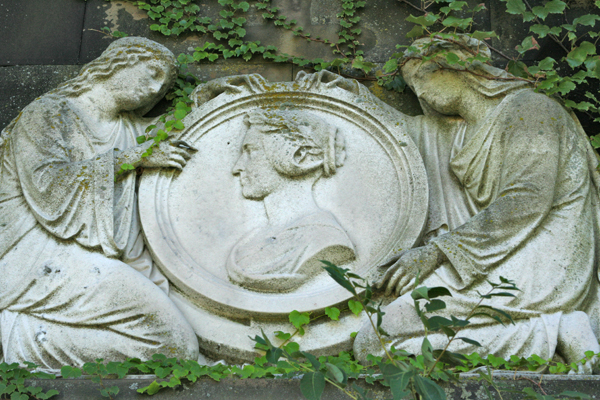
 A few years after visiting Boston, while reading Nathaniel Hawthorne’s The Scarlet Letter (1850), I was surprised  to find out his inspiration for the novel came from a stone in King’s Chapel Burying Ground. Supposedly, there’s a headstone inscribed with a script letter “A” which certain people take to indicate 'adultery.' I took some liberties with the photo at the beginning of this article − this is a stone from a cemetery in Delaware.The real headstone was that of Elizabeth Pain, the model for Hawthorne’s adulterous Hester Prynne, which you see in the photo below. Pain's headstone has an engraved coat of arms in which the letter 'A' appears in the shield to the right of two lions.

Elizabeth Pain Headstone (ref.)
The Scarlet Letter is a classic American novel, but without a doubt, a tedious read. It’s a fictional story, set in mid-seventeenth-century Puritan Boston, which  tells of Hester Prynne, who conceives a daughter through an adulterous affair. She is made a public example by being jailed for the crime of adultery and is derided by the good Puritans of Boston. Struggling to maintain her dignity, she is forced to wear a prominent scarlet letter 'A' on her breast (a patch of cloth embroidered to all her clothing) for the rest of her life. Not only does she soldier her way through adversity, but she protects the father's identity by not divulging it. As a result, flawed Puritanical thinking puts all the blame on her. The story is as much social commentary as Hawthorne embarrasses us into realizing that morally, no one, especially the Puritan townspeople, is any better than his main character. This is especially evident when the reader learns the father is none other than the town's own esteemed young priest! Hawthorne succeeds in making the point that nothing is sacred, that we are all flawed - in other words, we are human. Not one of us is any better than the other.

King's Chapel Burying Ground is actually mentioned in the final paragraph of The Scarlet Letter:

So said Hester Prynne, and glanced her sad eyes downward at the scarlet letter. And, after many, many years, a new grave was delved, near an old and sunken one, in that burial–ground beside which King’s Chapel has since been built. It was near that old and sunken grave, yet with a space between, as if the dust of the two sleepers had no right to mingle. Yet one tomb–stone served for both. All around, there were monuments carved with armorial bearings; and on this simple slab of slate—as the curious investigator may still discern, and perplex himself with the purport—there appeared the semblance of an engraved escutcheon. It bore a device, a herald’s wording of which may serve for a motto and brief description of our now concluded legend; so sombre is it, and relieved only by one ever–glowing point of light gloomier than the shadow:— “ON A FIELD, SABLE, THE LETTER A, GULES” - The Scarlet Letter, Nathanial Hawthorne
Sam Bellamy's Jolly Roger flag (ref.)
Nathanial Hawthorne was actually a descendant of John Hathorne, a judge during the Salem Witch Trials. Nathaniel added the 'w' to his name to distance himself from the horrors and embarrassment of his familial past. (What a difference a letter can make.) We don’t hear John’s name nearly as often as we hear about that other holier-than-thou witch burner, Cotton Mather (which happens to also be the name of a great power pop band), who lived in Boston at the same time as John Hathorne. Mather, by the way, also presided over pirate trials, attempting to extract confessions and reform them as they awaited the hangman's noose. He was involved in the trial of Sam Bellamy’s crew, as a result of the wreck of the pirate ship Wydah off the coast of Boston in 1717. Different pirates used different flags, and Bellamy's flag, coincidentally, was the aforementioned Jolly Roger.

Even if you're not a huge fan of history, Boston is well worth a visit. They've got a great hockey team and more private ice cream parlors and doughnut shops per capita than any city in America! And with Mount Auburn Cemetery just a couple miles from the center of town, what's not to like? 

Further Reading: 

King's Chapel Website
King's Chapel Burying Ground
Expedition Wydah, by Barry Clifford

Thursday, June 2, 2011

Secrets of Cemetery Monument Revealed

While every tiny tombstone and each magnificent cemetery memorial must have a story associated with it, the Gardel monument in Philadelphia’s Mount Vernon Cemetery is, in my opinion, highly unusual. Why? Because every aspect of its mysterious symbolism is documented.

The monument is the most conspicuous sculpture in the cemetery, being twenty-five feet high, pyramid-shaped and adorned with white marble statuary. Its right side can be seen from Lehigh Avenue, if you peer through the trees and weeds. Mount Vernon Cemetery is a strange place, whose story is a mystery to most people (even the folks who run Laurel Hill Cemetery across the street). It is kept locked up, and rarely do you see anyone at the gatehouse inside the entrance. In summer, the foliage is so overgrown that all you can see of the magnificent monuments are the tops of the obelisks here and there. Winter is the only time to see anything through the fencing. If you're very lucky, someone might answer the phone and you might schedule a time to be allowed in. Or, if you happen to drive by and see the guy with the truck inside the gate, you can accost him and see if he'll let you in. You're not allowed to walk around by yourself, either!

The Gardel monument with its brownstone pyramid and white marble figures seems to be an exercise in symbolism run amok. But how often do we get a precise description of such symbolism? Not very. The monument was constructed in the memory of Julia Hawks Gardel, who died in 1859, while "on tour" in Damascus, Syria (which I take to mean she was on a trip).

Author and historian Tom Keels says in his book, Philadelphia Cemeteries and Graveyards, “For many years, the Gardel monument was featured extensively on Mount Vernon brochures…today the monument stands guard over a derelict cemetery.” I located a brochure (circa late 1800s) at the Historical Society of Pennsylvania, in which the monument is described as a "splendid work of art." And it is that. To get an appreciation for the size of its marble statuary, note Frank, my photographer friend standing amidst the statuary. The sculptures are quite beautiful, albeit weathered and worn, with trees and vines growing in the cracks between the pyramid's brownstone blocks.

 Stereoscopic photograph of Gardel Monument, c. 1865  (ref.)

A friend of Frank's recently happened to acquire a vintage stereoscopic ("3-D") photograph of the Gardel monument (shown above), which has a printed explanation of the memorial on its back.While some mourning art is expressed with symbolism of a general kind (for example, a pyramid usually signifies 'eternity'), the Gardel monument was instead designed very purposefully to relate to the life - and death - of the deceased, Julia Gardel. In my experience, it is unusual to find such specifics in funerary art, where typically the highly personal meanings of statues and monuments have been lost to the ages. I've transcribed the description word for word, so please excuse the misspellings and odd terms.


            "Descriptive"


The Gardel family, while traveling from Jerusalem to Damascus, was attacked by the Bedouins,causing the death of Mrs. Gardel soon after arriving in Damascus.

Representatives of Europe, Asia, Africa, and America were present at the funeral, hence the artist’s idea – a funeral procession. A figure, representing Europe, preseded by a Genius with torch and key, who deposit the cineary urn in the pyramid.

Asia, represented by a female figure, seated on a camel in a kneeling posture.

Africa, a beautifully posed Egyptian female, reclining on a sphinx, an Egyptian emblem − head and chest of a woman, posterior portions the lion − typical of the overflow of the Nile, which always occurs under the signs of Leo and Virgo.

 The bas-relief over the door contains the bust of Mrs. Gardel, inclosed in a medallion, supported in the hands of hope and faith − emblems of the religious character of the deceased. The two figures are in the act of raising the medallion to the crown above it.

The uppermost figure represents America, surrounded by the emblems of the physical sciences, cut on both sides of her socle, and with one arm resting on the Bible, deposits with the other, on the head of the deceased, the crown of Immortelles, awarded to her long and earnest labors in the mental and moral education of American youth.


                Sculptor, G. Geef, Brussels, Siolvar of the King of Belgium. Cost, $31,000.


Julia and her husband Bertrand Gardel were teachers in Philadelphia, and must have been quite well off to afford such a cemetery memorial and a trip overseas (especially on a teacher's salary!). Bertrand Gardel, a French teacher and patron of the arts, was kind of mentor to the artist Thomas Eakins (at the time also a Philadelphia resident). According to author Sidney Kirkpatrick, Gardel "exposed Eakins to sculpture while supervising the construction of a 25-foot high monument he commissioned for his wife’s burial plot at Mount Vernon Cemetery." Further quoting Kirkpatrick from his book, The Revenge of Thomas Eakins, "the imposing pyramid-shaped memorial, gathering allegorical figures in mourning after a design by the Italian sculptor Antonio Canova, inspired Tom to try his own hand at funerary design." Bertrand Gardel himself was immortalized as one of the chess players in Eakins' painting, The Chess Players (1876). Bertrand is buried with Mrs. Gardel, having died 36 years later in 1895.

References and Further Reading: 

The Gardels on FindAGrave.com 
What are Stereoscopic Photographs?


Thursday, May 26, 2011

Flattened Tombstones

King David Memorial Park, Bensalem (NE Philadelphia)

What do Nancy Spungen (of "Sid and Nancy" fame) and actor John Barrymore have in common? Admittedly, not much. However, they both have flat-to-the-ground tombstones. Spungen is buried in a cemetery where flat stones are required, and Barrymore, along with the rest of the Barrymore theatrical dynasty, seems to have chosen flat markers by choice. While practical, I can't imagine anything more mundane.

Mt. Vernon Cemetery, Philadelphia

Back in the early 1990s, I made a trip to Forest Lawn Cemetery in Glendale California to see the Lone Ranger's grave, among others. I found that the majority of the 250,000 inhabitants have flush to the ground grave markers - all the same size! I certainly didn't find it very attractive - grassy fields punctuated with cheesy modern sculptures here and there. I could find none of the graves I came there to see. I remember asking the groundskeeper why its like this, and he replied, beaming, “It makes it so easy to cut the grass!

Obviously, that's the main attraction - ease of maintenance. But I just don't get it. Granted, we could not reproduce the splendor of a Victorian sculpture garden cemetery today - the cost would be prohibitive. Plus, stone carving just ain't what it used to be! While such cemeteries had a distinct plan, the sheer variety of the monuments themselves gave an air of and uniqueness to each cemetery.

The trend today, of course, is vastly different. Flat markers, or "grass markers," as they're called on the Bertolini Memorials and Monuments website, are only one of many regulations we are warned about:

CEMETERY RULES and REGULATIONS

Most cemeteries have regulations and rules concerning the size, style, color, and design of headstone, markers and memorials. Some examples are:

1. Catholic cemeteries always require a religious design on the headstone.
2. Some may not allow porcelain pictures placed on the surface of a stone.
3. Many sections of cemeteries require specific styles of markers such as a flat type. This makes it easier for lawn care maintenance.

A cemetery can not refuse acceptance of your memorial as long as it meets their provided specifications. The client has the right to purchase their memorial from a vendor of their choice.

As it turns out, the Forest Lawn Cemetery chain (in Southern California) may have actually been the instigator of this trend toward flat grave markers. In 1906, Forest Lawn was founded by a group of San Francisco businessmen, with Dr. Hubert Eaton credited as its founder. According to Wikipedia, Eaton developed  the "memorial park plan," of eliminating upright grave markers.

[Eaton] was convinced that most cemeteries were "unsightly, depressing stoneyards" and pledged to create one that would reflect his optimistic, Christian beliefs, "as unlike other cemeteries as sunshine is unlike darkness." He envisioned Forest Lawn to be "a great park devoid of misshapen monuments and other signs of earthly death, but filled with towering trees, sweeping lawns, splashing fountains, beautiful statuary, and ... memorial architecture" - ref

Ed at Jack Kerouac's grave


So in a cemetery filled with flat markers, how do visitors even find the graves of their loved ones? If the grounds are not maintained, grass and dirt can just cover them up! And what about all the states where it snows? I can see Forest Lawn not needing to concern itself with this, but the Barrymore and Spungen graves are in the Northeast part of the U.S. - Pennsylvania, in fact. It snows here! And what about Jack Kerouac's flat stone in Lowell, Massachusetts? Do you just not go and visit your loved ones' graves in the winter? (Click here for an amusing video of an adventure in the snow.)

Granted, my trip to Glendale was in the early 1990s, and the Internet was not yet the wealth of information that it is today.Websites like FindAGrave.com now help us in our quest. During a current search for comedian Sam Kinison's burial place, I was surprised to find these directions!

Burial: Memorial Park Cemetery
Tulsa,Tulsa County
Oklahoma, USA
Plot: Section 28 - Garden of the Apostles in the SE quad. GPS coordinates are N 36°05.095 W 095°52.814.

I think I'll end my little rant here with a story about Spungen's grave, and how Sid Vicious' mom wanted to bury his ashes there. The punk rock musician from the Sex Pistols supposedly stabbed his girlfriend Nancy Spungen to death in their suite at the Chelsea Hotel in Manhattan in 1978. Spungen was laid to rest at King David Memorial Park, Bensalem (NE Philadelphia), in Bucks county, PA. Vicious was arrested for the murder, but never went to trial. Three months later while out on bail, he overdosed on heroin and died. His mom, Ann, and some close friends had Sid's body cremated and intended to fulfill Sid's wish: "When I die, bury me next to Nancy."

Sid Vicious and Nancy Spungen, by Eileen Polk (ref.)
Spungen's mother, however, wanted no part of this, so the keepers of Sid's ashes attempted to do what my family has done in the past - illegally bury them on another person's plot. As bizarre as the following account is, I can relate. (Read about my own bizarre experiences disposing of family cremains here and here). Eileen Polk describes the experience in the book, Please Kill Me, The Uncensored Oral History of Punk; Polk was a photographer and friend of Sid and Nancy.

We're standing at the gravesite and it was snowing. We were all crying. We just said some prayers and left some flowers.Then we drove around to the other edge of the cemetery. We parked the car and Ann [Sid Vicious' mother] took the ashes, went over the fence, back to the gravesite, and dumped Sid's ashes on Nancy's grave. Then she came back and got in the car and said, 'Well, they're finally together.' And that was that.

Further Reading:

Read my other two Cemetery Traveler blog postings about disposing of cremains:
Nana's Ashes
Ceramic Death Portraits

About Forest Lawn Cemeteries, from Wikipedia:

"Forest Lawn's 300 acres of intensely landscaped grounds and thematic sculptures were the inspiration for the biting commentary of Evelyn Waugh's satirical novel The Loved One and Jessica Mitford's acerbic The American Way of Death. Many commentators have considered Forest Lawn to be a unique American creation, and perhaps a uniquely maudlin Los Angeles creation, with its 'theme park' approach to death."

Many thanks to Melanie Hoch at REPO records in Philadelphia for inspiration for this article.

Saturday, May 21, 2011

Graves of the Mob Bosses

Mob boss Angelo Bruno's grave
As I said in a previous blog, I feel a bit like a peeping tom when I get ideas from the pages of Facebook friends. I originally conceived of this blog as a memoir of sorts, but occasionally I get new ideas from Facebook, so thanks to you all. A month or so ago I happened on a page of photographs called "Grave Sites of Gangsters," by J. David Perry. Got me thinking about the grave sites of Philly mobsters.

In my 14 years of cemetery travel, I only remember one instance when I actually looked up where certain people were buried, in order to visit their graves. This was during a trip to Hollywood and the surrounding areas. Back in the early 2000s, I visited Marilyn Monroe’s crypt, a few of the Marx Brothers, Rudolph Valentino, The Lone Ranger, Alfalfa from the Little Rascals, and so on. Some day I’ll come across the photos from those cemeteries.

So if I ever find a notable tombstone or monument, it’s strictly by chance. It's been fortuitous to stumble upon the graves of John Barrymore, John Wilkes Booth, and Grover Cleveland, but I'm mainly shooting with blinders on. Think of all the interesting things I must be missing! What can I say, other than it’s taken a number of years for my interests in cemeteries to mature. Back then it was all about angels.

That’s where my focus was in the early days. Shot angels all over the U.S. for six years or more before I ever read a headstone inscription! I guess I just wasn’t prepared to take it all in. I wouldn’t even go into a cemetery if I couldn’t see angels from the road! Only after I kind of exhausted the obvious angelic possibilities, did I begin paying attention to other things. That led to an ever-expanding interest in cemeteries-- reading books, seeing what non-angelic cemeteries had to offer, appreciating other types of memorial architecture, talking with people who worked in cemeteries, and even dating them!

Gravesites of Gangsters

So I kind of surprised myself when I saw the “Grave Sites of Gangsters,” page. It occurred to me that, hey, Philly used to be rife with organized crime – I wonder where all those mobsters are buried? About 5 minutes of Internet searching brought me to the odd finding that the most notorious ones are buried in the very same cemetery where I began my cemetery photography in the late 1990s, right under those very angelic noses! In fact, this is one of the very first angel photographs I ever made, on the very first roll of film, in Holy Cross Cemetery in 1997.

Holy Cross Cemetery 

Holy Cross Cemetery in Yeadon, PA is about 2 miles from where I used to live in Delaware County − the southwestern suburbs of Philadelphia. It’s one of Philadelphia’s most unsung cemeteries. Why? It has more statues, monuments, and mausoleums than most cemeteries in the area. Although it’s of late Victorian age (est. 1890), it isn’t landscaped with the typical rolling hills and arboreal splendor. It’s all rather flat. None of the Catholic cemeteries in the area promote themselves as tourist destinations, so Holy Cross gets no publicity. However, it is kept up extremely well by the Archdiocese of Philadelphia and is a lovely place in which to wander. It was very convenient to my house – whenever a gathering storm arose, I would jump in the car with my cameras and head over there. For me it was wonderful − the place has so many angel statues you can’t swing a cat without hitting one (as Mark Twain would say).

It’s ironic that a Catholic cemetery would allow known criminals to be buried within its grounds. And then care for the graves, perpetually. No more hypocritical than Italian-American  mobsters being faux religious, I suppose, you know, all Catholic and god-fearing on the surface. (There have been a few, however, who have been denied a church funeral −John Gotti, Paul Castellano, Carmine Galante and Frank DeCicco.)

Googling Mobsters’ Graves 

My search began by Googling Angelo Bruno’s and The Chicken Man’s graves. Both had just been whacked when I first moved to Philly in the early 80s, and the city was still abuzz with the news. Specifically, I Googled “Angelo Bruno grave.”

The Websearch itself was rather interesting. “FindAGrave.com” is typically what comes up first when you search for a specific person’s grave. The site boasts “61 million grave records!” For each burial, the site gives a short bio with the specific location within the cemetery where the person’s buried. As I alluded to, both Bruno and the Chicken Man are noted as being buried at Holy Cross. Here’s Bruno’s data from the site:

Burial: Angelo Bruno
Holy Cross Cemetery
Yeadon
Delaware County
Pennsylvania, USA
Plot: Section 23, Range 2, Grave 16

FindAGrave even includes a map of the cemetery so you can find the section. Most cemeteries mark their sections with a small stone at the edge of the road border. The range and grave number is fairly easy to figure out, the range being the number of rows in (but you have to figure out from what side), and the grave number being the count from the end of the row (but you don’t know which end). Navigating around section 23 with the help of these coordinates and a bit of dead reckoning (pun intended), I came upon Angelo Bruno’s grave without too much trouble. The only thing notable was a tarnished 1959 penny on the stone. Makes you wonder if it was a family member who placed it there or what might happen to you if you snitched it.

Bruno is perhaps the best known Philly mobster of recent times, having been the boss of the city’s organized crime family from 1959 to 1980. Bruno was murdered with a shotgun blast to the head while sitting in his car in front of his house. The Bruno killing sparked years of family infighting with dozens of slayings. A year later, Bruno’s successor, Philip 'Chicken Man' Testa was blown up by a nail bomb at his home.

Angelo Bruno's house in South Philadelphia
Bruno’s house was up for sale in 2010. His daughter still lived there and wanted to move to Jersey (where all the Goodfellas seem to end up). Since his house is only about a mile from mine, I thought I’d stop by and snap a photo. People assume mobsters live in fancy homes or estates like the bosses on the  Sopranos. Bruno’s house was a very plain end-of-row, as you can see in the photo. John Stanfa, Bruno’s driver at the time of the killing, did the brick work on the front (in case you were wondering).

(Map link to Bruno's house – note that it is located on “E. Snyder Avenue!”)

Philip 'Chicken Man' Testa 

Though Phil Testa was only a mob boss for a year, he’s more famous in pop culture than Bruno. Bruce Springsteen opens his song “Atlantic City" with the line:
“Well they blew up the Chicken Man in Philly last night, now they blew up his house too….”
Philip "Chicken Man" Testa's house (r.) in South Philly
Testa, whose nickname came from his involvement in a poultry business, was killed when a nail bomb was exploded on his front porch as he was entering his house in South Philly (21st and Porter Streets). I took this photo a few days ago. The house is still there. His was the one on the right side of this twin. Obviously some remodeling has been done since the blast in 1981.Unlike the very commercial Snyder Avenue area where Bruno lived, Testa seemed to prefer the residential tree-lined streets across from Steven Girard Park.

Finding Testa’s grave was a bit more challenging. It probably took me 15 minutes to locate Bruno’s headstone, but it didn’t seem like Testa’s was there, at least according to the directions on FindAGrave.com. You figure it would be relatively easy, since they show you a photo of the actual stone.  So I gave up and re-checked the site. It was supposed to be in Section 27, but it didn’t seem to be there. I started thinking all these cloak-and-dagger thoughts like they must have moved the grave because rival crime families were desecrating it. Turned out FindAGrave had the wrong information. (I went back to the site today to send an email correction to the site author, but found all the specific location information for Testa’s grave removed.)

I visited the record keeper at Holy Cross and asked if she could tell me where Testa’s grave was located. That was a bold move on my part – I wasn’t sure they would give me any information at all, or they might want an explanation of why I wanted to know. Turned out not to be the case. No questions asked, the woman looked it up and gave me a map. Section 21, not 27. Strange how we often assume everything we read is factual (like Wikipedia, for instance).

Additional information I was given was the exact location and depth of Testa's coffin relative to the family stone and the other family members buried there. This kinda weirded me out, like, who would need to know that...? You’ll also notice Salvatore Testa’s name on the stone. Salvie was Phil Testa’s son. According to Wikipedia, “Three years later Salvatore was murdered on orders from Nicky Scarfo. Scarfo, despite being Salvatore's godfather at birth, began to feel threatened by the young capo's popularity in the family and was jealous of an article in the Wall Street Journal that noted Salvatore as a rich, young rising star within the Cosa Nostra underworld."

I was rather surprised to also find this mausoleum at Holy Cross. Michael Maggio was an old-time Mafia Don who sponsored Angelo Bruno for membership into the Philadelphia Family in the 1930s. A lot of people glorify such criminals, treat them like movie stars or folk heroes. One hopes that the line from Springsteen’s Atlantic City, “everything that dies someday comes back, “ does not apply to their kind. In closing, it amused me to see this notation with the Sad Pansy at the bottom of all the mobster’s pages on the FindAGrave site:


The Virtual Flowers feature has been turned off for this memorial because it was being continually misused.


References and Further Reading:

Italian Catholics against mobster church funerals
Canadian Catholics rationalize mobster church funerals
Angelo Bruno's House for Sale
Find-a-grave.com Angelo Bruno
Find-a-grave.com Philip Testa
Find-a-grave.com Michael Maggio

Chicken Man Video:  Mob Scene w/George Anastasia
Angelo Bruno Video:  Mob Scene w/George Anastasia
Archdiocese of Philadelphia Cemeteries


Saturday, May 14, 2011

Civil War P.O.W. Cemetery

Confederate burial trenches
Rest on embalmed and sainted dead
Dear as the blood ye gave
No impious footstep here shall tread
The herbage of your grave 


from "Bivouac of the Dead", by Theodore O’Hara (1820-1867)

Military cemeteries have never held my interest, photographically. Call it a flaw in my personality. Sure the tombstones create interesting patterns being all the same size, shape, and color (white marble, typically), spaced equally apart, but I’m more about entropy. And statuary. I’ve tried to photograph military stones, but the images just look clichéd. So imagine my surprise when I came upon “Finn’s Point National Cemetery” – certainly the strangest military cemetery around.

I was actually headed for Salem, New Jersey, driving south on Route 49 from the Delaware Memorial Bridge last fall. There’s a quaint churchyard cemetery in Salem, New Jersey where I hoped to make some fall foliage photos. A few miles from the center of town, I saw the sign for “Finn’s Point National Cemetery,” within Fort Mott State Park. What the heck, I had the time, and maybe being right on the bay, the place is all picturesque, who knows? So I headed down the road toward Fort Mott.

I drove miles through the rural farmland (which is actually in Pennsville, Salem County) until I almost gave up. No signs, nothing. Couldn’t even see the Delaware Bay. The woods and fields were beautiful, though, with their changing colors. One of the few times I actually pulled the car over to get out and make some photographs, another car slowed down, checked me out, and pulled off the road about 100 yards ahead. A guy with one leg got out of the driver’s side, went to the trunk, opened it, and took out some sort of election sign on a wooden stick and proceeded to hammer it into the ground. As I drove by, I glanced at the fellow in the passenger seat, and he was dressed in a white suit, sitting there all satisfied with himself like Boss Hogg from the old Dukes of Hazzard TV show! Small town politics.

And this area surely is small town America. Or has been since the early 1900s when the fishing industry collapsed. Throughout the 1800’s, oysters, sturgeon (for caviar), and blue claw crabs were overfished and as a result, entire industries disappeared. Now the sparsely populated coastal bay area subsists mainly on retail and farming, that is, until you get further south to Cape May where beach tourism takes over. I made the photo above in a small churchyard cemetery in Pennsville, NJ.

So the cemetery is smack dab in the middle of all this. You drive through the little Jersey towns of the Delaware Bay area and you’d swear John Prine had it in mind when he wrote the song, Paradise: "it’s a backwards old town that is often remembered, so many times that my memories are worn." This, to me, describes Salem perfectly – a place that’s been in existence since 1730 and whose main claim to fame is that it was on the steps of the Salem courthouse in 1820, that Colonel Robert Johnson proved the edibility of the tomato. Before 1820, Americans often assumed tomatoes were poisonous (ref.).

P.O.W. Cemetery on the Delaware Bay

As I drove through Fort Mott State Park (nature preserve) to get to the cemetery, even this jaded photographer was taken by nature’s charms. A forest of brightly colored trees lined the road to the right, while dense foliage almost hid an old canal to the left. When I arrived at the cemetery, I was surprised that it was so small (less than 5 acres). The area is all swamps and marshland, with retaining walls on two sides – very enchanting, yet desolate. There was a parking lot for about 5 cars, in which a solitary empty pickup sat. A groundskeeping crew of a few men were cutting grass around the old office building. Everything was locked up, even though this was the middle of a weekday. Obviously not a popular tourist destination. Look at the photos on the Fort Delaware website and you can see how remote this place is.

  Fort Delaware, built in 1817 on Pea Patch Island in the bay opposite Finn's Point, and was used as a prison camp during the Civil War (1861 - 1865). Both Confederate and Union dead who had died at the prison were buried here at Finn's Point. The fact that it’s a Prisoner of War (P.O.W.) cemetery distinguishes Finn’s Point from other military cemeteries. As I read the informational signage overlooking the bay, I found that 2,436 Confederate POWs are buried here, along with 135 Union soldiers. The fact that both Union and Confederate soldiers are buried within the same cemetery makes it quite unique. In a small separate section of the cemetery (shown below), you'll also find the graves of Russian and German P.O.W.s from WWII. Very odd indeed. The Germans and Russians had died while prisoners at Fort Dix, NJ.

German and Russian P.O.W. graves

Finn’s Point National Cemetery resides within Fort Mott State Park. Fort Mott was part of a three-fort defense system designed to protect the ports of Philadelphia following the Civil War. The other two forts in the system were Fort Delaware and Fort DuPont in Delaware City, Delaware. According to Wikipedia:

Originally purchased by the federal government to build a battery to protect the port of Philadelphia, the land became a cemetery by 1863 for Confederate prisoners of war who died while in captivity at Fort Delaware. One hundred and thirty five Union soldiers who died while serving as guards at the prison camp are also buried here. The death toll among prisoners of war and the guards was high, especially in the latter part of 1863 and throughout 1864. By July 1863, there were 12,595 prisoners on the island at nearby Fort Delaware which was only about 75 acres in size. Disease was rampant and nearly 2,700 prisoners died from malnutrition or neglect. Confederate prisoner interred at the cemetery totaled 2,436 and all are in general unmarked graves. - Wikipedia

You read dry statistics like that, and you're distanced from the actual pain and suffering. Think about that – 2,436 soldiers died while in prison. In addition to captured Confederate soldiers and sailors, convicted federal soldiers (Company Q), and local Southern sympathizers, most of the Confederates captured at Gettysburg were imprisoned here. R. Hugh Simmons, a member of the Fort Delaware Society adds a touch of humanity to the story:
The prison was built to house 10,000 POWs, and the barracks were divided to hold about 2,000 officers and civilians in one compound and about 8,000 privates and enlisted men in the other. "So you had 3,800 (Confederate) prisoners suddenly appear on the doorsteps," he says. "These guys were sick as dogs. They were badly treated en route, and the Union officers have testified to that. When they arrived here, they started dropping like flies." With little space on the island, Soldiers Burial Ground at Finns Point was pressed into service. There are 2,436 Confederates buried in seven parallel pits at Finns Point that run east to west, Simmons explains. They were buried in wooden coffins stacked three deep. Names plates were put on each coffin and covered in leather for future identification. But no records were kept, and it was impossible to identify anyone after the war. In 1875, the year the ground was designated a national cemetery, the Corps of Engineers exhumed the remains of 135 Union soldiers and 187 Confederates on Pea Patch Island and reburied them at Finns Point.

Confederate Monument
Within the cemetery are two monuments an 85-foot high obelisk (at left) dedicated to the Confederate dead, and a smaller memorial dedicated to the Union soldiers buried there (below). During my visit, the tall obelisk was encased in scaffolding, so I used a photo of it from Interment.net. The names of the 2,436 Confederate military prisoners who were interred in the mass burial trenches and pits at Finns Point appear on the 12 bronze memorial tablets placed around the base of the monument.


Union Monument (
Another interesting memorial is the series of seven metal plaques overlooking the end of the Confederate burial trenches (which you can clearly see in my photo at the top of this article – kind of chilling, isn't it?). On each plaque is engraved a quatrain from Theodore O'Hara's poem Bivouac of the Dead, the first of which is quoted at the beginning of this article. (If you go to Sheena Chi's Flick'r Photostream, you'll see individual photos of the plaques as well as many other fine photos from her well-documented visit to Finn's Point.) 

Reading this poetry as you walk quietly along the trenches, you assume its been solemn and peaceful like this since 1864: "No impious footstep here shall tread, the herbage of your grave." Almost as a mockery to O'Hara's poem, spree killer Andrew Cunanan committed one of his murders here on May 9, 1997, killing cemetery caretaker William Reese and stealing his truck. Cunanan had murdered at least five people, including fashion designer Gianni Versace, during a three-month period in 1997. If I had known this at the time I visited the cemetery, I probably wouldn't have even gotten out of my car.

Up until the end of 2009, Finn's Point National Cemetery had been allowing burials of U.S. military veterans from all wars after the Civil War. Over the past several years, the marshy ground has become an issue due to the high water table, so all burials, caskets as well as cremains, have ceased.  


For Further Reading:

Fort Delaware website
Fort Delaware Society/Finn's Point National Cemetery
An interesting history of Finn's point Cemetery
Pea Patch Island Documentary
Bivouac of the Dead article and poem
Fort Delaware Video Tour
Delaware River Forts