Thursday, April 28, 2016

The Odd End to Philadelphia's Odd Fellows Cemetery

William Dick Elementary School, Philadelphia (former site of Odd Fellows Cemetery)
Coffin piece from Odd Fellows Cemetery?
A few weeks ago I received an email from a woman who was wondering about the resolution of this situation. In December of 2013, wooden coffins were surprisingly unearthed under a schoolyard in north Philadelphia. The Philadelphia Water Company was digging under the playground at the William Dick Elementary School (shown above) when caskets and other remains were found. When the story hit the news on Dec. 4 (see links at end), there was much media coverage. I went to the site to check it out. As far as I can tell, none of the graves that were excavated at that time were moved - seems like the Philadelphia Water Company just did their piping work and filled the ground back in. There were pieces of old pine board laying around in the mud of the site, one of which I picked up. Possibly part of an old pine box.

I lost track of the story and began wondering myself whatever became of this find. I see no further mention of it on the Internet. At the time of the incident, I missed an email from a reporter asking me to comment on the situation. Had I made the interview, I would have suggested he contact The Odd Fellows Cemetery Company in northeast Philadelphia for comment. The site in question (24th and Diamond Streets), was originally the site of Odd Fellows Cemetery, which had been established in 1848.

Latest occupant of the land once occupied by the Odd Fellows Cemetery

About a hundred years later, in 1951, the City of Philadelphia displaced Odd Fellows Cemetery and used the space to build a housing project and this public school. About 80,000 bodies were supposedly moved to Lawnview Cemetery in Rockledge (a Philadelphia suburb in Montgomery County), and Mount Peace Cemetery, at 3111 West Lehigh Avenue, Philadelphia. Both locations were, and are still, owned by the Odd Fellows Cemetery Company. The woman who wrote to me had a vested interest in the situation. It seems that many of her ancestors had originally been buried at Odd Fellows Cemetery.


Ironically, a few months prior to the unearthing of the coffins at Odd Fellows' original site, she had requested copies of her ancestors' burial records from the Odd Fellows Cemetery Company in Rockledge. Her ancestors had been buried there in the 1860s, 1870s, and 1880s. She received the records, which were stamped "Moved to Lawnview in 1951," complete with lot numbers of the graves. She had accepted all this as fact until the coffins were discovered. Now she's not so sure.

Plaque on monument in Odd Fellows Cemetery

When a cemetery or graveyard is moved, those in charge most likely try to move all the bodies. However, its fairly common that stragglers are left behind, and found years later by accident. But if stragglers are later found, should they not be relocated as well? The Philadelphia Water Company temporarily halted its work in December 2013 so archaeologists could examine the findings. As I was doing research for this article, I did see that an attempt was made by Philly.com to contact Odd Fellows Cemetery Company at the time of the schoolyard excavation. Calls were not returned.


Lawnview Cemetery field where tens of thousands of bodies were reburied

Why the name "Odd Fellows?"
"The Independent Order of Odd Fellows began in 18th Century England, it was deemed odd to find people organized for the purpose of giving aid to those in need without recognition and pursuing projects for the benefits of all mankind." - http://www.ioof.org/

Plaque at Odd Fellows Cemetery
Odd Fellows began as a fraternal organization in America in 1819, and continues to this day. Currently, the organization sees itself as a "...family of Odd Fellowship, composed of Men, Women, and Youth, believing in a supreme being, the creator and preserver of the universe, who have come together in our local communities having the same beliefs and values as others, that; Friendship, Love and Truth are the basic guidelines that we need to follow in our daily lives"(ref.). Friendship, Love and Truth are usually symbolized by the three chain links seen in the photo at left; sometimes the letters F-L-T are written within the links.


Sidewalk at 24th and Diamond Streets
The photo at right was taken in April 2016. It shows the new sidewalks at 24th and Diamond Streets which were poured after the opened graves had been filled back in, subsequent to the Philadelphia Water Company finishing its work. The fence encloses the playground of the William Dick Public School. There is no memorial plaque or anything to indicate that portions of the Odd Fellows Cemetery still exist under the playground.

Lawnview Cemetery, Rockledge, PA
Lawnview Cemetery has been the recipient of tens of thousands of relocated graves over the years, from other cemeteries besides Odd Fellows. The most notorious being the twenty thousand graves from Philadelphia's Monument Cemetery, which was razed in 1956. The rumor was that all these bodies were dumped into a mass grave. If you talk to the people at Lawnview, they tell you that they have a record showing the actual plot where each body was buried. No reason not to trust that, except that, as people found out in north Philly in 2013, not all the graves (from Odd Fellows) were actually moved.

If you drive through Lawnview Cemetery, there is a vast field with no grave markers. This is where the burials from Monument Cemetery and Odd Fellows Cemetery are. There are no monuments, headstones, or markers of any kind because most of them were dumped into the Delaware River (you can read about that here). Some markers from Odd Fellows Cemetery remained, albeit buried, at their original location. News reports say that marble headstones were found during the Philadelphia Water Company's excavation in 2013. If you drive through Lawnview, I will tell you that the sight is a bit unsettling. The field in question looks flat at first glance. But if you drive, the lateral view you get is a decidedly unflat grassy field. The peaks of the many trenches they must have dug to accommodate the tens of thousands of bodies are quite obvious.

Fields of Graves - Lawnview Cemetery, Rockledge, PA

I realize that I've posed more questions than answers in this blog post. If anyone can shed light on the topic, please post a comment here or email me at mourningarts@yahoo.com.


References and Further Reading:

Sunday, April 17, 2016

A Roadside Memorial Like No Other

Unless you were purposely driving to the “Geigertown Central Railroad” in Geigertown, Pennsylvania, you would never see this roadside memorial to a lost son. And if you WERE driving there on purpose, you would probably know that the “Geigertown Central Railroad” is not an actual, official railroad line. It is a memorial to the man who amassed a large collection of trains.

People mourn, grieve, remember, and memorialize the dead in countless ways. I can respect that. Roadside memorials are quite common, in urban as well as rural areas. The big difference between the two is the sheer scope of land one can dedicate to rural memorials. Such is the Geigertown Central Railroad in southeast Pennsylvania – 150 acres, to be exact.

According to the Pottstown (Pennsylvania) Mercury, “D. J. Shirey was an active train enthusiast and collector and was killed in 1993 at the age of 26 when a crane overturned on him as he was trying to right a derailed train in Hamburg, Pennsylvania. The Geigertown Central Railroad Museum Inc. is a nonprofit corporation which the Shirey family has set up in D.J.’s memory. Essentially, they keep his collection in place.

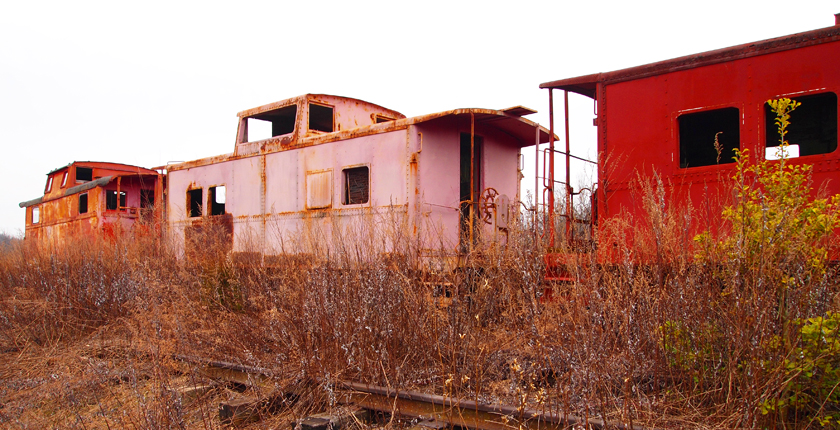
Unlike most train enthusiasts who collect HO gauge model trains, Shirley collected the real thing. If you see the acres of railroad track and antique locomotives, cabooses, and other rail cars rusting on this 150 acre-rural property, you would gather that Shirey’s hobby was somewhat more expansive (not to mention expensive) than most.
 
Shirley  was a member of a family who owned (and still owns) a trucking company (Shireys Trucking) in Geigertown, PA (about ten miles south of Reading). The “memorial” sprawls over acres of farmland along the side of 1403 Geigertown Road, directly across from the trucking operation.

Inside a caboose
"From a young age, his dream was to create his own railroad, which he named the 'Geigertown Central Railroad,' complete with engines, freight cars and tracks that would circle his farmhouse in the rolling hills of Geigertown,” according to the Oct. 6, 1993, article in the Mercury. D.J. Shirey married his wife Frances aboard a steam locomotive in 1991, and had moved from Geigertown to Hamburg with his wife and baby daughter about a year before his death.

While the average railroad enthusiast might build an HO gauge model railroad setup in his basement, Shirey bought and collected real trains! He had tracks laid on the family property on which to set the many steam locomotives, cabooses, and other types of rail cars amassed in his collection. If I were to guess the number of pieces on the property I would say about thirty. He even has old rusting cranes, bulldozers, and steam boilers. Piles of railroad ties, track, and spikes dot the landscape. There are railroad signs, sheds, and lights. Everything has been sitting there in the field rusting since D.J.’s death in 1993.

“With the help of his grandfather, Dave “Bob” Shirey, D.J. amassed quite a collection of rail cars, old trains, and rusting engines. Meanwhile, D.J. learned everything he could about railroading. For two years he drove the diesel engine in Pottstown that pushed the old Ironstone Ramble steam train. He was chief operating engineer for the Blue Mountain and Reading Railroad, where he had done “almost every job,” including driving and inspecting diesel and steam engines and shoveling coal into the locomotive’s fire box. Just a few months before his death, he became a locomotive steam boiler inspector.”

Back in 2005, some of the collection was auctioned off by his father, David Shirey. About thirty pieces remain, as a memorial to his son. How (and why) D.J. amassed this collection at such an early age is downright intriguing. Amidst the row of cabooses can be seen rusting steam shovels, bulldozers, and other old industrial equipment. Manual pumper cars and steam boilers sit idly alongside massive locomotives and other railroad cars. It is quite a scene. The photo below is in fact what you see from Geigertown Road.

Steam locomotives alongside Geigertown Road, Geigertown, Pennsylvania

If you donate some money, the family may let you roam about the property to view the cars up close, and even go inside them. (Photo at left shows inside of one train car looking out its door at the caboose.) The donation is for the upkeep of the collection, which it appears, probably amounts to cutting the grass in summer. When I was there this past winter exploring and making photographs with a friend who lives in the area, he nonchalantly suggested we come back again in the fall. I asked, why wait until fall? He said, “You wouldn’t want to be in these weeds when the rattlesnakes are around.” I figured I’d defer to his good judgement and not return until next fall.

References and Further Reading:

Thursday, April 7, 2016

Weird N.J. in Smithville!

"The Bishop"
Back in the day (which, I believe, was a Thursday), I had a few photos and stories published in Weird N.J. (i.e., Weird New Jersey). If you don’t know what that is, you’ve been missing out. If you DO know what Weird N.J. is, you’ll be tickled to know that my next public hanging will involve the creators and publishers of that magazine, those books, and the hosts of the (2005) History Channel television series, Weird U.S.! Yes, Mark Moran and Mark Sceurman, the creators and masterminds of all that Weirdness will be in attendance on April 16, 2016, at the annual Smithville (New Jersey) Art Walk! (To visit various Weird N.J. sites, please see links at end.)


Samplings of the Weirdness of Mark Moran and Mark Sceurman

Child's grave in Allegheny Cemetery, Pittsburgh, PA

Yours truly, Ed Snyder, will be there at an art booth with my friend Susan Agiro Spitz, another accomplished artist. We will be exhibiting our very weirdest cemetery photography. There will be books, matted photographs, and lovely greeting cards featuring our original images, all available for purchase. Some may even match your sofa.

A sampling of Susan’s work can be seen on her Susan's Secret Garden Facebook page.

Ed Snyder’s work can be seen on Ed Snyder's StoneAngels Photography Facebook page and on Ed's website, EdSnyderPhoto.com

Reclining Granite Woman, Holy Sepulchre Cemetery in East Orange, N.J.

I’ve never been to Historic Smithville, New Jersey, and I am quite looking forward to the event. My map shows it to be a lucky seven miles north of Atlantic City on Route 9. If you’ve never driven on Route 9, it is a photographer’s paradise of classic Jersey roadside attractions - like miniature houses and two-story milk bottles. And apparently, Smithville is haunted by the undead, if you can believe the paranormal experts (see this NYDaily News article!).

One thing that never seems to die is peoples' interest in death, and as a result, stories about and photos of cemeteries intrigue people. I will have quite a bit of my work there, including some of the images you see here. I chose them because they were all published at one time or another in a Weird N.J. publication. The color photos were made in Allegheny Cemetery in Pittsburgh, Pennsylvania, and were featured (pages 240-1) in the book, Weird Pennsylvania.

The black and white images were made in Holy Sepulchre Cemetery in East Orange, N.J. These were published in the Oct. 2004 issue of Weird N.J. magazine (“Your travel guide to N.J.’s local legends and best kept secrets”). On pages 42-3 you’ll find “The Parkway as Road to the Necropolis?” - a short narrative about my first visit to Holy Sepulchre. The Marks title this recurring section of their magazine “Cemetery Safari.” (This image at right is rather curious. I assume the statues were made in the likenesses of the woman (foreground) and man buried below. Someone once asked me, "Why are there statues of George Washington and Stalin in that cemetery?")

So please stop by the Historic Smithville Art Walk if you're in the neighborhood of Atlantic City on Saturday, April 16 (Rain Date April 17), 2016! Come see the fruits of our cemetery travel - photographs, greeting cards, books, and other death goodies! All for sale! Come and trade cemetery stories! Susan and I would love to meet you!

Smithville Art Walk

Date:
April 16th, 2016 (Rain Date 17th)
Time:  
10 a.m. to 5 p.m. 

References and further Reading:
Historic Smithville (New Jersey) website
What is Weird NJ?

Tuesday, March 29, 2016

Easter Egg Hunt in a Graveyard?

One of many areas decorated for West Laurel Hill Cemetery's Easter egg hunt

So here’s a short blog about an Easter egg hunt in a graveyard. Sounds kind of morbid, I will admit. However, cemeteries are doing anything they can these days to engage the community, to bring people through the gates (live people, that is), with the expectation that perhaps they will garner business at a later date.

West Laurel Hill Cemetery in Bala Cynwyd, Pennsylvania (a suburb of Philadelphia) has been having Easter egg hunts for the past fourteen years, if I heard the announcement correctly at the March 19, 2016 egg hunt.

Indoor activities for 350 kids at West Laurel Hill's Easter Egg Hunt, 2016

Another benefit of public engagement is that you help people accept death, as inevitable as death is. Come to the cemetery with your kids, have a fun time, see the pretty spring blossoms on the trees and flowers. Subconsciously you think, hey, this is not so bad. Not scary at all. Kind of like all the techniques used by childrens’ dentists these days to allay kids’ anxiety and yes, fears.

We fear death. However, Rachel Wolgemuth, in her book, Cemetery Tours and Programming (2016, Rowman and Littlefield), suggests ways to increase a community’s respect for these spaces. She describes “the reuses of both historic and contemporary burial grounds through the lenses of recreation, education, and reflection.” Rachel happens to be a friend of mine and coincidentally, works at West Laurel Hill Cemetery – so she speaks with authority.

Children waiting to dash, just before the tower bell struck eleven o'clock.

Why authority? Because West Laurel has obviously found ways to generate good will toward the community and to help “reimagine what burial grounds can be through the creation of innovative tours and programming.” The first Easter egg hunt I ever attended was here, with my wife and not-quite-two-year-old daughter, in 2011. It was fun, and I wrote about it in this blog (click link to take you there).

I must say that five years later, this event has become something extraordinary. There were about 350 kids this time, and 8,000 eggs! (They had 3,000 eggs in 2011).) The coordination, parking, scheduling, announcements, and pre-hunt activities for kids were much improved from the last time. Greatest improvement? Sections of lawn designated by signage for all the different age groups! This way, the little tykes didn’t get bowled over by the bigger kids and end up with no eggs. EVERYBODY got a bag full of big colorful plastic eggs filled with candy.

Easter Egg Hunt at West Laurel Hill Cemetery

After the hunt, there were prizes drawn for those who registered when they first arrived – golden eggs with a five-dollar-bill inside! There was music over the P.A. system outside and announcements were made to let everyone know what was happening next. But I’m getting ahead of myself here (that’s kind of how exciting it all was).

Daughter Olivia with Easter Bunnies!
The event was well-advertised locally. Registration began at 10 a.m., with TWO costumed (human) Easter Bunnies greeting visitors at the door to the conservatory (a building at the back of the cemetery, near the oldest graves). As you registered, you got to pick out a giant Zitner’s candy Easter egg. (Zitner's donated TONS of Easter candies to West Laurel for this event.) There was someone making balloon animals outside, as well as an artist drawing kids’ caricatures.

Registration for Egg Hunt

If it was too chilly for some outside, a huge room was set up inside for kids to create all kinds of Easter-themed arts and crafts. There were people doing face-painting as well.

Kids having fun at one of the indoor arts and crafts tables

Mausoleum walkway lined with candy!
When eleven o’clock approached, everyone went outside. It was a cool, overcast morning, and the lawns were littered with thousands of colored eggs as well as clear cellophane-wrapped chocolate eggs. I rather liked how they lined the walkway of this mausoleum with candies! The announcement was made that when the bell tower struck eleven o’clock, children were free to run amidst the mausoleums and monuments and collect as many eggs as they could carry in their bags and baskets! My now six-year-old daughter had a wonderful time.

Leaving the cemetery was well-coordinated, with orange traffic cones lining the roads and helpful cemetery employees pointing the way. West Laurel Hill Cemetery is a rather confusing place, but thanks to the dedicated professionals running it, a very welcoming place.

Monday, March 21, 2016

HEY JOE – A Rather Unusual Roadside Memorial

People mourn, grieve, remember, and memorialize the dead in countless ways. I can respect that. Recently, I happened upon a rather unusual rural memorial to the dearly departed. Rural roadside memorials have an advantage over urban memorials in the matter of sheer real estate. In the city, you’re pretty much contained to a telephone pole with a few bouquets of flowers placed around it. Out in the country, you can go large.

Author Ed Snyder (photo by Susan Argiro Spitz)
This week, we visit a memorial gorilla in south Jersey. Not just any gorilla, but a 25-foot high Fiberglas statue of a gorilla. Here's a photo of me (taken by my friend Susan Argiro Spitz) standing in front of the primate, just for size reference - I am six feet, two inches tall. When you see the name, "Mighty Joe," you might think of the King Kong-style giant gorilla, "Mighty Joe Young," star of the silver screen (1949). However, this is a memorial to a different Mighty Joe. The text on the gorilla's sign speaks for itself, a sad reminder of a lost son. I have transcribed the sign's text below.
Hello, 
My name is Mighty Joe
I have been placed here by the Valenzano family as a memorial
And to pay tribute to their son Joseph who now lives in the kingdom of heaven.
Joe was a big part of this family business and he was also a body builder
and won many awards. He was called “MIGHTY JOE” at times by
his family and friends. Joe was not only mighty in his appearance
but also in courage, spirit and love of family.
Joe is truly missed by his family and friends, but not forgotten,
And he is always in their thoughts and prayers.
My job is to look up to heaven from time to time and say
“HEY JOE WE WILL ALWAYS LOVE YOU” and to welcome you to our family business.
God bless you all and thanks for coming to see me.
Mighty Joe


The son may not have been more that eighteen when he died (by the look of the photo at the bottom of the sign) of a brain tumor in 1999. The family, who owns “Mighty Joe’s” gas station, grill, and deli on Route 206 in Shamong, New Jersey, purchased the gorilla from a South Jersey amusement park that closed. According to the good folks at Roadtrippers.com:

"Mighty Joe was previously located in Wildwood, NJ. He was installed at the Islander Raceway and Amusement Park where he was known as George the Gorilla. Today, a sign covers the two holes in his chest that had slides projecting from them."

Larry Valenzano, Mighty Joe's father, purchased the gorilla around 2003, had it restored, and installed it at the family business to serve as a mascot and memorial. Larry had seen the derelict gorilla in the broken down amusement park many times during trips to Wildwood and he said it always reminded him of his bodybuilder son. According to RoadsideAmerica.com:

"My wife thought I was crazy," Larry said. "She told me, 'That guy's not gonna sell you that gorilla. You're out of your mind. What makes you think he would sell that to you?'" But the guy did sell Larry the gorilla, bypassing 15 higher bidders. "'I don't need the money,'" Larry remembered him saying at the time. "'And the reason you want it is more important.'"

Mighty Joe’s actual address, should you want to meet him, is 1231 US Hwy 206, Shamong, New Jersey. Our kind friends at RoadsideAmerica.com give these specific directions: “Mighty Joe's Gas, Grill & Deli. On the west side of US Hwy 206, a little over four miles south of Hwy 70, and about a half-mile south of Tuckerton Rd."

The giant gorilla just appears out of nowhere as you're flying south on 206 through the Jersey Pine Barrens. Like so many of New Jersey’s roadside attractions, all of a sudden its just THERE! – and its up to you to decide whether you want to hit the brakes and investigate!

Thursday, March 10, 2016

Headstones – My Favorite Non-paved Surfaces

The weather mavens said on the radio the other day that snow was being forecast for the following morning, with a one to two-inch accumulation expected on non-paved surfaces. It continues to baffle me how the snow itself can actually discern a paved surface (roadway, parking lot, etc.) from a non-paved surface, and adjust its accumulation characteristics accordingly. One of MY favorite non-paved surfaces, by the way, happens to be grave markers.

Conditions were perfect on the morning in question – lightly snowing, about half an inch of heavy, wet snow covering my car, 39 degrees, no wind. With any luck, the monuments and tombstones at Philadelphia’s Laurel Hill Cemetery were also lightly covered, and would stay that way for a while. Being two weeks before Easter, this was probably the last snow of winter. I wanted to take advantage of it and make some photographs to post on my ”Cemeteries in the Snow” Facebook group page.

My friend Frank, who works at Laurel Hill, called me saying “It’s a winter wonderland up here!” This confirmed my suspicions that I was making a worthwhile run. The cemetery is about eight miles from where I live, and takes about forty minutes to drive there.

I arrived at the cemetery about 9:30 a.m., and shot for about two hours. The paved surfaces – the roadways – were clear of snow, which is key to me getting good photographs. My Saab convertible is about as effective in snow as a hoverboard. Someday I’ll get an SUV so I can plow through the snow and get all those great photos I’ve been missing.


What kind of photographs can you get in graveyards in the snow that you can't get when there is no snow? For one thing, snow allows you to create temporary graffiti on headstones (do clean them off after you are done so as not to irk other visitors).

Snow also adds contrast to the degree that it forces your eye in directions it may not have taken without the snow. For example, as many times as I’ve been to Laurel Hill Cemetery, I had never noticed this moth carving. I’ve only ever seen the moth on rare occasions on cemetery statuary. Consider this interesting passage from the Recoleta Cemetery (Buenos Aires) website:


"Moths are perfect symbols for cemeteries… Just think about it. As a caterpillar wraps itself in a cocoon, it appears to be dead. But after metamorphosis takes place, it is reborn as a winged creature that is attracted to light. The life cycle of a moth is therefore a wonderful allegory for a loved one who passes away, is transformed & later reborn… heading to the light."

"Heading to the light" - I like that description.You typically only see moths at twilight, flitting around a light of some sort. Death - in Western cultures - is typically seen as a nighttime thing, after which we eventually hope to see the heavenly light. Below is another depiction of spiritual release - the soul of the departed with wings, leaving the coffin and floating heavenward.

My buddy Frank, who had been busy working all morning, phoned me in the early afternoon to see if I had been there. When I told him I had been there and gone, he said, “You’re lucky you came early, there’s nothing left on any of the statues!” It had warmed up and most of the snow had melted away. Not all my photographic endeavors have been this successful!

Temporary graffiti, and a comment on mortality

Zinc monument, Laurel Hill Cemetery
Photographically, I made images that day with an assortment of cameras. For this blog post, I purposely used only those I made with my Apple iPhone 6. I get slightly different perspectives with the camera phone (phone camera?). The image at right came out rather well - a very unusual zinc (or "white bronze" - see my previous blog post about this) grave marker. This is about eight feet high and is inscribed on all four sides with information about the husband and wife who are buried beneath it. The snow makes the metal stand out more than it would against a grassy background.  

I posted several of the iPhone photographs I made during my visit on Instagram, having just opened one of these photo-based social media accounts. (Find me, Ed Snyder, as "mourningarts" on Instagram: https://www.instagram.com/mourningarts/)

As a photographer, it’s good to have destination sites in mind for when the weather decides to cooperate with your artistic tendencies. It's also good to be familiar with the site. It gives you the opportunity to use clever captions like this one for your photos:

March certainly came in like a lion this year!

If I had a handy cemetery lamb photo I would post that here. However, I don't, so that’s probably a wrap for my snowy cemetery excursions this year. Here in Philadelphia, we probably won't get any more snow on my favorite non-paved surfaces until next winter. Time to adjust my photographic endeavors accordingly. Next up - spring! Make hay while the sun shines, as they say!