Saturday, September 12, 2015

No More Racing in the Street

Roadside memorials are everywhere - tearful reminders of automobile accidents, usually, which resulted in unfortunate, untimely deaths. I happened upon one last week that surprised me. It was on a stretch of lonely road behind the Philadelphia International Airport. That's my blue Saab parked near it in the photo above.

Roadside Memorial
There is an access road, paved, that winds around the north side of the airport, called Fort Mifflin Road (you can reach it by following Enterprise Avenue once you exit Interstate 95). Back in 2007, I accidentally discovered that an S-shaped quarter mile of this road was used for street racing. Cars, quads, and motorcycles would congregate here with watchers around each bend to signal if the odd vehicle or police cruiser was heading toward the racing strip. Spectators would line the small grass-covered hill on the airport side of the road and watch the fun.


Racing cyclists on Fort Mifflin Road

If you continue down Fort Mifflin Road from where it intersects with Enterprise Avenue, you end up at Fort Mifflin Historic Park. The Fort, a National Historic Site on the Delaware River, helped America win the Revolutionary War by keeping a British armada from attacking Philadelphia in 1777. (An amazing story, if you’d like to read it at this link.)

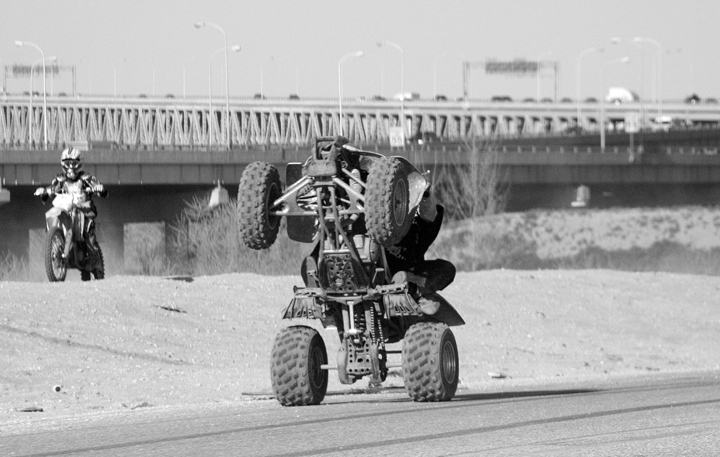
If you ever attended one of these (illegal) street racing events, you remember the noise and dust. Back in 2007, during my initial visit, I made this photo (above) of a rider falling off his quad as he reared it up into a wheelie position! (By the way, this is what the dirt track side of the road looked like back then, with I95 in the background.) I remember that day quite vividly. As the rider fell off, the quad continued on down the road, falling back on all four wheels, and … continued down the road headed straight for my car (which was parked on the side of the road)! As I started running toward my car, the rider got up and ran after his quad (which was maybe going about ten mph). He passed me and jumped up onto the moving vehicle, dropped into the driver’s seat, and retook control. I was shocked. Talk about goon riders. These guys were in it for the show, pulling all kinds of tricks for the crowd. 


And there was quite a crowd that day, maybe a hundred people and about thirty cars pulled up on the grass alongside the road. I’d gone back to this racing area every couple years to photograph the mayhem and every Saturday in the summer there were dozens of bikers tearing up the dirt track and racing in the street.

Crowd gathered to race and observe in 2011

“When the strip shuts down we run 'em in the street

From the fire roads to the interstate

Some guys they just give up living

And start dying little by little, piece by piece,

Some guys come home from work and wash up,

And go racin' in the street.”
– "Racing In The Street,” Bruce Springsteen

In addition to the paved road racing, the Motocross, quad, and dirt bike crowd had their own trails, jumps, and gullies to tear up. In the photo below, you can see the bare dirt behind the cars – this was the riding area. Now, in 2015, that area is overgrown with weeds and separated from the paved road by a steel guardrail. Near one of the bends in the road is a sign post decorated as a memorial, a symbol of urban mourning. 


His name was Ron, from what I could make out from the heartfelt goodbyes spray-painted on the guardrail. He was a cyclist who died at this point on the road, possibly while he was racing.

"For all the shut down strangers and hot rod angels,
Rumbling through this promised land …
"

 – "Racing In The Street," Bruce Springsteen


There is a color photograph, among other things, attached to the memorial pole. Stuffed animals, a broken guitar, and beer bottles are heaped at it's base in the weeds; a small guitar amplifier is attached to the top of the pole. He must have been a musician as well as a daredevil cyclist. The photo shows a young man on his motorcycle, with dates written below the image. The casual onlooker might simply assume that someone died in an automobile accident here.

"I want to blow 'em all out of their seats
Calling out around the world, we're going racin' in the street.”
    – "Racing In The Street," Bruce Springsteen


The date on the photo indicates that Tom (no last name written) was born in 1989 and died in 2013, at 23 years of age. The last time I had witnessed the street racing here was in 2011. In the four years since I’d been here, a few things have changed. Tom died, and maybe as a result of that, the authorities decided to put an end to the fun. Concrete road barriers were placed alongside the airport side of the roadway to keep cars from parking there, and spectators from climbing the hill. The guardrail was installed to barricade the dirt trail area on the opposite side of the road. In the photo below, you can see the overgrown area that was the dirt track. The signs beyond the road racing stretch of Fort Mifflin Road indicate that the land on the dirt track side of the road is owned by the Philadelphia Water Department. This area is home to their "water pollution control plant," a waste treatment facility - an area totally uninhabitable because of the smell.

Truly, "Darkness on the Edge of Town"

The road and trail racers have probably found new locations for their wild rides. I’ve stumbled upon them in the past and will likely stumble upon them in the future. One thing is certain, however - Tom, R.I.P., will not be one of the participants. 

In his dirge-like 1978 song, "Racing in the Street," Bruce Springsteen sings:

"Tonight, tonight the highway's bright
Out of our way, mister, you best keep
'Cause summer's here and the time is right
For racin' in the street."


(Click here to listen to this song from the album "Darkness on the Edge of Town" by Bruce Springsteen )
 

Friday, August 28, 2015

The "White Light" and the Atlantis Society

I’ve long been fascinated with the idea of burial at sea – the ocean as your final destination. The act has many romantic and historical connotations. Every once in a while the “Cemetery Traveler” in me will investigate such a service. Apparently, they exist along the east and west coasts of the United States. One such burial at sea operation is The Atlantis Society, on Lido Island of Newport Beach, California.

Atlantis, the (presumed) mythical “lost continent” that sunk into the sea, is presumably where the Atlantis Society got its name. The name itself conjures up Western Society’s profound fascination with the “lost civilization,” the powerful and advanced kingdom that sank, supposedly, into the ocean over the course of a night and a day, around 9,600 B.C. (ref.)

Newport Beach, California, as seen from across the bay on Lido Isle
I was in Newport Beach this past summer and decided to pay a visit to the “White Light,” the yacht used by the Atlantis Society for ocean burials. “White Light,” of course, is a perfect name for the ship that takes you on your final voyage. People who have had near-death experiences sometimes describe seeing a white light and feeling profound calm, which we assume is God, or heaven, or whatever you believe is supposed to greet you in the afterlife. So whatever you believe the “white light” to be – the Heavenly Presence or a neurological REM intrusion (a sensory mix-up as the brain wakes up) – you must admit that it’s a great name for a boat.

White Light, the boat, is typically docked at the far end of the pier at the Lido Village Marina. Lido is a small island off the shore of Newport Beach. To get there you simply drive through the astounding wealth that is Newport Beach – south on Newport Blvd. (California 55 Freeway), to the Pacific Coast Highway (PCH). Cross the PCH (California 1) and turn left at Via Lido (first light across the bridge). You’re now on the tiny island of Lido.

If you know the catchy 1976 Boz Scaggs song, “Lido Shuffle” (here’s a link to it), it will be going through your head as you drive past the palm trees and surfers on the bay. The song, by the way, has nothing to do with Lido Island. However, the lyrics totally describe this extremely affluent area of southern California:

"Lido, oh, oh, oh
He's for the money, he's for the show ..."

I drove across the bridge and made a left onto Via Lido, as the Atlantis Society’s website instructs me to do, then I made a quick left into the public parking structure. The stores and shops along the dock were under construction during my visit, so it was a bit of a challenge finding my way to the bay side where the marina is. Once there, you walk about a city block’s distance to the end of the dock where the “White Light” sign is hung. From a bit away, I saw a fellow hunched down on the deck of a yacht doing some work, and thought this might be the vessel in question.

The "White Light" from the Atlantis Society website

"White Light is a 67 foot LOA Chris Craft Commander, coast guard licensed and certified to carry up to 49 passengers to sea. Roomy, tastefully appointed and fully stabilized, White Light provides the perfect platform for your memorial service. Alcohol can be available upon request as we have a fully licensed and stocked bar." - Atlantis Society website


Unfortunately, the yacht I saw being worked on was the one in the slip NEXT to the empty slip where the White Light should have been. Perhaps it was out performing a burial service. (Burial at sea, as you can see from the AtlantisSociety website, is specifically the “scattering of ashes at sea,” not a full body burial.) I called the phone number on the sign with my cell phone and the gentleman at the other end of the line confirmed my suspicion – the captain had the ship out at sea performing a burial. He would not be back for two hours.


The Service:
"Families choosing to witness the scattering of ashes service will board the vessel at our dock in either Southern California or Washington state. From the berth, the yacht will proceed to a pre-established latitude and longitude."

"Once at that destination, a service is conducted by the Captain or Chaplain as requested followed by a flower toss and our Circle of Tribute. The vessel then cruises back to the dock.
Included in our service are coffee sodas and juices as well as roses for all the guests. Included, upon request, a commemorative certificate which includes the date and location of the final resting place will be mailed to the family." - Atlantis Society website


Should I come back in two hours to see the White Light? Who would disembark? How long would that take? Would that be too voyeuristic on my part? I decided not to wait but rather imagined myself a mourner seated on the “White Light” bench waiting to set out on that last voyage. I wondered what the neighboring yacht owners thought about this – was it like having a cemetery next to your house? The sun was shining, eighty degrees and no humidity - a beautiful day. A young boy was paddling a surfboard across the bay. Calm. I wondered if the mourners on the White Light were dressed in black? How could they even be sad in southern California?

A few years ago I visited with a man who does burials at sea (see link to my blog, "Burials at Sea") and was told that he does not go out to perform the service when the seas are not calm. I imagined all sorts of reasons why, such as safety and comfort to the passengers. What I did not realize until my visit to the Lido Village marina, was that a calm sea in the sunshine is more likely to result in a happy fond farewell. Scattering ashes of the departed by loved ones aboard the White Light should be a focused event, a ritual of closure, maybe even a celebration of life, unmarked by distracting rough seas or bad weather.

The Cost:
Every once in a while one of my Cemetery Travels doesn’t quite end up where I expected. This one ended up mostly in my imagination. Except for the fact that after my return to Philadelphia, I inquired about the price for a burial at sea, performed by the Atlantis Society. For up to six guests the fee is $850.00 and for over six and up to forty-nine the price goes to $985.00. Both are a two-hour service with beverages, roses and a small memorial service.

As I left the dock I walked past a small book shop called Lido Village Books beneath the parking garage. I cannot resist a book shop, especially a non-corporate, non-chainstore operation. Had a nice chat with the proprietor and bought a copy of Stephen King’s autobiographical book, On Writing. King most certainly has thought about the white light and near-death experiences. Regardless, one must admit that “White Light” is a great name for the boat that takes you on your final voyage!

References and Further Reading:
Atlantis Society’s website
Discovery video on seeing "white light" in a near death experience
Things to do on Lido Isle
"Burials at Sea"  Cemetery Traveler blog posting

Sunday, August 16, 2015

Headstones in the Wall

One of my blog readers emailed me this question recently:

“Have you ever seen or do you have any knowledge of a cemetery that has the tombstones set into a cemetery wall? If so, any idea as to the origins of this particular type of tombstone arrangement?”

I have seen this occasionally, and I wanted to share my observations with the wider audience because it is a curious sight, and not very common.You can see one example above.

Stacked, dislocated grave markers
In older graveyards, after headstones have fallen, people will sometimes collect the stones and set them into the cemetery wall, with mortar. My guess is that over the course of decades of collecting fallen stones and propping them against a wall or stacking them up, the corresponding grave locations have been lost. Therefore, the stones cannot be replaced back onto the correct graves.

As a way of preserving the stones (and the history of those interred), at some point people may take it upon themselves to set the stones into a wall. An example is the photo at top, from Philadelphia’s Old Pine Street Church Cemetery, a Colonial-era burying ground at Fourth and Pine Streets. Burials began at Old Pine in 1764, and the grave markers set into the wall are mostly those of 18th and very early 19th century Philadelphians. They were dislocated from their corresponding graves were reset into the wall during a reconstruction project in the 1960s.

Another technique for preserving the headstones which have been separated from their corresponding graves is to set them standing up in mortar as you see below. These stones were reset in 1999 by a group of volunteers. The grave markers had mostly fallen and the small B’nai Israel Burial Ground in Southwest Philadelphia had been neglected and vandalized. This was a way to clean up and create more of a memorial park effect. Headstones were set in concrete around the perimeter of the property. The graveyard had been established in 1856 by the (now defunct) B’nai Israel Congregation (read more about that in my blog post, “Abandoned Jewish Cemeteries.”)


B'nail Israel Burial Ground, Southwest Philadelphia
A possible answer to the original question of why tombstones may be set into a cemetery wall is that a headstone MAY be set into a wall, for instance a church wall, to indicated a burial at that spot. I suppose a wall could be built with provisions for adding grave markers, but you wouldn’t want to be repeatedly digging down to the foundation to bury people.

Reference and Further Reading:
A detail history of the tombstones in the wall of Old Pine Street Burial Ground is given in this wonderful Hidden City article, entitled,
The Tombstone Wall Of Society Hill