Wednesday, July 10, 2013

A Cemetery ... Coloring Book?

Your favorite Cemetery Traveler does not have to visit actual cemeteries to get his jollies. Oftentimes adventures can be had in other places, like a used book store, for example. Phoenix Book Store in Lambertville, New Jersey, has been something I’ve wanted to check out for months. In mid-June, I had the opportunity to do just that.

Let me start by saying that they are going out of business in August 2013, so time’s a wastin’ if this article excites you and you want to partake of their wares. Phoenix Books specializes in used, rare, and out-of-print books. Antiquarian booksellers are not businesses I frequent, but I do read a lot so it seemed worth checking out. When I got there, I was surprised to see a sign on the door saying everything was half price! So that made the not terribly high prices even more palatable.

I looked around a bit and noticed a large rack of photography books, art books, architecture books, but nothing having to do with cemeteries. After picking up a monograph of Brett Weston’s photography (Voyage of the Eye), it occurred to me to ask the shopkeeper, “Do you have any books on cemeteries?” He thought a moment then shook his head, saying, “No, we don’t … don’t think so …” And then he brightened up and said, “Oh wait! We do!” And he went darting off between the stacks (that’s librarian-speak for the shelves full of books). The kind gentleman returned with the coloring book you see pictured here.


I was astounded. Shocked, tickled even, by my good fortune. Ask and you shall receive. Who would have thought such a thing existed? Not I, said the Cemetery Photographer. The 8.5 x 11 inch sized, thirty-page paperback was published by California’s “Forest Lawn Memorial-Park Association” in 1962 (what were they thinking?!). While I paid four dollars for it, there is no actual price on the cover. This led me to believe that it was given to children (with a pack of crayons?) by the funeral director while the parents were …making final arrangements? But I was wrong (as I so often am). I found this tidbit on the Internet, written in 2009, recalling the author's memories from 1969:

"What I do remember very well is the Forest Lawn coloring book I bought in the gift shop. In it, one could lay crayons to the sculpture and buildings peppering the deep green landscape. (Green was a dominant color in this book.) The cover foretold the fun inside: two children, hand in hand, walk through Forest Lawn's open gate. Ah, family values. Four decades later, who knows if any of the Forest Lawns even have a gift shop."

I’m not certain the writer (Steve Crum) realized the oddness of his experience. Does anyone reading this blog know of any other cemeteries that have published coloring books? To a child, I suppose coloring a scene from the Crucifixion or angels serenading a deceased baby might not raise eyebrows. I know my own three-year-old daughter is undiscerning about what she colors. Granted, the Last Supper and the Pieta are relatively innocuous and safe, but wouldn’t you think coloring an outline of the Administration Building and the Flower Shop to be rather boring? And what about that front cover? A little boy and girl walking hand-in-hand through the cemetery gates? What’s up with that? Why the amber vortex beneath their feet? Are they entering a Disneylandia-type entertainment complex or did they just die and are entering Heaven? And why SIX scenes from the crucifixion?!

At the time of Steve Crum’s colorful experience (1969), I don’t expect Forest Lawn was the huge entity it is now, owning ten Forrest Lawn memorial parks around southern California. I’ve been to two – the one in the Hollywood Hills and the one in Glendale. Back in 1993, I visited the Glendale memorial park in search of movie stars’ graves. I found none, while I expected to see many. I guess I thought the place would look like the Hollywood Forever Cemetery (Hollywood, CA), where massive monuments to silver screen titans cover the grounds – even if you weren’t totally up on your silent movie star catalog, at this place ALL the surnames sound familiar! Not so at Forest Lawn. Forest Lawn is, as its architect might have said, more ‘dignified.’
 

According to the “Seeing Stars” website, “There are more major Hollywood stars buried at Forest Lawn Memorial Park than at any other spot in the world.” Now realize, there were no such websites in 1993. All I had to go on were some stupid “Hollywood Stars” maps that people sell on the street corners on Sunset Boulevard (which is where I bought mine). The Glendale Forest Lawn, I have since discovered, is the original and largest (300 acres) of the Forest Lawn Memorial Parks. That coupled with the fact that all the grave markers were flat-to-the-ground and very spread out, I found no movie stars.

Forest Lawn is a memorial park. At the time, I did not distinguish between this and a typical cemetery with upright headstones, statues, and monuments. At the time, I also did not realize the historical importance of Forest Lawn being the nation’s FIRST memorial park. For the uninitiated, a memorial park is a cemetery without upright gravestones or family monuments. They are characterized by flat meadow-like grassy fields with flush-to-the ground grave markers.
Back in 1912, a fellow by the name of Dr. Hubert Eaton purchased Forest Lawn Cemetery in Glendale, California (it was established in 1906). His innovative plan for the cemetery was to turn it into "a great park devoid of misshapen monuments and other signs of earthly death, but filled with towering trees, sweeping lawns, splashing fountains, beautiful statuary, and ... memorial architecture." (Wikipedia ref.)


For the most part, Dr. Eaton succeeded. His idea caught on and spread throughout America. I can’t say I’m a big fan of the concept, much preferring the art and architecture of an old Victorian cemetery. The major attraction of the memorial park to the owner, I am sure, is the relative ease with which the grounds can be maintained. Run that riding mower right over the flat grave markers – no bothersome statues and monuments to dodge, no meticulous weed-whacking necessary.

But according to the coloring book, Forest Lawn has many other attractions including the Finding of Moses Fountain, Wee Kirk o’ the Heather Chapel, and the Last Supper stained glass window in the Memorial Center of Honor. For a more updated list, you can check out Forest Lawn’s website.

So while Phoenix Books did not provide me with any other cemetery books, the Forest Lawn coloring Book is a substantial piece to add to my collection. I did find some other choice pieces,  including a copy of The Devils’Race Track – Mark Twain’s Great Dark Writings. I’m sure there are other treasures awaiting you in these last couple weeks before they close, so run! Perhaps like the phoenix of Greek mythology, it will go down in a blaze of fire and at some point be reborn, rising from the ashes of its predecessor.

Further Reading and Reference:

Yelp Review of Phoenix Books in Lambertville, New Jersey (with map):
Forest Lawn Memorial Parks website

Visit Phoenix Books before they close their doors forever in August, 2013!
49 N. Union Street
Lambertville, New Jersey 08530
609-397-4960

Sunday, July 7, 2013

Manahawkin Baptist Graveyard - Stronger Than The Storm


As I wrote about the west coast of the U.S. last week, it’s only fair to maintain a sense of balance with an east coast story. Last week I was at the Jersey Shore (Long Beach Island) with my wife and daughter, and so I made a trip to one of the local cemeteries (isn’t that what you would expect the Cemetery Traveler to do while on vacation?). Manahawkin, New Jersey is the last town on the mainland before you enter the causeway over to the island.

Last year I wrote about Greenwood Cemetery, a largish seaside cemetery on Route 9 south of Manahawkin. This time, I opted to head north. My map showed a Baptist Cemetery about a mile up the road (north on Route 9, past the Route 72 intersection, as shown on map).

Long Beach Island, in the aftermath of Hurricane Sandy (NJ.com image)
Woke up at 6:00 a.m., got dressed and made it out the door without waking anyone. Walked over to what is left of the beach as the sun had just risen and grabbed a couple shots of the show. As I drove the seven miles up the island to the causeway, the view was indeed depressing. In the year since I had last visited, Hurricane Sandy had wreaked massive destruction on the island. Here, a scant eight months later, homes were still up on blocks after being shifted off their foundations. Many businesses were boarded up, many areas of the ocean beach was gouged so that instead of smooth sand declining from the dunes to the water, there were canyon-like drop-offs of epic proportions.

One of many homes washed off its foundation (NJ.com image)
Still, the locals have done a great job putting this place back together - they certainly live up to their slogan, "Stronger than the Storm." That said, I couldn’t help wonder if the cemeteries suffered any damage. (Which reminds me – someone contacted me recently with a request to use my blog post "Washed Out Graves" - about flooded graveyards - as part of a presentation on Disaster Preparedness for Cemeteries.) Hurricane Sandy hit the east coast of the United States on October 29, 2012, with New York City and New Jersey suffering the worst damage. It was the second costliest hurricane in U.S. history, surpassed only by 2005's Hurricane Katrina

Baptist Cemetery was easy to find, what with its little white clapboard church situated at the front of the old graveyard. Talk about shelter from the storm – there are some eighteenth and even seventeenth century headstones here that are in such well-preserved condition, you’d think they’d been under glass for a hundred years! But I’m getting ahead of myself.

Johnette Napolitano – the gravely-voiced singer from the rock band Concrete Blonde – was playing a concert in San Francisco on this particular Sunday evening in San Francisco when I visited the Baptist cemetery. I bring this up mainly to convince myself that it was not her I saw roaming around the graveyard at seven a.m. accompanied by a guy carrying a guitar case. Might not have been the most unusual thing I’ve ever seen in a cemetery, but given the time of day, it qualifies for the top ten. Besides, Johnette is kind of spooky herself (just watch this video). I said, “Hi. Didn’t expect to see anyone else here this early.” The guy sort of smiled and they walked around to the other side of the old wooden church, then disappeared.

Baptist Church and Cemetery, Manahawkin, New Jersey
If you’re a legacy reader of this blog, you may recall that in my early days of cemetery photography, I wouldn’t be caught dead in a place like this. Not while I was alive and toting a camera, anyway. Why? No statues. Nary an angel. But after you’ve exhausted the possibilities of statuary photography (or rather, you've hit your own limits), you begin looking elsewhere. I’ve hence begun to appreciate other nuances of cemeteries (and there are thousands of such things, mind you). So the small country cemetery with nothing but stone slabs for gravemarkers does not escape my attention these days. And my photography and writing are all the better for it, I believe. So with that in mind, I began looking at the inscriptions and carvings on the stones.


Although there are a few newer (early twentieth century) granite monuments here, most of the head stones were of the large marble variety with the traditional images, poetry, and epitaphs. However, as I said, many were clearly readable and apparently not worn down by acid rain (is there less of this in coastal areas?). They were really quite beautiful, especially this pair of white marble nineteenth century markers with the clasped hands design. 

White marble headstones, about four feet high
To the left and behind the peeling white church building, I was somewhat shocked to find a small cluster of about five red sandstone grave markers, all but one standing upright. Obviously the oldest in the cemetery (eighteenth century), covered with some sort of lichen or mold that gave them the appearance of being old and worn. Red sandstone was quarried in North Jersey back in the 1700s and is commonly seen in cemeteries around Monmouth County (a bit north of here). Upon closer inspection, these stones were actually wonderfully preserved! I was amazed to see that the lettering and design carvings were not eroded at all, but simply camouflaged by the lichens. The text was clearly readable with border designs still quite crisp. This particular one (below) was dated 1794. A bit of proper cleaning and these stones would be the showpieces of the cemetery.

North Jersey red sandstone grave marker
Freshly-cut area where shrubs must have obscured headstones
Although the church (which I’m not sure was still “Baptist” as the maps indicated) was a bit ramshackle, it was obvious that the cemetery is being tended by someone. There was evidence that trees and bushes had been cut back and removed, to keep them from obscuring the gravestones. I thought this image (below) interesting – the marble stone on the left was still lichen-tinted from being in the tree’s shade for what must have been years, while its counterpart in the sun was lichen-free.


Though I could see no obvious hurricane damage in the cemetery, there was a very obvious reminder of nature’s powerful forces - a large granite monument to “The Unknown From the Sea” (a photo of which you can see at the beginning of this blog). This monument marks the graves of those unknown souls who have left the corporal realm by way of drowning, I suppose. It was in the center of a decoratively-fenced area of about 250 square feet toward the back of the grounds - plenty of room for folks who had tested their mettle against the mighty Atlantic Ocean, and lost.

Further reading:

Learn more about red sandstone and New Jersey gravemarkers in general in Adam R. Heinrich’s paper: 

Read about Manahawkin's Greenwood Cemetery in the "Jersey Shore Cemetery," blog by Ed Snyder

Wednesday, July 3, 2013

Burial at Sea

When it comes to the idea of “burial at sea,” I’m probably influenced more by the romanticism of the idea than anything else. My guess is that most of my readers are too. When it comes to the cold, hard facts of how someone gets buried at sea, I’m in a rather wobbly boat. So it was with great interest and fascination that I phoned Captain Johnnie Lee, the proprietor of Long Beach, California’s “Burials at Sea” service.

Queen Mary in background
Amidst the pleasure cruise docks, tourist traps, and the Queen Mary in Long Beach, California, is an interesting sign on Pine Street’s Dock 5: “Burials at Sea, by Captain Johnnie Lee (310) 387-0587.” I was in Long Beach a couple weeks ago, so I went down to the docks and phoned Captain Lee. Unfortunately, he was not at his boat at the time, so I only conducted a phone interview with him. He was very forthcoming with his information, and after I told him I’d like to interview him for my Cemetery Traveler blog, he invited me to the boat the next day. Unfortunately, I was in the midst of a teaching engagement at the Convention Center and so had very limited time.

The idea of burial at sea is intriguing to me, so I had many questions about it. What you see below is as close as I can get to a transcript of our conversation. I took notes while sitting on the pier across from his boat on a sunny Saturday afternoon in June, 2013.

Dock 5, Long Beach, California: location of Captain Lee's vessel
After I returned home to Philadelphia and read up on the subject, I found this excerpt from Captain Lee’s website. I’ll let it set the stage for the interview:

Capt. Lee, alongside his vessel, "The Great Faith" (ref.)
Image above and text below are from the website, “Burials at Sea by Captain Johnnie Lee:”

Scattering of ashes and a Sea Burial Ceremony is a time honored tradition. Widely accepted throughout the world, and becoming even more so considering factors such as cost, land use and environmental concerns, and acknowledged in the Book of Revelations, Chapter 20, Verse 13:
"And the Sea gave up her dead that were in it...."


Interview with Captain Johnnie Lee of “Burials at Sea”

CT: How many burials do you do?
JL: Three or four families per day on the weekend, and maybe one or two during the week. I’ve been doing this for about fifteen years. My business has grown to approximately 400 services annually.

CT: I assume we’re talking about ashes, not whole bodies?
JL: Correct. I do not do full body burials, just cremains. For full body burial, you have to go further out and you must be in at least 600 feet of water. You must also weigh the body down.

CT: How far out to sea do you go?
JL: Two to three miles – the law requires a minimum of five hundred yards.

CT: I hadn’t thought of that - there are laws and regulations …
JL: I am certified and licensed, as well as registered with the state [California Cemetery and Funeral Bureau] Cemetery Bureau.

I should note that my interview was done right off the top of my head. I called Captain Lee spur-of-the-moment, and I truly appreciate his graciousness and patience with me. So my questions kind of jumped all over the place, often being spurred in a new direction based on unexpected information imparted to me by Captain Lee.

CT: I assume your burials are somber events?
JL: Not really, it’s not sad. It’s peaceful, tranquil. The ocean helps a lot.

Image from the brochure shown above.

CT: How do you actually drop the ashes into the sea?
JL: I lower them into the ocean in a basket covered with red rose petals. When the last of the petals have floated away, I bring the basket back up.

CT: Sort of analogous to lowering a casket into the ground.
JL: Not really. It’s a scattering at sea.

CT: It seems romantic, something I don’t remember seeing anywhere on the East Coast.
JL: It’s not so much romantic – scattering at sea is part of the Asian, Indian, Hindu, and Buddhist culture, but is becoming widely accepted by all people.

CT: For others, whose religion does not dictate a water burial, it seems like there is no actual closure, no tangible memory left of the deceased – no grave to visit.
JL: The event is one of release and tranquility; each one is unique. I give each family an 8 1/2" X 11" certificate that has a seascape in the background, with their loved one's name, date the service was performed, GPS coordinates of the exact burial site, and my signature.

Image from the website "Burials at Sea by Captain Johnnie Lee"
[Captain Lee added, in a later conversation, "One of the advantages of a burial at sea service vs. the traditional, is you don't have to wait for business hours to go visit your loved ones.  Just go to the ocean, anywhere near the ocean, and you can have that closeness."]

CT: Do you get repeat business?
JL: Oh, yes many people who go out with me decide right then, that they want this type of service for themselves.

CT: Do you have any extraordinary recollections from your years of providing this service?
JL: Weather conditions. Choppy seas. On my first service, I let the surviving family member release the ashes overboard and the wind blew them back at us. Since then, I designed the basket approach.

End of Interview

I have to say that Captain Lee in no way thought this final comment humorous – he was very serious and treated the matter with the utmost respect. The honor and dignity afforded to the process and people involved by Captain Lee was quite obvious. My interview ended there with his invitation to meet me at his boat the next day. Unfortunately I could not do this.

One of the intriguing questions regarding a burial at sea service would be, “How much does it cost?” I have copied the full fee schedule from the Captain Lee's Burials at Sea website:

Fee Schedule

Witnessed Burials at Sea: $450.00 for 1 to 6 people on board when departing from Long Beach or Alamitos Bay*, $500.00 for 1 to 6 people on board when departing from Huntington Harbor. An affiliate vessel that carries up to 149 people on board is available. Please call Capt. John for pricing of this vessel. Fees are payable by Personal Check, Cash or Major Credit Card. Payments by Credit Card must be made two days before the planned departure date. Payments with Cash or Check may be made when we return to shore.

Permits: Client families are required to obtain the Burial At Sea Permit from their Mortuary, Crematory or local Department of Health, and bring it with them on the day that we depart. I will execute and file the Department of Health Permit with the appropriate agencies, with copies to my client family and Mortuary.
Non-Witnessed Burials, where I scatter the cremated remains without the family on board: $100.00 per scattering, payable upon receipt of cremated remains, and Permit.

Extended cruises and special requests may be accommodated.

* Note: An additional fee of $100.00 applies to Alamitos Bay departures only, payable directly to the Alamitos Bay Harbor Master.

Further Reading and References:

Burials at Sea by Captain Johnnie Lee website
Burial at sea, Wikipedia

Monday, June 24, 2013

Angel Skies

In a prior lifetime, I lived near a cemetery. Whenever I was home and the sky grew dark with an approaching storm, I would always check to see if the setting sun was also throwing bright horizontal light on the buildings in my neighborhood. If the conditions were such, I called this an “Angel Sky,” perfect (for me) lighting conditions for photographing cemetery angel statues. It was my personal, yet skewed version of "Rembrandt lighting," portrait lighting in which part of the figure is directly lit while a portion of it is in shadow.

Statue in Holy Cross Cemetery
I would jump in the car with my camera gear (always loaded with the right film!) and drive the two miles to Holy Cross Cemetery in Yeadon, Pennsylvania (a southwestern suburb of Philadelphia), to photograph the statues. This didn’t happen as often as I would have liked, but still, I made some great photographs over the years. Here's an example (at right) of one of those early images.

Fast forward a dozen years and I’m living in South Philly, eleven miles from Laurel Hill Cemetery. Laurel Hill is the closest cemetery to my house now - that is, the closest cemetery that has statues placed high enough off the ground that will allow me to take full advantage of an angel sky. Through city traffic, that’s a minimum of a half hour drive. So now when the atmospheric conditions are right, it is more difficult for me to make the most of it. Therefore, in most cases, I just curse my ill luck and go back to doing whatever I was doing, ignoring the sky.

This past Friday evening (in June), I looked out my window and the sky to the east was almost black! Not only that, but the late spring sun was blazing brightly low on the horizon (it was around seven p.m.). Assuming I’d never make it to Laurel Hill in time, I called my friend Frank who lives there (!) and asked him go out into the cemetery and make great photographs. I would enjoy the conditions vicariously through his work. He said, “Well, come on up.” It’s very convenient having friends who will unlock the gates for you at a moment’s notice! (Most cemeteries around Philadelphia are locked up at night.)

William F. Hughes, Philadelphia Hay King
I told him I couldn’t possibly get there in time and hung up. My wife said, “Go.” Was the long trip through ridiculous traffic worth ten minutes of actual shooting time? Arghh! Decisions! I dropped off my wife and our 3.8 year-old daughter at the neighbors’ for pizza, jumped in the turbo Saab and tore up the parkway. I called Frank and told him that I was on my way. Like William Hughes (statue at right) might have said, best to make hay while the sun shines (Hughes made a fortune as a hay marketer in mid-1800s Philadelphia). Frank said he’d put beers in the freezer and added, “There’s a rainbow over the cemetery.” Blast him. I dodged all the slow-moving traffic where I could and made it to Laurel Hill in about twenty minutes.

I arrived to find the lighting conditions still good! Score! I’m golden, literally and figuratively. The white marble statues were painted yellow by the sun. If only the darned things would have the common decency to be facing the right direction! Ah, well, one takes what one can get. I shot mostly in color, whereas in the past, I would have done all black and white. The intense golden saturated colors were too good to pass up!


The rainbow was gone, but there were about twenty minutes of sunlight left and the eastern sky was still dark! We jumped into Frank’s truck and sped off to the best part of the cemetery for front-lit statues. We utilized those last twenty minutes of sunlight quite efficiently, shooting a half dozen or so angels and other monuments in their gorgeous contrasty golden splendor. Soon after, the light grew dim and the sun lowered itself behind the trees across the western shore of the Schuylkill River. We retired to his patio for beers as we watched the azure sky grow darker over the hillside graves behind Laurel Hill’s gatehouse.

Sunday, June 16, 2013

"TearDrop Memories" and the Mourning Arts

If you’re at all into the mourning arts, you owe it to yourself to visit a shop in New Hope, Pennsylvania, called TearDrop Memories. The proprietor, Greg, is well-versed on the subject and can be wildly entertaining and informative. If you’re also into antique bird cages, he has them as well. I’ve never asked him about the connection – I’m sure there is one.

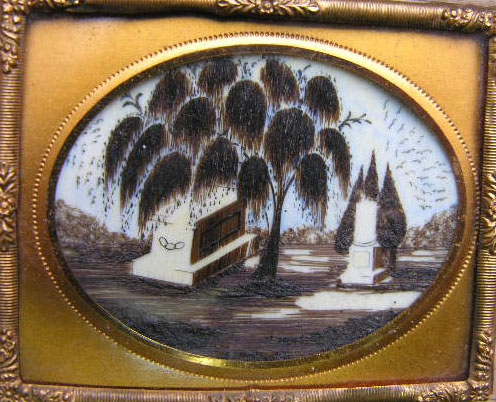
Pre-Civil War Hair Work Memorial
I just made my second visit to TearDrop Memories in six months. I suppose it will be a routine stop for me from now on when I visit New Hope or Lambertville (in Jersey, just across the river). Greg’s shop is unparalleled as to the extent of his collection, all but one item of which is for sale (you can ask him what that singular item is!). He has an inventory of thousands, large and small. Yes there are coffins and Victorian mourning attire, but there are also death masks and fine examples of Victorian mourning jewelry. (All the close-up images of mourning art pieces in this article are from TearDrop Memories' website.)

Check this out on Amazon.com
If you’re unfamiliar with mourning arts items, there’s a good book called Mourning Art and Jewelry (2004), by Maureen DeLorme. According to the author, decorative art to commemorate and memorialize the dead reached its zenith in beauty and popularity in the Victorian era. When the husband of Britain’s Queen Victoria, Prince Albert, died in 1861, Victoria went into a period of mourning that was unheard of up to that time. She eventually emerged from her overwhelming grief, and although she resumed her official duties, she dressed in black crepe for the remainder of her life. An entire industry of mourning arts grew out of this.

DeLorme explains: “Life spans were short … with the average age of Victorians at death being forty to forty-five.” Due to prevalent wars and the filth and grime of cities in the throes of the Industrial Revolution, people frequently did not live past the age of seventeen. Out of respect for the dead and a desire to preserve their memory, things like hair jewelry and mourning clothing were invented.  DeLorme states:

“Thus the pressures of continually facing death as an intrusion into everyday family life made the need to keep both the presence of the “Lost Beloved” near while simultaneously bidding farewell, a preoccupation. Victorians met this need by creating an extensive mourning culture employing elaborate mourning dress, jewelry, and funeral trappings; memorial portraits (both drawn and painted); postmortem photographs; sculptures, busts, and death masks; and a myriad of commemorative artifacts.”

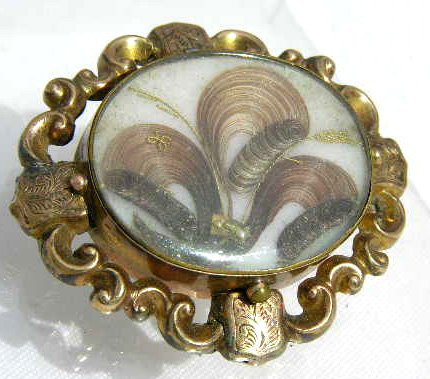
Example of Victorian Mourning Jewelry:
Human hair Memento Mori Remembrance Mourning Brooch
And by no means was this mourning culture isolated to Britain - mourning arts spread across the United States as well. You can see hundreds of full-color examples of these memorial items, with their histories, in DeLorme's book. You can also see most of them in person at TearDrop Memories. I’ve included in this article some photos I took in the shop, and you can see more on Greg’s website. Honestly, until you see such objects up close or hold them in your hand, you cannot fully appreciate their intense human connection.

Scene inside TearDrop Memories Antiques, showing Victorian bird cages

TearDrop Memories is located at 12 West Mechanic Street in New Hope (click for map), a block up the hill from New Hope’s storied Main Street (two blocks south of the bridge over to Lambertville). If you’ve never been to New Hope, you’re in for a surprise. This little town has a most intense tourist trade! Custom automobiles cruise the main street on sunny Sunday afternoons, while packs of deafening Harleys rumble by. In a four-block length of road, its not unusual to find fifty motorcycles parked. Leathers and feathers co-exist among the shops as well as on the shoppers themselves. Leaving the tourist traps one can veer up Mechanic Street past the quiet coffee shops and restaurants to number twelve, a storefront that welcomes you with an antique birdcage and an arrow inviting you down the steps to the back of the building, where TearDrop Memories is located. Goth girls, couples, and Victorian enthusiasts alike amble in to the small shop at a regular rate.

Greg Cristiano of TearDrop Memories
Outside on his patio, Greg stands a bird cage on a pole with a child’s white coffin propped against it. A curious juxtaposition for Main Street tourists to see. Once lured in, TearDrop Memories can certainly give you the willies. However, the one thing you can never fear is the act of asking questions. Greg, the owner, is most engaging, entertaining, and I might add, extremely well-schooled on his subject. He has been in this business since about 1996. He supplies both private collectors as well as cemeteries and museums with authentic mourning arts items.

Photo from TearDrop Memories' website


What can you find at TearDrop Memories?

One of  many displays at TearDrop Memories
Probably many things you never knew existed, like antique embalming pumps, mourning jewelry, wall hangings, clothing, memorial plates and other ceramics, coffin handles, coffin name plates, oh yes, coffins themselves. There are books, creepy dolls, death masks, post-mortem photographs, antique funeral parlor signs from when undertakers also built furniture. Many of the wall hangings and many of the brooches, pins, and rings incorporate the woven hair of the deceased (think weeping willow trees made of human hair). All in all, TearDrop Memories is a fabulous history lesson in our seldom discussed past.

Image from TearDrop Memories' website
On my most recent visit, I asked Greg to show me the weirdest thing in his shop. I won’t tell you what it was, but I’m guessing if you asked him on a different day, he’d pull something even more shocking out from under the counter! This place is not for the faint of heart. On one of the walls hangs an 8 by 10 inch lithographic remembrance of a child’s death (maybe from the late 1800s) – with four small coffin handles surrounding a little broken white porcelain angel. I commented “Why would you want something that grotesque hanging in your home reminding you of your child’s death?” Greg very astutely pointed out that it was one of the few things the family had to remind them of their child, not simply its death. He added, “Photography was invented in 1840, but it really wasn’t until after the 1910s that people could actually afford to have their picture taken. Up until then most people only had their photograph taken once in their lifetime.  So they wanted SOME tangible memory of the child.

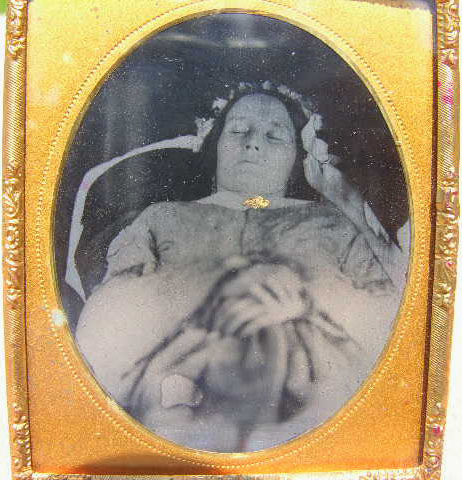
Post Mortem Ambrotype Photo 1850
As a photographer, I obviously have a soft spot in my heart for photographs and photography. I never thought about how precious a photograph could be, or used to be. Back in the Victorian era (1837 – 1901), it was a major life event to have your photograph taken. So after a child’s death, a remembrance of some sort was needed. I’m sure that if the cost of a photograph was great, the cost of a commissioned oil painting must have been out of most people’s reach. That said, people who had the money at the time of their child’s death would sometimes have a post-mortem photograph made of the child. Such photos might show the child in a coffin or dressed up and sitting up in a chair. Sometimes open eyes were painted on the closed eyelids, so as to appear alive, the way the family wanted to remember the child. TearDrop Memories has photographs of this sort for sale.

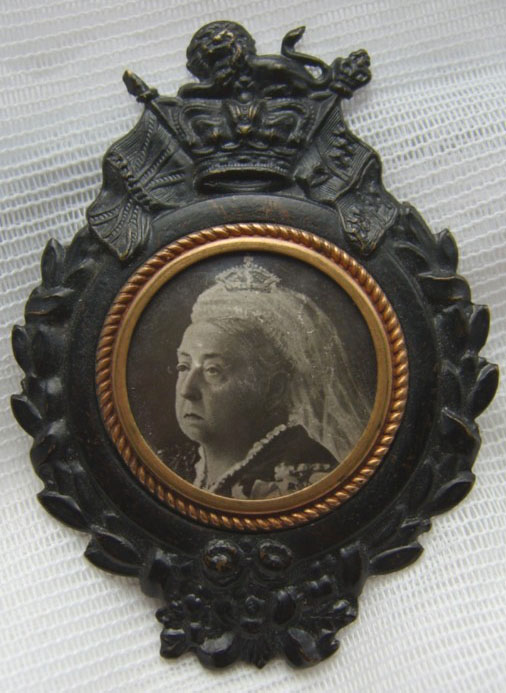
Queen Victoria Mourning Pin
The items in Greg’s store (and on his various websites, listed below) are not inexpensive. Even (at the time) throwaway Queen Victoria commemorative death pins can cost forty dollars. But you must remember that most of Greg’s inventory is unique, like the human beings they were designed to memorialize. So if you need an antique wicker casket or old marble headstones, this is the place to get them. Unlike the epitaphs carved on grave markers, Greg’s hours are not set in stone. It’s best to call him (215-862-3401) and leave a message regarding the day you’re planning to come by. He’ll phone you back and most likely have the door open for you whenever you’d like to stop in.

References and Further Information:

TearDrop Memories Antiques website
TearDrop Memories photos on Yelp site

Visit TearDrop Memories' web shops for great antique treasures:
http://www.TearDropMemories.com
http://www.NorthForkPets.com
http://www.MaidensMemoirs.com
http://www.WeSpeakAntique.com

TearDrop Memories Antiques
12 West Mechanic St. 2B
New Hope, PA. 18938
215 862-3401