Saturday, February 10, 2024

Falling Snow in the Cemetery

Okay, no more ChatGPT tricks. This is really me writing this. Really. No, wait, how would you know? Hopefully, my personality will suffuse the text to the degree that you’ll be able to tell its really me. I’m interested in my readers’ take on how I compare to AI, so please comment!

I should have named this post, “Falling In the Snow in the Cemetery,” since that’s one of the things that occurred during the recent January snow week while I was shooting cemeteries. But more on that as we slide along. I’ve photographed cemeteries in the snow many times, and recounted those experiences on this blog. Between January, 2022 and January, 2024, I really had no new experiences to recount.

Why is that? Well, it hadn’t snowed in the Philadelphia area in two solid years. We were due, I suppose. Can’t say I missed it all that much – go global warming! But we did recently get dumped on twice in one week – about three inches initially, then about six a few days later. I had a few opportunities to get out there with the cameras, so, Bob’s your chipmunk, as they say.

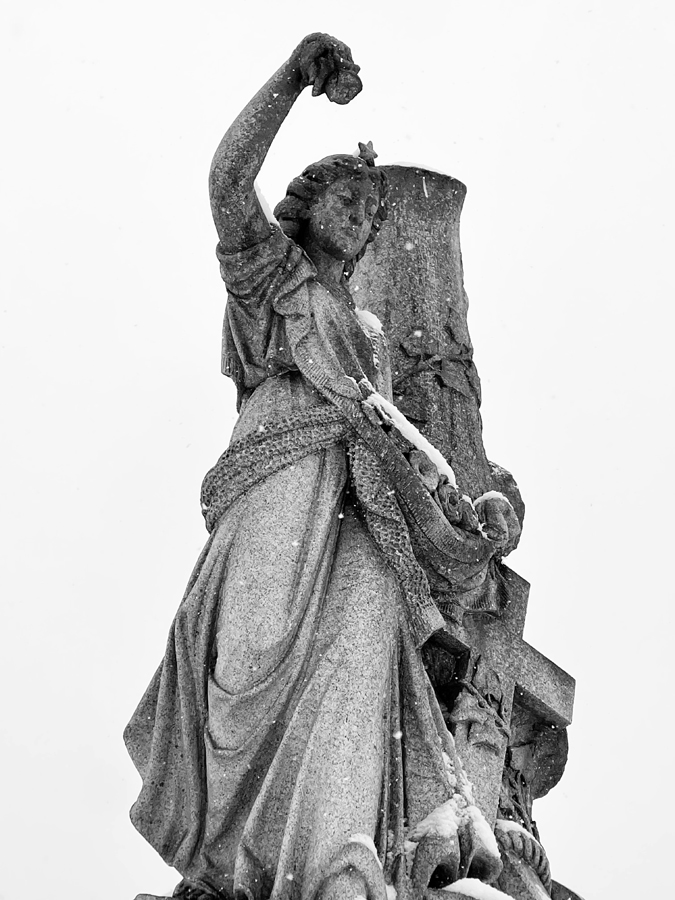
Old Swedes Church monument, Philadelphia
Early in the week, it snowed all day and I was able to get out to a few South Jersey cemeteries for some shooting before sunset. Actually, I began my snow shooting in the small Old Swede’s Church graveyard near my house in the Queen Village neighborhood of Philadelphia. The church sexton allows people to walk their dogs on the large open area next to the graveyard, and there were about ten dogs frolicking in the snow that morning. One woman had just entered the property and her large dog was pulling her along. She said something like “Slow down, Petey, I know you want to see your friends!”

Ben Franklin's grave, Christ Church Burial Ground (Pennies ...get it?)

Since I work in south Jersey, it was easy enough to visit nearby Harleigh, Old Camden, and Evergreen cemeteries after work. A few days later we had an all-day snow, so I was able to get out into an active snowstorm in Calvary Cemetery, in Cherry Hill. It remained cold for a week so I made the most of the weather by catching lingering snow in Philly’s Christ Church Burial Ground (Old City) as well as the Old Pine Church graveyard (Society Hill) on my way to and from work.

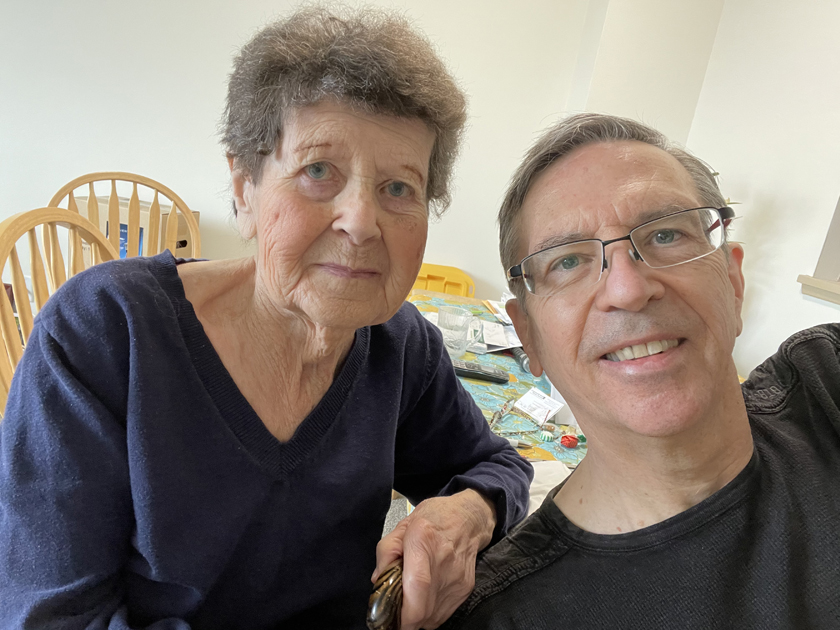
Selfie with friend in Calvary Cemetery, Hill of Cherries, New Jersey

But back to the beginning. The selfie you see of me (above) was made when I first arrived at Calvary. It was colder than a witty analogy. The photo below is me an hour later, after shooting in the piercing wind and trudging through six inches of fresh snow. Photographing cemeteries in a snowstorm can be quite an amazing experience – until its not. It is exhilarating to be out there alone with the elements, knowing full well no one else in their right mind is doing the same. Well, alone except for the groundskeepers plowing the cemetery roads. Probably wondering how unhinged this guy must be in the snow with all those cameras dangling from his neck. 

Jesus, it was cold out there!

As I repeatedly jammed additional “HotHands” chemical hand warmer pouches into my gloves, I kept thinking how I didn’t want to end up like Jack Nicholson in the final scene of “The Shining.” Its one thing to reach the point of self-actualization by getting that one-in-a-million shot, but the need for the safety of a warm vehicle in the dead of winter can knock you down a few pegs on Maslow’s pyramid, where you’re all of a sudden more concerned with basic survival needs. And losing digits.

Ansel Adams, eat your heart out. (Harleigh Cemetery, Camden, NJ)

Granted, this is nothing compared to what Ansel Adams went through to capture those gorgeous images of the snow-covered Rockies in Jellystone Park, or climbing onto his car roof with a tripod and a view camera to shoot, “Moonrise, Hernandez, New Mexico,” but it was challenging enough. Everything’s relative. Adams probably didn’t have a fourteen-year-old daughter at home who needed dinner made when she got home from school. 

Sunset, Evergreen Cemetery, Camden, NJ

Anyhow, that weekend it stayed cold (below freezing), so I spent a few hours trudging through Woodlands Cemetery in west Philly. Mainly I shot with the iPhone and Holga loaded with 120mm black and white film. It was so cold I couldn’t wind the film for the next exposure! (Remember winding film? …. Remember film? …)

Yours truly, with the Holga (Woodlands Cemetery)
The Holga. Yes, just another pain point in my photographic arsenal. A Holga is essentially a cheap plastic toy camera that uses 120mm film. As I write this, I’m waiting for the film processing place to develop my film, scan the negatives, and send them to Dropbox for me. I have no idea whether there will be anything good on that film. Actually I shot two rolls of 12 exposures (120 mm BW). I will wait until I get the results before I post this, so you can all witness either my ineptitude or my genius, whichever the case may be.

Turns out I was rewarded with two reasonable images – out of 24. Even a blind squirrel finds a nut twice a day. Here they are.

Holga images (L: Calvary Cemetery; R: Woodlands Cemetery)

Falling For You

At one point, in a cemetery I won’t name, I slipped on the ice. Wasn’t climbing on a monument. (Honestly, I don’t do that. Having seen a monument fall on a person, pin them to the ground and break their leg, I do avoid such near occasions). I was simply walking along the unplowed road, and my feet flew out from under me! My mind's eye was blind to the ice under the snow. I’d been looking out at the gravestones, eyes peeled for a good composition, instead of looking where I was walking. Obviously, I had not done the proper risk assessment. Hit my right shoulder on the ground with tremendous force:

According to Microsoft’s new AI powered Bing search engine:

"The gravitational force acting on a 200 lb mass is about 889 Newtons. A person who weighs about 200 pounds and falls just 6 feet will hit the ground with almost 10,000 pounds of force."

Calvary Cemetery, Cherry Hill, NJ
And I felt every one of those fekkin 10,000 pounds. Jesus H. Christ! Despite the pain, I made it okay hiking through the cemetery and shot for an hour, but then I realized I couldn’t raise my right arm very high. The next day, I couldn’t raise it at all. I spent the next week with T. Rex arms. Really thought I tore my rotator cuff. But after a week of Motrin smoothies, the pain began to
subside, and I started to regain my range of motion. I am glad that I continued shooting after the fall – I did make some decent photographs. Great art comes from great pain. 

Mausoleums, Harleigh Cemetery, Camden, NJ

Why Photograph Cemetery Statues?

Why subject myself to all this? Is it to capture/create a unique image? To build up my catalogue raisonnĂ©? To have ‘alone’ time? Or is it just the JOURNEY that’s important, more so than the destination? I think it’s a combination of all that, but my reason can best be summarized in something the artist Andrew Wyeth said to his granddaughter, Victoria Browning Wyeth, “my goal is not to make pictures but to express my love of these things.

I do love cemeteries and graveyards, which is why I use them in my art. Unlike Georgia O’Keeffe, who is widely known for her paintings of flowers, and said “I hate flowers – I paint them because they’re cheaper than models and they don’t move.” I appreciate the fact that access to cemetery statues is usually free and the statues (usually) don’t move. Cemeteries? I want to be there, and I want to create something. Paul Rudnick, in a recent New Yorker Shouts and Murmurs piece, wrote in jest about something “seemingly empty yet rife with meaning.” Describes cemeteries fairly well, don’t you think? 

Calvary Cemetery abstract, shot through glass in a snowstorm

While I certainly appreciate the beauty of a landscape or an Italian marble cemetery sculpture, I also appreciate the fact that people went out of their way to memorialize the dead. Sometimes a grave marker is the only tangible evidence that a person existed. Standing amidst these monuments can make one feel part of the human family. Like the dog, Petey, mentioned above, many of us just want to feel part of the whole.

Woodlands Cemetery, Philadelphia

Roland Barthes, the French literary theorist, philosopher, and critic said in 1977, “If photography is to be discussed on a serious level, it must be described in relation to death.” He added, “Its true that a photograph is a witness, but a witness of something that is no more” (Camera Lucida, 1980). So what better canvas with which to create new art than a cemetery? 

Sunset, Evergreen Cemetery, Camden, NJ

I also appreciate the beauty of a warm motor vehicle on a frigid day. Here’s another image I like, shot out the window of my wife’s Rav 4. Right after I made this image, I couldn’t get the power window to go back up! Panic. Twenty-four degrees outside. Another snowstorm expected tomorrow. After much fumbling around and considerably more panic, I realized there was an interlock on the door – a button that disables the power window function! Found that ten minutes later - released it and we’re back in business! Always never do that. But DO drive an SUV when you’re shooting cemeteries in the snow! You don’t want to get stuck. 

What Does Snow Add to a Photograph of Cemetery Statues?

To paraphrase Reese Witherspoon, who recently said that “Snow days were made for Chococinnos,” snow days were made for shooting cemetery statues. Why? Probably for the same reason she got in trouble for telling her TikTok followers that it was okay to eat snow. It’s novel, its enjoyable, and it probably won’t hurt you (unless you slip and fall in it, that is). 

Snow angel, Calvary Cemetery

Also, as I was surrounded by all this white, it dawned on me that one of the reasons I photograph cemetery statues is because they seem to be monochrome. They’re easy to shoot in black and white, and if you choose to shoot in color, there’s no color-balancing needed. No matter the hue, the observer’s brain corrects for it because you already know the statue is white. You don’t need a “Shirley” card to shoot cemetery statues.

(A Shirley card, by the way, was a photograph of a white woman (Shirley, a Kodak employee) used since the mid-1950s by Kodak photo labs to calibrate skin tones, shadows and light during the printing process.) 

Warholized cemetery angels (Evergreen Cemetery, Camden, NJ)

Supposedly, the Farmer’s Almanac said we are in for a rough winter. So maybe I’ll have more opportunities to shoot snow angels. I mentioned the Almanac prediction to my neighbor a couple months ago, a woman who moved to Philadelphia from Spain. She did not understand what the Farmer’s Almanac was, never having heard of it. I felt like an idiot trying to explain it, because, well, I couldn’t. To quote Pee-wee Herman: “Some things you wouldn’t understand. Some things you couldn’t understand. Some things you ... shouldn’t understand.” Like the image below….

The "Late Nights" image above is a mash up of two images combined as one. Both were made in south Jersey cemeteries during the snow week. Andy Warhol said that art is what you can get away with. Is it disrespectful or sacrilegious tromping through a graveyard making such photographs? I think that any attention we give those who have gone before us is a way of paying respect. Their memory lives on.
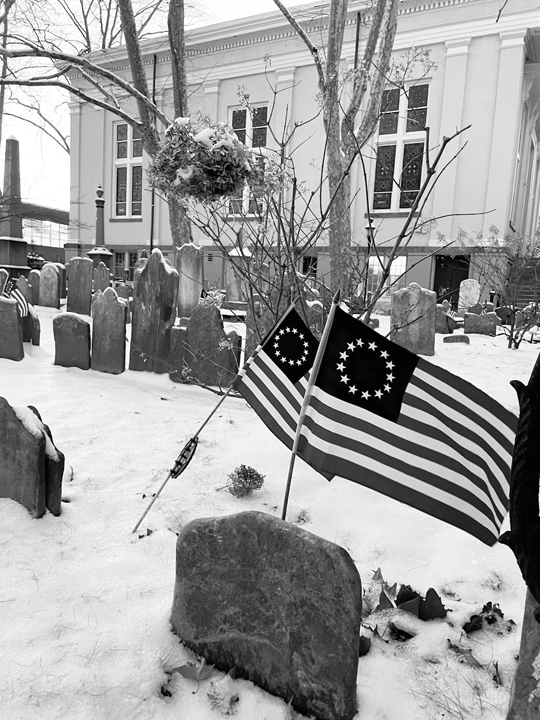
Old Pine Street Church, Philadelphia
One of the things Victoria Browning Wyeth has said about her Uncle Andy (who died in 2009) is that when she visits his grave, she pictures him deep underground in his casket smiling up at her. I think I’m going to imagine that from now on, when I’m photographing in cemeteries – those below are smiling up at me - and laughing, probably, when I fall.

(Cue up the R.E.M. song, “Fall On Me” ….. )


Saturday, January 27, 2024

Snow, Tombstones, and a Camera: A Hilarious Frolic in the Cemetery (by ChatGPT)

"Jesus, its cold out here ..."

Intro: If you were weirded out by my previous post, “Photographing Cemeteries in the Snow: A Frozen Elegy,” which I admitted at the end was generated by the IA program ChatGPT, here’s a doozy. I thought I would test the ap by inserting the word “funny” into my request. To wit, write a “500 word funny essay on photographing cemeteries in the snow.” Here’s where we landed. Like my previous post, I just added photographs that I took last week during and after a couple snowstorms in the Philadelphia/south Jersey area. The title was ChatGPT's idea.

Calvary Cemetery, Cherry Hill, NJ
Photographing cemeteries in the snow might sound like an odd choice for a lighthearted escapade, but sometimes humor emerges from the most unexpected places – or in this case, from the frosty embrace of gravestones and the whimsy of winter.

First things first, navigating a snow-covered cemetery with a camera is like trying to salsa dance in flippers – it's entertaining, awkward, and you're bound to draw some puzzled looks. Picture this: a photographer attempting to capture the perfect shot, slipping and sliding on icy paths, all while trying not to disturb the eternal slumber of those beneath. It's a slapstick comedy waiting to happen.

Calvary Cemetery, Cherry Hill, NJ

The snow, in all its fluffy glory, has a knack for turning tombstones into shape-shifting snow sculptures. Forget about reading the inscriptions; half the time, you're left deciphering what might be a name or just a whimsical snow doodle left by a particularly creative winter sprite. Perhaps the dearly departed are playing a frosty game of hide-and-seek, leaving photographers scratching their heads and chuckling at the snow-covered riddles.

Old Camden and Evergreen Cemeteries, Camden, NJ

Now, let's talk about the snow angels – not the celestial beings, but the unintentional ones photographers end up making. The cold ground and the excitement of capturing the perfect shot can lead to unexpected acrobatics. You might find yourself unintentionally channeling your inner winter Olympian with a graceful, or not so graceful, snow dive. The camera might capture a breathtaking shot, but the outtakes reel is a comedy goldmine.

Snow Angel, Woodlands Cemetery, Philadelphia

Evergreen Cemetery, Camden, NJ
As if nature itself is playing a prank, the weather during a cemetery photoshoot can be as capricious as a mischievous imp. One moment, the sun is casting a warm glow on the snow, turning the cemetery into a winter wonderland. The next, a snowstorm sweeps in, and you're left frantically trying to protect your camera from an unexpected icy baptism. It's a classic case of "weather, you had one job!"


Sheltering in place, Calvary Cemetery, Cherry Hill, New Jersey

.

Evergreen Cemetery, Camden, NJ

And let's not forget about the ghostly footprints that appear on the snowy canvas. In a normal world, these might evoke a sense of mystery and intrigue. In the world of cemetery photography, they're more likely to make you wonder if the resident spirits are testing out a new pair of snowshoes. Who knew the afterlife could be so fashion-forward?


As photographers tiptoe around the cemetery like clumsy ballet dancers, the hush of winter is occasionally interrupted by the unexpected symphony of wildlife. Squirrels, confused by the human antics, might decide to join the photoshoot, photobombing your carefully composed shots with their acrobatic antics. It's a woodland comedy show with an audience of one – you and your camera.

In conclusion, photographing cemeteries in the snow is a hilarious adventure, a quirky dance between the living and the departed, and a reminder that humor can be found even in the most unexpected places. So, grab your camera, put on your most absurd winter gear, and embark on a frolic through the snow-covered tombstones – who knows, you might capture the laughter of the dearly departed echoing through the frosty air.

Colestown Cemetery, Cherry Hill, New Jersey

Epilogue: WTF? …"weather, you had one job?" What ... does that mean? "Hilarious," as the title implies? Well, no. This is a fairly ridiculous and repulsive essay. Hopefully, my photos gave you a chuckle, at least. Rest assured, future frolics will be in my own awkward hand. I like giving new technology a shot, though. It helps me thrive as my truest self (a line I stole from one of the characters in the television streaming series, “Beef”).


Monday, January 22, 2024

Photographing Cemeteries in the Snow: A Frozen Elegy

Harleigh Cemetery, Camden, New Jersey

Cemeteries are often regarded as serene spaces, where the echoes of the past reverberate through weathered tombstones and ancient trees. When winter blankets these sacred grounds with a pristine layer of snow, a unique and ethereal atmosphere emerges, providing photographers with a captivating canvas to explore.

Calvary Cemetery, Cherry Hill, New Jersey

The snow-covered landscape transforms cemeteries into a surreal and hauntingly beautiful realm. The soft white blanket conceals the intricate details of tombstones, creating a minimalist aesthetic that accentuates the stark contrasts between life and death. Each snowflake delicately adorns the final resting places of the departed, adding a sense of purity to the somber scene.

Calvary Cemetery, Cherry Hill, New Jersey

One cannot ignore the symbolism embedded in the juxtaposition of snow and tombstones. The cold embrace of winter mirrors the inevitable passage of time and the transience of life. Through the lens of a camera, this frozen tableau becomes a poignant reminder of the cyclical nature of existence – a visual meditation on mortality and the enduring beauty that persists even in the face of decay.


Photographing cemeteries in the snow requires a keen eye for composition and a sensitivity to the emotional resonance of the scene. The muted tones of winter provide a natural backdrop that allows the subtle details of gravestones, sculptures, and mausoleums to stand out. Shadows cast by the soft winter light create a play of contrasts, enhancing the depth and texture of the frozen landscape.


The footprints in the snow tell stories of those who have come to pay their respects, leaving behind a temporary mark on the timeless canvas of the cemetery. Capturing these traces adds a layer of narrative to the photographs, inviting viewers to contemplate the connection between the living and the departed. The presence of footsteps also serves as a reminder of the shared human experience of mourning and remembrance.

As a photographer navigates the snow-covered paths, the silence of the cemetery becomes palpable. The hushed stillness of winter magnifies the solitude and contemplative atmosphere, inviting introspection and reflection. This silence, punctuated only by the crunch of snow underfoot, fosters a sense of reverence for the sacred space and the stories it holds.


Calvary Cemetery
The changing weather conditions further contribute to the dynamic nature of photographing cemeteries in the snow. Foggy mornings, gently falling snowflakes, or the soft glow of twilight can dramatically alter the mood of the photographs. Adapting to these elements requires patience and a willingness to embrace the unpredictability of nature, resulting in images that capture the ephemeral beauty of the moment.

Evergreen Cemetery, Camden, New Jersey

In conclusion, photographing cemeteries in the snow is a poetic exploration of life, death, and the enduring beauty that transcends the seasons. The frozen landscape becomes a canvas for contemplation, inviting viewers to reflect on the passage of time and the interconnectedness of past, present, and future. Through the lens of a camera, cemeteries in the snow reveal a frozen elegy, where silence and solitude merge to create a visual ode to the eternal cycle of existence.

EPILOGUE:

Not bad for a Chat GPT generated article, hm? I simply typed in, “500 word essay on photographing cemeteries in the snow,” and out popped this AI masterpiece in a second! It even came up with the title, "Photographing Cemeteries in the Snow: A Frozen Elegy." I just added photographs that I took last week during and after a couple snowstorms in South Jersey. What do you think? Kind of serious and melodramatic - frozen, even, huh? Maybe I should have said, "Make it sound like Ed Snyder wrote it ..."


Sunday, December 31, 2023

Do You See What I See…


Do You See What I See…?

No, this is not a Christmas blog, even though I am posting it as 2023 ends and 2024 begins. Maybe its about seeing into the future. I don’t see the way you do, and you don’t see the way I do. Does that make either of us wrong? Not only is it healthy to see things from another’s point of view, but it can also help your creativity.

What other people see

I posted the image above on Instagram and Facebook recently and had a comment that said, “For all the time I’ve spent there, I’ve never seen this!”

Even if the person HAD seen the stone, they would never have seen it, or captured its image, that way that I did. The monument is in Laurel hill Cemetery, Philadelphia. It sits atop a small, steep incline, and from the road, it doesn’t look that interesting (you can’t see the words). Remember when you went trick or treating in the suburbs as a kid? Was there a house up a hill that seemed like too much effort for a candy bar, so you skipped it?

I replied to the comment that its interesting how other people see the same thing differently. It happens to me a lot. Lighting and the direction you’re facing changes everything! Think about flea markets - you walk down the aisles in both directions, right? Otherwise, you miss stuff. Some years ago I found this awesome postmortem photograph in a vintage frame at a punk rock flea market. Got it for twenty-five bucks! Interesting thing is that I spotted it on my second trip down that aisle, in the opposite direction.

Once you do find that cemetery treasure during your next jaunt, how do you want to capture it in an image? It is true what Barthes says about a photograph (in his book, Camera Lucida), that it captures the death of something. So you cannot go back and capture the same cemetery image someone else did (or even the one I captured myself on an earlier excursion). You’d have to reproduce the angle of entry, composition, lighting, time of year, and so on. Impossible. But that’s what makes photography art. That's what makes a photograph singular.

PERSPECTIVE

I have often been jealous of images other photographers have made of the same scenes, same cemetery monuments that I have photographed. Theirs, at times, seem much better than my captures. But that’s how we learn, right? Art in general, gives us ideas for how we can improve our own art. And, it can be painstakingly frustrating at times. I used to photograph cemeteries with a friend who was easily a foot shorter than me. Just that difference in elevation provided entirely new perspectives on a given scene.

The easy way to see things differently (and maybe catch something that you missed before) is to make the extra effort to visit the same sites again. Park on the opposite side and walk in a direction you’re not used to. I have visited THE SAME CEMETERIES dozens of times! I typically find something I missed before.

Cemeteries and their monuments are not static. Stone erodes, visitors place decorations (or bury things), sometimes there is vandalism. And everything looks different under a blanket of snow. Shoot at the edges of the day – a low sun on the horizon throws warmer light and creates long shadows.

AFTER-CAPTURE PROCESSING

Plus, you’re probably not looking to simply document the existence of a gravemarker – you’re probably looking to create some artistic image, right? So go abstract. Use a photo editing ap like Hipstamatic, the one I used to capture the image at top. Perhaps you can try simple black and white, for a more abstract look. Most camera phones will let you change to black and white easily.

Straight camera phone shot of the same scene (rather boring, right?)

When I look at this standard, snapshot-style image above, it doesn’t really do anything for me. The stone is a powerful statement, but somehow a simple photograph does not project that message, that intent. Barthes might have said that the viewer should read in this photograph the “distress of a recent bereavement” (Camera Lucida). How to capture that feeling? A tintype ap can give this scene a very dated look, as tintypes were around in the Victorian era when this stone was carved.

Image edited with Hipstamatic tintype ap.

You’ll notice that the stone is lit with horizontal sunlight, which casts a shadow from the cross atop the "Crushed Hopes" grave marker. The angled sun also gives definition to the letters. If the face of the stone was lit with direct sunlight, you might not even see the letters.

Use Snapseed (camera phone image editor) or your camera (or camera phone’s) own photo editing software to create an image you like, one that successfully captures a mood. There are no rules! You’re not so much altering reality as creating a more accurate version of what you saw. I guess you might say that I am not an “incorruptible servant of artistic truth” as classical guitar maestro Segovia said about the composer Tedesco in 1939!

"Frozen Warnings," by Ed Snyder

A few hours before writing this blog, I drove over to Dirty Frank’s Bar, home of Philadelphia’s Off The Wall gallery. There was a recent group exhibit of art work, and one of my two pieces that was juried into the show was sold. I was picking up the unsold piece. I walked in and said hello to the curator who apologized that my second piece had sold. Hardly a wasted trip! That second piece you see above. I call it "Frozen Warnings." It is an image layered with two of my cemetery photographs. I was really happy with the image, and humbled that a stranger liked it enough to purchase it. "Frozen Warnings" is a composite of two cemetery images, neither of which I was truly happy with. But you know, when you're not happy with something, the end of the story can start today.

Epilogue

Maybe your hopes were crushed in some way last year. Artistically, perhaps you hit a wall. Horror author Grady Hendrix wrote, “Christmas is a time to be haunted by our memories, for every Christmas is our first Christmas without.” (This is from his 2023 article, How the Holidays Became Haunted,  https://www.tor.com).

Hendrix was talking about loved ones lost, but maybe we can think of it as old habits lost?  A few years ago I spent back to back New Years Days (two successive years) exploring an abandoned cemetery. Since then, I’ve developed arthritis in my hip so I think my days of jumping off walls into abandoned cemeteries are over. But if you stay creative, and are open to new ideas, there will always be new worlds to explore. The soul wants adventure.

And then there is luck, right? A red fox appears out of nowhere and poses in front of a tombstone. A parade of Harleys pours into the cemetery for a biker funeral. As they say in the Hunger Games stories, may the odds ever be in your favor.

Sunday, October 22, 2023

The Roadside Memorial - Supernaturally Gruesome

“On a dark desert highway…” as the Eagles' song goes. You can picture such an accident in a remote locale, but it actually occurred at a reasonable well-lit city intersection. I wrote this in the summer a few months ago, watching the Atlantic Ocean on a peaceful day, far removed from the grisly accident scene. So far from such pain.

Near the Philadelphia International Airport is the intersection of Lindbergh Boulevard and 84th Street  - a highly trafficked area. When I lived near there, I used to pass through the intersection daily on my way to work. For about a dozen years, there was a large roadside shrine of stuffed animals and the like, indicating a life lost on this roadway, I assumed. The memorial was removed sometime in 2022. 

I had stopped to photograph it a few times, in various seasons, in various years. The stuffed teddy bears and other characters would get water-logged and beaten down by the elements, and I noticed that these would be replaced with fresh ones from time to time. Sometimes, balloons were added. Usually such markers of urban mourning have some sort of document posted in its midst indicating the person whose life was lost. This memorial never had one that I ever saw.

Some years ago I had some of my photographs in a group show with other artists in Philadelphia, and as is customary, the gallery held an opening reception. Artists show up to discuss their work, potential customers show up to see the work and meet the artists. I think I had two photographs in the show, but I don’t remember what they were – although they probably had something to do with death (were I to guess).

My daughter Juli is an abstract painter and has told me that customers are more drawn to the artist’s story, than to the art work itself. She advised me to have a good story. You would think I was a reasonably good storyteller after all these "Cemetery Traveler" blog posts that I’ve done, and books that I’ve written. Maybe so, but I’m not a good on-the-spot salesperson. I prefer to let my work speak for itself. Sometimes that works, sometimes not.

One of the artists in attendance that evening was, however, a very good storyteller. He wasn’t trying to sell me his work, we were just passing the time talking to each other about our work. He told me a story that made my skin crawl.

When he found out that I explored and photographed cemeteries, he offered me this story. Turned out that HE was the person who kept that roadside memorial alive all those years! It has been about eight years since he told me this, so I’m a bit hazy on the details. I will recount it to the best of my recollection.

The storyteller was the uncle of the subject of the memorial. About ten years prior to his retelling of the story, his niece and three other seventeen and eighteen year-olds were going to a graduation party. The niece, lets call her Caitlin, had a younger brother, about four years old. The teens had begged the parents to let them drive to another graduation party and the parents let her take the car. It was raining that night.

As they approached the intersection at Lindbergh Boulevard and 84th Street, someone ran the light at high speed – probably forty or so miles per hour. The teens’ car was broadsided by a truck, I think, and I believe some of the teens survived. The storyteller’s niece did not.

He was asked to identify the body in the morgue at some point. I imagine her parents asked him to do that. He told me that she was cut in half, head to foot, right down the middle. A grisly scene to witness. Can you imagine the horror? 

At some point, maybe the next day, the girl’s younger brother was asking when Caitlin would be coming home. No one knew how to break the news to him. He told his parents he was talking to her in a dream he had the previous night. He was not upset. She told him she was alright. But the thing he was most puzzled about was the vertical line she had coming down her face, all the way down her body ….


Sunday, August 6, 2023

Eulogy for My Mother


So my Mom died a few days before Mother’s Day, on May 14, 2023, to be precise. I’ve sort of been collecting my thoughts these last few months trying to figure out what to say. She was 84.

It was inevitable, I suppose, that I would post a blog about this. Not that bringing myself to write something has been easy. It has not. It has, however, been easy to distract myself from doing it, by finding other things to do, like, oh, I don’t know … visiting cemeteries. But I’ve got skin in the game.

I don’t want this to be maudlin or clichĂ©d, like, to everything there is a season, I see her face in the sky, in the trees, in a running stream, all that junk. I do, however, see her face in a Wendy’s Strawberry Frosty and ripe tomatoes. She liked oddball stuff, like sardines, zucchini, black tea, fried green tomatoes, and SPAM. Which I attributed to her being of Welsh descent. I don’t know why.

Her physical health had been on a slow decline for about five years, but mentally, she was sharp. Spoke with her on the phone at least weekly (I live 120 miles away) and visited as often as I could. She loved her three children and four grandchildren. Wait – I’m getting maudlin. Let’s shift gears.

At the Bedside 

She fell in her apartment a few days before she died, and told my brother, “I think I need to go to the hospital.” I don’t really think any of us knew this was the beginning of the end, but I let my three grown children know, so they could visit. And they did. Bless them. And I know Mom enjoyed seeing them. They loved her. Her door was always open to them. It’s funny, they have so many DIFFERENT memories of her than I do. They all seem to have this lasting memory of the view over Wyoming Valley (northeast Pennsylvania) from my parents’ home on the mountain. 

Over the course of the next few days, she slowly got worse. Pain needed morphine; lungs needed oxygen. The afternoon she died, I had only been at her hospital bedside for about an hour when she started to slip away from us. My brother Tim was also there, along with my adult son Chris, and oldest daughter Juli with her new boyfriend. Wondered if this was their first date. I told him this was trial by fire for their relationship. My second oldest daughter, Collette, had been at her bedside for days prior to Mom’s demise. Her last remembrance of her grammy was when grammy was still alive. The next day my Mom was gone. Although I’m glad I was there for my Mom’s last conscious moments, I’m not sure which is easier to handle – being there or not, for that last breath.

Passing Away

When people say someone “passed away,” I always thought this was a lame and silly way of softening the blow. As Indian writer Sadhguru says, “Children are taught never to utter the word [death] at home, unless the God of Death chooses to visit, while the adults are on a quest to invent overly woke euphemisms that try to mask the bluntness of the event…” (Death – An Inside Story, Penguin, 2020).

I was surprised, however, to witness my Mom’s “passing.” That is truly how she seemed to leave us. Over the course of an hour, systems slowly shut down, pulse ox dropped (she was on cardiac monitoring), heart rate slowed, pressure dropped to essentially nothing. It was as if the curtains were slowly being drawn closed. Now I understand the gravestone symbolism of the stone-carved curtains being drawn. 

Did my twenty years’ worth of cemetery photography prepare me in any way for this? It did. I guess it made the inevitable seem more likely. Also made me realize that I’ve only got twenty years before I reach my Mom’s age. But I suppose that just as my Mom will continue to live on through all the people who knew her, I’ll live on in the memories, habits, and behaviors of people I know. 

My Mom liked my daughter Olivia’s fencing demonstration the last time we visited, and I only wish she could’ve heard and seen Olivia play the piano. I wish she could’ve seen rock star Chris on stage. I wish she could’ve seen Juli painting in her studio. I wish she could’ve joined me and Collette at the punk rock flea market. But she continues to live on in all of us.

All my children enjoy music, and my Mom did too. She was a big Tony Bennett fan, and I guess his death recently (July 21, 2023) is what finally prompted me to begin writing this. She and my Dad (also deceased) saw Bennett perform in the early 1960s at the Steel Pier in Atlantic City. Kind of glad she wasn’t around to see him go. He was a testament to longevity to her. 

Mom's last uneaten meal, with some forget-me-nots we sent her for Mother's Day.

I wish I got to play, “Hang Down Your Head, Tom Dooley,” for her on my guitar. If we had held a memorial service or funeral for her, this is the story I probably would have told. “Dooley” was one of the songs I practiced when I took guitar lessons when I was about thirteen. I wanted to play the guitar, but, it seems I didn’t necessarily want to LEARN how to play the guitar. The rare times I would practice at home I would plink out “Dooley” and my Dad would make fun of me. He would say, “Can you do anything other than go, ‘plink, plink, plink?’”  I never progressed while taking those lessons. I chalk it up to a bad teacher and a cheap guitar. Mom and Dad loved that song, but I never got good enough to play it. Now that I am good enough to play it (only took fifty years), I never did play it for my Mom.

Anyway - and this was back in maybe 1970 - she got fed up with my not wanting to practice one day and smashed the guitar over my head! Luckily, it was a cheap wooden acoustic, not a solid-body electric! To this day …. Or rather, to the day she died, she blocked out that episode of our relationship, said she really didn’t remember it. Ah, good times …

My interest in guitar playing resumed a couple years later as I witnessed my older cousin Jerry power chording his Les Paul through Creedence and Rolling Stones tunes. Mom went ahead and bought me a cheap electric with an amp and away I went. 

So here’s the punch line of the story. Mom hated snakes. She went to someone’s house after answering an ad in the “Country Impressions” newspaper to buy me a cheap electric guitar and amp. Legend has it that as she was paying the woman for the equipment, the woman asked her point blank if she was afraid of snakes. My mother probably paled and said “yyyyessss….?” The woman then said “Well, don’t turn around then. Just walk out this door and I’ll bring the guitar.” My mother, of course, whips around to see a giant snake stretched out on the sofa behind her! Mom took the storm door off its hinges as she threw herself outside to safety! But she came home with the guitar and amp for me. That’s what mothers do.


I appreciate all the condolences that people sent. So many heartfelt ones. I’d like to include some of them here, but I can’t really bear to look at them again. Death of a family member can bring out the best in people – and sometimes the worst. One of the most wonderful things that happened was when my childhood friend George called me to talk. We “came up” together, as is current parlance. He told me that my Mom was like a mother to him. Then he changed that and said, no she wasn’t “like a mother, she WAS my second mother!” George’s Mom (also deceased) made me feel as at home at their house as my Mom made George feel at home at our house. He said he would often have two dinners, one at my house and one when he returned to his own house. Pork chops, Shake ‘n’ Bake chicken. My mother fed people.

My brother, bless him, took care of our Mom for years and sorted through so much afterward – clearing out her apartment, notifying Social Security et. al. of her passing, picking up Mom’s ashes from the funeral home, speaking with friends and relatives about Mom’s death. I am so grateful that he did all that.

As for a legacy of sorts, my Mom wrote down in a spiral notebook things she wanted my thirteen-year-old daughter Olivia to read after Mom was gone. My Mom told me a few years ago that she was doing this, and would tell me things she was writing. As difficult as it was to talk to her about this at times, I’m so glad she did it. Olivia is the youngest of my children and therefore knew her grandma the least. I have the notebook, and while not confidential, I still can’t bear to open it. At some point, I’ll give it to Olivia. No doubt its written in cursive. My Mom was so thrilled that Olivia taught herself to write in cursive, even though it was no longer taught in school.

Mom was in severe pain for the last two years of her life. It’s really horrible that medical science couldn’t relieve her pain. I guess that's partly because medicine isn't all science - its mostly an art. You're lucky to get a good doctor. As Pulitzer Prize finalist Percival Everett says in his novel, “Dr. No,” “I was reminded that what we see is really all we know; everything else is induction, deduction, or simply guesswork.”

On the way back to Philadelphia the day she died, my son Chris and I stopped at a turnpike rest stop and I pulled up alongside a car that ironically had this placard on the side. My Mom loved all kinds of fish in cans - sardines, herring, whatever other fish they tin. I posted this photo with the caption below on Facebook the day she died. May 14. 

“This is for my mom. For those of you who knew her, you may have known that she liked tinned fish. Sardines and stuff like that. I used to joke with her all the time about how gross I thought that was. My mom died today at 2 PM. Mom, wherever you are, I hope there’s a lot less pain and a lot more tinned fish. Love you.”