Showing posts sorted by relevance for query temple. Sort by date Show all posts

Sunday, April 13, 2025

More Graves Unearthed on Temple's Campus

On April 11, 2025, the news announced that coffins and human remains were found during excavation for a new building on the Temple University campus in Philadelphia. Temple supposedly expected this. And they should have, since this former parking lot at Broad and Berks Streets had been home to 28,000 graves. Its kind of odd how NBC reports that the bodies were relocated in the 1950s to Lawnview Cemetery in Rockledge, a northeast Philly suburb. Well, obviously not all the bodies. The gravestones were not relocated there – they were dumped into the Delaware River.

Gravemarkers along the Delaware River, under Betsy Ross Bridge

Like so many other sites in Philadelphia formerly occupied by burial grounds, buildings that require deep foundations are seldom constructed. Guess why. Typically, a playground, ball park, or a parking lot is built on the land. Temple shelved plans for building a new football stadium where their Geasey Field is, most likely, because they were afraid to unearth graves. That complicates things. The current excavation has stopped. Temple was prepared, says the news, and immediately brought in the police, Philadelphia Coroner’s Office, a medical examiner, and an archeologist. 

Slogging around in the mud at the site I really had a sense that I had trodden on sacred ground. When we bury our people, we are bequeathing their remains to the earth. Handing it down, so to speak, in a reverent manner. This is not like throwing out the trash. When a cemetery is vacated, repurposed, not everything can be removed. It is just not possible. Remnants, no matter how small, remain. Bone fragments, coffins. 

When I reached into the mud to pick up a few pieces of the stone that had been broken away from the old cemetery wall, there was mud all over my hands. I got a jarring feeling as it covered my fingers – this is the same soil that held 28,000 bodies in 1956. 

Its like what Mark Twain said when he visited the Holy Land in 1867: you don’t need to be a Christian to realize and respect that something significant happened here. 

Current construction showing cemetery wall that borders North Broad Street

Why has Philadelphia abandoned and moved so many cemeteries throughout its history? We put forth great effort to memorialize ourselves, only to find that our monuments to immortality have not stood the test of time. As the city grew, cemeteries were unceremoniously destroyed. People actually now make stipulations in their burial contracts that their remains shall never be disturbed. There are, however, some recent and ongoing success stories in and around Philadelphia, where faltering cemeteries have been stabilized and restored by volunteers. Is it because we now care more than we used to?

Barnes and Noble link to preorder 
I cover many of these topics in my new book, Abandoned and Forgotten Cemeteries of Philadelphia and its Environs (Fonthill, 2025). In fact, what happened to Monument Cemetery is covered in great detail, with many photos of the gravestones under the Betsy Ross Bridge. One of them graces the cover of the book. (You can preorder the book from Amazon here - publication June 30, 2025.) In addition to the removal of cemeteries, the book – and upcoming public presentations –  will focus on recent discoveries, the frequent accidental unearthing of human remains, genealogical challenges, and the 200 unmarked burial grounds that silently sleep under Philadelphia’s streets, parking lots, and playgrounds. Ben Franklin said, “Show me your cemeteries and I will tell you what kind of people you have.”  

It will be interesting to see how this situation at Temple plays out. The coffins and bones were found about six feet below the surface of the original parking lot. As we all know, burials can be stacked. There could be layers of coffins deeper down. I am curious about Temple’s “protocol,” as they call it, for when human remains are found. I am curious about Temple’s “protocol,” as they call it, for when human remains are found. In Philadelphia, if the remains are found on private property, the landowner (in this case Temple University) does not own any human remains interred in that land. Under Pennsylvania law, such remains are under the control of next of kin/descendants and the courts. In this case, one would expect that Temple would have needed a court order to disturb these burials.

Original cemetery gatehouse on Broad Street

The plot of land where the discovery was made is to be the future home of Temple’s Klein College of Media and Communication, with planned completion in 2027. I wonder if the cemetery wall will remain, which still borders Broad Street? (You can see the wall in the gatehouse lithograph at left.) Current Temple students being interviewed find this all rather spooky. One student states that it's a weird history for a building where students will have to take classes. They will know that the building was constructed over a cemetery, and they did not remove all the bodies. Obviously the developer never saw the movie, Poltergeist.

As Temple’s online newsletter states, “This is a developing story, check back for updates.” (Click here for CBS News video.)

+++++++++++++++++++++++++++++++++++++++++++++++++++++++++++++

Please visit my previous posts on The Cemetery Traveler to read the history of Monument Cemetery, including its destruction and aftermath:

https://thecemeterytraveler.blogspot.com/2011/04/watery-remains-of-monument-cemetery.html

https://thecemeterytraveler.blogspot.com/2011/05/how-monument-cemetery-was-destroyed.html

https://thecemeterytraveler.blogspot.com/2012/03/beachcombing-in-hell-gravestones-of.html 

Friday, May 6, 2011

How Monument Cemetery was Destroyed


Concrete crypt being removed from Monument Cemetery, 1956
By the summer of 1956, the job of clearing Monument Cemetery was well under way. Bodies had already been removed from one section of the old grave yard. At that time, the University referring to it as PROGRESS, stated that "the old cemetery...will provide much needed parking space by fall." - Things that Aren't There Anymore


Betsy Ross Bridge in background
After my photo excursion to find the last remains of Philadelphia’s Monument Cemetery, I was overwhelmed with questions – my own as well as those posed by my readers. Questions like, how could some entity (Temple University, in this case) just buy a cemetery and build a parking lot over it? Was the cemetery actually abandoned?  Supposedly, all the bodies were removed, but how did they do that? And the families were okay with it? When this happened in 1956, the cemetery was over a century old – did they contact the relatives of the 28,000 people buried there? Why were all the monuments and headstones dumped into the Delaware River? I get a weird feeling now whenever I drive over the Betsy Ross Bridge, like its somehow sacrilegious that granite tombstones are part of its foundation.

They say the universe is finite, contained, and searchable, so, in an attempt to find answers, I paid a visit to the Pennsylvania Historical Society in Philadelphia. I knew from past visits here and to the Library Company of Philadelphia next door, that they had certain records related to area cemeteries. Once I got into the Historical Society to begin my research, I was amazed to find hundreds of bound volumes (handwritten as well as copied) of burial records and tombstone inscriptions from more cemeteries than I thought existed, along with all their original deeds, charters, and annual reports. There were also vintage brochures and guidebooks (c. 1850) printed by the large Victorian garden cemeteries for advertising purposes. You can actually peruse these wonderful parchment-like and very fragile volumes from the Laurel Hill, Woodlands, and Mt. Vernon cemeteries in Philadelphia. Wonderful lithographs of monuments, chapels, and gatehouses adorn the pages, many of which are either no longer in existence or are so weather-worn as to be barely recognizable. It’s obvious that such documentation is necessary for accurate restoration of cemetery sculpture and monuments. After about half an hour of searching, I came upon a three-volume set of documentation related to Monument Cemetery.

In the set of burial records were tombstone inscriptions, an alphabetical listing of those interred, and legal documentation for the property. At the end of Vol. I, there were dozens of copied newspaper clippings related to the battle to close the cemetery (mid-1950s). As I read through these clippings, certain things became clear
I better understood how a cemetery could be made to disappear.

In a nutshell, the cemetery had not been abandoned, it was destroyed. Bodies were reinterred elsewhere and most of the tombstones and monuments were dumped into the Delaware River, to be used as foundation rock for when the city built the Betsy Ross Bridge. In my previous blog,
The Watery Remains of Monument Cemetery,” I wrote about my excursion to find the stones, which are visible at low tide. Visible with a bit of work, that is. You can’t just look down into the water and see them as you drive across the bridge.

How did Temple University acquire Monument Cemetery
?
 

As the universe expands, so do universities. In the 1950s, Temple was developing itself into a commuter school, and needed more parking – and those 15 acres across the street were just being wasted on a cemetery. They’d actually been trying to acquire the cemetery since 1928, but continually met with resistance from the cemetery’s owners. 


Nearly bankrupt cemetery railroaded into oblivion?

According to records, the owners of Monument Cemetery only had about $11,000 in assets by 1953. This was barely enough income for the owners to provide necessary maintenance to the buildings and upkeep to the graves. With no new plots sold since 1929, there had been little income for 24 years (the only available burial space was in lots that had been previously sold). The cemetery had been in business for 114 years, and its 15 acres were filled to capacity with 28,000 graves. As a result, the cemetery physically deteriorated to the point where it invited vandalism. The owners were actively trying to sell it, but were “insensed” at potential buyers’ (including Temple) plans for the land. Eventually Temple lobbied the city government to condemn it, and ended up acquiring it after that occurred. According to the Philadelphia Evening Bulletin of May 28, 1953, public hearings were held in which “a number of persons” testified that “the cemetery was now a haven for rats, criminals, tramps, and sex offenders.” (Kind of sounds like the North Philly that we know today.)

It appears that legal title passed from the owners of Monument Cemetery to the City of Philadelphia, but I could find no record of the amount the owners were compensated. Once a government determines that private property is needed for the completion of a public project (Temple is a public, i.e. state school), that property is likely going to be lost (ref). The property owner is entitled to fair compensation for the loss, but it appears that Monument’s owners received far less (if anything). Kind of like when my grandmother's house was taken through "eminent domain" by a local municipality so that
a playground could be built. 

Estimated value of the land in the part of Philadelphia in which Monument Cemetery was situated was about $40,000 per acre, making the cemetery’s 15 acres worth about $600,000. Temple had previously stated that it could not afford to buy the land at that price. As Lawnview Cemetery (in Rockledge, a Philadelphia suburb) was later awarded a $700,000 contract by the city for “the transfer and perpetual care of the bodies,” I find it hard to believe the city paid Monument’s owners anything for the land.


Did they actually remove the bodies?

Well, if you can believe the newspapers, yes. But who knows? The crane in the top photo shows a concrete crypt being hoisted out of the ground, but what of the thousands of older burials that only had wooden coffins? I began to wonder what sort of notifications were sent to families whose loved one were buried there… eviction notices? Did they board up the periphery of the cemetery so people couldn’t see the coffins coming out of the ground? Did people care? I had to find out, and as I could find nothing on the topic online, I hoped the Historical Society would provide. 

The dozens of newspaper clippings mentioned above cover the final two years of the cemetery’s existence – from 1954 (when its fate was mired in political intrigue) to 1956 (when the cemetery was condemned, given to Temple, and dug up). During the time that the cemetery’s owners were trying to sell it in above-board fashion, Temple had made low offers, and was turned down. In its relentless quest for the land, Temple resorted to political tactics to have the ground condemned, while maintaining an air of empathy by declaring that if it acquired the cemetery, it would also have to dig up Temple's founder, Dr. Russell Conwell, and his wife, who were buried there. In the end, they moved those graves across the street near Conwell Hall (where I used to go to pay my daughter’s tuition).

How were lot holders notified?

Apparently, the majority were not. But first, let’s do some math. In 1954 when the cemetery owners sent out mailings to lot holders announcing the likelihood that graves would have to be moved when the cemetery was sold, they only had reliable contact information for 748 families - out of 28,000 burials. Of these 748, only 400 lot holders responded to mailings – 300 of whom met to vote on which cemetery they would want their ancestors moved to. Two cemeteries bid on the contract − Lawnview Cemetery and Philadelphia Memorial Park in Frazer, PA. Lawnview was chosen after a nine-month debate, mainly because it was closer to Monument Cemetery (more convenient for the lot holders) and it would charge less for removal of the bodies.  


So only 300 family plots were moved to Lawnview along with their monuments and headstones. I would assume that some of the remaining 100 of the contacted lot holders had their loved ones moved privately to different cemeteries at their own expense. But the vast majority of the 28,000 bodies, it seems, went unclaimed

In order to clear the land of human remains and stonework, 28,000 bodies had to be re-located, about 20,000 of which were unclaimed. These 20,000 – a staggering number − were the ones that were quietly dumped into a large mass grave at Lawnview Cemetery. Their monuments and any of the elaborately carved stonework that hadn't been claimed by relatives were sold to developers, and hauled to the river to be used as part of the foundation to build the Betsy Ross Bridge (construction was completed in 1976). Monuments, including major works of art by 19th century sculptors, were dumped into the river to be used as “riprap” (granite or concrete rubble from building and paving demolition commonly used to protect shorelines from water or ice erosion).

Did the public care what was going on?

Historian Tom Keels says, “…in the 1950s it was, 'This is an old moldy Victorian cemetery. Who cares.'"

“The way cemeteries and their occupants were treated after World War II was shocking. The city was in flux. It was losing jobs, it was losing people and there was a decision early on that the city was going to redevelop at least its central area. It was going to reinvent itself as a neo-colonial city. Society Hill and Independence Mall were constructed, while hundreds of Victorian buildings were razed ‘because 18th century was good, Victorian was bad.’ Unfortunately, this extended to many Victorian cemeteries.Tom Keels

Forgotten graves?  Not totally.

But what of the people whose loved ones were buried at Monument, who were not aware of its closing? Many of my current readers are appalled by what happened to this cemetery, shocked by the callousness of a modern society. Looking back, it seems that it all occurred precisely because of the modernism of our society and how we value “progress.” It all sounds like Temple and the City of Philadelphia tied up Monument Cemetery in a neat little package and everyone was happy. Today, it’s a different story, as I come upon these chilling posts on the reader forum of Geneology.com:


"they say there is a mass grave .. where is it and where are the babies that were buried there as there was so many of my family buried there too..why didn't anyone fight it and how could they get away with this? i can't believe the things i read about it as i look for my family .."

"hello thank you i went to find a grave and lawnview and typed in my family name but nothing..came up. do they have a list from monument and where all the people from monument were reburied. at least they could have done that. so many of my family was buried there. a lot of babies from years ago. a few made it to arlington but not many. thank you and i don't know how they could do things like this ..isn't anything sacred..? i sure appeciate your help. thank you again  -alice"

"Monument Cemetery. This is where my ancestors-Wareham- had a large family plot. It was removed and built over by Temple University. What a shame ! If you are connected to this family, please reply. Jeanie "

More about the
1956 dumping of tombstones into the river.

As I mentioned in my previous blog posting, “The Watery Remains of Monument Cemetery,” my friend Leo and I trekked out to the river last month and found the site of the discarded tombstones from Monument Cemetery. We only actually found about 50 exposed whole grave markers, so the rest must must be either buried, drowned, or reduced to rubble. When you think about it, roughly twenty thousand bodies were unclaimed, so there had to be several thousand gravemarkers discarded.


Sartain Monument (Univ of Penn)
Supposedly, John Sartain's Egyptian-style monument was dumped into the Delaware and is now part of the bridge. Sartain was one of the original designers of Monument Cemetery; he and his family were buried there. Sartain’s is not a name with which I was familiar, but to whom the literary world owes a debt of gratitude. He was Edgar Allen Poe’s friend, colleague, and publisher while Poe lived in Philadelphia.

John Sartain was a true renaissance man – publisher, engraver, artist, and architect. He was responsible for the design of Monument Cemetery’s gatehouse and the cemetery’s immense (over 70 feet high) central monument to George Washington and General Lafayette (seen at left being dismantled). According to Sartain’s autobiography, The Reminiscences of a Very Old Man, “Monument Cemetery” derived its name from this monument. Sartain’s own memorial (seen above in front of the base of the Washington monument in a 1954 photograph) lives with the fishes - supposedly dumped as unceremoniously as the rest of the stones.

Sartain's Union Magazine featured the first publication of Poe’s haunting poem, Annabel Lee, which is about a rivalry that resulted in a watery death. Makes you wonder what horrors Poe could have conjured with the idea of unearthing 28,000 graves and dumping their tombstones into the river. But then he probably would never have conceived of anything so bizarre – or did he?

And this was the reason that, long ago,
In this kingdom by the sea,
A wind blew out of a cloud, chilling
My beautiful Annabel Lee;
So that her high-born kinsmen came
And bore her away from me,
To shut her up in a sepulchre

In this kingdom by the sea. 

- from Annabel Lee, by Edgar Allan Poe


References for Further Reading:


Saturday, April 30, 2011

The Watery Remains of Monument Cemetery


Normally, I don’t find myself checking tide tables before going on a photographic excursion to a cemetery. But when my friend Leo and I decided to search for underwater tombstones from Philadelphia’s defunct Monument Cemetery, we needed to heed the table, as most of the stones are covered at high tide. No, these are not photographs of one of those offshore cemeteries in a coral reef − nothing quite so romantic. You’re looking at the remains of Monument Cemetery, Philadelphia’s largest vanished Victorian graveyard. 

Friday, April 22, 2011

        Tide       Height Sunrise  Moon  Time    
        Time       Feet    Sunset   

Low     12:13 AM   0.6   6:13 AM   Rise 12:11 AM   
High     5:43 AM   7.6   7:45 PM   Set   9:43 AM
Low     12:57 PM   0.4
High     6:21 PM   6.6


Offshore burial?
So my cemetery travels have taken me this time not to an actual cemetery, but to the Delaware River waterfront under the Betsy Ross Bridge (Philadelphia side), where the remains of this once grand cemetery lie. In this secluded, wooded, and posted (“No Trespassing”) area, scores of granite headstones, monuments, and ironwork lie on the shore, protrude from the embankment, and peek out of the murky river water.

How did tombstones get in the river?


I’d originally read about the demise of Monument Cemetery in Tom Keels’ book, Philadelphia Graveyards and Cemeteries, but I still thought it might be an urban legend.  When I read in his “Vanished Cemeteries” chapter  that the monuments and grave markers were dumped into the river and you can see them sticking out of the water at low tide, I knew I had to check this out personally. At my request, Tom graciously gave me quite specific directions to get there, adding:

 “… this is a fairly desolate, industrial area.  Please take all precautions − go with one or two people during the daytime, bring your cell phone, and be on the alert. ”

As with any attempt at urban exploration, you need to be prepared — hiking shoes, tough clothes, weapons. You never know what kind of nutters you’ll run into — members of the transient community, kids having beer parties, ne’er-do-wells. But success only comes to those who brass it out.

So after some months of planning and reading other people’s accounts of their treks to the riverfront (some successful, some not), I figured out when low tide would occur and enlisted my friend Leo to come along. As it turned out, access to the riverfront is made near the intersection of Delaware and Castor Avenues, in the Bridesburg section of Philadelphia, right between an abandoned power plant and an active industrial complex. The power plant was actually the site of my first official urban exploration excursion with a group of experienced explorers. At the last minute, I chickened out. It just seemed too risky − I’d already been arrested once for trespassing. The aborted power plant experience paid off, however, in that the vicinity was now familiar to me - the dumped gravestones from Monument Cemetery were at the same riverfront area, only on the opposite side of a canal.

The Demise of Monument Cemetery

Eighty gravestones vandalized at Monument Cemetery in 1938.

Monument Cemetery in Philadelphia (located at North Broad and Berks streets), was the city’s second Victorian garden cemetery, established in 1839, just after Laurel Hill (1836). Originally called Pere-Lachaise, after the first ever rural garden cemetery in Paris, it was renamed Monument Cemetery.  The history of the cemetery is not well-publicized, but it grew to a fairly large size (28,000 graves despite its relatively small 7-acre spread). The last burial occurred in 1929, and by 1938, the cemetery had fallen into disrepair. By the 1950s, the land became more desirable that the cemetery itself, and Temple University, across the street, wanted to buy it and build a parking lot.

Monument Cemetery found itself waning, but Temple helped it to hasten down the wind. According to Tom Keels:
 “Neighbors wanted to keep the cemetery, but Temple held public hearings and brought in local church people to convince the city to condemn it and let the school buy it. They claimed it was attracting teenagers who drank, then went out and robbed people. The tone was that not only was Monument Cemetery an eyesore, it was a moral blight. It was bringing down the entire North Philadelphia neighborhood [um, look at North Philly now − destroying that cemetery was supposed to prevent this?]. Of course, every single person I've spoken to who lived and worked in the Temple area at the time says it was a little rundown. The lawn needed mowing, but it was where they went to have lunch. It was the only quiet green place in the neighborhood."
http://archiver.rootsweb.ancestry.com

How was this allowed to happen? To put things into historical perspective, at this point in American history, people were not keen on Victoriana (anything from the era 1837–1901). Many Victorian era cemeteries fell into disrepair because people thought they were old fashioned.  Lot owners in many cemeteries across the U.S. were actually embarrassed by the old-fashioned gaudiness of their own family plots and removed the decorative fencing and other ironwork to sell for scrap. So even though many of Monument Cemetery’s lot owners fought the eviction of their ancestors, there really was not much public outcry against plowing over the cemetery and building a parking lot and playground (as Temple and the City’s Board of Education wanted). The photo above shows the 1956 dismantling of a memorial dedicated to George Washington and General Lafayette. Keels says, "Today they probably wouldn't be able to get away with that, but in the 1950s it was, 'This is an old moldy Victorian cemetery. Who cares.'"

Photo showing Betsy Ross Bridge (NJ 90) from an industrial area in the Bridesburg section of Philadelphia. (Photo by Steve Anderson.) from site: http://www.phillyroads.com/crossings/betsy-ross/

So Temple got its wish in 1956. They removed the bodies (most of which were reburied in a mass grave at Lawnview Cemetery in Rockledge, a northeastern suburb of Philadelphia) and took most of the headstones, monuments, and other decorative stonework and dumped it all into the Delaware River. The tombstones were used as the foundation for the Betsy Ross Bridge. Today, they can still be seen at low tide. To get to them, you need to walk over the canal bridge on Hedley Street (map link), approach the industrial site (shown above), and cut into the woods on the right side of the road. Your access is a break in the fence almost under Betsy herself. Close to the road this area is a dumping ground for old mattresses and sofas, further in its partyland for transients. Walk the quarter mile path along the canal through the woods to the river.

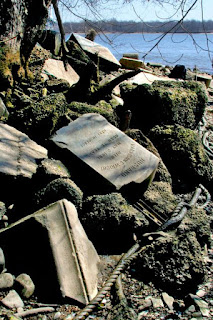
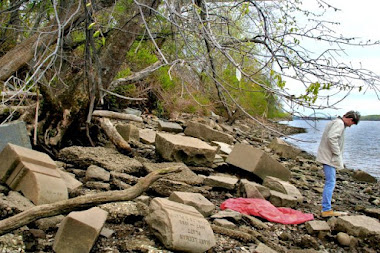
So we found the stones. I expected to see a few broken ones here and there poking out of the water, but was quite unprepared for the sight that presented itself.  As we approached the river, we could plainly see gravestones scattered along the rocky shore. In fact, much of the rock that made up the shore itself were broken tombstones − some marble, but mostly elegantly carved and polished granite stones, coping from family plots, huge blocks of foundation granite used for large monuments. These apparently are the ones that tumbled off the dump trucks, rolling over the stones that had already been dumped. I realized this as we climbed down the ten-foot embankment, using tombstones for steps. They protruded out from the dirt, making you wonder just how many were there. Certainly more than were obvious.

Shoreline under the Betsy Ross Bridge, Philadelphia
River tides are a funny thing. I learned this from one of the fishermen I work with. I just assumed that all water bodies connected to an ocean had low tide in the morning and high tide at night. Turns out that most places have two high and two low tides each day, and the actual hour at which these occur depends upon the phases of the moon (so low tide times for a particular day, for instance, can be eight hours later on the same day a week later!). While tides are predictable, their timing was not very practical for my photographic purposes. Low tide was to occur at 1 p.m. on Good Friday during the month of April. Therefore, take a vacation day from work.

Leo on tombstones, facing north
Good Friday was a perfect overcast day − flat lighting is good if you’re not sure what the shooting  conditions will be. As you can see from the chart excerpt at the beginning of this article, low tide occurred at this point in the Delaware River (tide times also change with your location!) at 12:57 pm, a good time to make photographs. We arrived about 2 pm. The timing was fairly critical since (according to the chart above), by 6 pm the sea level would rise six feet above its lowest point (which was about where it was on our arrival), covering most of the stones we photographed. You’ll notice mud on many of the stones, indicating they were all underwater earlier that morning.

Leo and I walked along the shore maybe the length of a city block and counted about 50 whole stones, with an additional eight peeking out of the water. After 130 years, inscriptions are still clearly visible on them − granite doesn’t fade as fast as people’s memories.

Standing near the water, looking up at an embankment made primarily of tombstones, I felt like I was at the foot of Golgatha − this was Good Friday, after all.  Seeing piles of grave markers and monuments, shaded by trees hung with condoms and other trash, made me wonder how anyone could do this to a cemetery. Couldn’t they at least bury the monuments, or smash them up into gravel? At the foot of the rubble was this headstone, which originally marked the grave of Capt. Babel H. Irons’ wife, Mary. No sign of Irons’ own marker, but what a great name! Every stone here has a story. After his death, it seems that Captain Irons had a 223-ton Philadelphia-based merchant sailing vessel named after him, so he must have been well-respected at the time.

According to the New York Times, a Marine Intelligence telegraph was received on Nov. 27, 1874 from the brig Castilian, which mentions Babel H. Irons. “…on the night of the 23d inst., in a south-east gale, lost boat, split foresail and jib, stove bulwarks, and had deck swept of galley, &c.” The Irons stone here on the river shore stares at you like the final flare from a shipwreck.

Frequently, I'm asked me how a cemetery becomes ‘abandoned.’ Well, that’s a topic for another blog. Monument Cemetery was not abandoned, let's be clear on that − it was destroyed. After reading what little is available on the Web about Monument Cemetery and after seeing the dumped stones, I had so many questions. I made an appointment to do some research at the Pennsylvania Historical Society in Philadelphia. Tune in next week to see what I dig up (pun intended).


Further Reading:
Nicole Clark's End of the road - Philadelphia's graveyards

Sunday, December 13, 2015

Union Cemetery Has Gone Missing ...

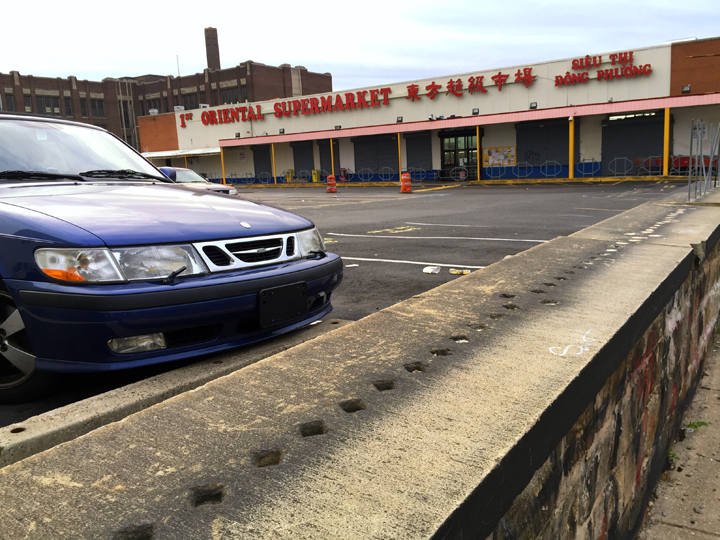
Here’s a short blog on an odd little situation I just discovered. I live in South Philadelphia near Third Street and Washington Avenue. At Sixth Street and Washington Avenue (running to Federal Street), there used to be a cemetery. It was called the Union Cemetery. The City of Philadelphia “removed” the cemetery around 1970 to further develop the commercial business corridor along Washington Avenue.

I have driven past the particular Asian supermarket you see in the photo above, which is at Sixth and Washington (Federal Street is behind it). I have driven past it hundreds of times since moving to the neighborhood in 2008. Until a few weeks ago, I had no idea that the stone wall along Sixth Street (on the south side of Washington) is the ACTUAL stone retaining wall of the Union Cemetery! Complete with holes in the granite top where the iron fence was anchored!

It is no wonder they would they destroy a cemetery to build a parking lot, but why KEEP the original retaining wall? If you’re expecting to find the answer here, you may as well stop reading – I don’t have it. There is quite a bit of information (and photos, as bizarre as that is!) on the cemetery’s demise all over the Internet, but I could not find out much about the wall. I suppose it will remain just one of those odd little cemetery facts.

Union Cemetery wall with fallen fencing, c. 1970 (Ref. 1)

I will quote a few of these sources and you can see more of the historic photos at the link to the Temple University Archives (at end). Temple, by the way, is no stranger to cemetery destruction. They conned the City of Philadelphia into condemning the city’s second Victorian cemetery in 1956 so the university could build a you guessed it – a parking lot. (Read more about that on my blog post, "How Monument Cemetery Was Destroyed," at the link at the end.)

Picking through human bones during excavation of Union Cemetery, c. 1970 (Ref. 2)

Historic map of South Philadelphia's Union Cemetery (Ref. 4)
But back to the little ol’ Union Cemetery, the graveyard in the Southwark section of Philadelphia which occupied land about the size of half a city block. The name "Union," perhaps, may have sprung from the fact that a union, or association, of people established it in 1841. Ironically, 100 Civil War soldiers - mostly Union Army veterans, I suppose - were later buried here. Where are they now? Under the parking lot of the Asian supermarket? Supposedly not. Above you see a photo of a young man picking through the bones in 1970 so they could be reinterred, in a mass grave, I expect, in Frazer, PA – a distant suburb of Philadelphia . Get those dead as far away from the living as possible! Make way for progress!

Original entrance gate from Union Cemetery resides at Philadelphia Memorial Park in Frazer, PA. (Ref. 1)

From the Find A Grave website (Ref. 1):

"The Union Burial Ground was located at the NE corner of 6th and Washington; Federal Streets in South Philly, was incorporated in 1841 as an "association" cemetery, catered to the poorer residence who as association members could obtain a decent family plot for $10.00. This cemetery was called Sixth Street Union to differentiate it from another Union Burial Ground at 10th and Washington Avenue. In 1970 the cemetery which contained the graves of over 100 Civil War Soldiers and Sailors and their families was neglected and vandalized. That same year the site was sold for use as a supermarket. About 2,000 graves were dug up, the remains boxed and then reburied in Philadelphia Memorial Park in Frazer, Chester County."
Casual onlookers during the demise of Union Cemetery, c. 1970 (Ref. 3)
 

Union Cemetery's decline began at the end of the nineteenth century, as the area's residents began to move away, edged out by commercialization. With no close relatives living nearby to care for the graves, the cemetery went to ruin (Ref. 4). As I said, by 1970, it was gone - gone, that is, except for one of it's retaining walls. Perhaps it was left intentionally as a reminder to future generations - a reminder of the ground's sacred past, or perhaps our callous handling of the dead.
Thursday, March 3, 2022

Secrets Revealed from Philadelphia's (Underwater) Monument Cemetery

On Saturday, March 12, 2022 – at 6 p.m. –  I will be giving a virtual presentation on the 1956 destruction of Monument Cemetery in Philadelphia. Many of you have seen my photographs or read my blogs from 2011 and 2012 (see links at end) concerning this landmark event in the city's history. Some of you have probably attended one of my physical or virtual presentations, which I've been calling, "Secrets Revealed from Philadelphia's (Underwater) Monument Cemetery." With each successive presentation, I update the content based on new research. 

The 2022 edition will follow suit and is being sponsored sponsored by the Philadelpha bookstore, A Novel Idea. I appreciate their help and urge you to visit this lovely boutique bookstore in the Passyunk Avenue neighborhood of South Philly. 

A Novel Idea
1726 E Passyunk Ave, Philadelphia, PA 19148 
(267) 764-1202

Each time I make this presentation, I advertise the event on social media. I typically get a slew of comments from people who were unaware of the situation. Last week when I posted the event, someone wrote, “How could this happen?” Another person responded quite succinctly:

70 years ago Temple needed parking. A cemetery was in the way.

That is, of course, the gist of it. However, my presentation fleshes out the story, covering the history of Monument Cemetery (established in 1837), its destruction, and the aftermath of its obliteration. 


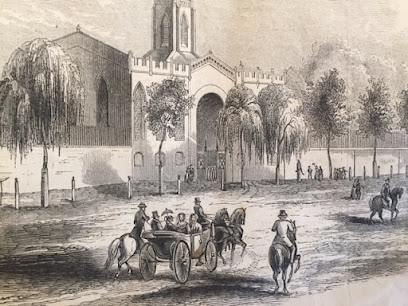
Above you see the Monument Cemetery gatehouse is it stood on North Broad Street in Philadelphia, in 1852 (Gleason’s Pictorial, Vol. III, No. 9, Aug. 28, 1852).


The comments people make (at both my in-person presentations as well as in Zoom virtuals) often provide me with missing details or ideas for further research. Examples include eye-witness accounts by people who were Temple students at the time the cemetery was razed, which certainly casts doubt upon the care which was supposedly exercised in the removal of the bodies.
When I advertise this presentation on Instagram or Facebook, I might get thirty comments, 95% of which will be in the “OMG-how-could-they-let-this-happen” category (which I expect), but there might be another 5% that will go something like this:

“…the graves were relocated, the headstones were used as backfill - no disrespect ...”

Gravestones along the Delaware
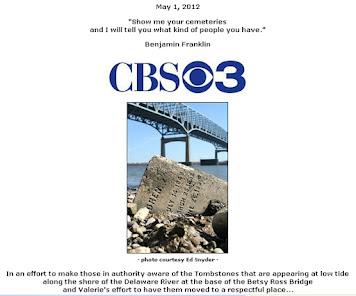
So yes, many of the gravestones were dumped into the Delaware River to help create a strong foundation for the Betsy Ross Bridge (which was then in the planning stage). Dozens of gravemarkers can still be seen at low tide under the bridge. There are differing points of view on this situation, and I am certainly open to everyone's opinion. We learn more about ourselves when we listen to others. Removal of cemeteries happened on a grand scale across the United States after the Industrial Revolution, as cities grew. Small church graveyards as well as large cemeteries often found themselves occupying land that was valued highly by developers. Probably the most disruptive example of this was in 1912 when San Francisco evicted all existing cemeteries - and those buried in them - from within the city limits. In 1929, it began moving the majority of its cemeteries to the town of Colma, California, just outside San Francisco. About 150,000 bodies were moved and many of the gravestones ended up in San Francisco Bay, where some can still be seen today. All in the name of progress.
Monument Cemetery was no different. It sat squarely in the way of the city’s expansion. Like San Francisco, Philadelphia’s population was growing, housing and factories needed to be built. And Monument Cemetery was not the only Philadelphia cemetery moved in that time period. While Monument held about 28,000 bodes, Lafayette Cemetery held about 47,000. Lafayette occupied the land where the present day Capitolo Playground sits in South Philly, next to the two famous cheese steak emporiums – Pat’s and Geno’s. The city paid a contractor to relocate the bodies, but wasn’t much concerned about their actual, eventual destination. But that's another story…

Vault being excavated from Monument Cemetery, Philadelphia, in 1956

And as you might guess (or maybe you might not), when cemeteries are moved, they never seem to move all the bodies. Which may be one reason Temple never went ahead with its plan to build a massive football field on the site previpously occupied by Monument Cemetery. You may have heard of the 2017 discovery of hundreds of bodies in a construction dig at Third and Arch Streets in Philadelphia, the site of the First Baptist Church of Philadelphia's burial ground. The bodies were supposedly relocated to Philadelphia’ Mount Moriah Cemetery in 1860. Well guess what - hundreds of bodies in wooden coffins were excavated from that construction site in 2017. Even when written accounts say that all the bodies were moved, well, all the bodies are never moved. Which is one reason they seldom build anything other than a ball field, playground, or parking lot over an old cemetery.


In conclusion, I try not to be critical. I just present the facts. We would all like to believe that we are, for the most part, good, honest, well-intentioned people. The actions described above were made by our ancestors, not us, right? 

Beware the Ideas of March! 

When I gave this presentation last year to an audience of about 175 attendees (hosted by the Athenaeum of Philadelphia), there was a comment in the Zoom chat – “We should raise money to have a commemorative bronze plaque made and attached to the original cemetery wall on the Temple University campus.” Yes, oddly, the cemetery’s stone border walls were kept in place! They are still there! What a fitting memory to this historic cemetery to have an historic marker or plaque placed on or near that wall.

Please join me at 6 p.m. on March 12! Here is the registration page for the presentation:


Further Reading:
My original three blog posts on the destruction of Monument Cemetery from my Cemetery Traveler blog:


If you want to read about the destruction of Lafayette Cemetery, please follow this link:


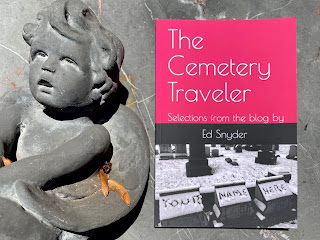
Also, my book, The Cemetery Traveler, which includes excerpts from these blogs, is available from Amazon: